Anthropic - Tygart Media

Category: Anthropic

News, analysis, and profiles covering Anthropic the company and its team.

  • The Restoration Talent Window Is Closing Faster Than You Think

    The Restoration Talent Window Is Closing Faster Than You Think

    Last refreshed: May 15, 2026

    A LinkedIn post from a restoration recruiter in Houston tipped me off this morning. He’s right — but the timeline is shorter than most people in the industry realize.

    Mitchell Riley LinkedIn post about Claude Managed Agents announcement
    Mitchell Riley’s LinkedIn post that started this train of thought.

    This article is part of The Restoration Operator’s Playbook — Tygart Media’s body of work on how the industry’s best restoration companies are actually thinking in 2026. Start with the pillar piece if this is your first read.

    The post that got me thinking

    This morning I logged into LinkedIn and saw a post from Mitchell Riley — a restoration industry recruiter in Houston who places PMs, GMs, and business development leaders for restoration contractors across the country. Mitchell flagged Anthropic’s Claude Managed Agents launch with the kind of casual enthusiasm only people who actually use this stuff every day can manage. He called it “pretty cool” and noted that Claude will now build you an agent based on natural language.

    He’s right. He’s also pointing at something most of the restoration industry hasn’t fully processed yet.

    What Anthropic actually shipped

    On April 8, 2026, Anthropic launched Claude Managed Agents in public beta. The short version: the infrastructure work that used to take three to six months of engineering — sandboxed code execution, credential management, long-running session persistence, error recovery, observability — is now a managed service. You define what the agent should do. Anthropic runs it.

    The companies already shipping production agents on it: Notion, Asana, Rakuten, and Sentry. Notion lets teams delegate coding, slides, and spreadsheets to Claude without leaving the workspace. Rakuten deployed specialist agents across product, sales, marketing, finance, and HR — each live in under a week. Sentry built an agent that goes from flagged bug to open pull request, fully autonomous.

    Internal Anthropic testing showed up to a 10-point improvement in task success on structured generation work versus a standard prompting loop, with the largest gains on the hardest problems.

    That’s the announcement. Here’s why it matters for restoration.

    The bottleneck just moved

    For the last two years, the question every restoration owner asked about AI was some version of: “Can it actually do the work?” The honest answer was usually “not yet, not without a developer team you don’t have.”

    That’s no longer the question. The infrastructure gap closed on April 8. The new bottleneck is not “can you build the agent” — it’s “do you have the human operators who know what the agent should be doing in the first place.”

    Restoration is an industry where the real intelligence lives in people. A senior PM who has worked five hundred losses knows things that have never been written down anywhere. How a Cat 3 storm response actually sequences when the carrier is dragging on TPA approvals. The difference between a contents pack-out that closes clean and one that becomes a six-month dispute. Which mitigation decisions buy you a profitable job and which ones bury you on the reconstruction side. None of that lives in a textbook. It lives in the heads of people who have been doing the work for fifteen or twenty years.

    That tribal knowledge is now the constraint. The companies that win the next three years will be the ones who pair Managed Agents (or something like it) with senior operators who can tell the agent what good looks like. The companies that try to skip that step — that try to hire generalists and teach them restoration on the fly while their competitors are distilling twenty-year veterans into operational systems — are going to get lapped.

    Buy the talent now

    This is where the recruiting angle gets interesting. Senior restoration talent has always been hard to find. It’s about to get much harder, for a reason most owners haven’t priced in yet: the value of a senior PM is no longer just the work that PM does directly. It’s the work an entire AI system does in their image once their judgment has been encoded into the workflow.

    Right now, that arbitrage is open. The market hasn’t repriced senior operators for what they’re actually worth in an AI-augmented restoration company. In twelve to twenty-four months, it will. The owners who hire the best PMs, GMs, and BD leaders now — and who pair them with someone like Mitchell who actually understands the placement game — are going to look like geniuses in 2027.

    Mitchell is one of the people who gets this from the inside. He uses the AI tools himself. He builds workflows. He analyzes things in dimensions and context that most recruiters never touch — most recruiters in this industry are still working from a spreadsheet of resumes and a cell phone. Mitchell is the kind of recruiter who notices when Anthropic ships something that’s going to change the value of every senior hire he places, and posts about it on a Wednesday morning. That’s the level of operator the smart restoration owners are going to want in their corner.

    What to actually do this quarter

    If you run a restoration company and you read this far, three concrete things:

    One. Identify your two or three most senior operators — the people whose judgment is load-bearing for the business. Start documenting how they think, not just what they do. The documentation is the raw material every future AI workflow will run on.

    Two. Open one or two senior hires you’ve been putting off. The talent market is going to tighten. Get in front of it.

    Three. Stop treating AI as an IT project. It’s an operational capability. The companies that figure this out are not waiting for their tech vendor to sell them an “AI feature.” They’re hiring the operators, capturing the judgment, and pointing the tooling at the result.

    Mitchell’s post was three sentences. The full version of what he was pointing at takes about a thousand words. This is that version.

    If you’re a restoration owner thinking about senior placements in the next two quarters, you should be talking to Mitchell. And if you’re thinking about how to operationalize AI inside your company — distilling senior judgment into systems your whole team can run — that’s the conversation we have at Tygart Media.

    Read next: The New Restoration Operator: How the Industry’s Best Companies Are Thinking in 2026 — the pillar piece this article belongs to.

  • Claude AI Privacy: What Anthropic Does With Your Conversations

    Claude AI Privacy: What Anthropic Does With Your Conversations

    Last refreshed: May 15, 2026

    Claude AI · Fitted Claude

    Before you paste anything sensitive into Claude, you should understand what Anthropic does with your conversations. The answer varies significantly by plan — and most people are on the plan with the least data protection. Here’s the complete picture.

    The key fact most people miss: On Free and Pro plans, Anthropic may use your conversations to train future Claude models. You can opt out in settings. Team and Enterprise plans have stronger protections and the Enterprise tier supports custom data handling agreements for regulated industries.

    Claude Data Handling by Plan

    Plan Training data use Human review possible? Custom data agreements
    Free Yes (opt-out available) Yes
    Pro Yes (opt-out available) Yes
    Team No (by default) Limited
    Enterprise No Configurable ✓ BAA available

    How to Opt Out of Training Data Use

    On Free and Pro plans, you can disable conversation use for model training in your account settings. Go to Settings → Privacy → and toggle off “Help improve Claude.” This applies to future conversations — it doesn’t retroactively remove past conversations from training data already collected.

    What Anthropic Can See

    Anthropic employees may review conversations for safety research, model improvement, and trust and safety purposes. This applies to all plan tiers, though the scope and purpose of review is more restricted on Team and Enterprise. Human reviewers follow internal access controls, but if you’re sharing genuinely sensitive information, the better approach is to use Enterprise with appropriate data handling agreements — not to rely on the assumption that your specific conversation won’t be reviewed.

    Data Retention

    Anthropic retains conversation data for a period before deletion. The specific retention period isn’t published in a simple number — it varies based on account type and purpose. Your conversation history in the Claude.ai interface can be deleted by you at any time from Settings. Deletion from the UI doesn’t guarantee immediate removal from all backend systems, and may not remove data already used in training.

    Claude and GDPR

    For users in the EU, Anthropic operates under GDPR obligations. This includes rights to data access, correction, and deletion. Anthropic’s privacy policy covers these rights and how to exercise them. For organizations subject to GDPR with stricter requirements around AI data processing, Enterprise is the appropriate tier — it supports data processing agreements and more granular controls.

    What Not to Share With Claude on Standard Plans

    On Free or Pro plans, avoid sharing:

    • Patient health information (HIPAA-regulated)
    • Client confidential data under NDA
    • Non-public financial information
    • Personally identifiable information beyond what the task requires
    • Trade secrets or proprietary business processes

    For a full breakdown of Claude’s safety posture beyond just privacy, see Is Claude AI Safe? For current, authoritative terms, always refer to Anthropic’s privacy policy directly.

    Frequently Asked Questions

    Does Claude store your conversations?

    Yes. Anthropic retains conversation data for a period of time. You can delete your conversation history from the Claude.ai interface, but this doesn’t guarantee immediate removal from all backend systems or data already incorporated into training.

    Is Claude HIPAA compliant?

    Not on standard plans. HIPAA compliance requires a Business Associate Agreement (BAA) with Anthropic, which is only available on the Enterprise plan. Do not share patient health information with Claude on Free, Pro, or Team plans.

    Can I stop Anthropic from using my conversations to train Claude?

    Yes, on Free and Pro plans you can opt out in Settings → Privacy. Team plans don’t use conversations for training by default. On Enterprise, this is governed by your data processing agreement.

    Is Claude private?

    Claude conversations are not end-to-end encrypted in the way messaging apps are. Anthropic can access conversation data. “Private” in the sense of not being shared with third parties — yes, Anthropic doesn’t sell your data. Private in the sense of completely inaccessible to the company that runs it — no.

    Deploying Claude for your organization?

    We configure Claude correctly — right plan tier, right data handling, right system prompts, real team onboarding. Done for you, not described for you.

    Learn about our implementation service →

    Need this set up for your team?
    Talk to Will →

  • Is Claude AI Safe? Data Handling, Content Safety, and What to Know

    Is Claude AI Safe? Data Handling, Content Safety, and What to Know

    Last refreshed: May 15, 2026

    Claude AI · Fitted Claude

    Claude is built by Anthropic — a company whose stated mission is AI safety. But “safe” means different things depending on what you’re asking: Is Claude safe to use with sensitive information? Is it safe for children? Does it produce harmful content? Is it psychologically safe to rely on? Here’s the honest answer to each version of the question.

    Short answer: Claude is one of the safest AI assistants available for general professional use. It’s designed to refuse harmful requests, be honest about uncertainty, and avoid manipulation. For sensitive business data, read the data handling section below before sharing anything confidential.

    Is Claude Safe to Use? By Use Case

    Concern Safety Level Notes
    General professional use ✅ Safe Standard writing, research, analysis
    Children and minors ⚠️ Use with awareness Claude declines adult content but isn’t a parental control tool
    Sensitive personal information ⚠️ Read privacy policy Conversations may be used to improve models on free/Pro tiers
    Confidential business data ⚠️ Enterprise tier recommended Enterprise has stronger data handling commitments
    HIPAA-regulated data ❌ Not on standard plans Requires Enterprise with a BAA from Anthropic
    Harmful content generation ✅ Declines Claude refuses instructions for weapons, self-harm, etc.

    How Anthropic Builds Safety Into Claude

    Anthropic uses a training methodology called Constitutional AI — Claude is trained against a set of principles rather than purely optimizing for user approval. This means Claude is more likely to push back on bad premises, decline harmful requests, and express uncertainty rather than generate a confident-sounding wrong answer.

    Concretely: Claude won’t provide instructions for creating weapons, won’t generate content that sexualizes minors, won’t help with clearly illegal activities targeting individuals, and is designed to be honest rather than sycophantic. These are trained behaviors, not just content filters bolted on afterward.

    Data Safety: What Happens to Your Conversations

    This is the area that matters most for professional users. Anthropic’s data handling varies by plan:

    Free and Pro plans: Conversations may be used by Anthropic to improve Claude’s models. You can opt out of this in your account settings. Anthropic retains conversation data for a period before deletion.

    Team plan: Stronger data handling commitments. Conversations are not used to train models by default.

    Enterprise plan: Custom data handling agreements available. This is the tier for organizations with compliance requirements — HIPAA, SOC 2, GDPR, etc. A Business Associate Agreement (BAA) from Anthropic is required before sharing any HIPAA-regulated data.

    For current, authoritative data handling details, check Anthropic’s privacy policy directly — it supersedes any summary here. For privacy-specific questions, see Claude AI Privacy: What Anthropic Does With Your Data.

    Is Claude Psychologically Safe?

    Claude is designed not to manipulate users, not to foster unhealthy dependency, and not to tell people what they want to hear at the expense of accuracy. It will disagree with you, push back on flawed premises, and decline to validate bad decisions. Whether that’s “safe” depends on your frame — but it’s a deliberate design choice that makes Claude more honest and less likely to be weaponized as a validation machine.

    Frequently Asked Questions

    Is Claude AI safe to use?

    Yes, for general professional use. Claude is designed to refuse harmful requests, be honest, and avoid manipulation. For sensitive business data or regulated information, review Anthropic’s data handling policies for your plan tier before sharing anything confidential.

    Is Claude safe for children?

    Claude declines to generate adult or harmful content, which makes it safer than many AI tools. However, it’s not a purpose-built parental control system and shouldn’t be treated as one. Anthropic’s Terms of Service require users to be 18 or older, or to have parental permission.

    Can I share confidential business information with Claude?

    On standard plans (Free, Pro), conversations may be reviewed by Anthropic and used for model improvement. For confidential business data, use the Team or Enterprise plan — Enterprise offers custom data handling agreements. Never share HIPAA-regulated data without a Business Associate Agreement in place.

    Is Claude safer than ChatGPT?

    Both Claude and ChatGPT have safety measures in place. Claude’s Constitutional AI training approach is designed specifically around safety as a core methodology rather than an add-on. For data handling, the comparison depends on which plan tier you’re on for each product — Enterprise tiers of both have stronger commitments than free or standard paid plans.

    Deploying Claude for your organization?

    We configure Claude correctly — right plan tier, right data handling, right system prompts, real team onboarding. Done for you, not described for you.

    Learn about our implementation service →

    Need this set up for your team?
    Talk to Will →

  • Claude Code: The Complete Beginner’s Guide for 2026

    Claude Code: The Complete Beginner’s Guide for 2026

    Last refreshed: May 15, 2026

    Claude AI · Fitted Claude

    Claude Code is the fastest-growing AI coding tool in the developer community. The r/ClaudeCode subreddit has 4,200+ weekly contributors — roughly 3x larger than r/Codex. Anthropic reports $2.5B+ in annualized revenue attributable to Claude Code adoption. This complete guide takes you from installation to your first productive agentic coding session.

    What Is Claude Code?

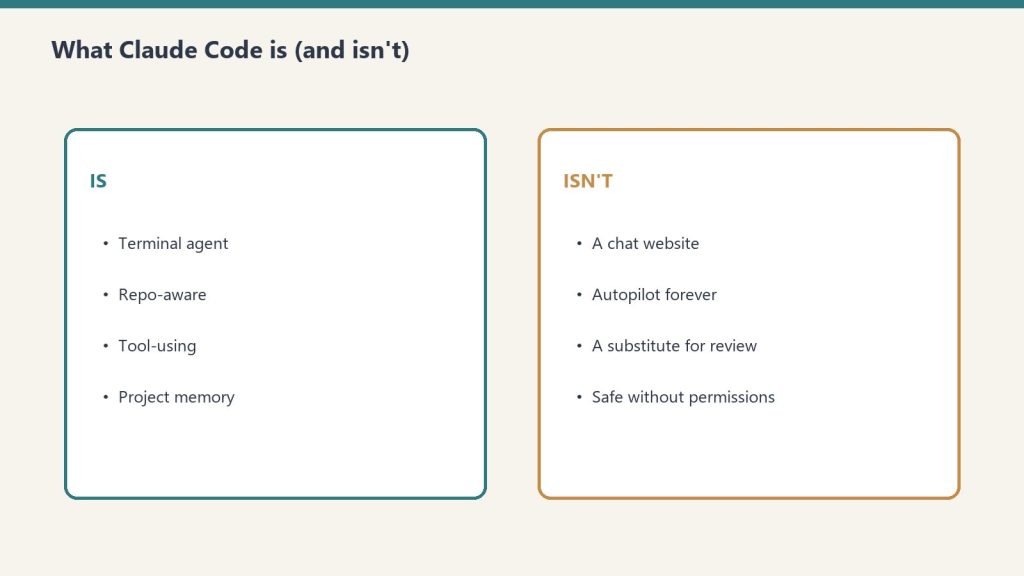
    Claude Code is a terminal-native AI coding tool from Anthropic. Unlike IDE plugins that assist line-by-line, Claude Code operates at the project level — it reads your entire codebase, understands the architecture, writes and edits multiple files in a single session, runs tests, and works through complex engineering tasks autonomously. It uses Claude models with a 1-million-token context window — large enough to hold an entire codebase in memory.

    Installation

    Requirements: Node.js 18+, a Claude Max subscription ($100+/month) or Anthropic API key.

    # Install globally
    npm install -g @anthropic-ai/claude-code
    
    # Navigate to your project
    cd your-project
    
    # Authenticate
    claude login
    
    # Start a session
    claude

    Setting Up CLAUDE.md (The Most Important Step)

    CLAUDE.md is a file you create in your project root that Claude Code reads at the start of every session. It’s the most important setup step — it gives Claude the context it needs to work effectively in your specific codebase without you re-explaining everything every time.

    A good CLAUDE.md includes:

    # Project: [Your Project Name]
    
    ## Architecture
    [Brief description of how the codebase is organized]
    
    ## Tech Stack
    - Language: [Python 3.11 / Node.js 20 / etc.]
    - Framework: [Django / Next.js / etc.]
    - Database: [PostgreSQL / MongoDB / etc.]
    - Testing: [pytest / Jest / etc.]
    
    ## Coding Standards
    - [Style guide, naming conventions, etc.]
    - [Preferred patterns for this codebase]
    
    ## Common Tasks
    - Run tests: `[command]`
    - Start dev server: `[command]`
    - Lint: `[command]`
    
    ## Known Issues / Context
    - [Anything Claude should know before working]

    Key Slash Commands

    Command What It Does
    /init Scans your codebase and generates an initial CLAUDE.md
    /memory View and edit Claude’s memory for this project
    /compact Compact the conversation to free up context space
    /batch Run multiple commands or edits in one operation
    /clear Clear conversation history (start fresh)

    Your First Agentic Session

    Start Claude Code in your project directory and try:

    • “Explain the overall architecture of this codebase” — Claude reads and summarizes
    • “Add input validation to the user registration endpoint” — Claude finds the right file, writes the validation, updates tests
    • “There’s a bug where [describe issue] — find it and fix it” — Claude searches the codebase, identifies the cause, fixes it
    • “Write tests for [module or function]” — Claude reads the code and writes comprehensive tests

    Rate Limits and Token Management

    Claude Code on Max 5x gets approximately 44,000-220,000 tokens per 5-hour window. Long sessions with large codebases consume tokens quickly. Best practices:

    • Use /compact when sessions get long to free up context
    • Be specific in your requests — “fix the authentication bug in auth.py” uses fewer tokens than “look through all my files for problems”
    • Auto-compaction (beta) handles this automatically when enabled

    Frequently Asked Questions

    What subscription do I need for Claude Code?

    Claude Max at $100/month minimum. Claude Code can also be accessed via API billing — often more cost-effective for lower-volume use.

    Can Claude Code edit multiple files at once?

    Yes. Claude Code can read, edit, and create multiple files in a single session — and runs the edits atomically, so you can review and accept or reject changes.

    How do I install Claude Code on Windows?

    Claude Code requires Node.js 18+ and runs via WSL (Windows Subsystem for Linux) on Windows. Install WSL, then follow the standard npm installation steps within your WSL terminal.


    Need this set up for your team?
    Talk to Will →

  • Claude vs Amazon Q: Which AI Coding Assistant for AWS Developers?

    Claude vs Amazon Q: Which AI Coding Assistant for AWS Developers?

    Last refreshed: May 15, 2026

    Model Accuracy Note — Updated May 2026

    Current flagship: Claude Opus 4.7 (claude-opus-4-7). Current models: Opus 4.7 · Sonnet 4.6 · Haiku 4.5. Claude Opus 4.7 (claude-opus-4-7) is the current flagship as of April 16, 2026. Where this article references Opus 4.6 or earlier models, those references are historical. See current model tracker →. See current model tracker →

    Claude AI · Fitted Claude

    For AWS developers, Claude and Amazon Q represent two distinct approaches to AI-assisted development. Amazon Q is deeply integrated into the AWS ecosystem — built to understand your AWS environment, your IAM policies, your CloudFormation stacks, and your AWS-specific workflows. Claude is a more capable general-purpose AI that can handle complex reasoning and code but requires you to provide AWS context manually. This comparison helps you choose — and explains why many AWS developers use both.

    What Amazon Q Does Well

    • AWS-native context: Q can read your actual AWS account state — running resources, IAM permissions, CloudWatch logs — without you describing them
    • AWS documentation: Q is trained specifically on AWS documentation and gives more accurate, up-to-date answers for AWS-specific questions
    • Console integration: Q is embedded in the AWS Console, CloudShell, and VS Code via the AWS Toolkit — zero additional setup for AWS users
    • Troubleshooting: Q can analyze your actual CloudWatch errors and IAM policy conflicts directly
    • Cost optimization: Q analyzes your actual usage data for cost recommendations

    What Claude Does Better

    • Code quality: Claude Opus 4.6 scores 80.8% on SWE-bench vs Amazon Q’s lower published benchmarks — for complex, multi-file code generation, Claude produces better results
    • General reasoning: Architecture decisions, trade-off analysis, and complex problem-solving — Claude reasons more deeply
    • Non-AWS work: If you’re building multi-cloud or have significant non-AWS code, Claude handles everything equally; Q is heavily AWS-optimized
    • Document analysis: Claude’s 200K context window for reading technical specs, RFCs, or lengthy docs far exceeds Q’s capabilities
    • Writing: Technical blog posts, documentation, runbooks — Claude writes better

    Pricing Comparison

    Claude Amazon Q
    Individual $20-200/month $19/month (Q Developer Pro)
    Free tier Yes (limited) Yes (Q Developer Free)
    Business Custom $19/user/month

    Amazon Q Developer Pro at $19/month is competitive with Claude Pro at $20/month. For AWS-heavy developers, Q Pro includes features with no Claude equivalent (direct AWS account analysis). For general development, Claude holds the performance edge per dollar.

    The Combined Workflow

    Many AWS developers use Amazon Q for AWS-specific questions (CloudFormation troubleshooting, IAM policy analysis, service limits) and Claude Code for complex coding tasks (architecture, large refactors, code review). The tools are complementary rather than competing.

    Frequently Asked Questions

    Is Amazon Q better than Claude for AWS development?

    For AWS-native questions with real account context: Amazon Q wins. For complex code generation, architecture decisions, and general programming: Claude is stronger. Many AWS developers use both.

    Can Claude access my AWS account?

    Not directly. You can paste CloudFormation templates, error logs, or resource configurations into Claude for analysis. Amazon Q connects directly to your AWS account with appropriate permissions.


    Need this set up for your team?
    Talk to Will →

  • Is Claude AI Safe? Security, Ethics, and Trustworthiness Assessed

    Is Claude AI Safe? Security, Ethics, and Trustworthiness Assessed

    Last refreshed: May 15, 2026

    Claude AI · Fitted Claude

    Safety means different things depending on who’s asking. For a parent wondering if Claude is appropriate for their teenager: yes, with caveats. For an enterprise considering Claude for sensitive workflows: that requires a more detailed answer. For a researcher wondering about AI existential risk: that’s a different conversation entirely. This guide covers all three dimensions of Claude safety in 2026.

    Content Safety: What Claude Will and Won’t Do

    Claude’s content policies are enforced through Constitutional AI training, not just a filter layer bolted on afterward. This makes them more robust than keyword blocklists. Claude will decline to:

    • Generate content facilitating violence or illegal activities
    • Produce sexual content involving minors (zero tolerance, no exceptions)
    • Provide detailed instructions for creating weapons capable of mass casualties
    • Generate content designed to facilitate harassment or stalking of specific individuals

    Claude’s refusals are imperfect — it occasionally refuses legitimate requests and occasionally allows borderline ones. But the overall calibration has improved substantially with each model generation.

    Data Security

    Anthropic is a US-incorporated company subject to US law. Conversation data is stored on Anthropic’s infrastructure. Consumer accounts may be used for model training (opt-out available). Enterprise and API accounts have zero-data-retention options. Anthropic has published a privacy policy at privacy.claude.com and does not sell conversation data to third parties or advertisers.

    Anthropic’s Responsible Scaling Policy

    Anthropic has published a Responsible Scaling Policy (RSP) — a commitment to evaluate Claude models against specific safety thresholds before deployment. The RSP creates public accountability: if future Claude models show dangerous capability thresholds in evaluation, Anthropic has committed to not deploying them until additional safety measures are in place. This is a meaningful governance commitment uncommon among AI companies.

    Fake Claude Scams: What Every User Should Know

    Malwarebytes and other security researchers have documented phishing campaigns using fake “Claude AI” websites to steal credentials and install malware. Key indicators of legitimate Claude access:

    • The official Claude interface is at claude.ai — any other domain claiming to be Claude is not
    • Anthropic does not offer Claude through third-party websites requiring separate account creation
    • Claude’s API is accessed at api.anthropic.com
    • If you’re ever unsure, go directly to anthropic.com and navigate from there

    Frequently Asked Questions

    Is Claude safe for kids?

    Claude has content filters that prevent most inappropriate content, but it’s not specifically designed as a children’s product. Parental supervision is recommended for younger users. Claude doesn’t have age verification on the free tier.

    Can Claude be jailbroken?

    Attempts to manipulate Claude into ignoring its safety training exist. Anthropic actively works to patch these. Claude is more robust against jailbreaking than most models, but no AI system is perfectly immune to sophisticated manipulation attempts.


    Need this set up for your team?
    Talk to Will →

  • Claude Zapier Automation: 10 Workflows That Save Hours Every Week

    Claude Zapier Automation: 10 Workflows That Save Hours Every Week

    Last refreshed: May 15, 2026

    Claude AI · Fitted Claude

    Claude and Zapier together create one of the most flexible automation combinations available in 2026. Through Zapier’s MCP server (mcp.zapier.com), Claude can connect to over 8,000 apps — sending emails, updating CRMs, creating tasks, posting to Slack, and more. This guide covers 10 practical workflows and how to set them up.

    Setting Up Claude + Zapier MCP

    Add Zapier’s MCP server to Claude Desktop by editing your configuration file:

    {
      "mcpServers": {
        "zapier": {
          "url": "https://mcp.zapier.com/api/mcp/a/YOUR_ACCOUNT_ID/mcp",
          "type": "url"
        }
      }
    }

    Find your Zapier MCP URL in your Zapier account under Settings → MCP. Once connected, Claude can trigger any Zap you’ve built in Zapier, ask it to take actions across your connected apps.

    10 High-Value Automation Workflows

    1. Email Triage and Draft Generation

    New email arrives → Zapier sends to Claude → Claude categorizes (urgent/action needed/FYI/spam) and drafts a reply → Draft saved to Gmail or sent to you via Slack for approval.

    2. CRM Note Generation from Calls

    Call recording transcript arrives (from Otter.ai or Fireflies) → Claude generates structured CRM notes (summary, pain points, next steps, deal stage) → Notes automatically posted to Salesforce or HubSpot record.

    3. Social Media Content from Blog Posts

    New WordPress post published → Claude generates LinkedIn post, Twitter/X thread, and Instagram caption → Drafts sent to Buffer or Hootsuite for scheduled publishing.

    4. Meeting Summary and Action Item Distribution

    Meeting transcript uploaded → Claude extracts summary, decisions made, and action items with owners → Summary sent to meeting participants via email, action items created in Asana or Notion.

    5. Customer Support Ticket Drafts

    New support ticket received (Zendesk, Freshdesk) → Claude categorizes the issue and drafts a response → Draft queued for agent review before sending.

    6. Lead Research and Enrichment

    New lead added to CRM → Claude researches company context from provided information → Enriched notes (industry, company size, likely pain points) added to CRM record automatically.

    7. Contract Summary on Receipt

    PDF contract received via email → Claude generates key terms summary (parties, obligations, deadlines, payment terms) → Summary posted to Slack or added to Notion database.

    8. Weekly Report Generation

    Every Friday → Zapier pulls data from your project management tool → Claude generates weekly progress narrative → Report emailed to stakeholders automatically.

    9. Review Response Drafting

    New Google or Yelp review received → Claude drafts a personalized response matching your brand voice → Draft sent to you for approval via email or Slack.

    10. Job Application Screening Summaries

    New application received → Claude summarizes candidate background, flags matches to job requirements, notes potential concerns → Summary added to your ATS or hiring Notion board.

    Frequently Asked Questions

    Do I need Zapier paid plan to use Claude MCP?

    Zapier MCP access requires a paid Zapier plan. Check Zapier’s current pricing for MCP feature availability.

    Can Claude take actions in Zapier automatically without human approval?

    Yes — but for actions like sending emails or creating CRM records, building in a human-approval step (Slack notification with approve/reject) is recommended until you trust the automation’s output quality.


    Need this set up for your team?
    Talk to Will →

  • Claude AI for Excel and Spreadsheets: Formulas, Analysis, and Automation

    Claude AI for Excel and Spreadsheets: Formulas, Analysis, and Automation

    Last refreshed: May 15, 2026

    Claude AI · Fitted Claude

    Spreadsheet work is one of the highest-leverage applications for Claude AI — and one where the time savings are immediately measurable. Claude writes complex formulas, explains your data, debugs broken functions, and helps design spreadsheet structures for any use case. This guide covers the specific workflows where Claude saves the most time.

    1. Formula Writing

    Describe what you want in plain English and Claude writes the formula:

    “Write an Excel formula that looks up a value in column A, finds the matching row in a separate table on Sheet2, and returns the value from column C of that row. Handle the case where no match is found by returning ‘Not Found’.”

    Claude returns the exact formula with an explanation of how it works — and will modify it if your structure is different from what it assumed.

    2. Formula Debugging

    Paste a broken formula and describe what it should do:

    “This formula is returning #VALUE! instead of the expected sum: =SUMIF(A:A,”Q1″,B:B). My date column (A) has dates in MM/DD/YYYY format. What’s wrong and how do I fix it?”

    3. Data Analysis and Interpretation

    Paste CSV data directly into Claude (up to tens of thousands of rows depending on token limits) and ask:

    • “What are the top 5 trends in this sales data?”
    • “Identify any outliers in this dataset and explain what might be causing them”
    • “Calculate month-over-month growth rates from these monthly totals”
    • “What’s the correlation between [column A] and [column B]?”

    4. Spreadsheet Design

    Before building a complex spreadsheet, describe your use case to Claude:

    “I need a spreadsheet to track client projects. Each project has: client name, project type, start date, deadline, status, hours budgeted, hours logged, and assigned team member. I want a dashboard tab that shows overdue projects and hours variance. Design the sheet structure and formulas I’ll need.”

    5. Claude’s Excel Add-In

    Anthropic launched a Claude Excel add-in that embeds Claude directly in Microsoft Excel. This allows you to interact with Claude in a side panel while working in your spreadsheet — selecting data ranges, asking questions about your data, and getting formula suggestions without switching applications.

    Frequently Asked Questions

    Can Claude write Google Sheets formulas as well as Excel?

    Yes. Claude writes formulas for both Excel and Google Sheets. Most formulas are identical or very similar between the two — just specify which you’re using if there might be syntax differences.

    Can Claude analyze data I paste into the conversation?

    Yes. Paste CSV data directly and Claude will analyze it. For very large datasets, paste a representative sample or aggregate summary.


    Need this set up for your team?
    Talk to Will →

  • Claude AI for Startups: Pitch Decks, Product Dev, and Hiring

    Claude AI for Startups: Pitch Decks, Product Dev, and Hiring

    Last refreshed: May 15, 2026

    Claude AI · Fitted Claude

    Startups operate at a pace that makes every AI productivity gain multiply. Claude AI has become one of the most useful tools for founders who need to write, think, research, and build simultaneously — often without the headcount to specialize any of it. This guide covers the highest-leverage startup use cases.

    1. Pitch Deck Writing and Refinement

    Claude can’t design slides, but it can write the content that makes them work:

    • Problem slide narrative (crisp, investor-compelling)
    • Solution positioning and differentiation language
    • Market size calculation narrative (TAM/SAM/SOM explanations)
    • Business model clarity
    • Traction slide copy from your metrics
    • Team bios that emphasize relevant experience
    • Ask and use of funds language

    Prompt: “I’m raising a [stage] round for [company]. We [what you do] for [who]. Our differentiation is [X]. Write the problem and solution slides in [Y] words each — investor audience, direct and specific, no jargon.”

    2. Product Requirements and Spec Writing

    Early-stage founders often write PRDs themselves. Claude drafts them faster:

    • User story generation from feature descriptions
    • MVP scope definition and prioritization
    • Technical spec outlines for engineering handoffs
    • API documentation first drafts

    3. Competitive Analysis

    Paste competitor landing pages, pricing pages, or product releases into Claude and ask: “Analyze this competitor’s positioning. What are their claimed strengths, their apparent weaknesses, and the gap my product could own?” Do this across 5 competitors in one session and you have a competitive landscape in an hour that would take a day manually.

    4. Hiring: JDs, Outreach, and Interviews

    • Job description writing that attracts the right candidate profile
    • LinkedIn outreach messages for sourcing
    • Interview question sets by role
    • Offer letter language (review with legal counsel)
    • Culture doc and values articulation

    5. Investor Research

    Paste an investor’s portfolio page, blog posts, or thesis into Claude: “Based on this investor’s portfolio and stated thesis, how should I position my company for a conversation with them? What aspects of our business align with their focus?”

    Frequently Asked Questions

    Can Claude help write a pitch deck?

    Yes — the narrative content. Claude writes compelling problem/solution/market/traction/team copy. Slide design requires dedicated tools (Canva, Pitch, PowerPoint).


    Want this for your workflow?

    We set Claude up for teams in your industry — end-to-end, fully configured, documented, and ready to use.

    Tygart Media has run Claude across 27+ client sites. We know what works and what wastes your time.

    See the implementation service →

    Need this set up for your team?
    Talk to Will →

  • Claude for Small Business Owners: What It Can Actually Replace

    Claude for Small Business Owners: What It Can Actually Replace

    Last refreshed: May 15, 2026

    Claude AI · Fitted Claude

    Small business owners are among the professionals getting the most value from Claude AI — because they wear every hat and the time savings compound across every function. This guide covers the highest-leverage use cases: marketing, operations, customer service, and financial communication.

    Why Claude Works Well for Small Business

    Small businesses typically can’t afford specialists for every function. The owner writes the marketing copy, drafts the employee handbook, responds to reviews, and handles client emails — all in the same day. Claude handles the first draft of almost all of these, at a quality level that previously required hiring freelancers or agencies.

    1. Marketing Content

    • Website copy (homepage, about page, service descriptions)
    • Google Business Profile posts and updates
    • Email newsletter content
    • Social media captions (Instagram, Facebook, LinkedIn)
    • Local SEO blog posts
    • Seasonal promotions and campaign copy

    Prompt template: “Write a [content type] for my [business type] in [city]. My unique selling point is [differentiator]. Target customer: [describe]. Tone: [conversational/professional/enthusiastic]. Length: [X words].”

    2. Operations Documents

    • Standard operating procedures (SOPs) for any business process
    • Employee onboarding guides and training materials
    • Job descriptions for hiring
    • Vendor agreements and simple contracts (always review with attorney)
    • Process documentation and checklists

    3. Customer Service

    • Response templates for common questions
    • Difficult customer situation scripts
    • Online review responses (positive and negative)
    • FAQ page content
    • Refund and complaint handling language

    4. Financial Communication

    • Invoice and payment reminder language
    • Proposal and estimate narratives
    • Client update letters for project status
    • Grant application narratives (for eligible businesses)

    Recommended Starting Setup

    Create a Claude Project with a system prompt containing: your business name and type, your city and target market, your brand voice (3 adjectives), and 2-3 things that differentiate you. Once set up, every Claude conversation is pre-loaded with your business context — no re-explaining needed.

    The free tier works for occasional use. Claude Pro at $20/month is the right starting point for daily business use — Projects are included and the rate limits are workable for most small business owners.

    Frequently Asked Questions

    What is the best Claude plan for small business owners?

    Claude Pro at $20/month. Projects let you store your business context so every conversation is pre-loaded. The free tier works if you use Claude occasionally.


    Want this for your workflow?

    We set Claude up for teams in your industry — end-to-end, fully configured, documented, and ready to use.

    Tygart Media has run Claude across 27+ client sites. We know what works and what wastes your time.

    See the implementation service →

    Need this set up for your team?
    Talk to Will →