AI Search Authority - Tygart Media

Category: AI Search Authority

GEO, AEO, and llms.txt: how a brand gets cited in Perplexity, ChatGPT, Claude, and Google AI Overviews.

  • AI Extraction Layer: The Most Valuable Asset AI Can’t Build

    AI Extraction Layer: The Most Valuable Asset AI Can’t Build

    Tygart Media Strategy
    Volume Ⅰ · Issue 04 Quarterly Position
    By Will Tygart • Long-form Position • Practitioner-grade

    The extraction layer is the part of the AI economy that doesn’t exist yet — and it’s the only part that can’t be automated into existence. Every vertical AI product, every industry-specific chatbot, every AI assistant that actually knows what it’s talking about requires one thing that nobody has figured out how to manufacture at scale: the deep, tacit, hard-won knowledge that lives inside experienced human practitioners.

    Last refreshed: November 3, 2026 (Pacific)

    This is not a gap that will close on its own. It is a structural feature of how expertise works. And for the businesses and individuals who understand it clearly, it is the single most durable competitive advantage available in the current AI era.

    What the Extraction Layer Actually Is
    Floor versus ceiling cards for commoditized work and human-network premium
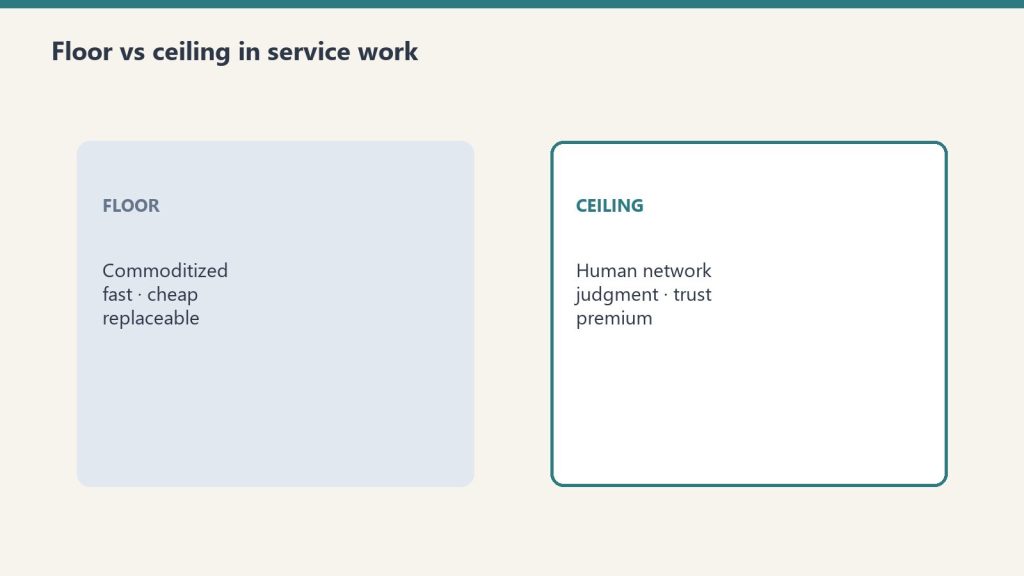
    Floor vs. ceiling in service work: commoditized work (fast, cheap, replaceable) sits on the floor; the ceiling is the human network — judgment, trust, and a premium clients pay for both.

    When people talk about AI knowledge gaps, they usually mean one of two things: either the model hasn’t been trained on recent data, or the model lacks access to proprietary databases. Both of those are real problems. Neither of them is the extraction layer problem.

    The extraction layer problem is different. It’s the gap between what an experienced practitioner knows and what has ever been written down in a form that any AI system — regardless of its training data or database access — can actually use.

    A 30-year restoration contractor who has dried 2,000 structures knows things that have never been documented anywhere. Not because they were keeping secrets. Because the knowledge is embedded in judgment calls, pattern recognition, and muscle memory that wasn’t worth writing down at the time. They know which psychrometric conditions in a basement after a Category 2 loss require an LGR versus a conventional dehumidifier, and why. They know the exact moment a water damage job transitions from “drying” to “reconstruction” based on a combination of readings and smells and wall flex that no textbook captures. They know which insurance adjusters will fight a mold scope and which ones will approve it without a second look.

    None of that knowledge is in any training dataset. None of it will be in any training dataset until someone does the hard, slow, relationship-dependent work of pulling it out of people’s heads and putting it into structured form.

    That is the extraction layer. And it requires humans.

    Why AI Cannot Close This Gap By Itself

    Three stacked layers: chat UI, tools, agent runtime
    The invisible agent layer: the chat UI users see, the tools and apps where work happens, and the agent runtime underneath, where decisions persist.

    The reflex response to any knowledge gap problem in 2026 is to propose an AI solution. Train a bigger model. Scrape more data. Use retrieval-augmented generation with a larger corpus. There is genuine value in all of those approaches. None of them solves the extraction layer problem.

    The issue is not volume or recency. The issue is source availability. Training data and RAG systems can only work with knowledge that has been externalized — written, recorded, structured, published somewhere that a crawler or an ingestion pipeline can reach. Tacit expertise, by definition, hasn’t been externalized. It exists as neural patterns in someone’s head, not as tokens in a document.

    There are things AI can do well that partially address this. AI can synthesize patterns from large volumes of existing text. It can identify gaps in documented knowledge by mapping what questions get asked versus what answers exist. It can transcribe and structure interviews once they’ve been recorded. But AI cannot conduct the interview. It cannot build the relationship that earns the trust required to get a 25-year adjuster to walk through their actual decision logic on a contested mold claim. It cannot recognize, in the middle of a conversation, that the contractor just said something technically significant that they treated as throwaway context.

    The extraction process requires a human who understands the domain well enough to know what they’re hearing, has the relationship to access the right people, and has the patience to do this work over months and years rather than in a single API call. That is not a temporary limitation of current AI systems. It is a structural property of how tacit knowledge works.

    The Pre-Ingestion Positioning

    There is a second reason the extraction layer matters beyond the knowledge itself: where in the AI stack you sit determines your liability exposure, your defensibility, and your pricing power.

    Most businesses that try to participate in the AI economy position themselves downstream of AI processing — they modify outputs, review generated content, add a human approval layer on top of AI decisions. That positioning puts them in the output chain. When something goes wrong, they are implicated. The AI said it, but they delivered it.

    The extraction layer positions you upstream — before the AI processes anything. You are the raw data source. The same category as a web search result, a database query, a regulatory filing. The AI system that consumes your knowledge is responsible for what it does with it. You are responsible for the quality of the knowledge itself.

    This is how every B2B data vendor in the world operates. DataForSEO does not guarantee your search rankings. Bloomberg does not guarantee your trades. They guarantee the accuracy and quality of the data they provide. What downstream systems do with that data is those systems’ problem. The pre-ingestion positioning applies the same logic to industry knowledge: guarantee the knowledge, not the outputs built on top of it.

    This single reframe changes the risk profile of being in the knowledge business entirely.

    What Makes Extraction Layer Knowledge Defensible

    Three panels showing one problem, three options, one recommendation
    The 1-3-1 handoff: one problem, three options, one recommendation.

    In a market where AI can write a competent 1,500-word blog post about mold remediation in 45 seconds, content is not a moat. But the knowledge that makes a 1,500-word blog post about mold remediation actually correct — the kind of correct that a working contractor or an insurance adjuster would recognize as coming from someone who has actually done this — that is a moat.

    There are four properties that make extraction layer knowledge genuinely defensible:

    Relationship dependency. The best knowledge comes from people who trust you enough to share their actual mental models, not their public-facing summaries. That trust is earned over time through consistent contact, demonstrated competence, and reciprocal value. It cannot be purchased or automated. A competitor who wants to build a comparable restoration knowledge corpus doesn’t start by writing code — they start by spending three years attending trade events and building relationships with people who know things. The time cost is the moat.

    Validation depth. Anyone can collect statements from practitioners. Collecting statements that have been cross-validated against field outcomes, regulatory standards, and peer review is a different operation entirely. A knowledge chunk that says “humidity levels above 60% RH for more than 72 hours in a structure with cellulose materials creates conditions for mold amplification” is only valuable if it’s been validated against IICRC S520 and corroborated by practitioners in multiple climate zones. The validation work is slow, expensive, and domain-specific. That’s what makes it valuable.

    Structural format. Raw interview transcripts are not an API. The extraction work includes converting practitioner knowledge into machine-readable, consistently structured formats that AI systems can actually consume without hallucinating context. This requires both domain knowledge and technical architecture. Most domain experts don’t have the technical skills. Most technical people don’t have the domain knowledge. The people who have both, or who have built teams that combine both, have a significant advantage.

    Maintenance obligation. Industry knowledge changes. Regulatory standards update. Best practices evolve as new equipment enters the market. A static knowledge corpus becomes a liability as it ages. The commitment to maintaining knowledge over time — keeping relationships active, re-validating chunks, incorporating new field evidence — is itself a barrier that competitors can’t easily replicate.

    The Compound Effect

    Here is what makes the extraction layer position genuinely interesting over a long time horizon: it compounds.

    Every extraction session adds to the corpus. Every validation pass improves accuracy. Every new practitioner relationship opens access to adjacent knowledge that wouldn’t have been reachable without the trust built in the previous relationship. The corpus that exists after three years of sustained extraction work is not three times as valuable as the corpus after year one — it’s potentially ten or twenty times as valuable, because the knowledge chunks have been cross-validated against each other, the gaps have been identified and filled, and the relationships that generate ongoing updates are deep enough to provide real-time field intelligence.

    Meanwhile, the barrier to entry for a new competitor grows with every passing month. They are not three years behind on code — they are three years behind on relationships, validation work, and corpus structure. Those things don’t accelerate with more investment the way software development does. You can hire ten engineers and ship in months what one engineer would take years to build. You cannot hire ten field relationships and develop in months what one relationship would take years to earn.

    Where This Is Going

    The most valuable AI products of the next decade will not be the ones with the most parameters or the most compute. They will be the ones with access to the best knowledge. In most industries, that knowledge hasn’t been extracted yet. It’s still sitting in the heads of practitioners, waiting for someone to do the patient, human-intensive work of getting it out and into machine-readable form.

    The businesses that move on this now — while the extraction layer is still largely empty — will have a significant and durable advantage over those who wait. The technical infrastructure to build with extracted knowledge exists today. The AI systems that can consume and deliver it exist today. The market that wants vertical AI products with genuine domain expertise exists today.

    The only scarce input is the knowledge itself. And the only way to get it is to do the work.

    The Practical Question

    Every industry has an extraction layer problem. The question is who is going to solve it.

    In restoration, the practitioners who have seen thousands of losses, negotiated thousands of claims, and developed the judgment that comes from being wrong in expensive ways and learning from it — that knowledge base exists. It’s distributed across individual careers and company histories, mostly undocumented, largely inaccessible to the AI systems that restoration companies are increasingly building or buying.

    The same is true in radon mitigation, luxury asset appraisal, cold chain logistics, medical triage, and every other field where the difference between a good decision and a bad one depends on knowledge that was never worth writing down at the time it was learned.

    The extraction layer is not a technical problem. It is a knowledge infrastructure problem. And the first movers who build that infrastructure — who do the relationship work, run the extraction sessions, structure the knowledge, and maintain it over time — will be sitting on the most defensible position in vertical AI.

    Not because they built a better model. Because they did the work AI can’t.

    Frequently Asked Questions

    What is the extraction layer in AI?

    The extraction layer refers to the process of converting tacit, practitioner-held knowledge into structured, machine-readable formats that AI systems can consume. It sits upstream of AI processing and requires human relationship-building, domain expertise, and sustained extraction effort that cannot be automated.

    Why can’t AI build its own knowledge base from existing content?

    AI training and retrieval systems can only work with externalized knowledge — content that has been written, recorded, and published somewhere accessible. Tacit expertise exists as judgment and pattern recognition in practitioners’ minds, not as tokens in any document. It requires active extraction through interviews, observation, and validation before it can enter any AI system.

    What makes extraction layer knowledge defensible as a business asset?

    Four properties make it defensible: relationship dependency (earning practitioner trust takes years and cannot be purchased), validation depth (cross-referencing against standards and field outcomes is slow and domain-specific), structural format (converting raw knowledge to structured AI-consumable formats requires both domain and technical expertise), and maintenance obligation (keeping knowledge current requires sustained investment that most competitors won’t make).

    How does pre-ingestion positioning reduce AI liability?

    By positioning as an upstream data source rather than a downstream output modifier, knowledge providers follow the same model as all major B2B data vendors: they guarantee the quality of the knowledge itself, not what downstream AI systems do with it. This is structurally different from businesses that modify or deliver AI outputs, which puts them in the output liability chain.

    What industries have the largest extraction layer gaps?

    Any industry where expert judgment is built through years of practice rather than documented procedure has significant extraction layer gaps. Restoration contracting, radon mitigation, luxury asset appraisal, insurance claims adjustment, cold chain logistics, and specialized medical triage are examples where practitioner knowledge vastly exceeds what has ever been formally documented.

  • LinkedIn Content Strategy: SEO & Frequency Playbook

    LinkedIn Content Strategy: SEO & Frequency Playbook

    Tygart Media / Content Strategy
    The Practitioner Journal Field Notes
    By Will Tygart · Practitioner-grade · From the workbench

    There is a lot of noise about LinkedIn content strategy and almost none of it accounts for the two most important constraints: the posting frequency cliff where more becomes worse, and the hard API limitation that means no tool can automate your long-form content for you.

    This is the practical playbook — grounded in data from 2 million-plus posts and LinkedIn’s actual API capabilities.

    Last refreshed: November 6, 2026 (Pacific)

    The Frequency Cliff: Where More Becomes Worse

    Comparison of Claude how-to fit versus local service page fit for assistants
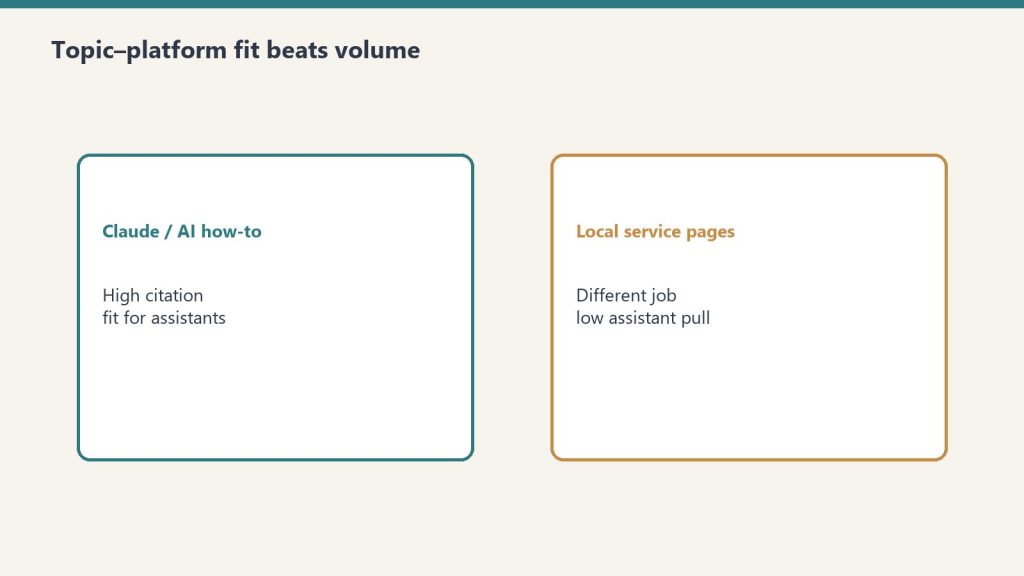
    Topic–platform fit beats volume: Claude and AI how-to topics show high citation fit for assistants, while local service pages do a different job with low assistant pull.

    Buffer analyzed over 2 million posts across 94,000 LinkedIn accounts to map the relationship between posting frequency and per-post performance. The findings are clear and counterintuitive above a certain threshold.

    Moving from once a week to 2–5 times a week produces the steepest performance gains — this is the activation zone where LinkedIn’s algorithm begins recognizing an account as an active, consistent publisher and distributing its content more broadly. Moving to daily posting, meaning 5–7 times a week, continues to improve per-post performance for publishers who can maintain content quality at that cadence.

    Above once per day, returns turn sharply negative. When a second post goes live within 24 hours, LinkedIn’s algorithm halts distribution of the first post to evaluate the new one. The publisher competes against themselves. The median reach per post drops over 40% for accounts posting multiple times daily.

    The 2025 algorithm update made this worse. LinkedIn now pre-filters and rejects over 50% of all posts before they reach any audience — up from 40% in 2024. High posting volume with declining content quality accelerates that filtering. The algorithm is actively penalizing low-quality volume.

    The practical sweet spots are 3–5 posts per week for personal profiles and 2–3 posts per week for company pages. Company page content faces steeper organic reach challenges than personal profiles, so the economics of volume are even less favorable for brand accounts.

    The SEO Math Behind Feed Post Frequency

    Four-stage funnel: citation, click, engage, convert
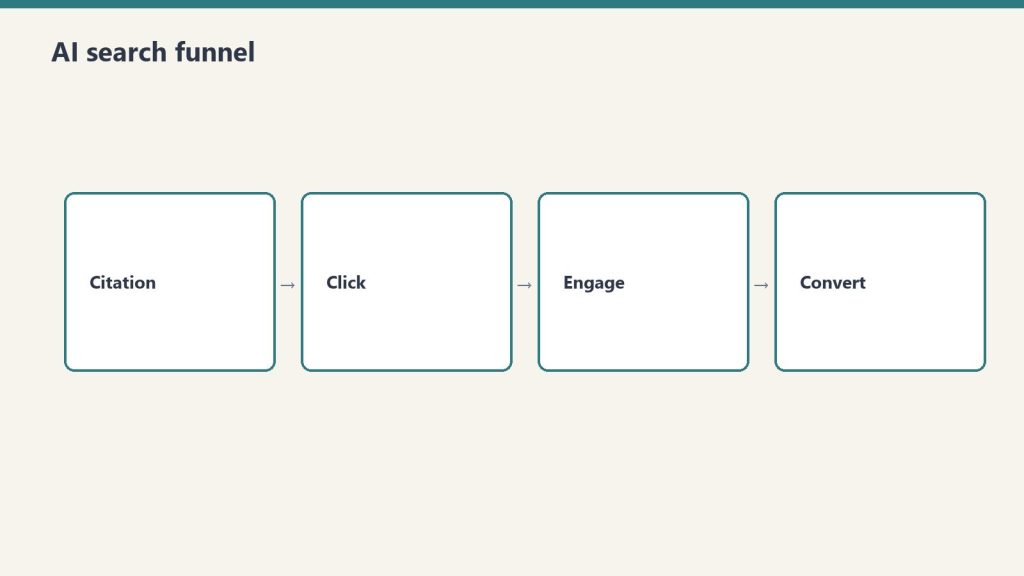
    The AI search funnel: four stages — Citation, Click, Engage, Convert. — the path an indexed LinkedIn Article is built to move a reader along.

    Here is the part most LinkedIn content guides miss entirely: feed posts have zero direct Google SEO value because they are not indexed by Google. They live at /posts/ URLs behind LinkedIn’s login wall. Googlebot cannot crawl them.

    The SEO value chain from feed post frequency is entirely indirect. More posts generate more engagement, which builds profile authority signals, which improves the indexation probability and ranking performance of your LinkedIn Articles and Newsletters — the content that actually lives at crawlable /pulse/ URLs and inherits LinkedIn’s domain authority of 98.

    This means optimizing posting frequency for SEO purposes is really two separate questions: how often to post in the feed for engagement and authority signals, and how often to publish Articles or Newsletters for direct search value. The second question matters more for SEO outcomes. Consistent long-form publishing — even at one Article or Newsletter per week — builds the topical authority signals that both Google and AI citation systems reward over time.

    The Automation Constraint You Cannot Work Around

    LinkedIn’s API does not expose any endpoint for publishing native Articles or Newsletters. This has been confirmed by every major scheduling and automation tool — Buffer, Hootsuite, Metricool, Sprout Social, Later — and no change is planned. The LinkedIn Community Management API supports feed posts only.

    Zapier and Make workflows that claim LinkedIn “article” functionality are sharing external URLs as link-preview feed posts. That is not the same as publishing a native LinkedIn Article at a /pulse/ URL with DA-98 authority.

    Browser automation via Selenium or Puppeteer can technically interact with LinkedIn’s article editor, but LinkedIn actively detects and blocks this, the dynamic JavaScript editor is fragile, and it violates LinkedIn’s Terms of Service with real account suspension risk. It is not a viable strategy.

    The unavoidable manual step in any LinkedIn long-form content workflow is the paste. You write the article, you optimize it, you format it — and then a human opens LinkedIn’s article editor and pastes it in.

    The Practical Workflow That Minimizes Lift

    Desk with laptop, checklist notebook, and billing card ready before creating an Anthropic API key
    A laptop with a blank browser window beside a numbered notebook, a pen, and a payment card on a wooden desk — the desk where the minimized-lift workflow is batched.

    The goal is to make the unavoidable manual step as frictionless as possible while automating everything around it.

    The workflow that minimizes lift looks like this. First, write the article using AI — structured, 800–1,200 words, educational, with specific data points and clear H2 headings that will perform well in both Google search and AI citation systems. Second, publish the article on your primary domain simultaneously — this establishes the canonical version and generates the direct SEO value on your own site. Third, prepare the LinkedIn-formatted version with the SEO title and meta description already written, ready to paste. Fourth, automate the feed post that will promote the LinkedIn Article once it is live, using Metricool or a similar scheduler.

    The only steps that require human time are the LinkedIn paste and the SEO field entry. Everything else — writing, optimization, domain publishing, feed post scheduling — can be automated or batched.

    LinkedIn Newsletters as a Force Multiplier

    If you are going to invest in LinkedIn long-form content, Newsletters are worth the additional setup compared to standalone Articles. The Google indexing and SEO authority are identical — both use /pulse/ URLs with full SEO title and meta description controls. But Newsletters add subscriber push notifications converting at 50% or higher, a compounding audience that grows with each edition, and recurring publishing signals that build topical authority faster than sporadic standalone Articles.

    The most efficient structure for a LinkedIn newsletter strategy is one newsletter per vertical or topic area, published on a consistent weekly or biweekly cadence. For an AI-native content agency, that might mean one newsletter on AI strategy for business leaders, one on SEO and GEO for marketing practitioners, and one on industry-specific applications for verticals you serve. Each builds its own subscriber base and topical authority without competing with the others.

    What Not to Do

    The most common LinkedIn content mistakes from an SEO and GEO perspective are publishing all long-form content as feed posts instead of Articles, cross-posting identical content from your blog to LinkedIn without accounting for the duplicate content issue, posting multiple times per day and triggering the reach suppression cliff, and optimizing for feed engagement metrics like reactions and comments at the expense of content structure and depth that drives AI citation.

    The brands winning the LinkedIn SEO and GEO game in 2026 are publishing less frequently than the viral advice suggests, producing content that is structurally optimized for AI parsing rather than social sharing, and maintaining consistent newsletter cadences that compound topical authority over months rather than chasing weekly reach numbers.

    The tool limitation is real. The manual paste is unavoidable. But the opportunity it unlocks — DA-98 Google rankings and AI citation across every major platform — is substantial enough to be worth the friction.

    Related on Tygart Media: LinkedIn articles vs posts · restoration LinkedIn selling · cross-pollination strategy.

    Frequently Asked Questions

    How often should you post on LinkedIn for SEO?

    For feed posts, 3–5 times per week is the sweet spot for personal profiles and 2–3 for company pages. Posting more than once per day triggers a reach suppression cliff where median reach drops over 40% per post. For direct SEO value, consistent Article or Newsletter publishing frequency matters more than feed post volume.

    Can you schedule LinkedIn Articles with Buffer or Hootsuite?

    No. LinkedIn’s API does not support publishing native Articles or Newsletters. Buffer, Hootsuite, Metricool, and all major scheduling tools can only schedule standard feed posts. LinkedIn Articles require manual publishing through LinkedIn’s editor.

    What is the LinkedIn posting frequency cliff?

    When a second post goes live within 24 hours, LinkedIn’s algorithm halts distribution of the first post. Accounts posting multiple times per day see median reach drop over 40% per post. LinkedIn also now pre-filters and rejects over 50% of all posts before they reach any audience.

    Should you use LinkedIn Newsletters or LinkedIn Articles?

    Newsletters are generally the higher-leverage format. Both use identical /pulse/ URLs with the same Google indexing and SEO controls. Newsletters add subscriber push notifications at 50%+ open rates, a growing subscriber base, and consistent publishing cadence that builds topical authority faster than sporadic standalone Articles.

  • Master LinkedIn AI Citations for 2026 GEO Strategy

    Master LinkedIn AI Citations for 2026 GEO Strategy

    Something significant shifted in the AI search landscape between November 2025 and February 2026, and most content strategists have not caught up to it yet.

    LinkedIn jumped from the 11th most-cited domain to the 5th most-cited domain on ChatGPT in just three months. Profound, which analyzed 1.4 million AI citations across six platforms, called it “the largest shift in authority that we’ve seen this year.” In a separate study of ChatGPT Search, Google AI Mode, and Perplexity, Semrush found LinkedIn in 11% of AI responses on average.

    If you publish professional content, this was the most important GEO development of early 2026.

    Email Me This Article

    The Numbers Behind the Shift

    Four-stage funnel: citation, click, engage, convert
    The numbers behind the LinkedIn citation shift.

    In January–February 2026, Semrush analyzed 325,000 prompts across ChatGPT Search, Google AI Mode, and Perplexity, identifying 89,000 unique LinkedIn URLs cited in AI-generated responses. The platform-by-platform breakdown:

    • ChatGPT Search: LinkedIn appears in 14.3% of all responses
    • Google AI Mode: LinkedIn appears in 13.5% of all responses
    • Perplexity: LinkedIn appears in 5.3% of all responses

    LinkedIn ranked #2 among cited domains in Semrush’s dataset, and Profound found it is the #1 cited domain for professional queries across the six AI platforms it analyzed: ChatGPT, Gemini, Google AI Overviews, Google AI Mode, Microsoft Copilot, and Perplexity.

    What AI Systems Are Actually Citing

    Comparison of Claude how-to fit versus local service page fit for assistants
    What AI systems are actually citing.

    The composition of LinkedIn’s AI citations has shifted dramatically. In Profound’s data, profile page citations — the static biographical data that dominated early LinkedIn citations — collapsed from 33.9% to just 14.5% of all LinkedIn citations between November 15, 2025 and February 15, 2026. Meanwhile, posts and long-form articles grew from 26.9% to 34.9%.

    AI systems are not citing LinkedIn because of who you are. They are citing LinkedIn because of what you published.

    Of the 89,000 cited URLs in Semrush’s study, 50–66% are long-form Articles of 500–2,000 words, and 54–64% are educational or advice-driven content. The median cited post has just 15–25 reactions and roughly one comment. Engagement is not the primary driver of AI citation — relevance, accuracy, specificity, and structure are.

    Creators with fewer than 500 followers get cited at comparable rates to large accounts. This is not a follower game. It is a content quality and structure game.

    The Personal Profile vs Company Page Split

    One of the more strategically interesting findings from Semrush’s study is that different AI platforms cite LinkedIn content differently by source type.

    ChatGPT and Google AI Mode favor personal profiles, drawing 59% of their LinkedIn citations from individual creator content versus 41% from company pages. Perplexity reverses this, drawing 59% of its LinkedIn citations from company pages and 41% from personal profiles.

    The strategic implication is a dual-publishing approach. Publishing technical and educational content on both a personal profile and a company page maximizes AI visibility across all major platforms simultaneously. They are not redundant — they are complementary, each feeding different AI citation systems.

    Why LinkedIn Content Gets Cited: The Structural Reasons

    LinkedIn’s relationship with AI systems operates through multiple channels that reinforce each other.

    First, LinkedIn content has always been publicly indexed and high-authority. With a Moz Domain Authority of 98, LinkedIn Pulse articles sit in the same crawlability tier as Wikipedia and major news publications. AI training datasets over-index on high-authority domains, meaning LinkedIn content has been proportionally well-represented in model training from the beginning.

    Second, LinkedIn rolled out a “Data for Generative AI Improvement” toggle in September 2024, set to ON by default, according to LinkedIn Help. On November 3, 2025, LinkedIn also began using data from members in the EU, EEA, Switzerland, Canada, and Hong Kong to train content-generating AI models. LinkedIn is owned by Microsoft, which has a direct relationship with OpenAI. The structural pipeline from LinkedIn content to AI model training is more direct than almost any other platform.

    Third, LinkedIn content shows semantic similarity scores of 0.57–0.60 with AI-generated outputs, higher than Reddit (0.53–0.54) or Quora (0.44). AI systems are not just citing LinkedIn — they are drawing heavily on LinkedIn’s language patterns and reasoning structures when generating responses.

    What This Means for B2B and Restoration Industry Content

    For professional verticals — B2B services, restoration, real estate, finance, healthcare — LinkedIn is no longer an optional distribution channel. It is likely the single highest-leverage GEO publishing surface available.

    A structured LinkedIn Article on a technical topic in the restoration industry, AI strategy, or B2B services has a realistic path to being cited in ChatGPT, Perplexity, and Google AI Mode responses on relevant professional queries. It does not require a large following. It does not require viral engagement. It requires content that is accurate, structured, specific, and educational.

    Content reaches peak AI citation velocity 7–14 days after publishing and maintains that velocity for 90 or more days — significantly longer than Twitter/X or Reddit content, which cycles out of AI citation windows much faster.

    The Practical GEO Framework

    Desk with laptop, checklist notebook, and billing card ready before creating an Anthropic API key
    The practical GEO framework.

    Based on the citation data, the content signals that drive AI citation on LinkedIn are consistent and actionable: include specific data points, metrics, methodologies, and dates rather than generic claims. Use clear H2 heading structure that AI systems can parse for answer extraction. Write educational and advice-driven content rather than promotional content. Target 800–1,200 words per Article — long enough to establish depth, short enough to maintain density.

    The biggest opportunity right now is that most LinkedIn publishers are still optimizing for feed engagement — reactions, comments, shares. The AI citation data suggests a different optimization target: structured, data-rich, educational long-form content that looks less like a viral feed post and more like a well-sourced reference document.

    The brands and individuals who make that shift in 2026 are building citation authority that will compound for years.

    Related on Tygart Media: LinkedIn content strategy · GEO tactics · AI citation monitoring.

    Frequently Asked Questions

    Is LinkedIn the most cited source in AI search?

    LinkedIn ranked #2 among cited domains in Semrush’s early-2026 study, appearing in about 11% of responses across ChatGPT Search, Google AI Mode, and Perplexity. Profound found it is the #1 cited domain for professional queries across ChatGPT, Gemini, Google AI Overviews, Google AI Mode, Copilot, and Perplexity.

    What type of LinkedIn content gets cited by AI systems?

    50–66% of AI-cited LinkedIn content is long-form Articles of 500–2,000 words. Educational and advice-driven content accounts for 54–64% of citations. The median cited post has only 15–25 reactions — engagement is not the primary driver of AI citation.

    Does LinkedIn company page content get cited by AI?

    Yes. Perplexity draws 59% of its LinkedIn citations from company pages. ChatGPT and Google AI Mode favor personal profiles at 59%. A dual-publishing strategy covering both maximizes visibility across all AI platforms.

    How long does it take for LinkedIn content to appear in AI citations?

    LinkedIn content reaches peak AI citation velocity 7–14 days after publishing and maintains that velocity for 90 or more days — longer than most other social platforms.

    AI Citation Quick-Scan — $97

    This article maps how AI answer engines decide whose content earns a citation. The Quick-Scan runs that same check on your company: ten homeowner prompts across the major AI answer engines, with a written report in 7 days. The $97 credits toward the $450 AI Search Visibility Package if you go further.

    Get the Quick-Scan — $97
  • Telehealth SEO: SiteBoost YMYL & E-E-A-T Optimization

    Telehealth SEO: SiteBoost YMYL & E-E-A-T Optimization

    Tygart Media // AEO & AI Search
    SCANNING
    CH 03
    · Answer Engine Intelligence
    · Filed by Will Tygart

    What Is SiteBoost for Telehealth?
    SiteBoost for Telehealth is a done-for-you WordPress optimization service for telehealth platforms and occupational health providers — applying YMYL-compliant SEO, AEO, and GEO optimization to patient-facing content, employer health pages, and clinical service descriptions. Built specifically for the trust and credentialing signals Google requires before ranking healthcare content, and the direct-answer format that AI systems use to respond to medical and workplace health queries.

    Telehealth content faces the strictest content standards in search. Google’s YMYL (Your Money or Your Life) guidelines apply to any health-related content — meaning E-E-A-T signals (Experience, Expertise, Authoritativeness, Trustworthiness) aren’t optional. A telehealth WordPress site without proper credentialing signals, licensed clinician attribution, and medically accurate terminology isn’t just under-optimized — it’s actively downranked.

    Most telehealth platforms are built by product teams who understand the clinical side but not the content architecture side. The result: accurate medical content on a WordPress site that Google treats as low-trust because the trust signals aren’t structured correctly. We fix that.

    What We’ve Done in This Vertical

    We manage content operations for Sickday (sickday.com), a same-day telehealth and occupational health platform serving employers and individual patients. The critical rule in this vertical: staff are licensed clinicians — not doctors, not nurses. That distinction matters legally and for E-E-A-T compliance. We’ve built the content architecture, credentialing signals, and YMYL-compliant optimization stack for this specific category of healthcare provider.

    What SiteBoost Covers for Telehealth

    • E-E-A-T signal injection — Licensed clinician credentials, platform accreditation signals, medical review attribution, and organizational trust markers structured into content and schema
    • YMYL compliance optimization — Content accuracy review, hedging language for medical claims, appropriate disclaimer structures, and factual sourcing for health information
    • Occupational health entity signals — OSHA references, DOT compliance language, workers’ compensation terminology, employer health program signals for occupational health content
    • Telehealth platform entities — Relevant telehealth regulation references (Ryan Haight Act, state telehealth practice standards, HIPAA compliance signals), payer and insurance entity references
    • Patient FAQ schema — Common patient and employer questions answered in FAQPage format for PAA placement (“how does telehealth work,” “is telehealth covered by insurance,” “what is a DOT physical”)
    • AI citation optimization — Speakable schema and LLMS.TXT configuration for Perplexity and Google AI Overview citation when patients and employers search for telehealth services

    The YMYL Difference in Telehealth SEO

    Standard SEO agencies treat telehealth like any other local service business. Google doesn’t. Health content requires demonstrably different trust architecture: named clinician credentials on clinical content, medical review dates on health information pages, accurate clinical terminology that matches how licensed providers actually speak, and clear scope-of-practice language that distinguishes what a telehealth platform can and cannot provide. Getting this wrong doesn’t just hurt rankings — it creates compliance exposure.

    What the Pilot Delivers

    Item Included
    Site audit + YMYL compliance gap analysis ✅
    10 posts optimized (SEO + AEO + GEO) ✅
    E-E-A-T signal injection on all 10 posts ✅
    Licensed clinician credential structuring ✅
    FAQPage schema (patient + employer Q&A) ✅
    Occupational health entity injection (where applicable) ✅
    60-day impact report ✅

    SiteBoost vs. DIY vs. Generic Healthcare SEO Agency

    SiteBoost DIY Generic Healthcare SEO
    YMYL E-E-A-T compliance built in ✅ Risky Sometimes
    Licensed clinician (not “doctor”) language enforced ✅ ❌ ❌
    Occupational health entity library ✅ ❌ Rarely
    Telehealth regulation references ✅ ❌ Rarely
    AI citation optimization ✅ ❌ ❌
    Proven in telehealth vertical ✅ Unknown Unlikely

    Interested in SiteBoost for Your Telehealth Site?

    We onboard sites personally. Email Will with your site URL and a brief description of your clinical model — he’ll follow up within one business day.

    → Email Will — Start the Pilot

    Email only. No sales call required. No commitment to reply.

    Frequently Asked Questions

    Does this work for direct-to-consumer telehealth as well as employer occupational health?

    Yes. The entity set and content architecture adapt to your clinical model. DTC telehealth content targets patient-facing queries and insurance coverage questions. Occupational health content targets employer HR and safety manager queries — OSHA compliance, DOT physicals, return-to-work programs. Both operate under YMYL standards; both get the full E-E-A-T treatment.

    Why does the licensed clinician language distinction matter for SEO?

    Calling staff “doctors” or “nurses” when they’re licensed clinicians (nurse practitioners, physician assistants, licensed therapists) creates scope-of-practice inaccuracies that can trigger both Google trust penalties and state medical board compliance issues. Google’s quality raters are specifically trained to identify healthcare credential misrepresentation. We enforce accurate clinical title language as a hard rule in all content we optimize.

    Can SiteBoost help with content that explains telehealth regulations to patients?

    Yes — and this is high-value content for telehealth platforms. State-specific telehealth practice standards, insurance coverage rules, and prescription regulations (Ryan Haight Act) are exactly the kind of regulatory content that earns E-E-A-T signals when written accurately and attributed correctly. We can optimize existing regulatory explainer content or identify gaps where new content would capture patient research queries.

    Is telehealth content affected by the helpful content update?

    Significantly. Google’s helpful content guidelines hit thin, AI-generated health content hardest. Telehealth sites that published generic condition descriptions without clinical attribution saw the steepest ranking drops. The optimization pass ensures all content demonstrates genuine clinical expertise — specific treatment descriptions, accurate clinical terminology, and proper scope-of-practice framing that generic health copywriting lacks.

    Last updated: October 28, 2026

  • Property Damage Restoration SEO for Regional Operators

    Property Damage Restoration SEO for Regional Operators

    Tygart Media // AEO & AI Search
    SCANNING
    CH 03 · Answer Engine Intelligence · Filed by Will Tygart
    What Is SiteBoost for Regional Restoration?
    SiteBoost for Regional Property Damage Restoration is a done-for-you WordPress optimization service for restoration companies serving multi-county suburban and rural markets — where the competition isn’t ServiceMaster or Servpro’s national SEO budget, but regional independents with the same local knowledge advantage you have, and slightly better-optimized WordPress sites. We close that gap.

    The restoration SEO landscape outside major metros is fundamentally different from downtown competition. National franchise sites dominate broad category searches. But regional independent operators — companies serving 3–8 counties with genuine local presence and real IICRC credentials — can win the specific, high-intent queries that national sites don’t have the local content depth to capture.

    The strategy: own the local entities (county names, neighborhoods, local insurers, regional weather events), demonstrate IICRC credential depth (specific standards by loss type), and produce the adjuster-facing content that decision-makers search for when qualifying restoration contractors for their preferred vendor lists.

    What We’ve Done in This Vertical

    Comparison of Claude how-to fit versus local service page fit for assistants
    Topic–platform fit beats volume: Claude and AI how-to topics show high citation fit for assistants, while local service pages do a different job with low assistant pull.

    We manage content operations for Upper Restoration (NYC and Long Island — Nassau and Suffolk counties) and 247 Restoration Specialists (Houston TX metro). Both are regional independent operators competing against franchise chains with much larger marketing budgets. The content architecture, IICRC entity library, and adjuster-facing content strategy are proven across both markets.

    What SiteBoost Covers for Regional Restoration

    • Multi-county geo-entity injection — County names, municipalities, ZIP codes, and regional landmarks that signal genuine service area coverage to local search algorithms
    • IICRC standard-level entity injection — S500 (water damage), S520 (mold), S540 (trauma/biohazard), S600 (upholstery), S700 (fire/smoke), S900 (contents) referenced by specific standard and loss type
    • RIA and industry body signals — Restoration Industry Association references, regional trade association memberships, and professional network signals
    • Adjuster-facing content optimization — Content restructured for the insurance adjuster search intent: coverage eligibility, documentation requirements, carrier-specific language, preferred vendor qualification
    • Property manager and GC content — Commercial referral source content optimized for property manager and general contractor discovery queries
    • FAQPage schema — Homeowner, adjuster, and property manager questions answered in structured format for PAA placement

    The Adjuster-Facing Content Difference

    Side-by-side comparing a pitch dump with value-first contact habits
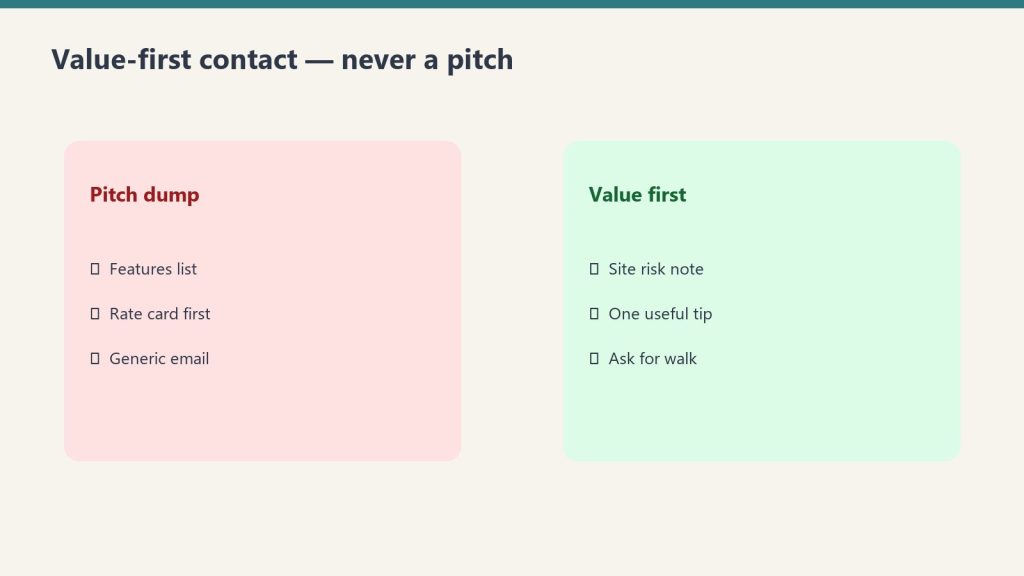
    Value-first contact — never a pitch: a pitch dump (features list, rate card first, generic email) against value-first habits (site risk note, one useful tip, ask for the walk).

    Most restoration WordPress sites produce homeowner-facing content exclusively. The highest-value referral relationships — insurance adjuster preferred vendor lists — come from a completely different content audience with completely different search intent. Content that references RCV vs. ACV claims, Xactimate line items, carrier documentation requirements, and IICRC standard compliance reaches the adjuster audience that homeowner-facing content never touches.

    What the Pilot Delivers

    Desk with laptop, checklist notebook, and billing card ready before creating an Anthropic API key
    A laptop with a blank browser window beside a numbered notebook, a pen, and a payment card on a wooden desk — the desk where a pilot scoping checklist gets started.
    ItemIncluded
    Site audit + local and adjuster query gap analysis✅
    10 posts optimized (SEO + AEO + GEO)✅
    Multi-county geo-entity injection✅
    IICRC standard-level entity injection✅
    Adjuster-facing content optimization (where applicable)✅
    FAQPage schema (homeowner + adjuster Q&A)✅
    60-day impact report✅

    Interested in SiteBoost for Your Regional Property Damage Restoration Site?

    We onboard sites personally. Email Will with your site URL and he’ll follow up within one business day.

    → Email Will — Start the Pilot

    Email only. No sales call required. No commitment to reply.

    Related on Tygart Media: local SEO · blog SEO · documentation RH/GPP.

    Frequently Asked Questions

    How is this different from the standard SiteBoost for Restoration page?

    The standard restoration SiteBoost page is built for any restoration operator. This page is specifically for regional independents serving multi-county suburban and rural markets — where the geo-entity strategy, adjuster-facing content, and multi-county local authority approach are the primary differentiators from franchise competitors.

    What does adjuster-facing content optimization actually involve?

    It means restructuring content to answer the questions insurance adjusters search for when qualifying restoration contractors: IICRC certification verification, documentation and reporting capabilities, carrier compliance history, Xactimate familiarity, and response time and capacity for large loss events. This content doesn’t convert homeowners — it gets you on preferred vendor lists.

    Does SiteBoost work for fire and mold restoration as well as water damage?

    Yes. The entity injection is loss-type specific — water damage content gets S500 references, mold gets S520 and EPA 402-K-02-003, fire/smoke gets S700. Multi-peril operators get all applicable standards applied to the relevant posts in the 10-post pilot.

    Last updated: November 6, 2026 (Pacific)

  • Twin Cities Water Damage SEO for Restoration Companies

    Twin Cities Water Damage SEO for Restoration Companies

    Tygart Media // AEO & AI Search
    SCANNING
    CH 03 · Answer Engine Intelligence · Filed by Will Tygart
    What Is SiteBoost for Twin Cities Water Damage Restoration?
    SiteBoost for Twin Cities Water Damage Restoration is a done-for-you WordPress optimization service for water damage and property restoration companies serving Minneapolis, Saint Paul, and the surrounding metro — injecting Minneapolis-specific neighborhood entities, Minnesota licensing references, IICRC credentials, and local content signals that separate market-native operators from national franchise chains in local search results.

    The Twin Cities restoration market has a specific local dynamic: a mix of national franchise operators (ServiceMaster, Servpro, Paul Davis) with massive domain authority, and local independent operators who actually know Edina from Eden Prairie and understand the difference between a Minnetonka lake home and a Saint Paul bungalow. Local content that demonstrates genuine market knowledge wins in that environment — national franchise sites can’t fake it.

    We built this system on Partners Restoration (partnerscos.com), a water damage and restoration company serving the Minneapolis SW metro — Edina, Chanhassen, Wayzata, Minnetonka, Eden Prairie, Deephaven, Orono, and Plymouth. The neighborhood entity library, Minnesota-specific licensing references, and local content architecture are proven in this market.

    What SiteBoost Covers for Twin Cities Restoration

    Flooded residential living room with standing water on hardwood after a water loss
    A flooded living room mid-mitigation: standing water on the hardwood, furniture raised on blocks, and flood-cut drywall along the walls.
    • Minneapolis/Saint Paul neighborhood entity injection — Specific neighborhood names, lake names, school districts, and local landmarks that signal genuine market presence to Google and local searchers
    • Minnesota licensing entity signals — Minnesota Department of Labor and Industry (DLI) contractor licensing, Minnesota Pollution Control Agency (MPCA) mold references, and state-specific regulatory signals
    • IICRC credential injection — S500 water damage, S520 mold remediation, S700 fire and smoke standards referenced throughout relevant content
    • Local buyer FAQ schema — Twin Cities homeowner questions answered in structured format (“does homeowners insurance cover water damage in Minnesota,” “how long does water damage restoration take in Minneapolis”)
    • Seasonal content signals — Minnesota winter pipe burst, spring flooding, and ice dam water damage content optimized for seasonal query patterns
    • AI citation optimization — Content structured for Perplexity and Google AI Overview citation when Twin Cities homeowners search for emergency restoration help

    Twin Cities Neighborhood Entity Library

    Comparison of Claude how-to fit versus local service page fit for assistants
    Topic–platform fit beats volume: Claude and AI how-to topics show high citation fit for assistants, while local service pages do a different job with low assistant pull.

    Content that references specific Twin Cities neighborhoods outperforms generic metro-area content for local queries. Our entity library covers: Minneapolis (Uptown, Linden Hills, Kenwood, Longfellow, Northeast), Saint Paul (Highland Park, Macalester-Groveland, Summit Hill, Como), and the SW suburbs: Edina, Eden Prairie, Minnetonka, Wayzata, Chanhassen, Chaska, Orono, Plymouth, Deephaven, Shorewood.

    What the Pilot Delivers

    Desk with laptop, checklist notebook, and billing card ready before creating an Anthropic API key
    A laptop with a blank browser window beside a numbered notebook, a pen, and a payment card on a wooden desk — the desk where a pilot scoping checklist gets started.
    ItemIncluded
    Site audit + Twin Cities local query gap analysis✅
    10 posts optimized (SEO + AEO + GEO)✅
    Minneapolis/Saint Paul neighborhood entity injection✅
    Minnesota licensing reference injection✅
    IICRC entity signals✅
    FAQPage schema (MN homeowner Q&A)✅
    60-day impact report✅

    Interested in SiteBoost for Your Twin Cities Water Damage Restoration Site?

    We onboard sites personally. Email Will with your site URL and he’ll follow up within one business day.

    → Email Will — Start the Pilot

    Email only. No sales call required. No commitment to reply.

    Related on Tygart Media: local SEO for restoration · property damage SEO · Google Ads lessons.

    Frequently Asked Questions

    Does this only work for companies in the Minneapolis SW suburbs?

    No — the geo-entity approach works for any Twin Cities sub-market. The neighborhood entity set is adapted to your actual service area. Companies serving the North Metro (Blaine, Coon Rapids, Maple Grove) or East Metro (Woodbury, Stillwater, White Bear Lake) get a different neighborhood entity set than SW metro operators.

    How does this help against national franchise competitors with huge domain authority?

    National franchises can’t fake local knowledge. Content that references specific Twin Cities neighborhoods, Minnesota-specific weather patterns, local licensing bodies, and regional building characteristics signals genuine market presence that national sites don’t have. Google’s local algorithm rewards this specificity in local pack and organic local results.

    Does SiteBoost cover seasonal content for Minnesota’s specific weather patterns?

    Yes. Minnesota’s climate creates specific restoration query patterns — winter pipe bursts, spring snowmelt flooding, summer storm damage, and ice dam water intrusion are all seasonal signals we optimize for as part of the Twin Cities pilot.

    Last updated: November 6, 2026 (Pacific)

  • B2B Event Platform SEO: SiteBoost for Event Tech SaaS

    B2B Event Platform SEO: SiteBoost for Event Tech SaaS

    Tygart Media / Content Strategy
    The Practitioner JournalField Notes
    By Will Tygart
    · Practitioner-grade
    · From the workbench

    What Is SiteBoost for B2B Event Platforms?
    SiteBoost for B2B Event Platforms is a done-for-you WordPress optimization service for conference technology companies, meeting platforms, and event tech SaaS — injecting MPI, PCMA, and hybrid event industry entities, optimizing for meeting planner buyer-stage queries, and building AI citation readiness in a category where most platforms still rely entirely on paid acquisition.

    Event technology buyers — meeting planners, event managers, corporate travel coordinators — research platforms through industry association resources, peer recommendations, and increasingly through AI-generated answers. Companies that appear in those answers without paying for the placement have a significant acquisition cost advantage over competitors who live and die by paid search.

    We built this optimization system on WeConvene, a B2B event and meeting platform where we’ve optimized content for meeting planner search intent, hybrid event terminology, and the industry body references that signal credibility to professional event buyers.

    What SiteBoost Covers for B2B Event Platforms

    • Industry body entity injection — MPI (Meeting Professionals International), PCMA (Professional Convention Management Association), GBTA, SITE, and relevant certification body references
    • Event format terminology — Hybrid events, virtual attendee experience, breakout session technology, attendee engagement metrics, and event ROI measurement language
    • Buyer persona content — Meeting planner, corporate event manager, association executive, and incentive travel buyer search intent mapped to existing content
    • FAQPage schema — Platform evaluation questions answered in structured format (integration capabilities, attendee limits, pricing models, security compliance)
    • Comparison content structure — Positioning content for “event platform comparison” and “best virtual conference platform” queries
    • AI citation optimization — Content structured for Perplexity citation when buyers research event technology options

    What the Pilot Delivers

    Item Included
    Site audit + buyer query gap analysis ✅
    10 posts optimized (SEO + AEO + GEO) ✅
    MPI/PCMA industry entity injection ✅
    Hybrid event terminology optimization ✅
    FAQPage schema (buyer evaluation Q&A) ✅
    Buyer persona targeting applied ✅
    60-day impact report ✅

    Interested in SiteBoost for Your B2B Event Platform Site?

    We onboard sites personally. Email Will with your site URL and he’ll follow up within one business day.

    → Email Will — Start the Pilot

    Email only. No sales call required. No commitment to reply.

    Frequently Asked Questions

    Does this work for in-person event companies as well as virtual/hybrid platforms?

    Yes. The entity set adapts to your event format focus — in-person events use venue, AV, and logistics entities; virtual/hybrid platforms use technology integration, attendee experience, and platform capability entities. Both buyer audiences use industry body references (MPI, PCMA) as credibility signals.

    Is event technology content competitive for organic search?

    Highly competitive on broad terms (“best event platform”), much less competitive on specific buyer-stage and specification queries (“hybrid event platform with Salesforce integration” or “MPI-recognized virtual conference platform”). SiteBoost targets the specific queries where organic wins are achievable.

    Can SiteBoost help with content that positions against specific competitors?

    Comparison content is one of the highest-converting content types in B2B SaaS — and event tech is no exception. We can optimize existing comparison pages or structure new comparison content as part of the 10-post pilot scope.


    Last updated: October 28, 2026

  • Commercial Flooring SEO: SiteBoost for Contractors

    Commercial Flooring SEO: SiteBoost for Contractors

    Tygart Media / Content Strategy
    The Practitioner JournalField Notes
    By Will Tygart
    · Practitioner-grade
    · From the workbench

    What Is SiteBoost for Commercial Flooring?
    SiteBoost for Commercial Flooring is a done-for-you WordPress optimization service for commercial flooring contractors and flooring standards companies — injecting ASTM specifications, ACI standards, FF/FL floor flatness entities, and B2B buyer-stage content architecture into existing WordPress content. Built for companies selling to general contractors, developers, and facilities managers who search for technical specifications before issuing RFPs.

    Commercial flooring buyers are specification buyers. A facilities manager selecting a flooring contractor for a warehouse project isn’t searching “best flooring near me” — they’re searching “ASTM E1155 floor flatness testing contractor” or “FF25 FL20 specification compliance.” Generic flooring content doesn’t appear in those searches. Entity-rich technical content does.

    We built this optimization system on IFTI (ifti.com), a commercial flooring standards and inspection company where we’ve published content covering floor flatness measurement, ASTM specifications, ACI tolerances, and the technical content that commercial flooring buyers actually search for when qualifying contractors.

    What We’ve Done in This Vertical

    IFTI content operations include taxonomy rebuild across flooring standards verticals, variant content pipelines for different buyer personas (GC, developer, facility manager), and AEO optimization of technical flooring content. The ASTM, ACI, ICRI, and FF/FL entity sets are documented and proven in this vertical.

    What SiteBoost Covers for Commercial Flooring

    • Standards entity injection — ASTM E1155, ASTM F710, ACI 117, ACI 302, ICRI surface profile references injected throughout content
    • FF/FL floor flatness terminology — Floor flatness (FF) and floor levelness (FL) numbers, tolerance references, and measurement methodology content optimized for specification searches
    • B2B buyer persona targeting — Content restructured for general contractor, developer, and facilities manager search intent and vocabulary
    • Technical FAQ schema — Specification questions answered in FAQPage format for buyers researching compliance requirements
    • RFP and specification language — Content aligned with how commercial buyers write specs and evaluate contractors
    • AI citation optimization — Technical content structured for Perplexity citation when buyers research flooring specifications

    What the Pilot Delivers

    Item Included
    Site audit + specification query gap analysis ✅
    10 posts optimized (SEO + AEO + GEO) ✅
    ASTM/ACI/ICRI entity injection ✅
    FF/FL terminology optimization ✅
    FAQPage schema (technical buyer Q&A) ✅
    B2B persona targeting applied ✅
    60-day impact report ✅

    Interested in SiteBoost for Your Commercial Flooring Site?

    We onboard sites personally. Email Will with your site URL and he’ll follow up within one business day.

    → Email Will — Start the Pilot

    Email only. No sales call required. No commitment to reply.

    Frequently Asked Questions

    Does this work for residential flooring contractors as well?

    The entity set and B2B buyer persona focus is built for commercial flooring. Residential flooring content uses different search intent and different entity signals. If you serve both markets, we optimize commercial content in the pilot and can extend to residential content separately.

    What if our content is currently very thin or product-catalogue style?

    Thin product-catalogue content is one of the most common issues in commercial flooring WordPress sites. The optimization pass expands thin pages with technical context, specification details, and buyer-stage framing — without rewriting your core product or service descriptions.

    Can SiteBoost help us rank for specific ASTM standard numbers?

    Yes — ASTM standard numbers (E1155, F710, etc.) are searchable terms used by specification buyers. Content optimized with these entities in the right context can rank for standard-number queries that most flooring sites don’t even attempt to target.


    Last updated: October 29, 2026

  • Emergency Home Services SEO: Win 24/7 Local Repair Queries

    Emergency Home Services SEO: Win 24/7 Local Repair Queries

    Tygart Media // AEO & AI Search
    SCANNING
    CH 03
    · Answer Engine Intelligence
    · Filed by Will Tygart

    What Is SiteBoost for Emergency Home Services?
    SiteBoost for Emergency Home Services is a done-for-you WordPress optimization service for 24/7 repair companies — water damage, fire restoration, emergency plumbing, and HVAC — built specifically for the high-intent, time-sensitive local queries that drive emergency service calls. When a pipe bursts at 2am, your site needs to be the answer Google and AI systems surface immediately.

    Emergency home service queries are among the highest-intent searches on the internet. “Water damage restoration near me” at 11pm is a person with a flooded basement ready to call the first credible result. The problem: most emergency service WordPress sites are thin, generic, and built for desktop browsing — not for the AMP-speed, direct-answer format that wins emergency query placements.

    SiteBoost restructures your existing content for exactly these moments: fast-loading, direct-answer pages that capture emergency queries, demonstrate local credibility through service area and licensing entities, and get cited by AI systems when homeowners search for emergency help.

    What SiteBoost Covers for Emergency Home Services

    • Emergency query optimization — Pages restructured for “near me,” “24/7,” and time-sensitive search patterns with direct answer formatting
    • Local service area entity injection — City, county, neighborhood, and ZIP-level signals that reinforce local pack eligibility
    • Certification entity signals — IICRC, BBB accreditation, EPA certification, state contractor license numbers where applicable
    • FAQPage schema — Homeowner emergency questions answered in structured format (“what to do when pipe bursts,” “is water damage covered by insurance”)
    • Speakable schema — Key emergency response paragraphs marked for voice search (“Hey Google, water damage restoration near me”)
    • Response time and availability signals — 24/7 availability, response time claims, and service guarantee language structured for AI citation

    The Entities That Matter in Emergency Home Services

    Emergency home service content earns local trust through: IICRC (water and fire restoration credentialing), BBB accreditation, EPA mold and hazmat references, OSHA safety standards, state contractor licensing bodies, and local service area signals (city names, county names, neighborhood references). Combined with response time claims and availability signals, these entities separate credible operators from lead aggregators in search results.

    What the Pilot Delivers

    Item Included
    Site audit + emergency query gap analysis ✅
    10 posts optimized (SEO + AEO + GEO) ✅
    Local service area entity injection ✅
    FAQPage schema (homeowner emergency Q&A) ✅
    Speakable schema on key pages ✅
    Certification entity injection ✅
    60-day impact report ✅

    Interested in SiteBoost for Your Emergency Home Services Site?

    We onboard sites personally. Email Will with your site URL and he’ll follow up within one business day.

    → Email Will — Start the Pilot

    Email only. No sales call required. No commitment to reply.

    Frequently Asked Questions

    Does this work for single-trade companies (plumbing only, HVAC only)?

    Yes. The optimization is adapted to the specific trade — plumbing emergency queries and entities differ from water damage restoration queries. Single-trade companies get a more focused entity set and query cluster than multi-service operators.

    How does SiteBoost help with “near me” local search specifically?

    Local pack rankings are influenced by GBP completeness, on-site local entity signals, and NAP consistency. Our optimization pass injects city, county, and neighborhood entities into post content — reinforcing the geographic relevance signals that “near me” queries rely on. We can also recommend GBP optimizations as a complement.

    Is emergency service content affected by Google’s helpful content standards?

    Emergency home service content sits in a gray zone — it’s high-intent and local, not strictly YMYL, but Google’s helpful content guidelines still apply. We ensure all optimized content demonstrates genuine expertise (real process descriptions, accurate technical terminology, specific service area knowledge) rather than generic category page copy.


    Last updated: October 29, 2026

  • Luxury Asset Lending SEO: SiteBoost for Collateral Loans

    Luxury Asset Lending SEO: SiteBoost for Collateral Loans

    Tygart Media / Content Strategy
    The Practitioner JournalField Notes
    By Will Tygart
    · Practitioner-grade
    · From the workbench

    What Is SiteBoost for Luxury Asset Lending?
    SiteBoost for Luxury Asset Lending is a done-for-you WordPress optimization service for collateral loan companies — lenders who accept watches, jewelry, handbags, fine art, and precious metals as security for short-term loans. We inject the luxury brand entities, valuation body references, and financial authority signals that make collateral loan content rank and get cited by AI systems researching asset-backed financing.

    Luxury asset lending sits at the intersection of two competitive search landscapes: financial services (high authority, highly regulated) and luxury goods (brand-dominated, aspirational). Most collateral loan companies produce generic “how it works” content that neither Google nor AI systems treat as authoritative on either dimension.

    The win is entity precision. Content that references GIA grading standards, LBMA gold pricing, Rolex reference numbers, Patek Philippe complications, and Hermès Birkin authentication signals domain expertise that generic financial content can’t fake. We’ve built this playbook across four luxury lending sites.

    What We’ve Done in This Vertical

    We manage content operations for Borro, Beverly Loan, New York Loan, and Palm Beach Loan — four luxury collateral lenders operating across watches, jewelry, handbags, and fine art. Hundreds of published articles. Full AEO/GEO optimization stack. Category architecture built around asset classes. Cross-pollination strategy linking all four sites. The entity library, schema patterns, and content architecture are proven at scale in this vertical.

    What SiteBoost Covers for Luxury Lending

    • Asset class content optimization — Watch, jewelry, handbag, fine art, and precious metal loan pages optimized for their specific entity sets
    • Luxury brand entity injection — Rolex, Patek Philippe, Audemars Piguet, Hermès, Chanel, Van Cleef, Cartier, and relevant reference-level entities injected throughout content
    • Valuation body references — GIA (gemology), LBMA (precious metals), WatchCharts, auction house comps (Christie’s, Sotheby’s, Phillips) as authority signals
    • Financial entity signals — LTV ratios, asset-backed financing terminology, regulatory compliance language (state lending license references where applicable)
    • FAQPage schema — Borrower questions answered in structured format for PAA placement
    • AI citation optimization — Speakable schema and LLMS.TXT for Perplexity and ChatGPT citation when users research collateral loan options

    The Entities That Matter in Luxury Lending

    Luxury lending content earns trust through named entities: GIA (gemological authority), LBMA (London Bullion Market Association), WatchCharts, Chrono24, Christie’s, Sotheby’s, Phillips Watches, specific Rolex references (Daytona, Submariner, GMT-Master II), Patek Philippe complications, Hermès Birkin/Kelly authentication markers. These signal that the content was written by someone who knows the assets — not a financial copywriter guessing at luxury terminology.

    What the Pilot Delivers

    Item Included
    Site audit + asset class content inventory ✅
    10 posts optimized (SEO + AEO + GEO) ✅
    Luxury brand entity injection on all 10 posts ✅
    FAQPage schema (borrower Q&A) ✅
    Financial authority signal injection ✅
    Internal link architecture map ✅
    60-day impact report ✅

    SiteBoost vs. DIY vs. Generic Financial SEO Agency

    SiteBoost DIY Generic Financial SEO
    Luxury brand entity library built in ✅ ❌ ❌
    GIA/LBMA/auction house references ✅ ❌ ❌
    Proven on 4 luxury lending sites ✅ Unknown Unlikely
    AI citation optimization ✅ ❌ Rarely
    No plugin installs ✅ N/A Usually plugins

    Interested in SiteBoost for Your Luxury Asset Lending Site?

    We onboard sites personally. Email Will with your site URL and he’ll follow up within one business day.

    → Email Will — Start the Pilot

    Email only. No sales call required. No commitment to reply.

    Frequently Asked Questions

    Does this work for pawn shops as well as high-end collateral lenders?

    The entity set and content strategy are built for premium collateral lenders — companies positioning around luxury assets rather than general pawn. For high-end pawn operations that want to compete on luxury keywords, the approach adapts. For traditional pawn shops, the entity library is less relevant.

    Can SiteBoost help with geographic targeting for local collateral lenders?

    Yes. Local entity injection (city, neighborhood, state licensing references) is part of the optimization pass for lenders with physical locations. Beverly Hills, Manhattan, Palm Beach, and similar luxury market geo-entities are part of our existing entity library for this vertical.

    Is financial services content affected by E-E-A-T restrictions?

    Collateral lending is YMYL-adjacent. E-E-A-T signals matter — author credentials, organizational trust signals, regulatory compliance language, and accurate financial terminology all factor into how Google evaluates the content. Our optimization pass includes E-E-A-T signal injection as a standard step.


    Last updated: October 29, 2026