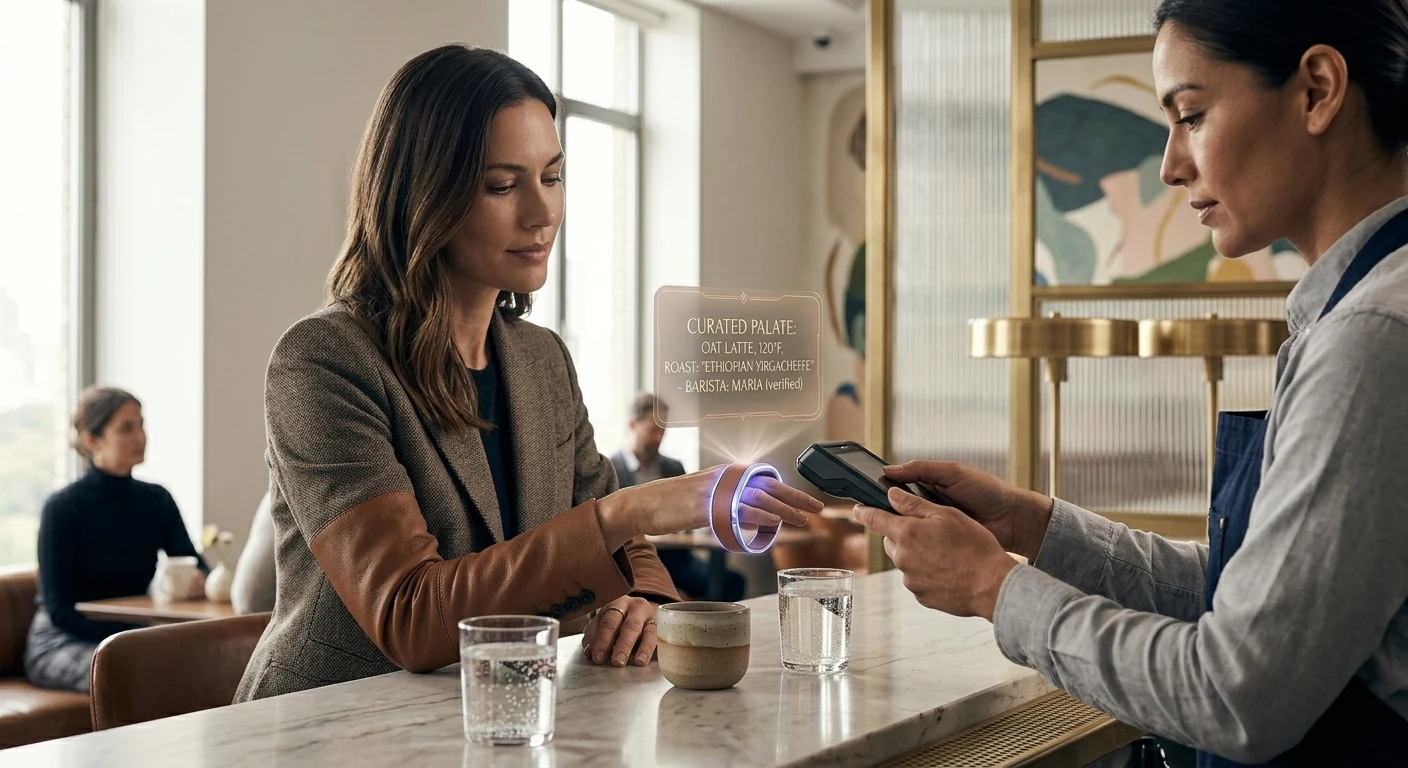
Most people own a Nespresso machine. It is fast. It is consistent. It is convenient. It produces a perfectly fine cup of coffee with zero effort, every time, exactly the way the manufacturer designed. And yet, in kitchens across the country, there is also a French press sitting on the counter. The Nespresso gets used on weekday mornings when the only thing that matters is getting to work on time. The French press gets used on Sunday morning, when the person making the coffee actually wants the experience of making it, smelling it, waiting for it, sharing it.
The Nespresso did not kill the French press. The Nespresso raised the floor of coffee — anyone in any kitchen can now produce a decent cup without skill or time. The French press did not become obsolete. It became the thing you choose when you want more than convenience. When you want texture. When you want ritual. When you want the human thing the machine cannot give you.
This is the structural pattern that nobody is naming clearly enough about what software has done to service professions, and what AI is now accelerating. Software raised the floor of every service industry it touched. It did not touch the ceiling. Zillow did not kill realtors. TurboTax did not kill accountants. Robo-advisors did not kill financial advisors. LegalZoom did not kill lawyers. The platforms made the procedural floor of those services cheap and accessible. The ceiling — the human work, the trust, the network, the curation, the membership into something larger than a transaction — became the only thing left worth paying for. And the practitioners who figured this out are thriving while everyone else complains about the platforms.
The Pattern Is Older Than AI
The temptation in 2026 is to frame everything happening to service professions as an AI story. That framing is too small. The pattern of software raising the floor and forcing the ceiling to evolve has been playing out for at least twenty-five years, and AI is just the latest and fastest example of it. The story matters because the responses that worked for prior waves of disruption are exactly the responses that work for the AI wave too.
Look at what actually happened in each industry.
Zillow and the major real estate platforms made listings, comps, and basic property data free and accessible to anyone with a phone. The procedural work that real estate agents used to gatekeep — finding houses, pulling comps, scheduling viewings — became commoditized. The reaction in the industry was loud and panicked. Realtors were going to be replaced. The platforms were going to disintermediate the agents. The commission model was going to collapse.
None of that happened. What happened instead was that the realtors whose entire value was the gatekept information got squeezed out, and the realtors who had built genuine community relationships, neighborhood expertise, and trusted networks became more valuable than ever. The platforms raised the floor. The ceiling — knowing the neighborhood, knowing the schools, knowing which contractor to call, knowing which neighbors will be at the block party, knowing the mortgage broker who actually closes on time — became the entire offering. The best realtors in any town are not selling houses. They are selling membership in a community network that you happen to enter by buying a house from them.
TurboTax did something similar to the tax profession. Simple returns became free. The procedural floor of preparing a standard W-2 return collapsed in value. The reaction was the same panic. Accountants were going to be replaced. The CPA license was going to lose meaning. None of that happened either. What happened was that the accountants whose business was simple returns got compressed, and the accountants who built actual advisory relationships, tax strategy expertise, business consulting integration, and ongoing trusted-advisor positions became more valuable than ever. The platform raised the floor. The ceiling became advisory, relational, strategic. The CPA who is your trusted advisor for the next thirty years of your financial life is not selling tax returns. They are selling a membership in their judgment.
The robo-advisors did the same thing to financial advisory. Vanguard, Betterment, Wealthfront, and the platform offerings from the major brokerages made basic portfolio construction, rebalancing, and tax-loss harvesting free or near-free. The reaction was identical. Financial advisors were going to be replaced by algorithms. The 1% fee was going to die. None of that happened. The advisors whose entire value was basic portfolio construction got compressed. The advisors who built genuine financial planning relationships, comprehensive life integration, estate and tax coordination, behavioral coaching during market stress, and trusted multi-generational relationships became more valuable than ever. The robo raised the floor. The ceiling — comprehensive judgment about a specific family’s specific situation, integrated across decades — became the entire offering.
LegalZoom did it to legal services. Incorporation, simple wills, trademark filings, basic contracts — all commoditized. The lawyers who depended on those transactions for income compressed. The lawyers who built strategic advisory relationships with businesses, complex estate planning relationships with families, and judgment-heavy practice areas thrived. The platform raised the floor. The ceiling became the trusted advisor relationship that no platform can replicate.
The pattern is the same in every case. The platform commoditizes the procedural floor. The panic predicts the death of the profession. The death does not happen. The practitioners who were already on the floor compress. The practitioners who climb to the ceiling — relationships, networks, judgment, curation, trust, community — thrive at a level they never reached before. The industry survives, often more profitably than before, but the shape of the work and the identity of the practitioners shift dramatically.
What the Ceiling Actually Is
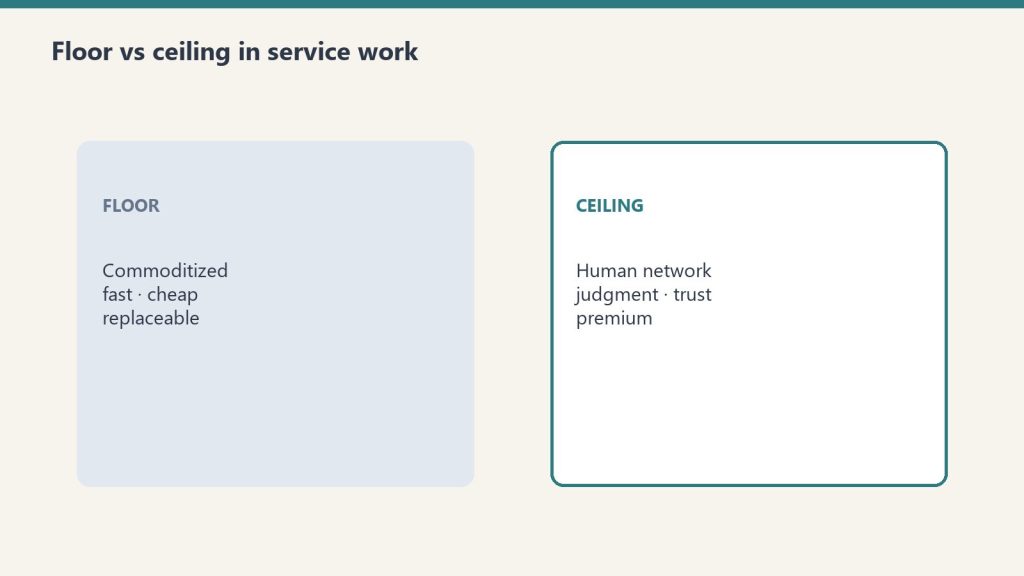
The word “ceiling” can sound abstract. Let us make it concrete. The ceiling of any service profession, in the era of commoditized procedural floor work, is the human network the practitioner builds around the work. The practitioner is not selling the transaction. They are selling membership into something larger.
The realtor who has built a real community network is not selling a house. They are selling a relationship with someone who knows the town. When you buy a house from them, you are getting introduced to the local contractor who will not gouge you on the roof you need replaced in three years. You are getting an invitation to the neighborhood holiday party where you will meet the parents your kids will grow up with. You are getting a referral to the mortgage broker who will close on time even when the appraisal comes in low. You are getting the name of the senior partner at the law firm who handles the messy probate work nobody else wants. You are getting the introduction to the local employer who is hiring exactly the kind of role your spouse needs. You are getting access to a network that took the realtor twenty years to build, and you are paying a commission to enter it.
The accountant who has built a real advisory practice is not selling a tax return. They are selling a thirty-year relationship with someone who knows your financial life, your business, your family, your risks, and your goals. When you have a question about whether to take the offer your business just received, the accountant is the first call. When your parent dies and the estate is complicated, the accountant is the first call. When your kid wants to start a business, the accountant is the first call. The annual tax return is the artifact of the relationship, not the product.
The financial advisor who has built a real planning practice is not selling investment management. They are selling a multi-decade trusted relationship that integrates every financial decision in your life. When the market is down 40 percent and you want to panic-sell, the advisor is the voice that keeps you from doing the wrong thing. When your aging parents need long-term care and the family does not know how to pay for it, the advisor is the person who has thought about that scenario for years and has the network of attorneys and care coordinators to handle it.
The insurance agent who has built a real practice is not selling a policy. They are selling someone who shows up when the house burns down, who knows the adjuster personally, who pushes the claim through when the carrier is dragging its feet, who connects you to the restoration company that will actually be there at three in the morning. The policy is the contract. The relationship is the product.
The pattern is consistent. The ceiling is the network. The ceiling is the trust. The ceiling is the membership. The platform sells the transaction. The practitioner sells membership into a human network that the platform structurally cannot replicate, because the platform is a transaction engine and the network is a lifetime accumulation of relationships, reputation, and judgment.
Why People Will Pay More for the Ceiling Than They Ever Paid for the Floor
The financial economics of the ceiling shift in service professions are widely misunderstood. The default assumption is that when the floor gets commoditized, total industry revenue declines because the average transaction price falls. This is partly true and obscures the more important truth.
The transactions that used to be the entire industry move to the platforms. The customers who only ever wanted the floor service — the cheap tax return, the basic listing search, the simple incorporation — leave the human practitioners and go to the platforms. That is a real loss of volume at the bottom.
But the customers who want the ceiling service — and there are far more of them than the platforms or the industry consultants assume — start paying more, not less, for the human practitioner. They are no longer paying for a tax return. They are paying for a thirty-year advisor. The annual fee for the ceiling relationship is significantly higher than the fee for the floor transaction ever was. The customer perceives the value as much higher, because they are getting something they cannot get anywhere else.
The practitioners who climb to the ceiling end up with smaller client rosters but higher revenue per client and dramatically higher career stability. They are no longer competing with the platforms. They are operating in a category the platforms do not enter. They are also operating in a category that has high client retention, strong referral dynamics, and pricing power that floor practitioners never had.
This is why the realtors who have built genuine community networks routinely outearn the realtors who depend on Zillow leads. It is why the accountants who run advisory practices outearn the ones who run tax-prep mills. It is why the financial advisors with comprehensive planning practices outearn the ones running portfolio management businesses. The economics of the ceiling are better than the economics of the floor ever were, but only for the practitioners who actually build something the platforms cannot replicate.
The Nespresso Effect in Daily Life
Now consider what is happening at the consumer level, beyond just service professions. People are increasingly surrounded by convenient, AI-augmented, software-mediated experiences. Nespresso machines. DoorDash deliveries. Streaming algorithms. Dating apps. Robo-advisors. The platforms have made convenience the default in almost every domain of life.
And yet — across exactly this same period — the cultural pull toward the human and analog version is intensifying, not weakening. Sourdough bread baking became a mass phenomenon. Vinyl records outsell CDs again. Independent bookstores are growing. Farmers markets are mobbed on Saturday mornings. The local coffee shop with the slow pour-over has a line out the door. Concert ticket prices are climbing because people will pay anything to be in a room with other humans experiencing something live. Small-batch everything — beer, whiskey, chocolate, soap — commands premium prices that the mass-produced version cannot touch.
The Nespresso machine is great. People also genuinely want the French press, and the cafe, and the conversation. The convenience layer is necessary infrastructure. The human layer is what people actually crave, especially as the convenience layer expands. The more the platforms commoditize the procedural baseline of everything, the more people search for the human version of whatever it is they used to get from a person.
For service professions, this is the cultural tailwind nobody is naming. The clients who want a thirty-year advisor relationship are not declining in numbers. They are increasing, because everything else in their lives is becoming algorithmically mediated and the desire for one or two genuinely human relationships is rising in response. The realtor who is also the trusted community connector is in more demand, not less. The accountant who knows your family is more valuable, not less. The insurance agent who shows up at midnight is the one people refer to their entire network.
The platforms are creating the demand for the human ceiling at the same time they commoditize the floor. The Nespresso era is the French press era. They coexist. People want both, for different purposes, and they pay differently for each.
What This Means for AI Specifically
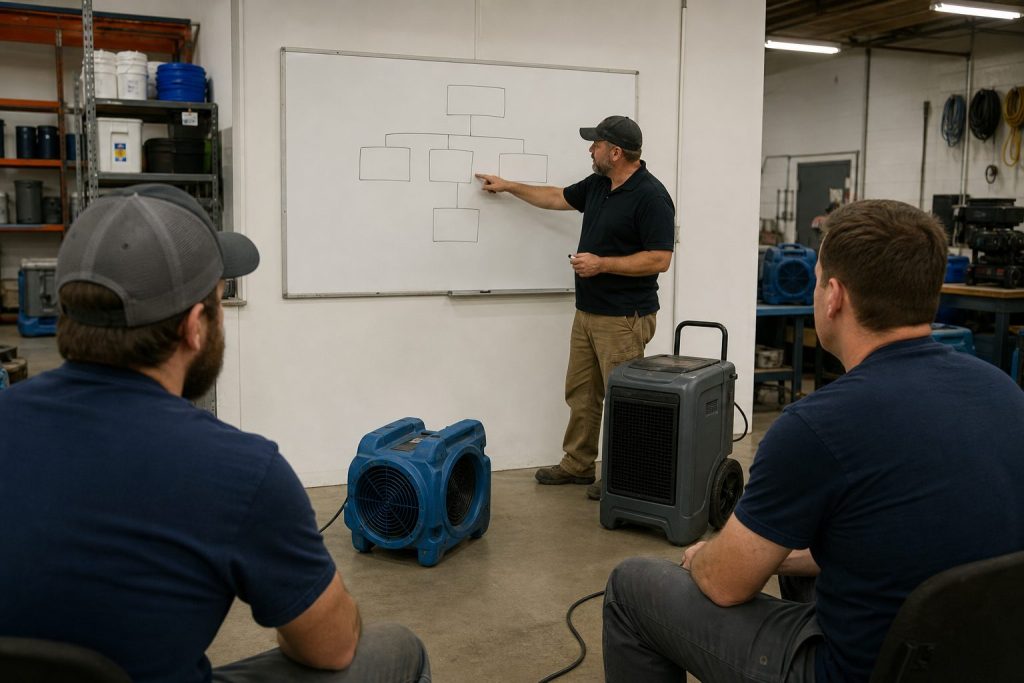
Set aside the multi-decade history of software commoditization for a moment, and look just at AI. The same pattern is now playing out across the service professions that have not yet been hit by their dedicated platform.
AI is the next layer of floor-raising for every service profession. Document drafting, research, basic analysis, routine communication, scheduling, follow-up — AI is absorbing all of it across every field simultaneously. The lawyers, accountants, advisors, agents, and consultants who built their practices on producing those outputs are facing the same compression that Zillow created for realtors and TurboTax created for accountants.
The response is the same. Climb to the ceiling. Use AI to handle the procedural floor of your work. Spend the time you save building the network, the relationships, the trust, the membership offering that no AI can replicate. The practitioners who do this in the next twenty-four months will own their niches for the next twenty years. The ones who keep doing floor work and competing with AI on speed and price will be commoditized, exactly the way the floor realtors and tax-prep mills were commoditized by their respective platforms.
The pattern that already played out across real estate, tax, financial advisory, and legal is now playing out across every remaining service profession simultaneously. AI is the cross-industry platform. The response that worked in the prior waves works in this one too.
How to Build the Ceiling Offering in Any Service Profession
The practical move for any service professional who recognizes this pattern is the same regardless of industry. Build the network. Build the relationships. Build the membership. Make the transaction the artifact of a much larger human offering.
Identify the specific community you serve. Not a target market in the abstract. A specific community of people who share a context — geographic, professional, lifestyle, life stage — that you can become the central connector of. The realtors who win build community networks around specific neighborhoods. The accountants who win build advisory networks around specific business owner segments. The financial advisors who win build planning networks around specific life-stage cohorts. The narrower and more specific, the more powerful the network becomes, because the practitioner can know everyone in it personally.
Become the connector. The practitioner’s job is to connect the people in their network to each other and to the resources they need. The realtor introduces the new buyer to the contractor, the mortgage broker, the school principal, the neighborhood association. The accountant introduces the business owner to the attorney, the banker, the consultant, the bookkeeper. The financial advisor introduces the family to the estate attorney, the elder care coordinator, the insurance specialist. The connecting is the value. The transaction is just the entry point.
Curate ruthlessly. The network is only as valuable as the trust the practitioner has built into it. Connect people to providers you genuinely trust. Refuse to connect them to providers who would damage the trust. Treat your referral list as a curated product, because that is what it is. The practitioners who refer indiscriminately destroy the trust that gives the network its value.
Use AI for the floor work, religiously. Automate the documents, the routine communication, the scheduling, the basic research. Free up the hours that used to go to procedural work. Reinvest those hours in the relationships that build the network. The judgment and the trust are the only defensible assets left. Build them.
Price for membership, not transactions. The pricing model that fits the ceiling offering is closer to a retainer, an annual relationship fee, or a long-term advisory engagement than a per-transaction commission. Some industries cannot fully escape transactional pricing structures, but every service profession has room to shift the revenue model toward something that reflects the actual value being delivered, which is the ongoing membership rather than the one-time service.
The Specific Industries This Applies To Right Now

This pattern is in active play across multiple service professions right now. For each, the platform that raised the floor and the human ceiling that practitioners can build to.
Real estate. Zillow, Redfin, Realtor.com raised the floor. The ceiling is the community network — neighborhood expertise, trusted referrals, ongoing community membership built around home purchase.
Insurance brokerage. Lemonade, Geico’s app, the captive carrier software raised the floor. The ceiling is the at-claim concierge relationship — the agent who shows up when the loss happens, knows the adjuster, knows the restoration company, and pushes the claim through.
Financial advisory. Vanguard, Betterment, Wealthfront, Schwab’s robo-advisor raised the floor. The ceiling is comprehensive multi-decade life planning — integrated tax, estate, family dynamics, business transitions, behavioral coaching through market stress.
Tax preparation and accounting. TurboTax, H&R Block’s software, QuickBooks raised the floor. The ceiling is the trusted-advisor relationship — strategic tax planning, business consulting, multi-decade financial intimacy with a specific family or business.
Legal services. LegalZoom, Rocket Lawyer raised the floor on standard incorporations, wills, and contracts. The ceiling is the trusted attorney relationship — strategic counsel on the difficult cases, the messy estates, the complex business transactions, the litigation that requires judgment beyond any document automation.
Primary care medicine. Telehealth apps, One Medical, Forward, retail clinic chains raised the floor on routine episodic care. The ceiling is the continuous trusted physician relationship — knowing the patient over decades, integrating mental health and physical health, navigating complex family medical dynamics, advocating through the specialist system.
Mortgage brokerage. Rocket Mortgage, Better.com raised the floor on standard refinances and conforming purchases. The ceiling is the broker who handles the complex situations the platforms cannot — self-employed buyers, jumbo loans, unusual property types, time-pressured closings where human judgment and lender relationships matter.
Travel agency. Expedia, Booking, Kayak raised the floor on standard bookings. The ceiling is the travel curator who knows you, builds bespoke trips, has lifelong relationships with operators in destination markets, and shows up when the trip falls apart. Most consumer travel went to the platforms. The high end of travel curation is doing better than ever.
Photography. Smartphones and AI image tools raised the floor on standard photos. The ceiling is the photographer with vision, relationships with specific subjects, presence in moments that matter, and the kind of curated visual storytelling that no automated tool produces.
The pattern repeats across virtually every service profession that depends on a mix of procedural and relational work. The procedural part goes to the platform or the AI. The relational part becomes the entire offering. The practitioners who build the relational offering deliberately and durably end up in a better economic position than they ever held in the era before commoditization.
Frequently Asked Questions
Why did Zillow not kill real estate agents?
Zillow commoditized the procedural floor of real estate — listings, comps, scheduling — but did not touch the ceiling, which is the community network, the neighborhood expertise, and the trusted referral relationships that good agents build over years. The agents whose entire value was the gatekept information got squeezed out. The agents who built genuine community networks thrived because Zillow could not replicate their human ceiling.
What is the floor and ceiling framework for service professions?
Every service profession has a floor of procedural, transactional, documentable work that platforms and AI are commoditizing, and a ceiling of relational, judgment-based, network-driven work that platforms structurally cannot replicate. The practitioners who survive commoditization deliberately shift their time, energy, and offerings toward the ceiling and let the platforms have the floor.
What does it mean to sell membership instead of transactions?
Selling membership means structuring the offering so that the client is not paying for a single service event but for ongoing access to the practitioner’s network, judgment, and curation. The realtor who introduces the new buyer to contractors, neighbors, mortgage brokers, and employers is selling membership in a community network, not a house transaction. The same pattern applies across every service profession.
Will AI replace lawyers, accountants, financial advisors, and other professionals?
No. AI will replace the procedural floor of those professions — document drafting, basic analysis, routine research, standard preparation — but cannot replace the trusted-advisor relationship, the judgment on complex situations, and the network that defines the senior practitioners in those fields. The pattern is identical to what software platforms have done to these industries over the prior twenty-five years.
What is the Nespresso vs French press metaphor for service work?
The Nespresso represents the convenient, automated, platform-delivered version of any service — fast, consistent, low-effort, low-price. The French press represents the human, slower, ritual-driven, higher-touch version. Both coexist. The Nespresso did not kill the French press. The platforms did not kill the human service practitioner. The practitioner who deliberately becomes the French press — the human ritual nobody can get from the platform — captures the part of demand that the platforms cannot serve.
How does a service professional start building the ceiling offering?
Identify a specific community to serve. Become the connector of that community. Curate referrals ruthlessly. Use AI for floor work. Price for ongoing relationship rather than one-time transaction. The transition usually takes two to three years to fully build, but practitioners who start now will own their niches for the next twenty years while floor-focused competitors get progressively commoditized.
The Bottom Line
Software raised the floor of every service profession it touched. Zillow, TurboTax, the robo-advisors, LegalZoom — each one commoditized the procedural baseline of an industry and triggered panic about the death of the profession. None of those deaths happened. The professions evolved. The practitioners who depended entirely on procedural work compressed. The practitioners who built networks, relationships, trust, and curation became more valuable than ever. The floor went to the platform. The ceiling became the entire game.
AI is the next platform layer, hitting every service profession simultaneously. The response that worked in real estate, tax, financial advisory, and legal works for the AI wave too. Climb to the ceiling. Build the network. Sell membership instead of transactions. Become the human ritual that no machine can replicate — the French press in the era of Nespresso.
People will always want both. The convenience layer is necessary infrastructure. The human layer is what they actually crave, particularly as the convenience layer expands. The service professionals who deliberately build the human ceiling in the next two to three years will dominate their niches for the next twenty. The ones who try to compete with the platforms on speed and price will be commoditized along with the platforms themselves. The choice is being made right now in every service profession. Make it deliberately.
The Tacit Knowledge Cluster — Further Reading
This piece is part of a larger body of writing on what the AI shift and the broader software-platform shift actually mean for service professions and the workers in them. The full cluster:
The Core Thesis
- AI Raises the Floor, Not the Ceiling — the macro thesis for industrial trades.
- Software Raised the Floor, Not the Ceiling — the broader pattern across service professions, with the Nespresso/French press metaphor.
- Tacit Knowledge Is the Last Moat — the philosophical frame.
- The Gray Tsunami — the retirement wave story.
For Your Career
Service Profession Playbooks
- Zillow Did Not Kill Realtors — the community network business for real estate.
- The Insurance Agent’s Future — the claim concierge model.
- The Financial Advisor’s Future — comprehensive life planning after the robos.
- The Accountant’s Future — the trusted advisor practice after TurboTax.
Industry-Specific Trade Answers
- Will AI Replace HVAC Technicians?
- Will AI Replace Electricians?
- Will AI Replace Plumbers?
- Will AI Replace Nurses?
Direct Letters to Each Audience
- This Is Your Moment — to veteran operators.
- Go Find the Veterans Now — to younger operators.
- The Asset Sitting in Their Head — to owners and acquirers.
- The Apprenticeship Is the Curriculum — to trainers and educators.
- Your Partner Is Sitting on the Most Valuable Asset — to families.
- Come Back — to retired operators.
For Practitioners
- How to Run a Human Distillery Interview — the field manual.
Leave a Reply