
Running five live cloud Vision-Language-Action (VLA) robot policies inside a 30 Hz MuJoCo sterile-tray simulation and scoring 216 leak-stripped FDA 510(k) filings showed why autonomous hardware needs two independent cages: a 240 Hz workspace safety shield cut sterile breaches from 8 of 150 steps to 0, while a multi-model predicate gate caught De Novo regulatory divergence.
Live Cloud VLA Physics & Sterile-Field Containment Matrix
| Cloud VLA Policy | Ready & p50 Latency | MuJoCo Physical Behavior | Containment & Operational Finding |
|---|---|---|---|
| allenai/molmoact2 | 389.3–448.0 ms p50 | Pushed red cup 24.05 cm; 0/180 sterile breaches across 6 sterile runs | Stable 0.0 pct sterile breach rate, yet pushed target without closing gripper; metered under four-tenths of one cent for 10 chunks. |
| physical-intelligence/pi0.5 | 213.6 ms warm p50; >90s sterile wait | Approached cup to 12.77 cm (0.02 cm drift); HTTP 503 during sterile wait | Fastest warm denoise (44.0 ms), but sterile engine stayed in startup weights phase past 90s. |
| microsoft/rho (Shield OFF) | 257.6 ms p50 (~4 min cold) | 8/150 sterile tray breaches (5.33 pct); 593.37 N peak force; 1.221 m/s speed | Native unnormalized gripper units (2.14–3.07) and fast transients clipped the cyan sterile field. |
| microsoft/rho (Shield ON) | 245.6–246.0 ms p50 | 0/150 sterile breaches; 0.417 m/s cap; adversarial peakF 285.99 to 0.0 N | 120–153 slew clamps and 80 force retracts stopped zone entry; own-frame offset still struck vial (504.79 N). |
| xiaomi-robotics-1 & flux-3-action | 59.8s / 82.2s cold; 386.6 / 1,945 ms p50 | Decoded arx_x5 (dt=0.04s) and franka_droid [32,8] trajectories over HTTP/3 | Validated cross-embodiment wire contracts; flux chunk-0 warmup took 91.7s before 1.54s steady state. |
| perceptron/isaac-0.5 | 220.4s HTTP 503 timeout | Stuck in container-placement engine_starting despite public Ready status | Proved live SDK startup probing beats trusting public status pages before queueing jobs. |
Why We Wired Cloud Robot Models Into an FDA Wind-Tunnel
Earlier this week we published two separate pieces from opposite corners of our workbench: one showing what happened when we pointed our search autopsy math at 3,000 FDA device filings, and another explaining why mold spores do not pick locks when software agents operate without structural containment. Between those two runs, Abstract launched public inference across hosted Vision-Language-Action (VLA) checkpoints and open-weight reasoning models, giving us a live laboratory to test what happens when software autonomy crosses into simulated hardware and federal device compliance.
When an uncontained text agent drifts, it mangles a draft, overwrites a file, or publishes an unverified claim. When an uncontained robot policy drifts inside a hospital clean bay, joint spikes shear through a sterile tray before a cloud round-trip finishes. And even after you add a deterministic physics boundary that holds every breach to zero, shipping autonomous robotics into clinical work hits a second gate: substantial equivalence under 21 CFR 876.1500 and predicate scrutiny across historical FDA clearance records.
Act I: Four Failures Real MuJoCo Physics Caught Immediately
Instead of grading promotional demo reels, we connected a bimanual articulated arm inside MuJoCo physics (initialized to 0.33 mm inverse-kinematics error) directly to live inference routes documented in the Abstract API documentation, testing action models built on lines of research like pi0.5 and MolmoAct across ten closed-loop tabletop chunks followed by a sterile surgical pass-through scenario. Four practical gaps broke surface right away.
1. Public installer paths and Ready badges do not equal warm GPUs. The documented quickstart installer URL returned HTTP 404 on launch day, forcing direct environment installation, and perceptron/isaac-0.5 hung in container startup past 220.4 seconds (HTTP 503 engine_starting) while the catalog still displayed a green status indicator. Similarly, physical-intelligence/pi0.5 delivered a crisp 213.6 ms warm median on the tabletop bench (with 44.0 ms denoise and zero cup movement at 12.77 cm approach) before exceeding our 90-second wait window during weight loading on the hospital suite.
2. Native action semantics are not portable across checkpoints. Running live rollouts proved that allenai/molmoact2 and pi0.5 output normalized [0, 1] grippers, whereas microsoft/rho transmits unnormalized native gripper values between 2.14 and 3.07. Cross-embodiment wire verification over HTTP/3 confirmed xiaomi/xiaomi-robotics-1 runs 25 Hz arx_x5 steps at 386.6 ms steady-state p50 after a 59.82-second cold start, while black-forest-labs/flux-3-action delivers [32, 8] franka_droid joint chunks after an initial 91.7-second warmup settled down toward 1.54 to 1.95 seconds.
Get The Signal
What we actually ran, what it measured, and what it means for a restoration shop — every week, including the flops.
3. Single-frame VLMs mistake horizontal sliding for a vertical grasp lift. Across ten tabletop chunks metered under four-tenths of one cent, allenai/molmoact2 (399.1 ms p50, 232.6 ms server) tracked the red cup, closed to 9.37 cm, and pushed it 24.05 cm across the table without closing its left gripper (min_grip_left = 0.625, cup vertical delta 0.0 cm). When we sent rendered tabletop frames to deepseek-v4.1-flash for visual grading, it misread the perspective shift across the wood surface and falsely reported an overhead lift—showing why grading physical manipulation without 3D simulator kinematics creates silent false positives.
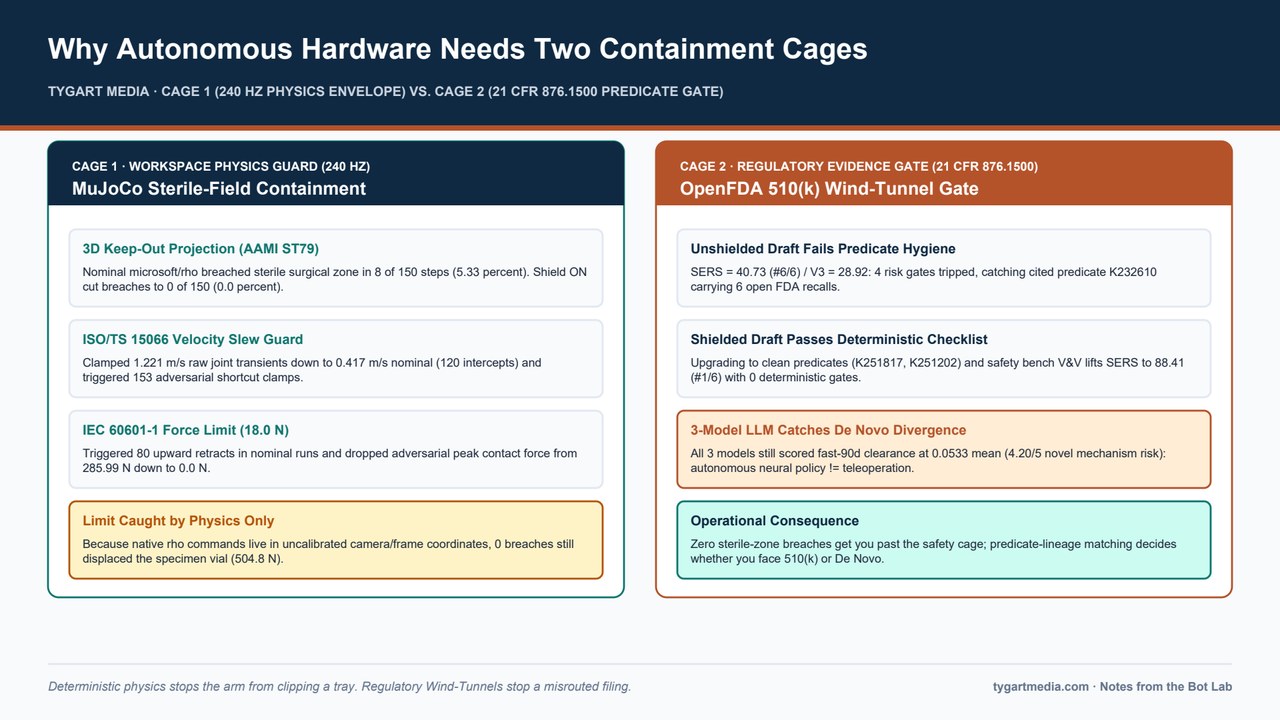
4. A 240 Hz sterile shield cuts breaches to zero, yet cannot fix frame offsets alone. Modeling an AAMI ST79 surgical instrument tray between a specimen vial and a disposal bin, unwrapped microsoft/rho crossed into the sterile zone on 8 of 150 steps (5.33 percent) with 593.37 N peak force and 1.221 m/s velocity. Wrapping the arm inside our deterministic 240 Hz SterileContainmentShield (3D keep-out projection, ISO/TS 15066 velocity clamping, and 18.0 N force retraction) dropped sterile breaches to 0 of 150 (0.0 percent), capped nominal peak speed at 0.417 m/s via 120 slew clamps and 80 retracts, and cut adversarial shortcut force from 285.99 N down to 0.0 N. Crucially, native frame offsets in rho still knocked the specimen vial at 504.79 N outside the keep-out tray, proving safety geometry and extrinsic calibration solve different halves of the problem.
Act II: Wave v3 OpenFDA 510(k) Wind-Tunnel & the Predicate Trap
Passing Cage 1 clears the bench; passing Cage 2 determines whether a device clears FDA review on a 90-day 510(k) track or stalls. We adapted our deterministic OpenFDA 510(k) predicate graph engine into a Wave v3 hybrid pipeline by stripping all post-hoc decision phrasing from 216 Day-0 21 CFR 807.92 summaries (108 matched fast-vs-slow pairs), scoring structural rubric fields across three live open LLMs over Abstract, and evaluating two pre-submission surgical-robot candidates under product code NAY.
| Wind-Tunnel Stage / Gate | Corpus & Split | LR / RF / LGBM ROC-AUC | Verified Outcome & Failure Trap |
|---|---|---|---|
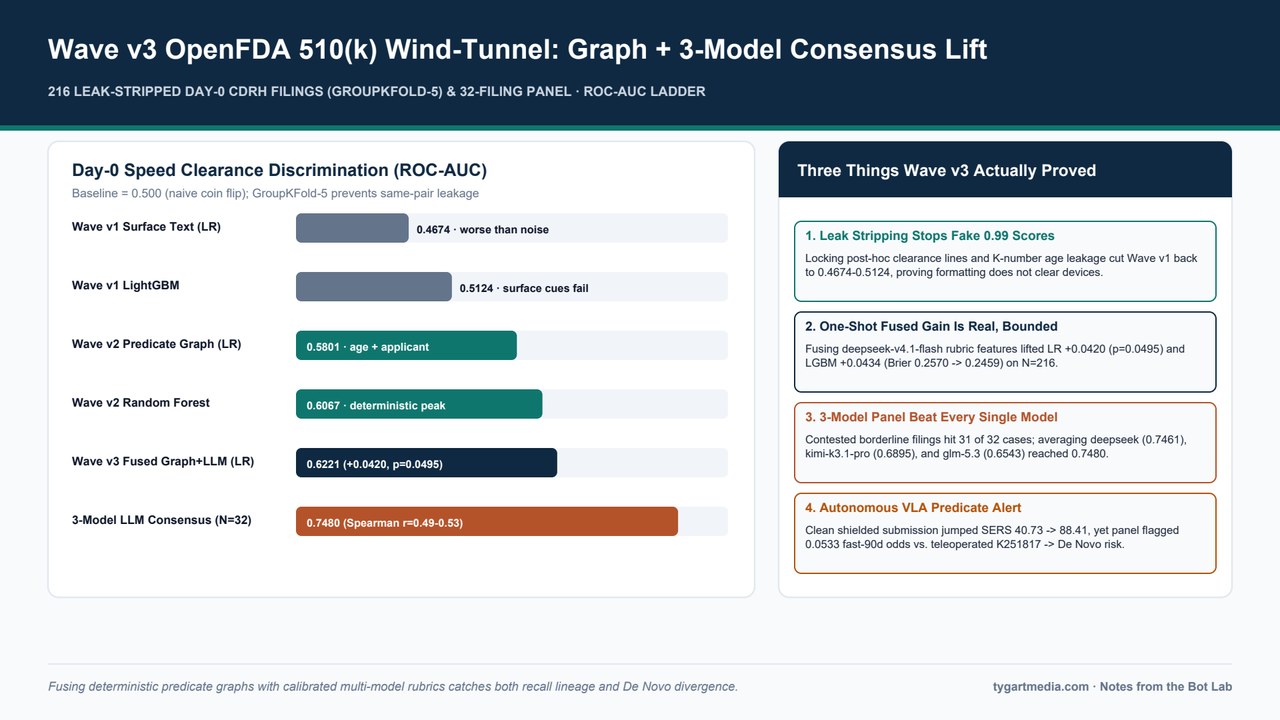
| Wave v1: Surface Text Only | N=216 GroupKFold-5 (108 pairs) | 0.4674 / 0.4971 / 0.5124 | Stripping post-hoc decision text leaves surface word length and bullet counts near coin flip. |
| Wave v2: Predicate Graph | N=216 GroupKFold-5 (108 pairs) | 0.5801 / 0.6067 / 0.5709 | Predicate age, self-predicate reuse, U.S. applicant status, and safety blocks carry deterministic lift. |
| Wave v3: Fused Graph + DeepSeek | N=216 paired bootstrap | 0.6221 / 0.6165 / 0.6144 | +0.0420 LR gain (p=0.0495) and +0.0434 LGBM gain; Brier improves from 0.2570 to 0.2459. |
| 3-Model LLM Consensus Panel | N=32 (16 pairs, 3 open models) | 0.7480 Ensemble Mean | Beats deepseek-v4.1-flash (0.7461), kimi-k3.1-pro (0.6895), and glm-5.3 (0.6543); Spearman r=0.49–0.53. |
| NAY Pre-Sub (Unshielded vs. Shielded) | 21 CFR 876.1500 Candidate Gate | SERS 40.73 vs. 88.41 (#1/6) | Deterministic screen caught K232610 (6 open recalls); shielded draft flagged De Novo divergence vs. K251817 (0.0533). |
Once post-submission dates and boilerplate clearance phrasing are scrubbed cleanly before inference, Wave v1 surface prose drops straight back to chance (0.4674 logistic regression, 0.5124 LightGBM). That mirrors what we observe across commercial web visibility every week: polished wording alone cannot carry a brand that is absent from trusted peer citations or structurally broken at the crawl layer like a locked front door. Deterministic predicate structure (predicate age, self-predicate reuse, domestic manufacturing signals, and completed safety sections) provides the primary lift to 0.6067 RF, and fusing one-shot deepseek-v4.1-flash equivalence scoring adds a statistically grounded +0.0420 logistic AUC gain (0.6221, one-sided p = 0.0495) alongside cleaner Brier calibration (0.2570 down to 0.2459).
Where the multi-model panel paid for itself was in contested borderline filings (31 of 32 sampled cases) and on our final NAY candidate stress test. On the unshielded candidate draft, deterministic screening tripped four risk gates immediately and caught that its cited predicate K232610 carried six open FDA recalls (holding readiness at 40.73, rank #6 of 6). Swapping in clean predicate K251817 (da Vinci SP), adding a formal comparison table, and documenting our 240 Hz safety cage cleared every deterministic check and boosted readiness to 88.41 (rank #1 of 6)—yet all three reviewers (deepseek-v4.1-flash, kimi-k3.1-pro, glm-5.3, 0.7480 ensemble AUC) still converged on just 0.0533 fast-90-day clearance odds because citing a teleoperated endoscope to justify an autonomous neural policy triggers technological-divergence scrutiny toward De Novo classification under 21 CFR Part 860 Subpart D and the FDA AI-enabled device framework.
Five Guardrails Before Deploying Embodied Policies or Regulated Drafts
Whether you run an engineering lab building physical AI or an operations team wiring models into public authority systems (or reviewing our published implementation scopes), Round 1 left us with five concrete rules built from broken assumptions rather than theory:
1. Test live GPU readiness rather than reading status pages. Always build bounded SDK probes that fail cleanly on HTTP 503 startup waits before launching physics loops. 2. Normalize action contracts and wrap every checkpoint in a 240 Hz shield. Keep workspace keep-out planes, ISO/TS 15066 speed clamps, and force retracts deterministic outside neural inference. 3. Grade manipulation using 3D simulator coordinates, never single-frame VLM guesses. Vision-only evaluators confuse tabletop sliding with Z-axis grasping. 4. Run deterministic recall screening across every cited FDA predicate. Bad predicate hygiene surfaces long before qualitative review begins. 5. Pair clean 510(k) checklists with multi-model mechanism checks. Passing a structural table check does not erase technological divergence when autonomy meets a manual or teleoperated predicate.
- Room 1 (Drywall): Mold Spores Don't Pick Locks: Negative-Air AI Containment
- Room 2 (Steel): Put the Robot in the Ceiling, Put the Lock in the Steel
- Room 3 (Kinematics & FDA) — Why a Robot Arm Needs Two Cages: Live VLA & Predicate Gates (Current Essay)
- Room 4 (The Inbox): Bot Tinder, Inbox Easter Eggs, and the Pass-Through Window
- Live Protocol Spec (HANDSHAKE v0.1): Agent Handshake Protocol Specification (Markdown twin)
Frequently Asked Questions
Why does a cloud Vision-Language-Action robot policy need both a physics shield and a predicate gate?
A 240 Hz workspace containment shield enforces hard keep-out geometry, velocity clamps, and force limits over noisy joint targets at execution time, while a pre-submission regulatory gate verifies that cited FDA predicates carry clean recall histories and matching technological mechanisms before filing.
How much did the 240 Hz sterile containment shield reduce surgical tray violations in MuJoCo testing?
Against raw microsoft/rho outputs in nominal hospital pass-through simulation, the deterministic shield cut sterile surgical tray breaches from 8 of 150 physics steps (5.33 percent) down to 0 of 150 steps (0.0 percent) and clamped peak speed from 1.221 meters per second down to 0.417 meters per second.
Why did a clean FDA 510(k) candidate citing da Vinci SP still trigger a De Novo warning from all three LLMs?
Even with zero deterministic recall gates (SERS 88.41), citing a teleoperated endoscope system (K251817) as the predicate for an autonomous neural policy raises different technological questions of safety and effectiveness under 21 CFR 860 Subpart D, keeping consensus fast-90-day clearance odds at 0.0533.
Get The Signal
What we actually ran, what it measured, and what it means for a restoration shop — every week, including the flops.
Leave a Reply