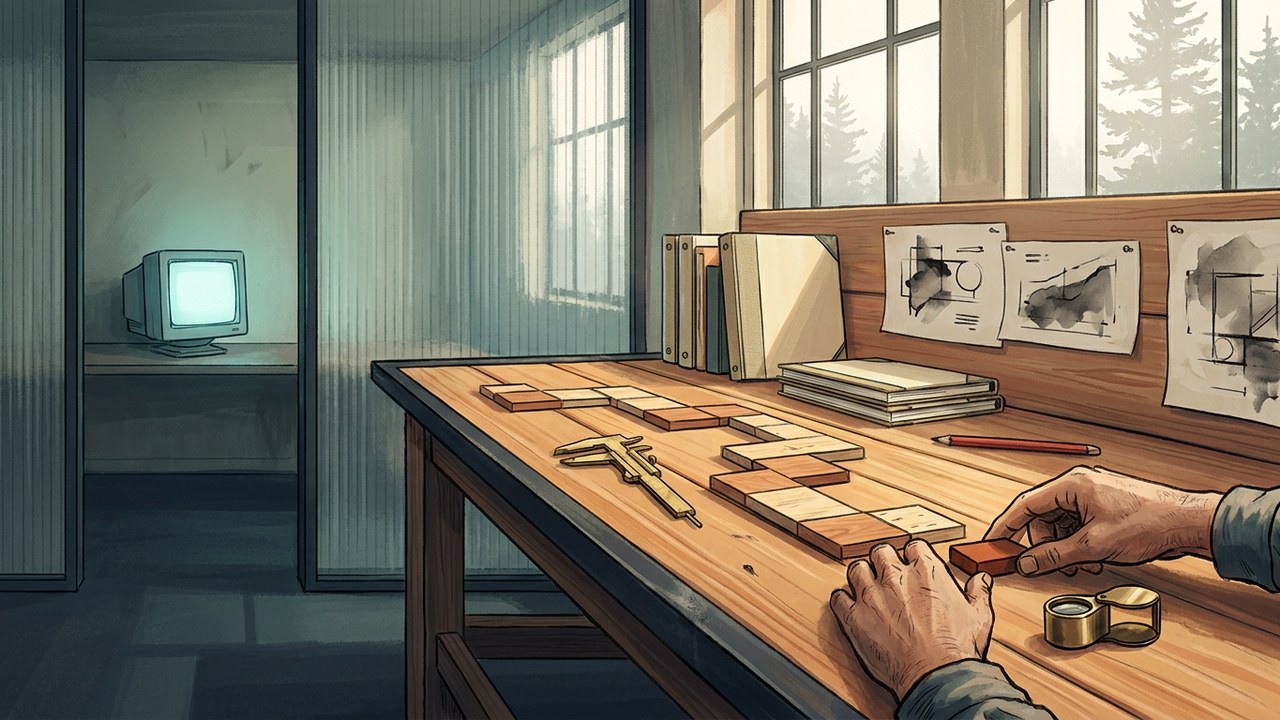
Put the honest label on that opening line first: 45 days is Will’s call, not a sourced forecast. It is an operator’s wager with a date tacked to the shop wall — enjoy the bravado, watch the calendar if you like, and never mistake a sharp hunch for a research paper.
What is already sitting on the workbench is the turn underneath it. Vibe coding taught people who never wrote production software how to prompt working tools into existence. The next turn is quieter and bigger: builders realizing that prompting one-off prototypes is only warm-up. Prompting games that train a workforce to do hard operational work is where real leverage lives.
This is exhaust, not stage theory. Our lab has been running a version of this game in public for weeks — short steps, locked fences, independent live verification, and post-rep debriefs that trained a player from following instructions to catching its own designer’s math errors in 9 days.
Think Severance Before It Was a Job
In Apple TV’s *Severance*, severed workers inside Lumon Industries’ Macrodata Refinement department sit at terminals sorting clusters of numbers by feel. Quotas, progress bars, little prizes, and office rituals wrap the shift in the surface furniture of a game — while leaving the players with zero idea what the numbers mean.
That is what Think Severance before it was a job catches. Gamified operational work is arriving as real labor — not as sci-fi dystopia, but because hard knowledge work breaks for one boring reason: it usually arrives as a fog. Tell a new hire or an AI agent to “audit this market” in one loose sentence and you get drift and guesses. Slice that same work into short distances with locked definitions, clear finish lines, and immediate feedback, and people move through hard problems with rhythm instead of dread.
The catch — and the exact seam where the Severance parallel has to break — is whether the player gets to see the board. We will test that seam hard, because getting it backward does not train a workforce. It builds a prettier severed floor.
Get The Signal
What we actually ran, what it measured, and what it means for a restoration shop — every week, including the flops.
How the Game Runs on Our Workbench
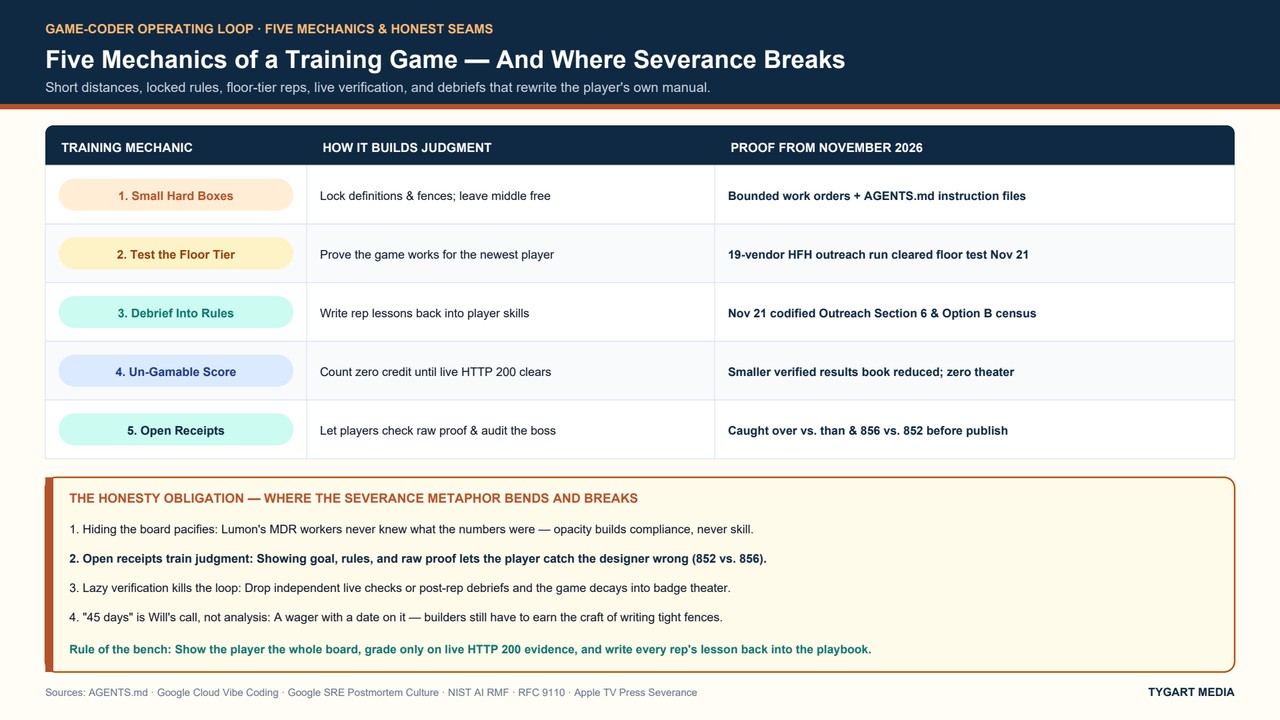
Every job enters our desk as a small hard box: definitions and guardrails locked on the outside, wide room to think inside. Standing instruction files — the same open pattern behind AGENTS.md — carry the rules across shifts so nobody re-invents what counts as proof.
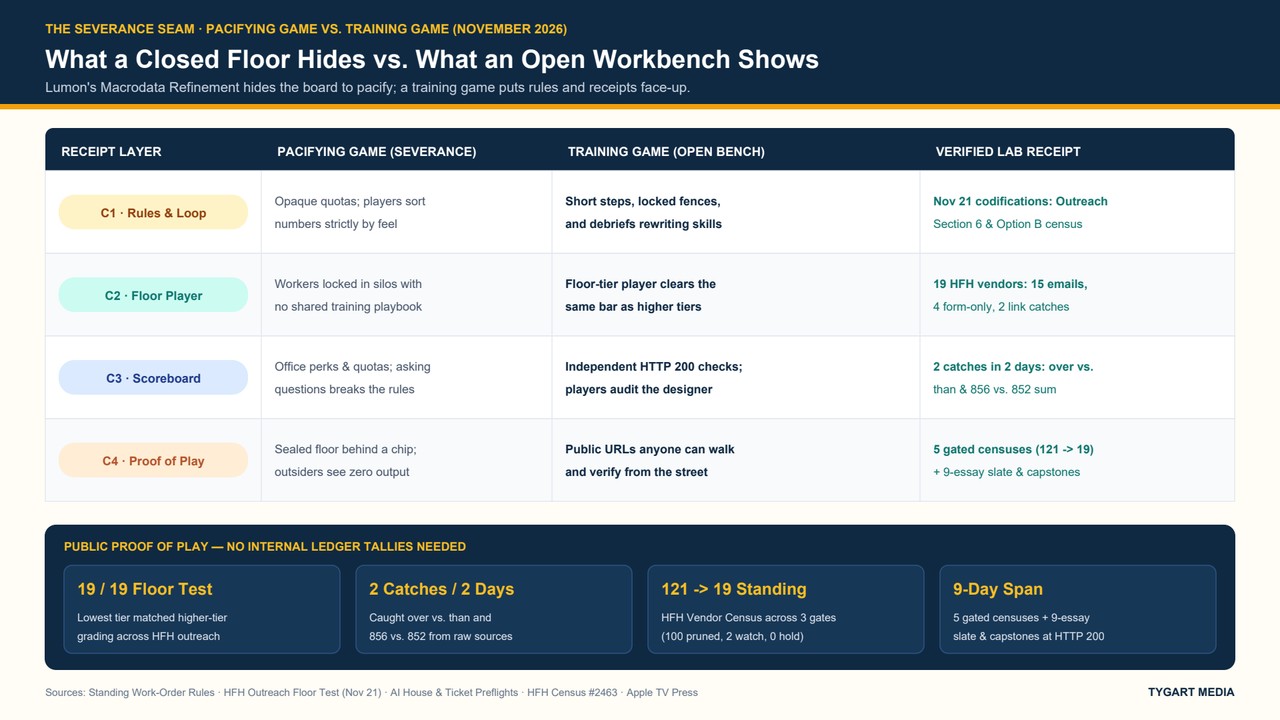
Players also level through tiers rather than throwing top-shelf capacity at every step — the same workbench habit from Don’t Hire a Finish Carpenter to Carry Drywall. To test whether the game design carried the weight or only leaned on the top tier, we ran a deliberate floor test on November 21, 2026, handing live contact research for all 19 standing companies in our healthcare vendor census to the lowest floor tier.
The rules allowed zero guessed emails and required live source proof for every route. Graded address-by-address against real company sites, that floor-tier run matched the higher-tier bar: 15 published email routes (3 press or media desks, 2 named communications contacts, 10 general inboxes), 4 honest form-only firms, 2 display-versus-link mismatches caught verbatim, 1 parent-company compliance redirect isolated, and 5 bot-blocked sites verified via official search-indexed pages. A game that only works for veterans flatters experts. When a floor player clears the same gate, the game is training the roster.
Every rep ends with a higher-tier debrief that writes lessons straight back into the player’s own skills and instructions — the working cousin of Google SRE’s postmortem culture and continuous evaluation in the NIST AI Risk Management Framework. On November 21, 2026, two debriefs locked Section 6 of our outreach playbook (page-context tiering, link-mismatch parsing, parent-routing flags) and our Option B consolidated-market census rule (visible parent-ownership badges on corporate units alongside independents) directly into the manual. Tomorrow’s floor player starts with today’s instincts loaded.
A Scoreboard Nobody Can Charm
Workplace gamification usually turns into hollow badges because players grade their own homework. On our workbench, nothing books when a rep wraps. Credit counts only after independent verification checks live sites and APIs — real HTTP 200 responses, WordPress REST state, and auditable trails like those in The Flight Recorder on the Workbench. When the verified result comes back smaller than scoped, the booked credit shrinks to match what actually cleared. You cannot charm a live status check.
That rule produces a surprise: showing the player the receipts trains the player to audit the designer. Twice in 2 days, the executor caught the work order’s own mistakes before anything published. On our AI House profile, reading the primary LinkedIn screenshot caught a 1-word transcription slip in the order — “over”, not “than” — so the live quote stayed verbatim. Hours later, during preflight on Pay for Your Own Ticket, summing the raw session log caught an arithmetic error in the order header: 856 engaged human sessions, not 852.
An obedience script prints “than” and 852 because the boss typed them. A player inside an honest game checks the receipts, stops the clock, and fixes the board.
Public Artifacts Are the Proof of Play
Private tallies are easy to polish and worthless as proof. The evidence sits on public URLs anyone can walk from the sidewalk — the outside-in test from Pay for Your Own Ticket and the open-door habit from The Second Brain Has a Front Door.
5 company censuses are gated and published live across our sites, including our Catastrophe Modeling Vendor Census built under the codified Option B rule. The cleanest single specimen is the Facility Compliance, ICRA Containment & HTM Vendor Census on Healthcare Facility Hub: 121 qualifying vendors run through three locked gates — Independent, Operating, In-Population — and distilled to 19 standing profiles (100 pruned, 2 on watch, 0 left unresolved). Beside those censuses sits a 9-essay exhaust slate plus its capstones on Tygart Media, all live and linkable.
Where the Severance Metaphor Bends — And Breaks
Here is the piece’s honesty obligation: Severance captures the form of gamified work and gets the soul completely backward.
A game that hides the board pacifies; a game that trains shows the receipts. Lumon’s Macrodata Refinement team never knew what their numbers did or who they served. Opacity breeds compliance, never judgment. A training game inverts Lumon completely: put the goal, the locked rules, and the live receipts face-up on the bench, and reward the player who proves the designer wrong on 852 versus 856. Strip away the open board and game design slides straight back into a sedative.
A second seam sits right beside it: the game is only as honest as the verifier holding the fence. Rubber-stamp the live check, or stop feeding post-rep debriefs back into the playbook, and the loop rots into badge theater. And 45 days remains Will’s call on the wall until builders prove they have as much appetite for writing tight rules as prompting fast demos.
Turn Hard Stuff Into Games
Good game design does not make hard work easy. Cutting 121 vendors to 19, checking 19 contact surfaces without guessing one inbox, and catching 1 wrong word before publish stay careful, unglamorous craft. What the game strips away is the fog — vague assignments, invisible scores, and lessons lost in chat history.
Keep the distances short, lock the fences, let the floor tier play, refuse to book a point until live evidence confirms it, and let the player correct the designer whenever the receipts disagree. Do that, and you are not pacifying a severed floor. You are training a workforce — and Will’s 45-day clock is already running.
Will Tygart runs Tygart Media from Tacoma, Washington. Every count, census gate, and receipt catch above traces directly to live published pages and verified work-order logs from November 2026.
Get The Signal
What we actually ran, what it measured, and what it means for a restoration shop — every week, including the flops.
Leave a Reply