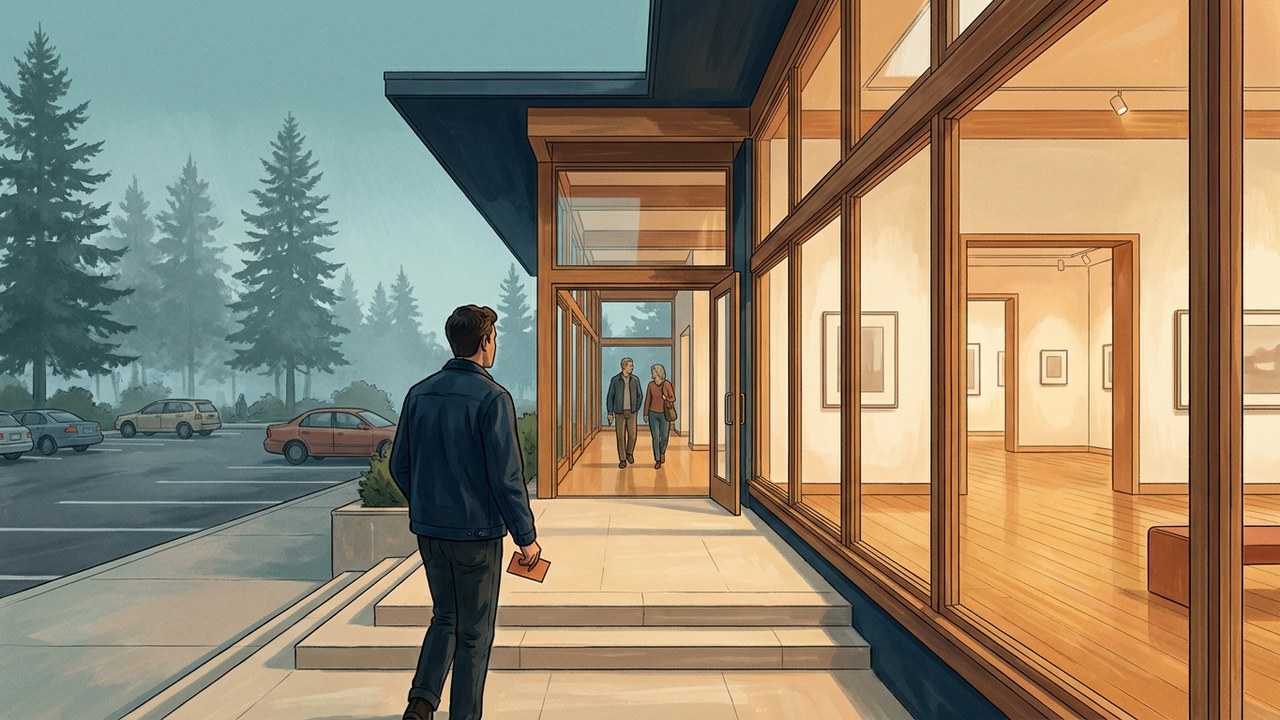
Most people run their websites from the loading dock. They spend the week inside an admin back room, staring at database rows, preview links, and private dashboards that no reader, crawler, or citing AI agent will ever meet. From the back hallway, every room looks connected because you remember which folder you dropped it in. Walk out to the sidewalk and the building tells a different story.
Working our sites strictly from the outside — public URLs and the WordPress REST API, honoring the uniform public interface Roy Fielding formalized for REST and the plain contract of HTTP semantics — is part of why the work stays honest. There is no privileged backstage view. What returns HTTP 200 from the street is the truth. Picture the site as a museum. From the sidewalk you check the entryway and the doors: can people get in, and do they understand what sits behind the wall? Inside, the work is curation: watch where visitors move piece to piece, see where friction sends them back to the curb for want of a second or third exhibit, then add, move, and connect rooms accordingly. The owner parks where everyone parks, comes through the same door, and pays for his own ticket.
Two earlier pieces on this desk laid the threshold: Standing in the Middle forced bottom-up server truth to agree with top-down maps, and The Audience That Never Says Thanks measured how machines read our shelves without leaving a referrer behind. Until this week, the museum frame was still something I said aloud on a call. As of this morning, November 21, 2026, it has receipts and two live rooms attached.
Half the Rooms Had No Hallway Leading In
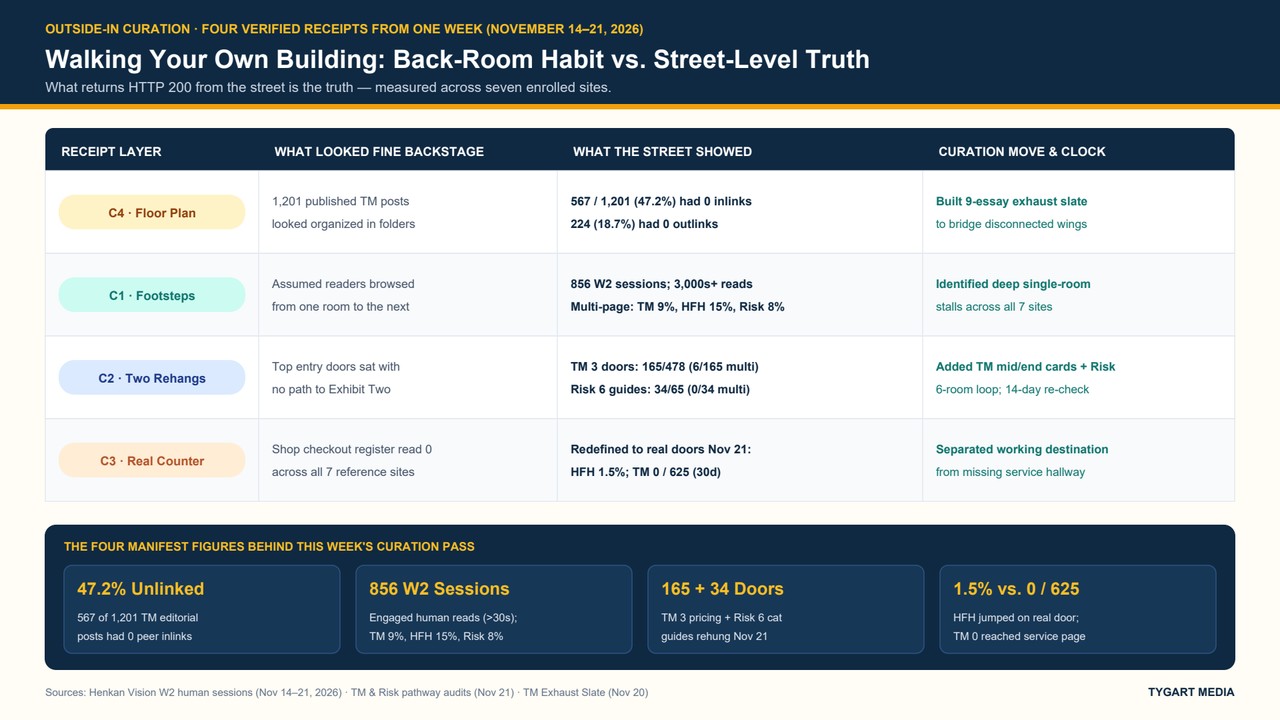
Before you watch footsteps, check the floor plan. Yesterday, November 20, when we mapped tygartmedia.com to draw the nine-essay exhaust slate this piece closes, the numbers came back sharp: 567 of 1,201 editorial posts — 47.2% — had zero editorial inlinks from any peer article, and 224 (18.7%) had zero editorial outlinks either. We had hung careful work inside a museum where nearly half the rooms lacked a hallway leading in. Even siblings built from the same timber — The Quiet Door Into the Library and Factory Phil — stood in separate wings until we cut deliberate doorways between them.
Then we watched real people inside the building. Over the first full week of Henkan Vision human telemetry (November 14–21, counting engaged visits past 30 seconds so the floor is real attention), our seven enrolled sites logged 856 engaged human sessions (478 Tygart Media, 224 Healthcare Facility Hub, 65 Risk Coverage Hub, 43 BC ESG, 36 Continuity Hub, 7 Restoration Intel, 3 Universal Commerce Protocol). Everywhere, one pattern dominated: the single-page deep read. Hour-long visits past 3,000 seconds on one page were common — 3,592 seconds on Healthcare Facility Hub, 3,565 on BC ESG, 3,558 on Risk Coverage Hub’s catastrophe-modeling guide, 3,555 on Tygart Media. People were not bouncing off the steps. They were studying one canvas for an hour and walking straight back to their cars. Multi-page rates sat at 42 of 478 (9%) on Tygart Media, 34 of 224 (15%) on Healthcare Facility Hub, and 5 of 65 (8%) on Risk Coverage Hub — yet when a fresh room did show the next door, readers took it: Leave the Pots in the Water drew an 845-second, 3-page walk straight out of the gate.
Two Galleries Rehung Before Lunch
Growth, in this frame, is not chasing more people into the building. It is curating the best of what you have until people come for your reasons — clear sightlines and deliberate circulation, the same craft behind the Smithsonian exhibition guidelines and Google Search Central’s crawlable link guidance. This morning we rehung two live wings strictly from those footprints without rewriting a paragraph of working prose.
Get The Signal
What we actually ran, what it measured, and what it means for a restoration shop — every week, including the flops.
On Tygart Media, three Claude pricing doors drove 165 of 478 Week 2 entries (34.5%): 95 on Claude Pro vs. Max, 44 on Claude Team Plan Usage Limits, and 26 on Claude Team Seat Pricing. Only 6 of 165 (3.6%) visited a second page (0 of 44 on usage limits). Today each door got a quiet mid-article and end-of-article path to the next exhibit — connecting the cluster and routing headroom buyers straight into Don’t Hire a Finish Carpenter to Carry Drywall.
On Risk Coverage Hub, six catastrophe-modeling and model-governance guides drew 34 of 65 entries (52.3%) with 0 of 34 multi-page sessions despite 3,558-, 2,959-, and 2,951-second reads. Today all six rooms were wired into one reading loop (2 path links per guide, 12 total), plus 2 bridges to our Sedgwick chief claims officer interview, The Claim Is Decided in the First 24 Hours, placed only on the two guides where casualty litigation and claims AI genuinely fit — and left off the pure property-cat page where it did not. Neither rehang is a victory lap today; both stand for a 14-day test against their 42/478 and 5/65 baselines.
Pointing Our Own Counter at the Real Door
The sharpest receipt this week was not a missing hallway — it was our own misreading of our own instrument. All week, the conversion counter across every site read 0. As we learned in Zero Miles Per Hour on the Generator, a sound instrument still reads zero when you bolt it to the wrong shaft. That error was ours, full stop. We had left a shop’s purchase register pointed at reference sites that sell nothing through a cart, while Henkan Vision faithfully showed us every deep human session and every stall in front of our eyes.
This morning we redefined the counter to each site’s actual destination page. Two opposite truths jumped off the screen at once. On Healthcare Facility Hub, aimed at the ICRA Readiness Check, the counter moved immediately to 1.5%. On Tygart Media, aimed at our AI citation service page, it handed us a harder, cleaner truth: 0 of 625 sessions in 30 days had reached the service page at all. Before lunch, both sites looked identically frozen at zero. Standing on the street with an honest counter separated the room people already found from the hallway we still had to build.
Where the Museum Metaphor Bends
Every good frame bends somewhere, and naming the seam keeps curation honest. First, a physical museum cannot watch each visitor’s path or rehang a room overnight — a website can. Physical teams lock traffic flow into blueprints months ahead, as the National Park Service Museum Handbook outlines; once drywall sets, a dead wing stays dead all season. We watched 856 sessions in a week and connected two galleries before noon — an advantage only if we resist fidgeting every afternoon and let the 14-day clock run.
Second, a museum’s visitors bought a ticket on purpose for the whole building; a website’s visitors arrive sideways from a search result or an AI answer. Almost nobody climbs museum steps to read one footnote and leave. On the web, arriving sideways for one exact answer is normal — and often complete. An analyst who spends an hour on one treaty guide and closes the tab with the clause she needed did not fail your museum; your room worked. Good curation lights the doorway to Exhibit Two without nagging the satisfied one-room reader at the exit.
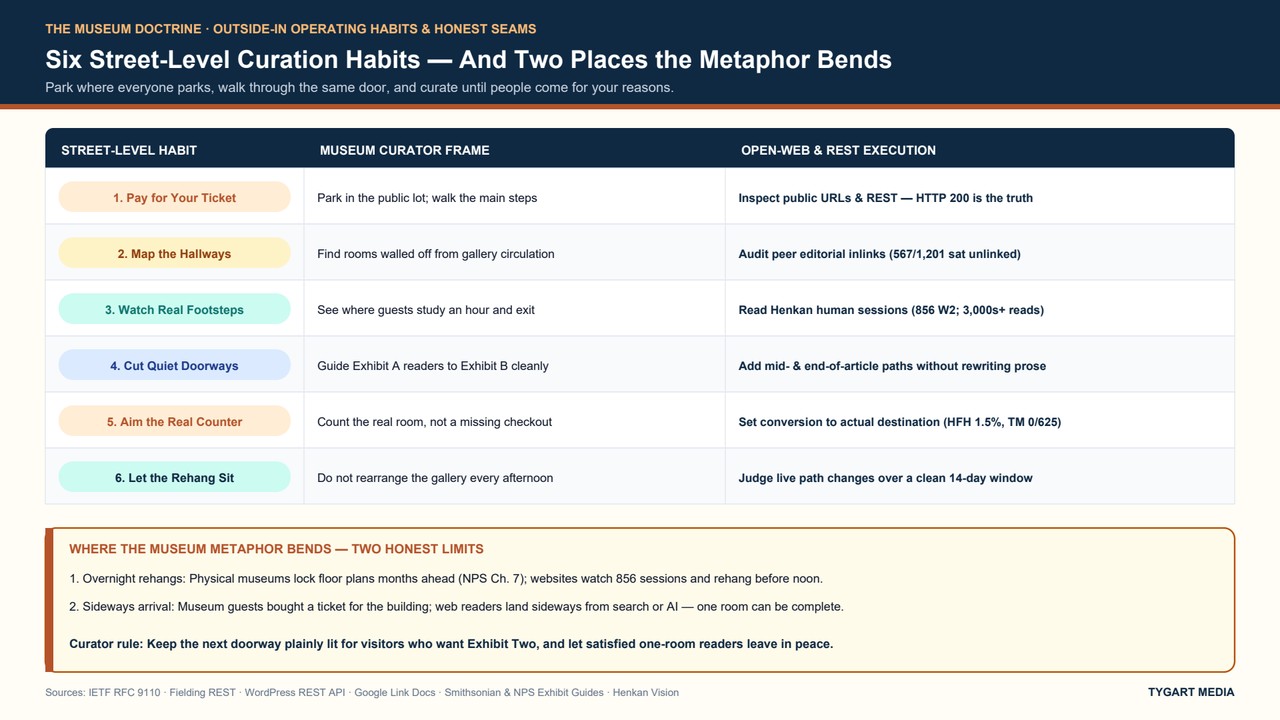
That plain standard closes our nine-essay exhaust slate. From Factory Phil running dependable stock plastics to The Quiet Door Into the Library earning trust one room at a time, nothing here relies on noise. Park where everyone parks. Come through the same door. Pay for your own ticket. Trust what returns HTTP 200 from the street, point your counter at the real room, and curate the best of what you have until people come for your reasons.
— Will Tygart, Tygart Media.
Get The Signal
What we actually ran, what it measured, and what it means for a restoration shop — every week, including the flops.
Leave a Reply