Inspired by a September 13 carousel from Matteo Barletta’s local-SEO account @gmbcrush, walking foundation repair contractors through Google Business Profile optimization. The playbook ports straight to restoration. Here is the translation.
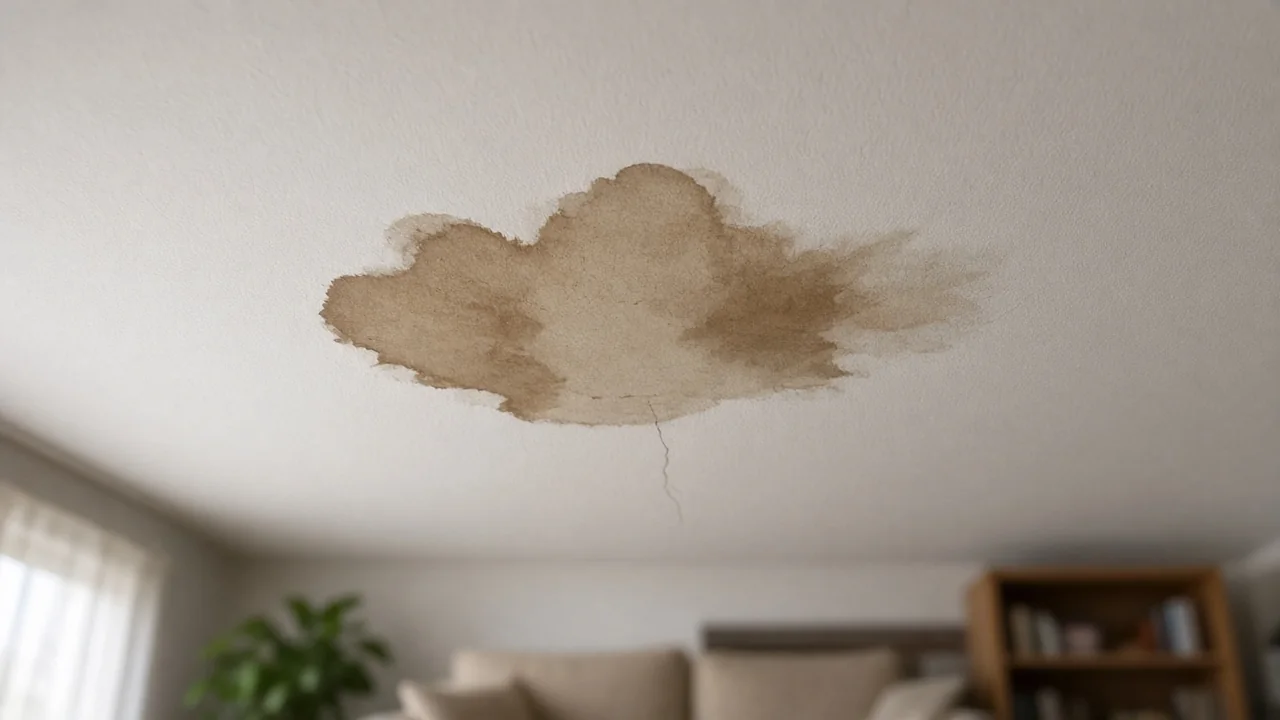
Your customer’s ceiling has a brown stain shaped like Texas. They don’t search “structural drying.” They search “brown stain on ceiling” or “ceiling stain from leak.”
That gap, between what homeowners type and what contractors write on their Google Business Profile, is the whole game. Barletta’s insight for foundation repair was symptom language: homeowners search for doors that won’t latch and cracks in brick, while most profiles answer in “piering” and “underpinning” that nobody types. Restoration has the same disease, and ours might be worse.
The restoration symptom dictionary
Every estimate you’ve ever written started with what the homeowner noticed, not what you did about it. That’s your keyword list. It’s already in your head:
| They search | You want to write | Write this instead |
|---|---|---|
| musty smell in basement | microbial remediation | musty basement smell, where it comes from and what fixes it |
| brown stain on ceiling | structural drying | ceiling water stain repair |
| floor feels spongy | psychrometric drying chamber | warped or buckling floor from water damage |
| black spots on wall | HEPA-filtered containment | black spots on drywall after a leak |
| house smells after rain | building envelope failure | musty house smell when it rains |

Nobody has ever typed “psychrometry” into Google looking for help. Your GBP should read like the conversation at the kitchen table, not the invoice.
Where symptom language lives on your profile
Business description. Lead with the problems you solve, in the words customers use. “We find where the water’s coming from, dry it out, and put it back together” beats a list of certifications. Certifications still belong on the profile. They just don’t belong in the first sentence.
Services. Google gives you service entries with descriptions. Most contractors list “Water Damage Restoration” with an empty description. That’s a wasted ranking asset. Each service description is a place to put two or three symptom phrases: “Ceiling stains, warped flooring, and musty smells after leaks or flooding. We locate the source, dry the structure, and restore the room.”
Posts. Barletta’s other sharp point: post against moisture cycles, not calendar dates. Restoration demand follows water, not months. When the spring rains start, post about basement seepage. When freeze season hits, post about burst pipes. A post titled “What that brown ceiling stain is telling you” published the week after a storm will outperform a generic “Call us for water damage!” post every time.
Q&A. Seed your own Q&A with the questions customers actually ask on the phone: “Do you handle the insurance claim?” “How long does drying take?” “Will I have to leave the house?” Every one of those is a search query wearing a question mark.
Review responses. When you reply to reviews, echo the symptom: “Glad we got that musty basement dried out for you.” You’re writing ad copy that ranks, disguised as good manners.
Pick your primary category by revenue
Barletta’s rule, and it’s the one most contractors get wrong: your primary category should be the thing that makes you the most money, not the thing you do the most of. If water mitigation pays the bills, “Water damage restoration service” is your primary category even if you also do mold, fire, and carpet cleaning. The primary category carries the most ranking weight. Spend it on revenue.
The operator's edge
Here’s why this playbook favors actual contractors over marketers: you already know the symptoms. You’ve stood in a thousand living rooms and heard a thousand versions of “there’s this smell.” No keyword tool knows what your customers say at the kitchen table. You do. Write it down the way they said it, put it on the profile, and you’ve done the thing most agencies charge for.
This is a living playbook. As we audit client profiles and learn what moves, the internal version grows. The GBP Audit Kit scores every listing against the same 40-point standard we hold our own clients to.
Leave a Reply