Claude’s API pricing is token-based: you pay for the tokens you send (input) and the tokens Claude generates (output). But raw per-token prices are only part of the story. Rate limits, service tiers, prompt caching, batch processing, and feature-specific charges all affect your actual bill. This guide covers every component of Claude API pricing as of September 2026. Last refreshed: September 2026.
Direct Answer (September 2026): Current first-party list rates from platform.claude.com pricing: Haiku 4.5 $1 / $5 per MTok; Sonnet 4.6 $3 / $15; Sonnet 5 $2 / $10; Opus 4.8 and Opus 5 $5 / $25; Fable 5 and Fable 5.1 $10 / $50. Retired Opus 4 / 4.1 remain $15 / $75 where still hosted. Prompt caching reads are 10% of input on most models (2.5% on Fable 5.1 / Mythos 5.1). Batch API is 50% off.
Per-Token Pricing by Model

All prices are per million tokens (MTok), verified September 15, 2026 against Anthropic’s platform pricing table. Fable 5 / Fable 5.1, the highest current list price, costs $10/MTok input and $50/MTok output. Opus 5 and Opus 4.8 cost $5/MTok input and $25/MTok output. Sonnet 4.6 costs $3/MTok input and $15/MTok output. Sonnet 5 is listed at $2/MTok input and $10/MTok output. Haiku 4.5 costs $1/MTok input and $5/MTok output. Retired Opus 4.1 (and Opus 4 on remaining hosts) is still $15 / $75. Do not treat those retired SKUs as current Opus list price.
Prompt Caching Pricing
Prompt caching lets you store frequently-used context so you don’t pay full input price every time. Caching has two cost components: a cache write at 1.25x the standard input rate for a 5-minute TTL (2x for a 1-hour TTL), and a cache read at 10% of the standard input rate on most models. For Opus 4.8 / Opus 5, 5-minute cache writes cost $6.25/MTok and cache reads cost $0.50/MTok. For Sonnet 4.6, writes are $3.75/MTok and reads are $0.30/MTok. For Haiku 4.5, writes are $1.25/MTok and reads are $0.10/MTok. Fable 5.1 and Mythos 5.1 cache reads are $0.25/MTok (0.025x input), not the 0.1x rate used on older models.
Batch Processing: 50% Off
The Batch API processes requests asynchronously and charges half the standard rate. If you have workloads that don’t need real-time responses — document processing, content generation, data analysis — batch processing cuts your costs in half. Combining batch processing with prompt caching can reduce costs sharply compared to standard synchronous requests.
How to Calculate Your Monthly Bill
A practical example: suppose your application sends an average of 2,000 tokens of input and receives 500 tokens of output per request, and you make 10,000 requests per day using Sonnet 4.6. Daily input tokens: 2,000 × 10,000 = 20M tokens → 20 MTok × $3 = $60/day. Daily output tokens: 500 × 10,000 = 5M tokens → 5 MTok × $15 = $75/day. Daily total: $135/day. Monthly total (30 days): approximately $4,050/month.
Now apply optimizations. If 80% of your input is cacheable after the first request: cached input = 16 MTok × $0.30 = $4.80 + uncached 4 MTok × $3 = $12 → $16.80 input instead of $60. If you can batch 50% of requests: half your remaining token bill drops by 50%. Optimized monthly estimate: roughly $1,500–2,000/month versus $4,050 at list price.
Service Tiers and Rate Limits

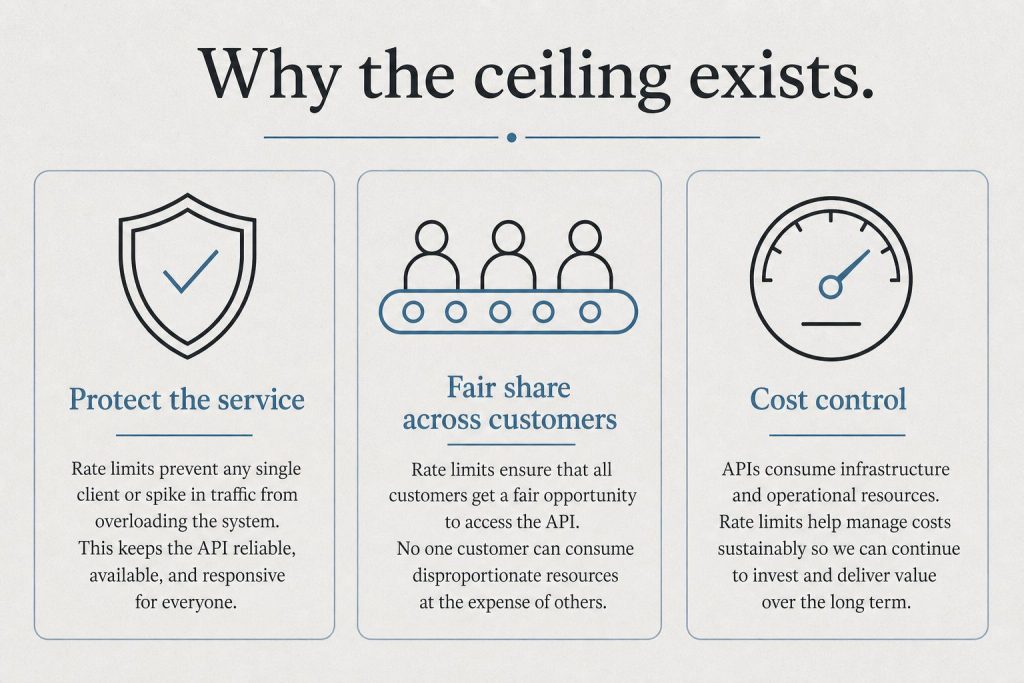
Anthropic offers three service tiers that affect availability and pricing. Priority tier is for organizations with a capacity commitment. Standard tier is the default for both piloting and scaling everyday use cases. Batch tier offers 50% savings for asynchronous workloads. Spend caps on self-serve usage tiers (Start $500 / month, Build $1,000 / month, Scale $200,000 / month) are published on the rate-limits docs; Custom has no public cap. Rate limits increase as spend grows. You can view current limits in the Claude Console.
Additional Platform Costs
Beyond token costs, Anthropic charges for specific platform features. US-only inference (`inference_geo: “us”`) on Claude 4.6 and later models costs 1.1x standard token rates. Fast mode for Opus 5 and Opus 4.8 is listed at $10 / $50 per MTok (2x standard). Fast mode is first-party API only and does not combine with Batch. Check the live feature table on the official pricing page before you budget web search or code-execution add-ons; those line items move independently of model list prices.
Frequently Asked Questions
How much does Claude API cost for a small project?
A small project making 100-500 API calls per day with Haiku 4.5 might cost $5-30/month. Using Sonnet 4.6 at the same volume would be roughly $15-90/month. Your actual cost depends on the length of inputs and outputs.
Is there a free tier for the Claude API?
Anthropic does not offer a permanent free API tier. You need to add a payment method and load credits to use the API. New accounts start with conservative rate limits that increase over time.
What’s the cheapest way to use the Claude API?
Use Haiku 4.5 ($1/MTok input), enable prompt caching for repeated context, and use batch processing for non-real-time work (50% off). Combined, that is the lowest public list path.
How do Claude API costs compare to OpenAI?
At the top of Anthropic’s current list, Fable 5.1 is $10/$50 per MTok. Current Opus (4.8 / 5) is $5/$25. Mid-tier Sonnet 4.6 is $3/$15; Sonnet 5 is $2/$10. OpenAI’s GPT-5 standard list is $1.25 input / $10 output per million tokens. Compare the exact SKU pair, not the family name.
Related: Claude AI Pricing (2026) — every plan, API rate, and the cost calculator
Leave a Reply