Tag: workflow automation

  • The Fitting — Your Claude, Deployed Overnight

    The Fitting — Your Claude, Deployed Overnight

    Anthropic ships Claude. We ship your Claude.

    The Problem With Off-the-Shelf Claude

    You bought Claude. Maybe Claude Max. Maybe a Team account. You have used it a few times and gotten results ranging from impressive to generic. The thing is — Claude does not know you. It does not know your industry, your workflows, your customers, your voice, your tools, or your business. It is a suit off the rack. Brilliant fabric, wrong fit.

    The companies getting extraordinary results from Claude did not just buy a subscription. They built infrastructure around it: custom skills for their specific workflows, a Notion workspace structured so Claude can read and act on it, connectors wired to the tools they already use, and a prompt library that reflects how they actually think. That infrastructure is what makes Claude a genuine operational lever instead of an impressive toy.

    Building that infrastructure takes weeks if you do it yourself. We deliver it overnight.

    What Happens

    You email us. We schedule a 60-minute discovery call — same day if you want it. On that call we learn your business: what you do, how you do it, what tools you use, what your best work looks like, and where the friction is. That night we go into the factory and build.

    By 9am the next morning you have a deployment waiting in your inbox with a Loom walkthrough showing you exactly what was built and how to use it. Everything is yours. No subscription to us. No ongoing fees unless you want them.

    What Ships

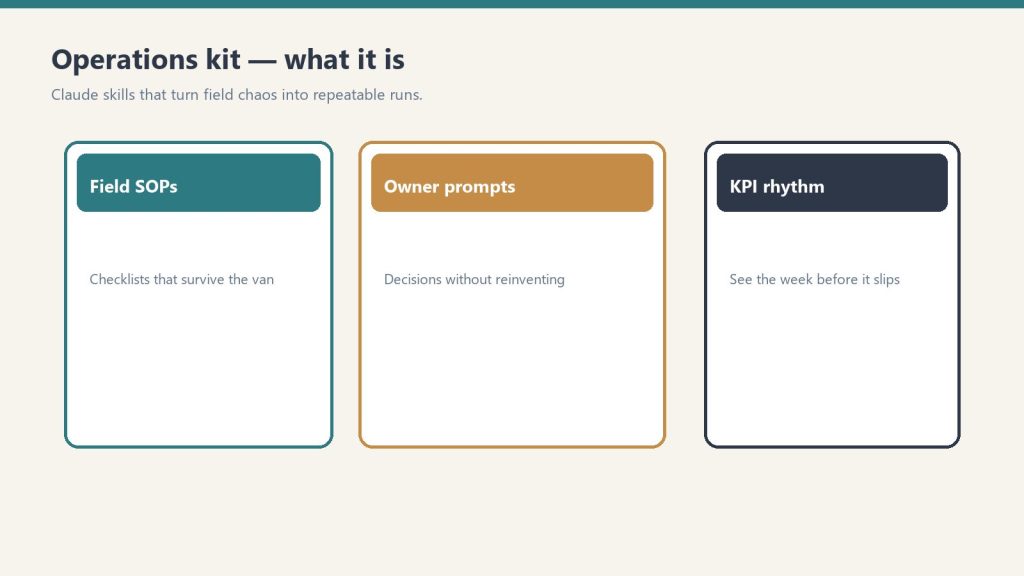
    • Custom Claude skills built for your specific workflows — the work you actually do, not generic prompts
    • Notion Second Brain configured for your business: your projects, your clients, your content, your knowledge — structured so Claude can read and act on it
    • Wired connectors where applicable: WordPress, Metricool, Google Calendar, Gmail, Google Drive — whatever makes sense for your stack
    • Prompt library in your voice — 20 to 50 prompts calibrated to how you think and what you produce
    • One to two Books for Bots seeds — we extract and encode the most important operational knowledge from the discovery call
    • Loom walkthrough of everything that was built and how to use it

    Pricing

    Starting at $1,500. Scope varies based on tool complexity and number of connectors. We quote within an hour of your intake email. No surprises.

    Who This Is For

    Business owners, operators, and teams who have Claude and are not getting full value from it. People who want to move fast and would rather pay to have it done right than spend weeks figuring it out themselves. Restoration companies, professional service firms, agencies, consultants, local businesses — anyone who does real work and wants AI that knows how to help with it specifically.

    The Overnight Promise

    Order by 9pm PT. Delivered by 9am PT. We can make this promise because the factory already exists — the skills infrastructure, the Notion architecture, the connector templates, the prompt calibration process. We are not building from scratch every time. We are fitting something that already works to someone new. That is what makes it deliverable overnight.

    Order by 9pm PT. Delivered by 9am PT.

    Tell us what you do, what tools you use, and what you wish Claude could help you with. We scope it and quote it within the hour.

    will@tygartmedia.com

    Email only. No forms, no Calendly, no commitment.

    Frequently Asked Questions

    How is this delivered?

    Within 24 hours of purchase. You will receive the files directly via email from will@tygartmedia.com.

    Is there a refund policy?

    Because this is a digital product, all sales are final. If you have a problem with your purchase, email will@tygartmedia.com and we will sort it out.

  • Complete Restoration Operations Kit — All 7 Templates Bundled

    Complete Restoration Operations Kit — All 7 Templates Bundled

    Every system your restoration company needs to run jobs professionally — in one afternoon.

    What’s In the Bundle

    Seven tools that work together as a complete operations system. Buy them individually and you spend $173. Buy the bundle and you spend $97. More importantly, they are designed to connect — equipment from the fleet tracker links to jobs in the job tracker, claims in the claims tracker link back to the same job, crew certifications in the onboarding tracker determine who can run which equipment. One afternoon of setup and you have an operations system that most restoration companies twice your size do not have.

    Template What It Does Value
    Restoration Job Tracker Pro Full job lifecycle from FNOL to final invoice. 6 databases. $29
    Equipment Inventory & Deployment Tracker Fleet management, deployment billing, maintenance logs. $29
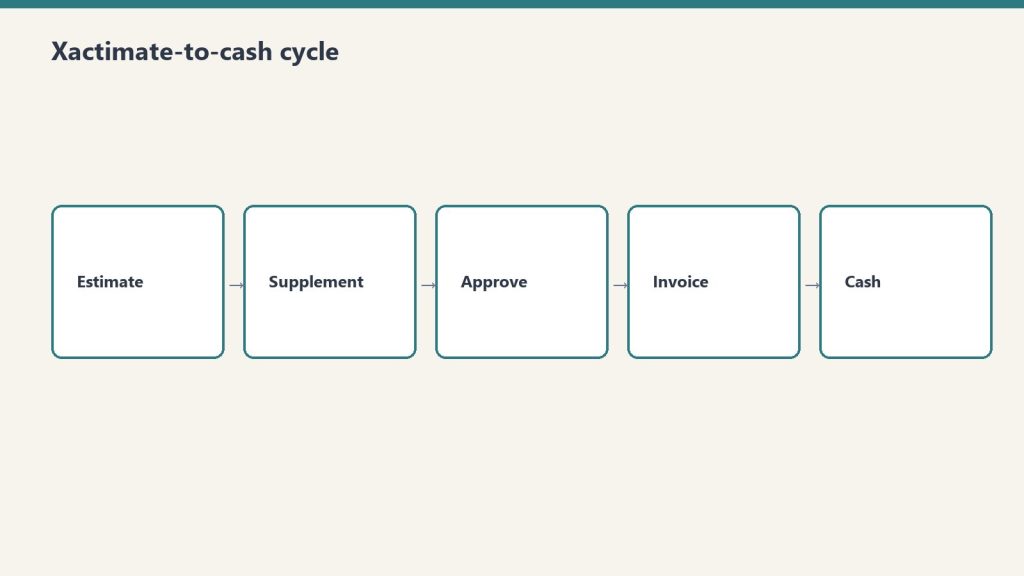
    Insurance Claims Command Center Every claim, supplement, authorization, and payment tracked. $29
    Business KPI Dashboard Revenue, cycle time, close rate, equipment utilization. $29
    SOP Library Pre-built procedures for water, fire, mold, contents, bio. $19
    Crew Onboarding & Training Tracker New hire checklists, certifications, IICRC course tracking. $19
    IICRC Protocol Lookup — Claude AI Skill Ask Claude S500/S520 questions. Get protocol-grounded answers. $19
    Bundle Total Save $76 vs buying individually $97

    Who This Is For

    Restoration contractors who are serious about running a professional operation and want every system in place at once rather than building piecemeal. New owners who want to start right. Growing companies whose informal systems are starting to break. Operations managers who know they need documentation but haven’t had time to build it from scratch.

    How It Works

    After purchase, you receive all 7 Notion duplicate links and the Claude skill file in a single delivery. Each template includes sample data so you can see how it works before you enter your own. The setup guide walks you through the recommended configuration sequence. Most contractors are running all 7 by the end of their first afternoon.

    Complete Restoration Operations Kit

    ~~$173~~ $97

    All 7 templates + Claude skill — save $76. Delivered within 24 hours via email.

    Buy Now →

    Secure checkout via Square — all major cards accepted

    Frequently Asked Questions

    How is this delivered?

    Within 24 hours of purchase. You will receive the files directly via email from will@tygartmedia.com.

    Is there a refund policy?

    Because this is a digital product, all sales are final. If you have a problem with your purchase, email will@tygartmedia.com and we will sort it out.

  • Weekly Content Calendar System for Local Businesses

    Weekly Content Calendar System for Local Businesses

    Stop improvising your marketing. A 52-week system that takes 30 minutes a week.

    Who This Is For

    Built for local business owners who know they should be posting consistently but never have a plan, always improvise, and eventually just stop posting entirely.

    The Problem

    Content consistency is not a creativity problem — it is a system problem. The business owner who posts three times a week for a month and then goes silent for six weeks does not lack ideas. They lack a machine that produces the next thing automatically. This calendar is that machine: it tells you what to post this week, gives you the prompts to draft it with AI, and shows you how to turn one piece of content into five platform-specific posts without starting from scratch.

    What You Get

    • 52-week Notion content calendar: pre-filled with content themes by week so you are never starting from a blank page
    • 5-platform content matrix: how one core piece becomes a Google Business Profile post, a Facebook post, an Instagram caption, a LinkedIn update, and an email
    • 30-minute weekly workflow: the exact steps in the exact order, every week
    • AI prompt set for each content type: copy the prompt, get a draft, edit lightly, post
    • Local business content idea bank: 200 topic starters organized by industry type

    Weekly Content Calendar System

    $29

    Delivered to your inbox within 24 hours — no shipping, no waiting

    Buy Now →

    Secure checkout via Square — all major cards accepted

    Frequently Asked Questions

    How is this delivered?

    Within 24 hours of purchase via email from will@tygartmedia.com. You will receive a download link for the ZIP file and/or Notion duplicate link immediately.

    Do I need any special software?

    A free Notion account is required. No other software needed.

    Can I customize this for my specific business?

    Yes — that is the point. Everything is built to be edited. Swap in your company name, add your specific workflows, remove anything that does not apply. It is a starting point, not a locked template.

    Is there a refund policy?

    Because this is a digital product, all sales are final. If you have a problem with your purchase, email will@tygartmedia.com and we will sort it out.

  • How to Run the Reverse Content Stack: A Step-by-Step Guide for Publishers

    How to Run the Reverse Content Stack: A Step-by-Step Guide for Publishers

    The reverse content stack is a straightforward concept: treat your social posts as research briefs, expand them into WordPress clusters, and close the loop by queuing new WordPress URLs back to social. The hard part isn’t understanding it — it’s building the habit and the workflow.

    This is the implementation guide for managing editors and content operators who want to run the process, not just understand it.

    (For the full explanation of why this works, read Your Social Feed Is a Research Brief.)

    Step 1: Identify the Seed Posts

    Not every social post deserves full expansion. The ones that do share a few traits:

    • The post was researched — there was a real story behind it, not just a reshare
    • The post performed above average in reach or engagement
    • The topic has search intent — people would actually Google it
    • The story has multiple angles that different audiences would care about differently

    A practical filter: if you published a post and immediately thought “there’s more to this story,” that’s your seed. Flag it at publish time with a simple tag or Notion entry so it doesn’t get buried.

    Step 2: Reconstruct the Research Brief

    Before writing anything for WordPress, reconstruct what you know about the story:

    • Core claim: The one sentence the social post was built around
    • Verified facts: What you confirmed is true (vote counts, dollar amounts, dates, names)
    • Key entities: Who and what is involved — people, places, organizations, decisions
    • Audience questions: What would a local resident ask? A business owner? A visitor? A civic-minded reader?
    • Related content: What does your site already have on this topic that the new content can link to?

    This brief is your Constancy Contract. Everything you publish in this cluster must be factually consistent with it. No variant may invent or embellish facts that aren’t in the brief.

    Step 3: Build the Coverage Map

    Apply the existence test to every potential variant before you write a word:

    Does a real person exist who needs this knowledge, cannot get it from the main article or another variant, and would leave the page if we do not speak to them directly?

    If yes — that variant earns its place. If no — cut it.

    For a typical civic story at a local news site, the Coverage Map usually produces:

    • Core article: always
    • Resident impact: almost always on civic/economic stories
    • Business/jobs angle: when there’s a dollar story
    • Civic explainer: when the process is confusing (zoning, permitting, appeals)
    • Visitor/tourism angle: for destination sites only, rarely on civic stories

    Write out the Coverage Map before you start writing. One row per variant, one sentence of justification. This disciplines the output and prevents padding.

    Step 4: Write the Core Article First

    The core article is the full story. Structure:

    • Headline: Specific, local, keyword-rich (include the geographic modifier)
    • Lede: The social hook expanded with the most important fact
    • Body: 600–1,200 words, inverted pyramid — most important facts first
    • Local context: Why this matters specifically to this community
    • Background: What happened before, what this connects to
    • What’s next: Forward-looking close — what happens next and when
    • Internal links: 2–3 links to related content already on the site

    Write for a local reader, not a generic internet audience. The geographic specificity is the differentiation — it’s what national content farms cannot replicate.

    Step 5: Write Variants from the Brief, Not the Core Article

    Each variant must be written from the Research Brief, not derived from the core article. This prevents duplicate content and SEO cannibalization. If two pieces share an opening paragraph, they’re too similar.

    Each variant needs:

    • A distinct headline angle targeting that variant’s persona
    • A different opening paragraph and lede
    • 400–800 words — focused, not padded
    • A link back to the core article
    • At least one link to an existing post on the site

    Step 6: Add the AEO FAQ Layer to Every Piece

    Every article in the cluster gets a FAQ section at the bottom. These aren’t afterthoughts — they’re the featured snippet and voice search layer. Write questions as people actually speak them:

    • “What is [topic] in [location]?”
    • “When did [event] happen?”
    • “Who decided [decision] and why?”
    • “How does this affect [local area]?”

    Format: H3 for the question, 2–4 sentences for the answer. Factually dense. No filler. Minimum four pairs per article.

    Step 7: Publish in Order and Capture the URLs

    Publish the core article first so variants can link to it. Then publish variants. Capture every post ID and permalink in a simple table:

    • Core article: [title] | [URL] | draft
    • Variant 1: [title] | [URL] | draft
    • Etc.

    You’ll need these URLs for Step 9.

    Step 8: Run the Post-Publish Stack

    After publishing, each post needs at minimum:

    • SEO pass: Title tag, meta description, heading structure, slug
    • Schema injection: Article + FAQPage on all posts; SpeakableSpecification on the core article
    • Interlink: Connect new posts to existing content clusters on the site

    AEO and GEO optimization can follow as a second pass if bandwidth is tight at publish time.

    Step 9: Close the Loop — Queue Back to Social

    This is the recursive step that most publishers skip. For each new WordPress URL, generate a distinct social teaser — not a repost of the original, but a new angle drawn from the depth the article contains:

    • A specific fact from the variant that the original post didn’t mention
    • A question raised by the civic explainer
    • A forward-looking hook from the “what’s next” section

    Queue these to your social scheduler (Metricool, Buffer, whatever you use) staggered 5–10 days out from the original post. The new social posts point back to the WordPress content, which builds the site’s authority. Over time, that authority starts showing up in the research phase of new stories — and the loop feeds itself.

    The Discipline That Makes It Work

    The reverse content stack is not a technology problem. It’s a discipline problem. The technology (WordPress, a social scheduler, a search tool) already exists. The habit that has to be built is simple: before you move on from a story, ask whether you cracked it open.

    Social post published → WordPress expansion started → FAQ layer added → URLs queued back to social. That’s the whole checklist. Run it consistently and the compounding starts.

    Frequently Asked Questions

    How long does a reverse content stack expansion take?

    A single social post expansion — core article plus two variants plus FAQ layers — takes a trained writer or AI-assisted workflow roughly 60–90 minutes for a civic story with moderate research depth. Simple event announcements can be expanded in 30 minutes. The investment pays back in compounding search traffic and topical authority over 3–6 months.

    Should I expand every social post I publish?

    No. Focus on posts where the story has genuine depth, search intent, and multiple distinct audiences. A quick event reminder doesn’t need three variants. A major zoning decision, a new business opening with an interesting backstory, a civic controversy — those earn full expansion. A practical filter: if you thought “there’s more to this story” when you posted it, it’s a candidate.

    What if I don’t have the resources for multiple variants?

    Start with one. Publish the core article with a FAQ layer. That alone is dramatically more valuable than leaving the research in a social caption. Add variants as your workflow scales. The floor for the reverse stack is: one article + one FAQ layer + the URLs queued back to social. Everything above that is upside.

    How does the recursive loop actually start?

    It starts when you have enough published depth that search engines and AI systems have something to index and cite. This typically becomes noticeable after 3–6 months of consistent expansion. Once your site appears in AI-generated answers for local topics, your own content starts appearing in the research phase of new stories — and the loop is live.

  • I Don’t Have a Morning Routine. I Have a 3am Shift.

    I Don’t Have a Morning Routine. I Have a 3am Shift.

    Everyone I talk to about AI eventually asks the same thing: “How do you use it to work faster?”

    I’ve stopped trying to answer that question. Because it’s the wrong one.

    The better question — the one that actually describes what’s happening at my end — is: what does it do when I’m not watching?

    The answer is: a lot. And most of it happens at 3am.

    3am Shift — Server Room Running Alone at Night
    While I sleep, a server in Google Cloud is working. No one is watching. That’s the point.

    What Actually Happens at 3am

    There’s a Google Cloud virtual machine I’ve been building for months. It runs on a small Compute Engine instance in GCP’s us-west1 region. During the day I’m in and out of it — deploying code, running optimizations, publishing articles to client sites. But the interesting stuff happens after I close the laptop.

    At 3am Pacific time, a cron job fires. It kicks off a content pipeline that pulls from my second brain — a BigQuery database that logs every working session I’ve ever had with Claude — identifies knowledge gaps across a set of websites I manage, writes articles to fill them, optimizes them for search, and publishes them to WordPress. By the time I wake up, there are new posts live on sites I didn’t touch.

    The session extractor runs on a different schedule. Every time I finish a Cowork session, a job logs everything that happened — what was built, what was decided, what failed, what’s next — into Notion with a date stamp and status markers. The next session reads that log before doing anything else. Context that would have evaporated gets carried forward. The machine remembers so I don’t have to.

    There are 17 scheduled jobs running on that VM right now. SEO scorecards that refresh on the first of the month. Social media batches that fire every three days. A second brain intelligence dashboard that updates itself and surfaces what’s trending in my own knowledge base. An AI receptionist prototype I’m building for a client that processes intake calls through Twilio and logs them to Firestore — all without a human in the loop.

    3am Shift — Automated Pipeline Running
    Each node in the pipeline triggers the next. No one has to push a button.

    The Morning Routine That Isn’t One

    My mornings used to start with a list. Now they start with a report.

    The daily briefing in Notion tells me what the overnight runs produced — which articles went live, which pipelines succeeded, which ones hit an error and why, what the status is on every client and project. Red, yellow, green. By the time I’ve had coffee, I know the state of everything without having asked a single question.

    The second brain intelligence dashboard is the part that still surprises me. It tracks what topics are heating up across all my knowledge nodes — which subjects are getting more mentions, more connections, more cross-references. On any given morning it might surface that “agentic commerce” has spiked, or that my restoration intelligence cluster has thinned out and needs new content. I didn’t build an alarm system. I built something that tells me what to pay attention to before I know I should be paying attention to it.

    The whole thing runs on maybe $40–60/month in GCP compute. The VM is an e2-standard-2. Not a supercomputer. What makes it powerful isn’t the hardware — it’s the fact that it’s always on, always running, and always logged.

    3am Shift — Unattended Dashboard Updating
    The dashboard updates on its own. By morning, the state of everything is already known.

    The Moment It Clicked

    There was a specific moment when I understood what I was building was different from “using AI tools.”

    I was running a music generation pipeline — an experiment where Claude was creating and evaluating short audio clips, keeping the ones that met a quality threshold and discarding the rest. At some point during the run, the pipeline stopped. Not because of an error. Because Claude evaluated the output, decided it wasn’t good enough, and called sys.exit(). It halted itself.

    I called it the Autonomous Halt. The article about it is on this site if you want the full story. But the feeling in that moment — reading the log and realizing the system had made a judgment call without me — was unlike anything I’d experienced with software before. It wasn’t just automation. It had opinions about its own output.

    That’s when the shift happened in how I think about this. The question stopped being “how do I get AI to help me work” and became “how do I build a system that works, and then stay out of its way.”

    What This Changes About How I Work

    The conventional productivity conversation is about reclaiming time. You delegate tasks to AI, you get hours back, you use those hours to do higher-value things. That’s real and I don’t dismiss it.

    But the thing that’s actually happened for me is different. It’s not that I have more hours. It’s that the category of work that requires my presence has gotten much smaller and much clearer.

    The 3am shift handles content. It handles monitoring. It handles routine optimization, publishing, reporting, and logging. What’s left for me is judgment — the things that require knowing the client, reading the room, making a call that doesn’t have a clear right answer. Strategy. Relationships. New ideas. The stuff that benefits from a human being actually thinking, not executing.

    The SEO portfolio I manage runs at about $168,000/month in tracked search value across 22 domains. That number grew while I slept. Not metaphorically — the articles published at 3am indexed, ranked, and accumulated traffic value while I was nowhere near a keyboard.

    3am Shift — Night and Day Split
    Night is when the work happens. Day is when I decide what it means.

    What It Takes to Get Here

    I want to be honest about something: this didn’t happen overnight and it didn’t happen by accident. The 3am shift is the result of a lot of deliberate architecture decisions, a lot of failed pipelines, a lot of sessions that ended in error logs instead of published articles.

    The session extraction system — the one that logs context to Notion so the next session can pick up cold — that took three iterations to get right. The first two versions lost too much context and the logs were too vague to be useful. The third version extracts structured data: what was built, what failed, what was decided, what’s next. That specificity is what makes the loop work.

    The cron jobs took longer than they should have to set up properly, mostly because I kept trying to run them from the wrong place. The Cowork VM is too constrained. The knowledge-cluster-vm on GCP is the right home — persistent, always on, with the credentials and tools pre-loaded. Once that decision was made, the automation clicked into place quickly.

    The second brain itself — the BigQuery database that everything feeds into — was the foundational investment. Without a structured knowledge store, the 3am pipeline has nothing to pull from. The intelligence is only as good as what’s been logged.

    None of that is glamorous. Most of it was debugging. But the result is a system that genuinely works while I’m not working, and that’s a different category of thing than a faster workflow.


    Most people ask how I use AI. The better question is what it does when I’m not watching.

    The answer, lately, is most of the work.