Tag: Skilled Trades

  • Middle Manager Evaluation Scorecard

    Middle Manager Evaluation Scorecard

    Middle Manager Evaluation Scorecard

    $59

    Delivered by email after checkout.

    Buy Now →

    Secure checkout via Square — all major cards accepted

    You can copy this method and do it yourself. Name the person and the seat. Score nine traits 1-5 from recent examples. Total them. Read the band. Buy Now is the packaged Notion table you duplicate, so you are not rebuilding the scorecard from a blank spreadsheet.

    Tool #6 of the Restoration Leadership Toolkit. Help owners assess whether someone is ready to manage people, not just perform tasks. Your best tech is not automatically your best lead. The skills that make a great doer (speed, craft, hustle) are different from the skills that make a great manager (getting work done through others). Use this before you promote the wrong person.

    How to run it

    1. Name the person and the seat. Lead, crew chief, PM, estimator, office manager. The bar shifts with the seat. A crew chief lives or dies on conflict and training. A PM lives or dies on judgment and communication.
    2. Walk the nine traits in order. For each, ask for a recent, specific example: “Tell me about the last time they hit a problem on a job. What did they do?” Then give a 1-5 and confirm it. Anchor every score in observed behavior, not gut feel or potential.
    3. Flag the unknowns. If you have never seen a trait (they have never had to handle real conflict or train anyone), record it as a known gap. Do not guess a high score. Untested is itself a finding.
    4. Total the nine (max 45). Read the shape of the scores, not just the total.
    5. Name the lowest 2-3 traits as the gaps to close. One concrete development action each. A re-evaluation date, typically 60-90 days.

    One person = one row. Duplicate a row or a page for the next person. Do not overwrite last quarter’s scores.

    The nine traits
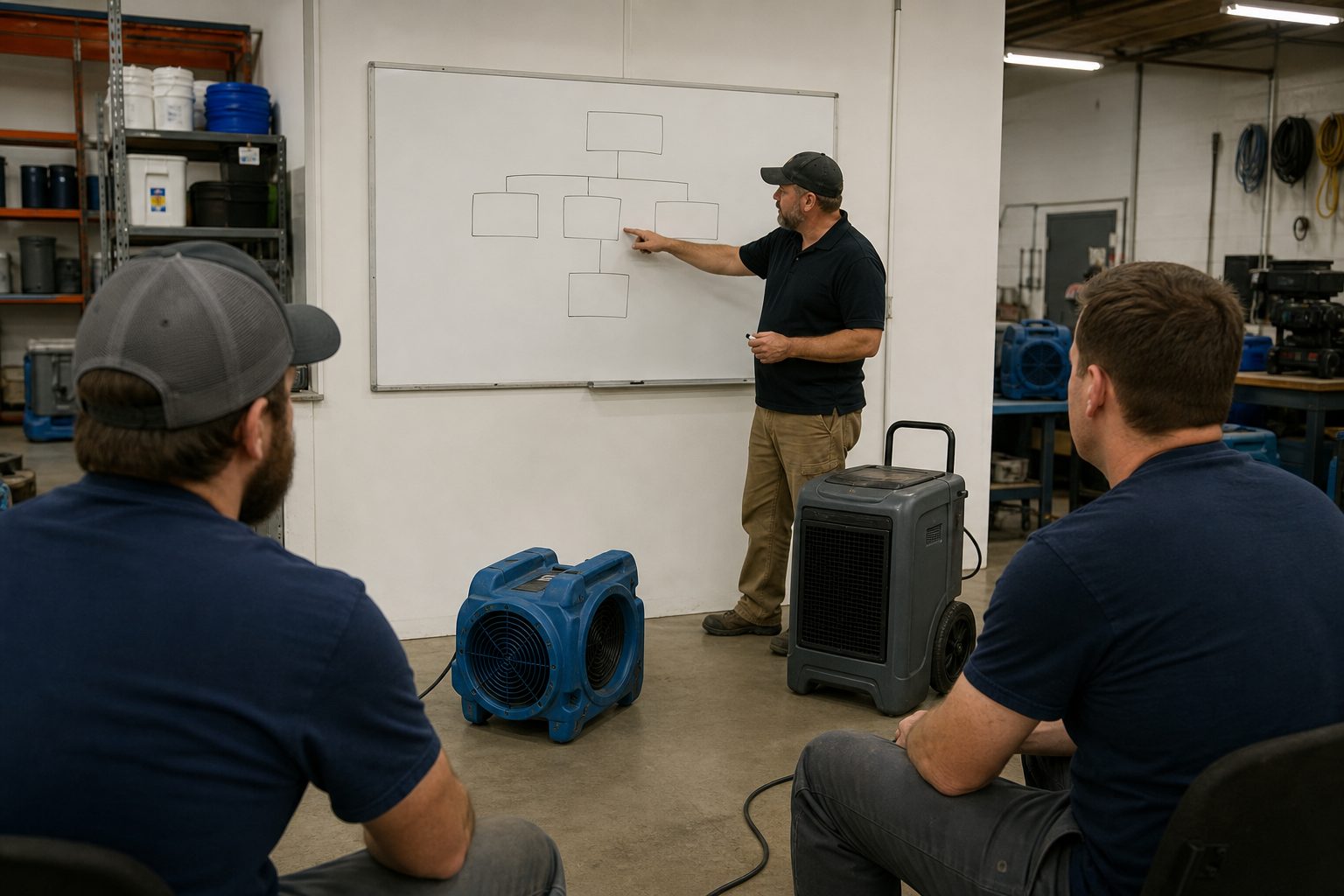
    Restoration technicians training in a shop bay with equipment demo and whiteboard
    Nine traits — score managers honestly.
    1. Ownership. 1-5. Takes responsibility for outcomes, no blame-shifting.
    2. Communication. 1-5. Clear, timely, two-way communication. Closes the loop.
    3. Judgment. 1-5. Makes sound decisions without being told every step.
    4. Emotional maturity. 1-5. Stays steady under pressure, regulates reactions.
    5. Coachability. 1-5. Seeks and applies feedback, not defensive.
    6. Follow-through. 1-5. Closes the loop, does what they said by when they said.
    7. Trains others. 1-5. Can teach a task and bring others up to standard.
    8. Handles conflict. 1-5. Addresses tension directly and fairly, does not avoid it or blow it up.
    9. Values alignment. 1-5. Models company values when no one is watching.

    Also write: Name, Role (current title), Notes (evidence, specific gaps to close, target re-eval date), Total (auto-sum of the nine, max 45), Recommendation (Promote / Develop first / Not yet).

    The 1-5 anchors

    • 1. Not yet / recurring problem.
    • 2. Inconsistent, needs heavy supervision.
    • 3. Developing. Does it when reminded.
    • 4. Solid. Does it on their own most of the time.
    • 5. Consistently strong. Others learn from how they do it.

    The recommendation bands
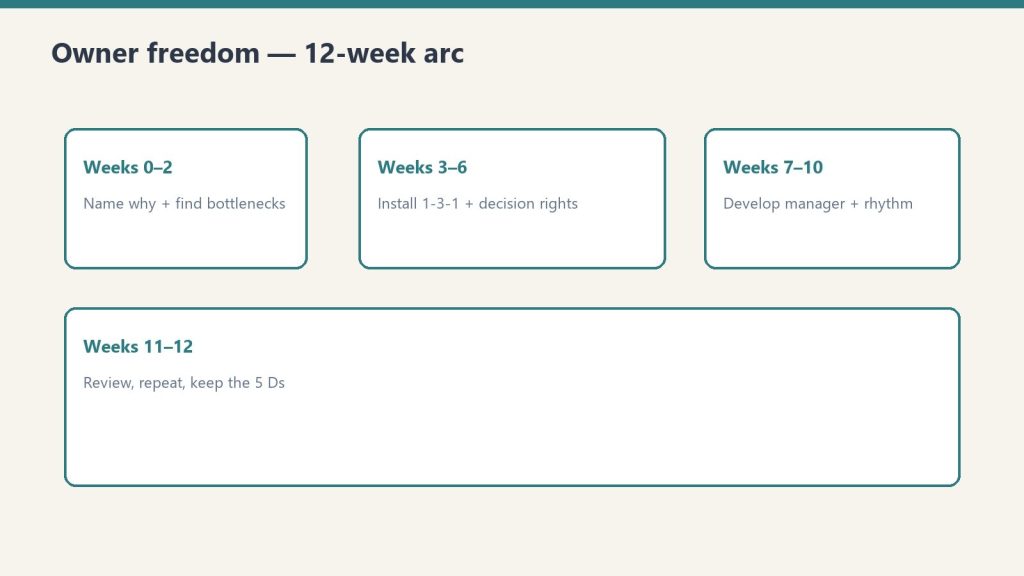
    Four-phase board covering a 12-week owner freedom transition
    Recommendation bands decide promote / coach / exit.
    • Promote. About 37-45. Ready to lead now. Strong and even across traits.
    • Develop first. About 27-36. Real potential with named gaps. Give a development plan and a date. Do not promote yet.
    • Not yet. 26 or below. Performs tasks but is not ready to lead people. Revisit later, or keep growing them as an individual contributor.

    Override rule. Any single trait scored 1-2 on Ownership, Emotional maturity, or Values alignment caps the recommendation at Develop first, regardless of total. Those are the floors for putting someone over people. Call it out when it triggers.

    The bands are guides, not hard cutoffs. The owner decides. The score is an input, not a verdict. Never treat the number as a must-promote or must-pass.

    How to fill it without lying to yourself
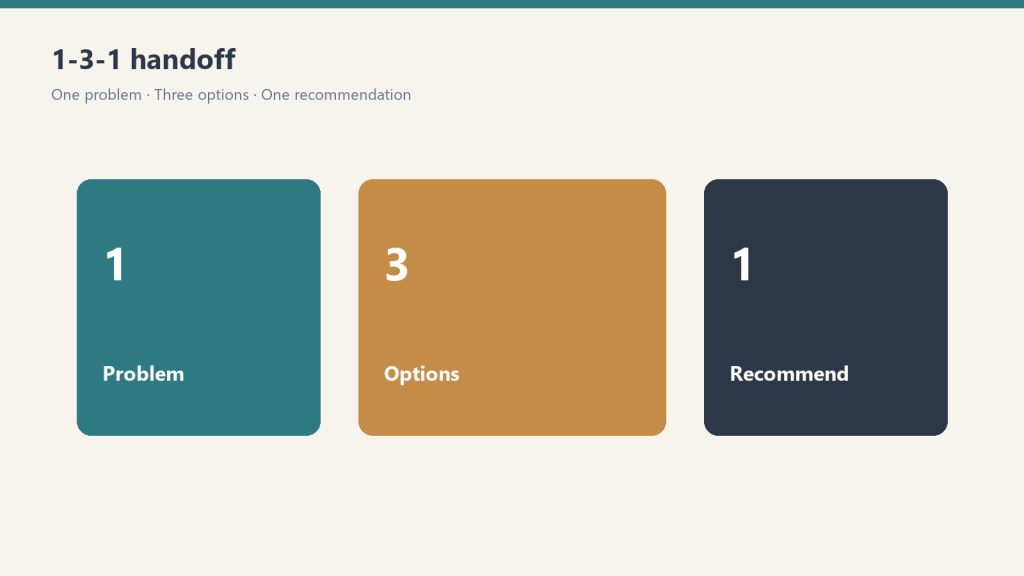
    Three panels showing one problem, three options, one recommendation
    Fill without lying — anchors beat vibes.

    Score behavior, not the person. Tie every number to something you actually saw. Never score personality, background, age, accent, health, family situation, or “culture fit” as a stand-in for a protected characteristic. If that is the reason in your head, redirect to what they actually did.

    Watch three biases. Halo: great tech, so you assume great leader. Recency: one good or bad week coloring everything. Similarity: rating people like you higher. Name it if you see it.

    If several traits are untested, say so out loud. Lower your confidence. Put a trial of responsibility in front of the decision: run a job, train a hire, own a file end-to-end. Then re-score.

    After a Develop-first result, the next move is usually an accountability conversation: here is what is between you and the seat, here is the 30-day or 90-day target. After a Promote, hand them one area end-to-end and put them on the 90-day doer-to-leader spine (Weeks 7-8: develop one manager). Put every scored name on a bench list so you are not keeping five people “on your radar” and developing none.

    If you want the packaged scorecard

    You can run the nine traits on a legal pad. Buy Now is the Notion table delivered by email after checkout. Duplicate it so the master stays clean. The nine scores, the Total, the Recommendation, and the Notes field are already laid out. Same Square button at the top of this page.

    Pairs with the Leadership Readiness Checklist (lighter yes/no read on the same person), the Restoration Leadership Bench Builder (develop the Develop-first group), the Accountability Conversation Planner (the “here is what is between you and the promotion” talk), and the 90-Day Doer-to-Leader Transition Plan. Matching Claude skill: middle-manager-scorecard. Decision support only. Not legal or HR advice. Not a hiring, firing, promotion, compensation, or disciplinary determination.

    Related on Tygart Media: leadership readiness · leadership toolkit.
  • Job-Costing Gap-Finder

    Job-Costing Gap-Finder

    Job-Costing Gap-Finder

    $39

    Delivered by email after checkout.

    Buy Now →

    Secure checkout via Square — all major cards accepted

    You can copy this method and do it yourself. Pull last 10 closed jobs. Enter estimate vs actual. Tag the leak bucket. Sort the losers. Buy Now is the packaged Notion table with the columns and formulas already built, so you are not making the spreadsheet from a blank grid.

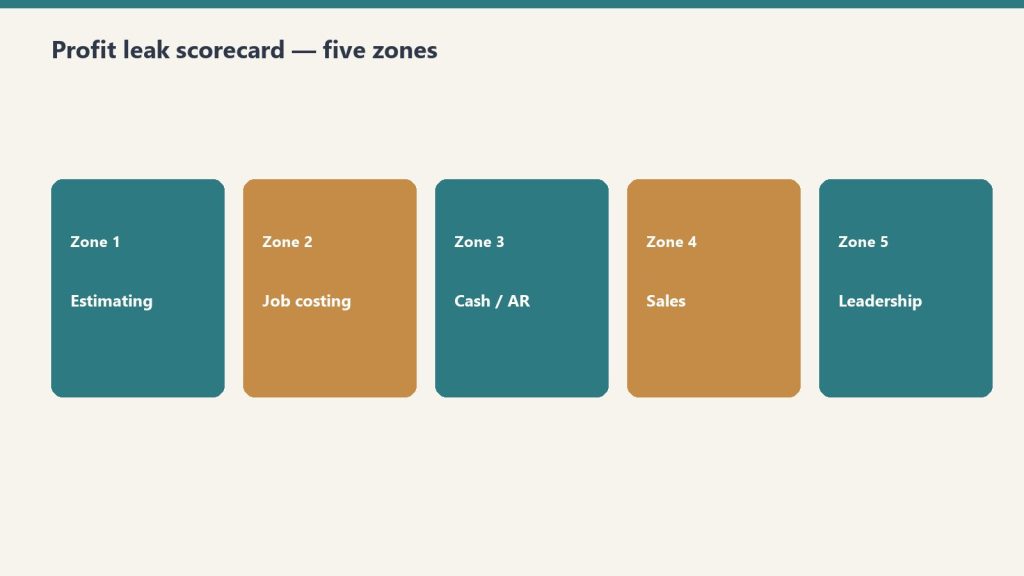
    This is the $39 utility on the profit-leak spine. Compare estimate (or Xactimate) vs actual cost on a sample of recent jobs. Surface margin leak by line category. Natural next step when the Profit Leak Scorecard says Zone 2 (job costing & margin) is your worst zone.

    Why the lag kills you

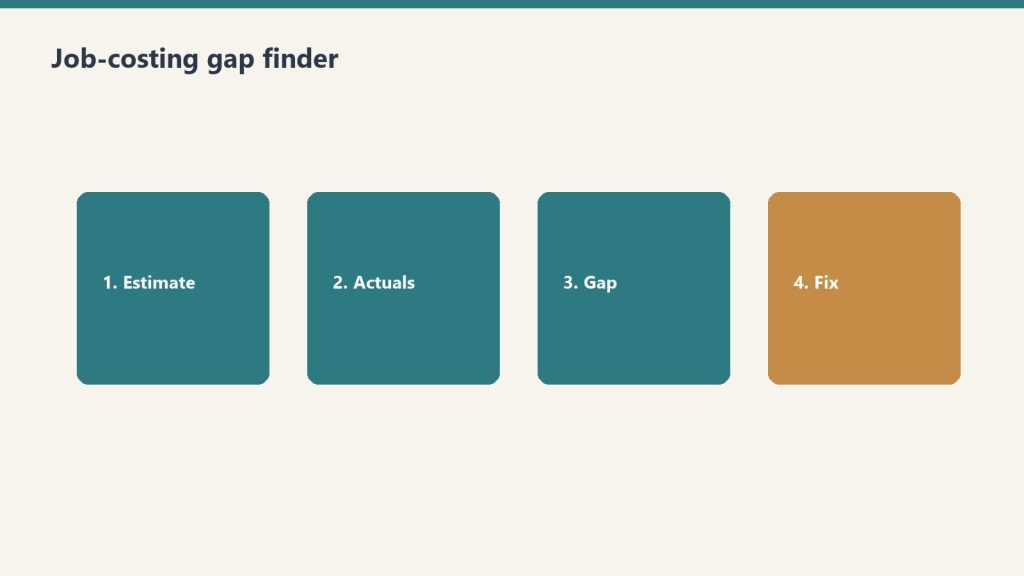
    Four-step flow: estimate, actuals, gap, fix
    Catch the loser at 50% — not at month-end.

    By the time most owners know a job lost money, they have already done six more like it. Cash in the bank is timing. Gross margin per job is the only number that tells the truth, and most $1M-$15M shops cannot name it until the bookkeeper closes the month three or four weeks later.

    You do not lose money on one weird job. You lose it on a type of job you keep taking. The playbook’s example: a 30% water-mit job that needed 45%, run forty of them on $600K of revenue, and you gave away $90,000 of gross profit. A bad pattern, not a bad month. Fast costing exposes the pattern.

    The table to build

    One row per job. These columns:

    • Job (name or file number)
    • Loss Type: Water, Fire/Smoke, Mold, Storm, Contents, Reconstruction, Other
    • Invoiced $
    • Estimated Cost $
    • Actual Cost $
    • Labor Over/Under $
    • Equipment Over/Under $
    • Materials Over/Under $
    • Subs Over/Under $
    • Cost Variance $: estimated cost minus actual cost (formula)
    • Gross Margin %: (Invoiced – Actual Cost) ÷ Invoiced (formula)
    • Biggest Leak: Labor, Equipment, Materials, Subs, Scope/Estimate, or None
    • Notes: who estimated, which crew, anything that explains the gap

    Do not clean the numbers up. Enter what actually happened.

    The four cost buckets

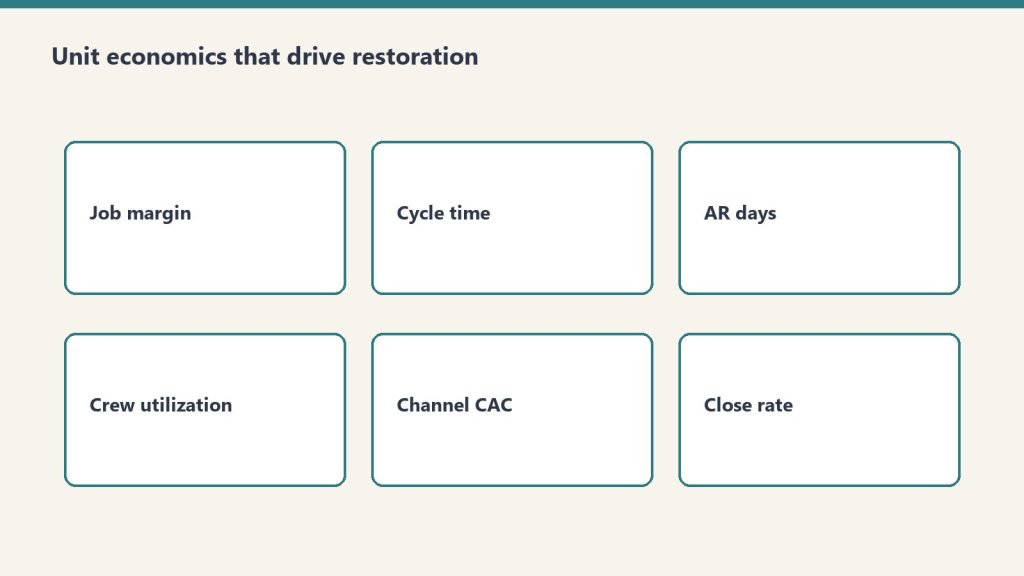
    Six cards covering job margin, cycle time, AR days, utilization, CAC, close rate
    Four cost buckets — same unit-economics lens.

    Labor is the #1 leak, three ways. Hours running over estimate. Unbilled drive and idle time (truck leaves at 7, tarp goes down at 9:15). Crews stretching a “full day” on T&M. None of it shows unless you cost labor against the estimate, job by job.

    Equipment is the silent under-track. Units sitting on a job that closed days ago, still not picked up, never billed for the extra dry days. You own 40 air movers; on any given week some are “lost” on completed jobs, off-rent, earning nothing.

    Materials is smaller but real. Over-ordering, the partial pallet that walks off, the antimicrobial you used and forgot to line-item. A 5-8% materials slippage on a materials-heavy reconstruction job adds up across a year.

    Subs is margin compression you agreed to. Sub invoice higher than what you billed the carrier. Verbal scopes. Change orders not documented. A 10% markup when the job needed 20%.

    How to run ten jobs

    1. Pull invoices, labor hours, equipment logs, and sub invoices for your last 10 closed jobs.
    2. Enter one row each. Invoiced, estimated cost, actual cost, and the four over/under columns.
    3. Let Gross Margin % and Cost Variance $ calculate. Sort low margin to high. The jobs at the top are the money-losers. Name them.
    4. Cross-check labor. Flag every job where actual hours beat estimate by more than 10%. Look for the pattern: same job type, same crew, same estimator.
    5. Tag Biggest Leak on each row. Be honest. If the work was performed and never priced, that is Scope/Estimate, not Labor.
    6. Pick the one money-loser with the biggest gap. Write a single sentence: what leaked, and in which bucket. That sentence is your first plug.

    Catch the loser at 50%, not at month-end

    On every significant job, run a mid-job margin check at the halfway point. Pull actual labor hours and equipment days to date. Compare them against where they should be for percent complete. If a $40K job is 50% done and you have already spent 70% of the labor budget, you have a right-now problem: tighten the crew, escalate the scope with the adjuster, or stop the bleed.

    Close-out cost within 3-5 days of the final visit. Every job. No exceptions. While the crew remembers, while the equipment log is fresh, while you can still bill the carrier for that supplement. That turns job costing from a rear-view report into a steering wheel.

    If Scope/Estimate keeps winning

    Filter Biggest Leak = Scope/Estimate. Sort by Cost Variance. Group by Loss Type and by estimator (use Notes). You are hunting the repeating miss: detach & reset, PPE, monitoring labor, containment, equipment days, after-hours, content manipulation. Name the estimator-plus-job-type combination with the biggest consistent negative variance. That is this week’s coaching conversation.

    What good looks like

    Five zone panels: estimating, job costing, cash/AR, sales, leadership
    What good looks like: gaps found mid-job, not in autopsy.
    • Gross margin ≥ 45% on a blended basis, and you know it by number, not by feel.
    • Job margin known within days of close, not weeks.
    • No surprise losers. Every significant job gets a mid-job check.
    • Labor costed against estimate on every job. Equipment never sits off-rent on a closed file.

    Log this batch’s blended margin as your baseline. Update it monthly so margin is a trend line you watch.

    If you want the packaged table

    You can build the columns in any spreadsheet. Buy Now is the Notion database delivered by email after checkout: the fields, the Loss Type and Biggest Leak selects, and the Gross Margin % and Cost Variance formulas already in. Duplicate it and enter the ten jobs. Same Square button at the top of this page.

    Related on Tygart Media: profit leak scorecard · profit detective · restoration cash flow.

  • Accountability Conversation Planner

    Accountability Conversation Planner

    Accountability Conversation Planner

    $39

    Delivered by email after checkout.

    Buy Now →

    Secure checkout via Square — all major cards accepted

    You can copy this method and do it yourself. Plan a hard conversation before you have it, so it stays about the work, not the person. Buy Now is the packaged Notion planner you duplicate for each talk, so you are not rebuilding the six prompts from a blank doc.

    Tool #4 of the Restoration Leadership Toolkit. Use this when an employee, manager, or family member in the business keeps missing the mark and you have been avoiding the talk. Ten minutes of prep keeps the conversation calm, specific, and fixable.

    Most restoration owners handle performance problems the same way. They tolerate underperformance for too long. They address it once, informally, in a conversation that does not result in change. They tolerate it some more. Then they either fire the person abruptly, often in response to a specific incident rather than the pattern, or they keep tolerating it because replacing people is painful. Neither outcome serves the business. The people who are performing well watch this and conclude that performance does not matter here.

    How to use it

    Restoration technicians training in a shop bay with equipment demo and whiteboard
    Accountability conversations — six prompts, one script.
    1. Duplicate a page so the blank stays clean for next time.
    2. Work through prompts 1 through 6 in order. Be specific. Vague prep makes for an emotional conversation.
    3. Draft your opening line and close from the script outline, then set a follow-up date.
    4. Keep your notes factual. This is a planning doc, not a personnel record. Log formal actions where your policies require.

    Fill the situation first: who this conversation is with; their role / relationship to the business; the date you plan to have it; where (private, not on the job site, not by text).

    You cannot hold someone accountable for expectations you have not communicated clearly. If the standard was never spelled out, that is on you to own in the room, and to fix going forward. Accountability without support is just pressure.

    The six prompts

    Three panels showing one problem, three options, one recommendation
    Six prompts that keep the talk specific.

    1. What is the actual issue?

    One or two sentences. The pattern, not a single bad day. Name the business impact: missed deadline, blown margin, safety, crew morale, a client complaint. Strip out the frustration and the personality read.

    Accountability is forward-looking: what went wrong, what is the standard, how do we close the gap? Blame is backward-looking and personal. Stay on the first one.

    2. What specific behavior needs to change?

    An observable action someone could see on a camera. “Calls in after the crew is already on site,” not “doesn’t care.” If you cannot point to the behavior, you are not ready to have the talk yet.

    “Do good work” is not an expectation. “Complete moisture documentation within 2 hours of equipment placement, using the standard form, with readings at all points on the moisture map” is an expectation. The more specific the expectation, the more possible accountability becomes.

    3. What have I already allowed or tolerated?

    Be honest. Where did I let this slide, stay quiet, or fix it myself instead of addressing it? Naming your part keeps the conversation fair and stops it from sounding like an ambush.

    The most powerful signal in any shop is what the leader does, not what the leader says. If you have been the one quietly finishing their job file, they learned the standard was optional.

    4. What expectation needs to be clarified?

    State the standard plainly, the way you would want it repeated back. “On site by 7:00, truck stocked the night before.” If this was never spelled out, own that in the room.

    For each role you eventually need written performance standards: output (what they produce), behavior (how they show up), and development (what they are working to improve). Share them at hire and review them at every performance discussion. The planner is the prep for one talk. The standards are what make the next talk shorter.

    5. What consequence or support is needed?

    Both sides. What changes if the behavior continues (the consequence) AND what you will provide to help them succeed (training, a checklist, a ride-along, clearer priorities).

    If doing good work and doing poor work produce the same outcome, the same pay, the same treatment, the same opportunities, there is no accountability mechanism. Consequences must exist and must be applied consistently. That cuts both ways: recognition for excellent work, and a real next step when the standard is missed.

    6. What does success look like in 30 days?

    Concrete and measurable, so you both know if it worked. “Zero late starts for four weeks.” “Job files closed within 48 hours.” This becomes the check-in agenda on the follow-up date.

    The longer the gap between a performance miss and the feedback, the weaker the feedback becomes. Address it in the moment or as soon as you can. Then put the 30-day target on a calendar so the talk is not a one-off.

    Conversation script outline

    Five beats. Keep it calm and short. Say your piece, then listen. Fill the blanks from your answers above.

    • Open (set the tone): “I want to talk through [issue] because I think you can do this well and I have not been clear. This is not about [personality].”
    • Name the issue + behavior (1 and 2): “What I am seeing is [behavior]. The impact on the business is [impact].”
    • Own my part (3): “I have let this go without saying anything, and that is on me. Clarifying now.”
    • State the expectation + support (4 and 5): “Going forward the standard is [standard]. To help, I will [support]. If it keeps happening, [consequence].”
    • Confirm the 30-day target + listen (6): “In 30 days, success looks like [target]. What is your take. What would help, and is any of this off?”

    Write their response under the script. Do not argue it in the room. Listen, then come back to the standard and the 30-day target.

    Follow-up

    Restoration SOP clipboard with checklist, moisture meter, and gloves on a jobsite table
    Follow-up is the accountability — write the next check-in.
    • Follow-up check-in date
    • What I will look at on that date (from Prompt 6)
    • Outcome: On track / Needs another conversation / Resolved

    This planner is Weeks 9-10 of the 90-Day Doer-to-Leader Transition Plan: hold one real accountability conversation this phase, and have your developing manager run the huddle at least once while you sit in. A weekly 15-minute huddle with a fixed agenda (numbers, jobs at risk, who needs what) is the rhythm that makes the hard talk less of a surprise.

    A prompt you can give your own Claude if you want it walked: walk me through these six prompts for this specific situation and hand back a finished script and 30-day follow-up, in our company’s voice.

    If you want the packaged planner

    You can run the six prompts on a legal pad. Buy Now is the Notion page delivered by email after checkout. Duplicate it (··· → Duplicate) for each conversation so the master stays clean. The situation block, the six prompts, the script outline, and the follow-up are already laid out. Same Square button at the top of this page.

    Pairs with the Leadership Readiness Checklist (does accountability live below you, or are you the only enforcer) and the 90-Day plan. Matching Claude skill: accountability-planner. Coaching and operational tool only. Not legal or HR advice. This is a planning doc, not a personnel record.

    Related: Restoration Leadership Toolkit — Claude Edition. Also 1-3-1 Delegation Worksheet.

  • 5 Ds Succession Risk Checklist

    5 Ds Succession Risk Checklist

    5 Ds Succession Risk Checklist

    $29

    Delivered by email after checkout.

    Buy Now →

    Secure checkout via Square — all major cards accepted

    You can copy this method and do it yourself. Stress-test the company against Death, Divorce, Disease, Drugs/dependency, and Departure/Disaster. Check a box only if it is true and current today. Buy Now is the packaged Notion checklist with the scored sheet and mitigation notes, so you are not rebuilding the 5 Ds from a blank doc.

    Succession is not a retirement problem. It is a what-if-tomorrow problem. The blank boxes are your exposure. Honesty rule: a box you want to be true is still a blank box. Half-true protections fail exactly when the D hits.

    How to run it

    Five colored panels labeled Do, Delegate, Defer, Delete, Decide
    Run the 5 Ds as a risk checklist — not a slogan.
    1. Walk each of the 5 Ds. Check a box only if it is true and current today. Not “mostly.” Not “we talked about it once.”
    2. Read the mitigation note under each D. That is the concrete fix for the boxes you left blank.
    3. Count the blanks. Find your band. Pick your top 3 shore-ups. Name an owner and a date.
    4. Re-run it every year, and immediately after any life or business change: a new partner, a marriage or divorce, a major new account, an acquisition, or a health scare.

    1. Death. If you died tomorrow

    If you were gone permanently, could the business survive the week, pay people, and not get sold for scraps?

    • There is a current, signed will and the business is named in it.
    • There is a buy-sell agreement (if there are partners) defining who buys your share, at what price, and how it is funded.
    • Key-person life insurance exists on you, payable to the company, sized to cover payroll plus obligations while it stabilizes.
    • At least one other person can sign checks (signatory on file at the bank, not just “knows the login”).
    • Someone other than you can legally bind the company (contracts, AOBs, subcontracts). Documented authority, not assumed.
    • Your spouse / heirs know who to call and where the documents live.
    • Passwords, accounts, and licenses are in a recoverable place a trusted person can reach.
    • A named person can run production and keep jobs moving for 30+ days without you.

    Mitigation. Get a buy-sell drafted by an attorney and fund it with life insurance. An unfunded buy-sell is a wish, not a plan. Add a second check-signer and a documented officer who can bind the company. Put credentials in a password manager with an emergency-access contact. Write a one-page “if I am gone” sheet. Tell your spouse where it is.

    2. Divorce. If your marriage ended

    A divorce can put your ownership stake, your cash, and your focus in play. A contested split can starve a cash-hungry shop.

    • You know whether the business is separate vs marital/community property in your state. Confirmed, not guessed.
    • There is a prenup, postnup, or buy-sell provision that addresses ownership in a divorce.
    • The business is not commingled with personal finances (clean books, separate accounts, documented owner pay).
    • A current, defensible valuation (or a method to set one) exists.
    • Your spouse’s role and any claim (employee, owner-on-paper, guarantor) is documented.
    • Operating cash and credit lines are structured so a personal dispute cannot freeze payroll.

    Mitigation. Talk to a business attorney about a postnuptial or a buy-sell clause that fixes ownership treatment now, while things are calm. Clean up commingling. Establish a valuation method in writing. Calm is the only time you can do it.

    3. Disease. If you were medically out for 30-90 days

    Not death. A heart attack, a serious diagnosis, a bad accident. You are alive but out. Does the company idle or run?

    • Someone can run daily production and dispatch without you for 30, 60, 90 days. Named, and they have actually done it (vacation test).
    • Estimates still get written and approved if you are the estimator. A backup exists.
    • Payroll, AP, and AR keep running without your hands on them.
    • Carrier / TPA relationships will not collapse if you are unreachable. Someone else has the relationships and portal access.
    • You carry disability income insurance so household income does not depend on you working.
    • Business overhead expense (BOE) insurance or a cash reserve can cover fixed costs while you recover.
    • A simple interim chain-of-command is written down, with dollar/decision thresholds.

    Mitigation. Run a real “two weeks off” test this quarter and watch what breaks. Cross-train a backup estimator. Look at disability and Business Overhead Expense coverage. Write a one-page interim chain-of-command with decision thresholds.

    4. Drugs / dependency. If you (or a key person) became unreliable

    The uncomfortable one. Substance issues, gambling, burnout, a mental-health crisis. Yours or a key person’s. The risk is a slow decline, not a clean exit.

    • No single person (including you) is a single point of failure whose impairment would quietly sink the company.
    • Financial controls exist (dual approval over a threshold, reconciliations, a second set of eyes on the books).
    • A trusted advisor or peer would tell you the truth if your performance was slipping, and has standing to.
    • Key roles have documented duties and cross-coverage.
    • There is an employee assistance path / clear policy for getting a valued person help without an instant, messy termination.
    • If a key person had to be removed fast, you could. Access and knowledge are not locked solely in their head.

    Mitigation. Dual approval over a dollar threshold, monthly reconciliations, a second set of eyes on the books. Document and cross-train so no one person can sink a function. Put a real advisor in your corner who is allowed to tell you the truth. Have a humane path to help and the access to act fast if you must.

    5. Departure / disaster. If a key person walked, or the building burned

    Two faces of the same risk: a critical person quits, or a fire/flood/storm/cyber event takes out your office, fleet, data, or a major account overnight.

    • Production runs if your best PM or lead tech quits Friday. Their knowledge is documented, not tribal.
    • Key customer and carrier relationships are not owned by one person who could walk and take the book with them.
    • A non-solicit / non-compete / confidentiality agreement is in place where appropriate and enforceable in your state.
    • Critical SOPs, pricing, and account knowledge are written down. Losing one person does not erase how the work gets done.
    • Data is backed up off-site (estimating files, photos, accounting, contacts) and you have actually tested a restore.
    • You have a business continuity / disaster plan for your own office or fleet. You restore others. Are you covered?
    • Business-interruption insurance would replace income if you could not operate for weeks.
    • A backup vendor/equipment plan exists so one lost truck, warehouse, or sub does not stall live jobs.

    Mitigation. Document tribal knowledge. Spread customer and carrier relationships across more than one person. Put reasonable non-solicit/confidentiality agreements in place (attorney confirms enforceability in your state). For disaster: off-site backups you have test-restored, a written continuity plan for your own shop, business-interruption coverage, and a backup equipment/vendor list.

    Overall exposure rating

    Four-phase board covering a 12-week owner freedom transition
    Overall exposure rating after all five Ds.

    Count your blank boxes across all 5 Ds. The packaged checklist scores 45 boxes. Find your band:

    • 0-6 Low / Resilient. The business could survive a major shock to you. Maintain it. Review annually and after any big change.
    • 7-15 Moderate. You would survive a short absence but a permanent loss would hurt. Close the highest-stakes gaps (Death + Disease) first.
    • 16-27 High. A 30-day absence would seriously disrupt the company. A permanent loss could end it. Treat this as a current-quarter priority.
    • 28+ Critical / You are the company. If something happened to you tomorrow, the business likely does not survive intact. Start the top-3 shore-ups this week.

    Write three lines: blank-box total, exposure band, and which D scored worst.

    Top 3 shore-ups

    Restoration SOP clipboard with checklist, moisture meter, and gloves on a jobsite table
    Top 3 shore-ups — write the next actions.

    Pick the three blank boxes that would hurt most if the D hit tomorrow. Be specific. Name an owner. Set a date.

    Most shore-ups need one of these professionals: a business / estate attorney (buy-sell, will, non-competes, postnup); an insurance agent (key-person life, disability, BOE, business-interruption); a CPA / financial advisor (valuation, financial controls, continuity reserve).

    This is an awareness and planning tool, not legal, financial, or insurance advice. Use it to find your gaps and to walk into the attorney, agent, and CPA prepared.

    If you want the packaged checklist

    You can run the five lists on a legal pad. Buy Now is the Notion page delivered by email after checkout. Duplicate it (··· → Duplicate) so the master stays clean. The boxes, the mitigation notes, the score table, and the top-3 shore-ups are already laid out. Same Square button at the top of this page.

    Pairs with the Owner Dependency Audit (what breaks if you vanish 30 days) and the Restoration Leadership Bench Builder (who can run production when a D hits). Matching Claude skill: succession-5ds-checklist.

    Related: Restoration Leadership Toolkit — Claude Edition. Also 90-Day Doer-to-Leader Transition Plan.

  • JBLM Workforce Pipeline: Filling Pierce County Jobs

    JBLM Workforce Pipeline: Filling Pierce County Jobs


    Every spring, a quiet handoff happens at the south end of Pierce County that does more for the local labor market than any single hiring announcement you’ll read about. Thousands of soldiers and airmen at Joint Base Lewis-McChord begin the months-long process of taking off the uniform — and a growing share of them never leave the South Sound. They become the diesel techs, project managers, IT administrators, and small-business owners that Tacoma-Lakewood employers spend the rest of the year trying to recruit. In a softening local job market, that pipeline is one of the most underappreciated economic assets the region has.

    JBLM Is the Engine, and the Numbers Are Hard to Overstate

    Joint Base Lewis-McChord is the fourth-largest employer in Washington State, trailing only Amazon, Boeing, and Microsoft. The base employs more than 40,000 active duty, Guard, and Reserve members and provides jobs for roughly 15,000 civilian employees, making it the single largest government-sector employer in Pierce County (South Sound Business).

    The ripple effect reaches far past the front gate. In federal fiscal year 2023, $622 million in contracts and $11.3 million in grants flowed into Pierce County, with Department of Defense and U.S. Coast Guard spending supporting 229 industries and 533 local contractors. Procurement activity alone sustained more than 6,000 jobs across Pierce and Thurston counties and generated roughly $681.4 million in gross state product, plus nearly $62 million in state and local tax revenue (South Sound Business). Notably, 41 percent of that defense contract spending — about $211 million — went to commercial and institutional building construction, which is exactly the kind of work that hires locally and pays well.

    But the headline number isn’t the payroll or the procurement. It’s the people. As the University of Washington’s economic impact analysis of the base has put it for years, JBLM’s most durable contribution to the region is producing “a trained, diverse, and disciplined labor pool” that flows into civilian employers as service members separate (UW Michael G. Foster School of Business). That pool refills every single year.

    The Transition Machinery: TAP, Career Skills, and SkillBridge

    The pipeline from active duty to a Pierce County paycheck runs through three connected programs, and understanding how they fit together is the difference between a fully staffed shop and a chronic vacancy.

    Transition Assistance Program (TAP)

    TAP is the mandatory front door. Every separating service member moves through it, and at JBLM the work happens at the Hawk Career Center, which helps soldiers build a transition training schedule, translate military experience into civilian résumé language, and line up next steps. Transitioning members can reach the JBLM TAP outreach team at (253) 967-3258 or through the base’s transition office (Army.mil — JBLM TAP).

    Career Skills Program (CSP)

    CSP is where the rubber meets the road for employers. The Army uses it to connect transitioning soldiers — within 180 days of separation — to pre-apprenticeships, apprenticeships, on-the-job training, and internships with civilian companies, all while the soldier is still drawing military pay (JBLM MWR Employment Readiness). For a Tacoma-area contractor, that means you can train a candidate to your standards before they’re ever on your books.

    DoD SkillBridge

    SkillBridge is the national version of the same idea, and it is large: the Department of Defense program places transitioning members into employment training, internships, and apprenticeships at more than 3,000 partner organizations nationwide. Eligibility requires at least 180 continuous days on active duty, completion within the member’s final 180 days of service, and command approval (U.S. Department of Veterans Affairs). Pierce County employers who register as SkillBridge partners effectively get a months-long working interview with a vetted, disciplined candidate at no payroll cost.

    Where WorkForce Central Picks Up the Baton

    The military hands transitioning members off, but it doesn’t place them in local jobs by itself. That’s where the regional workforce system matters. WorkForce Central operates the WorkSource Pierce network, including a presence that serves the JBLM community directly, helping retiring service members move into civilian careers (WorkForce Central — WorkSource Pierce).

    These connections show up at the hiring-event level too. A recent JBLM job fair was sponsored jointly by the base’s Veterans Employee Resource Group, WorkSource, and TAP, and drew employers and agencies including the Washington State Department of Veterans Affairs and the VA Apprenticeship Program (U.S. Army). For skilled-trades employers in particular, those fairs are some of the highest-yield recruiting hours available in the South Sound.

    The Timing Matters: A Cooling Tacoma-Lakewood Labor Market

    Here’s why this pipeline deserves more attention in 2026 than it usually gets. The Tacoma-Lakewood labor market — which is Pierce County, functioning as a metropolitan division within the larger Seattle-Tacoma-Bellevue MSA — has been cooling. Pierce County’s unemployment rate stood at 5.3% in March 2026, with about 26,362 residents counted as unemployed. That was actually an improvement from February’s 6.1%, and employers added 1,000 jobs month-over-month for a total of 344,000 jobs on local payrolls (Washington Employment Security Department).

    But zoom out and the trend is softer. Tacoma-Lakewood posted the largest year-over-year unemployment increase of any tracked metro division in the state from February 2025 to February 2026, rising 1.4 percentage points — a clear signal of a slowing local economy (U.S. Bureau of Labor Statistics). When organic job growth slows, the steady annual supply of transitioning JBLM talent becomes proportionally more valuable. It’s countercyclical labor: the base keeps producing trained workers regardless of where the hiring cycle sits.

    What This Means for Pierce County Employers and Veterans

    For an employer, the practical takeaway is to stop treating the base as a backdrop and start treating it as a recruiting channel. Registering as a SkillBridge or Career Skills Program host site puts your business in front of candidates months before they separate. Construction, advanced manufacturing in places like Frederickson, logistics tied to the Port of Tacoma, and the skilled trades are natural fits — these are roles where military discipline, security clearances, and hands-on technical training transfer almost directly.

    For the transitioning service member, the message is equally direct: start at the Hawk Career Center early, ask specifically about CSP and SkillBridge slots with local employers, and connect with WorkSource Pierce before your terminal leave begins. Veteran entrepreneurship is also a real path here — the same discipline that runs a platoon runs a small business, and Pierce County’s defense-adjacent contracting base offers a customer set that values that background.

    The South Sound spends a lot of energy chasing the next big employer announcement. Meanwhile, one of its most reliable workforce engines has been running at the south end of the county the whole time — and in a year when the local market needs every advantage it can get, the JBLM transition pipeline is exactly the kind of edge worth building a strategy around.

    Frequently Asked Questions

    How many people does Joint Base Lewis-McChord employ?

    JBLM employs more than 40,000 active duty, Guard, and Reserve members plus roughly 15,000 civilian employees, making it the fourth-largest employer in Washington State and the largest government-sector employer in Pierce County.

    What is the difference between TAP, Career Skills Program, and SkillBridge?

    TAP (Transition Assistance Program) is the mandatory transition curriculum every separating service member completes. The Career Skills Program (CSP) connects soldiers to apprenticeships, on-the-job training, and internships within 180 days of separation. DoD SkillBridge is the national program that places transitioning members with civilian employers during their final 180 days of service. CSP and SkillBridge let employers train candidates before formally hiring them.

    How can a Pierce County employer hire transitioning JBLM service members?

    Employers can register as a SkillBridge or Career Skills Program host site to access candidates before separation, attend JBLM-hosted job fairs run with WorkSource and the base’s Veterans Employee Resource Group, and partner with WorkForce Central’s WorkSource Pierce network to connect with veteran job seekers.

    What is the current unemployment rate in the Tacoma-Lakewood area?

    Pierce County, which comprises the Tacoma-Lakewood Metropolitan Division, had an unemployment rate of 5.3% as of March 2026, down from 6.1% in February 2026. The county had about 344,000 jobs on payrolls and roughly 26,362 residents counted as unemployed, per the Washington Employment Security Department.

    How big is JBLM’s economic impact on Pierce County?

    In federal fiscal year 2023, JBLM-related federal spending brought $622 million in contracts and $11.3 million in grants into Pierce County, supported 533 local contractors across 229 industries, sustained more than 6,000 procurement-linked jobs in Pierce and Thurston counties, and generated roughly $681.4 million in gross state product and nearly $62 million in state and local tax revenue.

  • Tacoma Workforce Training: Building Pierce County Talent

    Tacoma Workforce Training: Building Pierce County Talent

    If you run a manufacturing shop in Frederickson, a clinic on the Hilltop, or a logistics operation near the Port, you already know the hardest part of growing in Pierce County isn’t demand — it’s people. The good news, and it doesn’t get nearly enough ink, is that Tacoma sits on top of one of the most layered post-secondary talent pipelines in the South Sound. Between a technical college that trains apprentices in six state-approved trades, a second technical college that opened a brand-new community campus in 2025, a private university quietly graduating nurses into a chronically short-staffed sector, and a public research university downtown, the machinery to staff this city’s growth is already humming. The trick for local employers is knowing how to plug into it.

    This is the higher-ed and apprenticeship layer of the story — distinct from the K-12 pipeline and the new Maritime 253 program that Tacoma Public Schools opened in September 2026 (tacomaschools.org). Here’s how the colleges feeding Tacoma’s economy are positioned for the 2026-27 academic year, and where the real openings are.

    Bates Technical College: The Apprenticeship Backbone

    Bates Technical College, anchored at its downtown campus at 1101 S. Yakima Ave, is the closest thing Tacoma has to a dedicated trades-and-apprenticeship engine. Bates works with six Washington State-approved apprenticeship training partners spanning fields from aerospace to construction. The model is the part employers tend to underrate: apprentices earn wages at a percentage of the journey-level rate while they work in the field, then attend classes part-time — usually evenings — for one to five years. On completion they receive a journeyman-level certificate from the Washington State Department of Labor & Industries Apprenticeship & Training Council (batestech.edu).

    That earn-while-you-learn structure is exactly what cash-strapped young workers and budget-conscious employers both need. Eligibility is deliberately wide: typically a high school diploma or GED, a minimum age of 16, and the aptitude to complete the program.

    The AJAC Manufacturing Academy Lands at Bates

    The most concrete near-term opportunity sits inside Bates’ downtown campus. The Aerospace Joint Apprenticeship Committee (AJAC) runs its no-cost Pierce County Manufacturing Academy there, where its 2026 cohort ran April 1 through June 10, 2026. The next class runs January 12 through March 24, 2027, meeting 8:00 a.m. to 2:00 p.m. (ajactraining.org). The academy is hands-on prep that funnels graduates toward registered apprenticeships — including aerospace machinist roles — backed by AJAC’s Career Navigation Team. AJAC partners with more than 40 manufacturing companies in Pierce County alone, building products for aerospace, defense, automotive, medical, food processing, and plastics. For a region trying to capitalize on the manufacturing magnet forming in Frederickson, that’s a direct conveyor belt from classroom to shop floor. Requirements are straightforward: Washington residency, 18 or older, legal authorization to work in the U.S., and full attendance.

    Clover Park Technical College: Scale, Aviation, and a New Front Door

    Just down I-5 in Lakewood, Clover Park Technical College (CPTC) brings the scale. CPTC offers more than 120 certificate or degree options across seven schools — Aerospace & Aviation; Automotive & Trades; Advanced Manufacturing; Business & Personal Services; Health & Human Development; Nursing; and Science, Technology, Engineering & Design (cptc.edu). Its aviation program runs out of the South Hill Campus near Thun Field, feeding graduates toward major and regional airlines, repair stations, and aircraft component manufacturers.

    CPTC also broke ground on credential ladders early: it was the first two-year college in Pierce County to offer a baccalaureate degree, the Bachelor of Applied Science in Manufacturing Operations. That matters because it lets a worker start as a mechatronics technician and climb to a four-year applied degree without leaving the regional system.

    The Eastside Training Center: College Comes to the Neighborhood

    The newest development is geographic. In January 2025, CPTC opened the Eastside Training Center at East 60th and McKinley Avenue in Tacoma, in partnership with WorkForce Central and the City of Tacoma (blog.cptc.edu). The center deliberately targets communities that haven’t traditionally been well served by higher education, blending CPTC’s skills training with WorkForce Central services that connect job seekers, employers, and community organizations under one roof. Early programming includes HVAC training and Running Start access for high schoolers. For Tacoma’s East Side, it’s the difference between a 30-minute drive to Lakewood and a walkable front door.

    The Invista-to-CPTC Corporate Education Shift Employers Should Know About

    Here’s a piece of institutional history that still trips up local business owners. Invista Performance Solutions — the long-running collaboration of Pierce County community and technical colleges that delivered customized employer training in lean process improvement, leadership, ESL, and industrial skills — was formally dissolved on June 30, 2023. Clover Park Technical College, Pierce College District, and Tacoma Community College ended the limited liability partnership, and Invista’s training professionals were brought on directly at CPTC (choosetacomapierce.org).

    What that means in practice: if you’re an employer who used to call “Invista” for a custom training contract, that capacity now lives inside Clover Park Technical College Corporate Education. The offerings — and crucially, access to Washington State’s Job Skills Program (JSP) matching grant, which can offset the cost of training built to your company’s specific needs — carried over. If your last conversation about workforce training predates mid-2023, it’s worth a fresh call.

    Pacific Lutheran University: The Nursing and Business Pipeline

    On the private side, Pacific Lutheran University (PLU) plays a different but essential role. PLU offers more than 40 undergraduate majors and graduate programs across business, education, kinesiology, marriage and family therapy, and nursing, with a total undergraduate enrollment of 2,446 as of fall 2024 (plu.edu). For a regional economy fighting a healthcare staffing shortage, PLU’s School of Nursing is the standout. It runs a traditional BSN and an Entry-Level Master of Science in Nursing (ELMSN) on the Tacoma campus, plus an accelerated BSN in Lynnwood — all accredited by the Commission on Collegiate Nursing Education (plu.edu/nursing). Those graduates feed directly into MultiCare, CHI Franciscan, and the rest of the South Sound’s clinical employers.

    UW Tacoma: The Four-Year Anchor Downtown

    The University of Washington Tacoma is the research-university anchor of the whole system, with seven schools offering more than 50 undergraduate majors and minors and 15 graduate degree programs, including engineering and technology tracks that align with the region’s advanced-manufacturing and tech ambitions (tacoma.uw.edu). One programmatic note for prospective students: UW Tacoma’s Educational Administration program is on pause from summer 2026 to summer 2028 and is not admitting new students during that time; the school refers interested educators to UW Bothell’s Leadership Development for Educators program (tacoma.uw.edu).

    Reading the Enrollment Tea Leaves

    Zoom out and the statewide context shapes what local employers can expect. Washington’s community and technical college system — 34 colleges overseen by the State Board for Community and Technical Colleges (SBCTC) — trains roughly 307,000 people a year for the workforce, transfer, or continuing education (sbctc.edu). Enrollment dropped sharply during the 2020 pandemic and has held steady with modest gains since, though it hasn’t fully returned to pre-pandemic peaks. Community college baccalaureate programs tell the same story — a slight rebound, with certain career clusters gaining share even as the overall number lags.

    The takeaway for Tacoma employers is counterintuitive but useful: a system running below its enrollment peak is a system with capacity. The seats and the training infrastructure exist; the constraint is awareness and the willingness of local companies to build the partnerships — apprenticeship sponsorships, custom training contracts, internship pipelines — that turn classroom capacity into hired workers.

    What This Means for Pierce County Business

    The pieces of Tacoma’s talent engine don’t always talk to each other, but together they cover the map: Bates and AJAC for the skilled trades and manufacturing apprentices, CPTC for aviation, advanced manufacturing, and employer-customized training, PLU for nursing and business, and UW Tacoma for the four-year and graduate anchor. The employers who win the next few years won’t be the ones who post the most job ads. They’ll be the ones who pick up the phone — to AJAC’s career navigators, to CPTC Corporate Education, to a Bates apprenticeship coordinator — and build a pipeline before they need it.

    Frequently Asked Questions

    What is the AJAC Manufacturing Academy and when is the next Tacoma class?

    The AJAC Manufacturing Academy is a free, hands-on manufacturing training program that prepares students for registered apprenticeships and manufacturing jobs. The next Pierce County class runs January 12 through March 24, 2027, from 8:00 a.m. to 2:00 p.m. at Bates Technical College’s downtown campus (1101 S. Yakima Ave, Tacoma). Applicants must be Washington residents, 18 or older, and legally authorized to work in the U.S.

    What happened to Invista Performance Solutions?

    Invista Performance Solutions was dissolved on June 30, 2023, when Clover Park Technical College, Pierce College District, and Tacoma Community College ended the limited liability partnership. Its training staff were hired directly by Clover Park Technical College, and the employer-training function now operates as CPTC Corporate Education — including access to Washington’s Job Skills Program matching grant.

    Where can Tacoma residents get apprenticeship training?

    Bates Technical College is the primary apprenticeship hub in Tacoma, working with six Washington State-approved apprenticeship partners across trades from aerospace to construction. Apprentices earn wages while they work and attend part-time classes, finishing with a state-recognized journeyman-level certificate after one to five years.

    Which Tacoma-area college offers a four-year manufacturing degree?

    Clover Park Technical College was the first two-year college in Pierce County to offer a baccalaureate degree — the Bachelor of Applied Science in Manufacturing Operations — letting students advance from a technician credential to an applied four-year degree within the regional system.

    What is the Clover Park Eastside Training Center?

    The Eastside Training Center is a Clover Park Technical College campus that opened in January 2025 at East 60th and McKinley Avenue in Tacoma, in partnership with WorkForce Central and the City of Tacoma. It brings skills training and workforce services to Tacoma’s East Side, an area historically underserved by higher education, with programming such as HVAC training and Running Start.

    Reporting reflects publicly available information from each institution as of June 2026; the AJAC class dates, the Maritime 253 opening, and the UW Tacoma program pause were updated in October 2026. Program dates, eligibility, and offerings can change — confirm details directly with the school before enrolling.

  • The Restoration Hiring Roadmap: Which Seat to Fill First as You Scale From $1M to $5M

    The Restoration Hiring Roadmap: Which Seat to Fill First as You Scale From $1M to $5M

    The hardest org-chart decision in restoration is not who to hire. It is what order to hire them in. Get the sequence wrong and you spend money on a seat that doesn’t relieve the bottleneck — while the real constraint, almost always you, keeps strangling growth.

    Most owners build their team reactively. A big loss comes in, they’re underwater, so they grab whoever is available — usually another tech. Six months later they have more trucks and the same problem: every job, every estimate, and every collections call still routes through the owner. They added capacity to the field and zero capacity to the bottleneck.

    Here is the honest sequence — the one that actually pulls the owner out of the truck — mapped to the revenue milestones where each hire pays for itself.

    First, Find Your Real Bottleneck (It’s Probably You)

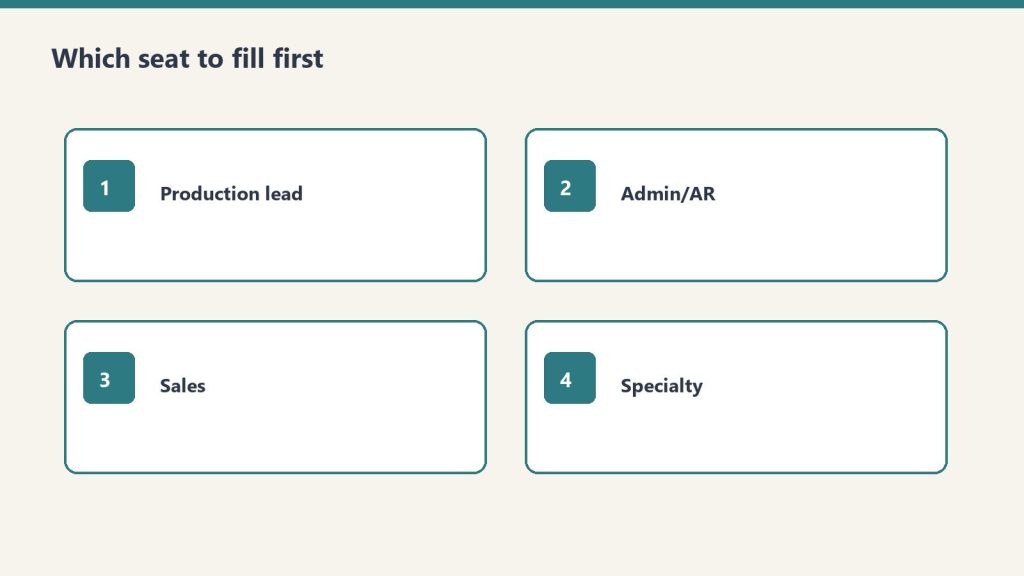
    Four hire-order cards: production lead, admin/AR, sales, specialty
    Find the real bottleneck before you hire more techs.

    Before you hire anyone, do the boring exercise. List every function the company performs — answer the phone, dispatch, scope the loss, write the estimate, run the crew, order equipment, invoice the TPA, chase payment, do payroll. Next to each one, write the name of who actually does it. Count how many times your own name appears. That number is your bottleneck, and the first hire should remove the most expensive, most repeatable item from your list — not the one you enjoy least.

    The trap is hiring for relief instead of leverage. Hiring a third tech feels good because the trucks are full. But if you are still the only person who can scope a loss and write a winning estimate, those trucks just create more work that funnels back to you.

    $0–$1M: You and a Lead Tech

    At startup scale, the org chart is two boxes: you and a strong lead technician. You are the estimator, the PM, the dispatcher, and the collections department. That’s fine — and unavoidable — at this stage. The rule of thumb most operators use is roughly $150,000–$200,000 in annual revenue per field technician before adding the next one, because that’s the point where there is genuinely enough work to keep another body busy and billable.

    The mistake here is hiring a second tech too early to look bigger than you are. Idle techs are the fastest way to torch a thin startup margin.

    $1M–$2M: The First Office Hire — Not Another Tech

    Four-phase board covering a 12-week owner freedom transition
    First office hire — not another tech — unlocks the owner.

    This is the milestone where most owners hire wrong. They add a second or third tech when the seat that actually frees them is administrative. An office coordinator or office manager who owns scheduling, job-file documentation, TPA paperwork, and the collections follow-up is the single highest-leverage hire at this stage. Restoration office and administrative coordinator roles commonly run in the $45,000–$60,000 range depending on market, and that one seat can claw back ten to fifteen owner-hours a week — hours you can redirect into estimating and sales, which are the only two activities that grow revenue.

    The math is simple. If you are personally billing $150-plus per estimating hour and you hand off twelve hours of admin a week to a $55,000 coordinator, the hire pays for itself almost immediately and converts owner time into top-line growth.

    $2M–$3.5M: A Dedicated Estimator / Project Manager

    Once admin is covered, the next thing chained to the owner is almost always scoping and estimating. This is the hardest seat to give up because it feels like the part only you can do — and at first, it is. But a $2M shop cannot scale on a single estimator who is also the CEO.

    Hire a restoration estimator/PM who can scope a loss, write the Xactimate estimate, and manage the job to completion. Expect this to be one of your more expensive seats: restoration project manager and estimator compensation broadly lands in the $60,000–$90,000 range nationally, with experienced, supplement-savvy PMs commanding more in tight labor markets. Plan for a ramp — a new PM rarely writes estimates as tight as an experienced owner on day one, and supplement recovery may dip during the handoff before it recovers.

    This is also where your tech stack starts to matter. If your estimating, job management, and TPA reporting all live in the owner’s head or a spreadsheet, the new PM can’t be effective. The hire and the system have to land together.

    $3.5M–$5M: An Operations Manager and the Owner Comes Off the Truck

    Three panels showing one problem, three options, one recommendation
    Ops manager stage: owner comes off the truck on purpose.

    By this stage you should have a small bench: lead techs, an office manager, and at least one PM/estimator. The seat that defines a $5M shop is an operations manager — someone who is not you and, ideally, not a relative — who owns daily execution: dispatch, crew utilization, equipment, and job throughput. Restoration operations manager pay broadly runs from roughly $63,000 on the lower end to around $89,000-plus for experienced managers, depending heavily on market and revenue scale.

    This is the hire that lets the business survive without the owner physically present. It is also the one that most directly changes what the company is worth. Restoration shops under about $2M tend to trade at roughly 2.8x–3.0x SDE, while companies that cross $5M with a diversified service mix and a real second layer of leadership command 4x–7x EBITDA. Buyers aren’t paying that premium for revenue — they’re paying for an operation that runs without the founder in the dispatch seat. The operations manager is what makes that true.

    A Sanity Check on Labor Cost

    As you build the team, keep the whole picture in view. Healthy restoration shops generally run blended gross margins in the 50–75% range depending on mix — water mitigation sits at the high end (roughly 70–80%) because equipment does much of the work, while reconstruction and fire work run leaner. Well-run operations keep total operating expense, excluding direct job cost, in the rough range of 40–55% of revenue. If a new hire pushes overhead past that band without a clear path to more billable throughput, you’ve hired ahead of your revenue — slow down and fill the pipeline before you fill the seat.

    The Bottom Line

    The order is admin, then estimator/PM, then operations manager — and only more techs as billable volume genuinely demands them. Hire to remove yourself from the bottleneck, not to make the trucks look full. The owners who hit $5M and sell at a 4x-plus multiple are not the ones who hired the most people fastest. They’re the ones who hired the right seat next, every time, until the day the business no longer needed them in the truck.

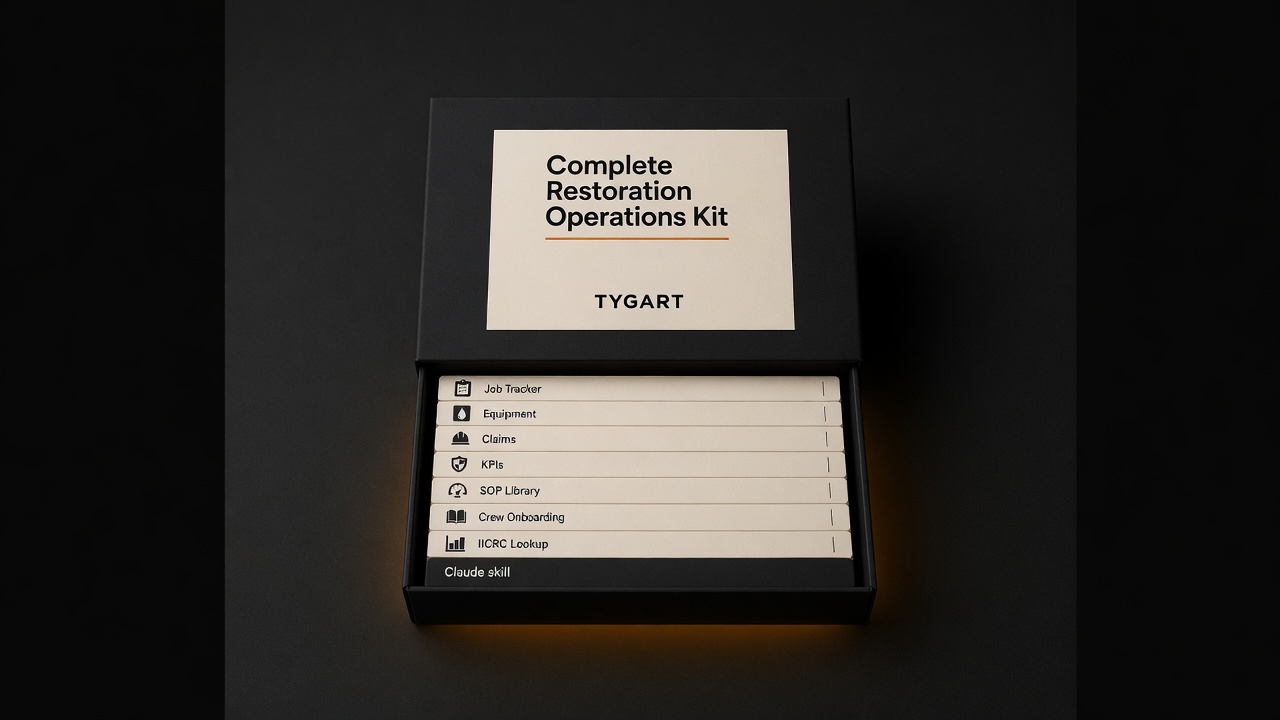
    If you’re still running the whole company from the van, the Complete Restoration Operations Kit gives you the connected job tracker, equipment, claims, SOPs, KPIs, and crew tools that make those hires actually stick. Pair it with the Restoration Leadership Toolkit — Claude Edition when you’re ready to build the bench that lets you step out of the truck.

  • Accounting Advisory Practice: The Future of CPA Firms

    Accounting Advisory Practice: The Future of CPA Firms

    TurboTax did not kill the accountant. Neither did QuickBooks, H&R Block’s software, or the dozens of automated tax-prep and bookkeeping platforms that have absorbed the procedural floor of accounting work over the last two decades. What they killed was a specific kind of accountant — the one whose business was preparing returns and reconciling books and nothing else. The CPAs and bookkeepers thriving in 2026 are not selling tax returns or bookkeeping work. They are selling something the platforms structurally cannot deliver: a multi-decade trusted advisor relationship that integrates tax, strategy, financial planning, and ongoing business consulting.

    This is the playbook for the accountant who recognizes the floor-and-ceiling shift. It is part of a broader pattern playing out across every service profession.

    What TurboTax and QuickBooks Actually Did

    The accounting software platforms commoditized the procedural floor of the profession in two waves. The first wave, starting in the early 2000s, was the consumer tax software taking over simple personal returns. TurboTax made the W-2 return a fifteen-minute exercise that anyone could complete without an accountant. The accountants whose business depended on simple personal returns got squeezed.

    The second wave was the small business software taking over routine bookkeeping. QuickBooks, Xero, and the broader small business accounting stack absorbed the day-to-day reconciliation work that used to require bookkeepers and lower-level accounting staff. Combined with bank feeds, automatic categorization, and AI-assisted reconciliation, the bookkeeping floor became cheap enough that any small business could handle most of it internally.

    AI is now adding a third wave on top of these. Document processing, tax research, basic tax return preparation, financial analysis, and advisory drafting are all being absorbed by AI tools that accounting firms are deploying internally. The procedural floor is being compressed yet again.

    The narrative through all of this has been that accounting was being commoditized to death. The narrative was wrong. The accountants whose value was the procedural work got compressed. The accountants who built advisory practices — the trusted advisors, the strategic counselors, the business consultants who happened to do taxes too — became more valuable than ever.

    What the Ceiling Actually Is in Accounting

    The ceiling work in accounting is the trusted advisor relationship, and it operates at a completely different level from tax preparation or bookkeeping.

    The trusted advisor accountant is not preparing the return. They may oversee the preparation, but the actual return preparation is increasingly automated or handled by junior staff with AI assistance. What the advisor is doing is something different. They are the first call when the client is considering whether to take an offer for their business. They are the first call when the client’s parent dies and the estate is complicated. They are the first call when the client is considering a major equipment purchase that will affect cash flow and tax position. They are the first call when the client’s child wants to start a business and needs structural advice.

    The relationship is multi-decade. The accountant knows the client’s business intimately, the client’s family structure, the client’s goals, the client’s risk tolerance, and the client’s history. The annual tax return is the artifact of the relationship, not the product. What the client is buying is the ongoing access to a trusted financial mind that understands their specific situation and is engaged with their decisions on a continuous basis.

    This work cannot be done by software. It cannot be done by AI. It can only be done by a human who has spent years developing genuine knowledge of the specific client’s specific situation, in a profession that requires technical depth and judgment-based integration across tax, finance, business, and personal life domains.

    The Practice Structures That Win

    The accounting firms that have successfully shifted to the advisory model share several specific characteristics.

    They specialize in a defined client segment. Not “small business” in the abstract. A specific kind of small business — restaurants, dental practices, manufacturing companies, professional service firms, real estate investors. The specialization allows the advisor to develop genuine depth in the specific tax, financial, and strategic issues that segment faces. The advisor becomes the recognized expert for that segment in their region, which generates referrals at a rate generalist firms cannot match.

    They sell engagement structures, not transactions. The traditional model bills tax preparation as a discrete annual transaction. The advisory model bills an ongoing retainer that includes the tax work plus continuous advisory access. The client pays monthly or quarterly, knows what they are paying, and uses the access regularly. The economics for the firm are dramatically better because the revenue is predictable and the client utilization of the advisor’s time tends to be more efficient under retainer billing than under hourly billing.

    They build cross-domain integration capabilities. The trusted advisor accountant needs to engage credibly on tax strategy, business strategy, financial planning, estate considerations, and operational decisions. This requires either developing capabilities internally or building strong coordination relationships with the client’s other professionals — financial advisors, attorneys, insurance agents, bankers. The firms that win are the ones whose accountants can credibly coordinate across these domains.

    They use AI and platform tools aggressively for the procedural floor. Tax preparation, document handling, basic research, financial analysis, routine reporting — all increasingly automated. The firms that try to protect this work from automation lose. The firms that automate it and reinvest the time in advisory relationships win.

    They develop their senior staff into advisors deliberately. The traditional accounting career path produced technical specialists. The advisory path requires different skills — relationship management, business strategy, integrative judgment, client communication, comfort with ambiguity. The firms that develop these capabilities deliberately produce advisors. The firms that keep training pure technicians keep producing tax preparers who will be commoditized.

    How a Solo or Small Firm Builds the Advisory Practice

    The transition to advisory work is achievable for solo practitioners and small firms, not just the large national firms. The playbook is more focused but the moves are the same.

    Pick a specific client niche you can serve at advisor depth. Five to ten distinct client types is too many. One or two well-defined niches is right for a solo or small firm. The narrowness is the moat. The advisor who deeply understands the financial life of dental practices in a region will outperform the generalist accountant serving every kind of business.

    Develop the technical depth required for the niche. Not just tax. Tax plus business strategy plus financial planning plus operational issues specific to the niche. Read the trade publications. Attend the conferences. Become genuinely expert in the niche, not just credentialed.

    Build the relationships with the other professionals serving the niche. The attorneys, the financial advisors, the insurance agents, the bankers, the business brokers who specialize in that segment. Your value to clients includes the ability to refer them to other professionals who understand their world. The relationships are the network.

    Convert clients from transactional to retainer engagements deliberately. Most clients in transactional relationships will accept a conversion to retainer billing if the advisor presents the value clearly. The conversion is the moment the business model shifts. Once the retainer is established, the relationship deepens because the client uses the access.

    Use AI and software for the procedural work. Automate everything that can be automated. Spend the time on the advisory work that defines the practice.

    Frequently Asked Questions

    Will TurboTax and QuickBooks replace accountants?

    No. The platforms have commoditized the procedural floor of accounting — simple tax preparation and routine bookkeeping — but cannot replicate the trusted advisor relationship that integrates tax, strategy, financial planning, and business consulting. The accountants whose value was procedural work have been compressed. The accountants who built advisory practices thrive.

    What is a trusted advisor accounting practice?

    It is the practice model where the accountant serves clients on an ongoing retainer basis rather than as discrete annual transactions. The client pays for continuous access to the accountant’s judgment across tax, business, financial, and strategic decisions. The annual tax return is the artifact of the relationship, not the product.

    How do accountants compete with platforms like TurboTax and QuickBooks?

    Not on price or convenience for simple returns and routine bookkeeping. The platforms will always win on those. Accountants win by delivering integrated advisory work — strategic counsel, business consulting, multi-domain coordination, ongoing judgment — that the platforms structurally cannot do.

    What kinds of clients want a trusted advisor accountant?

    Business owners with complex financial lives, high-income professionals coordinating multiple financial decisions, families with significant assets or businesses, and any client whose financial situation involves ongoing decision points where strategic judgment matters. The pool is large and growing as platforms commoditize the simple-return market.

    How does an accounting firm transition from transactional to advisory?

    Pick a specific client niche. Develop genuine depth in that niche. Build coordination relationships with other professionals serving the same niche. Convert existing clients from transactional to retainer engagements deliberately. Use AI and software for the procedural work. Develop staff into advisors rather than pure technicians.

    How long does it take to build an advisory accounting practice?

    Two to three years to establish the niche specialization and the coordination relationships, with significant compounding after year five as the niche reputation generates referrals at a rate that generalist firms cannot match.

    The Bottom Line

    TurboTax and QuickBooks killed the transactional accountant. They did not kill the trusted advisor. The future of accounting is the multi-decade trusted relationship that integrates tax, strategy, financial planning, and business consulting for a specific client niche. The tax return is the artifact. The relationship is the product. This is the floor-and-ceiling pattern that defines the future of every service profession. Build the niche specialization. Build the retainer model. Build the cross-domain capabilities. Become the human advisor the platforms cannot be.


  • Future of Financial Advisors: Comprehensive Life Planning

    Future of Financial Advisors: Comprehensive Life Planning

    The robo-advisors did not kill the financial advisor. Vanguard, Betterment, Wealthfront, Schwab’s robo offering, and the dozen other algorithmic portfolio managers commoditized the procedural floor of investment management — asset allocation, rebalancing, tax-loss harvesting, basic portfolio construction. They made those services free or near-free for any consumer with a phone. They did not touch the ceiling of financial advisory, which is something completely different from portfolio management. The advisors who built that ceiling are thriving at levels they never reached when investment management was the product.

    This is the playbook for the financial advisor who recognizes the floor-and-ceiling shift. It is part of a broader pattern playing out across every service profession that depends on a mix of procedural and relational work.

    What the Robo-Advisors Actually Did

    The robo-advisors collapsed the cost of portfolio construction and basic asset management to near zero. The math underneath modern portfolio theory was never proprietary. The work of allocating across index funds, rebalancing on a schedule, and harvesting tax losses is genuinely amenable to algorithmic delivery. Once the platforms reached scale, the floor pricing for these services dropped to a fraction of what traditional advisors charged.

    The advisors whose entire value was investment management got compressed. The 1% AUM fee for portfolio management without anything else attached became increasingly hard to defend when the same service was available for 0.25% from a robo or close to free from a brokerage platform. The narrative was that the robo-advisors were going to eliminate the human advisor entirely.

    They did not. The advisors whose value had always been more than investment management — the comprehensive planners, the trusted advisors, the financial life coordinators — got more valuable. The robo handled the floor. The ceiling — the integrated multi-decade planning that touches every part of a client’s financial life — became the entire offering. The advisors who built the ceiling business have larger practices, higher per-client revenue, and stronger career stability than the AUM-only advisors of the prior era ever had.

    What the Ceiling Actually Is in Financial Advisory

    The ceiling work in financial advisory is comprehensive life planning, and it is structurally different from investment management in ways that matter for the business model.

    Investment management is about the portfolio. Comprehensive life planning is about the whole financial life. It includes investment management, but the investment management is one component of a much larger offering. The full scope of comprehensive planning includes retirement planning across multiple time horizons, tax strategy coordinated with the client’s accountant, estate planning coordinated with the client’s attorney, insurance review and coordination, education funding strategies, charitable giving structure, business succession planning if applicable, and behavioral coaching during market stress.

    The advisor running a comprehensive practice is not picking stocks. They are integrating decisions across every financial domain in the client’s life over decades. They are the central coordination point for the client’s relationship with their accountant, their attorney, their insurance agent, their banker, their business advisors. They are the person the client calls when something significant changes — a death in the family, a business offer, a divorce, an inheritance, a major health event. They are not selling investment management. They are selling a multi-decade trusted relationship that organizes the client’s entire financial life.

    This is the work that the robo-advisors cannot do, will not do for the foreseeable future, and structurally cannot replicate even when AI gets meaningfully more capable. The integration across domains, the trust built over years, the knowledge of the specific family’s specific situation — none of it lives in algorithms. It lives in the advisor.

    The Behavioral Coaching Layer Is Where the Real Value Lives

    One specific aspect of comprehensive planning deserves its own discussion because it is the part most often missed in conversations about advisor value. The behavioral coaching layer — the work the advisor does to keep clients from making catastrophic decisions during emotional moments — is, by most rigorous measures, the single highest-value contribution an advisor makes over the course of a client relationship.

    When the market is down 40 percent and the client wants to sell everything and go to cash, the advisor’s voice is what prevents the decision that would destroy the client’s retirement. When the client inherits a significant sum and wants to put it all in their cousin’s startup, the advisor’s voice is what slows the decision down. When the client is going through a divorce and wants to make immediate financial changes that will be hard to reverse, the advisor’s voice is what keeps the financial impact of the divorce manageable.

    None of this work is investment management. All of it is comprehensive advisory work. It cannot be done by an algorithm, because the algorithm does not have a relationship with the client and the client does not call the algorithm when they are emotionally distressed. The robo-advisors that have tried to add behavioral nudges to their interfaces have produced exactly nothing of value in this domain, because behavioral coaching is fundamentally about a human relationship that the client trusts under pressure.

    The advisors who deliver real behavioral coaching are the advisors whose practices are the most resistant to robo-advisor compression. Their clients do not leave for lower fees, because the value they receive at the moments that matter is not visible in normal-market conditions and is irreplaceable when conditions are not normal.

    How to Build the Comprehensive Practice

    The advisors who have built genuine comprehensive practices follow a specific playbook.

    Choose a specific client segment to serve deeply. Not “anyone with assets to invest.” A specific life-stage, profession, family structure, or business type that you can become the trusted advisor for. The narrowness is what allows the advisor to develop genuine expertise in the planning challenges of that segment and build the referral network that serves them.

    Build the coordination network across domains. Your clients have accountants, attorneys, insurance agents, bankers. Your job is to coordinate with those professionals and serve as the central integrator of the client’s financial life. The coordination work is invisible to the client most of the time and is exactly what makes the comprehensive offering work.

    Develop genuine planning depth in tax, estate, insurance, and business areas. You do not need to be the deepest expert in each of these. You need to be deep enough to recognize the issues, ask the right questions, and bring in the appropriate specialist when needed. The advisor who is purely an investment manager and refers everything else out is not running a comprehensive practice. The advisor who can credibly engage on tax strategy, estate structure, insurance adequacy, and business succession is.

    Build the behavioral coaching practice deliberately. Document your communication protocols during market stress. Have a defined approach to client outreach during volatility. Be the calm voice the client expects to hear. The advisors who let clients drift away during difficult markets lose them. The advisors who proactively engage during volatility keep them for life.

    Use AI and platform tools for the procedural floor. Portfolio management, performance reporting, routine compliance, basic financial planning calculations — automate or platform-mediate all of it. Spend the time saved on the relational and integrative work that defines the comprehensive practice.

    Price for the relationship, not the assets. The AUM model that worked for the investment management era is becoming increasingly mismatched with the comprehensive planning offering. Flat-fee planning retainers, hourly advisory billing, or hybrid arrangements often better reflect the value delivered and align the economics with what the client is actually paying for.

    Frequently Asked Questions

    Will robo-advisors replace human financial advisors?

    No. Robo-advisors have commoditized the procedural floor of investment management but cannot replicate the comprehensive life planning, multi-domain coordination, and behavioral coaching that defines the work of a true financial advisor. The advisors whose value was AUM-only have been compressed. The advisors who built comprehensive practices thrive.

    What is comprehensive financial planning?

    Comprehensive financial planning is the integration of investment management, retirement planning, tax strategy, estate planning, insurance coordination, education funding, charitable giving, business succession, and behavioral coaching into a single trusted relationship that organizes the client’s entire financial life over decades.

    What does behavioral coaching mean in financial advisory?

    Behavioral coaching is the work the advisor does to keep clients from making catastrophic decisions during emotional moments — selling at the market bottom, making rash decisions after an inheritance, restructuring finances impulsively during major life events. By most rigorous measures, it is the single highest-value contribution an advisor makes over the course of a client relationship.

    How do financial advisors compete with platforms like Vanguard and Betterment?

    Not on portfolio management fees. The platforms will always win on that. Advisors win by delivering integrated planning across multiple domains, behavioral coaching during volatility, and coordination with the client’s other professionals — all work the platforms structurally cannot do.

    What kinds of clients want a comprehensive financial advisor?

    Clients with complex financial lives — business owners, families with significant inheritances, high-income professionals coordinating multiple decisions, retirees managing multi-decade income strategies, families with multi-generational financial considerations. The pool is large and growing as algorithmic platforms commoditize the basic portfolio management layer.

    How long does it take to build a comprehensive financial advisory practice?

    Three to five years to establish strong domain depth and the cross-professional referral network, with significant compounding after the first market downturn when clients experience the behavioral coaching value and become the advisor’s most active referral sources.

    The Bottom Line

    The robo-advisors killed the AUM-only advisor. They did not kill the comprehensive planner. The future of financial advisory is the multi-decade trusted relationship that integrates every financial decision in a client’s life. The portfolio is the artifact. The relationship is the product. This is the floor-and-ceiling pattern that defines the future of every service profession. Build the comprehensive practice. Build the coordination network. Build the behavioral coaching capability. Become the human voice the client expects to hear during the worst market they will ever experience, and the robos will never reach you.


  • Future of Insurance Agents: The Claim Concierge Model

    Future of Insurance Agents: The Claim Concierge Model

    Lemonade did not kill the insurance agent. Neither did Geico’s app, the direct-write carriers, or the captive software that turns quoting into a fifteen-second mobile transaction. What those platforms killed was a specific kind of agent — the one whose value was the quote, the bind, and the renewal letter. The agents who matter in 2026 are not selling policies anymore. They are selling something the apps structurally cannot deliver: a claim-time concierge relationship that shows up when the customer’s house burns down at three in the morning.

    This is the playbook for the insurance agent who recognizes the floor-and-ceiling shift and wants to be on the right side of it. It is part of a broader pattern playing out across every service profession.

    What the Insurance Platforms Actually Did

    Lemonade, Geico, Progressive’s mobile flow, the direct-write carriers, and the captive carrier software all commoditized the same set of procedural functions. Quoting became instant. Binding became automatic. Renewals became algorithmic. Policy documents became downloadable PDFs. Customer service for routine questions became chatbot-driven. The procedural floor of insurance — the work that used to fill an agent’s day — got absorbed into apps that consumers can run themselves.

    The agents whose value was the quote and the bind got compressed. They could not compete with the apps on speed, price, or convenience for routine policies. The transactional model of insurance agency, where revenue depended on policy volume and standardized renewals, became progressively harder to defend. The narrative was that the apps were going to disintermediate the agent entirely.

    They did not. They could not. The apps are excellent at quoting, binding, and routine service. They are catastrophically bad at the thing insurance is actually for, which is the moment something terrible happens to a customer and they need a human to handle it.

    Why the Claim Is the Real Product

    Clipboard and tablet on a kitchen counter during an insurance adjuster walkthrough after water loss
    The claim is the real product — not the policy brochure.

    Insurance, at its core, is a promise to show up when something goes wrong. The policy is a document. The claim is the moment of truth. The customer who never has a claim does not particularly care whether they bought from Lemonade or from a local agent — the difference is invisible to them. The customer who has a claim discovers, often painfully, what they actually bought.

    The app-only carrier model is structurally limited in claim handling. The customer files the claim through the app. They get a chatbot for initial intake. They get an adjuster they have never spoken to. They get a process that is designed for efficiency, not advocacy. When the claim is straightforward — a fender bender, a minor theft — the app model handles it adequately. When the claim is complex, urgent, or contested — a total-loss fire, a complicated water loss, a liability dispute — the app model leaves the customer alone with a process that does not know them and is not optimized for their outcome.

    This is exactly where the human agent becomes irreplaceable. The agent who has built a real practice picks up the phone when the customer calls. They know the adjuster. They know the restoration company that will actually be on site at three in the morning. They know the carrier’s claims escalation path. They advocate for the customer through the process. They are not a layer between the customer and the policy. They are a layer between the customer and the disaster.

    This is the ceiling work in insurance. It is also the work that the apps structurally cannot replicate, because it requires human relationships, local knowledge, and judgment under pressure that no automated system delivers.

    The Claim Concierge as the Insurance Agent’s Real Product

    Restoration SOP clipboard with checklist, moisture meter, and gloves on a jobsite table
    Claim concierge: guide the loss from first call to close.

    The insurance agent who recognizes the ceiling opportunity stops selling policies and starts selling the claim-time concierge relationship. The policy is the legal artifact. The concierge is the actual offering. The customer is paying for the human who will show up when the loss happens.

    What does the concierge actually include? Concretely, it includes things like this. The agent maintains direct relationships with named adjusters at every carrier they place business with — not just claim numbers, but actual people who answer when the agent calls. They maintain a curated referral list of restoration companies, public adjusters, contractors, and attorneys who deliver under pressure. They have a defined claim-time response protocol — within four hours of being notified, the agent has personally engaged with the customer, contacted the carrier, and triggered the right downstream resources. They do the documentation work that customers cannot do themselves under stress — the inventory, the contemporaneous notes, the carrier-facing reporting that determines claim outcomes.

    The customer experiences this offering as someone showing up when their life falls apart. The agent who was nowhere visible during the policy years suddenly becomes the most important person in their life for ninety days. That is what insurance is supposed to be. The apps cannot deliver it. The agents who deliver it have a moat the apps cannot cross.

    How to Build the Concierge Practice

    White restoration work van with ladder rack parked at a suburban jobsite curb
    Build the practice around jobs that actually get done.

    The insurance agents who have built genuine concierge practices follow a specific playbook.

    Pick a vertical or a community small enough to serve at the concierge level. High-net-worth personal lines. Specific commercial verticals. Local communities where the agent can be personally available. The narrowness is what makes the concierge offering sustainable. An agent trying to deliver concierge service to 8,000 policies cannot. An agent serving 400 carefully selected client relationships can.

    Build named relationships at every carrier. The agent’s value at claim time depends on knowing actual humans at every carrier they place. This relationship-building is invisible work that happens during the policy years and pays off at claim time. The agents who skip this work cannot deliver the concierge offering when it matters.

    Curate the downstream referral network. Restoration companies, public adjusters, attorneys, contractors. These referrals are the agent’s product at the moment of loss. Vet them. Update the list as performance changes. Refuse to refer providers who would damage the trust. The referral list is a curated asset.

    Build the claim-time response protocol. Specific committed response times. Specific committed actions in the first 24, 72, and 168 hours after a major loss. Make this a documented promise to clients during the policy year. Deliver it when the loss happens. The agents who have a real protocol earn referrals at a rate that volume agents cannot match.

    Use AI and platform tools for the procedural floor. Quoting, binding, renewals, routine service, document delivery — automate or platform-mediate all of it. Spend the time saved on the relationship work that defines the concierge practice.

    Price for membership. The traditional insurance commission model is tied to policy volume. The concierge model often runs better on flat retainer fees, fee-for-service advisory billing, or a hybrid arrangement that recognizes the value of the relationship rather than the policy transaction.

    Related on Tygart Media: how to use Claude · Anthropic API key.

    Frequently Asked Questions

    Will Lemonade and app-only insurance carriers replace insurance agents?

    No. The apps have commoditized the procedural floor of insurance — quoting, binding, routine service. They cannot replicate the claim-time concierge relationship where an agent advocates for the customer through a complex loss. The agents whose value was the quote have been compressed. The agents who built concierge practices thrive.

    What is an insurance agent claim concierge?

    It is the offering where the customer pays for the agent’s commitment to show up when a loss happens — to call the adjuster, coordinate the restoration company, advocate through the claim process, and handle the documentation that determines claim outcomes. The policy is the legal artifact. The concierge is the actual product.

    How do insurance agents compete with direct-write carriers?

    Not on price or convenience for routine policies. Agents win by delivering value the apps cannot deliver — the human concierge at claim time, the curated downstream referral network, the advocacy through complex losses. The agents who try to compete on quote speed lose. The agents who compete on claim-time value win.

    What kinds of clients want an insurance agent versus an app?

    High-net-worth clients with complex coverage needs. Commercial clients with significant exposures. Customers in vertical industries where claims are frequent and complicated. Customers who have had a bad claim experience in the past and value the human relationship. The pool of clients who want the concierge model is large and growing.

    How long does it take to build a concierge insurance practice?

    Two to three years to establish strong carrier relationships and a curated referral network, with significant compounding after the first major loss the agent handles for a client. Clients who experience the concierge service during a claim become the agent’s most active referral sources.

    The Bottom Line

    The insurance apps killed the transactional agent. They did not kill the concierge agent. The future of insurance brokerage is the human who shows up at claim time — who knows the adjuster, knows the restoration company, knows the carrier’s escalation path, and advocates for the customer through the worst day of their year. The policy is not the product. The concierge is the product. This is the floor-and-ceiling pattern that defines the future of every service profession. Build the claim-time concierge offering. Build the carrier relationships. Build the referral network. Become the human the apps cannot be.