From the Restoration Intel desk — first published at Restoration Intel.
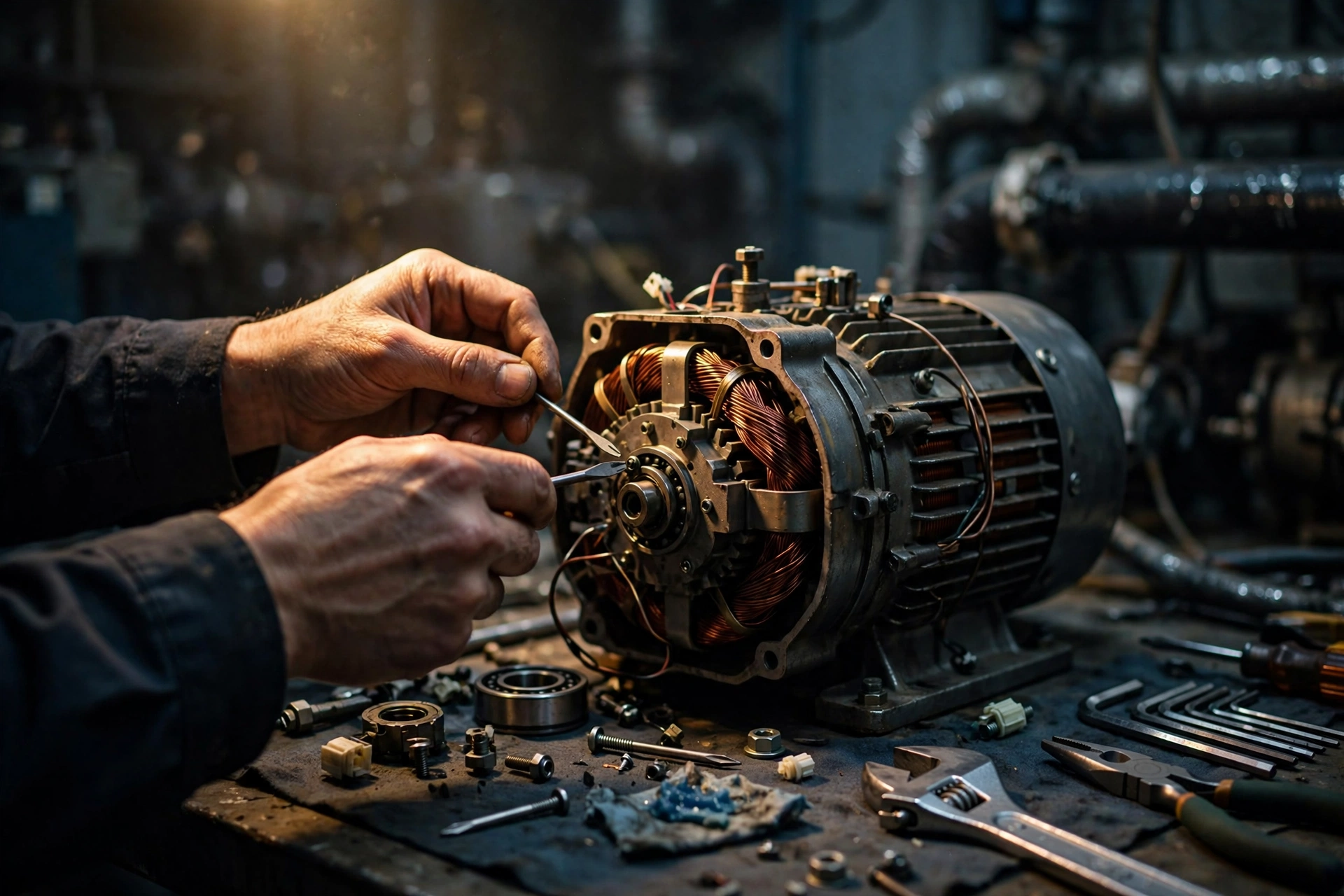
The motor I had to change was on a gas-fired M20, and the M20 was on the bottom of a double stack — two big dehumidifiers piled one on the other, on a military base, in a spot you could barely get to. There was no version of that job where the machine came to me. I shut it down, I got in there, I pulled the motor, and I put the new one in, because that was the job. Nobody I worked for at the time would have dreamed of doing it any other way.
That was Shawn’s rule, and Shawn ran the shop.
Shawn was the head technician at Munters when I came in. Before that he’d put together tractor trailers, and he’d worked aircraft carriers — hundreds of pieces of equipment spread across a carrier deck, dust collectors and all the rest, keeping the blasting and the paint where it belonged and keeping the ship from rusting while men worked on it. He was, flat out, amazing at the work.
For years I told people Shawn didn’t like me, and I want to correct that here, because I’ve had a long time to think about it and I don’t believe it anymore. I was the golden boy. I was the favorite. Everybody liked me, and I came at the work like a sales guy — relationships first, personality up front. Shawn came at it from the trade. What he wanted from me wasn’t affection and it wasn’t obedience; it was respect — for the trade, for the equipment, for the people, for the company. And there was more to it than my feelings: I was on his team, which meant my work was a direct reflection on him, to his peers and to everybody who knew what he stood for. A man driven on pride and respect and effort doesn’t hand his name to somebody who hasn’t earned it yet. It took me a while to appreciate that. The man who taught me the most in that trade started out not trusting what I was — and he was right not to, until I showed him different.
Here is the rule, the whole rule: you did not swap out equipment.
Everybody else in the business, their answer to a dead machine was a phone call — get a replacement sent, swap it, move on. Shawn’s answer was: grab a motor. Grab whatever you need. Fix it where it sits. The little refrigerant dehumidifiers, the ones the whole industry boxed up and sent back to the manufacturer, Shawn was too proud for that. Too proud. We ordered the computer boards. We ordered the pumps. We replaced electrical motors in machines most shops wouldn’t open. When we traveled to other offices we’d find the pile — every office had one, dead equipment in a corner that nobody ever had time to fix — and while we were there, we fixed it. Stuff got sent to us from other places and we fixed that too. That’s what we got known as.
Some of it you couldn’t have swapped if you’d wanted to. A piece of equipment goes under an aircraft carrier in a dry dock, or out on a Coast Guard ice cutter, it stays there for months, and it is your equipment that you are charging them for. You are not going to ask the crane operator to lift your broken machine out and fly in a fresh one. You fix it under the ship. It was burn the boats, all the way down — there was no retreat available, so there was only the work.
I was not a mechanical person. I want that on the record too. I worked on dirt bikes for my kids. I changed some oil. That’s the whole résumé I walked in with. And I became a good technician — a really good one — for exactly one reason: I was never afforded the swap. I have come to believe I was lucky in that. If the easy door had been open, I’d have walked through it like everybody else, and I’d have stayed exactly as mechanical as I was on day one. The constraint was the teacher. Shawn just made sure the constraint never let up.
Now, I’ve spent years since then on the other side of this — the worksheets, the SOPs, the procedures, the micro stuff — and I believe in all of it; we run on it. But here is what thirty years of watching it taught me: an SOP can tell a man what to do. It cannot tell him why, and on the bad days the why is the only thing still standing. Shawn never handed me a why. He handed me a word, by example, and the word is pride.
Pride is a precise word. Say a man is nice and nobody really knows what you mean. Say a man is kind and everybody knows. Pride is like kind. It means: I am not going to be the one who quit. I am not going to be the one who lost. I am going to try my best, and I am not going to be a burden on anybody. And here is the part nobody puts in the manual: people notice. They know who you are. That’s how you infect an entire company — not with a binder. You choose a way, and you hold it where people can see it, and it spreads.
It’s the same reason I don’t chase five-star reviews the way people think. The goal was never the stars. The goal is to do such a good job that your customers want to flex you — they send their friends to you the way you’d send a friend to the BMW dealer you trust, or to that realtor who takes everybody to the famous restaurant. You become the name they show off with. Nobody ever flexed a company that cut corners politely and followed its own SOP.
So no — I am not going to write an SOP that says try your best and give people what they paid for. If that sentence has to live in a procedure manual, the manual has already failed. What I’ll say instead, to anybody who works with me, is the thing Shawn said to me without ever saying it: take pride in your work. This is what pride looks like — a motor changed at the bottom of a stack because that’s where the machine was. And this is what pride doesn’t look like — a box on a pallet, going back to the manufacturer, with your name on the return label.
Shawn would not have shipped the box.
Questions
- Where in your operation is the swap the default answer — and what would your people learn if it wasn’t available?
- What dead pile is sitting in your corner right now, and whose pride is going to have to fix it?
- If your customers flex anybody, is it you?
Leave a Reply