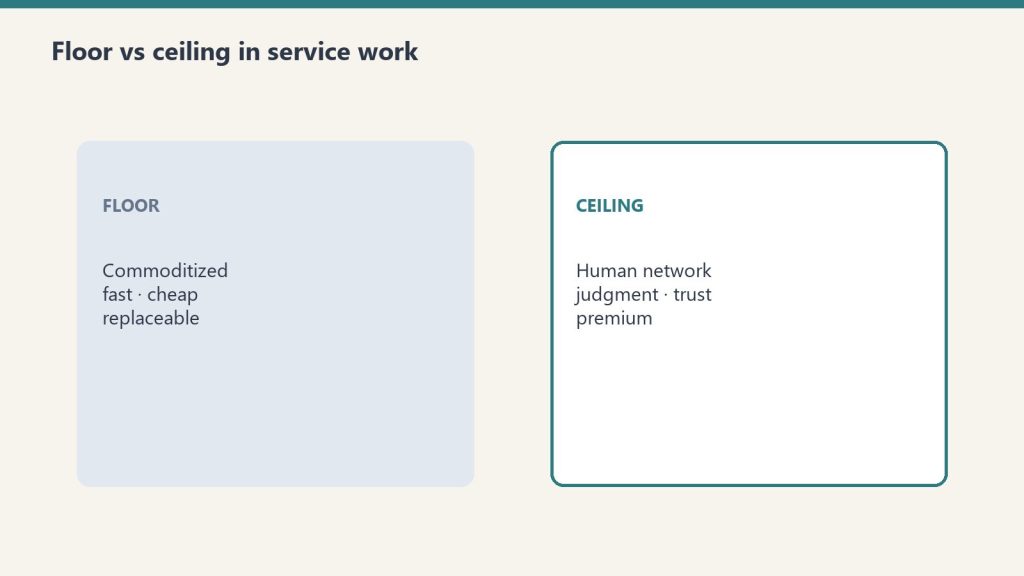
The Human Distillery is the structured methodology for extracting tacit knowledge from senior operators and converting it into transferable artifacts. It is the practical mechanism behind the broader thesis that AI raises the floor of every industry but cannot touch the ceiling. This article is the field manual. It tells you exactly how to prepare for, structure, and run an interview that surfaces the knowledge that lives only in the heads of veteran operators, and convert that knowledge into a form that is useful to apprentices, successors, AI systems, and the company that owns it.
This is not a theoretical document. This is a practitioner’s playbook. If you work in a skilled industry, run a company that depends on senior expertise, train operators, or are responsible for institutional knowledge preservation, you can run a Human Distillery interview using the structure below. The first one you run will be awkward. The fifth one you run will be revelatory. By the tenth one, you will be capturing knowledge at a rate that fundamentally changes the knowledge-asset position of whatever you are working on.
What You Are Actually Trying to Extract
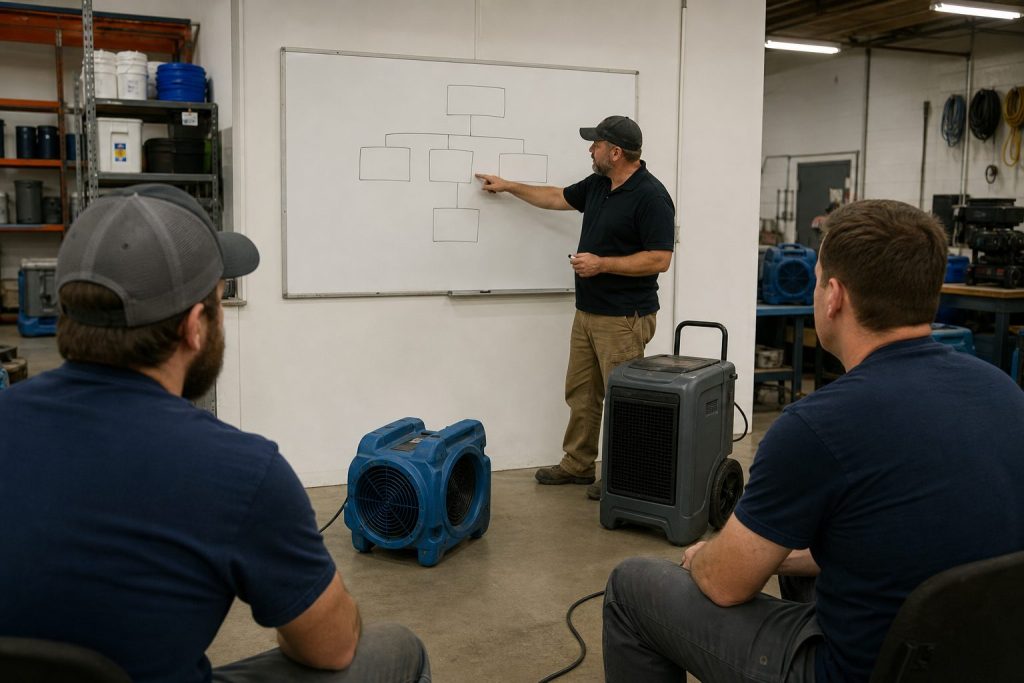
The first thing to internalize before running a Distillery interview is that you are not collecting information. You are surfacing patterns of judgment that the interviewee cannot easily access from inside their own head. The knowledge you want lives below conscious thought for the senior operator. They know what to do in a complex situation because they have done it a thousand times, but they cannot necessarily tell you what rule they are following, because the rule has compressed itself into intuition.
Your job as the interviewer is to ask the kinds of questions that force the implicit rule back up into conscious thought, where it can be articulated. The right questions are concrete, specific, situational, and slightly contrarian. The wrong questions are abstract, general, philosophical, and respectful. You want the senior operator to say things like, “well, in that specific situation, you would actually do X, even though the standard says Y, because…” The “because” is the entire game. That is where tacit knowledge lives.
If your interview produces a transcript that reads like a textbook chapter, you have failed. The senior operator gave you the explicit, documented knowledge — the floor. You have not extracted the ceiling. If the transcript reads like a series of specific, weirdly granular war stories with judgment calls buried inside them, you have succeeded. The ceiling is in there. You can extract it later.
Selecting the Right Interviewee
Not every senior operator is a good Distillery candidate. The right candidate has three characteristics.
First, they have substantial depth in the actual craft, not just the management of the craft. The owner who has spent twenty years running a company but never put hands on the actual work is not the right candidate. The senior technician, project manager, estimator, or operator who has been hands-on for twenty or thirty years is. The knowledge you want is in the hands and the head, not in the org chart.
Second, they have to be capable of self-reflection. Some senior operators have all the knowledge but cannot articulate any of it because they have never had to. Others have the knowledge and have spent years informally teaching it to junior people, so the articulation muscle is already developed. Prioritize the second group. They will produce more useful output per hour of interview time.
Third, they have to trust the process. The interview will only produce real material if the interviewee believes the interviewer is going to use the output well. If they suspect the output will be used to replace them, or to commodify their value, or to extract it without acknowledgment, they will give you the floor and withhold the ceiling. The trust setup before the first interview is more important than any specific question you ask during it.
Preparing for the Interview
The preparation determines the quality of the output. Three days of preparation will produce a one-hour interview that surfaces material a casual interviewer would not get in ten hours. Here is what to do.
Spend half a day learning the basic vocabulary and structure of their work. You do not need to become an expert. You need to know enough that the operator does not have to translate every term back to layperson language. They should be able to use industry shorthand and trust that you will follow. If they have to dumb it down, the conversation flattens and the real material does not surface.
Identify five specific scenarios in their work that would force judgment calls. Not generic categories — specific situations. “A water damage job where the homeowner is also the insurance adjuster’s cousin.” “A scope dispute on a complex commercial loss where the carrier has hired a third-party adjuster.” “A drying decision on a 1920s building with mixed materials and an aggressive timeline.” The specificity is what forces judgment to the surface. Generic prompts produce generic answers.
Prepare a small number of contrarian questions. Things like, “When does the standard procedure actually produce a worse outcome?” or “What do most operators in your industry get wrong that they do not realize?” or “If you had to train someone to make one specific judgment call faster, which one would matter most?” These questions invite the senior operator to articulate the parts of their judgment that diverge from the documented body of knowledge, which is exactly the material you want.
Set up the recording properly. Both audio and ideally video. A transcript-only capture loses the tonal information that distinguishes a confident judgment from an uncertain one. If the interview is in person, set the recorder once and forget about it. Stop after every interview to verify the recording captured cleanly. There is nothing more painful than discovering a great interview did not record.
The Interview Structure
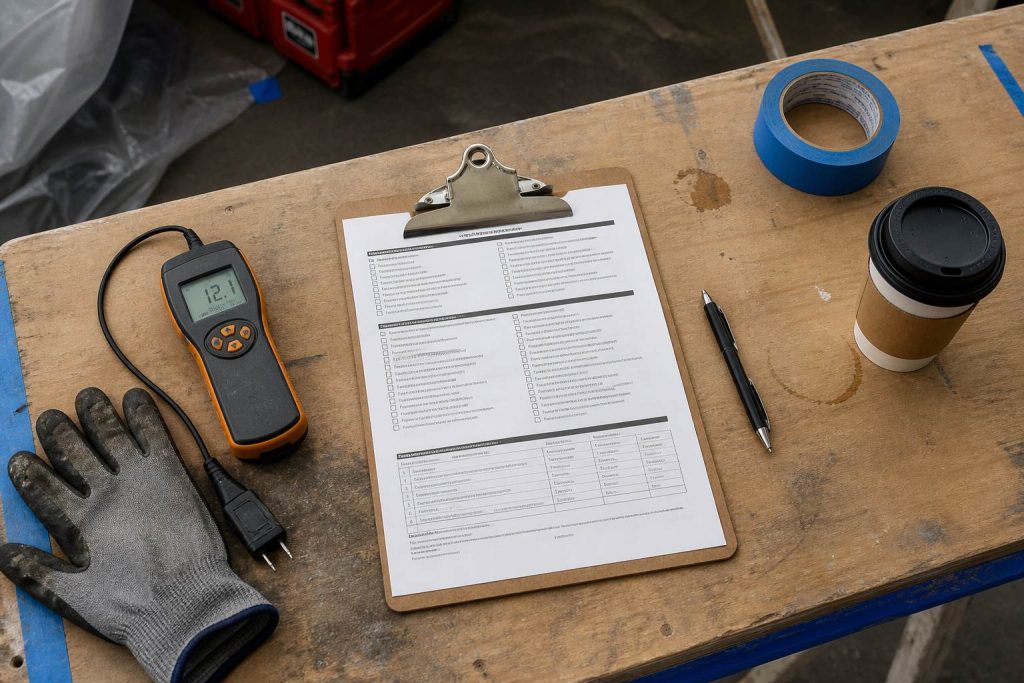
A productive Distillery interview is between sixty and ninety minutes. Beyond ninety minutes, the operator gets tired and the material degrades. Less than sixty minutes, you do not get past the warm-up.
The structure that works most reliably is the following.
Minutes 0 to 10 — The warm-up. Start with something easy. Ask them about their career arc. How did they get into this work? What did the industry look like when they started? What changed? This is not the high-value material. It is the setup that lets the operator settle into the conversation and start trusting the interviewer. Do not try to extract gold in the first ten minutes. You are building rapport.
Minutes 10 to 30 — The first specific scenario. Move into the first prepared scenario. Be concrete. “Walk me through what you would actually do if you got called to…” Let them talk. Do not interrupt. When they reach a judgment call, slow them down. “Wait. Why that and not Y? What signal told you X was the right read?” Push gently into the reasoning. Their initial answer will often be a surface explanation. The second and third “why” questions are where the real material surfaces.
Minutes 30 to 60 — The second and third scenarios. Run two more specific scenarios with the same structure. You will start to see patterns across the scenarios — recurring judgment moves the operator makes, common signals they read, frameworks they apply without realizing they are applying them. Note the patterns as they emerge. The patterns are more valuable than any single scenario, because they are what generalizes.
Minutes 60 to 80 — The contrarian section. Now move into the contrarian questions. The senior operator is warmed up, the rapport is established, and they are willing to say the things they would not have said at the beginning of the conversation. “What do most operators get wrong?” “Where does the standard procedure actually fail?” “What did you used to believe that you no longer believe?” This is often the most material-dense section of the interview.
Minutes 80 to 90 — The synthesis. Ask them to reflect on the conversation itself. “What is the one thing you would want a younger operator to take from this conversation?” “If you had to summarize the most important judgment move in your career, what would it be?” These prompts produce compact, articulate summaries that the operator could not have given you at the beginning of the conversation because they had not yet surfaced the underlying material.
Mistakes to Avoid
The interviewer mistakes that destroy a Distillery session are predictable. Avoid them.
Do not lead the witness. The interviewer’s job is to ask, not to teach. If you start telling the operator what you think the right answer is, they will defer to your framing and stop producing original material. Stay in question mode.
Do not interrupt. The most valuable material often comes in the second or third minute of a long answer, after the operator has worked through the obvious surface response and started getting into the actual reasoning. If you cut them off to ask a follow-up at minute one, you never get to the deeper layer.
Do not chase tangents. Senior operators have decades of war stories and will gladly wander into them. A few tangents are useful for rapport. Too many tangents destroy the session. Gently steer back to the prepared scenarios.
Do not accept abstractions. If the operator answers a specific question with a general principle, push them back into specifics. “Can you give me an example of the last time that came up?” The specifics carry the judgment. The abstractions are what they have been telling themselves the principle is, not what they actually do.
Do not flinch from the moments when the operator says something controversial or contradicts industry orthodoxy. Those moments are gold. Most of the real ceiling material in any industry diverges from the documented orthodoxy in some specific way, because the orthodoxy is the average and the ceiling is by definition above average. Lean into those moments.
What to Do With the Output
One Distillery interview produces a sixty-to-ninety-minute recording. The raw material is not the deliverable. The deliverable is what you build from it.
Transcribe the interview within forty-eight hours. Use whatever transcription tool is current. Read the transcript through once without trying to extract anything, just to refresh your memory of the conversation.
On the second read, mark every judgment call the operator made. Every instance where they made a decision that diverged from the standard procedure, every signal they read, every framework they applied. Mark them. These are the artifacts.
On the third read, look for patterns. Which judgment moves came up multiple times? What signals did the operator return to across different scenarios? What frameworks were they applying without naming them? The patterns generalize across situations and are the most useful output for downstream use.
Convert the patterns into a structured artifact. The format depends on the use case. For internal training, build a playbook organized by scenario type with the judgment patterns embedded. For AI training data, produce structured Q-and-A or scenario-and-decision pairs. For preservation purposes, build a narrative knowledge document organized around the operator’s career arc and the lessons embedded in it. The same raw interview can feed multiple deliverables.
Share the output back to the operator before you use it. They should review it for accuracy, fill in places where their meaning was misrepresented, and approve the final version. This step is non-negotiable. It respects them, improves the quality of the output, and builds the trust that will let you come back for a second interview.
Why This Works
The Human Distillery methodology works because it solves the fundamental problem of tacit knowledge transfer. Tacit knowledge cannot be written down by the person who has it, because they cannot consciously access most of it. It can only be surfaced through structured conversation with someone whose specific job is to make the implicit explicit. Once surfaced, it can be converted into transferable form. Once transferable, it can be used to train apprentices, inform AI systems, and preserve institutional capability across generations.
The methodology was originally developed in the context of restoration industry knowledge capture, but it generalizes across every skilled industry. The patterns are the same. The pacing is the same. The mistakes to avoid are the same. The output is the same. Once you can run a Distillery interview in one domain, you can run it in any domain where tacit expertise exists.
The institutions that figure this out first — the companies, training organizations, certifying bodies, acquirers, and family successors who run deliberate Distillery programs across their veteran population — will capture an asset that competitors cannot replicate by ingesting more public data. The asset is the knowledge that has never been public. Once captured, it stays inside the institution that captured it. It becomes a real moat.
Related on Tygart Media: elicitation over extraction · how to use Claude · Claude calibration.
Frequently Asked Questions
How long does a Human Distillery interview take?
The interview itself runs sixty to ninety minutes. Beyond that, the operator gets tired and the material degrades. The preparation takes about half a day for the first interview with a given operator, less for subsequent ones. The post-interview processing — transcription, pattern extraction, artifact construction — takes another half day to full day depending on how the output will be used.
Who is the right interviewee for a Distillery process?
A senior operator with substantial hands-on depth in the actual craft (not just management of it), the capacity for self-reflection, and trust in how the output will be used. Pure management figures who never did the work directly are not the right candidates. The knowledge lives in the hands and the head of practitioners.
What kinds of questions surface tacit knowledge?
Concrete, specific, situational, and slightly contrarian questions work. Generic and abstract questions produce generic and abstract answers. The right prompts force the operator to walk through specific scenarios and articulate the judgment calls they would actually make, then push deeper with “why?” follow-ups until the underlying reasoning surfaces.
How do you convert an interview into a usable artifact?
Transcribe within forty-eight hours. Read three times — once for memory, once to mark judgment calls, once to identify patterns. Convert the patterns into a structured format appropriate to the use case — internal playbook, AI training data, or narrative knowledge document. Always share the output back to the operator for review and approval before use.
Can AI conduct the interview instead of a human?
Currently no, and probably not in the near future. The skill of a great Distillery interview is reading the operator’s tone, knowing when to push and when to back off, recognizing the moments where real material is about to surface and slowing down to capture it. That is itself a tacit skill that an AI system cannot yet replicate. AI can assist with transcription and pattern extraction after the interview, but the interview itself is human work.
What happens if the operator does not want to be interviewed?
Then they should not be interviewed. The methodology only works when the operator trusts the process and chooses to participate. Coerced or reluctant interviews produce floor-level material at best. The right move is to start with operators who are willing, demonstrate the value of the output, and let the willing examples persuade the hesitant ones over time.
The Bottom Line
The Human Distillery is a method, not a mystery. It can be learned. It can be practiced. It produces real, valuable, transferable artifacts. And it solves the most consequential problem in the AI era for any skilled industry — how to capture the tacit knowledge that defines great operators before it walks away with retirement, exits the business with a sale, or simply degrades with mortality.
If you are responsible for institutional knowledge in any skilled industry, the highest-leverage thing you can do this quarter is run three Distillery interviews with your most respected senior operators. The output will surprise you. The patterns you find will inform every operator development decision your company makes for the next decade. The artifacts will be reusable across training, AI deployment, acquisition diligence, and family knowledge preservation.
The methodology is here. The window is open. The senior operators in your network are mostly willing to participate if approached correctly. Schedule the first interview this month. The hardest part is starting. After that, the methodology does the work.