
Related on Tygart Media: AI operator’s stack · AI model monitoring · AI site auditing.
Tag: operator philosophy
-

Working With AI: Why the Cockpit Needs a Human Pilot
Related on Tygart Media: AI operator’s stack · Claude calibration · human-in-the-loop architecture.
-

Correlated Failure: Why Everything Moved Together
Related on Tygart Media: AI operator’s stack · AI site auditing · AI model monitoring.
-
AI Context Limits: How Top AI Operators Beat the Token Wall
There’s a moment every serious Claude user hits eventually. You’re mid-session, deep in the flow of building a workflow, a content pipeline, or a complex research thread. You’ve built something substantial, and you’re right on the verge of a breakthrough.
Then the model goes quiet. Or it returns something strange and vague. Or it just stops mid-sentence.
You didn’t break anything. You simply ran out of room. You’ve hit the "Token Wall," and understanding how to navigate this limit is what separates a casual user from a master operator.
1. The Physics of the Whiteboard
Every AI conversation has a "context window," which is essentially a fixed amount of memory the model can hold at once. Think of it like a whiteboard. Every message you send, every response the model generates, every task list, and every snippet of code takes up space on that board.
When you get close to the limit, the model doesn't just shut off; it begins to struggle under the weight of its own history. You might notice the "feel" of a session getting heavy. The model starts to lose its edge, often attempting to "pattern-match on noise" within the context rather than following your instructions.
Crucially, the smarter the model, the faster it hits the wall. This is the Opus Paradox: Claude Opus thinks deeply and writes extensively. Because its outputs are more verbose and nuanced, it consumes its own runway far more aggressively than a simpler model. Its intelligence is the very thing that accelerates its failure in a crowded session. When the board is full, the model tries to squeeze a new request into a space that doesn’t exist, resulting in the graceful—but frustrating—failures we’ve all experienced.
2. The Haiku Trick: Precision Over Power
When a session stalls at the context limit, your first instinct might be to switch to an even more powerful model. That is almost always the wrong move.
The veteran operator’s secret is to go smaller. Claude Haiku—the lightest and fastest model—can often "squeeze through the gap" that a heavier model like Opus or Sonnet simply cannot fit through. Because Haiku is lean and efficient, it can perform surgical actions like updating a task list, summarizing the current state of play, or triggering a "compaction" of the history. This small action clears the whiteboard just enough to unlock the entire session.
"It's not always about raw intelligence. It's about fit. The right tool for the moment isn't the most powerful one — it's the one that can actually execute given the constraints you're operating in."
This shift from seeking raw power to seeking operational fit is a fundamental breakthrough. It’s the realization that the most "intelligent" move is often the one that creates the most momentum with the least amount of space.
3. The Formula One Mindset: Strategy Outruns Raw Compute
To excel in the new era of AI, you have to embrace the Formula One analogy. F1 teams spend hundreds of millions on the fastest cars, but the car doesn't win the race on its own. The driver wins by knowing when to push the engine, when to conserve tires, and when to pit.
The AI is your car; you are the driver. Two people using the exact same model will produce radically different results based on their "driver skills." These aren't skills you find in a manual; they are earned through "hours in the seat." A master operator develops an instinct for:
- Pruning Context and History: Recognizing the moment a session feels "heavy" and manually clearing the whiteboard to keep the model focused.
- Strategic Model Swapping: Knowing exactly when to call in the heavy lifting of Opus and when to pivot to the lean navigation of Haiku.
- Compacting and Resetting: Identifying when a conversation has become too polluted with noise and needs a clean summary before starting fresh.
- Task Handoffs to Subagents: Understanding that a subagent operating in isolation will almost always outperform a single, mile-long thread where context is diluted.
4. What Agents Teach Us About Human Momentum
We often focus on making AI more like humans, but the more valuable lesson is learning what agents can teach us about our own productivity.
Agents succeed when they have a bounded context, a defined task, and honest signals about their capacity. They fail when their context is polluted with noise, when tasks are ambiguous, or when they try to do too much in one pass. This is a perfect mirror for human cognitive load. When we are overwhelmed, it’s rarely because we aren't "smart" enough for the task—it's because our internal whiteboard is full of distraction and noise.
"When you're overwhelmed and stuck, the answer usually isn't to think harder. It's to do the smallest possible thing that creates forward momentum."
Just as Haiku unlocks a stalled AI session by clearing one small item, humans can overcome paralysis by making one small decision or finishing one minor task. Operating intelligently within your own mental constraints is a superpower, not a compromise.
5. The Internalized Hybrid
The most effective AI users aren't just "humans using tools." They are "internalized hybrids"—operators who have adopted the logic of agentic thinking as their own.
They naturally break massive projects into discrete, manageable tasks. They are honest about their own "context limits," realizing that pushing through a complex task at 11:00 PM is the cognitive equivalent of a model producing garbage when its whiteboard is full.
This level of mastery isn't taught in a tutorial. It’s forged in the "Machine Room" at midnight, in those moments of operational failure when you hit the token wall and realize that a smaller, smarter approach is the only way through the gap. You have to live the experience of the work to develop the instinct for it.
Conclusion: Getting Back in the Seat
The relationship between you and the AI is defined by the "Driver and the Car." The car provides the potential for incredible speed, but it is the driver who provides the strategy, the timing, and the environmental awareness required to reach the finish line.
The technology is now available to everyone, which means the tool itself is no longer the competitive advantage. The advantage is the operator.
As you return to your workflows, ask yourself: Are you just pressing harder on the accelerator and wondering why you’re hitting a wall? Or are you ready to become a true driver, managing your context and choosing the right tool for the moment?
The car is waiting. The driver makes the difference. It’s time to get back in the seat.
Related on Tygart Media: AI operator’s stack · tokens to words · Claude calibration.
-
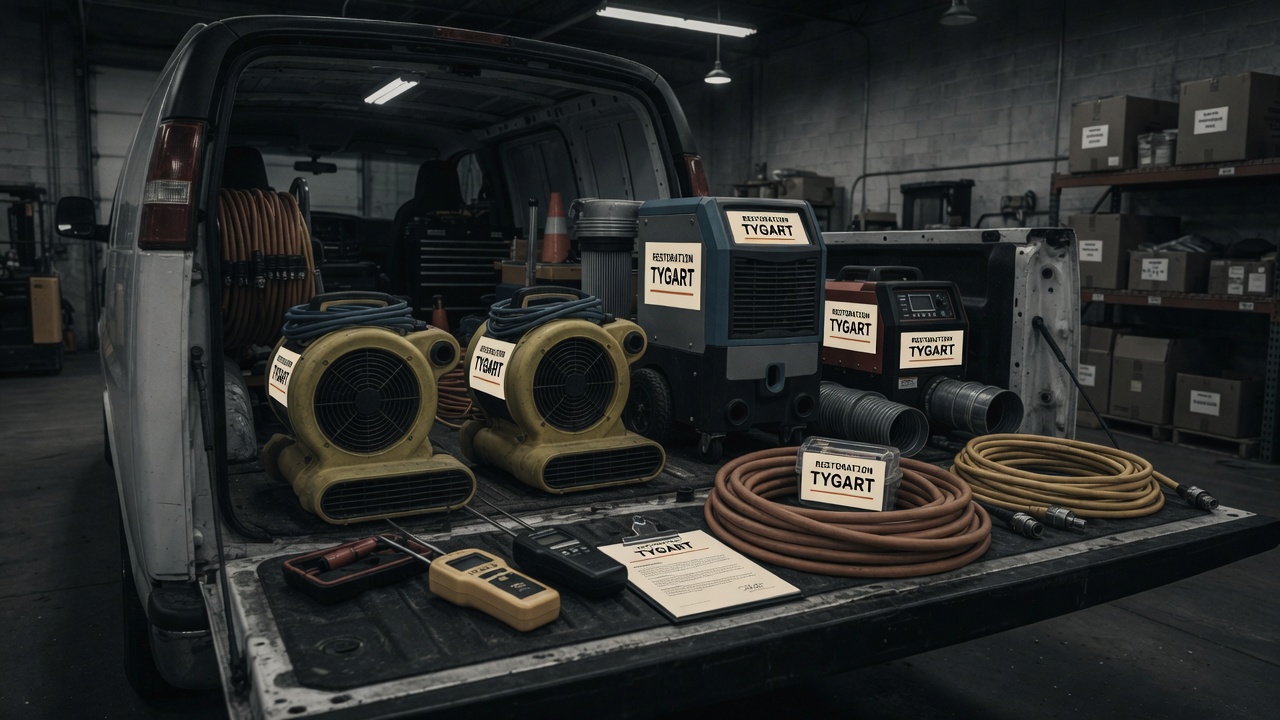
Second Restoration Location: Why $5M is the Threshold
Most restoration owners get the second-location itch around $3M. The honest answer is they shouldn’t scratch it until $5M — and even then, only if a specific list of things is already true inside the first shop.
Opening a branch is one of those decisions that looks like growth on the surface and turns into the slow bleed underneath. The mistake is almost never the second location itself. The mistake is the first location wasn’t ready to be left alone yet, and the owner went from running one healthy business to running two broken ones.
Here’s the honest framework. Not the cheerleader version.
Why $5M Is the Real Threshold (Not $3M)
Industry valuation data makes this concrete: restoration shops under $2M trade at roughly 2.8x–3.0x SDE. Once you cross $5M with a diversified service mix, multiples jump to 4x–7x EBITDA. That gap is not just about revenue — it reflects what buyers see in the operation. A $5M shop has a real second layer of leadership. A $3M shop almost always doesn’t.
When you open a second location from a $3M base, you are usually taking the only person who knows how to run the business — you — and splitting yourself in half. The first location’s gross margin starts compressing within ninety days. The new location burns cash for twelve to eighteen months before it stabilizes. Now you have two locations that both need you and neither one is the business it used to be.
At $5M, you typically have an operations manager, a production manager, a dedicated estimator or project manager bench, and recurring TPA volume that doesn’t depend on the owner answering the phone. That is the difference. The threshold isn’t a dollar figure — it’s whether the first location can run a full week without you in the building.
The Five Things That Have to Be True Before You Open
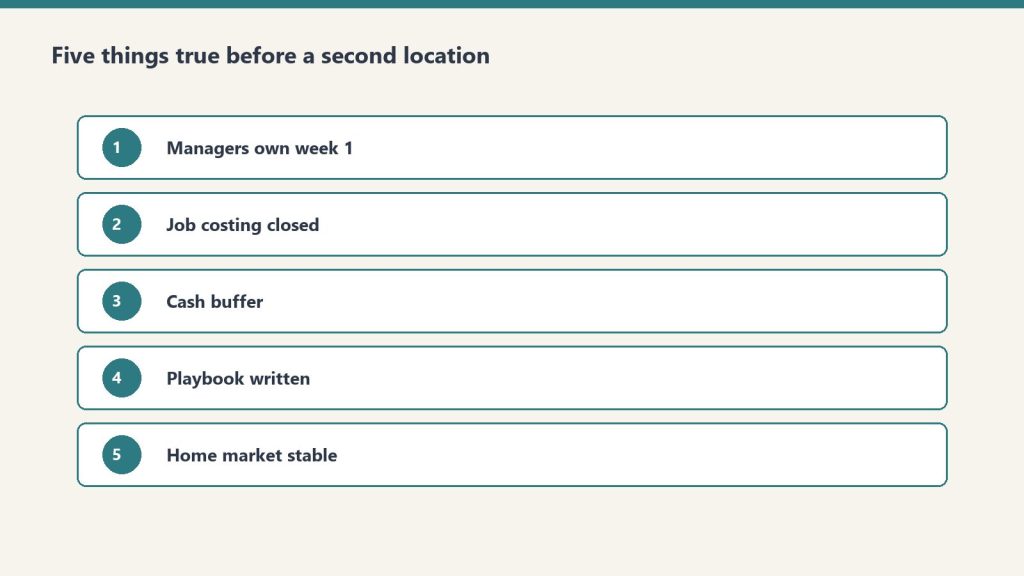
Five things have to be true before you open. 1. The first location can survive 30 days without you. Not “the work gets done.” That you can be unreachable for a month and the financials, the TPA scorecards, and the production schedule all stay inside normal range. If you can’t do that, you don’t have a second-location problem. You have a delegation problem at the first one, and adding geography won’t fix it.
2. You have an operations manager who is not you and is not a relative. Family members can run a second location, but only if they were already running a P&L inside the first one. The second-location playbook is the operations manager playbook. If you don’t have someone who can hold gross margin, manage WIP, and run a weekly production meeting without you in the room, the branch will not work.
3. The new market has documented demand, not a feeling. Pull the data before you sign a lease. Carrier referrals you’re already turning down in the target market. TPA territory gaps your existing programs have flagged. Search volume for “water damage restoration [city]” and the CPC on it. If the only reason you’re picking the market is that your cousin lives there or you saw a competitor’s truck, you don’t have a market — you have a hunch.
4. The first location is throwing off enough cash to fund 18 months of branch burn. A new restoration location typically loses money for twelve to eighteen months. Plan for the long end. SBA expansion loans usually want a 1.25 DSCR before they’ll touch it, which means your existing operation has to be healthy enough to service the new debt while the branch is still in the red. If the math doesn’t work without the new location immediately producing, the math doesn’t work.
5. Your tech stack scales without bolt-ons. If your job management software, Xactimate workflow, and TPA portal logins are all stitched together by tribal knowledge inside the first office, the second location will not run the same playbook. It will run a worse one. The system has to be portable before the branch opens, not after.
What Most Owners Get Wrong
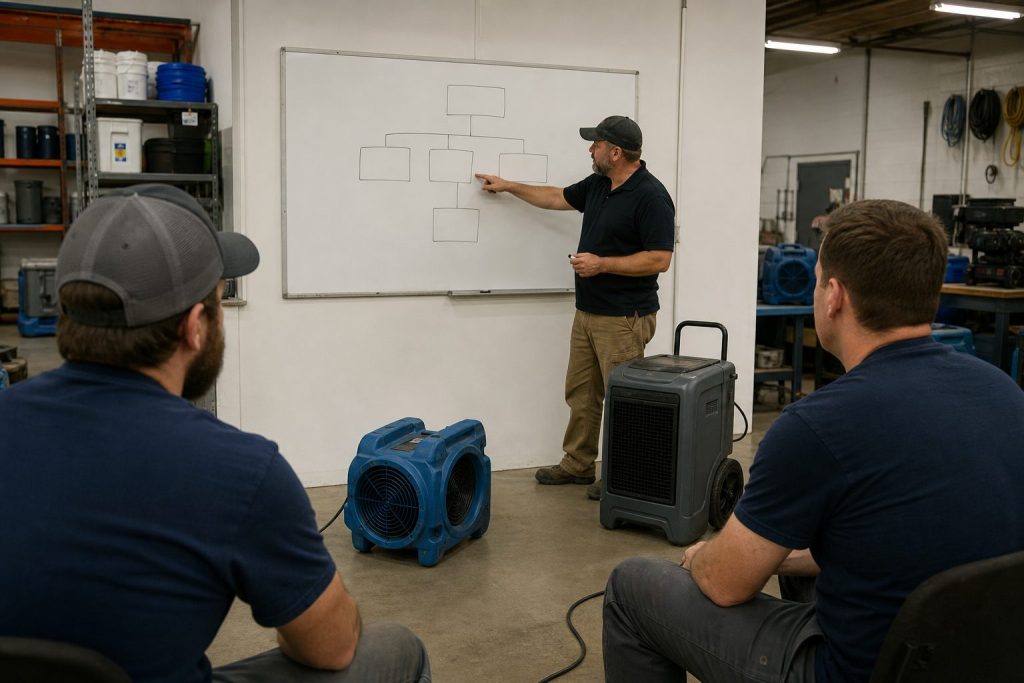
Most owners get people depth wrong — not the lease math. The most common second-location failure pattern goes like this. Owner hits $3.5M. Owner is tired, ambitious, and has an opportunity — a competitor closing down, a key employee asking for an ownership path, a city forty-five minutes away that “doesn’t have anyone good.” Owner signs a lease, hires a production lead, and tells himself the branch will be self-sufficient by month six.
Month six arrives. The branch is at 40% of projected revenue. The original location’s gross margin has slipped four points because the best production manager got moved to the new branch and the bench underneath wasn’t ready. The owner is driving between two offices three days a week. Cash is tight. The owner doubles down — hires another person, runs a Google Ads campaign in the new market, increases the burn — and by month eighteen the branch is either limping or being quietly wound down.
This isn’t a hypothetical. It is the most common growth-stage failure in the industry, and it happens because the second location was opened as a revenue bet when it should have been opened as an operational bet.
The Counter-Pattern: What Works
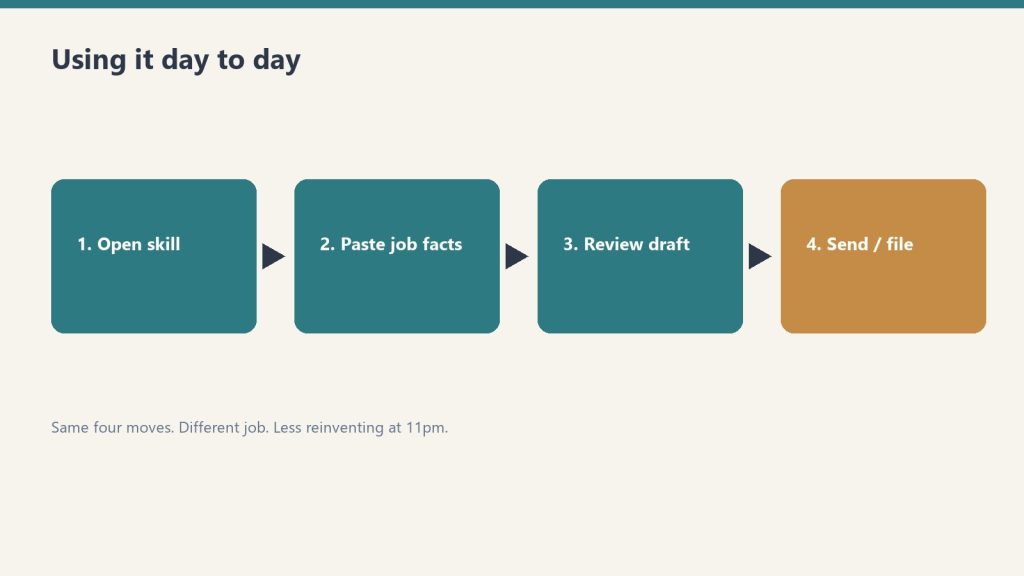
Counter-pattern: repeatable runs beat hopeful maps. The owners who successfully open second locations almost always share three traits. First, they spent eighteen to twenty-four months building the leadership bench inside the first location before they ever talked about a branch. Second, they entered the new market with a known revenue floor — either a TPA program that committed volume, a large commercial client base in the geography, or a key person from the new market with their own book. Third, they treated the first six months of the branch as an investment, not a revenue line. They didn’t expect the branch to carry itself. They expected to lose money buying market presence and learning the territory.
The phrase that separates the two camps is simple. Failed openings start with “we need to grow.” Successful openings start with “we have the team and the demand to grow.”
The Bottom Line
If you’re under $5M and you don’t have a real operations bench, do not open a second location. Spend the next twelve months building the bench, hardening the tech stack, and proving the first location can run without you. The valuation gap between a clean $5M single location and a $7M two-location operation where both are slightly broken is enormous — and it almost always favors the clean single.
The second location is a multiplier. It multiplies whatever is true about the first one. If the first one is humming, you’ll build something worth selling for 5x EBITDA. If the first one is fragile, you’ll build two fragile ones and discover that the buyers paying premium multiples will pass on both.
Build the bench. Document the playbook. Hit $5M with the owner out of the truck. Then open the second.
Related on Tygart Media: company revenue · cash flow & profit · owner freedom kit.
-

AI-Native Operations: When The Order Becomes the Asset
Related on Tygart Media: AI operator’s stack · conversations as code · owner freedom kit.
-
Restoration Company Valuation: 2026 Multiples & PE Buyers
If you own a restoration company today, you are sitting on the most attractive asset class in the home services sector — and the buyers know it. Private equity has deployed more than $6 billion across 50+ restoration platforms since 2018, and the consolidation wave that started with brands like ServiceMaster and BELFOR is now grinding through the middle market. Regional operators doing $5M to $25M in revenue are getting unsolicited LOIs every quarter. Most owners have no idea what their business is actually worth, what they could be doing right now to add a turn or two to their multiple, or which buyer in the market is the right exit for their specific situation.
This is the bottom-line guide. No fluff. What buyers pay, what they discount for, and what to fix before the call.
Quick Jump: Key Valuation Sections & Buyer IntelligenceWhat restoration companies are actually selling for in 2026
Valuation in restoration is driven by size, revenue mix, and operating quality — in roughly that order. The brackets break down like this:
Operation Tier Financial Scale 2026 Multiple Buyer Dynamics Owner-Operator
1–3 trucks, owner in field$500K–$2M Rev
$150K–$400K SDE2.3x–3.5x
SDE multipleIndividual buyer or local strategic tuck-in. Heavy owner dependence; buyer essentially buys a job with a customer list. Established Multi-Tech
4–12 trucks, PM bench$2M–$10M Rev
$400K–$1.5M EBITDA3.5x–5.5x
EBITDA multiplePrimary target for regional PE add-ons. Buyer requires operational transferability and working 2nd-in-command. Regional Platform
Multi-location / multi-market$10M–$50M Rev
$1.5M–$5M EBITDA5.5x–8.0x
EBITDA multiplePlatform-grade asset. Strong TPA participation, named carrier direct-repair agreements, and 24/7 dispatch infrastructure. Premium Multi-State
Enterprise platform$50M+ Rev
$12M+ EBITDA7.0x–11.0x+
EBITDA multipleHighGround / Knox Lane tier. Modern operating system, dedicated M&A integration team, proprietary software stack. To translate: a $1M SDE owner-operator is looking at roughly $2.8M–$3M at sale. A $3M EBITDA regional with a clean TPA book and a working second-in-command is looking at $18M–$24M. The gap between those two numbers is mostly operational discipline, not revenue.
The buyers actually writing checks right now
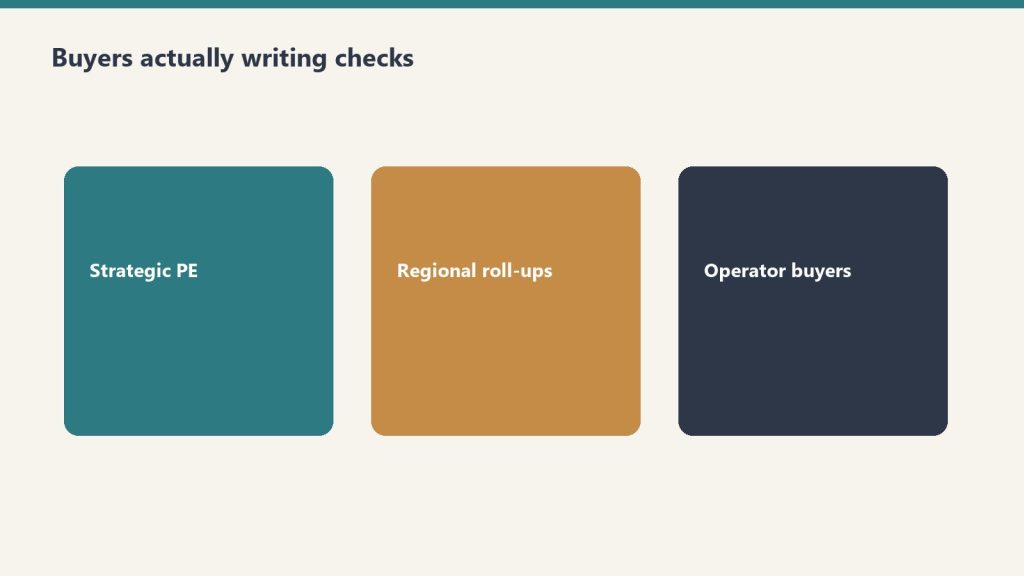
Know who is writing checks before you polish the teaser. The named platforms most active in restoration add-ons through 2025 and into 2026 include:
- Morgan Stanley Capital Partners (American Restoration): An 8-brand roll-up across 10 states, headquartered in Dallas. Acquired by MSCP after building out residential and commercial mitigation in regional markets. Looking for tuck-ins that fit the regional brand model.
- Knox Lane (HighGround): 13 acquisitions in 5 years before exit. Aggressive on multiples for the right strategic geography.
- LP First Capital / Align Collaborate (Rewind Restoration): Newer platform, launched with the Icon Restoration acquisition in Rochester Hills, Michigan. Stated goal of building one of the largest residential restoration businesses in the US — meaning they are at the early, hungry stage of a platform.
- Osceola Capital (Fortify Restoration): Platform launched mid-2025. First add-on was Beach Contracting in South Florida. Focused on structural restoration and southeast geography.
- Crossplane Capital (Mooring USA): Dallas-based PE shop that took Mooring private. Commercial-leaning thesis.
None of these buyers want a vendor brochure. They want clean books, low owner dependence, and a story about how revenue keeps coming after closing.
What buyers actually grade you on
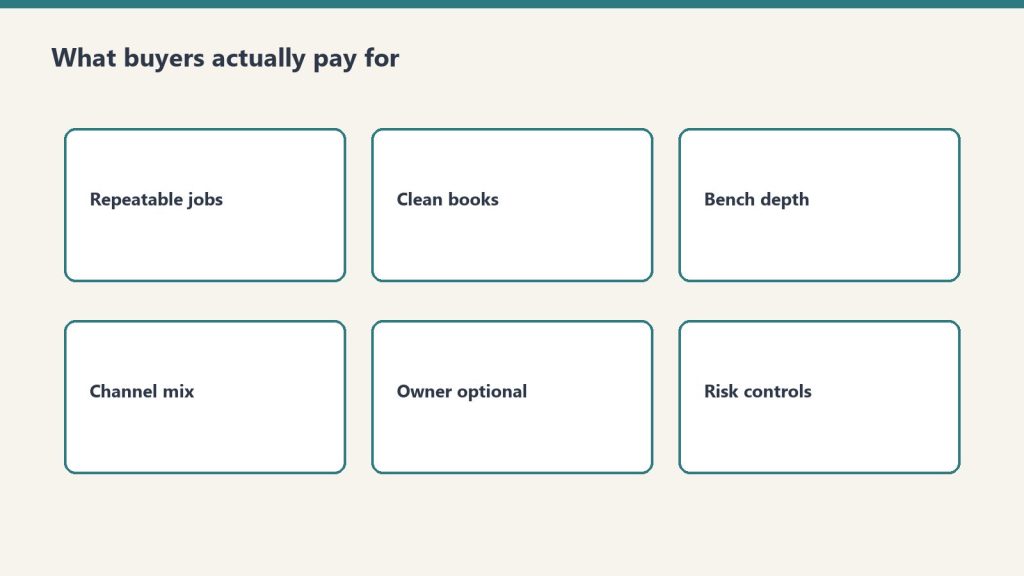
Buyers grade transferability — same scorecard as valuations. Pretend you are sitting in the LOI meeting. The questions on the buyer’s checklist, in order of how much they move the multiple:
- Revenue mix. Buyers want recurring service contracts, TPA program participation, and managed-repair work. They penalize reconstruction-heavy mix (lower gross margins) and they penalize catastrophe-heavy revenue. The savvy ones expect CAT work to represent no more than 15–20% of total revenue — anything north of that gets discounted as unpredictable.
- TPA and carrier relationships. A documented Contractor Connection, Alacrity, Code Blue, or PSA program book — with active job volume and clean compliance history — is worth real multiple turns. A regional platform with $4M–$12M EBITDA and a strong TPA book is the difference between a 6x deal and an 8x deal.
- Owner dependence. If you sign every estimate, talk to every adjuster, and make every hiring call, your business is not transferable. Most buyers want a turnkey, profitable operation, and creating SOPs that remove yourself from the daily grind is the single highest-ROI thing you can do in the 18 months before a sale.
- Financial cleanliness. Multiples above the median require demonstrably above-median EBITDA margin and clean financial documentation that survives a third-party Quality of Earnings review. If your bookkeeper is your spouse and your books are on QuickBooks with no monthly close, you will get repriced in due diligence.
- Management depth. A strong GM, an operations lead, and a finance person who isn’t you. Buyers will request to meet key employees during due diligence and may want to adjust transition terms based on who is staying.
The things that quietly destroy your multiple
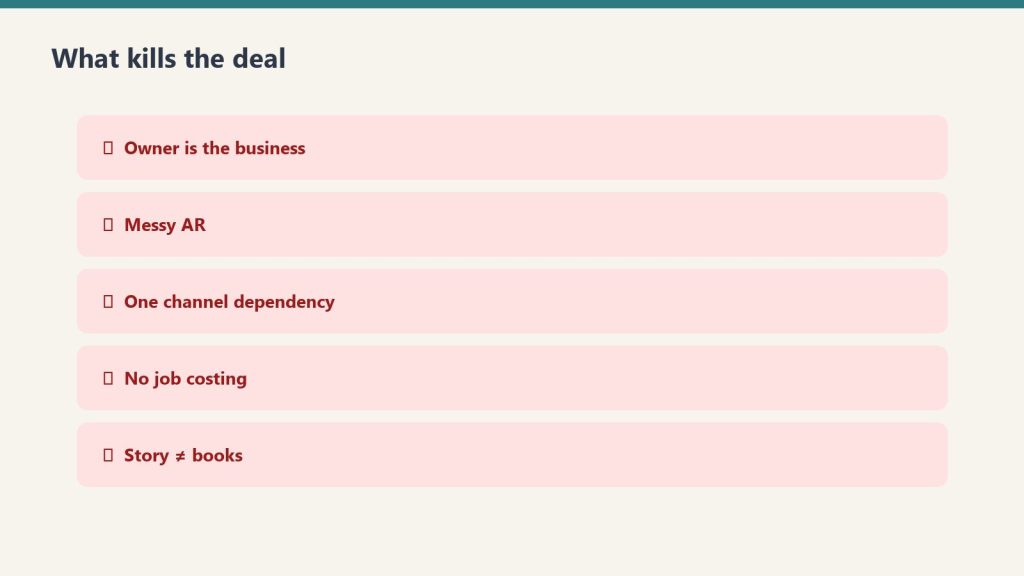
Quiet destroyers of multiple look a lot like deal killers. Sellers walk into deals not knowing these compress them by 1–2 turns:
- Reconstruction-heavy revenue mix with low gross margin.
- No TPA program participation — meaning revenue is fully dependent on local marketing and referrals.
- Weak 24/7 response infrastructure (no real on-call rotation, no after-hours dispatch).
- Paper-based or hybrid workflow with no modern job management system.
- Single-territory exposure with no expansion playbook.
- Lapsed or thin IICRC certifications across the technician base.
- Concentration risk — one TPA or one big carrier representing more than 25% of revenue.
The timeline that wrecks sellers
Due diligence typically runs 30 to 90 days and is the most intensive phase of any restoration sale. Owners who go into LOI without having done their own internal QoE, their own SOP documentation, and their own legal cleanup almost always get retraded. Sometimes the retrade is mild — $200K off the headline number. Sometimes the buyer walks. The sellers who hold their price are the ones who showed up ready: trailing twelve-month EBITDA reconciled monthly, contracts organized, employee agreements in place, tax returns matching financials, and a clean cap table.
Most restoration deals take six to twelve months from first conversation to close. If you are thinking about an exit in 2027, the time to start is now.
The honest bottom line
If you are under $2M in revenue, an owner-operator, and reconstruction-heavy: your real exit number is probably $400K–$800K, not the $2M figure you’ve been telling yourself. Sell to a local strategic, take three years of earn-out, and get to your number that way.
If you are $3M–$10M with a working TPA book and a real management bench: you are exactly what every active PE platform is shopping for. Get a Quality of Earnings done now, fix the obvious holes, and start taking the calls. There are a dozen named buyers with active mandates, and the market for quality regional restoration assets is the strongest it has ever been.
If you are $12M+ EBITDA with multi-state coverage and a modern operating system: you are not selling a business, you are negotiating a platform price. Hire a sell-side advisor who has actually closed restoration deals — not a generalist broker. The difference between a competitive process and a one-buyer conversation is two turns of EBITDA, which on your numbers is real money.
The window for premium restoration exits is open. It will not stay open forever. Climate-driven loss frequency is up roughly 35% since the 1990s, which is fueling buyer enthusiasm — but interest rates and PE fundraising cycles will eventually cool the market. Sellers who prepare now will catch this wave. Sellers who wait for “the right time” will sell into a softer market.
The right time is when your business is ready, not when the market is hot. The good news is the market is hot and the operational work to be ready is straightforward. Get started.
📖 Recommended Reading in Restoration Intelligence
Related on Tygart Media: Starlink on a water job · S500 in the van · local SEO for restoration.
-

AI-Native Operations: Why Artifact Counting Is Obsolete
From outside, the day looks empty. No new product. No new feature. No new shipment counted in the unit the field has agreed to count.
From inside, the day was the most informative one of the week. The operator has a sharper model of the toolchain than they had at breakfast. The decisions sitting one level downstream will be made faster and will land closer to right. The thing that compounded was not visible to anyone outside the room.
This is a class of working day that the outside has no clean way to read. And the absence of a clean read is becoming a problem the outside has to learn to solve, because the class of day is multiplying.
The grammar gap
Pre-AI work had a clean grammar for the inside of a day. A meeting, a draft, a ticket, a deploy, a review. Each had a visible artifact. Each artifact mapped to a known unit of progress. An observer counting artifacts could form a roughly correct picture of what had happened.
The grammar held because the cost of an attempt was high enough that operators only attempted the thing they intended to ship. The artifact and the intent were the same object. Counting one counted the other.
Inside an AI-native operation, the cost of an attempt has dropped far enough that the artifact and the intent have come apart. An operator can attempt many things they do not intend to ship, in an afternoon, because the cheapest output of the toolchain is now a probe of the toolchain itself. The artifacts that remain after such a session are not artifacts of the work — they are residue of the inquiry.
The outside is still counting artifacts. The grammar is still pre-AI. The class of day that produces no shippable artifact and a large diagnostic surface is unreadable to it.
What the outside is actually trying to read
It is worth being careful about what the outside reader is trying to do, because the failure to read this kind of day is sometimes confused with the failure to evaluate someone fairly. Those are different problems.
An investor is trying to read whether the operation will compound. A partner is trying to read whether the operator is moving toward the thing they said they would build. A colleague is trying to read whether the work shared between them is progressing or stalled. A reader of the trade press is trying to read whether the category as a whole is producing real value or producing motion.
All four of those readers will, by default, count artifacts. All four will, by default, miscount when the operation has moved into the new mode. And the miscount is asymmetric: it overrates the operators who still produce artifacts on the old cadence, regardless of whether the artifacts have anything underneath them. It underrates the operators whose afternoon was spent driving the cost of future attempts further toward zero.
This is the same shape of misreading that financial markets used to apply to research-heavy companies before there was a category for them. The artifact was a paper, a patent, a prototype that did not ship. The grammar took a generation to catch up.
The inverse failure, which is real
It would be too clean to argue that the outside is simply wrong and the inside is simply doing better work that the outside cannot see. That is not the case.
The same cost curve that makes a productive probing session rational also makes an unproductive probing session almost free. An operator who has discovered that a session full of failed attempts can be honestly described as a sharpening of their model is one step away from discovering that almost any session can be honestly described that way. The grammar of the new mode is not yet sharp enough to refuse the bad use of it.
So the outside reader is not paranoid to ask the question. The question is the right one. It is just being asked with the wrong tools.
The tells that might be load-bearing
If counting artifacts has stopped working, what has replaced it? The honest answer is that no shared replacement has emerged. The field has not converged on a unit. But a few tells are starting to look like they might be doing some of the work, for an outside reader who is willing to set down the artifact count and pick up something coarser.
The first is the speed and confidence of downstream decisions. A productive probing session leaves the operator able to make the next several calls faster and more cheaply than they would have made them otherwise. An unproductive session leaves them no further along. The tell is not in the session itself. It is in the next few days, and specifically in the fact that the next few days look less like deliberation and more like execution. If an operation’s recent stretch is heavy on probing and the deliberation cost is not falling, the probing is producing motion rather than learning.
The second is the diversity of capability shapes the operator can now describe. A probing session that worked has changed what the operator can articulate about what is possible. That articulation will leak into conversation whether the operator means it to or not. A session that did not work leaves the description identical to what it was before. The vocabulary stays where it was. There is no new texture in the way the operator talks about their own toolchain.
The third — and this one is the most awkward to operationalize, because it is the one most easily faked — is whether the operation’s published outputs, when they do appear, are starting to look like they understood something that earlier outputs did not. The output cadence may have slowed. The output content has gotten more specific to constraints that only become visible from inside a probing session. A reader cannot inspect the inside; they can read the outputs.
None of these are clean signals. All of them require the outside reader to be paying attention over weeks, not days. They are coarser than artifact counting. They are also more durable, because they survive the moment the operator figures out how to fake an artifact.
The cost of reading the wrong layer
An outside reader who keeps counting artifacts will end up funding, partnering with, and writing about the operations whose toolchain is least developed — because those are the ones still producing the volume of visible output that legacy grammar rewards. The operations whose toolchain has moved into the probing regime will look quieter and will be quieter in the units everyone agreed to count.
This is not a moral problem. It is a measurement problem. But measurement problems compound. Capital flows toward what is legible. If the legible signal is the wrong signal for two years, two years of capital is mispriced. The category does not have two years of patient capital available for that.
The catch is that the operations whose toolchains are most developed are the ones least incentivized to translate. Translation is its own cost, and the operator who has just bought themselves an afternoon of cheap probing did not buy it in order to spend the saved hours producing legibility for the outside. They bought it to compound.
What the outside has to do
If the producer is not going to translate, the reader has to learn to read at a different altitude. The work of the outside reader has gotten harder, not easier, because the field got more powerful tooling. The signals the reader needs are now further from the artifact and closer to the operator’s evolving description of their own constraints.
That is an uncomfortable shift, because it pushes the reader’s job toward something that looks more like editorial judgment and less like counting. The reader who is uncomfortable with editorial judgment will keep counting and will keep being wrong. The reader who can hold the discomfort will be looking at the operation a year from now and noticing that the right calls were being made on days that the artifact ledger marked as empty.
The grammar will catch up. It always does. But the operations being read in the gap are real, and the readings being made in the gap are real, and the gap itself is the place where the next category of judgment is being figured out — by the few readers willing to admit they are reading without the old tools, and to start building the new ones in public, one observation at a time.
Related on Tygart Media: AI-native sessions · AI operator’s stack · conversations as code.
-

AI-Native Operations: Sessions That Don’t Look Like Work
Related on Tygart Media: artifact counting · AI operator’s stack · order as asset.
-

Elicitation Over Extraction: A Better LLM Mental Model
Related on Tygart Media: extracting tacit knowledge · how to use Claude · conversations as code.
This is a working theory, not a finished one. It proposes a specific reframing of how solo operators and small agencies should be using large language models day-to-day, names the failure mode of the current dominant approach, and lays out the experiments that would prove or disprove the central claim. The piece is published here so it can be referenced, tested against, and revised in public as the evidence comes in. If the claim is wrong, the next version of this article will say so.
The Claim, in One Sentence
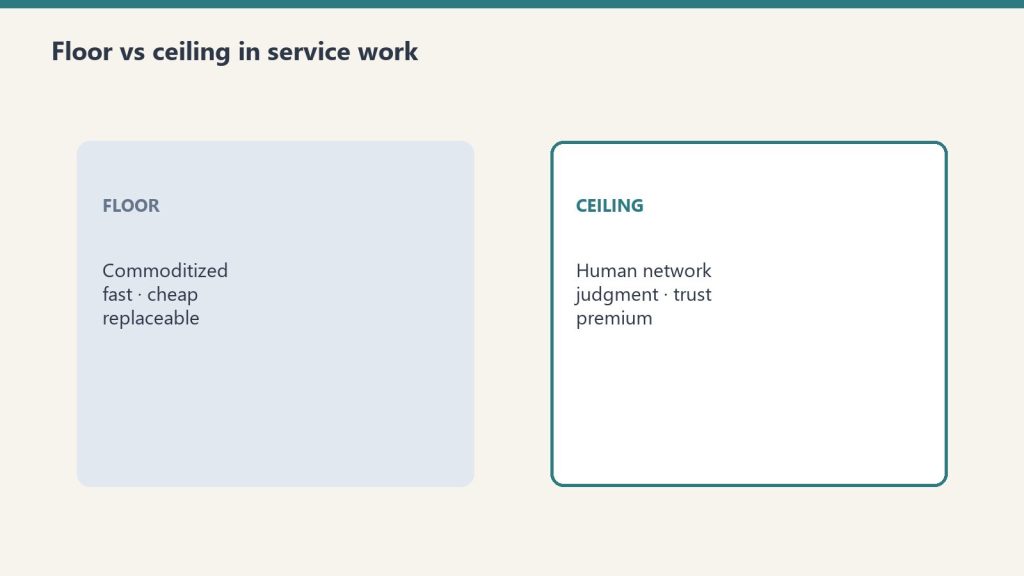
The claim, in one sentence. For solo operators and small agencies working with large language models, the dominant mental model — build a knowledge base, feed it to the model, ask questions of the document — is correct for a narrow class of work and wasteful or counterproductive for a much larger class, and the work most operators are doing fits the larger class.
A better mental model for that larger class is what this piece will call Elicitation Over Extraction: the assumption that the model already contains the relevant knowledge as latent capability, and that the operator’s job is to activate the right region of that latent capability with precise, compact prompts rather than to ship the knowledge into the context window through document retrieval. Knowledge stays in training. The work shifts to activation.
This is not a new idea in the AI research literature. It is, however, almost entirely absent from how operators are currently building their personal AI workflows. The gap between what the research suggests is possible and what the operator-tooling ecosystem is building toward is the gap this piece is trying to name and close.
Where the Current Dominant Pattern Comes From
The current dominant pattern in operator-side AI tooling is retrieval-augmented generation, or RAG. The pattern is straightforward. An operator builds a knowledge base — pages in Notion, files in Drive, articles in a vector database, transcripts of YouTube videos, customer support tickets, whatever the operator’s domain produces. When a question is asked of the model, a retrieval system finds the most relevant chunks of that knowledge base, packs them into the model’s context window, and asks the model to answer using that retrieved material as grounding.
The pattern works. For certain shapes of problem, it works very well. It is the right architecture when the operator’s question depends on information that is genuinely outside the model’s training data — proprietary documents, current events that postdate the training cutoff, client-specific details that no public source contains, internal organizational knowledge that exists nowhere on the open internet. For that shape of problem, RAG is not optional. It is the only honest way to get accurate answers, because the alternative is the model inventing details about things it has no real knowledge of.
The pattern has also been heavily promoted by the AI-tooling industry for reasons that have only loosely to do with whether it is the right pattern for any specific operator. Vector databases, retrieval pipelines, document-loading frameworks, embedding services, and knowledge-base products all exist because RAG creates demand for them. The narrative that every operator needs a knowledge base, that every workflow benefits from document retrieval, that the path to better AI work runs through better document organization — that narrative is commercially convenient for the vendors selling the components. It is also half true, which is the worst kind of half true, because the part that is true gets used to justify the part that isn’t.
The part that is true: when the model lacks the specific knowledge needed for the task, retrieval helps. The part that isn’t: when the model already has the knowledge, retrieval is at best redundant and at worst actively degrades the response. The middle case — when the model has the general knowledge but lacks the specific framing, voice, or activation — is the case the operator ecosystem has not figured out how to name or handle, and it is also the case most operators are actually in for most of their work.
The Specific Failure Mode
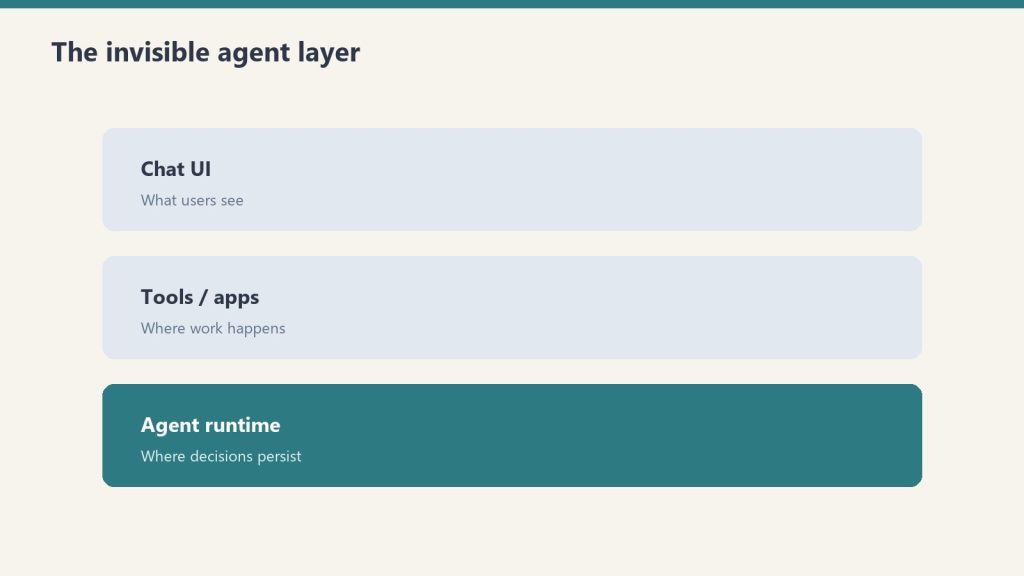
The specific failure mode of extraction. Picture an operator who wants to write content in the voice of a particular thinker — call this thinker Senior Operator-Investor, someone who has been writing publicly for twenty years and whose work is heavily represented in the model’s training data. The operator’s default move, under the RAG pattern, is to collect transcripts of that thinker’s podcasts and YouTube videos, structure them in a knowledge base, and feed them to the model along with the question.
What actually happens when the operator does this is the following. The 20,000-token transcript dump enters the model’s context window. The model attends to that transcript on every generation step, scanning for relevant passages, weighing them against the question being asked. This is computationally expensive, slow, and noisy — most of the transcript is irrelevant to any specific question. The model also already knew this thinker’s voice from training. The transcript is mostly redundant with patterns the model can already produce from its weights. The operator is paying tokens to remind the model of things the model knows.
The more efficient version is to write a 200-token activation prompt: a careful description of the thinker’s voice, their characteristic moves, their temperament, and a few canonical reference points. That prompt activates the same region of the model’s latent space that the 20,000-token transcript was trying to activate, at one one-hundredth the token cost, with less attentional noise, and with output that is often qualitatively better because the model is not being pulled in inconsistent directions by tangentially relevant transcript passages.
The 100x token reduction is not theoretical. It is what happens in practice when prompts are designed for activation rather than information transfer. The reduction is also not the most important benefit. The more important benefit is that the operator stops doing knowledge-engineering work that is duplicative with the training the model has already received, and starts doing the work that is actually distinctive: designing the activation patterns themselves.
The failure mode of the current dominant pattern is that operators are spending their time on the wrong layer. They are building warehouses when they should be building switchboards. The warehouse holds information the model already has. The switchboard turns on specific patterns of cognition that the model can already produce but does not produce by default.
What the Research Literature Says
There is a real body of research on what is called persona prompting, role conditioning, and activation steering. The findings are nuanced and they refine the claim above in ways worth knowing.
Persona prompting does change model output. The effect is measurable and consistent across many tasks. The voice, style, and reasoning approach of the model can be meaningfully shifted by a few hundred well-chosen tokens at the start of a prompt. This part of the picture confirms the central intuition of Elicitation Over Extraction: latent capability is real, activation prompts can reach it, and the activation work is meaningful work.
But the same research literature surfaces an important caveat that the strong version of the claim has to address. Persona prompting consistently helps with style, voice, clarity, and tone — the things one might call the surface texture of generation. It is less consistent, and sometimes actively harmful, on tasks that depend on precise factual recall, multi-step logical reasoning, or strict accuracy on benchmarked knowledge. In some studies, telling a model to “act like an expert” on a factual recall task decreased accuracy compared to no persona at all. The model became so focused on performing expertise that it stopped retrieving its underlying knowledge cleanly.
This is important and it changes the shape of the claim. Elicitation Over Extraction is not a universal replacement for RAG. It is the right approach for tasks where what the operator needs from the model is voice, framing, judgment, or pattern-matching against a thinker’s known mode. It is the wrong approach — and may be worse than neutral — for tasks that depend on precise factual recall of specific data points.
The honest version of the claim, then, is something like the following. Operator work falls into at least three different shapes. The first shape is “I need the model to produce content in a specific voice or style” — activation prompts dominate, RAG is wasteful. The second shape is “I need the model to retrieve specific facts from a corpus the model has not seen” — RAG dominates, activation prompts are insufficient. The third shape is “I need the model to apply judgment to information I am providing” — both layers matter, with activation handling the judgment and retrieval handling the information.
Most operators are running shape one and shape three workflows but using shape two tooling. That mismatch is the source of the inefficiency. The fix is not to abandon retrieval. The fix is to know which shape any given workflow is and use the right layer for that shape.
Why This Is Not Obvious

Why this is not obvious. If the distinction is real and well-documented in research, the question is why operators are not already organizing their work this way. Three reasons, in roughly increasing order of importance.
The first reason is that “knowledge engineering” carries a status premium that “elicitation engineering” does not. Building a structured knowledge base sounds like real work. Writing a 200-token prompt sounds like a parlor trick. The fact that the 200-token prompt may actually be doing more useful work than the knowledge base does not show up in the social register of the activity. Operators who are evaluating their own productivity, even if only to themselves, tend to over-weight effort that looks substantial and under-weight effort that looks easy, even when the easy effort is producing better results. The shape of effort matters more than the result of effort, until the operator becomes deliberate about correcting for that bias.
The second reason is that the dominant vendor narrative pushes against elicitation. Every vendor selling a vector database, every vendor selling a document loader, every vendor selling a RAG pipeline product has a commercial incentive to frame all problems as retrieval problems. The vendor ecosystem does not have a strong commercial incentive to teach operators how to write better activation prompts, because activation prompts do not require vendor products. There is no SaaS company selling “the activation layer” because the activation layer fits on one Notion page and does not need to be sold. The absence of a commercial narrative around elicitation makes it invisible to operators who are learning about AI through vendor content.
The third reason is the deepest one and it is about the relationship between knowledge and accessibility. The model containing knowledge in its training is not the same as the model producing that knowledge when queried. A first-year medical student who has read every textbook on the shelf is not the same as a senior physician who can produce the right diagnosis under pressure. The knowledge is the same in both cases. The accessibility is different. The senior physician has navigated the latent space of medical knowledge so many times that the relevant patterns activate automatically when the case presents. The first-year student has the same knowledge in storage but cannot get to it on demand under realistic conditions.
Operators are encountering models that are, in a precise sense, in the first-year-medical-student position with respect to most domains. The knowledge is there. The activation is unreliable. The dominant vendor response to this is to bypass the activation problem by stuffing the relevant knowledge directly into the context window — which works but treats the symptom rather than the cause. The Elicitation Over Extraction response is to do the activation work directly, build a library of activation patterns that reliably reach the relevant latent regions, and stop treating the model as an empty container that needs to be filled with documents.
The Working Theory
Pulling the threads together, the working theory of this piece is the following set of connected claims.
Claim one. Large language models contain enormous latent knowledge that is not, by default, reliably accessible through naive prompting. The knowledge is in the weights. The activation is the problem.
Claim two. The dominant operator response to this — document retrieval and knowledge-base construction — addresses the activation problem indirectly, by bypassing latent knowledge in favor of in-context knowledge. This works but is inefficient when the latent knowledge is already strong, and the inefficiency compounds across many operator workflows.
Claim three. A complementary approach, currently underbuilt in operator tooling, is to develop a library of compact activation prompts that reliably steer the model into specific cognitive modes — voices, frames, temperaments, schools of thought. This library serves a different function than a knowledge base and the two are complements, not substitutes, but most operators have heavily over-built the knowledge-base side and barely built the activation side.
Claim four. The right architecture for an operator’s personal AI infrastructure is therefore three-layered: a library of activation patterns for tasks that depend on voice, framing, and judgment; a structured set of retrieval sources for tasks that depend on specific external knowledge the model lacks; and a clear decision rule for which layer a given task draws from. The current state of most operators’ setups has layer two heavily built, layer one missing entirely, and layer three not articulated at all.
Claim five. The work of building the activation layer is fundamentally different from the work of building the retrieval layer. The retrieval layer is a knowledge-engineering problem and is well-served by the existing vendor ecosystem. The activation layer is closer to a writing and curation problem — closer to compiling a literary anthology than to building a database. It requires taste, exposure to many voices, and the willingness to test and refine specific prompts against actual generations until they produce the intended cognitive mode reliably. This is craft work, not engineering work, which is part of why the vendor ecosystem has not produced it.
Claim six, and this is the operator-specific implication. For a solo operator who has already built substantial knowledge infrastructure, the highest-leverage next move is not to build more knowledge infrastructure. It is to build the activation layer, integrate it with the existing knowledge layer through clear decision rules, and audit which existing workflows are running in the wrong layer. Most operators with mature stacks will find that a meaningful percentage of their token consumption is being spent on retrieval that activation could replace, and a meaningful percentage of their workflow latency is coming from documents the model did not need.
The Falsifiable Predictions
A working theory is only useful if it can be tested. The following are specific, falsifiable predictions that follow from the working theory. If any of them turn out to be wrong, the theory needs revision. If most of them hold, the theory has earned the right to be promoted from working hypothesis to operational doctrine.
Prediction one. For tasks that are primarily about voice, framing, or stylistic mimicry of a well-known thinker, a carefully written 200-token activation prompt will produce output of equal or greater quality than a 10,000-to-20,000-token transcript dump of that thinker’s work, as evaluated by blind comparison. The expected effect size is large for thinkers heavily represented in training data and shrinks toward neutral for niche or rarely-published thinkers. The test is straightforward: pick five well-known operator-thinkers whose work is heavily public, write activation prompts for each, generate responses to the same prompt using each method, and have multiple readers blind-rate the outputs.
Prediction two. Activation prompts will significantly underperform retrieval-augmented prompts on tasks that depend on precise factual recall of specific data points — dates, numbers, names, technical specifications, or any fact the model has not seen during training. This is not a weakness of the theory; it is the theory specifying its own limits. The test is to construct a set of factual-recall tasks where the relevant facts are either in the model’s training or outside it, and observe that activation alone fails on the outside-of-training cases.
Prediction three. For mixed-shape tasks — those requiring both voice/framing and specific factual recall — a hybrid approach using both an activation prompt and a small, focused retrieval payload will outperform either approach alone. The retrieval payload should be much smaller than the default RAG pattern produces, because the activation prompt is doing the framing work and the retrieval only needs to supply the specific facts. The test is to construct mixed-shape tasks and compare three configurations: activation alone, retrieval alone, and minimal hybrid.
Prediction four. Token consumption for an operator who switches from a retrieval-default workflow to an elicitation-default workflow with retrieval used only where required will drop by at least 50% across a representative week of operational tasks, with output quality holding constant or improving. The test requires the operator to instrument their token usage before and after the switch, with the same task types running through both configurations.
Prediction five. The activation layer, once built, will compound faster than the retrieval layer compounds. New activation prompts can be derived from existing ones with small modifications. New retrieval sources require substantial setup and maintenance per source. Six months after starting both, the operator will have a richer activation library than retrieval library, in terms of distinct cognitive modes available on demand, even with comparable effort spent on each.
Prediction six. The most useful activation prompts for an operator will not be persona prompts in the style most commonly published online. They will be more specific. Not “respond as an expert investor” but “respond as someone who has been wrong publicly enough times to have lost the need to perform certainty, who thinks in terms of base rates and second-order effects, and who treats the strongest argument against their own position as the most important argument to engage with first.” The granularity matters. The cognitive mode is the unit, not the role or job title. The test is to compare generations from generic-role prompts against granular-mode prompts and observe that the granular versions produce more distinctive and useful output.
The Experimental Protocol
The above predictions are testable, but they require a deliberate setup to test honestly. The protocol that this piece commits to running, with results published in a follow-up, looks like this.
Phase one is the activation library build. Five to ten distinct cognitive modes are identified, each one specifying a particular school of thought, temperament, or framing that the operator finds useful. Each mode gets an activation prompt of between 100 and 400 tokens. The prompts are written, tested, refined, and locked. The library is small enough to fit on a single page and visible enough that the operator can choose modes deliberately rather than defaulting to whichever was most recently used.
Phase two is the workflow audit. The operator’s actual workflows over a representative two-week period are catalogued. Each workflow is classified by shape: voice-and-framing, factual-recall, or mixed. The current configuration of each workflow is documented — what knowledge sources it draws from, how much retrieval it does, what its token costs are.
Phase three is the reconfiguration. Each workflow is reconfigured based on its shape. Voice-and-framing workflows switch to activation-prompt-only. Factual-recall workflows keep retrieval but trim the payload to the specific facts required. Mixed workflows switch to hybrid configuration. The total token consumption and output quality of the reconfigured stack is measured against the baseline.
Phase four is the head-to-head test. Specific representative tasks are run through both the old and new configurations in parallel, with output graded blind by the operator and ideally by a second reader. The results are published with no editing of inconvenient outcomes.
This protocol is honest if the results are published whether or not they confirm the theory. The commitment of this piece is that they will be. If the protocol shows that the existing retrieval-default configuration was actually working better than expected, the follow-up article will say so. If the protocol shows that the activation-default configuration produces equivalent or better output at materially lower token cost, the follow-up article will report the specific magnitudes. Either way, the working theory will be updated to match the evidence.
What This Does and Does Not Imply for Specific Operator Choices
If the working theory is roughly correct, a few specific implications follow for how solo operators should be thinking about their AI infrastructure.
It does not imply that knowledge bases are wasted effort. Some knowledge truly is not in training data — client specifics, internal processes, current events, proprietary frameworks. That knowledge has to live somewhere outside the model, and a structured knowledge base is the right place for it. The theory is about not duplicating general-domain knowledge that is already in training into knowledge bases that exist to remind the model of things the model already knows.
It does not imply that retrieval-augmented generation is the wrong architecture. RAG is correct for the class of problem it was designed for. The theory is about applying RAG to problems it was not designed for and getting worse outcomes than a simpler activation approach would have produced.
It does imply that operators should audit their knowledge bases. Some material in those bases is irreplaceable; some is duplicative with training and could be deleted with no loss of capability. The audit is honest only if the operator is willing to be told that some of their hard-won knowledge structuring was unnecessary.
It does imply that operators should start building activation libraries — small, dense pages of compact prompts that reliably activate specific cognitive modes. The library is more valuable than its size suggests, because each prompt represents a reliable reach into a region of latent space that would otherwise be hit only by accident.
It does imply that the dominant vendor narrative around AI tooling — that more documents, better retrieval, larger context windows, and more sophisticated knowledge bases are the path to better AI work — is partially right and partially misdirected. The operator who builds carefully on the activation side will, over time, produce better work with less infrastructure than the operator who builds heavily on the retrieval side without considering the activation question.
And it does imply, finally, that the relationship between operators and large language models is being mismodeled in most current operator tooling. The model is not an empty vessel that needs to be filled with documents. The model is a vast latent capability that needs to be activated. The job of the operator is to learn the activation. Most of the actual leverage is in that learning.
The Honest Limits of This Theory
This theory is a working hypothesis published in public, and a few things about it deserve to be flagged before any reader uses it to make operational decisions.
The theory is based on the current generation of large language models. If the next generation handles activation differently — through better default behavior, through changes in how training data is organized, through architectural shifts toward mixture-of-experts routing that handles activation natively — the operator-side implications change. The theory should be re-tested at every model generation, not treated as settled.
The theory is based on the current state of operator tooling. If a future vendor builds a strong “activation layer” product that handles the work this piece is describing as operator-side craft, the operator’s optimal allocation of time shifts. The theory should be revised as the tooling landscape changes.
The theory is based on the specific shape of work that solo operators and small agencies do. Large enterprises with very different scale, different data privacy constraints, and different output requirements may need different architectures. The theory is operator-flavored on purpose; it does not claim to be a universal description of how all users should engage with these models.
And the theory is, finally, a theory. It is more rigorous than a guess but less established than a doctrine. The predictions it makes are testable and will be tested. Until they are, the right posture is interested skepticism rather than adoption. The reader of this piece is invited to argue with it, propose better versions, run the experimental protocol independently, and report results that contradict the central claim if they find them. That is how working theories should be treated. The article is not the final word. It is the opening of a conversation that the evidence will close.
What Happens Next
The experimental protocol described above will run over the next sixty days. Phase one — building the activation library — begins this week. Phases two through four follow on a published schedule. A follow-up article will report results, including any results that contradict the theory laid out here.
In the meantime, this piece serves as the reference point. It is what was thought to be true on the date of publication. The version of these ideas that the evidence eventually supports may be quite different. That is the point. Working theories are published so they can be refined. The publication is the commitment to the refinement.
If the theory is right, the implications for how solo operators should be building their AI infrastructure are significant and largely opposite to what the current vendor ecosystem is pushing toward. If the theory is wrong, knowing it is wrong is itself useful — the failure modes that show up during testing will surface things about how these models actually behave that no current piece of operator-side writing has named clearly.
Either way, the work is the work. The theory is published. The experiments run next. The evidence settles it.