
The single biggest reason restoration companies stall at 5-10 employees isn’t sales, marketing, or capital — it’s role confusion. When everyone owns everything, nobody owns anything. This is the org chart and role definitions that scale.
The four functional buckets
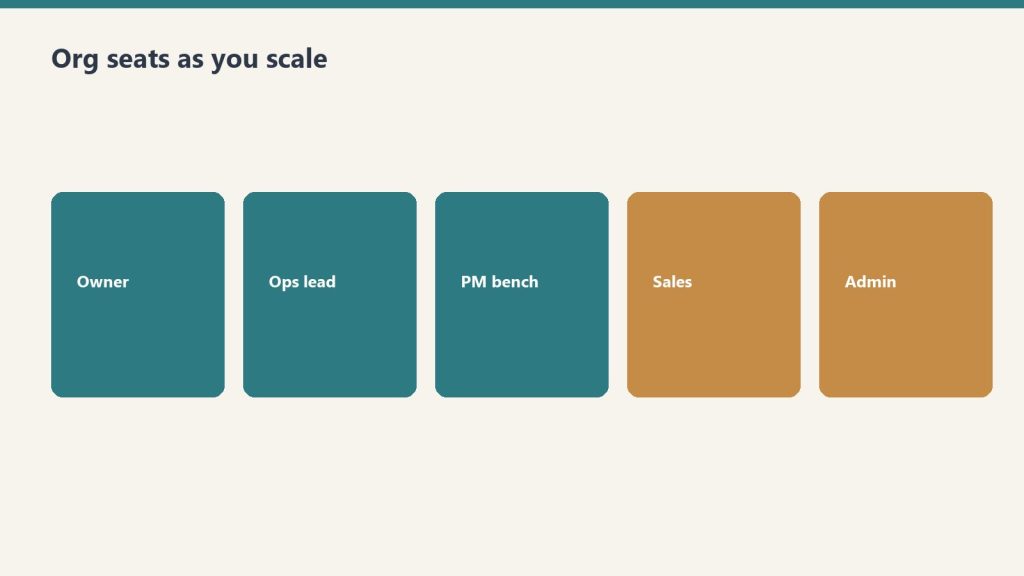
Every restoration company, no matter the size, operates through four functional buckets. The org chart is just how those buckets get assigned to humans.
- Sales / Estimating: Get the work, scope the work, price the work.
- Production: Do the work to scope, on time, with documentation.
- Operations / Dispatch: Schedule the work, deploy people and equipment, monitor progress.
- Admin / Finance: Bill the work, collect the money, run AR/AP, payroll, compliance.
In a 1-truck shop, the owner does all four. In a 50-employee shop, each bucket has 3-5 people. The transition between is where companies break.
Role definitions that hold up
Owner / President
Strategy, banking, major TPA relationships, key insurance carrier relationships, hiring, culture, financial oversight. Past 5 trucks, the owner should not be on jobs unless it’s a CAT event or a VIP customer.
Operations Manager
Owns production across all crews. Responsible for safety, equipment, training, technician performance, and quality control. KPI: jobs completed on schedule and to scope.
Estimator
Owns scope and pricing. Sketches in Xactimate, builds estimates, writes supplements, interfaces with adjusters. KPI: scope accuracy, supplement approval rate, estimate cycle time.
Project Manager (PM)
Owns 8-15 active jobs end-to-end. Customer communication, photo documentation, scope adherence, schedule, billing readiness. KPI: customer NPS, days to invoice ready, scope-vs-actuals variance.
Dispatcher / Coordinator
Owns the schedule. Receives intake calls, deploys crews, tracks equipment, handles afterhours rotation. KPI: response time, crew utilization, equipment turn time.
Lead Technician
Runs a 2-3 person crew on the truck. Owns documentation in the field, daily moisture readings, safety, customer experience on site. KPI: drying days, photo completeness, customer feedback.
Office Manager / Bookkeeper
Owns AR, AP, payroll prep, compliance filings, vendor management, certificate of insurance management. KPI: DSO, AR aging, on-time payroll.
How the chart evolves by employee count
| Size | Org Structure |
|---|---|
| 1-3 employees | Owner does sales/estimating/dispatch/AR. Lead Tech + Helper run production. |
| 4-7 employees | Add Office Manager (AR/AP/intake). Owner still estimates and dispatches. |
| 8-12 employees | Add Estimator and Dispatcher. Owner moves to sales relationships and oversight. |
| 13-20 employees | Add Operations Manager and PM(s). Owner exits production decisions entirely. |
| 20+ employees | Multiple PMs, dedicated equipment tech, marketing role, possibly second estimator. |
RACI for the most common breakdowns
The biggest role conflicts in restoration org charts are around: scope changes mid-job, supplement responsibility, customer complaints, and equipment loss. Document RACI (Responsible, Accountable, Consulted, Informed) for each:
- Scope change mid-job: Lead Tech responsible for surfacing it, PM accountable for approving and updating estimate, Estimator consulted, Customer informed.
- Supplements: Estimator responsible and accountable, PM consulted, Adjuster the recipient.
- Customer complaint: PM responsible and accountable, Operations Manager consulted, Owner informed unless escalated.
- Equipment loss: Lead Tech responsible for reporting, Operations Manager accountable for resolution, Office Manager informed for asset register update.
FAQs about restoration org charts
When should I hire an Operations Manager?
When you have 3+ active production crews running daily. Below that, the owner can still maintain quality oversight personally. Above that, things slip without a dedicated ops role.
Should the estimator and PM be the same person?
In small shops (under 8 employees), yes — one person handles both. Past 10 employees, separate them. The skillsets diverge: estimating is a pricing-and-defense role, PM is a customer-and-schedule role.
Do I need a dedicated dispatcher or can the office manager dispatch?
Office Manager can dispatch up to 2-3 trucks. Past that, dispatch demands too much real-time attention to combine with billing/AR work. Split the roles.
What’s the right pay band for an Operations Manager?
$70K – $110K base + 5-15% performance bonus is the typical 2026 range for restoration Operations Managers, depending on market and revenue size. Multi-location regional ops managers push $130K-$160K.
How do I avoid hiring my way into bloat?
Tie every role to a revenue trigger and a documented KPI. If a role can’t be tied to a measurable output, it’s not yet a role — it’s the owner offloading anxiety.
Operator playbook: Restoration Startup and Scaling Master Guide.
Related on Tygart Media: Starlink on a water job · S500 in the van · local SEO for restoration.
Get The Signal
What we actually ran, what it measured, and what it means for a restoration shop — every week, including the flops.
Leave a Reply