A fence contractor moved a few points in a month. That is not a failure. Grid rank is a slow instrument. Restoration owners treat it like a storm ticket and cancel when week four is quiet.
The pin is for the next wet season and the next 11 p.m. search. Reviews, photos, citations, and a live category need to sit there long enough for prominence to catch. Judge the file on whether the work is happening every week, not on whether Tuesday was busy.
Pressure washing is easy to start, so everyone starts it, so price becomes the product. The better home-service bets are the ones that require a license. Mold in the walls is not a Facebook-marketplace job. The homeowner pays the licensed crew and rarely negotiates in a smaller market.
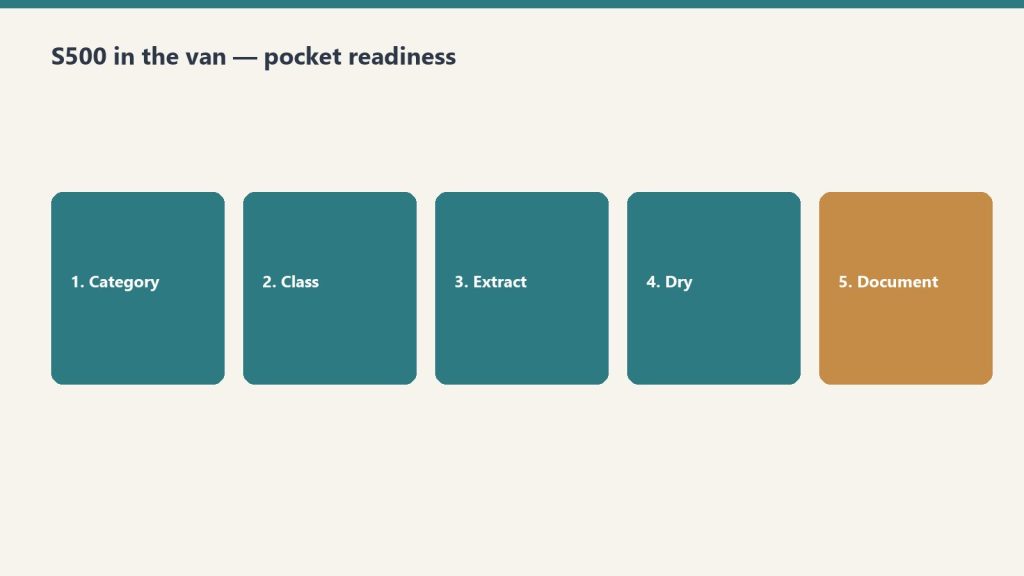
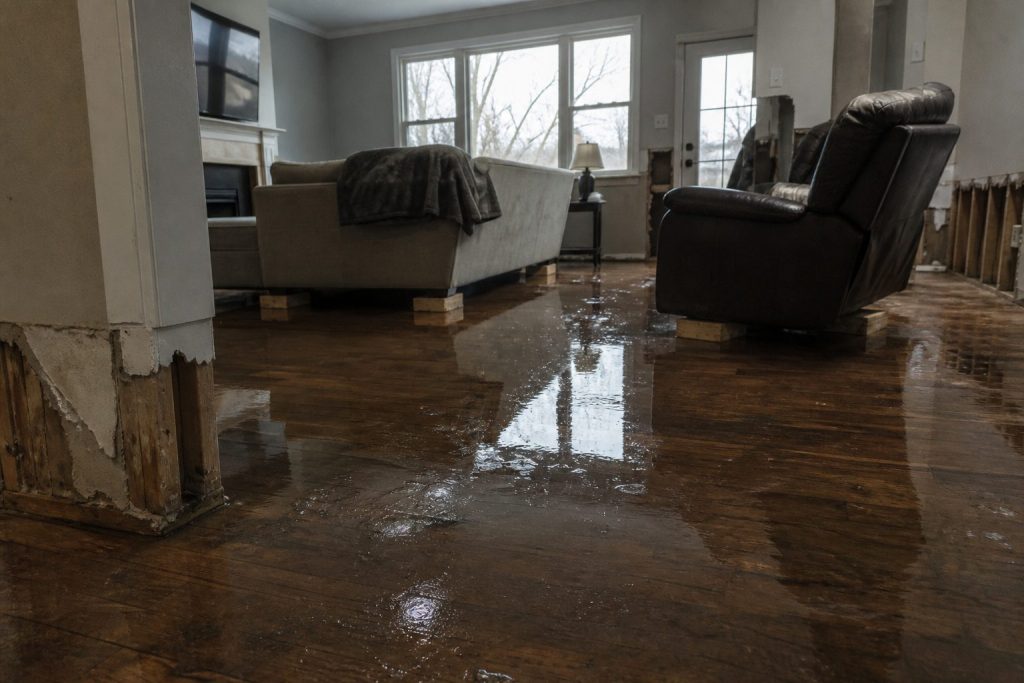
Restoration has both layers. Unlicensed “we dry houses” crews will always undercut a Category 1 extract. That is not your race. IICRC S500/S520, state mold licenses, documented meters, and a paper trail the adjuster can read are why a 2 a.m. sewage job does not get three quotes.
Put the credentials on the pin, the header, and the service page. Then do the work those credentials claim. Price holds when the alternative looks like a shop vac and a prayer.
A 30-year local name carries branded Google searches, reviews tied to that string, pin history, citations, the phone number people still have in a notes app, and referrals that start with “call these guys.” Wipe it on day one and the shop looks like it opened last month.
Restoration add: adjusters and property managers do not update their vendor list because you bought new truck wraps. They call the name that last sent a clean moisture map. Matching vans are a bad trade for that file.
Keep the domain, the number, and the Google profile where they sit. If the parent brand has to show, use a bridge: “[Old Name], a [Parent] company.” Update GBP, site, and citations together. Redirect the old domain. Leave the old phone live while branded search moves.
Full rebrand only when the old name is radioactive — bad reviews, legal mess, or no search demand. Otherwise you paid for years of local trust and then deleted the receipt.
Every new restoration owner wants to rank for “water damage repair” this month. In a lot of markets that phrase is already owned by shops that locked preferred-vendor lists in 2008. The pipe bursts, the adjuster hands over three names, and your beautiful water page never gets the call.
Mold is often the door that is still open. Homeowners pay out of pocket or pick the contractor without waiting on a carrier sheet. Sales cycle is short. Jobs in many markets land in the three-to-eight-thousand range. Local keywords can still move in ninety days if the page is real.
How to run the lane without abandoning water
Give mold remediation its own URL. S520 language, containment photos, clearance testing explained in plain words, city name in the title.
Write the delayed-loss pages: “mold after a slow leak,” “mold after the insurance dry-out ended too soon.” That is retail demand water shops ignore.
Keep water, sewage, and fire pages live. They are the storm asset. They are not the only asset.
Use mold cash to stay staffed for the next wet month instead of waiting on claims to clear.
This is not “quit water.” It is “stop betting the company on a keyword the incumbents already bought with relationships.” Water still pays the trucks when weather shows up. Mold pays the trucks while you wait.
Starting a restoration company in 2026 is part trade business, part insurance navigation, and part marketing engine. The market is real — the U.S. damage restoration services industry is roughly $7.1 billion with 60,000+ businesses already operating — but margins live or die on the first 90 days of operating decisions. This is the operator blueprint.
What it actually costs to start
What it actually costs to start — framing without sticky \$.
Forget the “start with $5,000” social media posts. A real restoration company opening day in 2026 looks like this:
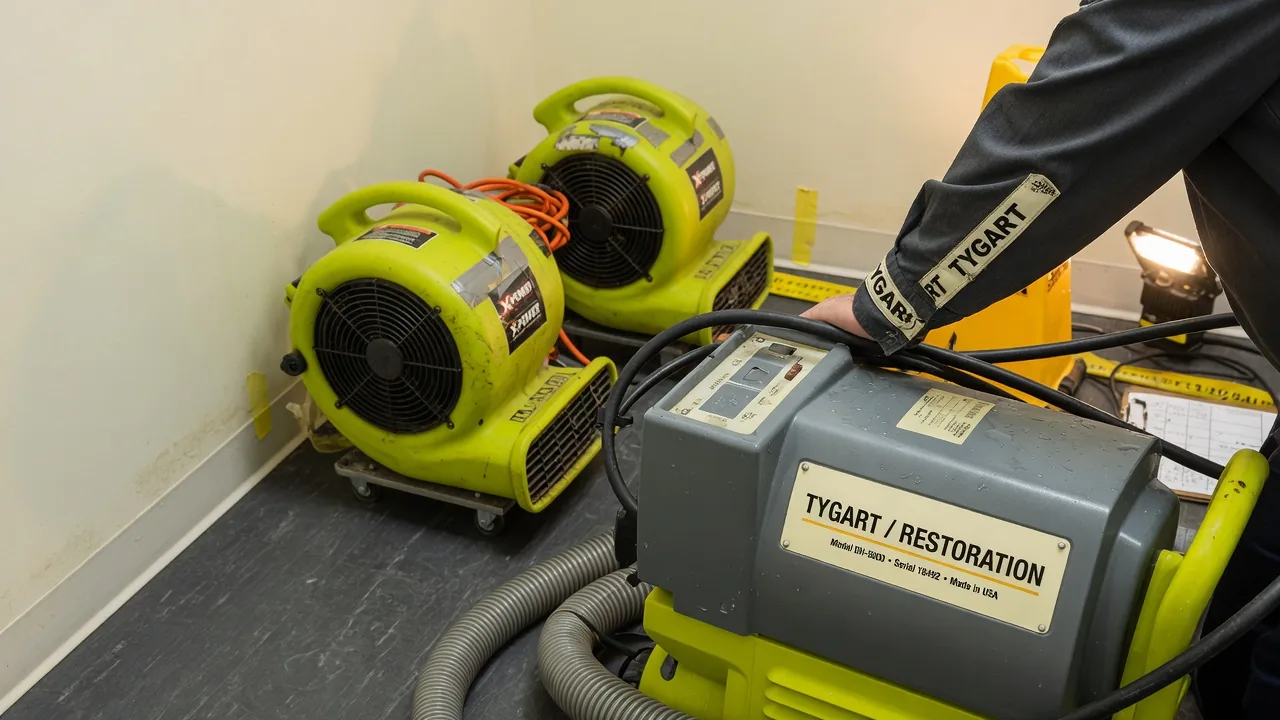
Equipment package (water mitigation only): $20,000 – $50,000. Air movers ~$250 each (you’ll need 12-20), small dehumidifiers ~$1,000, large LGRs ~$2,500, HEPA air scrubbers, moisture meters, thermal camera, extraction wand or truck-mount.
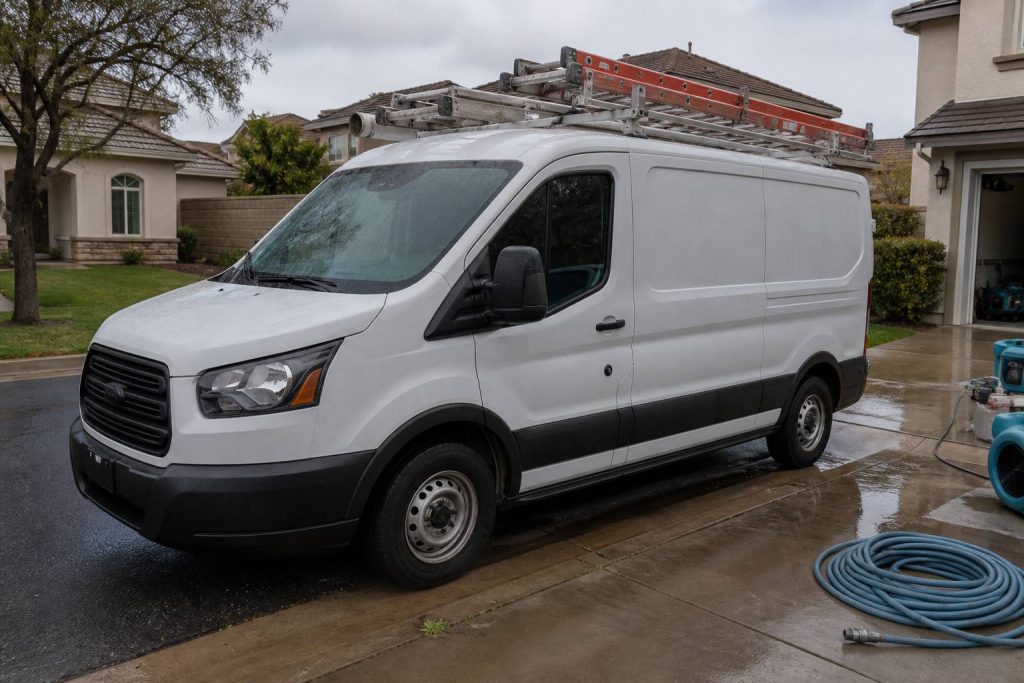
Service vehicle: $40,000 – $50,000 for a used cargo van fitted out, or $60,000 – $80,000+ for a new one.
IICRC certifications: $1,000 – $2,500 to get an owner through WRT, ASD, AMRT.
Insurance: General liability + commercial auto + pollution liability + workers comp typically runs $8,000 – $15,000/year for a 1-2 truck shop.
Working capital (payroll, fuel, software for 90 days): $30,000 – $75,000.
A bootstrapped 1-truck launch lands around $80,000 – $150,000 cash to be safe. Detailed industry models for fully-equipped multi-truck launches put the all-in number closer to $794,000 — but that’s not what most operators do on day one. Most start lean and reinvest.
The certifications that actually matter
Certifications that actually matter.
You can legally start a restoration company without IICRC certs in most states — but you cannot work TPA programs, you cannot pass insurance carrier audits, and you cannot bill standard scopes credibly. Get these in this order:
WRT (Water Damage Restoration Technician) — the prerequisite for everything else.
ASD (Applied Structural Drying) — to actually do drying competently.
AMRT (Applied Microbial Remediation Technician) — opens mold work and protocol-driven jobs.
FSRT and OCT — once fire and contents work enters the mix.
Insurance, licensing, and the legal floor
Restoration is one of the most insurance-heavy small businesses you can start. You will get audited. Required minimums for most TPA programs and many commercial work:
$1M / $2M general liability with mold endorsement.
$1M commercial auto.
State-required workers comp (not optional once you have employees).
Pollution liability is increasingly required for any work involving Cat 3 water or mold.
State licensing varies widely. California requires a contractor’s license (B or specialty). Florida requires mold remediation licensure. Texas requires mold remediation contractor licensing for any covered mold work. Check your state contractor licensing board before spending a dollar on equipment.
How you find the first 30 jobs
How you find the first 30 jobs.
Nobody hands you work in restoration. The first 30 jobs come from a stack of overlapping moves:
Plumbers: Walk into 50 plumbing shops in your service area with donuts and a one-pager. Plumbers refer water losses every week and most have no go-to restorer.
Property management companies: Cold-call, drop off business cards, get on after-hours emergency lists.
GBP + LSA + emergency-keyword Google Ads: Day-one local search presence is non-negotiable.
Insurance agents (independent, not just captive): They refer to whoever they trust to make their client happy.
TPA enrollment: Enrolling in Contractor Connection, Alacrity, or Code Blue takes time — start the applications in month one.
The most common failure mode in restoration startups isn’t going broke — it’s getting stuck. The owner runs every job, sells every job, estimates every job, and 18 months in still has 1 truck and no time to grow. Set the trigger now: at $40,000/month in revenue, hire your first technician. Don’t wait until you’re drowning.
FAQs about starting a restoration company
How much money do I really need to start a restoration company?
For a lean 1-truck water mitigation launch in 2026, plan on $80,000 – $150,000 in cash including equipment, vehicle, insurance, certifications, marketing, and 90 days of working capital. Multi-truck launches with fire and mold capability run $400,000 – $800,000+.
Do I need IICRC certification to legally start a restoration company?
Most states do not require IICRC certification to legally operate. However, you cannot enroll in TPA programs (Contractor Connection, Alacrity, Code Blue), pass most insurance carrier audits, or credibly bill standard scopes without it. Treat WRT, ASD, and AMRT as effectively required.
What licenses do I need to start a restoration company?
It varies by state. California requires a contractor’s license. Florida and Texas require mold remediation licensure. Almost all states require a business license, sales tax registration, and workers comp once you have employees. Always confirm with your state contractor licensing board before launching.
How long does it take to break even in restoration?
A focused 1-truck water-only operation typically reaches breakeven in 6 – 12 months if marketing and TPA work pick up. Operators who add fire and mold capability faster usually break even slower because they spread capital thinner across more equipment categories.
Should I buy a franchise or start independent?
Franchises (Servpro, Restoration 1, ServiceMaster) provide brand, lead flow, and TPA shortcuts — at the cost of $50,000 – $80,000 in initial fees plus ongoing royalties of 5-10%. Independents keep more margin but have to build everything themselves. The right answer depends on your starting capital, marketing skill, and tolerance for slow ramp.
A restoration business plan exists for one reason: to convince a third party (banker, TPA program manager, investor, partner) that you understand the economics of the business you’re building. Most plans fail not because the writing is bad, but because the numbers don’t reflect how restoration actually operates.
The 8 sections that have to be in it
Eight sections that have to be in the plan.
Executive summary. One page. Who you are, what you do, where you operate, the funding ask, and the headline financial outlook.
Company overview. Legal structure, ownership, location, service area, founding team backgrounds.
Market analysis. The U.S. damage restoration market is roughly $7.1 billion with ~60,000 companies. Identify your local market size, top 5 competitors, and your differentiation.
Marketing and sales plan. How you’ll generate work — referral channels, TPA enrollments, digital, fleet visibility.
This is where most restoration business plans collapse under scrutiny. Bake in real numbers:
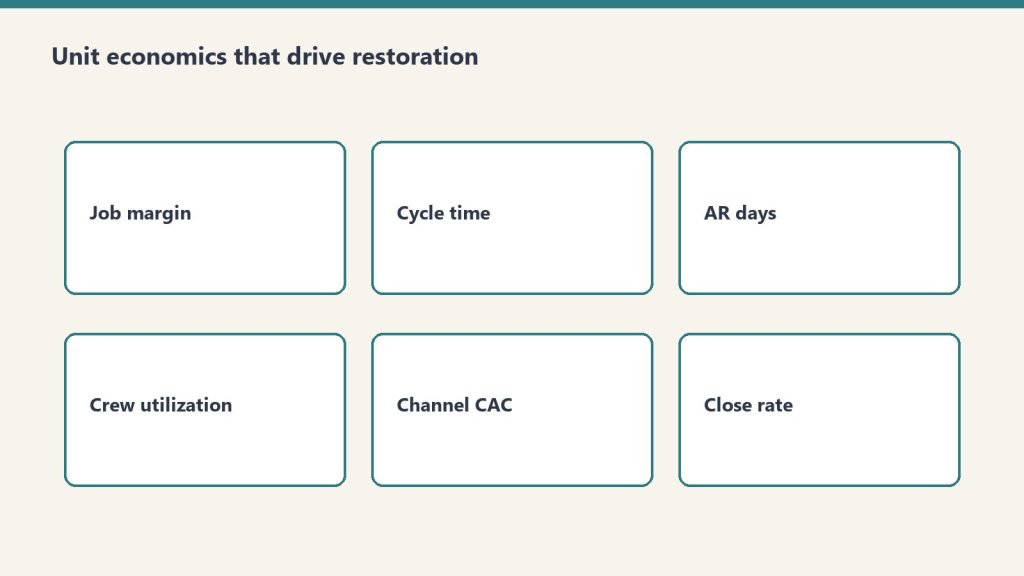
Revenue per truck per month: $30,000 – $50,000 is realistic for a mature crew on consistent water/mold work. Don’t model $80,000/truck unless you can show how.
Gross margin: 40-55% on mitigation, 25-35% on reconstruction. Blended typically 35-45%.
Labor as % of revenue: 28-35% for production technicians.
Equipment depreciation: 5-7 years straight line on dehus and air movers.
Marketing spend: 5-10% of revenue is realistic for growth-mode restoration companies.
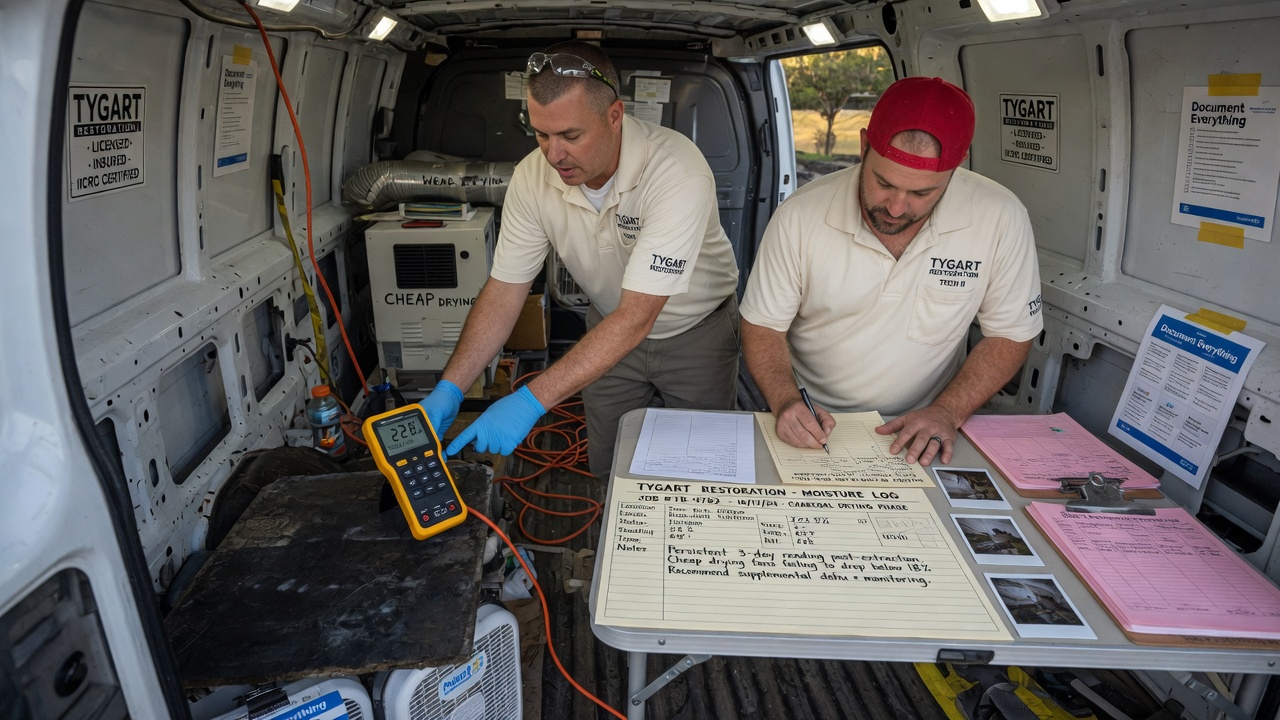
DSO (days sales outstanding): Plan for 60-90 days on insurance work, 30 on cash work. This is the cash flow killer.
What TPA program managers look for
What TPA program managers look for.
If your business plan exists to support a TPA enrollment application (Contractor Connection, Alacrity, Code Blue), they care about:
Service area definition and response time commitments.
Insurance coverage levels meeting program minimums.
IICRC certifications across the team.
Production capacity (number of technicians, trucks, equipment cache).
Quality systems — photo documentation, scope adherence, customer satisfaction tracking.
Financial stability evidence.
What bankers look for
SBA 7(a) lenders and restoration-friendly community banks want different things than TPAs:
Owner cash injection: 10-20% of total project cost.
Personal guarantee. Non-negotiable.
Industry experience. 2+ years in restoration is the soft minimum.
DSCR (debt service coverage ratio) above 1.25.
Realistic AR aging assumptions. Bankers know insurance pays slow.
The revenue model you should actually run
The revenue model you should actually run.
Most failed restoration business plans assume linear revenue growth. Real restoration revenue is lumpy, seasonal, and event-driven (CAT events, freeze events, hurricane events). Build your model with a base run rate plus a CAT event uplift assumption — and keep enough working capital for a slow quarter.
FAQs about restoration business plans
How long should a restoration business plan be?
20-30 pages for a bank or investor plan. 5-10 pages for a TPA enrollment package. Anything over 40 pages signals padding.
What revenue should I project for year 1?
A 1-truck water-only operation typically lands $250,000 – $500,000 in year 1. A 2-truck operation with fire capability and active TPA enrollments can hit $750,000 – $1.2M. Don’t project $2M in year 1 unless you have signed referral agreements to back it up.
Do I need a business plan if I’m self-funding?
Yes. Even without a banker, the business plan forces you to confront equipment costs, insurance levels, marketing budget, and the math of when you can hire your first employee. Self-funded operators who skip the plan tend to run out of cash in month 9.
What is the typical EBITDA margin for a restoration company?
Mature, well-run restoration companies operate at 12-18% EBITDA margins. Owner-operator shops often run 5-10% because the owner is undercompensated. Multi-location regional players in good markets can push 18-22%.
Should I include reconstruction in my year-1 plan?
Most operators add reconstruction in year 2 or 3, not year 1. Reconstruction adds licensing complexity, longer DSO, lower gross margin, and dramatically more capital requirements. Lead with mitigation, build cash, then layer reconstruction.
Equipment is the line item that surprises new restoration operators the most. The catalog photos look cheap. The package quotes from suppliers look expensive. The truth is somewhere in between, and the right answer depends on whether you’re outfitting one truck or three.
Mold: Negative air machines ($800 – $1,500), additional HEPA scrubbers, containment poly and zipper doors, full PPE program. Plan on $5,000 – $10,000 added.
Contents: Pack-out boxes, content cleaning station, ultrasonic cleaner ($2,000 – $8,000), storage racks. Plan on $5,000 – $20,000 added.
Vehicle costs (2026)
Used cargo van + basic shelving: $35,000 – $50,000.
New cargo van + custom buildout: $60,000 – $90,000.
Industry models for fully-equipped multi-truck launches put the initial fleet investment at ~$80,000 for two service vans, with total capital expenditures including specialized equipment around $172,000.
Three realistic startup tiers
Three realistic startup tiers — no sticky dollar stickers.
Tier 1: Lean Owner-Operator ($80K – $150K total cash)
1 used van
Water mitigation only
16 air movers, 2 small dehus, 1 LGR, 1 HEPA
Owner-only crew
Tier 2: Mid-Tier Multi-Service ($250K – $450K total cash)
Tier 3: Multi-Truck Production Shop ($500K – $1M+ total cash)
3-5 vans + 1 box truck
Water + fire + mold + contents + light reconstruction
80+ air movers, 12+ dehus, 8+ HEPA, full negative air kit, content cleaning station
5-8 technicians + dispatcher
Equipment pitfalls to avoid
Buying everything new at launch. Used dehumidifiers and air movers from auctions or other restorers can cut equipment cost 40-60%.
Underbuying air movers. 16 is the practical floor — large losses eat 30+ on day one.
Skipping the thermal camera. It pays for itself in scope defensibility on the first 3 jobs.
Cheap moisture meters. Insurance adjusters notice. Buy Delmhorst or Tramex.
Ignoring asset tracking. By job 50 you’ll lose track of where your equipment is. Plan tracking from day one.
FAQs about restoration equipment costs
How many air movers do I need to start?
Minimum 16. A typical Cat 1 water loss in a 2,000 sq ft home requires 12-20 air movers running 3-5 days. Underbuying means you can only run one job at a time, which kills revenue per truck.
Should I buy used or new restoration equipment?
Air movers and small dehus: used is fine if you can verify hours and condition. Large LGR dehumidifiers: buy new — refurb risk on compressor failure isn’t worth the savings. Trucks: used with a real PPI is the budget winner.
What is the cheapest way to start a restoration company?
Lean owner-operator with $80K cash: used van, 16 air movers, 2 dehus, 1 HEPA, water mitigation only, owner does all production for the first 6 months. Add capability as cash flow allows.
Do I need a truck-mount extractor?
For pure water mitigation, a portable extractor ($3,500 – $5,000) is enough for the first year. Truck-mounts ($15,000 – $25,000) become worth it when you’re running 5+ jobs/week or doing significant carpet cleaning.
What software should I budget for?
Xactimate ($150-200/month base + per-estimate fees), Encircle or Magicplan ($50-150/month), DASH or Restoration Manager ($200-500/month), QuickBooks ($30-90/month). Plan on $400-800/month in software once you’re operational.
Most restoration companies plateau at one truck and one owner-operator burning out at 70-hour weeks. The jump to two trucks is harder than it looks — and the jump from two to five is what separates a job from a real business. This is the operator’s version of how that scaling actually happens.
Why most restoration companies stay stuck at one truck
Why most restoration companies stay stuck at one truck.
The 1-truck plateau isn’t a marketing problem — it’s a structural one. The owner is the estimator, the dispatcher, the lead tech, the QA reviewer, the AR clerk, and the salesperson. Every additional job adds load to all six roles simultaneously. There is no room to grow until at least one role gets unloaded.
The hiring sequence that actually scales
The hiring sequence that actually scales.
Hire #1: Lead Technician (~$40K monthly revenue trigger). Frees the owner from production. Pay $22-32/hr depending on market and certifications.
Hire #2: Helper / Apprentice (~$60K monthly revenue trigger). Fills out a 2-person production crew. Pay $17-22/hr.
Hire #4: Second Lead Tech (~$120K monthly revenue trigger). Enables a second crew, second truck.
Hire #5: Estimator (~$150K monthly revenue trigger). Owns Xactimate sketch, scope, and supplements.
Hire #6: Project Manager / Operations Manager (~$200K+ monthly revenue trigger). Owns daily production oversight across multiple crews.
The dispatch problem
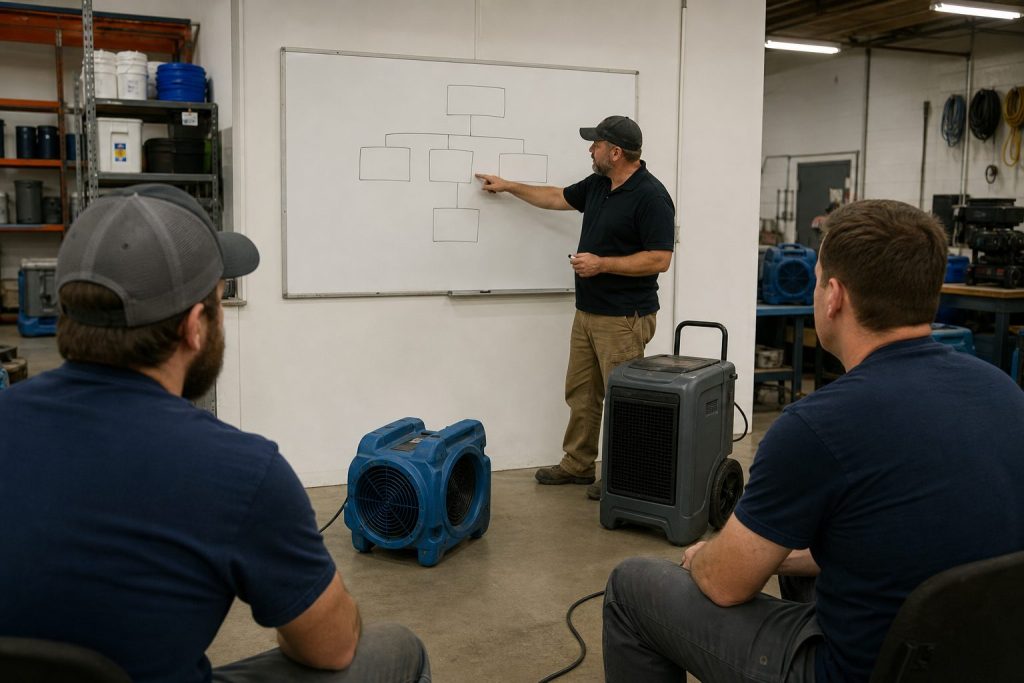
One truck is easy — you go where you go. Two trucks is the hardest dispatch challenge in the company because the owner is still mentally dispatching from the field. Three+ trucks demands a real dispatcher and a real software system. Restoration Manager, DASH, Encircle, or Job Nimbus are all viable. The wrong answer is a whiteboard in the office past truck #2.
Equipment cache scaling
The naive math is “double the trucks, double the equipment.” The real math accounts for utilization:
1 truck: 16-20 air movers, 2-3 dehus, 2 HEPA.
2 trucks: 40-50 air movers, 5-7 dehus, 4 HEPA. (Not 32-40 air movers — concurrent jobs eat more.)
3 trucks: 70-90 air movers, 10-12 dehus, 6+ HEPA, asset tracking system non-negotiable.
5 trucks: 120+ air movers, 18+ dehus, dedicated equipment tech who handles cleaning/maintenance.
Working capital as you scale
Insurance work pays in 60-90 days. Payroll runs every 2 weeks. The faster you grow, the more cash you have tied up in AR. A useful rule:
Cash on hand should equal 60 days of operating expenses + 30 days of net AR.
Operators who scale without honoring this rule end up factoring receivables at painful discount rates (often 2-5% per invoice) just to make payroll. Build a line of credit before you need it.
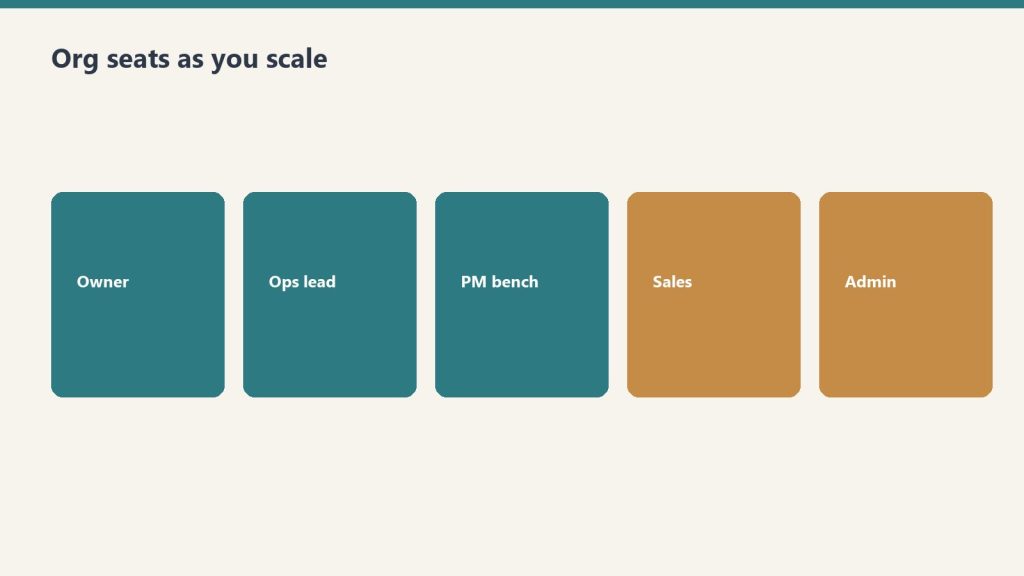
The org chart that supports 5 trucks
The org chart that supports five trucks.
Once you’re past 3 trucks, the org chart is the company. A typical 5-truck shop has:
Equipment Tech (part-time at 3 trucks, full-time at 5)
That’s 12-18 people running ~$2-4M in revenue.
FAQs about scaling a restoration company
How much revenue do I need before hiring my first employee?
$30,000 – $40,000 in monthly revenue, sustained for 60+ days. Hiring before that level usually means the owner is still on the truck and the new hire is an idle expense.
How many trucks can one dispatcher handle?
A trained dispatcher comfortably handles 4-6 trucks. Beyond 6, you need either a second dispatcher or a project manager / dispatcher hybrid model with crews assigned to specific PMs.
What’s the right truck-to-technician ratio?
2 technicians per truck is the working standard for water mitigation. Fire and contents work often pushes to 3 per truck because of pack-out labor. Mold remediation runs 2-3 per truck depending on containment scope.
When should I add reconstruction services?
Most operators add reconstruction in year 2-3, after mitigation revenue is stable at $1M+ annual. Earlier addition spreads capital and management attention too thin. Reconstruction also extends DSO from 60 days to 90-120 days, which strains cash flow.
Should I open a second location to scale?
Not until your primary location runs 4+ trucks profitably and you have a proven Operations Manager who can be promoted to run location #1 when you focus on launching #2. Premature multi-location expansion is the most common reason 7-figure restoration companies blow up.
The single biggest reason restoration companies stall at 5-10 employees isn’t sales, marketing, or capital — it’s role confusion. When everyone owns everything, nobody owns anything. This is the org chart and role definitions that scale.
The four functional buckets
Four functional buckets on the org chart.
Every restoration company, no matter the size, operates through four functional buckets. The org chart is just how those buckets get assigned to humans.
Sales / Estimating: Get the work, scope the work, price the work.
Production: Do the work to scope, on time, with documentation.
Operations / Dispatch: Schedule the work, deploy people and equipment, monitor progress.
Admin / Finance: Bill the work, collect the money, run AR/AP, payroll, compliance.
In a 1-truck shop, the owner does all four. In a 50-employee shop, each bucket has 3-5 people. The transition between is where companies break.
Role definitions that hold up
Role definitions that hold up.
Owner / President
Strategy, banking, major TPA relationships, key insurance carrier relationships, hiring, culture, financial oversight. Past 5 trucks, the owner should not be on jobs unless it’s a CAT event or a VIP customer.
Operations Manager
Owns production across all crews. Responsible for safety, equipment, training, technician performance, and quality control. KPI: jobs completed on schedule and to scope.
Estimator
Owns scope and pricing. Sketches in Xactimate, builds estimates, writes supplements, interfaces with adjusters. KPI: scope accuracy, supplement approval rate, estimate cycle time.
Project Manager (PM)
Owns 8-15 active jobs end-to-end. Customer communication, photo documentation, scope adherence, schedule, billing readiness. KPI: customer NPS, days to invoice ready, scope-vs-actuals variance.
Runs a 2-3 person crew on the truck. Owns documentation in the field, daily moisture readings, safety, customer experience on site. KPI: drying days, photo completeness, customer feedback.
Office Manager / Bookkeeper
Owns AR, AP, payroll prep, compliance filings, vendor management, certificate of insurance management. KPI: DSO, AR aging, on-time payroll.
How the chart evolves by employee count
How the chart evolves by employee count.
Size
Org Structure
1-3 employees
Owner does sales/estimating/dispatch/AR. Lead Tech + Helper run production.
4-7 employees
Add Office Manager (AR/AP/intake). Owner still estimates and dispatches.
8-12 employees
Add Estimator and Dispatcher. Owner moves to sales relationships and oversight.
13-20 employees
Add Operations Manager and PM(s). Owner exits production decisions entirely.
20+ employees
Multiple PMs, dedicated equipment tech, marketing role, possibly second estimator.
RACI for the most common breakdowns
The biggest role conflicts in restoration org charts are around: scope changes mid-job, supplement responsibility, customer complaints, and equipment loss. Document RACI (Responsible, Accountable, Consulted, Informed) for each:
Scope change mid-job: Lead Tech responsible for surfacing it, PM accountable for approving and updating estimate, Estimator consulted, Customer informed.
Supplements: Estimator responsible and accountable, PM consulted, Adjuster the recipient.
Equipment loss: Lead Tech responsible for reporting, Operations Manager accountable for resolution, Office Manager informed for asset register update.
FAQs about restoration org charts
When should I hire an Operations Manager?
When you have 3+ active production crews running daily. Below that, the owner can still maintain quality oversight personally. Above that, things slip without a dedicated ops role.
Should the estimator and PM be the same person?
In small shops (under 8 employees), yes — one person handles both. Past 10 employees, separate them. The skillsets diverge: estimating is a pricing-and-defense role, PM is a customer-and-schedule role.
Do I need a dedicated dispatcher or can the office manager dispatch?
Office Manager can dispatch up to 2-3 trucks. Past that, dispatch demands too much real-time attention to combine with billing/AR work. Split the roles.
What’s the right pay band for an Operations Manager?
$70K – $110K base + 5-15% performance bonus is the typical 2026 range for restoration Operations Managers, depending on market and revenue size. Multi-location regional ops managers push $130K-$160K.
How do I avoid hiring my way into bloat?
Tie every role to a revenue trigger and a documented KPI. If a role can’t be tied to a measurable output, it’s not yet a role — it’s the owner offloading anxiety.
The restoration M&A market is the busiest it’s ever been. Private equity has deployed $6 billion+ across 50+ platforms since 2018, with notable exits like HighGround (13 acquisitions in 5 years to Knox Lane) and American Restoration (an 8-brand roll-up to Morgan Stanley) proving the playbook. If you own a restoration company, understanding the exit math is no longer optional.
Current 2026 valuation multiples
How buyers frame valuation — without sticky multiples on the graphic.
Restoration company values vary widely by size, mix, and quality of operations:
$3M – $10M revenue shops: 4x – 7x EBITDA range, with quality operators commanding the high end.
$10M+ regional platforms: 7x – 10x EBITDA on PE platform deals.
Industry average: Average EBITDA multiples across restoration companies range 3.24x – 4.31x; the broader observable range is 3-8x.
What PE buyers actually want
What PE buyers actually want from a restoration platform.
The typical PE acquisition strategy is to pay 3.0x – 3.5x SDE for a $2M – $5M revenue shop, bolt it onto a platform, and exit in 3-5 years at 4.5x – 5.5x to a larger PE platform or strategic. To be the kind of shop they’ll pay for, you need:
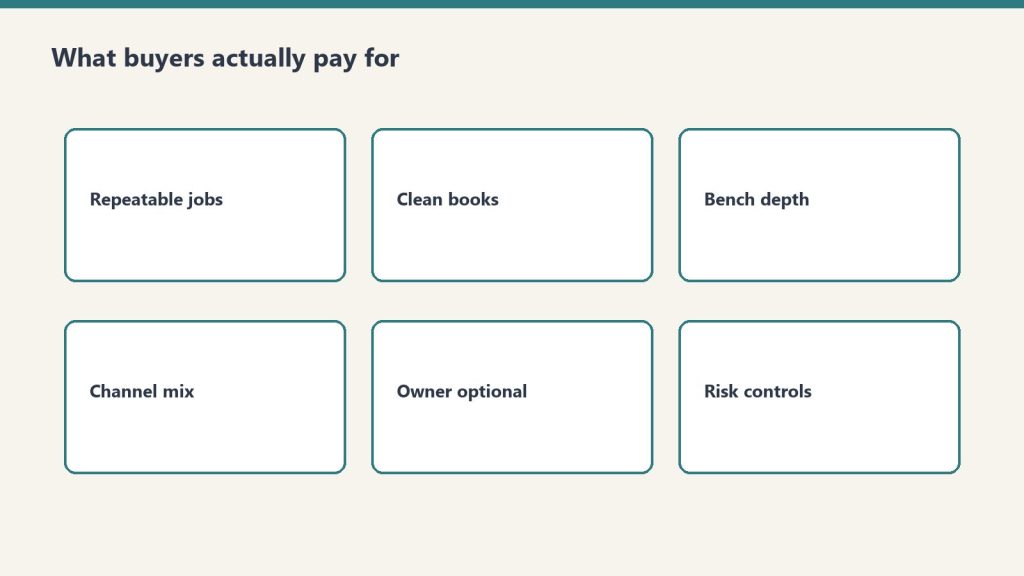
Clean books. 3+ years of clean P&Ls, balance sheet, and tax returns. No commingled personal expenses.
Diversified revenue. No single TPA, carrier, or referral source over 30% of revenue.
Contracts and relationships (commercial property management portfolios).
Trained workforce (especially in tight labor markets).
The 24-month exit prep checklist
The 24-month exit prep checklist.
Months 1-6: Engage a CPA to clean books. Recast personal expenses to show true SDE/EBITDA. Build a 3-year P&L deck.
Months 6-12: Document SOPs, formalize org chart, name an Operations Manager who can run it without you. Diversify referral sources to cap any single source under 30%.
Months 12-18: Engage an M&A advisor (industry-specific is much better than generalist). Build CIM (Confidential Information Memorandum). Stress-test working capital.
Months 18-24: Run buyer process. Multiple LOIs preferred. Negotiate structure (cash at close, earn-out, rollover equity).
Deal structure: what’s actually offered
Most restoration deals are not 100% cash at close. Typical structures:
60-80% cash at close.
10-25% earn-out tied to revenue or EBITDA targets over 1-3 years.
5-15% rollover equity in the acquiring platform — often the highest-return component if the platform exits well.
Owner consulting/employment agreement for 1-3 years to support transition.
FAQs about restoration acquisitions and exits
What multiple will I get for my restoration company?
Realistic 2026 ranges: under-$1M revenue 1-2x SDE; $1M-$3M revenue 2.5x-3.5x SDE; $3M-$10M revenue 4x-7x EBITDA; $10M+ revenue 7x-10x EBITDA on PE platform deals. Quality of books and management depth move you within those ranges.
What’s the difference between SDE and EBITDA in restoration deals?
SDE (seller’s discretionary earnings) adds back the owner’s salary, benefits, and one-time/personal expenses — used for owner-operator businesses. EBITDA is earnings before interest, taxes, depreciation, amortization — used for businesses where the owner doesn’t run daily operations. Most sub-$3M restoration shops trade on SDE; most over-$5M trade on EBITDA.
How long does it take to sell a restoration company?
From engaging an M&A advisor to closing, plan on 9-15 months. Including the 12-24 months of pre-sale prep work, the full timeline is often 2-3 years.
Should I sell to PE or to a strategic?
PE typically pays slightly higher multiples but expects more rigor (clean books, management depth, growth story). Strategics may pay less in cash but offer faster close and less due diligence intensity. The right answer depends on your goals — maximum dollars vs. maximum simplicity.
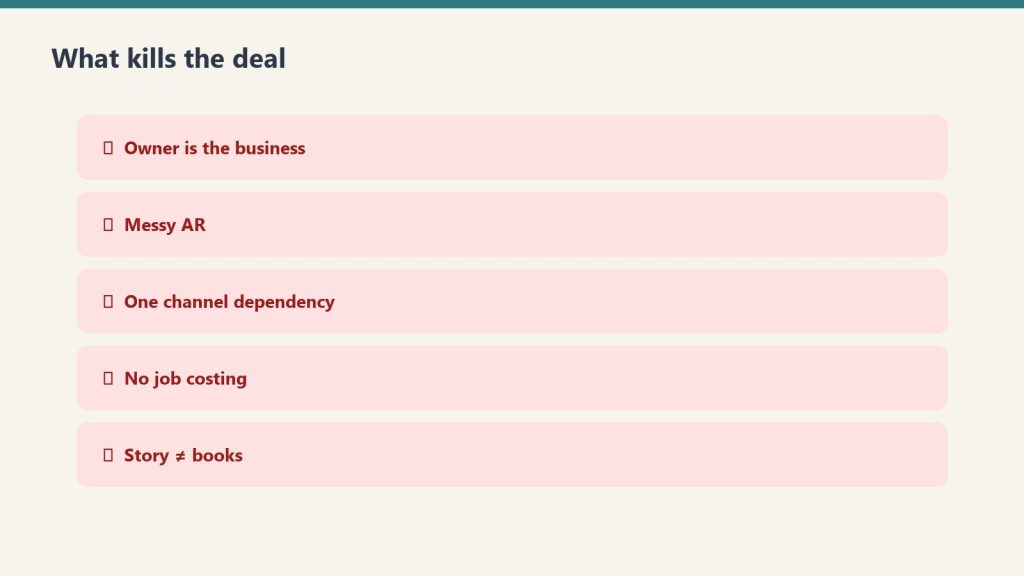
What kills restoration company sale value?
Customer concentration over 30%, owner-as-rainmaker dependency, sloppy books, expired insurance, lapsed TPA enrollments, pending litigation, missing equipment records, and undisclosed family employees. Address all of these in the 24-month prep window.