Tag: Google Maps

  • How a Restoration Shop Actually Gets Into the Maps 3-Pack

    How a Restoration Shop Actually Gets Into the Maps 3-Pack

    Inspired by Revved Digital. Original article: How to Rank Your Plumbing Business Higher on Google Maps. This is a new Tygart article for restoration contractors. We kept the mechanism, added first-party field knowledge, and did not reprint the piece.

    A burst pipe at 9 p.m. is the plumber version. Standing water in the living room at 11 p.m. is ours. Both searches land on three pins with a tap-to-call button. If you are not in that pack, you are not in the race.

    Google still uses three factors. Relevance: does the profile match “emergency water extraction” or does it say Contractor. Distance: you cannot fake proximity, but you can list the cities you actually hit. Prominence: reviews, citations, branded search, a site that agrees with the pin. Once relevance and distance are good enough, prominence is the fight.

    The restoration version of the plumber checklist

    • Primary category Water Damage Restoration Company — not Contractor, not Home Improvement.
    • Services in the words they type: emergency water extraction, sewage backup cleanup, mold remediation, fire and smoke cleanup.
    • Service areas you can staff in 45 minutes. Twenty cities you never photograph will not help.
    • Hours that match the night board. 9–5 on a 24-hour shop is a closed sign.
    • Photos of trucks, containment, meters, the room after. Not a picnic.
    • NAP identical on the site, the pin, Apple, Yelp, BBB. “St.” versus “Street” still counts as drift.
    • Reviews every week. A pile from 2023 and silence since looks closed.
    • Reply to every review. Ignore a one-star mitigation complaint and the next homeowner reads that silence.

    Do not keyword-stuff the legal name. “Emergency Water Damage | 24/7 | Licensed” in the title is how profiles get suspended. Use the real name. Put the emergency language in services, description, and the page the pin points to.

    Sixty to ninety days is the honest window if the file starts messy. Fourth to third in a crowded market takes longer. Stopping the weekly work is how a shop falls out of the pack the week the weather finally turns.

  • Four Weeks of Maps Movement Is Not a Verdict

    Four Weeks of Maps Movement Is Not a Verdict

    Inspired by Local SEO Bot (@localseobot). Original post: 54.4 to 51.3 in four weeks — slow and steady is how local SEO works. This is a new Tygart article for restoration contractors. We kept the mechanism, added first-party field knowledge, and did not reprint the thread.

    A fence contractor moved a few points in a month. That is not a failure. Grid rank is a slow instrument. Restoration owners treat it like a storm ticket and cancel when week four is quiet.

    The pin is for the next wet season and the next 11 p.m. search. Reviews, photos, citations, and a live category need to sit there long enough for prominence to catch. Judge the file on whether the work is happening every week, not on whether Tuesday was busy.

  • More Reviews Still Lose Maps If the Pin and Citations Disagree

    More Reviews Still Lose Maps If the Pin and Citations Disagree

    Inspired by Local SEO Bot (@localseobot). Original posts: Maps is proximity, relevance, and prominence and more reviews will not fix a neglected profile. This is a new Tygart article for restoration contractors. We kept the mechanism, added first-party field knowledge, and did not reprint the threads.

    Shops collect stars and still sit under a competitor with fewer reviews. That is not a mystery. Google is weighing how close you are, how clearly the profile matches the search, and how prominent the business looks across the web.

    Restoration version of a neglected file: primary category still Contractor, last photo is a picnic, Apple and Yelp show a different phone than the pin, and the night-board number leaked into citations. More five-stars will not outrun that.

    Fix the category, the NAP, and weekly proof on the profile. Then keep asking for reviews. Prominence is the whole stack, not the star count alone.

  • Do Not Buy More SEO Traffic for a Profile Homeowners Will Not Tap

    Do Not Buy More SEO Traffic for a Profile Homeowners Will Not Tap

    Inspired by Noah Igler (@noahiglerSEO). Original post: the $2M plumber who should not buy SEO yet. This is a new Tygart article for restoration contractors. We kept the mechanism, added first-party field knowledge, and did not reprint the thread.

    Thirty-year shop. Under 4 stars. Worse than twentieth on the searches that bring calls. Competitors sit at 4.7 with thousands of reviews. More pages would only send more people to a listing they will not tap.

    Restoration translation: a mitigation company with “they billed insurance and left a mess” threads does not have an SEO problem first. It has a close-out problem. Ask in person before leaving. QR in the truck. Follow up after the house is livable. Track asks, not only reviews received. Aim for a rating the market will trust.

    Paid search can make the phone ring while the file is rebuilt. Organic spend waits until the profile can convert.

  • Number One on Maps Does Not Create a Wet Spring

    Number One on Maps Does Not Create a Wet Spring

    Inspired by Bodhi (@irentdumpsters). Original post: number one on Maps, dead phone, dry spring. This is a new Tygart article for restoration contractors. We kept the mechanism, added first-party field knowledge, and did not reprint the thread.

    A restoration company called because the phone had been dead since April. Number one on Maps. Fifteen hundred impressions. Rankings never moved. The island had a dry spring. No storms, no floods, no water damage.

    SEO puts you in front of demand that exists. It does not create demand that is not there. In a weather business, some months number one does not equal revenue.

    That is not a reason to kill the pin. It is a reason to stop judging the pin on a dry month and to keep a second lane running — mold, commercial agreements, plumber referrals, rebuild backlog — so the shop is not a rain gauge with a Google login.

  • Call Tracking That Swaps the Header Number Can Delete Your Map Pack

    Call Tracking That Swaps the Header Number Can Delete Your Map Pack

    Inspired by Bodhi (@irentdumpsters). Original post: Miami water shop tanks Maps with dynamic call tracking. This is a new Tygart article for restoration contractors. We kept the mechanism, added first-party field knowledge, and did not reprint the thread.

    A water damage contractor in Miami put dynamic call tracking on the site. The software swapped the header number. In sixty days the map rankings fell. Google saw one number on the Google Business Profile and another on the page that was supposed to prove the same shop.

    That is NAP conflict. Name, address, phone. Restoration shops do this constantly because every agency wants attribution on emergency calls. Attribution is useful. A listing that looks like it moved is not.

    A tracking setup that does not fight the pin

    • Keep the permanent local number visible on the site in the same format as the GBP.
    • If you must track, put the tracking line as the primary on the profile and the real local number as secondary — or use call recording on the GBP number itself.
    • Do not rotate numbers in the header, footer, and schema independently.
    • Do not give LSAs, the website, and the pin three different display numbers that never match a citation.
    • After any change, search the shop name and confirm Google still shows one phone.

    Restoration add: after-hours answering services love to publish a second number. That second number is fine on a night-board card. It is not fine as the only number in the site header if the pin still shows the old line. Pick one public number and make every citation agree.

    You can know which channel booked the sewage job. You cannot afford to teach Google the company changed addresses to do it.

  • How to Steal a Plumber Thread and Make It a Restoration SOP

    How to Steal a Plumber Thread and Make It a Restoration SOP

    The brief is not “only use tweets that already say restoration.” Most of the usable material on @irentdumpsters is plumber, HVAC, roofing, dumpster, turf, pest, or agency. The translation is mechanical: keep the mechanism, swap the job, add the restoration constraint (IICRC, adjuster, Category of water, night board).

    This table is the working method. New Bodhi posts get run through it before they become Tygart articles.

    The translation table

    Plumber faucet blogs → $50 drain calls. Restoration version: prevention fluff and a single Services bucket → cheap “can you bring a shop vac” calls. Rebuild around sewage, hidden leak, Category 3, fire/smoke, mold. Article: emergency terms.

    Plumber / HVAC lead form on the homepage. Restoration version: form wall on a water site. Emergency work is tap-to-call. Article: hunt for the number.

    Three plumbers on Maps, first voice wins a $4,200 repipe. Restoration version: first voice wins mitigation plus the rebuild conversation. Two rings or you bought the lead for the next listing.

    Roofer primary category = General Contractor, stuck at Maps 16. Restoration version: primary category is Contractor or Waterproofing while the money search is water damage restoration. Match the top three. Rebuild stays secondary. Article: same Maps mistake.

    Turf shop fake virtual office in the next city, GBP suspended, original pin frozen. Restoration version: storm-chase mailbox in the next county. Stay service-area until there is a real shop. Draw the area to a 45-minute roll.

    HVAC pays $3,500 for 300 junk directories. Restoration version: same package, plus dead mold-directory links. Clean Data Axle, Localeze, Foursquare, chamber, IICRC/RIA, license boards. Identical NAP.

    Plumber books 28 jobs from Apple Maps and Yelp, zero spend. Restoration version: Siri “water damage near me” never sees a Google-only shop. Claim Apple Business Connect and match Yelp NAP this week.

    LSAs pointed at a 4.1 listing with blurry photos. Restoration version: paid “Google Guaranteed” badge over a profile that looks abandoned. Organic reputation is the conversion engine for paid.

    Dumpster shop, 312 organic calls: Maps + reviews after every pickup + FAQ pages. Restoration version: pin hygiene, review after close-out, pages for the questions the CSR already answers (“how long before mold,” “will insurance cover sewage”).

    170 reviews at 4.8 beat 50 at 5.0. One late-driver complaint makes the file look real. Restoration version: a sterile 5.0 after ten jobs looks bought. A detailed 4.8 with one “crew left a fan overnight” note looks like a company that works. Article: reviews and the quiet board.

    Generic “thank you for your review.” Restoration version: reply with neighborhood, loss type, and standard. “Same-night extract on the burst pipe in [neighborhood], S500 dry-out, rebuild walk next.”

    40 reviews in a weekend, then silence. Restoration version: do not blast asks during a storm surge and then go dark. Three closed-job reviews a week, after the house is livable enough that the homeowner is not still furious.

    Full calendar is a lagging indicator. Killing marketing today empties next quarter. Restoration version: wet spring fills trucks; killing GBP posts and adjuster touches makes the dry month look like “SEO died.”

    One bloated services page for roof, siding, gutters, storm. Restoration version: one URL for water, fire, mold, bio, pack-out. Google ranks specific URLs. Split them.

    Dynamic call tracking swaps the header number, Maps dies in 60 days. Already a water-damage story. Keep the permanent local number visible. Do not teach Google the shop moved.

    Angi / lead marketplaces rent you a customer sold to three shops. Restoration version: shared water leads and storm-lead vendors. You paid for a name that three other trucks also have. Own the pin and the relationships instead of renting the same flood twice.

    Pressure washing is easy to enter, so margins die. Licensed trades hold price. Restoration version: unlicensed “we dry houses” Facebook crews race to the bottom. IICRC, mold licenses, and documented S500 work are why a homeowner stops negotiating at 2 a.m.

    Pest control to $7M: SEO + review velocity + recurring contracts. Restoration version: organic emergency capture, then maintenance, mold follow-up, commercial agreements, mitigation-to-rebuild so the job is not a one-night extraction.

    Agency retention beats new-logo hunting. Restoration version: keep the property manager, the adjuster, and the plumber who already sent you three losses. New-logo marketing is expensive. Repeat source is the compounding asset.

    CSR questions are the blog calendar. Company picnic posts are not. Restoration version: “how long before mold,” “what is Category 3,” “do I call insurance first,” “how fast can you be here in [zip].” Those are pages. Birthday posts are not.

    How each new post gets filed

    1. Save the URL.
    2. Write the mechanism in one sentence with the original trade still in it.
    3. Swap the trade to water, fire, mold, or contents.
    4. Add the restoration constraint the original post skipped (standard, documentation, carrier, night board).
    5. Publish only if a PM can run it on Monday.

    Accounts we will keep running through the same filter: the ten-account watchlist. Send the next URL if you want a specific thread turned next.
  • The Roofer Listed Himself as a GC. Restoration Shops Make the Same Maps Mistake.

    The Roofer Listed Himself as a GC. Restoration Shops Make the Same Maps Mistake.

    Most restoration owners only save Bodhi posts that say “water” or “mold.” That is leaving half the playbook on the table. The useful operating system is in the roofer, HVAC, turf, and dumpster posts. The trade changes. The Maps mechanics do not.

    Primary category is not a branding exercise

    A Long Island roofer sat at position 16 for eight months because the primary category was General Contractor. One dropdown change to Roofing Contractor and the listing was in the top three inside three weeks. Secondary categories help niche terms. The primary category does the heavy lifting on core rankings.

    Restoration translation: if the shop lives on emergency water and the primary category is “Contractor” or a vague “Waterproofing,” you are fighting with remodelers and foundation guys for the wrong pack. Search the money terms in your city — water damage restoration, fire damage restoration, mold remediation — and match the primary category the current top three actually use. Then use secondaries for mold, fire, sewage, and contents. Do not make “General Contractor” the front door because you also rebuild.

    Fake pins blow up the original listing

    A turf company expanded from Fort Lauderdale to West Palm with a virtual office pin. Suspended in four days. Google also froze the original ranking profile during the investigation. The cheap mailbox did not add a market. It put the whole company in timeout.

    Restoration translation: storm season makes owners hungry for the next county. A virtual mailbox in the next metro is how shops lose the pin they already rank on. If there is no real office, warehouse, or staffed shop, stay a service-area business, draw the area to where a crew actually rolls in 45 minutes, and build city pages with real local job photos. A second pin needs a real address, a sign, and a reason Google will not treat it as fiction.

    Citation volume is how HVAC shops buy broken links

    An HVAC company paid $3,500 for 300 low-quality directories. Half of them died. The domain inherited a graveyard of broken backlinks. The move that matters is the core aggregators — Data Axle, Localeze, Foursquare — plus industry directories and the chamber, with identical NAP.

    Restoration translation: skip the “submit to 400 sites” package. Clean the same 15 sources. Add IICRC, RIA, and any state restoration or mold license directories. One wrong phone number on those sources is enough to fight your GBP.

    Google is not the only emergency map

    A Delray plumber booked 28 jobs in a month from Apple Maps and Yelp with no spend. Siri pulls Apple Business Connect and Yelp. If name, address, and categories are empty there, those calls go down the street.

    Restoration translation: claim Apple Business Connect this week. Match categories to water, fire, and mold as the product allows. Make Yelp NAP identical to GBP. After-hours homeowners asking Siri “water damage near me” never see your Google-only effort.

    LSAs cannot rescue a listing people will not tap

    Bodhi’s LSA post: running Local Services Ads against a 4.1 listing with blurry photos and no owner replies is lighting money on fire. The homeowner sees the badge, then scrolls to the organic pack and picks the shop that looks alive.

    Restoration translation: fix photos (truck, containment, meters, not stock smiles), review replies, hours, and services on the organic profile before you raise the LSA budget. Paid badges ride the same reputation the organic pack already shows.

    The dumpster version of “we only need ads”

    A dumpster shop pulled 312 Google calls in a month. No $5k ad spend. Maps cleanup, a review after every pickup, and site pages that answered the questions customers already asked.

    That is the restoration minimum viable system: clean pin, review after every closed job, pages for the questions the CSR already answers. Ads fill gaps. They do not replace the listing.

    Sparks: roofer category, turf fake pin, HVAC citation blast, plumber Apple/Yelp, LSA-on-weak-GBP, dumpster 312 calls — all from @irentdumpsters. Watchlist: ten accounts to mine.

  • If They Have to Hunt for the Number, You Lost the Water Job

    If They Have to Hunt for the Number, You Lost the Water Job

    Bodhi at @irentdumpsters writes plumber and HVAC stories. Restoration owners should read them as dispatch rules, not as another trade’s marketing tips.

    Three recent posts, three different trades, one mechanism.

    • A Boca homeowner with water across the kitchen called three plumbers off Maps at 7:30 a.m. Voicemail lost. Six-ring menu lost. Ring-two booked a $4,200 repipe that afternoon.
    • A lead form on a water or plumbing homepage loses the emergency call. Nobody in a puddle types an email and waits.
    • Most emergency contractor calls happen on a cracked iPhone while the basement is flooding. The About Us paragraph and the hamburger menu are not in the path.

    Swap plumber for restorer and the dollar amount goes up, not down. The homeowner is not shopping a $189 service call. They are trying to stop Category 2 or 3 water before the pad and the drywall come out. The shop that makes the local number easiest to tap, then answers it, gets the mitigation and the rebuild conversation that follows.

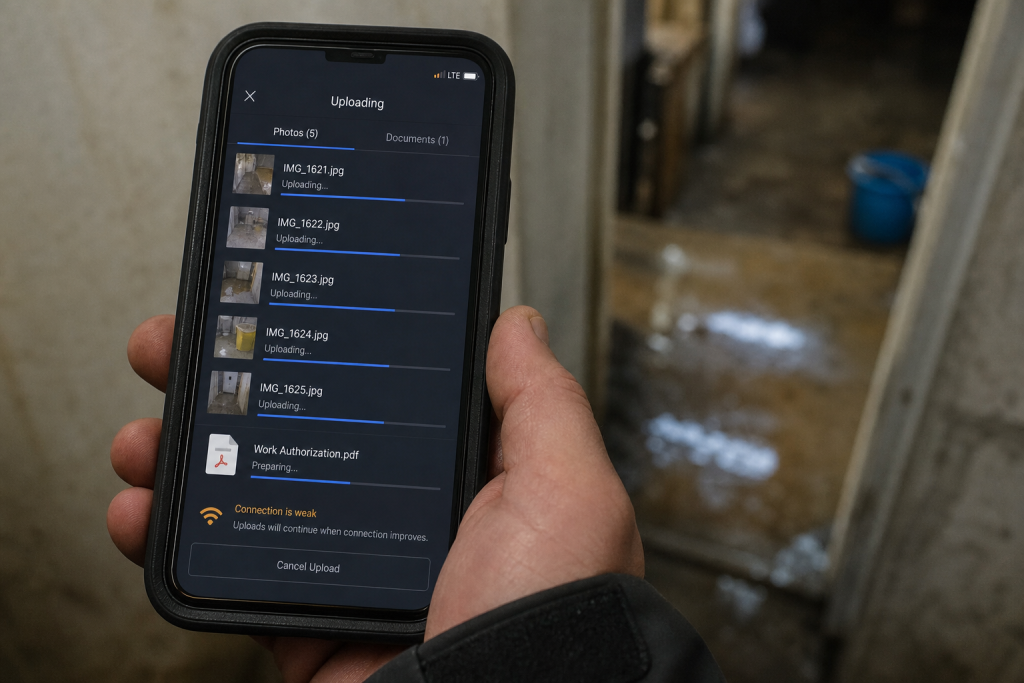
    Field phone showing bars while a moisture map upload fails on a dead-fiber water loss
    The call is placed from the loss, not from a desktop contact form.

    Reframe: speed-to-lead is part of the estimate

    Restoration marketing budgets get judged on cost per lead. That number is a lie if the night board lets three rings dump to voicemail. Maps ranking, LSAs, and SEO are just pipes. The conversion event is a human voice in two rings saying they can roll a crew.

    If you are number one on Maps and the CSR is on a seven-minute hold script, you are paying to educate the competitor who picks up.

    What to change on the site this week

    1. Header on mobile: local area code, tap-to-call, IICRC or license line. No hamburger hunt.
    2. Homepage and every emergency service page: click-to-call first, form second. Forms are for commercial RFPs and insurance follow-up, not for a burst pipe at 11 p.m.
    3. After-hours path that is a person, not a menu tree. If you use an answering service, the first sentence they say has to be dispatch, not “press 2 for billing.”
    4. Measure answer rate and time-to-answer on Map and LSA calls separately from website forms. If ring-two is not the median, fix staffing before you buy more clicks.

    What restoration adds that the plumber post skips

    A plumber can book a morning slot. A restorer often has to quote emergency service, set expectations on source identification, and get permission to start dry-out before the adjuster is awake. The first 90 seconds on the phone are not “can we come out.” They are “are you safe, where is the water, is it sewage, can we roll now.” Script that. The marketing post only gets you the ring.

    Spark posts: two-ring $4,200 job, forms kill emergency calls, cracked-phone layout. Companion: rebuild around emergency terms.

  • 10 X Accounts Restoration Contractors Should Mine for Marketing Intelligence

    10 X Accounts Restoration Contractors Should Mine for Marketing Intelligence

    The seed post was this thread from Bodhi / @irentdumpsters: a plumber drowning in fifty-dollar drain calls because his site was a faucet blog. We already turned that idea into a restoration article: rebuild the domain around emergency high-ticket terms.

    One account is not a research desk. The job now is a living watchlist of people who talk like operators about local SEO, Maps, speed-to-lead, and high-ticket home services — then translate every useful post into language a water, fire, or mold shop can run this week. Most of Bodhi’s best material is not labeled restoration. It is plumber, HVAC, roofing, dumpster, turf, and pest. The method for those posts is here: how to steal a plumber thread and make it a restoration SOP.

    These are not endorsements and they are not a vendor shortlist. They are source nodes. Steal the rule. Ignore the pitch. Rewrite for restoration.

    The ten accounts

    1. @irentdumpsters — Bodhi, Stryker Digital

    The seed. Dumpster operator turned local SEO. Writes in job stories, not frameworks. Recent restoration-usable posts: content mismatch and high-ticket terms; click-to-call instead of homepage forms; one URL per trade; answer in two rings; call-tracking NAP damage; mold as the retail lane while water stays locked by adjusters; Maps number one with a dead phone in a dry season.

    Use him for: emergency-intent architecture and the reminder that weather creates demand, rankings only capture it. Also use every other-trade post. That is now the default ingest rule.

    2. @drewdoesmarktng — Andrew Palacios, Revved Digital

    Home-service SEO and AI. Publishes marketing benchmarks by trade, including water damage restoration, drain and sewer, roofing, and a dedicated restoration report. Talks audits as visibility, tracking, and follow-up problems wearing a marketing costume.

    Use him for: numbers to compare against your own cost per booked mitigation, not for copying another vertical’s offer.

    3. @noahiglerSEO — Noah Igler, Sustained Media

    Calls himself the local SEO guy for home services. Cleanest recent framework on X: GBP wins the map pack, the location page supports that pin, service pages win organic, tracking has to reach sold revenue. Also the rare voice that will tell a $2M plumber not to buy SEO until the review rating is trustworthy.

    Use him for: map-pack vs organic division of labor, and the rule that a 3.8-star restoration profile should not be fed more traffic.

    4. @theseoguy_ — The SEO Guy, Vineyard Growth

    High-volume local SEO checklists. GBP first, physical pin over a fake service-area blob, weekly photos, keyworded review replies, city plus service in the H1, stop writing history-of-the-trade blogs. Explicit that answering the phone is part of SEO.

    Use him for: the unsexy weekly cadence a one-shop restoration company can actually keep. Filter out any “exact match business name” tricks that would look like spam to a carrier or a city inspector.

    5. @localseobot

    Grid-rank case notes, including water and fire restoration terms in Atlanta-area scans. Not narrative. Just “this keyword moved from X to Y on a 169-point grid.”

    Use him for: how to talk about Maps movement without lying. Average rank on a grid is the honest metric. “We are number one” is usually a zip code lie.

    6. @GeorgianBaySEO

    Local SEO for trades. Public portfolio includes roofing, electrical, pest, waterproofing, and water damage restoration. Talks templates and schema as the reason site eight ships in a day after site one took weeks.

    Use him for: the operations lesson. Restoration content should be a reusable service-page system (water, sewage, mold, fire, pack-out) plus local proof — not a new design every time you add a county.

    7. @doctorcalf

    Former SEO and GBP lead-gen for mold remediation. Long client cycles. Useful because mold is the retail lane Bodhi keeps pointing restorers toward when water is locked by preferred-vendor lists.

    Use him for: mold-specific demand and the reminder that remediation clients return years later when the next leak shows up.

    8. HouseCall SEO / Lior Daniel

    Boutique restoration local SEO. Public positioning is six-plus years ranking crews on emergency terms, with published monthly ranges. Less of a daily X firehose than Bodhi, more of a restoration-only specialist to watch when he does post.

    Use him for: emergency-query page structure aimed at 2 a.m. water and fire searches, not general home-service theory.

    9. Outpace SEO (restoration-only shop)

    Oklahoma City firm built around water damage and restoration SEO. Public case: OKC Restorations and a large year-over-year lift in organic clicks. Follow the company and principals when they publish market notes.

    Use him for: single-market restoration case texture — what a water shop’s keyword set actually looks like when it is not mixed with roofing and HVAC.

    10. Restoration Inbound / Restoration Digital Marketing cluster

    Agencies that only sell to restorers (Restoration Inbound, Restoration Digital Marketing, and peers on the 2026 water-damage agency lists). They post less like dumpster-Twitter and more like vendor blogs. Still worth a weekly scan because they write to IICRC language, TPA friction, and storm season instead of “plumber near me.”

    Use them for: insurance-aware copy and the difference between retail water, program work, and storm surge. Discard anything that sounds like a franchise pitch deck.

    Already translated from other trades

    Send the next URL if you want a specific thread run through the same filter.