Pressure washing is easy to start, so everyone starts it, so price becomes the product. The better home-service bets are the ones that require a license. Mold in the walls is not a Facebook-marketplace job. The homeowner pays the licensed crew and rarely negotiates in a smaller market.
Restoration has both layers. Unlicensed “we dry houses” crews will always undercut a Category 1 extract. That is not your race. IICRC S500/S520, state mold licenses, documented meters, and a paper trail the adjuster can read are why a 2 a.m. sewage job does not get three quotes.
Put the credentials on the pin, the header, and the service page. Then do the work those credentials claim. Price holds when the alternative looks like a shop vac and a prayer.
Every new restoration owner wants to rank for “water damage repair” this month. In a lot of markets that phrase is already owned by shops that locked preferred-vendor lists in 2008. The pipe bursts, the adjuster hands over three names, and your beautiful water page never gets the call.
Mold is often the door that is still open. Homeowners pay out of pocket or pick the contractor without waiting on a carrier sheet. Sales cycle is short. Jobs in many markets land in the three-to-eight-thousand range. Local keywords can still move in ninety days if the page is real.
How to run the lane without abandoning water
Give mold remediation its own URL. S520 language, containment photos, clearance testing explained in plain words, city name in the title.
Write the delayed-loss pages: “mold after a slow leak,” “mold after the insurance dry-out ended too soon.” That is retail demand water shops ignore.
Keep water, sewage, and fire pages live. They are the storm asset. They are not the only asset.
Use mold cash to stay staffed for the next wet month instead of waiting on claims to clear.
This is not “quit water.” It is “stop betting the company on a keyword the incumbents already bought with relationships.” Water still pays the trucks when weather shows up. Mold pays the trucks while you wait.
Inspired by Bodhi (@irentdumpsters). Original post: the Delray plumber / faucet-blog thread. This is a new Tygart article for restoration contractors. We kept the mechanism, added first-party field knowledge, and did not reprint the thread.
On September 5, 2026, Bodhi at @irentdumpsters posted a plumber story that restoration owners should tape to the office wall.
A shop in Delray Beach could not understand why the phone only rang for fifty-dollar drain snakes. The website had forty blog posts about leaky faucets and loose toilet handles. The work that buys trucks and pays commercial mortgages was emergency slab leaks and broken sewer mains. When water is moving under tile at two in the morning, the homeowner is not reading a faucet explainer. They are typing slab leak detection plus the city name while standing in a puddle.
They rebuilt the site around high-ticket emergency terms. In ninety days the shop booked three slab leak jobs averaging sixty-eight hundred dollars each, and stopped waking techs at midnight for kitchen sinks.
That is not a plumbing anecdote. That is the default failure mode of independent restoration marketing.
The restoration version of the faucet blog
Walk most water, fire, and mold sites and you will find the same mismatch. The company owns extractors, dehumidifiers, containment, and an IICRC-trained crew. The content library is “10 tips to prevent a wet basement,” “what is humidity,” and a single Services page that dumps water, fire, mold, biohazard, and pack-out onto one URL.
Google does not send the job you want. It sends the job your pages describe.
If the strongest pages on the domain answer “how to dry a small leak” and “when to call a plumber,” you will get small leaks and plumber overflow. If the strongest pages answer “sewage backup cleanup [city],” “category 3 water damage [city],” “hidden slab leak under tile,” and “mold remediation after a slow leak,” you get the jobs that fill a week of labor and a rebuild estimate.
What homeowners actually type at 2 a.m.
Emergency restoration search is not a research session. It is a cracked-phone query from a hallway that smells like drywall. The phrases that buy trucks look like this:
water damage restoration + city
emergency water extraction + city
burst pipe water damage + neighborhood
sewage backup cleanup + city
slab leak detection + city
black water cleanup
mold remediation + city
fire damage restoration + city
smoke damage cleanup
Those queries need a dedicated URL, a visible click-to-call number, license and IICRC proof above the fold on mobile, and photos from real local jobs. They do not need a 400-word “welcome to our family-owned company” block.
The 90-day rebuild for a restoration domain
Do not start by writing more blog posts. Start by killing the mismatch.
1. List the jobs that pay the mortgage
Pull last year’s sold jobs. Rank them by gross and by contribution margin, not by call volume. For most shops the list is some mix of category 2 and 3 water, sewage, hidden leaks, mold after a delayed loss, fire/smoke, and commercial emergency response. Those become the only service pages that matter for ninety days.
2. Give each high-ticket job its own URL
Google ranks distinct URLs for specific intent. A single “Our Services” page that lists water, fire, mold, and contents will not outrank a competitor who published 1,200 words on sewage backup cleanup with local photos, category definitions from IICRC S500, and a same-night dispatch CTA.
Build silos, not buckets. Water extraction. Sewage. Slab / hidden leak. Mold remediation. Fire and smoke. Pack-out. Commercial emergency. Each page answers one search, shows one class of proof, and asks for one action: tap to call.
3. Stop hiding the phone behind a form
A lead form on the homepage of a water restoration site loses emergency calls. Nobody standing in Category 3 water wants to type an email and wait. They tap click-to-call and hire the first crew that picks up. Put the local area code, a giant tap target, and license proof at the top of the mobile template. Answer in two rings or the ranking is buying leads for the shop that does.
4. Write the questions the CSR already answers
The content calendar is already sitting on the phone log. How long before mold after a flood. Will insurance cover a slab leak. What is Category 3 water. How fast can a crew be on site in this zip. Those are real searches. Company picnic posts are not.
5. Pick a lane insurance has not locked
Every restoration owner wants to rank for “water damage repair” on day one. In many markets the twenty-year shops already own the adjuster list. Mold remediation is often the faster retail lane: homeowners pay out of pocket or choose the contractor without waiting on a preferred-vendor sheet. Jobs in the three-to-eight-thousand range, shorter sales cycle, keywords you can actually move in ninety days. Use that cash to stay in front of the water losses when the weather finally turns.
What not to copy blindly
SEO puts you in front of demand that exists. It does not invent a wet spring. Rankings without weather, without an answered line, and without a review profile people trust are decoration.
Call tracking can also sink the listing. Dynamic number insertion that swaps the header number away from the Google Business Profile creates NAP conflict. Track without making Google think the shop moved.
The operator checklist
Print last year’s jobs by margin. Circle the five that buy trucks.
Map each circled job to one live URL. If it shares a page with three other trades, it does not count.
Open the site on a phone. If the number is not tappable in two seconds, fix the header before you write another paragraph.
Kill or noindex the faucet-class posts that train Google you are a handyman blog.
Publish one emergency page per week for eight weeks: sewage, hidden leak, Category 3, mold after water, fire/smoke, commercial after-hours, pack-out, storm response.
Put IICRC S500 / S520 language and real job photos on those pages, not stock “happy family” images.
Direct answer: Real estate agents are a high-frequency referral partner for restoration companies because every home sale passes through a home inspection, and home inspections routinely uncover water damage, mold, failed crawl spaces, roof leaks, and moisture problems that threaten to kill the deal. The agent whose commission is on the line needs a restoration company that can be on site in twenty-four hours, produce a scope and a remediation timeline that fits inside the closing window, and deliver clearance documentation that the lender, the buyer’s agent, and the underwriter will all accept. That’s the entire job. Most restoration companies have never built a realtor program designed around the closing clock — and the one that does becomes the default in a fifty-agent brokerage before anyone else figures it out. RESPA and state-specific rules restrict how referral compensation works between real estate and settlement-service providers, so the program has to be built on speed and documentation, not cash.
Real estate agents look like an easy referral channel from the outside. They meet new homeowners every week. They have client lists. They go to networking events. Every restoration company’s marketing director has at some point said “we should work with realtors.” Very few companies ever build anything durable out of that intent.
The reason is that the realtor channel runs on a different economic clock than any other trade in this series. A plumber’s referral is triggered by a water event; your job is to arrive fast and remediate. A property manager’s referral is triggered by a tenant complaint; your job is to respond and document. A realtor’s referral is triggered by a deal that is about to fall apart — and the clock isn’t three days, it’s often seven or fourteen. If you can’t work inside that clock with scope, price, and documentation that lets the lender and the underwriter approve the loan, the commission goes away, the agent finds somebody who can, and you are never called again.
This article is the operational view of how real estate agents actually make money, how and why restoration work gets discovered during a transaction, why most restoration-to-realtor referral programs fail, and the specific ninety-day program to become the restoration company a brokerage calls when a closing is on the line. It is the ninth article in The Restoration Operator’s Playbook partner-industries series.
How a Real Estate Agent Actually Makes Money
Understand their economics or don’t walk in their door.
The commission structure. Agents earn commission on each transaction they close. Historically this was a single listing-side commission negotiated by the seller (typically 5–6 percent of sale price) and split between the listing brokerage and the buyer-side brokerage, with each brokerage then splitting with its agent. Recent NAR settlement changes (2024 rule changes) have restructured buyer-agent compensation in many markets, but the underlying math is similar: total agent-side compensation on a typical U.S. transaction runs 4–6 percent of sale price, split between listing side and buyer side, and then split again between brokerage and agent.
Brokerage splits and caps. Newer brokerages run 85/15 (agent/brokerage) with low annual caps — REAL, eXp Realty. Traditional franchise brands like Century 21 run 70/30 on starter plans, 90/10 on top plans. Keller Williams runs a 64/30/6 model (agent/market center/KWRI) with a variable annual cap. Boutique and independent brokerages vary widely. Top producers on capped models hit their cap mid-year and keep 100 percent of every additional commission until year-end. This is why top agents work volume aggressively — every closing after the cap is pure take-home.
What an agent actually nets. On a $400,000 home with a 5.5 percent total commission, the gross commission pool is $22,000. Split between listing and buyer sides, each side gets $11,000. After a 70/30 brokerage split, the agent receives $7,700. After desk fees, marketing costs, MLS fees, and self-employment tax, the net is closer to $5,000–$6,000. That number matters because it tells you exactly why a deal that falls apart over a $4,000 mold scope feels like a personal crisis to the agent.
Typical agent volume. The median U.S. agent closes roughly 10 transactions per year. Top producers close 40–200+ per year. A mid-career full-time agent in a healthy market closes 15–25. A team lead running a 5-agent team closes 50–150.
The time pressure. Typical closing timeline from contract to close is 30–45 days. Inspection and due-diligence window is usually days 7–14 of that window. Any restoration scope uncovered at inspection must fit inside the remaining 20–35 days — and the lender’s underwriter usually wants clearance documentation in hand at least 5–7 days before closing. That leaves 15–28 days of practical working time. Often less.
The operational engine. Most agents work out of a brokerage or a team. Day to day they live inside the MLS, a CRM (kvCore, BoomTown, Follow Up Boss, Lofty, Chime), a transaction-management platform (Dotloop, Skyslope, DocuSign Transaction Rooms), and Zillow/Realtor.com/Redfin lead flow. Their inspector, lender, title officer, home warranty company, and handful of trade vendors form a loose network they call on every transaction. Your name either gets into that loose network or it doesn’t.
How Real Estate Agents Acquire Business
Understanding where an agent’s business comes from tells you what they need from you.
Sphere of influence. 60–80 percent of top-agent business comes from past clients, referrals, and personal network. Agents who have been in business five-plus years run on this almost exclusively.
Open houses and farming. Door-knocking, direct mail, and open-house prospecting — declining but still active. Newer agents rely on these more.
Online leads. Zillow Premier Agent, Realtor.com leads, Redfin Partner, and various paid-lead platforms. Expensive per lead, converting at low rates, but filling the top of the funnel for volume agents.
Team-generated leads. Agents inside teams receive leads the team pays to generate, typically on a 50/50 split with the team lead. This is a fast path for newer agents.
Referral partners. Lenders, title companies, home inspectors, moving companies, warranty providers, and service trades. This is where you sit — or want to sit.
Brokerage and franchise brand. Brand signals matter less than they used to, but still a factor.
The takeaway: an agent’s business runs on trust and speed. They send referrals to vendors who protect their deals and make them look competent to their clients. They stop sending referrals to vendors who blow up deals or embarrass them.
Why the Realtor Channel Runs on a Different Clock Than Any Other Trade
Realtor channel runs on a different clock — speed closes deals.
This is the strategic hinge of the article.
Every other partner industry in this series operates on an event-driven or recurring-revenue clock:
Plumber: water event, response now, you mitigate, customer repairs later
HVAC: equipment service or install, discovery happens incidentally
Property manager: dispatch now, close the ticket, repeat
Pest control: quarterly route, recurring calendar
General contractor: demo uncovers damage, project pauses, you mitigate, rebuild resumes
The realtor clock is different. It’s a deal clock — thirty days from contract to close, minus days already burned, minus the lender underwriter’s buffer at the end. By the time you get the call, there might be fifteen days of working time left to:
Visit the property
Produce a scope
Negotiate who pays (seller, buyer, or credit at closing)
Execute the work
Deliver clearance documentation
Get the lender to accept the clearance
Close the deal
If you can’t run that entire sequence inside the window, the deal dies, the agent loses the commission, the buyer loses the home, the seller loses the sale, and your phone never rings from that agent again.
Everything about the program has to be built backwards from that clock:
Twenty-four-hour site visit
Scope delivered inside 48 hours
Flat-rate or unit pricing the parties can agree on without negotiation
Work executable inside 3–5 working days for standard scopes
Clearance documentation that lenders and underwriters accept
Communication with the agent, the inspector, the lender, and title happening in parallel
The restoration company that builds this program is scarce. The realtors who find one talk about it for years.
The Six Transaction Moments Where Restoration Work Gets Discovered
Six transaction moments where restoration work gets discovered.
Moment 1: The home inspection during due diligence. Days 7–14 of escrow. The buyer’s inspector produces a report flagging mold in the basement, water stains on the ceiling, elevated moisture readings, or failed crawl-space vapor barrier. The buyer’s agent brings the report to the listing agent. Negotiation starts immediately. This is the single highest-frequency and highest-stakes moment in the channel.
Moment 2: The specialized mold, radon, or moisture inspection. Many markets see specialized inspections triggered by the general inspector’s findings. Positive mold test, elevated moisture, confirmed water intrusion. These drive a second round of scope negotiation and tighten the timeline because they typically arrive on days 10–14.
Moment 3: The pre-listing walkthrough. Listing agent walks a seller’s home before taking it to market and sees obvious moisture issues — stained baseboards, musty basement, bath fan venting into the attic. A smart listing agent recommends remediation before the home hits the market, because a clean disclosure and a pre-listing clearance letter protects the seller from downstream disputes and supports a stronger listing price.
Moment 4: The lender-required repair at underwriting. The underwriter reviews the appraisal, sees a note about moisture or mold, and requires repair-and-clearance as a condition of the loan. This happens on days 25–35 of escrow. The clock is tighter than any other scenario.
Moment 5: The post-closing discovery within the first year. Buyer moves in, discovers water damage the seller did not disclose, and calls the agent. The agent wants to protect the relationship and avoid being named in a disclosure dispute. You become the remediation company, and often the documentation expert the agent points to when the attorney gets involved.
Moment 6: The investor rehab or flip. Real estate investor-clients of the agent buy a distressed or storm-damaged home. The restoration scope is large and the rebuild is larger. Flip investors operate on faster clocks than owner-occupants — sometimes 7–10 days from possession to restoration complete.
Train your intake and your sales conversations around these six moments. Every referral, agent script, and rate sheet should map to one.
Why Most Restoration-to-Realtor Referral Programs Fail
1. Building the program around the agent, not the deal clock. Restoration companies who spend marketing budget on realtor happy hours, broker lunches, and branded swag without ever engineering a 72-hour turnaround scope-and-clearance process are paying for goodwill they can’t cash. The realtor remembers your logo but doesn’t call you when a deal is on fire because you haven’t proven you can save it.
2. Variable pricing that can’t be negotiated inside a day. If your price on a standard basement mold remediation varies by $3,000 depending on how the estimator felt, the agent can’t use your scope in a repair-credit negotiation. The deal stalls. You have to publish a rate sheet the parties can work with inside an hour.
3. Clearance documentation that lenders reject. If your closeout package doesn’t include third-party clearance sampling where required, signed inspection reports, photo documentation, and protocol narratives that underwriters will accept, you might finish the work on day 20 and still watch the deal blow up on day 35 because the bank won’t clear to close. This has to be resolved on the front end, not argued in the final week.
4. RESPA violations in the referral compensation structure. The Real Estate Settlement Procedures Act prohibits fee-for-referral arrangements between real estate agents and “settlement service providers” on federally related mortgage transactions. State real estate commissions layer additional rules on top. Restoration remediation services on a home sale can fall inside the settlement-service definition depending on the state. Offering a referral fee to a realtor in exchange for the mold job on a transaction is a regulatory risk for both of you, and it’s also usually against the brokerage’s internal policy. The safe default: no cash referral fees on transaction-driven work.
5. Competing with the agent’s own handyman or contractor network. If the agent already has a trade vendor they like who handles smaller moisture issues and you show up pitching full-service restoration, you’re replacing a relationship. Better to position yourself specifically as the fast-turnaround remediation-with-clearance specialist for the scopes the agent’s handyman can’t handle — IICRC-certified scopes, third-party sampling, lender-accepted documentation.
6. Treating the listing agent and the buyer’s agent the same. Their incentives are different. The listing agent wants the seller’s disclosure to be clean and the deal to close at list price. The buyer’s agent wants the repair credit or the price concession to protect their client. The restoration scope you produce lands differently depending on which side of the table. Knowing which agent is driving the call — and which side of the negotiation you’re helping — matters for every conversation.
Ten Operational Disciplines for a Realtor Referral Channel That Works
Ten operational disciplines for a realtor referral channel.
1. Published rate sheet for the ten most common transaction scopes. Basement mold (small, medium, large square footage bands). Crawl-space mold and vapor barrier replacement. Attic mold. Bathroom mold behind drywall. Moisture mapping with report. Kitchen-area water damage. Flooring water mitigation. Attic rodent-contaminated insulation removal. HVAC sanitization. Clearance-sampling-only. Rate sheet emailed to every agent partner. Updated annually.
2. 24-hour site visit commitment, 48-hour scope delivery. Written into every agent communication. This is the promise that earns the relationship.
3. Clearance-documentation package built to lender standards. Third-party mold sampling where scope requires, laboratory results with chain of custody, protocol narratives, moisture readings, photo documentation, signed certificate of completion. Delivered as a single PDF acceptable to underwriters.
4. Dedicated intake line for transaction-driven work. Agents and inspectors call one number, get a human inside three rings. Intake is trained to recognize deal-clock urgency and triage appropriately.
5. Named account manager who knows transaction terminology. “Repair credit,” “seller concession,” “due-diligence period,” “clear-to-close,” “option money,” “earnest money,” “lender-required repair.” Your point of contact for realtors uses their vocabulary fluently.
6. Relationships with home inspectors in your market. Home inspectors are the upstream source of every transaction-driven referral. Get to know the top 5–10 inspectors in your market, host them for IICRC-topic education sessions, and make yourself the name they mention when they spot moisture during an inspection.
7. Pre-listing consultation program. Free 30-minute consultation for a listing agent’s seller clients who have moisture concerns before the home goes to market. Catches issues early, makes the remediation routine instead of panic work, and gives the agent a service they can offer as part of their listing presentation.
8. Co-branded seller disclosure package. Short one-pager the listing agent can include in the seller’s property disclosure: “Mold remediation performed by [your company] on [date], clearance report attached.” Professional, useful, protects the seller and the agent.
9. Brokerage-level education without a sales pitch. Offer to teach a 45-minute class at the brokerage on “how water damage and mold issues get resolved during escrow.” Technical, useful, free. Works at almost every mid-sized brokerage. Build a rotating class calendar and hit six brokerages a year.
10. Never discuss referral compensation. Full stop. If an agent asks what you pay for referrals, you answer: “We don’t do referral compensation — we’re focused on making sure your deals close on time with documentation that holds up to the lender. That’s the value you get from working with us.” It’s the only safe answer.
The Two-Way Reciprocity Model for Realtors
Reciprocity in the realtor channel looks different than any other trade because of RESPA.
Flow 1: Realtor → restoration. Agent calls you with a transaction-driven scope. You respond in 24 hours, produce the scope, execute the work, deliver clearance inside the window. The agent’s deal closes.
Flow 2: Restoration → realtor, through customer introductions. When a restoration client of yours mentions they’re planning to sell, move, or buy, and you know which agent partner serves their area and price point, you make a warm introduction — “[agent name] is an excellent agent in that market, I’ve worked with them on several transactions.” No fee, no kickback, no tracking of who closed whom. The agent earns the business through their own skill. You’re just the person who made a professional introduction. This is legal everywhere.
Flow 3: Joint education for agents and their clients. Co-branded content for the agent’s listings — “moisture and mold essentials for home sellers,” “how to prepare your home for inspection,” “what an inspection report actually means.” Lives on the agent’s website, on yours, in their listing packets. You get mental real estate with every seller the agent represents. They get useful content for their marketing.
Flow 4: Inspector introductions. Inspectors refer to both realtors and restoration companies. Being the restoration company a top inspector trusts means the agent gets your name three times — once from the inspector, once from another agent who worked with you, once from the lender or title officer who saw your clearance documentation on a prior deal. Compounding mental real estate is the durable output of an aligned channel.
Track the channel on referrals in and introductions out. If you’re getting ten deals a year from an agent and you’ve never introduced them to a restoration client selling their home, the relationship is one-sided and probably won’t survive the next market cycle.
The Ninety-Day Realtor Partnership Program
Week 1: Target selection. Identify the top 20 producing agents in your service area by transaction volume. Identify the top 5 team leads. Identify the top 5 home inspectors. Identify the top 3 mid-to-large brokerages that dominate your market.
Week 2: Rate sheet finalization. Build the ten-scope rate sheet. Have it reviewed internally. Print it clean. Email-ready PDF.
Week 3: Clearance package template finalization. Build the lender-ready clearance package template. Walk it through with a loan officer at a local mortgage company to confirm it meets underwriter expectations. Adjust.
Week 4: Inspector outreach first. Before you approach agents, meet with three home inspectors in your market. Coffee, 30 minutes, bring the rate sheet. Ask what they see during inspections, what scopes they flag most, what restoration companies they currently recommend when they see moisture. Offer to be the name they mention on the next finding.
Week 5: First brokerage class booked. Pick one brokerage. Offer a 45-minute class on “how water and mold issues get resolved during escrow.” Provide coffee and breakfast. Teach, don’t sell.
Week 6: First transaction call handled. By now a first referral should be in motion from either the inspector outreach or the brokerage class. Execute with the 24-hour-visit, 48-hour-scope, clearance-documentation standard. Deal closes on time.
Week 7: Debrief with the agent. Fifteen-minute call. What worked? Anything they wished went differently? Did the lender accept the clearance without friction? These are the questions that improve the program.
Week 8: Second brokerage class booked. Different brokerage. Same content, refined.
Week 9: Pre-listing consultation program launched. Email to the 20 target agents introducing the free pre-listing mold/moisture consultation for seller clients. Track how many take you up on it.
Week 10: Inspector education event. Host 4–6 inspectors for a half-day IICRC-content session. Not a sales event — a technical session. They leave smarter, and you become the company they recommend when they find moisture.
Week 11: Clearance package refinement. By now you’ve delivered 3–8 clearance packages. Review what worked, what lenders questioned, and refine. Update the template.
Week 12: Quarterly business review internally. Measure the channel. Referrals per agent, close-on-time rate, brokerage classes delivered, inspector relationships active. Plan Q2.
By day ninety, you should have two to three brokerage classes delivered, three to five inspector relationships active, ten to twenty agents aware of you, five to ten transaction-driven jobs executed, and a clearance-documentation track record that agents and inspectors will remember.
Where to Start This Week
Build the ten-scope transaction rate sheet before calling anyone.
Walk the clearance-documentation template through a loan officer for lender acceptance review.
Identify the top three home inspectors in your market by reputation — inspectors are your upstream.
Pick one brokerage to offer a class at. Email the sales manager.
Decide who on your team owns the realtor channel. Must be someone fluent in transaction language and comfortable under deal-clock pressure.
Draft the co-branded seller disclosure one-pager for listing agents.
Read RESPA Section 8 and your state’s real estate commission rules on referral compensation. Not the summary — the statute.
If you’re stuck on step one, the rate sheet alone will put you ahead of nearly every competitor in your market. Realtors and inspectors don’t get unit pricing on mold and moisture scopes. Handing them one makes you the professional.
Next in the queue: pool and spa service, roofers, appliance installers.
Frequently Asked Questions
Can I pay a realtor a referral fee on a transaction-related restoration job?
Generally no. The Real Estate Settlement Procedures Act (RESPA) Section 8 prohibits fee-for-referral arrangements between real estate brokers and settlement service providers on federally related mortgage transactions. State real estate commissions add their own rules, many of which extend the prohibition further. Restoration services that are part of closing the sale — mold remediation, water damage work, clearance documentation — often fall inside the settlement-service definition. The safe default is no cash referral fees on transaction-driven work. The channel runs on speed, documentation, and closing deals on time, not on referral payments.
What about a listing agent bonus for remediation performed before the home goes to market?
Pre-listing remediation performed before a property is under contract and before any settlement-service relationship exists may fall outside RESPA in some interpretations, but state real estate commission rules often still restrict agent compensation from vendors. The safest and simplest posture is the same as on transaction-driven work: no cash compensation. Agents who value you will refer you because you make their listings cleaner, not because you pay.
How fast can a typical mold or moisture remediation actually close a deal that’s on the clock?
Standard scopes — isolated areas under 100–200 square feet, no structural work, straightforward clearance sampling — can move from initial visit to clearance-in-hand in 5–8 working days. Larger scopes or scopes involving structural drying, slab work, or significant demo can run 10–20 working days. The variable is clearance — if you’re using third-party sampling, lab turnaround adds 2–5 days. Build your agent conversations around realistic timelines from day one, not optimistic ones.
Who pays for the restoration when it’s discovered at inspection?
Negotiated between buyer and seller. Common outcomes: seller pays and completes remediation before closing, seller credits buyer at closing and buyer handles remediation after, split cost, price concession with buyer handling remediation, or deal falls apart. The agent on either side uses your scope document as the basis for that negotiation. If your number is clean and your timeline is firm, the negotiation resolves faster and the deal survives.
Should I try to get preferred-vendor status at a brokerage?
Few mid-market brokerages maintain formal preferred-vendor status for restoration; it’s more common for lenders, title, and home warranty. What you can earn is informal default status with a cluster of agents inside a brokerage — the name everyone at that office mentions when a mold issue lands on a deal. The ninety-day program is how you build that default status. Formal preferred-vendor programs when they exist often have compliance gates (insurance, references, sometimes fees) similar to the property manager prequal process.
How is this different from the property manager partnership?
Property managers produce recurring dispatch volume on their managed doors. Realtors produce episodic deal-clock volume tied to transactions. A property manager relationship is about rate sheets, documentation, and response time on a steady cadence. A realtor relationship is about rate sheets, documentation, response time, and clearance standards that satisfy lenders — the underwriting bar is higher on transaction work because the lender is a stakeholder. Many restoration companies run both channels; the operational stack overlaps significantly, and the realtor channel layers specifically on transaction-clock execution and lender-accepted clearance packages.
Direct answer: General contractors are a strategically different referral partner than any other trade in this series because they are simultaneously the largest threat to your reconstruction revenue and the most reliable source of mid-demolition mitigation discovery work. When a GC opens up a wall on a kitchen remodel and finds black mold on a studwall or wet insulation above a ceiling, they need a mitigation partner who can be on site in under twenty-four hours, contain the problem, produce clearance, and then hand the rebuild back to them without competing. The restoration company that learns to be the “fastest, cleanest, non-threatening” mitigation partner to three or four quality GCs in their market unlocks a referral channel the volume trades can’t match — but only if they’ve solved the scope-lane problem first.
Most restoration owners view general contractors as either a threat or an afterthought. Some see GCs as the company that won the rebuild they should have gotten. Others see them as a generic “referral source” in the same bucket as plumbers and realtors. Both views cost money.
The truth is more specific. General contractors are the trade most likely to find mitigation work that nobody else sees — because they’re the ones literally opening walls, pulling ceilings, and removing cabinets. They are also the trade with the highest probability of scope conflict with a restoration company, because reconstruction is revenue for both sides.
This article teaches you how general contractors actually make money, how they operate day-to-day, the six moments in a remodel or build where they discover mitigation work, why the partnership almost always fails on scope-lane ambiguity, and the specific ninety-day program to turn three GCs in your market into a predictable referral channel without ever fighting over the rebuild. It is the sixth in The Restoration Operator’s Playbook partner-industries series, and it is the one that requires the most precision.
How a General Contractor Actually Makes Money
If you’re going to stand in front of a GC owner or project manager and have them take you seriously, you have to understand their economics at the same depth a good estimator does.
The revenue mix. A mid-market residential remodeling GC typically runs between $1.5M and $8M in annual revenue per operator. The 2024 NAHB data pegs the average residential remodeler at roughly $2.7M in total revenue. Project mix is typically 60–80 percent remodel work (kitchens, baths, additions, whole-home) and 20–40 percent smaller handyman or carpentry work. Some GCs cross into light commercial or multifamily; those carry different economics.
The margin structure. Residential remodelers hit their highest net profit margins in nearly thirty years in 2024 — 6.3 percent net on average, with gross margins at 29.9 percent. That’s a five-point improvement over 2021. Healthy GCs target 8–10 percent net margin. The ones working below that are either buying market share or bleeding on one or two bad projects. Standard markup on remodel work runs 20–30 percent on total project cost, with over 30 percent of builders marking up 25 percent or more.
Overhead and profit is a specific line. On any professional estimate, “O&P” is a visible markup — typically 10 percent overhead and 10 percent profit, stacked on cost, which is the industry-standard 10-and-10 that insurance carriers have grudgingly accepted on reconstruction for decades. GCs defend that line because without it they operate at a loss. Every negotiation on a restoration-related rebuild is a negotiation on O&P.
The project lifecycle. A typical residential remodel moves through six stages: lead intake, estimate/design, contract signing, pre-construction planning, active construction, punch list and closeout. A kitchen remodel runs four to eight weeks of active construction. A whole-home remodel runs three to nine months. The GC’s cash flow is governed by draw schedules — deposit, then progress payments at defined milestones. Any surprise (mold discovered, water damage found, structural rot) that pauses the project threatens the draw schedule, which is why they care intensely about who they call when it happens.
The operational engine. Most mid-market GCs run with a small office team (owner, estimator, one or two project managers, bookkeeper) and a blend of W-2 lead carpenters and subcontractor trades. Their software stack is typically Buildertrend, CoConstruct, JobTread, Builderall, or a lower-end ProCore. Selections, change orders, and daily logs all live in that software. Your name has to end up in their change-order workflow as the default mitigation partner.
How General Contractors Acquire Customers
Understanding how GCs sell tells you exactly what they need from a partner.
Referrals from past clients. For quality residential remodelers, 50–70 percent of revenue comes from past client referrals and word of mouth. The longer they’ve been in market, the higher that percentage. This is why a single bad experience with a mitigation partner that delays a project will end the relationship — their entire business model rests on not producing unhappy customers.
Designers, architects, and realtors. Design-build and custom GCs work a network of interior designers and architects who spec them into projects. Higher-end GCs cultivate realtor relationships for pre-sale and post-sale remodeling work. This is a slow-flywheel channel; referrals trickle in over years.
Organic search and GBP. “Kitchen remodel contractor [city]” and bathroom-specific searches are the largest digital lead source for most remodelers. GBP reviews, photo portfolios, and answer-engine-optimized pages drive the top of the local pack. Houzz and similar portfolio platforms supplement.
Paid lead platforms. Angi, Thumbtack, Porch, and HomeAdvisor are where the lower-margin, more-competitive segment lives. Established GCs with strong referral flywheels usually minimize their reliance on these platforms. Volume remodelers use them aggressively and accept thinner margins.
Home shows and events. Local home shows, Parade of Homes, and neighborhood-specific events are still a real channel for custom builders and high-end remodelers. The economics are project-specific — a single $150,000 remodel from a home show pays for the booth many times over.
Insurance work. Some GCs specialize in insurance reconstruction — storm damage, fire rebuild, water damage reconstruction after mitigation. This is the lane that creates the most direct scope conflict with full-service restoration companies. If a GC’s book is 40+ percent insurance rebuild work, they are a competitor more than a partner. If it’s less than 15 percent, they are a natural referral source.
The takeaway: GCs live on reputation, speed, and not surprising their clients. Everything you offer them has to be oriented around protecting their schedule, their margin, and their client relationship.
Why the GC Referral Channel Is Structurally Different from Plumbers, HVAC, or Pest Control
GCs discover mitigation mid-demolition — be ready for that call.
This is the strategic hinge of the whole article.
A plumber who calls you on a burst pipe has no financial stake in the mitigation scope or the reconstruction scope. They stop at the isolation valve. They want the homeowner taken care of so they get referrals back. The economics are clean.
A general contractor who finds mold or water damage during demolition has a financial stake in at least the reconstruction scope, sometimes both. Their options when they uncover mitigation work are:
Stop the project, call in an independent mitigation company, eat the schedule hit, and continue their own rebuild.
Try to handle the mitigation themselves without proper training, insurance, or containment protocols.
Hand the job fully to a restoration company that will mitigate and rebuild — losing the rebuild.
Refuse to touch it and bounce the homeowner to a restorer entirely — losing everything.
Option 1 is what they want. It’s the only option where the GC keeps their client, keeps their rebuild scope, protects their insurance and liability position, and doesn’t spread mold through an occupied home (which is a real risk when untrained remodel crews attempt mold removal — their general liability policy specifically excludes pollution and mold work).
Option 2 is what most of them default to when they don’t have a trusted restoration partner. The results range from acceptable to catastrophic. It also violates the nearly-universal state rule that the company assessing mold cannot also be the company remediating it.
Your entire value proposition to a GC is making Option 1 effortless — fast, clean, scoped correctly, with clearance documentation that protects everyone, and with a handoff back to their rebuild that they can defend to their client.
If you can’t credibly commit to not touching the rebuild, you are Option 3 in their mind and they will never call you except in emergencies. If you can commit to it in writing and prove it over three or four projects, you become the default in their change-order workflow.
The Six Mitigation-Discovery Moments on a General Contractor Project
Six mitigation-discovery moments on a GC project.
Every one of these moments is a mid-project crisis for the GC. Learn them.
Moment 1: The kitchen or bath demo. Cabinets come off the wall, drywall gets cut, and the crew finds dark mold behind the sink run, on the back of a dishwasher cabinet, or inside a vanity toe kick from a slow supply-line drip. This is the single most common discovery moment in residential remodeling. The GC needs containment up, air scrubbers running, and a mitigation scope on paper within twenty-four hours so the remodel can continue on the rest of the footprint.
Moment 2: The ceiling pull on a second-story bath addition. A GC opening the ceiling below a second-story bathroom finds wet insulation, stained subfloor, and microbial growth from years of a slow toilet flange leak or shower pan failure. The mitigation lane is clear; the rebuild lane is clearly the GC’s. This is one of the cleanest scope hand-offs in the business.
Moment 3: The basement or crawl walk during a whole-home remodel. The GC doing a whole-home remodel puts a foreman into the crawl or basement early and finds efflorescence, standing water, failed sump, and microbial growth on joists. Dry-out and remediation are a mitigation scope; slab repair, joist sistering, and finish are the GC’s rebuild.
Moment 4: The hurricane, storm, or fire rebuild discovery. A GC hired directly by a homeowner after a storm or fire event to handle rebuild often discovers that the prior “mitigation” was incomplete — unreached wet materials behind the walls, inadequate drying, hidden mold on the back side of sheathing. They need a mitigation partner to redo the work, document it, and produce clearance so their rebuild stands up to inspection and claim scrutiny.
Moment 5: The pre-closing renovation before a home sale. A realtor or seller hires a GC to do punch-list rehab before listing. During the work, the GC finds active moisture issues that will kill the deal if not documented, remediated, and cleared. These are time-pressured — the listing is either on the market or about to be — and the margin is typically healthier because the seller is motivated.
Moment 6: The commercial tenant improvement. A GC doing a tenant improvement build-out in an older commercial space opens the ceiling and finds chronic roof leak damage, legacy microbial growth, or insulation contamination. Landlord, tenant, and GC all want the mitigation handled quickly and documented cleanly. These scopes can be sizable and are the highest-dollar on the GC-partnership list.
Why Most Restoration-to-GC Partnerships Fail
The failure modes here are sharper and more consequential than in any of the other partner-industry pairings.
1. Competing on the rebuild. The single largest mistake. If a GC refers you a mitigation job and you bid the rebuild on top of it, you have ended the relationship on day one. Every GC relationship has to open with an explicit, written lane agreement: you handle mitigation, containment, drying, remediation, documentation, clearance. They handle reconstruction. Full stop.
2. Slow scope-and-start on the mitigation. A GC’s rebuild schedule is frozen until mitigation completes. Every day you add to the mitigation scope costs them money in trade coordination, client patience, and possibly liquidated damages on commercial work. A twenty-four-hour site visit, a same-day scope, and a start-by-tomorrow commitment is the minimum bar.
3. Surprising the client without the GC on the call. The GC owns the client relationship. If your PM walks into the homeowner’s kitchen and starts talking scope, pricing, or what should be done without looping in the GC, you’ve just undermined their authority on their own project. Every client conversation goes through the GC unless they’ve explicitly handed it off.
4. Bad containment or cross-contamination. A restoration company that spreads mold to clean parts of the GC’s project, or that fails to protect cabinets, floors, and finishes the GC has already installed, will never be called again. The physical craftsmanship of the containment and protection is the entire test.
5. Insurance-funded work confusion. Some of these discoveries are covered by the homeowner’s policy, some aren’t. If you start talking directly to adjusters before the GC has set the stage, you’ve changed the dynamic of the project. Coordination with the GC on claim intake is mandatory.
6. No clearance documentation. The GC needs a third-party clearance letter or an in-house clearance protocol documented to a level that protects them and their client. If your mitigation closes with nothing but an invoice, you’ve left the GC exposed. This is where restoration companies who “just do the work” lose to restoration companies who “do the work and document the work.”
Ten Operational Disciplines for a GC Referral Channel That Works
If you want this to be a reliable flow rather than a lucky phone call every six months, run the channel with real rigor.
1. Written scope-lane agreement with every GC partner. One page. You do mitigation, containment, dry-out, remediation, documentation, clearance. They do reconstruction. Your estimating software is set to exclude reconstruction line items by default on their projects. Signed by both owners. Filed.
2. One trained project manager as the single point of contact per GC. Not a general intake desk. The same PM takes every call from that GC, runs every project, attends every discovery meeting. Relationships are human.
3. Twenty-four-hour site visit commitment. Non-negotiable. When a GC calls, you’re on site inside twenty-four hours with a scope roughed and the crew scheduled. Your intake has to be routed so GC calls skip the residential queue entirely.
4. Scope-first pricing, not low-ball pricing. You are not competing with three other restoration companies on price. You are competing on speed, clean work, and clear documentation. Price accordingly. Race-to-the-bottom pricing signals you’ll cut corners on containment, which is exactly what the GC can’t afford.
5. Explicit hand-off protocol. At the end of mitigation: site walk with the GC’s PM, clearance documentation delivered, photo documentation of affected materials turned over, a short written narrative that the GC can give their client. The project resumes the next day with zero ambiguity.
6. GC-specific change-order language. Your proposals should use the language of the GC’s world — “change-order eligible scope,” “trade coordination window,” “documentation package for client file.” It makes you look like a fluent partner, not a volume restoration brand.
7. Do not talk to the homeowner or adjuster without the GC. Every client communication goes through the GC unless they’ve explicitly authorized a direct line. On a call with the adjuster, the GC is on the line or cc’d.
8. Reciprocity on clean rebuild referrals. When a homeowner calls you directly for a mitigation scope that will clearly need reconstruction, name the GC. Hand over the client cleanly. Do not quietly refer the rebuild to a friend-of-a-friend and think they won’t notice. The GC partner will find out and the relationship is over.
9. Quarterly ride-along or site tour. Once a quarter, visit one of their active projects to see how they work, meet the lead carpenter, and understand how they run sites. The reverse is valuable too — invite them to your warehouse and show them how your dry-out and containment equipment works.
10. Named inclusion in their subcontractor prequalification file. Most real GCs maintain a prequal file — insurance certs, licenses, references, W-9. Fill it out completely and keep it current. If you’re in the file, you’re in the bid. If you’re not, you’re not.
The Two-Way Reciprocity Model (Calibrated for GC Scope Risk)
The reciprocity model here is different from plumbers or pest control because the scope overlap is real.
Flow 1: GC → restoration. GC discovers water, mold, or structural moisture during demolition or build. Calls your PM directly. Site visit within twenty-four hours. Scope delivered within forty-eight. Mitigation executed. Clearance issued. Rebuild returned to the GC. Documentation package in the client file.
Flow 2: Restoration → GC. A homeowner calls you direct on a loss that will clearly require meaningful reconstruction — drywall finishing beyond patchwork, flooring, cabinetry, full bathroom rebuild, whole-room restoration. You complete mitigation. You hand the client to the GC partner for the rebuild. You name the GC on the job site, in the clearance letter, and in the customer conversation. You take a referral fee only if it’s legal in your state and on that specific job type — otherwise the reciprocity itself is the currency.
Flow 3: Joint emergency protocol for large losses. On a catastrophic loss (major fire, multi-room flood, commercial water event), you and the GC mobilize together on day one. You handle emergency mitigation, contents, containment, dry-out. The GC is named on the mitigation certificate of completion. The rebuild proposal goes out under the GC’s name with your mitigation documentation attached. Large losses are where this partnership earns most of its annual revenue — one $250,000 reconstruction with a $60,000 mitigation scope attached is worth more than twenty small kitchen-demo discoveries.
Track all three flows in a shared ledger. When the volumes drift or the reciprocity breaks, fix it fast.
The Ninety-Day General Contractor Partnership Program
Ninety-day GC program — calibrate for scope risk.
One GC at a time. No shortcuts. This one requires more trust-building than any of the other partner industries.
Week 1: Target selection. Identify three to five GCs in your market who do residential remodel work in the $50,000 to $500,000 project range, have strong GBP reviews, and are clearly not insurance-rebuild specialists. Pull their portfolio. Look at their before-and-after photos for the kind of demo work that uncovers mitigation scopes.
Week 2: Cold email to the owner, then the PM. Short. “We’re a restoration company in [market]. We only do mitigation — we don’t compete on reconstruction. We’d like to be in your change-order workflow when demo uncovers mold or water damage. Thirty minutes.” Attach your scope-lane agreement as a draft.
Week 3: First meeting — owner and PM together if possible. Bring the scope-lane agreement, the intake protocol, a sample clearance package from a prior project, and the twenty-four-hour response commitment in writing. Ask questions about their recent projects where discovery became a problem. Listen for the horror stories — that’s your value prop.
Week 4: Prequal file completed. Insurance certs, licenses, references, W-9, certificates of completion on a few recent jobs. Submit it as a professional document. Many GCs have never seen a restoration company fill this out completely.
Week 5: First project. Could be a small one. Could be something the GC was going to handle in-house. Say yes, execute inside twenty-four hours, deliver a clean clearance package, hand the rebuild back with a written site walk. Do it at a margin you can defend — not a loss leader. Loss leaders tell the GC you’ll cut corners under pressure.
Week 6: Debrief with the GC PM. Fifteen-minute call after the first project. What worked? What didn’t? What do they want done differently next time? Write the notes into your internal protocol.
Week 7: Joint training for the GC’s lead carpenters. Thirty minutes. Show the carpenters exactly what to do when they find mold or moisture — stop work, isolate, photograph, call the GC PM, call you. Print a laminated card for their trucks. This one step will triple your referral volume over the next ninety days because the carpenters are where the discoveries happen, not the PM.
Week 8: Second project. By now you should be naturally getting more work. Same standard: twenty-four-hour site visit, clean containment, hand-off documentation. Reciprocity flow starts here — when a homeowner calls you direct with a loss that needs rebuild, name this GC.
Week 9: Commercial referral. Ask the GC if they have any commercial tenant-improvement projects in the pipeline. Commercial TI work is high-dollar and high-frequency for mitigation discovery.
Week 10: Second GC opened. Repeat the program on the next target. Two to four GC partners is the sustainable max per market — more creates scope and loyalty confusion.
Week 11: Quarterly business review cadence established. Recurring meeting every ninety days. Owner, their PM, your PM, your owner. Review projects completed, response time, client satisfaction, reciprocity volume. Adjust.
Week 12: Co-authored content. Joint article or video for both websites. Subject: “What your remodeler should do the moment they find mold.” Durable SEO for both brands. Signals the partnership is real.
By day ninety, you should have two GCs running a steady referral flow, a scope-lane agreement filed with each, and a track record of twenty-four-hour site visits and clean hand-offs that nobody else in your market can match.
Where to Start This Week
Seven actions for the next seven days:
Write your scope-lane agreement before you call anyone. One page. Mitigation lane vs. reconstruction lane. Have your attorney check it.
Pull the prequal file — insurance certs, licenses, references, W-9, sample clearance letter — into a single PDF.
Pick the three best mid-market remodel-focused GCs in your service area.
Decide which PM on your team owns GC accounts. Give them a dedicated number.
Draft the cold email. Forty words. Lead with “we don’t compete on rebuild.”
Build the laminated “what to do when you find mold” card for carpenter trucks.
Book the first meeting.
If you’re stuck on target selection, default to the GC with the strongest design-build portfolio in the $100,000-$300,000 residential remodel band. Those are the projects that discover mitigation work most often and have the margins to do right by you as a partner.
Next partner industries in the queue: property managers, adjusters, realtors, pool and spa service, roofers, appliance installers. Each will follow the same research-first, operational-truth, ninety-day-program structure.
Frequently Asked Questions
Should I refuse reconstruction scope entirely on GC-referred work?
Yes. On work a GC refers you, the scope lane is mitigation only. You might bid reconstruction on projects the GC is not involved in — direct-to-consumer losses, insurance-rebuild work from adjuster referrals, commercial projects where the building owner hires you directly. But on anything that comes through a GC partner, the mitigation stops at clearance and the rebuild returns to them. This is the whole basis of the relationship.
What if the homeowner specifically asks me to do the rebuild after mitigation?
You tell them the truth: “We specialize in mitigation. Your GC [name] is your rebuild partner — we work with them on every project we touch at this scope, and they’ll deliver a better finish on the remodel than we would.” Then you call the GC immediately and let them know. This behavior — visible, repeatable — is what buys you the next ten referrals from that GC.
How do I handle insurance claims on GC-referred work?
Coordinate with the GC on day one. If the loss is claim-eligible, you file the mitigation documentation with the adjuster, the GC files the rebuild documentation. Both of you get paid through the claim, both of you stay in your lane. Adjuster conversations either happen with the GC on the line or with the GC cc’d on the summary email. Never cut the GC out of the adjuster channel.
What’s a fair referral fee to a GC, and should I pay one?
Most states restrict or prohibit paid referrals on insurance-funded work. On non-insurance projects (direct-pay remodels where discovery triggers mitigation), state law varies. Many restoration-GC relationships operate entirely on reciprocity — no money changes hands, each side refers the other for the lane they own. Where fees are legal and customary, $250 to $500 per closed mitigation job is a common range. Check your state’s statute and your insurance carrier’s rules before formalizing.
How is this different from a plumber or HVAC partnership?
Plumber and HVAC partnerships carry almost no scope-overlap risk — they stop at the fixture or equipment, you handle everything else. GC partnerships carry real scope-overlap risk — you both could handle reconstruction if the relationship isn’t explicitly lane-gated. The upside is larger: a single GC with a strong remodel book can produce more annual mitigation volume than a plumbing partnership because their techs are literally opening walls four or five days a week. The downside is bigger too: one scope-lane violation kills the relationship permanently.
What if the GC already has a restoration partner?
Almost every quality GC has a name they call in emergencies. The real question is whether that incumbent partner has a scope-lane agreement in writing, a twenty-four-hour site visit commitment, a documented prequal file, a dedicated PM on the account, and a written hand-off protocol. Most don’t. Your competitive move is professionalism at the operational layer — arrive with the whole stack assembled, do better work on the first project, and let the GC make the natural switch. In many cases you’ll earn the secondary slot first and the primary slot within two quarters as the incumbent fails to match your response time.
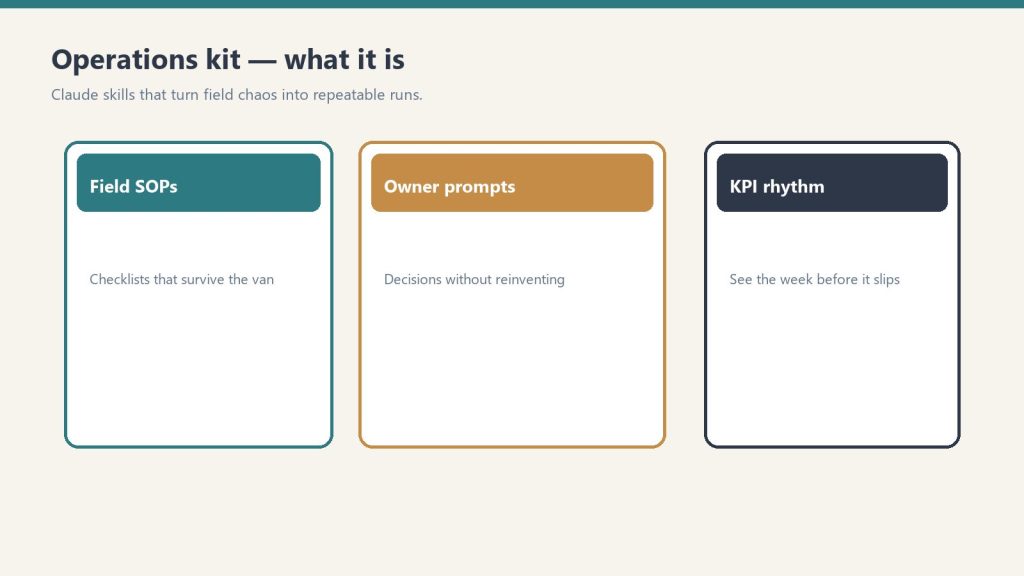
Ask Claude any restoration question. Get an answer grounded in IICRC S500/S520 standards.
Who This Is For
Who the IICRC protocol lookup skill is for.
Built for restoration technicians and project managers who need quick, accurate answers to technical drying questions in the field — without carrying a manual or waiting to call a trainer.
The Problem
The protocol lookup problem.
IICRC standards are the backbone of defensible restoration work. But S500 and S520 are dense documents, and the answers to specific field questions — what drying class applies here, how do I size equipment for this structure, what does this GPP reading mean, how do I document this for the adjuster — are not always easy to find quickly under job pressure. This Claude skill turns your AI assistant into a protocol reference that speaks restoration.
What You Get
What you get with the IICRC skill.
Answers technical drying questions with IICRC S500/S520 backing — water damage categories, drying classes 1 through 4, equipment sizing formulas
Explains psychrometrics and GPP calculations in plain language your crew can act on
Covers mold remediation protocols from S520: containment, clearance, documentation
Helps structure drying progress documentation for adjuster review
Works even better when you attach your own IICRC PDF to the conversation
Includes a 25-prompt starter library of the most common restoration protocol queries
Setup guide: installed and running in under 5 minutes
IICRC Protocol Lookup — Claude AI Skill for Restoration Contractors
$19
Delivered to your inbox within 24 hours — no shipping, no waiting
Secure checkout via Square — all major cards accepted
Frequently Asked Questions
How is this delivered?
Within 24 hours of purchase via email from will@tygartmedia.com. You will receive your download link immediately — Notion duplicate link, skill file, or both depending on the product.
Do I need any special software?
A free Notion account is required for the template products. The Claude skill requires a Claude account (free tier works for most uses).
Can I customize this for my company?
Yes — everything is built to be edited. Add your company name, your specific workflows, your equipment rates. It is a starting point, not a locked system.
Is there a refund policy?
Because this is a digital product, all sales are final. If you have a problem with your purchase, email will@tygartmedia.com and we will sort it out.
Every procedure your crew needs, documented and accessible — not a PDF that lives in a drawer.
Who This Is For
Who the SOP library is for.
Built for restoration owners who know their company needs documented procedures but have never had time to build them.
The Problem
The SOP coverage problem.
Most restoration companies run on institutional knowledge — what the senior tech knows, what the owner remembers, what got passed down verbally on the first job. That works until the senior tech leaves, or a new hire does something wrong, or an adjuster asks for your remediation protocol documentation. Every serious restoration company needs written procedures. Almost none of them have them.
Secure checkout via Square — all major cards accepted
Frequently Asked Questions
How is this delivered?
Within 24 hours of purchase via email from will@tygartmedia.com. You will receive a download link for the ZIP file and/or Notion duplicate link immediately.
Do I need any special software?
A free Notion account is required. No other software needed.
Can I customize this for my specific business?
Yes — that is the point. Everything is built to be edited. Swap in your company name, add your specific workflows, remove anything that does not apply. It is a starting point, not a locked template.
Is there a refund policy?
Because this is a digital product, all sales are final. If you have a problem with your purchase, email will@tygartmedia.com and we will sort it out.
“Black mold” is one of the most fear-inducing phrases in home ownership — and one of the most misused. When a home inspector, contractor, or alarmed homeowner reports “black mold” in a crawl space, it rarely means the Stachybotrys chartarum that has become synonymous with toxic mold in public consciousness. In the vast majority of cases, what appears as black growth on crawl space joists is Cladosporium, Aspergillus niger, or Trichoderma — common environmental molds that are black or dark-colored but are not Stachybotrys, do not produce the same mycotoxins, and are not classified as the highly toxic species that media coverage has made synonymous with “black mold.” Understanding the distinction — and the response — protects homeowners from both false alarm and genuine health risk.
What “Black Mold” Actually Means
The color of a mold does not identify its species. Dozens of common mold species produce dark — green-black, olive-black, or true black — pigmentation. The color results from melanin production in the mold’s outer spore layer, which serves as UV protection. Molds that are black in color include:
Cladosporium: One of the most common indoor and outdoor mold genera worldwide. Produces dark green to black colonies. Found on virtually every crawl space inspection with elevated humidity. Not classified as a high-risk toxin producer. Causes allergic responses in sensitive individuals but is not the “toxic black mold” of media coverage.
Aspergillus niger: Produces black-spored colonies. Common environmental mold. Some Aspergillus species produce aflatoxins and other mycotoxins at high concentrations but A. niger specifically is not among the highest-concern species.
Trichoderma: Dark green to black or white-green colonies. Very common in damp wood environments including crawl spaces. Not a significant mycotoxin producer in most species.
Stachybotrys chartarum: The actual “toxic black mold.” Black, slimy colonies. Grows specifically on chronically wet cellulose materials (paper, cardboard, ceiling tiles, wallboard) — not typically on wood surfaces, which is why it is less common in crawl spaces than in water-damaged drywall. Its growth requires sustained liquid water contact with cellulose over weeks to months — not just elevated humidity.
Is Stachybotrys Actually Present in Crawl Spaces?
Stachybotrys can appear in crawl spaces, but it is less common than in above-grade water damage scenarios because:
Structural wood (joists, sill plates, beams) is not the preferred substrate for Stachybotrys — it prefers cellulose-rich materials with lower lignin content (paper facing, cardboard, drywall)
The kraft paper facing on deteriorating fiberglass insulation in a wet crawl space is a more likely Stachybotrys substrate than the wood itself
Stachybotrys requires sustained liquid water contact to establish — not just elevated humidity. A crawl space with condensation and 80% RH may support abundant Cladosporium, Aspergillus, and Penicillium but not Stachybotrys unless there is direct water wetting of organic materials
This does not mean Stachybotrys is impossible in crawl spaces — it appears on wet insulation backing, on stored cardboard, and occasionally on severely water-damaged wood. But the presence of black mold growth in a crawl space is not a reliable indicator of Stachybotrys specifically — visual inspection cannot distinguish between species.
How to Identify Stachybotrys vs. Common Black Molds
The only reliable way to distinguish mold species is laboratory analysis. Visual differentiation is not reliable — a trained mycologist can make educated guesses based on colony morphology, growth pattern, and substrate, but cannot definitively identify species by looking at them. Options for testing:
Surface sampling (tape lift or swab): A sample from the affected surface is analyzed by a certified laboratory using microscopy or culture. Cost: $30–$75 per sample from a DIY kit (Zefon, Pro-Lab), $150–$300 per sample from a professional industrial hygienist. Results identify genus and sometimes species.
Air sampling: An ImpingerAir or similar device draws a measured volume of air through a collection cassette that captures spores. Analysis identifies airborne species and concentrations. Cost: $200–$400 per air sample location from a professional. More informative for indoor air quality assessment than surface samples.
ERMI (Environmental Relative Moldiness Index): A standardized DNA-based dust sample analysis that identifies 36 mold species from a single dust sample. Cost: $200–$300 per home sample. Provides the most comprehensive species identification from a single collection.
The Appropriate Response — Regardless of Species
Here is the practical reality: the correct response to visible black mold growth in a crawl space is the same whether it is Cladosporium or Stachybotrys — address the moisture source, remediate the visible mold, and prevent recurrence through encapsulation. The urgency and the protection level used during remediation may differ (Stachybotrys warrants full respiratory protection and containment; Cladosporium warrants at minimum an N95 and protective clothing), but the fundamental response is identical.
Testing for specific species before deciding whether to remediate is rarely necessary. The presence of any significant visible mold in a crawl space — regardless of color or species — is a moisture problem that requires the same treatment: address the humidity source, remediate the mold, prevent recurrence. The species identification is more relevant to health impact assessment for specific occupants (particularly immunocompromised individuals) than to the remediation decision itself.
When Species Identification Matters
Species testing is warranted in specific circumstances:
An occupant of the home has been experiencing unexplained neurological symptoms, chronic fatigue, or other symptoms consistent with mycotoxin exposure at high concentrations — a physician has requested specific mold species identification
Insurance claims where Stachybotrys confirmation affects coverage determination
Litigation or legal proceedings where species identification is relevant to causation assessment
A contractor is proposing significantly more expensive “toxic mold remediation” scope than standard mold remediation — verify whether Stachybotrys is actually present before accepting the premium scope
Frequently Asked Questions
How dangerous is black mold in a crawl space?
Black-colored mold in a crawl space is most commonly Cladosporium, Aspergillus, or similar common environmental species — not Stachybotrys, the mycotoxin-producing species associated with “toxic mold.” All visible mold in a crawl space warrants remediation and moisture control because any significant mold load contributes to indoor air quality problems via the stack effect. The species-specific danger level varies, but the correct response is the same: remediate and address the moisture source.
How do I test for black mold in my crawl space?
A tape lift or swab surface sample analyzed by a certified laboratory identifies the mold species. DIY kits (Zefon, Pro-Lab) cost $30–$75 per sample; professional industrial hygienist testing costs $150–$300 per sample. Air sampling ($200–$400 per location) identifies airborne species concentrations. ERMI dust testing ($200–$300) provides the most comprehensive species profile from a single sample. Testing before remediation is not always necessary — the response is similar for most species.
Can I remove black mold from a crawl space myself?
For limited surface mold (under 25% of joist surfaces) without confirmed or suspected Stachybotrys: DIY remediation with proper PPE (N95 respirator, Tyvek coveralls, gloves, eye protection), HEPA vacuuming, borate treatment, and post-treatment encapsulation is reasonable. For extensive mold, confirmed Stachybotrys, or occupants with immune compromise or known mold sensitivity: professional remediation is strongly recommended. Any DIY remediation must be paired with addressing the moisture source — otherwise mold returns within months.
Mold in a crawl space is one of the most alarming things a homeowner can discover — and one of the most frequently misunderstood. The sight of dark growth on floor joists triggers fear of toxic mold, expensive remediation, and compromised home value. In reality, crawl space mold is common, the risk level varies significantly by species and extent, and the correct remediation approach depends on accurately characterizing what you have. This guide covers identification, causes, remediation, and prevention — in that order, because diagnosis determines everything else.
Is It Mold? Distinguishing Mold from Common Lookalikes
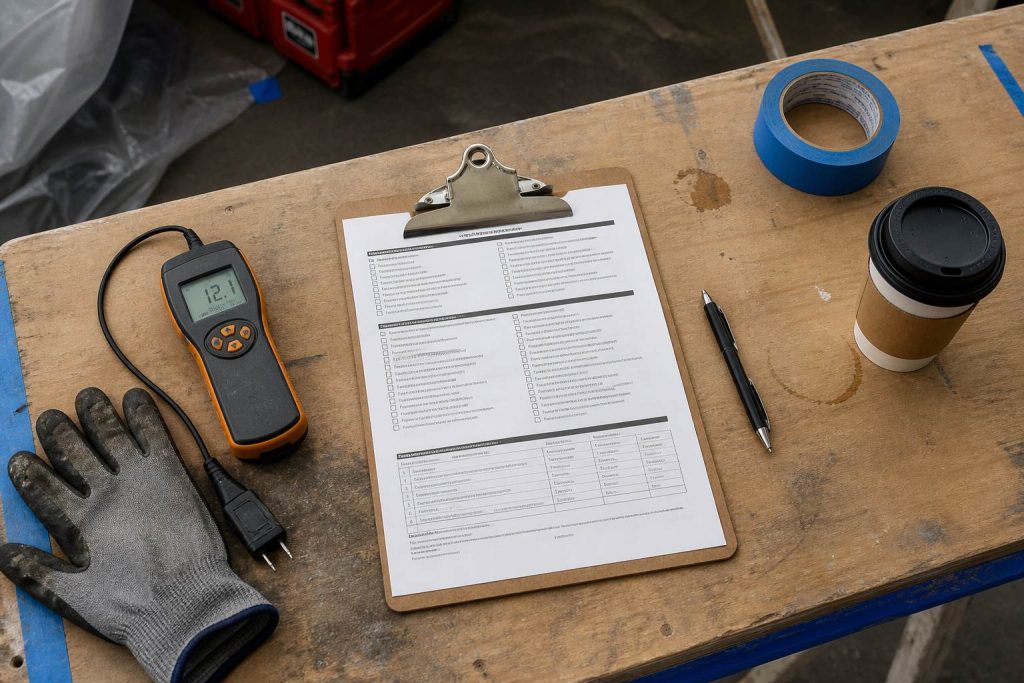
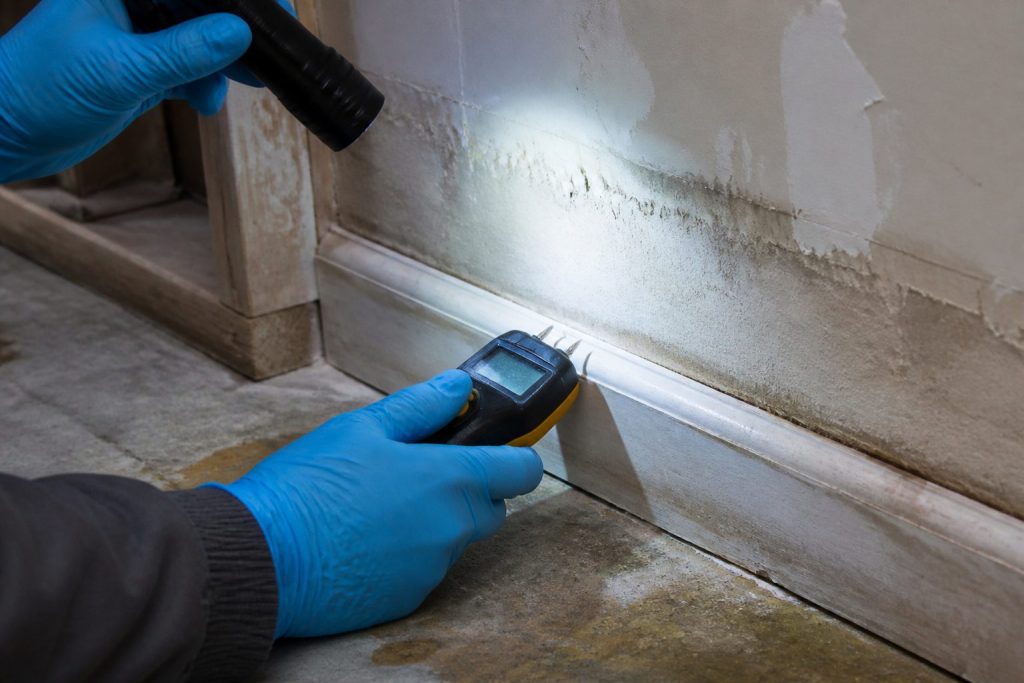
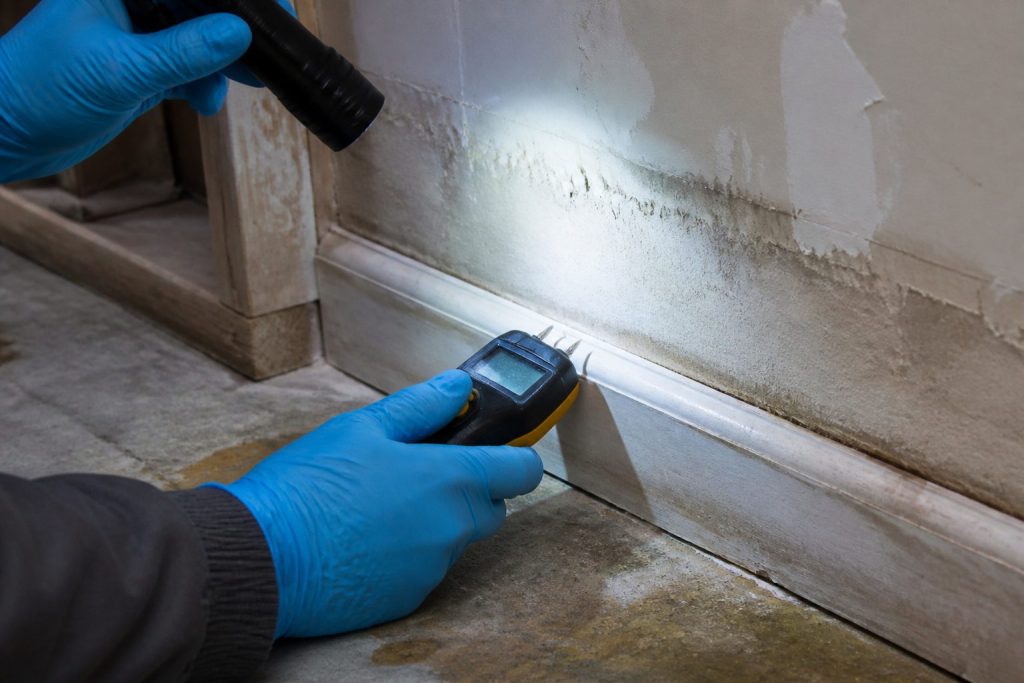
Measure before you argue about mold.
Efflorescence
Efflorescence is a white, powdery or crystalline deposit that forms on concrete, masonry, and block foundation walls when water moves through the material and evaporates at the surface, depositing dissolved mineral salts. It is completely non-biological, not a health hazard, and not mold. Efflorescence indicates water movement through foundation materials — a moisture problem — but the white deposits themselves are minerals. If what you see on your foundation walls is white, powdery, and crystalline (not fuzzy or growing), it is almost certainly efflorescence, not mold.
Wood Staining
Wood staining — blue-gray or black discoloration of wood without surface growth — is caused by a group of fungi called sapstain or bluestain fungi. These fungi penetrate the wood fibers and produce pigmented compounds, causing discoloration. Bluestain fungi do not degrade structural wood fibers (they consume sugars in sapwood but not the cellulose that provides strength) and are not generally considered a health hazard. However, their presence indicates past or present elevated wood moisture content — the same conditions that enable structural wood rot and health-relevant mold species.
Surface Mold
True surface mold on crawl space wood appears as fuzzy or powdery growth — white, gray, green, black, or multi-colored depending on the species — that sits on the wood surface rather than penetrating it. The most common crawl space mold species are Penicillium, Aspergillus, Cladosporium, and Trichoderma — which appear white, green-gray, or black. Surface mold can often be wiped off the wood surface (unlike bluestain staining, which penetrates the fibers). The presence of surface mold indicates current or recent elevated humidity conditions.
Wood Rot
Wood rot (brown rot or white rot fungi) is a structural fungal attack that actually degrades wood fibers, weakening the structural capacity of joists, beams, and sill plates. Brown rot crumbles wood into cube-shaped pieces that crack along the grain; white rot attacks both lignin and cellulose, leaving a white, stringy, spongy residue. Wood rot requires sustained wood moisture content above 19–28% to become active — it indicates a chronic, severe moisture problem. This is not a cosmetic issue — rotted structural wood requires replacement.
What Causes Crawl Space Mold
Mold requires three conditions to grow: a food source (organic material — wood, paper, insulation), water (specifically, relative humidity above approximately 70% or wood moisture content above 18–19%), and temperatures above approximately 40°F. All three are present in most vented crawl spaces during warm, humid months.
The specific mechanism in most crawl spaces: warm, humid outdoor air enters through foundation vents in summer and contacts the cooler underside of the subfloor and floor joists. The air cools to its dew point, depositing liquid moisture on wood surfaces. This elevated wood surface moisture — not standing water, just the condensed humidity from the air — is sufficient to enable mold growth on the wood surfaces within days to weeks of sustained exposure.
Secondary causes include: plumbing leaks from pipes in the crawl space that have gone undetected, HVAC condensate lines that drip into the crawl space, inadequate grading that directs surface runoff toward the foundation, and dryer vents that exhaust into the crawl space (prohibited by code but found in older homes).
Health Risk Assessment: Is Crawl Space Mold Dangerous?
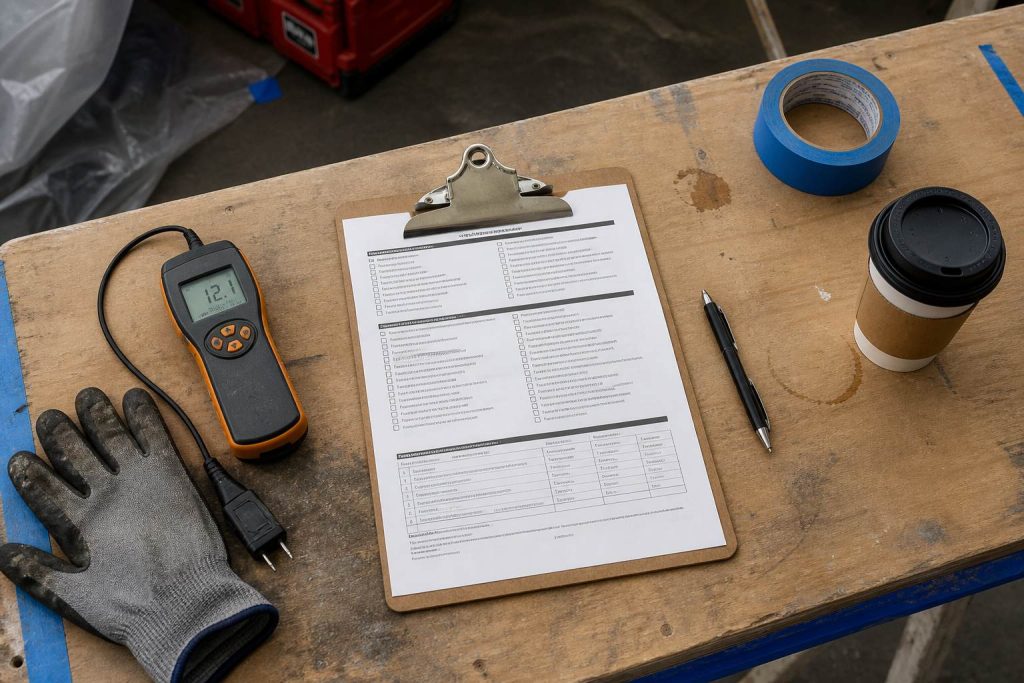
Inspection is a sequence, not a vibe.
The health relevance of crawl space mold depends on what is growing, how much, and how effectively the stack effect carries crawl space air into living spaces. Key points:
Research documents that 40–60% of first-floor air in a home with a vented crawl space comes from that crawl space. Mold spores in the crawl space air are entering the living space continuously.
The most common crawl space mold species (Penicillium, Aspergillus, Cladosporium) are widespread environmental molds that healthy adults tolerate at typical background concentrations. They become problematic at high indoor concentrations, particularly for individuals with mold allergies, asthma, or compromised immune systems.
Stachybotrys chartarum (“black mold”) is relatively rare in crawl spaces — it requires chronically wet cellulose materials and grows slowly. When it does appear, it is more concerning due to its mycotoxin production at high concentrations.
The practical health risk from crawl space mold in an occupied home is real but often overstated. It is highest for individuals who spend time in the crawl space directly, those with mold sensitivity, and children and immunocompromised individuals who live in the home long-term with elevated crawl space mold loading.
Crawl Space Mold Removal: The Process
Containment first — then removal.
Scope Assessment First
Before removing mold, establish the scope. A crawl space inspection with a moisture meter and flashlight should answer: what percentage of the crawl space joist surfaces are affected? Is the mold surface-only or has wood degradation occurred? Are structural wood members affected or primarily insulation, sheathing, and blocking?
EPA guidance considers mold remediation above 10 square feet to warrant professional involvement. In a crawl space context, 10 sq ft of mold growth on joists is relatively minor. Extensive mold coverage — 50%+ of the joist surfaces in a 1,500 sq ft crawl space — is substantial remediation work.
Safety Equipment
For any crawl space mold work — DIY or professional:
N95 or P100 respirator (not a dust mask — a rated respirator)
Disposable Tyvek coveralls or clothing that will be washed immediately after
Nitrile gloves
Eye protection
Temporary lighting — a bright, portable LED work light is essential in a dark crawl space
The Remediation Steps
Address the moisture source first: Remediating mold without fixing what caused it is pointless — mold returns within 1–3 months of re-exposure to the same conditions. Fix the drainage, seal the crawl space, or install the dehumidifier before or simultaneously with mold remediation.
HEPA vacuum the affected surfaces: Before any wet treatment, HEPA-vacuum the mold to remove bulk spores without dispersing them into the air. A standard vacuum will spread spores; a HEPA-filtered vacuum captures them.
Apply a biocide or antimicrobial treatment: A registered EPA antimicrobial product labeled for mold remediation is applied to affected surfaces. Sodium hypochlorite (bleach) is effective on non-porous surfaces but less effective on porous wood — it kills surface mold but does not penetrate to kill embedded hyphae. Professional-grade products like Foster 40-80 or BioSide are more appropriate for wood surfaces. Borate-based treatments (Tim-bor, Boracare) kill mold and provide residual protection against future growth.
Allow surfaces to dry completely: Treated surfaces must dry before being enclosed by vapor barrier or spray foam.
Apply an encapsulant: A mold-resistant coating or encapsulant applied over remediated wood surfaces seals residual spores and provides a physical barrier against future moisture intrusion at the wood surface. This is distinct from the crawl space vapor barrier — it is applied directly to the wood surfaces.
When to Hire a Professional
Professional crawl space mold remediation is appropriate when: mold coverage exceeds 25–30% of the crawl space surface area; structural wood rot is present and lumber replacement is needed; the mold type is unknown and testing is warranted; or an occupant of the home has documented mold sensitivity, asthma, or compromised immune function. Professional remediation cost: $1,500–$6,000 for moderate crawl space mold; $5,000–$15,000 for extensive mold with structural wood damage.
It depends on the species, extent, and the home’s occupants. Common crawl space mold species (Penicillium, Aspergillus, Cladosporium) are significant at high concentrations, particularly for individuals with mold allergies, asthma, or compromised immunity. The stack effect carries crawl space air into living spaces — making crawl space mold a real indoor air quality concern. Extensive mold growth in a home with sensitive occupants warrants prompt professional remediation.
What kills mold in a crawl space?
For wood surfaces: borate-based treatments (Tim-bor, Boracare) are most effective — they penetrate wood fibers, kill embedded mold, and provide residual protection. Bleach kills surface mold on non-porous surfaces but is less effective on porous wood. Professional-grade antimicrobial products (Foster 40-80, BioSide) are the industry standard for professional remediation. In all cases, addressing the moisture source is essential — without fixing the underlying humidity problem, mold returns within months.
How much does crawl space mold remediation cost?
DIY remediation of limited mold (under 25% surface coverage, no structural wood damage): $100–$400 in materials — HEPA vacuum, respirator, biocide treatment, encapsulant. Professional remediation: $1,500–$6,000 for moderate mold; $5,000–$15,000 for extensive mold with structural damage. Encapsulation to prevent recurrence adds $5,000–$15,000 to the project total but eliminates the conditions that enable future mold growth.
Will encapsulation fix my crawl space mold problem?
Encapsulation prevents future mold growth by eliminating the moisture conditions that enable it. But existing mold must be remediated before encapsulation — sealing living mold beneath a vapor barrier traps it and allows it to continue growing in the sealed, dark environment. The correct sequence: remediate existing mold, verify the wood is dry, then encapsulate to prevent recurrence.
By Will Tygart · Practitioner-grade · From the workbench
Your competitor is ranking for 340 keywords in your city. You’re ranking for 12. The difference isn’t budget. It’s architecture.
I’ve audited over 200 restoration company websites in the last two years. The pattern is always the same: a homepage, an “About” page, four service pages that each say basically the same thing, and a blog with 15 posts nobody reads. Then they wonder why the company across town—smaller crew, older trucks, half the reviews—outranks them on every search that matters.
The answer is always topical architecture. The companies dominating local search in restoration have built their sites like machines—every page serving a purpose, every internal link carrying authority, every piece of content mapped to a specific keyword cluster. The rest are publishing into a void.
The Hub-and-Spoke Model That Restoration Companies Keep Getting Wrong
The hub-and-spoke model restoration companies keep getting wrong.
Everyone talks about hub-and-spoke content. Almost nobody executes it correctly in restoration.
Here’s what it actually means: you build one comprehensive hub page targeting your broadest keyword (“water damage restoration [city]”), then surround it with 8-12 spoke pages targeting long-tail variations and subtopics (“basement water damage restoration [city],” “burst pipe cleanup [city],” “water damage insurance claims [city]”). Every spoke links back to the hub. The hub links out to every spoke. Google reads this structure and understands that your site has comprehensive coverage of the topic.
Where restoration companies fail: they build the hub page and call it done. Or they build spokes that don’t link back to the hub. Or they build spokes that compete with each other for the same keywords—cannibalizing their own rankings. A spoke page about “emergency water extraction” and another about “emergency water removal” aren’t two pages. They’re one page fighting itself.
The fix is a keyword map built before a single word gets written. Every page gets one primary keyword, one URL, and a defined relationship to its hub. No overlaps. No orphans. No cannibalization.
Content Velocity: Why Publishing Speed Matters More Than You Think
Content velocity — why publishing speed matters.
Google’s algorithm rewards sites that demonstrate consistent publishing velocity. Not volume for volume’s sake—but a steady cadence of new, quality content that signals an active, authoritative presence on a topic.
The restoration companies that moved from “one blog post when we feel like it” to “two quality posts per week, every week” saw measurable domain authority increases within 90 days. One company went from 47 indexed pages to 142 in four months and watched their organic traffic increase 284%. Not because every post generated traffic on its own—but because the cumulative topical coverage told Google “this site knows water damage restoration in Houston better than anyone else.”
Content velocity in 2026 doesn’t mean churning out AI slop. It means having a production system—editorial calendar, keyword assignments, writer guidelines, quality gates—that produces at a pace your competitors can’t sustain. Two excellent posts per week beats ten mediocre posts per week, every time. But two excellent posts per week also beats one excellent post per month.
The Pillar Page Strategy That Generates $40,000 Months
A pillar page is a hub page on steroids. It covers a topic comprehensively—3,000 to 5,000 words—with jump links to sections, embedded FAQ schema, and internal links to every related piece of content on your site. It’s designed to be the definitive resource on a topic within your market.
One restoration company built a single pillar page: “The Complete Guide to Water Damage Restoration in [Metro Area].” It covered the entire process—from discovery to insurance claim to reconstruction. It included local permit requirements, average cost data from their own projects, a timeline by damage category, and a section addressing every question from the top 20 “People Also Ask” results for their target keywords.
That single page now ranks #1 for 23 keyword variations and generates 40-60 leads per month. At their close rate and average job value, it’s a $40,000/month page. One page.
The secret isn’t the word count. It’s the information density, the local specificity, and the structural internal linking that passes authority from every spoke page back to this hub. The page ranks because the entire site architecture supports it.
Editorial Planning: The Calendar That Prints Money
The highest-performing restoration content strategies I’ve seen run on 90-day editorial calendars mapped to three inputs: keyword opportunity data, seasonal demand patterns, and competitive gaps.
Keyword opportunity data tells you which topics have search volume with achievable competition. In restoration, this often reveals surprising opportunities—”dehumidifier rental [city]” might have 500 searches/month with almost no competition, while “water damage restoration [city]” has 2,000 searches/month with 40 competitors fighting over it.
Seasonal demand patterns tell you when to publish. Fire damage content should hit peak indexation before wildfire season. Hurricane preparedness content should publish in May, not August when it’s already too late to rank. Frozen pipe content should go live in September—three months before the first freeze—so Google has time to crawl, index, and rank it before demand peaks.
Competitive gaps tell you where to aim. If every competitor in your market has water damage content but nobody has published on commercial smoke damage restoration, that’s your lane. If competitors cover residential mold but ignore post-construction mold testing, that’s your lane. The editorial calendar should systematically fill every gap your competitors leave open.
Internal Linking: The Free Ranking Boost 90% of Restoration Sites Ignore
Internal linking is the most underutilized ranking factor in restoration SEO. It costs nothing, takes minimal time, and produces measurable ranking improvements—yet nine out of ten restoration sites have broken or nonexistent internal link structures.
The rules: every new post should link to at least 3-5 existing relevant pages on your site. Every existing page that relates to a new post should be updated with a link to that new post. Hub pages should link to all their spokes. Spokes should link to their hub and to 2-3 sibling spokes. Anchor text should be descriptive and keyword-relevant—”water damage restoration in Houston” not “click here.”
One company added 150 internal links across 45 existing pages in a single afternoon. Within 30 days, 12 pages that had been stuck on page 2 moved to page 1. The only change was internal linking. No new content. No backlinks. Just connecting the pages that already existed.
The 12-Month Content Architecture Roadmap
The 12-month content architecture roadmap.
Months 1-3: Build foundational hub pages for your top 3-4 service categories. Water damage, fire damage, mold remediation, storm damage. Each hub gets a full keyword map and 4-6 initial spoke pages. Implement site-wide internal linking protocol.
Months 4-6: Build pillar pages for your highest-revenue services. Expand spoke coverage to 10-12 per hub. Begin publishing to your editorial calendar at 2 posts/week minimum. Add FAQ schema to every existing page.
Months 7-9: Attack competitive gaps identified in your editorial calendar. Build spoke pages for long-tail keywords your competitors don’t cover. Update and expand existing content with new data, seasonal information, and additional internal links.
Months 10-12: Measure, optimize, consolidate. Identify underperforming content and either improve it or redirect it. Double down on the topics driving the most leads. Build your year-two calendar based on 12 months of performance data.
This isn’t a content strategy. It’s a content architecture. The difference is that architecture is permanent. Strategy changes with the wind. Architecture compounds.
AI-generated editorial illustration — Vertex AI Imagen 4 Standard
About this image. This image was generated by Google’s Vertex AI Imagen 4 model as the featured visual for Content Architecture for Restoration Companies: The System That Turns Blog Posts Into Lead Machines . Every image in the Tygart Media visual library is AI-generated, converted to WebP for optimal performance, and enriched with IPTC/XMP metadata for search engine discoverability.
Model: Vertex AI Imagen 4 Standard (imagen-4.0-generate-001)