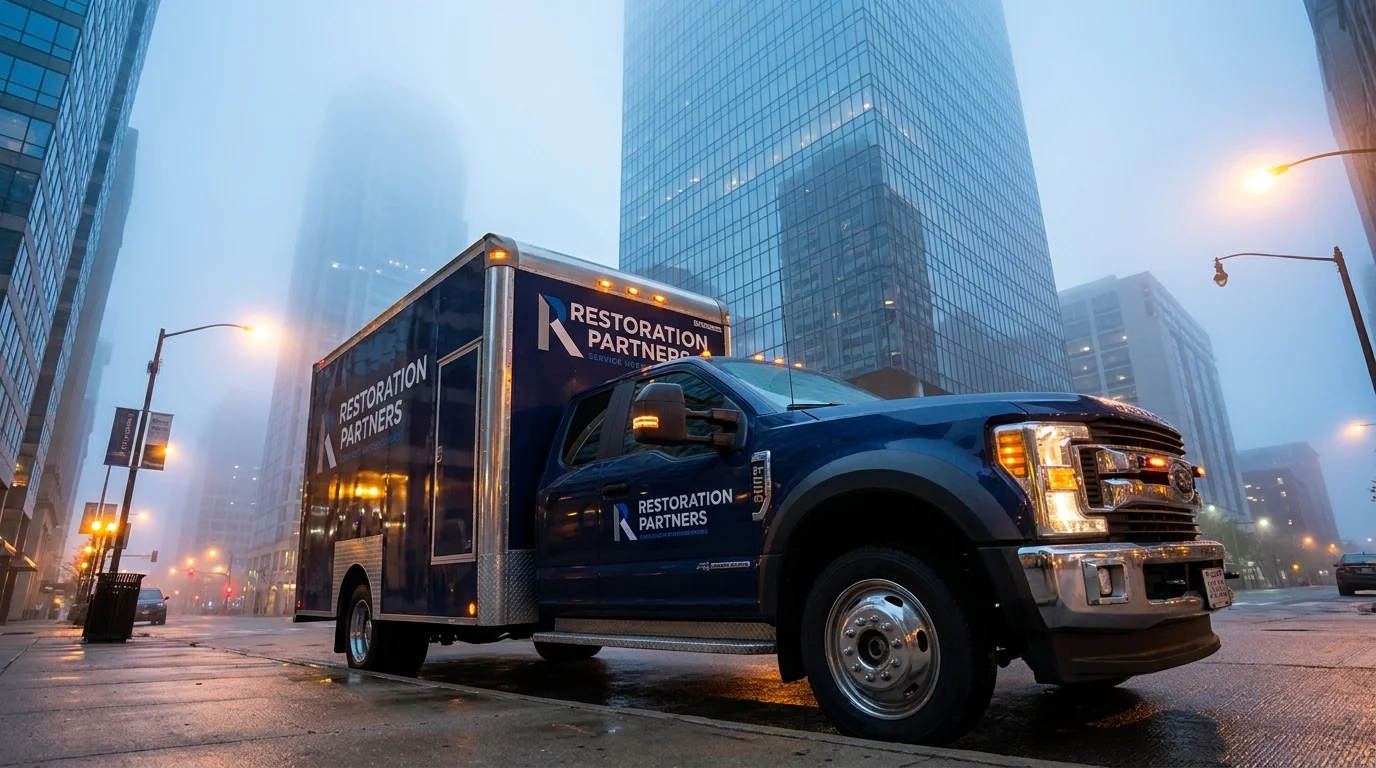
Most restoration companies plateau at one truck and one owner-operator burning out at 70-hour weeks. The jump to two trucks is harder than it looks — and the jump from two to five is what separates a job from a real business. This is the operator’s version of how that scaling actually happens.
Why most restoration companies stay stuck at one truck
The 1-truck plateau isn’t a marketing problem — it’s a structural one. The owner is the estimator, the dispatcher, the lead tech, the QA reviewer, the AR clerk, and the salesperson. Every additional job adds load to all six roles simultaneously. There is no room to grow until at least one role gets unloaded.
The hiring sequence that actually scales
- Hire #1: Lead Technician (~$40K monthly revenue trigger). Frees the owner from production. Pay $22-32/hr depending on market and certifications.
- Hire #2: Helper / Apprentice (~$60K monthly revenue trigger). Fills out a 2-person production crew. Pay $17-22/hr.
- Hire #3: Dispatcher / Office Coordinator (~$80K monthly revenue trigger). Owns scheduling, photo intake, customer communication. Pay $18-26/hr or $40-55K salary.
- Hire #4: Second Lead Tech (~$120K monthly revenue trigger). Enables a second crew, second truck.
- Hire #5: Estimator (~$150K monthly revenue trigger). Owns Xactimate sketch, scope, and supplements.
- Hire #6: Project Manager / Operations Manager (~$200K+ monthly revenue trigger). Owns daily production oversight across multiple crews.
The dispatch problem
One truck is easy — you go where you go. Two trucks is the hardest dispatch challenge in the company because the owner is still mentally dispatching from the field. Three+ trucks demands a real dispatcher and a real software system. Restoration Manager, DASH, Encircle, or Job Nimbus are all viable. The wrong answer is a whiteboard in the office past truck #2.
Equipment cache scaling
The naive math is “double the trucks, double the equipment.” The real math accounts for utilization:
- 1 truck: 16-20 air movers, 2-3 dehus, 2 HEPA.
- 2 trucks: 40-50 air movers, 5-7 dehus, 4 HEPA. (Not 32-40 air movers — concurrent jobs eat more.)
- 3 trucks: 70-90 air movers, 10-12 dehus, 6+ HEPA, asset tracking system non-negotiable.
- 5 trucks: 120+ air movers, 18+ dehus, dedicated equipment tech who handles cleaning/maintenance.
Working capital as you scale
Insurance work pays in 60-90 days. Payroll runs every 2 weeks. The faster you grow, the more cash you have tied up in AR. A useful rule:
Cash on hand should equal 60 days of operating expenses + 30 days of net AR.
Operators who scale without honoring this rule end up factoring receivables at painful discount rates (often 2-5% per invoice) just to make payroll. Build a line of credit before you need it.
The org chart that supports 5 trucks
Once you’re past 3 trucks, the org chart is the company. A typical 5-truck shop has:
- Owner / President
- Operations Manager (production oversight, equipment, safety)
- Estimator(s)
- Project Manager(s) — 1 per 2-3 crews
- Dispatcher
- Office Manager (AR, billing, supplements)
- Lead Technicians (one per truck)
- Technicians / Helpers
- Equipment Tech (part-time at 3 trucks, full-time at 5)
That’s 12-18 people running ~$2-4M in revenue.
FAQs about scaling a restoration company
How much revenue do I need before hiring my first employee?
$30,000 – $40,000 in monthly revenue, sustained for 60+ days. Hiring before that level usually means the owner is still on the truck and the new hire is an idle expense.
How many trucks can one dispatcher handle?
A trained dispatcher comfortably handles 4-6 trucks. Beyond 6, you need either a second dispatcher or a project manager / dispatcher hybrid model with crews assigned to specific PMs.
What’s the right truck-to-technician ratio?
2 technicians per truck is the working standard for water mitigation. Fire and contents work often pushes to 3 per truck because of pack-out labor. Mold remediation runs 2-3 per truck depending on containment scope.
When should I add reconstruction services?
Most operators add reconstruction in year 2-3, after mitigation revenue is stable at $1M+ annual. Earlier addition spreads capital and management attention too thin. Reconstruction also extends DSO from 60 days to 90-120 days, which strains cash flow.
Should I open a second location to scale?
Not until your primary location runs 4+ trucks profitably and you have a proven Operations Manager who can be promoted to run location #1 when you focus on launching #2. Premature multi-location expansion is the most common reason 7-figure restoration companies blow up.
Operator playbook: Restoration Startup and Scaling Master Guide.
Leave a Reply