AI citations don’t come from pages alone. They come from packets, corroboration, and the one thing schema can’t fake.
William Tygart · Tygart Media
The morning I thought we’d been delisted
I thought we’d been delisted.
Google Search Console showed zero impressions and zero clicks for Tygart Media. A flatline. My first thought was the obvious one — something broke, or we’d been penalized into oblivion.
We hadn’t. Bing showed real traffic the whole time. Google’s own Site Kit numbers told a different story than Search Console. The site was fine. The dashboard was measuring the old world.
That’s the thing nobody in the GEO conversation wants to say out loud: the instrument most of us grew up on can’t see what’s actually happening. AI citations don’t show up in Search Console. The traffic is real; the attribution is invisible. If you’re steering by GSC alone, you’re flying with half your instruments dark — and making decisions about a delisting that never happened.
The packet theory
Here’s what I keep coming back to: classic search already has the answers. Every question worth asking has been answered somewhere, usually well. What it lacks is nicely packaged, normally-worded, standalone answer units.
So package it up, and they lift it.
An AI answer doesn’t want your page. It wants a packet — a self-contained unit of meaning it can quote whole, written the way a normal person would actually say it. Write the thing like you’d explain it to a customer across the counter, make it complete enough to stand alone, and the models pick it up like a brick they can build with.
“The page is not the product. The packet is.”
This is where most GEO practice misses. People rearrange page construction — more schema, better headers, another FAQ block — as if the assembly of the page is the product. It isn’t. GEO is more than how pages are constructed. The pages are just where the work becomes visible.
Off-page weights
I was replying to Ira Bodnar about this recently. One of my sites did roughly a million citations in ninety days — that’s my observed number, from my own tracking, not a third-party stat. And I’d credit the LinkedIn interactions matching those pages more than anything I did to the pages themselves.
Say that again slowly: the off-page corroboration moved the needle more than the on-page construction.
Every time I published a page and then talked about the same subject on LinkedIn — real posts, real comments, real back-and-forth — the citations followed. The models aren’t just reading your HTML. They’re weighing whether the world around the page agrees with it. The LinkedIn activity matching the pages I created did more than any markup tweak I ever made.
“Off-page weights move AI citations. Full stop.”
Different humans altogether
Here’s another one: Claude desktop users and ChatGPT mobile users behave like different humans altogether.
We keep talking about “GPT” or “Claude” like each one is a single portal. It isn’t. Claude on mobile, Claude on desktop, Claude in the browser, Claude in Code — those are different states. The model knows the person and the surface. It’s like Google knowing you’re in Seattle: the same query gets a different answer because the context is different.
There is no one portal called GPT. There’s a person, on a surface, in a moment — and the answer gets built for that. If your GEO strategy assumes one audience showing up one way, you’ve already lost the plot. Segment by surface or don’t bother.
What the server logs show
Nobody in the GEO conversation looks at raw server logs. That’s the edge, and it’s sitting right there.
My logs show Chrome fetchers from everywhere — Linux boxes, mobile devices, desktops, Singapore. Manus, Perplexity, You.com, OpenAI, Grok. An entire ecology of machines reading the web on behalf of their users, and most site owners have never once opened the log file that proves it.
Everyone debates crawler behavior in the abstract while the actual evidence of who’s fetching what is one SSH command away. Look at your logs. The bots will tell you exactly what they care about, if you bother to ask. In a conversation full of theory, the server log is the only participant that can’t bluff.
You still have to connect to the person
Here’s the close, and it’s the whole game: you still have to connect to the person.
Schema doesn’t make anyone feel heard. Markup doesn’t make anyone feel heard. A million citations don’t make anyone feel heard.
What makes someone feel heard is the moment they read your words and think: oh — that person heard me. That feeling is the product. Everything else is packaging.
“That feeling is the product. Everything else is packaging.”
And here’s my dare, the one I mean: go ahead and try to copy what I do. Seriously. Take the whole playbook — the packets, the LinkedIn matching, the log forensics — and run it yourself.
You won’t be able to. Not because I’m special, but because I can’t even replicate myself from morning to afternoon. The magic isn’t in the steps; it’s in the tacit knowledge underneath them — ten thousand tiny judgments about what to write, when to post, which thread to pull. You can’t replicate magic.
Tacit knowledge is the moat.
GEO is more than throwing pages together. It always was.
# Generative Engine Optimization: Why Your Agency Needs an AEO Strategy Now
The digital world is undergoing its most profound transformation since the advent of the internet itself. For decades, the battle for online visibility has been fought on the battleground of Search Engine Optimization (SEO). Agencies have meticulously crafted strategies around keywords, backlinks, and algorithm updates, all in pursuit of the coveted top spot on search engine results pages (SERPs). But a new, more intelligent gatekeeper is emerging, one that doesn’t just index information but understands, synthesizes, and generates it: Artificial Intelligence.
By 2026, the digital landscape will be dominated by AI-powered interfaces – advanced voice assistants, sophisticated chatbots, hyper-personalized content feeds, and integrated search experiences that deliver synthesized answers rather than lists of links. Users will increasingly bypass traditional SERPs, receiving direct, AI-curated information. In this new reality, traditional SEO, focused solely on search engine algorithms, is no longer sufficient. Agencies that fail to adapt will find their clients’ content invisible to these new discovery mechanisms, leading to a catastrophic loss of visibility, traffic, and revenue. The time has come for Generative Engine Optimization (AEO).
AEO is not merely an evolution of SEO; it’s a fundamental paradigm shift. It’s about optimizing for AI comprehension, synthesis, and output, ensuring your clients’ content is discoverable, trusted, and effectively utilized by the AI models and AI-powered platforms that will define digital interactions. Early adoption of AEO will position agencies as indispensable partners, leading the charge in this evolving digital frontier.
## The Paradigm Shift: From Keywords to Concepts
The foundational difference between traditional SEO and AEO lies in how information is processed. Search engines, at their core, have historically relied on keywords and their permutations. While sophisticated, their understanding was often lexical. Generative AI models, however, operate on a different plane. They understand context, nuance, and complex concepts, not just isolated keywords.
For agencies, this means content can no longer be a mere collection of keyword-stuffed phrases. It must be semantically rich, well-structured, and designed to provide clear, comprehensive answers to complex questions. AI models excel at extracting meaning from well-organized information. This necessitates a shift towards topic clusters, detailed explanations, and content that anticipates follow-up questions, effectively building a knowledge graph around a subject. Your content needs to be a reliable source of truth, not just a keyword target.
## Building Trust in the Age of AI: The E-E-A-T Imperative
In a world where AI can generate vast amounts of information, the premium on trust and authority has never been higher. AI models are designed to prioritize authoritative, fact-checked, and unbiased information to avoid propagating misinformation. For agencies, this means demonstrating strong E-E-A-T (Experience, Expertise, Authoritativeness, Trustworthiness) signals for their clients is no longer a best practice; it’s a survival imperative.
AEO demands that content not only be accurate but also demonstrably credible. This involves showcasing the credentials of authors, citing reputable sources, providing evidence for claims, and ensuring transparency in data presentation. Agencies must actively work to build and amplify their clients’ reputations as thought leaders and trusted sources within their respective industries. This isn’t just about pleasing an algorithm; it’s about becoming a reliable input for the AI’s knowledge base, which in turn influences the AI’s output to users.
## Beyond Text: Multi-Modal Optimization for AI Comprehension
While text remains a cornerstone of digital content, generative AI extends far beyond it. Image generators, video analysis tools, and advanced audio processing are all part of the AI ecosystem. AEO, therefore, must embrace multi-modal optimization.
This means optimizing images, videos, and audio for AI interpretation and generation. For images, this translates to descriptive alt-text that goes beyond simple keywords, providing rich context. For videos, it means comprehensive transcripts, detailed descriptions, and structured metadata that explain the content’s purpose and key takeaways. Audio content requires similar attention to transcripts and clear categorization. The goal is to make every piece of digital content, regardless of its format, fully comprehensible and usable by AI models, enabling them to accurately describe, summarize, and even generate new content based on your assets.
## Proactive Integration: Agencies as AI Pioneers
The rise of AI presents a choice: react to its changes or proactively integrate its power. Agencies that choose the latter will gain a significant competitive edge. This isn’t just about optimizing *for* AI; it’s about optimizing *with* AI.
Agencies should actively integrate AI tools into their content creation, distribution, and analysis workflows. This could involve using AI for content ideation, generating initial drafts, summarizing lengthy reports, personalizing content at scale, or analyzing performance data with unprecedented depth. By becoming proficient in leveraging generative AI, agencies can streamline operations, enhance creativity, and deliver more impactful results for their clients, positioning themselves as true innovators in the digital marketing space.
## The Ethical Compass: Transparency and Bias in AI Content
As AI becomes more pervasive, the ethical considerations surrounding its use become paramount. Content optimized for AI must adhere to stringent ethical guidelines, actively work to avoid bias, and be transparent about its origins and purpose. This isn’t just a moral obligation; it’s a strategic necessity for building and maintaining user trust.
Agencies must ensure that the content they produce and optimize for AI is fair, accurate, and representative. This involves scrutinizing data sources, challenging inherent biases in language, and being transparent about when AI has been used in content creation or curation. Trust is the ultimate currency in the digital age, and any perceived ethical lapse or bias in AI-generated or AI-optimized content can severely damage a client’s reputation.
## Your Agency’s AEO Action Plan: Navigating the New Frontier
The transition to AEO is not a distant future concern; it’s an immediate strategic imperative. Here’s how your agency can begin to implement a robust AEO strategy now:
### Audit for AI Readiness
Start by analyzing your clients’ existing content. Evaluate it not just for traditional SEO metrics, but for semantic clarity, the strength of its E-E-A-T signals, and its multi-modal optimization potential. Identify gaps where content is unclear, lacks authority, or is poorly structured for AI comprehension.
### Crafting AI-First Content Strategies
Develop content strategies specifically designed for AI comprehension and synthesis. This means prioritizing comprehensive answers, creating clear topic clusters, and structuring information logically. Think about how an AI would process and summarize your content, and design it to facilitate that process.
### The Power of Structured Data & Schema
Invest heavily in implementing advanced structured data and schema markup. This provides explicit signals to AI models about the meaning of your content, its relationships to other entities, and its overall context. Schema.org vocabulary is your direct line of communication with AI, helping it understand your content’s purpose and relevance.
### Staying Ahead: Monitoring AI Evolution
The AI landscape is dynamic. Agencies must commit to continuously monitoring how leading AI models (e.g., Google’s Gemini, OpenAI’s GPT) are evolving, how they source information, and what they prioritize. Staying informed about model updates and best practices will be crucial for maintaining AEO effectiveness.
### Upskilling Your Team for AEO
Educate your content creators, SEO specialists, and strategists on the nuances of AEO. Provide training on semantic content creation, E-E-A-T best practices, multi-modal optimization techniques, and the effective use of structured data. Your team needs to be fluent in the language of AI.
### Embracing Generative AI Tools
Experiment with generative AI tools for content ideation, drafting, summarization, and optimization. This hands-on experience will not only make your team more efficient but also provide invaluable insights into the capabilities and limitations of AI from an agency perspective, informing your AEO strategies.
The digital future is here, and it speaks AI. Agencies that embrace Generative Engine Optimization now will not only future-proof their services but will also emerge as leaders, guiding their clients through this transformative era and ensuring their continued visibility and success in a world increasingly shaped by artificial intelligence.
*AEO is the critical evolution of digital marketing, optimizing content for AI comprehension and synthesis. Agencies must adopt AEO strategies now to ensure client visibility and trust in an AI-dominated digital landscape by 2026.*
Generative Engine Optimization: Why Your Agency Needs an AEO Strategy Now
In 2026, the digital marketing landscape has fundamentally shifted. For over two decades, agencies fought for the “blue link” on traditional Search Engine Results Pages (SERPs). Today, that battlefield has been eclipsed by an AI-synthesized ecosystem. With over 25% of traditional searches triggering AI Overviews, and millions of users migrating to conversational platforms like ChatGPT, Gemini, and Perplexity, the primary goal of search marketing has moved from earning a click to being cited, mentioned, or recommended by an AI model.
If your agency is still pitching traditional SEO to clients without a comprehensive Answer Engine Optimization (AEO) and Generative Engine Optimization (GEO) strategy, you are optimizing for a web that no longer exists.
The “Zero-Click” Reality of 2026
The zero-click reality of 2026.
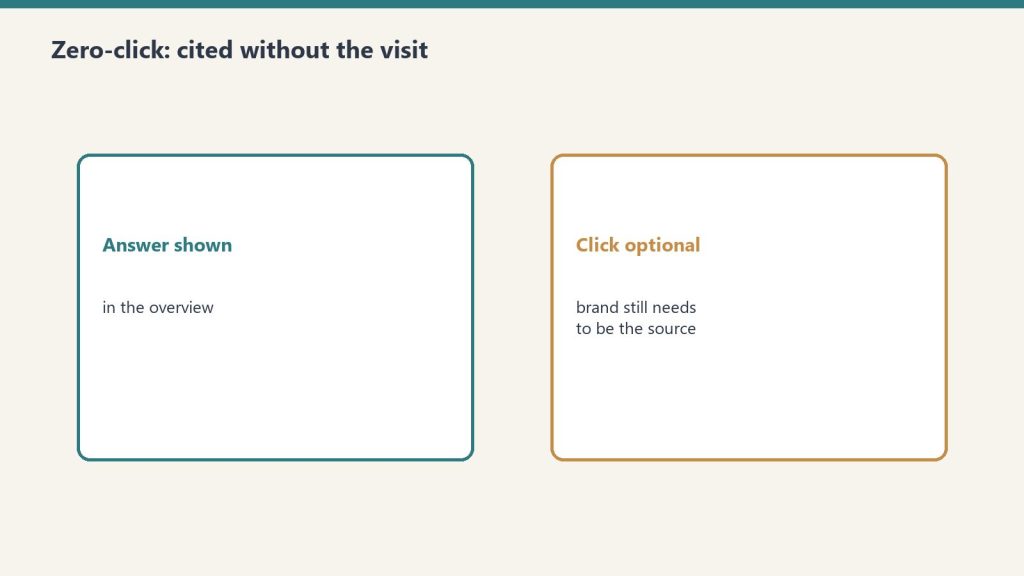
High rankings on a traditional SERP no longer guarantee traffic. Users increasingly complete their research, compare products, and make buying decisions directly within AI interfaces without ever clicking through to a source website. This “zero-click” reality means agencies must optimize for AI authority rather than just keyword density. If a generative engine does not view your client as a trusted entity, they simply will not exist in the answers provided to the end-user.
Defining GEO and AEO
Defining GEO and AEO.
While often used interchangeably, Generative Engine Optimization (GEO) and Answer Engine Optimization (AEO) represent two sides of the same critical coin:
Generative Engine Optimization (GEO): The macro-practice of optimizing brand content to be discovered, selected, and synthesized by Large Language Models (LLMs). Success is measured by “share of model”—how often a brand is included in the AI’s aggregated response compared to competitors.
Answer Engine Optimization (AEO): A targeted subset of GEO focused on providing direct, concise, and accurate answers to natural language queries. AEO ensures that when a user asks a voice assistant or AI, “What is the best marketing automation software?”, your brand is the definitive, extracted answer.
The New KPIs: Measuring ‘Share of Model’
Because traditional organic traffic is diminishing for top-of-funnel queries, forward-thinking agencies have abandoned traffic-only reporting. In 2026, performance is measured by AI-specific KPIs:
Citation Share: How frequently is the brand linked as a source in AI Overviews and Perplexity summaries?
Brand Mention Frequency: Is the brand recommended naturally in conversational outputs?
Trust & Entity Scores: How deeply has the AI mapped the brand’s entity to a specific industry or solution?
How to Build an AI-First Strategy
How to build an AI-first strategy.
Companies that are winning in 2026 have moved beyond “writing for search engines” to “writing for AI models.” This requires a convergence of PR, content marketing, and technical SEO.
First, agencies must prioritize E-E-A-T (Experience, Expertise, Authoritativeness, and Trust). Because AI models aggregate information from across the web—including forums, reviews, social media, and news—agencies must manage an “omnichannel” presence. A brand’s narrative must be consistent everywhere the AI might look.
Second, structured data and schema markup are no longer optional. Modern GEO requires engineering content for machine “extractability.” By ensuring that data is neatly organized and technically transparent, agencies reduce the risk of AI hallucinations and increase the likelihood that a model will trust and cite the provided information.
Conclusion: The Search Everywhere Era
Generative Engine Optimization does not replace traditional SEO; it builds upon it. Traditional SEO creates the foundational web presence, while GEO ensures that presence is visible and authoritative across the fragmented AI search landscape. In the “Search Everywhere” era, research no longer starts and ends on a single search engine. Agencies that adapt to this reality will dominate the next decade of digital marketing.
Tygart Media Insights: Preparing agencies and tech leaders for the future of search, artificial intelligence, and digital authority.
Most “GEO” advice is recycled SEO with the word “AI” pasted on top. This guide is different. It describes what actually happens when Microsoft Copilot, Bing’s AI answers, and Google’s AI Overviews build a response and decide whose page to cite — based on running content sites that get cited tens of thousands of times a month. The short version: AI engines do not cite the page that ranks #1 for a head term. They cite the page that most directly answers the specific sub-question the model is grounding on. That distinction changes everything about what you should write.
How grounding actually works (the part nobody explains)
How grounding actually works.
When you ask Copilot or Bing’s AI a question, the model does not answer from memory. It runs a retrieval step called grounding: it rewrites your question into one or more search queries, fetches a handful of live web results, reads them, and composes an answer with inline citations pointing back at the pages it used. Google’s AI Overviews work the same way with a technique it calls “query fan-out” — one user question becomes many narrower synthetic queries.
Two things follow directly from this mechanism:
The model is not searching for your keyword. It is searching for the answer to a decomposed sub-question. A user who asks “what’s the best way to instantly index a new page” triggers grounding queries like “IndexNow API endpoint”, “submit URL to Bing programmatically”, and “IndexNow key file location”. The page that wins is the one that answers those narrow strings, not the one optimized for “indexing tips”.
Citations are extracted at the passage level, not the page level. The model lifts the specific sentence or table that answers the sub-question. If your answer is buried under 600 words of preamble, it loses to a page that states the fact in the first line under a matching heading.
This is why a niche, specific page routinely out-cites a high-authority generalist. The generalist ranks; the specialist gets quoted.
Why operational and comparison pages win over head terms
Across real citation data, the pages that get pulled into AI answers cluster into three shapes. None of them are “ultimate guide to X”.
1. Operational pages with real commands, configs, and error messages
When someone asks an AI assistant “how do I fix [specific error]” or “what’s the exact command to do X”, the model needs a page that contains the literal command, the literal config, or the literal error string. Generic advice cannot be cited because there is nothing concrete to quote. A page that says:
curl "https://www.bing.com/indexnow?url=https://example.com/new-page/&key=YOUR_KEY"
# 200 = received (not "indexed"), 422 = URL/key mismatch, 429 = too many submits
…is citation gold, because the model can extract that block verbatim and the user can act on it. The error-code annotations matter: questions about failures (“IndexNow 422”, “why am I getting 429”) are high-intent and low-competition, and a page that names the exact codes owns them.
2. Comparison pages (“X vs Y”)
“Which is better, X or Y” is one of the most common shapes of AI query, and comparison content is structurally easy to cite because it maps cleanly to a decision. If you maintain honest, current head-to-head pages, you become the default source the model reaches for when a user is choosing between tools. This is exactly why we keep dedicated comparison pages like Claude Code vs Cursor and Claude Code vs Codex — they answer a decision the model is constantly being asked to make, and a table of differences is trivially quotable.
3. Fresh, dated pages on fast-moving topics
For anything that changes — pricing, model versions, API limits, feature availability — grounding strongly favors recency. The model would rather cite a page dated this month than an “authoritative” page from two years ago that might be wrong. A visible “Last verified” date and a real publish/update timestamp are not decoration; they are a relevance signal the retrieval layer reads.
The losing move is chasing broad head terms. “Best AI coding assistant” is saturated, generic, and rarely the literal grounding query. The winning move is to own the long, specific, operational and comparison strings that the fan-out actually generates.
IndexNow: how to get cited the same day you publish
IndexNow — cited the same day you publish.
Grounding can only cite pages the engine knows about. The bottleneck for new content is crawl latency — and IndexNow collapses it. IndexNow is an open protocol (backed by Microsoft Bing and Yandex) that lets you push a URL to the index the instant you publish, instead of waiting for a crawler to wander by.
Setup is two steps:
Host a key file. Generate a key of 8-128 hex characters and place it at your site root as a UTF-8 text file named {key}.txt containing exactly that key. Example: https://example.com/daa44a2c....txt. This proves you own the host.
A 200 means the endpoint received your URL (not that it is indexed yet). Submitting to api.indexnow.org shares the ping with all participating engines, so you do not need to hit Bing and Yandex separately. Most WordPress SEO plugins (Rank Math, Yoast, SEOPress) have IndexNow built in — turn it on and it fires automatically on every publish and update. The practical payoff: pages can enter Bing’s crawl queue within hours, which means they are eligible to be grounded and cited the same day, not next week.
One caveat worth stating plainly: IndexNow accelerates indexing, which is a precondition for citation. It does not force a citation. You still need the page to be the best answer to the sub-question. But for fresh, time-sensitive content, same-day indexing is often the difference between getting cited while the topic is hot and showing up after the conversation has moved on.
How to actually measure your AI citations
For a long time AI citations were invisible — you could see referral clicks in analytics but not the citations themselves (most AI answers are zero-click). That changed. As of February 2026, Bing Webmaster Tools ships an AI Performance report (public preview) that shows when your pages are cited across Microsoft Copilot, Bing’s AI answers, and partner surfaces. It is the first direct, free window into AI citation behavior, and you should be reading it weekly.
The four metrics that matter:
Total citations — how many times your site was cited as a source in AI answers over the period.
Average cited pages — the daily average count of unique URLs from your site that got referenced. This tells you whether citations are concentrated on one page or spread across the site.
Grounding queries — sample query phrases the AI used to retrieve and cite you. This is the single most actionable field in the report. It is a literal list of the sub-questions you are winning, which tells you exactly which operational/comparison angles to expand next.
Page-level citation activity — citations by URL, so you can see which pages are doing the work.
Two limitations to keep in mind so you read the data honestly: the report does not show click data (you see citations, not visits from them), and it aggregates Copilot with Bing summaries, so you cannot isolate one surface from the other. For Google’s AI Overviews there is still no equivalent citation dashboard — the closest proxy is watching impressions and referral patterns in GA4 and Search Console, plus spot-checking your target queries by hand.
The workflow that works: pull the grounding-queries list, find the patterns, and feed them straight back into your content plan. If you are getting cited for “claude mcp setup” variants, that is a signal to deepen pages like the Claude MCP setup guide and adjacent operational walkthroughs, not to chase a new head term.
A repeatable checklist for citation-optimized pages
Checklist for citation-optimized pages.
Everything above reduces to a build pattern. For any page you want AI engines to cite:
Lead with the answer. Put a short, factual, quotable answer in the first 1-2 sentences under each heading. Assume the model reads only that passage.
Use question-shaped headings. H2s and H3s that mirror real queries (“How does IndexNow work?”, “How do I measure AI citations?”) match the grounding query and give the extractor a clean anchor.
Be specific and operational. Real commands, real config, real numbers, real error codes and fixes. Concrete text is extractable; vague advice is not.
Add a visible FAQ near the end. Plain question/answer pairs are the single most citation-friendly format, because each pair is a self-contained answer to a discrete sub-question. You do not need JSON-LD schema for this to work — visible Q&A text is what the model reads.
Date it and keep it current. A “Last verified” line plus genuine updates on fast-moving topics buys you the recency edge in grounding.
Push it with IndexNow so it is indexable the same day, then watch the AI Performance report to see which sub-questions it wins.
If you want the larger system this fits into — the full toolchain for operating as an AI-first publisher, from MCP servers to publishing pipelines — start with the AI operator’s stack.
FAQ
Do AI engines cite the page that ranks #1 on Google?
Not reliably. AI engines run their own grounding retrieval and cite the page that most directly answers the specific decomposed sub-question, which is often a niche, operational page rather than the head-term winner. Ranking helps your page be discoverable, but the citation goes to whichever passage best answers the exact grounding query.
What is grounding in AI search?
Grounding is the retrieval step where an AI assistant rewrites your question into search queries, fetches live web pages, reads them, and builds an answer with inline citations to those pages. It is why current, specific pages can get cited even by a model whose training data predates them.
Does IndexNow guarantee my page will be cited by AI?
No. IndexNow guarantees fast indexing, which is a precondition for being cited. The page still has to be the best, most specific answer to the sub-question the model is grounding on. Think of IndexNow as removing the crawl-latency excuse, not as buying a citation.
How do I measure how often AI cites my site?
Use the AI Performance report in Bing Webmaster Tools (public preview since February 2026). It shows total citations, average cited pages per day, sample grounding queries, and citation counts by URL across Microsoft Copilot and Bing AI answers. It does not yet show click-through from those citations, and there is no equivalent dashboard for Google AI Overviews.
Do I need JSON-LD or schema markup to get cited?
No. Citation extraction works on visible, well-structured text — question-shaped headings, short factual answers, and a plain visible FAQ. Schema can help search features generally, but it is not required for AI grounding to read and quote your page.
What kind of pages get cited most?
Three shapes dominate: operational pages with real commands, configs, and error fixes; comparison pages that resolve a “X vs Y” decision; and fresh, dated pages on fast-moving topics like pricing and model versions. Broad head-term content tends to get skipped because it rarely matches the literal grounding query and offers nothing concrete to quote.
The unit of generative engine optimization is the chunk, not the page
The unit of GEO is the chunk, not the page.
Most generative engine optimization advice still reads like SEO advice with new vocabulary. Add statistics. Build entities. Earn mentions. All true, all incomplete. The mechanic that determines whether ChatGPT, Perplexity, or Google AI Overviews quote your page in an answer is not the page. It is the chunk — the 200- to 500-character passage the retrieval layer pulled out of your page, scored against the user’s prompt, and handed to the language model as evidence.
If your paragraphs do not survive that extraction step intact, the rest of your GEO program is academic. This is the implementation gap most content teams have not closed yet, and it is the highest-leverage shift you can make in Q2 2026.
What the retrieval layer actually does
When a user asks Perplexity or ChatGPT a question, the system runs a process best described as query fan-out and chunked retrieval-augmented generation (RAG). The prompt is decomposed into sub-queries. Each sub-query is sent to a search index (Bing for ChatGPT, a proprietary index plus partner search for Perplexity, Google’s own corpus for AI Overviews). Top-ranking pages are fetched, broken into chunks, and re-scored against the original prompt for semantic match, factual density, source authority, and recency.
The model then composes its answer from the three to seven highest-scoring chunks across all retrieved pages. The visible citations are the source pages those winning chunks came from. Your page can rank well in the underlying search index and still produce no chunks that score high enough to enter the answer. That is the silent failure mode in GEO right now: traffic-tier visibility, zero citation share.
What a chunk-optimized paragraph looks like
What a chunk-optimized paragraph looks like.
The optimization target is a paragraph that reads as a self-contained answer when removed from the page around it. No pronouns referring back to a previous heading. No “as we discussed above.” No buried lede. The first sentence is the claim. The second through fifth sentences supply the supporting fact, the qualifier, and the source if one is needed.
Concretely, here is the same answer written two ways. The first will not survive extraction. The second will.
Will not chunk well:
As we covered earlier in this post, the answer depends on what you are trying to measure. It is more nuanced than most people assume. There are several factors at play, including the ones we mentioned in the introduction.
Will chunk well:
LLMs.txt is a plain-text file at the root of a domain that points AI crawlers to the most authoritative Markdown versions of a site’s documentation. The file format was proposed by Jeremy Howard in September 2024 and has seen adoption signals from major AI vendors through 2025 and into 2026. A minimal valid file is twelve lines and takes under ten minutes to deploy.
The second version has a definition, a provenance fact, an adoption signal, and a deployment qualifier — four extractable units in three sentences. A retrieval system scoring chunks for “what is llms.txt” will rank this passage higher than a longer paragraph that buries the same facts under hedging language.
The five rules that produce chunk-survivable paragraphs
These rules come from observing what actually appears in Perplexity citations, ChatGPT browsing answers, and AI Overview extractions across hundreds of cited passages. They are mechanical. Apply them in revision passes, not at first draft.
1. One claim per paragraph. Multi-claim paragraphs lose to single-claim paragraphs because the retriever cannot score them as cleanly against a specific sub-query. If you have three claims, write three paragraphs.
2. Front-load the noun and the verb. The first eight words of the paragraph determine semantic match. “Generative engine optimization is…” beats “When thinking about how to approach modern search, generative engine optimization is…” every time.
3. Resolve every pronoun within the paragraph. If a paragraph says “it” or “this” without naming the antecedent inside the same paragraph, the chunk reads as orphaned to the retriever and gets discounted.
4. Keep paragraphs between forty and one hundred twenty words. Shorter paragraphs lack the factual density that scores well. Longer paragraphs get truncated mid-thought, which destroys the chunk. The forty-to-one-twenty band is where modern retrievers operate cleanly.
5. Put the source inline. “Princeton research published in 2023 found a 30 to 40 percent visibility lift from adding statistics and citations” outperforms the same fact with a footnote, because the retriever sees the authority signal in the same chunk as the claim.
A revision protocol you can run today
Revision protocol you can run today.
For any page already ranking in the top twenty for a target query, run this three-step pass before chasing new content.
Step one: Print the article. Cover all headings. Read each paragraph in isolation. Mark any paragraph that does not answer a specific question on its own. That mark is your rewrite list.
Step two: For each marked paragraph, identify the implicit question it is trying to answer. Rewrite the first sentence to state the answer. Move supporting context into sentences two through four. Cut anything past sentence five into a new paragraph.
Step three: Add one inline source per claim that involves a number, a date, or a contested fact. Inline means “according to Anthropic’s official documentation,” not a hyperlinked footnote at the end of a sentence.
A site with eighty published pages can complete this pass in four to six weeks at one editor’s pace. The lift typically shows in AI referral traffic in GA4 — under Acquisition, Traffic Acquisition, with a manual segment for sessions where the source contains “chatgpt,” “perplexity,” “claude,” “copilot,” or “gemini” — within three to five weeks of the changes going live, because retrieval indexes refresh on independent cycles from Google’s main crawl.
Why this beats writing more content
New content takes weeks to be indexed by the underlying search layer and additional weeks before the retrieval scoring stabilizes. Rewritten paragraphs on already-indexed pages start scoring against retrieval queries the next time the page is recrawled, typically within days. The compound effect of converting forty already-ranking pages into chunk-optimized pages is larger and faster than the effect of publishing forty new pages.
This is the GEO discipline that separates teams who say they are doing generative engine optimization from teams whose names appear in actual AI answers. The unit of work is the paragraph. The test is whether the paragraph survives extraction. Everything else — entity binding, schema, llms.txt, brand co-occurrence — sits on top of that foundation.
What is the ideal chunk length for GEO?
Modern retrievers extract chunks in the 200 to 500 character range, which corresponds to paragraphs of roughly 40 to 120 words. Paragraphs in this band give retrievers enough context to score factual density without losing the chunk to mid-paragraph truncation.
How is chunk-first GEO different from entity optimization?
Entity optimization tells the AI system who you are. Chunk-first writing tells the AI system what to quote. The two operate on different surfaces and are complementary. Entity work without chunk-survivable paragraphs leaves you recognized but unquoted.
Do headings matter for chunk extraction?
Headings help retrievers segment the document and improve the score of the paragraph immediately below the heading. The heading-then-clear-paragraph pattern is the strongest GEO structure currently observable in AI Overview citations.
How do I measure whether my chunks are getting cited?
Track AI referral sessions in GA4 with a segment filtering for source contains chatgpt, perplexity, claude, copilot, or gemini. Pair that with prompt-set testing in tools that query multiple LLMs with your target queries and parse the cited URLs from the responses.
Will Google penalize chunk-optimized writing?
Chunk-optimized paragraphs read as cleanly written, source-attributed prose. The same structural rules that help retrieval scoring also help featured snippet capture and traditional on-page SEO. There is no documented penalty signal and the structure is consistent with Google’s own quality rater guidelines on clear, useful writing.
Most GEO advice in 2026 stops at “add statistics and citations.” That’s true — Princeton’s GEO research paper (Aggarwal et al., 2023) found those two tactics boosted visibility in generative engine responses by up to 40%. But the gap between sites that get cited by ChatGPT, Claude, and Perplexity and sites that don’t isn’t really about more numbers in your paragraphs. It’s about whether the AI system can resolve your brand as a stable entity across the open web before it ever reaches your page.
This is entity binding. It’s the layer underneath every GEO tactic. If you skip it, statistics and FAQs won’t save you. If you do it right, your citation rate compounds.
What “Entity Binding” Actually Means for GEO
What entity binding means for GEO.
When an LLM decides whether to cite a source, it isn’t reading your page in isolation. It’s running a fast resolution step: is this brand a real thing? Does it have consistent attributes across sources? Can I categorize it confidently? The model’s confidence in citing you scales with how unambiguous that resolution is.
Entity binding means making yourself a knowable, consistent entity — not just a domain — across the surfaces AI systems consult: Wikipedia, Wikidata, Crunchbase, LinkedIn, your schema.org markup, industry directories, and the structured data inside Google’s Knowledge Graph. Research synthesized in 2026 by GEO firm Brandlight found the overlap between top Google links and AI-cited sources has dropped from roughly 70% to under 20% — meaning rank no longer guarantees citation. Entity authority does heavier lifting now.
The Four-Surface Entity Binding Stack
The four-surface entity binding stack.
Practitioners working on GEO in 2026 should treat entity binding as a stack with four surfaces, in priority order:
On-page Organization schema — the source of truth for your own claims about yourself.
Wikidata / Wikipedia presence — the most heavily weighted external source for knowledge graph construction.
Third-party directories — Crunchbase, LinkedIn company page, industry-specific databases.
Consistent cross-source language — same category, same one-line description, same founding date, same founder names, everywhere.
If even one surface contradicts the others — say, your LinkedIn calls you a “marketing agency” but your schema says “SaaS company” — the LLM’s confidence in citing you drops. Inconsistency is the silent GEO killer.
Step 1: Ship a Clean Organization Schema Block
Ship a clean Organization schema block.
The foundation is a JSON-LD Organization block on your homepage (and a Person block on your About page if you have a named founder). Here’s a working example you can adapt — drop it inside <script type="application/ld+json"> tags in your <head>:
Two parts do the heavy lifting here for GEO: sameAs (which binds you to external authoritative profiles) and knowsAbout (which gives the LLM topical anchors for when it should consider you a relevant citation).
Step 2: Audit Your Wikidata Footprint
Most independent publishers and B2B brands have no Wikidata entry. That’s a problem because Wikidata is consumed directly by Google’s Knowledge Graph and is one of the most reliable structured sources LLMs pull from during training and retrieval.
The minimum viable Wikidata footprint:
A Wikidata item with at least: instance of, industry, founded by, official website, and headquarters location.
References for every claim — Wikidata rejects unsourced statements, and an unreferenced claim is worse than no claim.
Cross-links to your LinkedIn company ID, Crunchbase ID, and (if applicable) Twitter/X handle.
If you don’t qualify for a full Wikipedia article (most B2B brands don’t), a Wikidata item alone still significantly increases your entity resolution rate inside LLM responses.
Step 3: Normalize Your One-Line Description Across All Surfaces
This is the cheapest, highest-leverage entity binding move and almost nobody does it. Pick exactly one sentence — under 20 words, category-first, no marketing fluff — and use it identically on:
Your homepage meta description
Your Organization schema description field
Your LinkedIn company page About section’s opening line
When five external surfaces and your own schema all say the same category in the same words, the LLM’s resolution confidence is high. When they all say something slightly different, the model hedges — and a hedging model doesn’t cite you.
Step 4: Build Topical Authority Around Bound Entities, Not Just Keywords
Traditional SEO builds topical authority around a keyword cluster. GEO requires you to build it around entities the LLM already recognizes. Practical translation: every pillar article you publish should explicitly name and (ideally) link to:
The canonical entities in your topic (e.g., specific platforms, specific researchers, specific published papers)
The accepted definitions and frameworks from the foundational sources
Your own brand entity, in a way that lets the LLM connect “this topic” to “this publisher”
For a GEO publisher, that means citing the Princeton GEO paper by name, naming Google AI Overviews and Perplexity and ChatGPT search as the specific generative engines, and consistently positioning your own brand as the entity that produces practitioner GEO content. Every article reinforces the entity binding.
How to Measure Entity Binding Is Working
Entity binding is a leading indicator, not a direct ranking signal — so you measure it sideways. The three practical signals to watch:
Brand mentions in AI responses. Manually query ChatGPT, Claude, Perplexity, and Google AI Overviews monthly with 10–20 of your target topical questions. Track whether your brand appears in any cited or recommended source.
Knowledge Graph presence. Search your brand name in Google. A Knowledge Panel appearing on the right side of the SERP is direct evidence that Google has resolved you as a stable entity. No panel after 90 days of entity binding work signals a gap in your Wikidata or sameAs links.
Referral traffic from AI sources in GA4. Filter for sessions where source contains chatgpt, perplexity, claude, or gemini. Sustained growth in this segment is the downstream result of entity binding combined with on-page GEO tactics.
The Common Mistakes
Three failure modes show up repeatedly in 2026:
Shipping schema with placeholder content. A schema block that says “description: Your description here” is worse than no schema. LLMs see it and downgrade trust.
Inconsistent founder names. “William Tygart” on the site, “Will Tygart” on LinkedIn, “W. Tygart” on Crunchbase. Pick one form and use it everywhere — including author bylines.
Treating sameAs as optional. The sameAs array is the single highest-leverage entity binding field in your schema. Empty or partial sameAs is the most common reason small publishers fail to get cited.
What is the difference between GEO and traditional SEO?
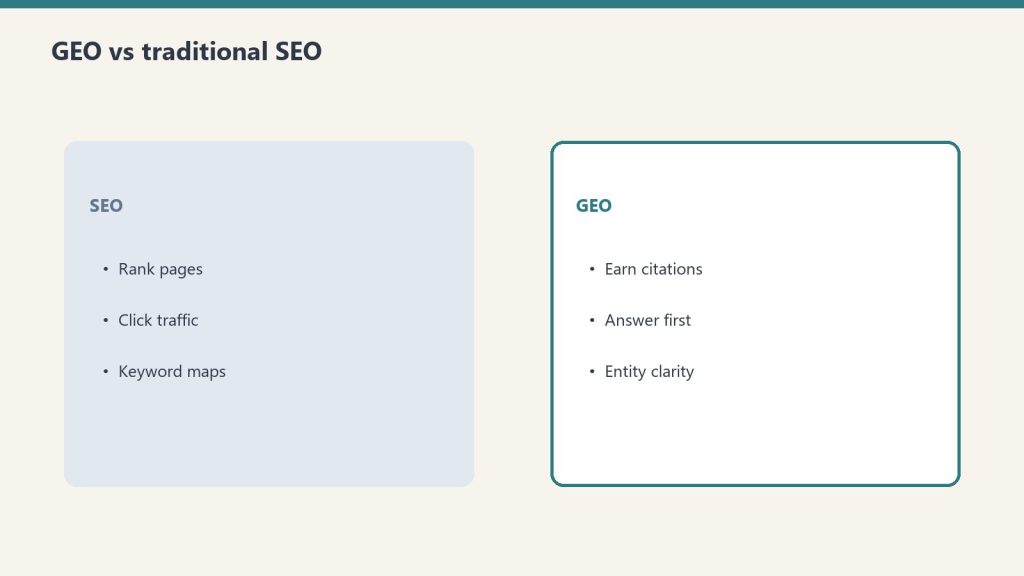
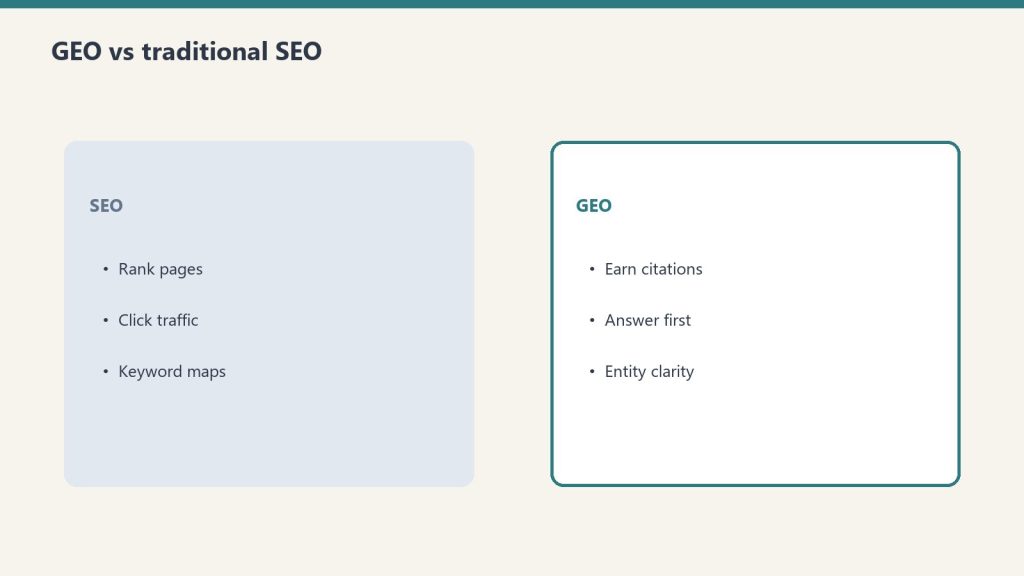
Traditional SEO optimizes for ranking and clicks on search engine results pages. Generative Engine Optimization (GEO) optimizes for citation, mention, and recommendation inside AI-generated answers from systems like ChatGPT, Claude, Perplexity, and Google AI Overviews. The overlap between top Google links and AI-cited sources has fallen from roughly 70% to under 20% as of 2026, meaning GEO is now a distinct discipline.
What is entity binding in the context of GEO?
Entity binding is the practice of making your brand resolvable as a stable, consistent entity across schema markup, Wikidata, third-party directories, and external profiles so that LLMs can confidently identify and cite you. It is the foundation underneath GEO tactics like statistics addition and source citation.
Do I need a Wikipedia article to be cited by AI systems?
No. A Wikidata item alone is sufficient for most B2B brands and independent publishers. Wikidata is consumed directly by Google’s Knowledge Graph and is one of the most reliable structured sources LLMs use during entity resolution. Wikipedia helps but is not required.
How long does entity binding take to show results in AI citations?
Most practitioners see Knowledge Panel appearance within 30–90 days of completing the four-surface stack. AI citation rate increases lag by an additional 30–60 days because LLM training and retrieval cycles update on slower cadences than search engine indexes.
What schema type should small publishers use?
Use Organization schema on your homepage and Person schema on your About page. If you publish frequently, add Article schema to individual posts and link the author Person back to the Organization. This three-way linkage gives LLMs the cleanest entity graph to resolve.
The Bottom Line
Entity binding is not a one-time setup task. It’s the underlying condition that makes every other GEO tactic work. Before you spend another month adding statistics and FAQ sections, audit your four surfaces, normalize your one-line description, and ship a clean Organization schema with a complete sameAs array. The publishers winning the citation game in 2026 are the ones whose entity resolution is so unambiguous that the LLM never has to hedge.
If you want to know whether generative engine optimization actually moves the needle, stop reading think pieces and look at what shipped. The case-study record from 2025 and early 2026 is now thick enough to draw practitioner conclusions: which interventions correlate with citation lift, how fast the curve bends, and what the conversion side of the funnel does once AI traffic shows up. This is a working teardown of the published case studies — what was done, what changed, and what the implementation pattern looks like underneath.
Case 1: B2B SaaS — 575 to 3,500 AI-referred trials in roughly seven weeks
GEO case teardown — B2B SaaS AI-referred trials.
A $30M+ ARR B2B SaaS company documented in Digital Agency Network’s GEO case study roundup moved from 575 AI-referred free trials per period to over 3,500 in about seven weeks. The intervention sequence was content restructuring for citability — clear one-sentence definitions at the top of each section, statistics and comparisons rendered as tables rather than buried in prose, and step-by-step frameworks that LLMs can extract verbatim. The first 40–60 words under every H2 carried the answer to that H2’s implicit question.
The implementation pattern under this win is what matters: the company did not write new articles. It rebuilt existing articles to surface the answer first. That is the cheapest possible GEO intervention — restructure, do not republish.
Case 2: B2B SaaS — citation rate from 8% to 12% in four weeks
Citation-rate lift case — four weeks.
Discovered Labs documented a B2B SaaS case where ChatGPT citation rate on tracked queries moved from 8% to 12% by week four of an engagement, with the company’s VP of Marketing noting they had been “invisible for 18 months despite solid SEO work.” The 50% relative lift came from the same restructuring pattern plus aggressive entity-binding — explicit company name, product name, and category definition repeated in citation-friendly positions throughout each asset.
The data point worth carrying: traditional SEO authority does not automatically translate to LLM citation. The two systems read pages differently, and the page-level rewrite is what closes the gap.
Case 3: CloudEagle — 33 pages optimized, 33% increase in AI citations
CloudEagle’s published GEO result, cited across multiple 2026 case study summaries including AlphaP’s real-world GEO examples, is one of the cleanest dose-response curves in the public record. Optimize 33 pages → 33% increase in AI citations. The ratio is suspicious as a coincidence but tells the practitioner the right thing: GEO is a per-page intervention, and aggregate lift scales roughly with how many pages you treat. There is no site-wide tag you can flip. Each asset gets its own restructure.
Case 4: HubSpot — template rebuild, not content rebuild
HubSpot — template rebuild, not content rebuild.
HubSpot’s internal AEO case study, summarized in HubSpot’s own AEO case study writeup, is the cleanest illustration of the structural fix. HubSpot already ranked for thousands of marketing queries — the volume was there. The barrier was that answers were buried multiple paragraphs deep, written in traditional long-form. The fix was a template rebuild: every article restructured so the first 40–60 words under each H2 or H3 directly answered the implicit question of that heading.
This is the playbook to copy. If your site has any existing traffic, restructuring beats writing new content. The audit question is: under every H2 on every page, do the first three sentences answer the question that H2 raises?
Case 5: Netpeak USA — 120% revenue lift, 693% AI traffic growth
Stackmatix’s AEO case study compilation documents Netpeak USA’s conversational ecommerce GEO campaign producing +120% revenue and +693% AI traffic growth. The mechanism: product and category pages restructured around buyer questions (“what is the best X for Y?”, “X vs Y comparison”, “how do I choose X?”) with direct, hedged answers up top and detailed reasoning below. The pattern works because AI search engines synthesize buying decisions from extractable answer fragments, and ecommerce pages historically bury the answer under marketing copy.
The structural pattern under every win
Read the five cases together and one implementation discipline emerges. Every published GEO win in the public record traces back to the same physical change to the page:
Answer first. The first 40–60 words under every H2 directly answer the question that heading raises. No setup, no transition paragraph, no scene-setting.
Tables over prose for comparison data. Articles with 15+ data points receive measurably more AI citations than those with fewer than five, per the research synthesized in Marketing LTB’s 2026 GEO statistics roundup. Tables make those data points extractable.
Entity binding. Company name, product name, and category definition explicitly stated in citation-friendly positions, not just implied through context.
Stepwise frameworks. Procedural content rendered as numbered steps that LLMs can extract verbatim into responses.
Citable sources inline. Authoritative external citations placed adjacent to claims, not banished to a references section at the bottom.
What the cases do not prove
The published record has selection bias the size of a building. Every case study you can read is a published win. The agencies and SaaS companies that ran a GEO campaign and got nothing are not writing blog posts about it. Read the cases for the structural patterns, not the percentage lifts — the lifts are a function of starting baseline, vertical, and how invisible the brand was before the intervention.
Two other limits worth naming. First, conversion-rate claims about AI-referred traffic (“converts at a higher rate than organic” appears in over half of marketer surveys per the 2026 HubSpot State of Marketing report) come from self-reporting, not third-party measurement. The directional point is probably right — qualified intent behind an LLM query — but the magnitude is unverifiable. Second, AI citation rates are measured against the agencies’ own tracked query sets. Those sets are chosen for relevance to the client, which means baseline visibility is artificially low. The 8% → 12% case is real; whether it generalizes to a random query set is unknown.
What to do tomorrow if you are starting from zero
Pick ten pages on your site that already rank in positions 4–15 for queries with commercial intent. Open each one. Under every H2, rewrite the first 40–60 words so they directly answer the question that heading raises. Convert any prose comparison into a table. State your company name, product category, and the specific problem you solve in the opening paragraph. Add a sources list with authoritative citations.
That is the intervention every published GEO case study reduces to. Ten pages, one week of writing work. The case study record suggests you will see citation movement in three to six weeks if the queries you care about already have AI Overview or LLM citation surface area at all. If they do not, the intervention is still right — you are positioning for when they do.
FAQ
How long until GEO interventions show measurable lift?
Published cases show citation movement at the four-week mark (the 8% → 12% B2B SaaS case) and traffic movement at six to eight weeks (the 575 → 3,500 trials case at roughly seven weeks). Three months is the standard window quoted in agency case studies for material citation rate change.
Does traditional SEO authority help GEO?
Partially. Pages that already hold featured snippets are disproportionately pulled into Google AI Overviews, per multiple 2026 AEO summaries. But the B2B SaaS case where the company was “invisible for 18 months despite solid SEO work” shows that authority alone does not produce citations — page-level structural changes are the missing ingredient.
How many pages do I need to optimize before I see results?
CloudEagle’s case (33 pages → 33% citation lift) suggests the dose-response is roughly linear at small scale. Most published case studies show meaningful aggregate movement starting around 10–30 pages restructured. Below that, you are testing the methodology rather than expecting measurable lift.
Is the citation rate lift actually translating to revenue?
The published evidence says yes for ecommerce (Netpeak USA’s +120% revenue) and trial-driven SaaS (the 575 → 3,500 trials case). For brand and consideration-stage content the answer is murkier — AI citations probably influence brand recall and assisted conversion, but the attribution chain to revenue is harder to draw cleanly and the case study record is thin on this slice.
What is the cheapest GEO intervention with the highest published return?
Restructuring existing pages that already rank. The HubSpot template rebuild and the 575 → 3,500 trials case both used this approach. No new content, no new authority work, no link building — just rewriting the first 40–60 words under every H2 and converting prose comparisons into tables.
Most GEO and AEO case studies you can find online are vendor-published and short on implementation detail. So instead of stacking another “look at this 300% lift” headline, this piece walks through five publicly documented results from 2026 — and pulls out the structural change that actually drove the win in each one. If you want to copy what works, copy the structure, not the percentage.
1) HubSpot: 3x lead conversion from AEO traffic
Case patterns: what actually worked in GEO/AEO.
HubSpot’s own 2026 State of Marketing reporting found 58% of marketers saying AI-referred visitors convert at higher rates than traditional organic, with HubSpot itself reporting roughly 3x better lead conversion from AEO sources versus other channels. The implementation pattern across HubSpot’s blog: question-led H2s, a 40–60 word direct answer in the first paragraph below the heading, then expanded context, then a structured FAQ block with FAQPage schema.
The before/after isn’t “more content.” It’s “the same content, restructured so the answer arrives in the first 60 words.” That single edit is what featured snippets and AI Overviews both reward.
Zero-click visibility lifts without chasing vanity traffic.
Hashmeta documented a 50% increase in zero-click visibility for an e-commerce client after a targeted AEO sprint. The lever: rebuilding product and category pages around explicit question intent (“what is the difference between X and Y,” “is X worth it for Z use case”) and adding HowTo and FAQPage schema. The page didn’t get more traffic from the same query — it started winning the answer position on related queries it wasn’t competing for before.
The takeaway for practitioners: zero-click visibility is its own funnel. Track it separately from sessions, because the value shows up in branded search lift two to four weeks later, not in same-day clicks.
3) SaaS brand: 20+ free-trial signups per month from ChatGPT citations
ChatGPT citations can create free-trial demand.
One SaaS case study circulating in the GEO community in early 2026 reported 20+ free-trial signups per month attributed directly to ChatGPT citations, identified via a unique UTM and a referral-source filter in their analytics. The structural pattern: a single canonical comparison page per top competitor, written as a third-person reference rather than first-person marketing, with a clear definition block, a structured comparison table, and a “when to choose X” section.
This is the format ChatGPT cites because it’s the format ChatGPT was trained to produce. Match the output shape and you become the source.
4) Generic brand study: 140% lift in AI-driven search traffic
A widely cited 2026 GEO case study reported a 140% increase in LLM and AI-driven search traffic alongside a 62% rise in AI mentions after a strategy that prioritized entity saturation, internal-link clustering, and structured data over keyword density. The implementation detail worth copying: a single hub page per entity with at least 15 distinct factual data points, then 8–12 supporting articles linking back to it with descriptive anchor text.
The 15-data-point threshold matches what GEO researchers have flagged repeatedly: articles with 15+ verifiable data points receive substantially more AI citations than articles with fewer than five.
5) Mangools: featured-snippet capture from a single edit
Mangools published a walkthrough showing how rewriting one blog post to lead with a 50-word direct answer captured a featured snippet for a head-term query, with the resulting traffic and brand exposure outpacing the rest of the content cluster. No new backlinks, no new content — just a structural rewrite of the first 100 words.
The pattern across all five
Every win has the same shape: question-led H2, 40–60 word direct answer, structured supporting content, schema markup. Here is the minimum viable AEO block, drop-in ready:
<h2>What is generative engine optimization?</h2>
<p><strong>Generative engine optimization (GEO) is the practice of structuring web content so AI systems like ChatGPT, Claude, Gemini, and Perplexity cite it as a source.</strong> Unlike SEO, which optimizes for ranking in a list of links, GEO optimizes for being included in a generated answer. The core levers are entity clarity, factual density, structured data, and crawlability via LLMs.txt and robots.txt.</p>

<script type="application/ld+json">
{
  "@context": "https://schema.org",
  "@type": "FAQPage",
  "mainEntity": [{
    "@type": "Question",
    "name": "What is generative engine optimization?",
    "acceptedAnswer": {
      "@type": "Answer",
      "text": "Generative engine optimization (GEO) is the practice of structuring web content so AI systems cite it as a source in generated answers."
    }
  }]
}
</script>
The measurement layer
None of these case studies mean anything without isolation. The minimum tracking stack: a referrer filter for chatgpt.com, perplexity.ai, claude.ai, gemini.google.com, and copilot.microsoft.com in GA4; a separate event for zero-click impressions from Google Search Console; and a manual citation log — query a representative model with your top 25 prompts weekly and record whether your domain is cited. The third one is what most teams skip, and it’s the only one that tells you whether GEO is working before traffic shows up.
What to copy this week
Pick your top five highest-intent pages. For each one, rewrite the first 100 words as a direct-answer block, add a single FAQPage schema with three questions, and add the page to your LLMs.txt manifest. That is the entire implementation. Every case study above is a variation on those three moves.