⚠️ آخر تحديث: 28 أبريل 2026 — المعلومات تتحقق منها يومياً، كل اللينكات للمصادر الرسمية.
آخر مرة العراق لعب في كأس العالم كانت عام 1986 في المكسيك. أربعين سنة. جيل كامل انتظر هذه اللحظة. والآن، في 2026، المنتخب العراقي رجع — وهذه الصفحة للمشجع العراقي الذي يحلم بأن يكون هناك.
مباريات العراق في كأس العالم 2026
🇮🇶 العراق ضد النرويج — الثلاثاء 16 يونيو — Gillette Stadium، بوسطن (فوكسبورو)
🇮🇶 فرنسا ضد العراق — الاثنين 22 يونيو — Lincoln Financial Field، فيلادلفيا
🇮🇶 العراق ضد السنغال — الخميس 26 يونيو — NRG Stadium، هيوستن
⚽ المجموعة I — مع فرنسا والنرويج والسنغال
العراق لا يلعب في سياتل — بس سياتل تستاهل الزيارة
مباريات العراق في بوسطن وفيلادلفيا وهيوستن. لكن إذا كنت تخطط لرحلة طويلة تشمل أكثر من مباراة، سياتل — على الساحل الغربي — تستحق زيارة في إطار رحلتك الأمريكية الكبيرة.
التأشيرة للمواطنين العراقيين — أهم خطوة
العراقيون بحاجة لتأشيرة B1/B2 لدخول أمريكا. العراق ليس على قائمة الحظر ولا على برنامج الضمان — يعني يمكن التقديم على التأشيرة بشكل عادي.
الجالية العراقية في أمريكا كبيرة ومنتشرة في مدن عدة — ديترويت وميشيغان لديهم أكبر جالية عراقية في أمريكا، وكذلك شيكاغو وهيوستن وكاليفورنيا. إذا لديك أقارب أو أصدقاء في أمريكا، التواصل معهم يمكن أن يسهل رحلتك كثيراً.
البكاء المسموح به — أربعون عاماً
لا تحتاج لأسباب كثيرة. أربعون سنة غياب. كل من يرتدي القميص الأحمر في الملعب يحمل هذا الثقل. هذا الكأس ليس فقط عن الكرة — هو عن الانتماء وعودة الهوية إلى الملعب الأكبر في العالم.
⚠️ آخر تحديث: 28 أبريل 2026 — المعلومات دي بتتغير. كل المعلومات الجوهرية فيها لينك للمصدر الرسمي. اتحقق دايماً من المصدر قبل ما تعمل أي حاجة.
مصر بتلعب في سياتل مرتين في كأس العالم 2026 — 15 يونيو ضد بلجيكا، و26 يونيو ضد إيران. لو عندك تذكرة وعاوز تكون هناك، الخبر الكويس إن المصريين مش محظور عليهم السفر لأمريكا ومش عليهم برنامج ضمان التأشيرة. الطريق صعب بس ممكن — والصفحة دي هتوضه خطوة بخطوة.
الخلاصة: المصريين محتاجين تأشيرة B1/B2 لدخول أمريكا. مفيش حظر سفر على مصر. مفيش برنامج ضمان. اعمل FIFA PASS فوراً عشان تاخد موعد أولوية في السفارة — المواعيد بتخلص.
هل المصريين ممنوعين من دخول أمريكا؟
لأ. مصر مش ضمن الدول المحظورة، ومش ضمن الدول اللي عليها برنامج ضمان التأشيرة (Visa Bond Program). المصريين بيقدروا يقدموا على تأشيرة B1/B2 عادي.
اللي عليك تعرفه: مصر مش ضمن برنامج الإعفاء من التأشيرة (Visa Waiver Program)، يعني لازم تاخد تأشيرة. بس التأشيرة دي ممكنة — ومع FIFA PASS ممكن تاخد موعد أسرع.
إيه هو FIFA PASS وازاي يساعدك؟
الـ FIFA PASS هو برنامج رسمي من وزارة الخارجية الأمريكية بيدي لحاملي تذاكر كأس العالم 2026 أولوية في مواعيد مقابلة التأشيرة. يعني بدل ما تستنى شهور، ممكن تاخد موعد أسرع بكتير.
مهم جداً: الـ FIFA PASS مش ضمان إن التأشيرة هتتوافق. هو بس بيسرع موعد المقابلة. القرار النهائي للمسؤول القنصلي.
الخطوات بالتفصيل
الخطوة 1: تأكد إن عندك تذكرة رسمية لكأس العالم
لازم يكون عندك تذكرة رسمية من موقع FIFA. رقم مرجع التذكرة ده اللي هتحتاجه للـ FIFA PASS. لو مش عندك تذكرة لسه، روح على الموقع الرسمي لكأس العالم FIFA 2026 وابحث عن التذاكر المتاحة.
If you’ve optimized content for Google and still can’t get AI systems to cite you, you’re running the wrong playbook. GEO — Generative Engine Optimization — is the discipline of making your content visible, credible, and citable to AI engines like ChatGPT, Claude, Perplexity, Gemini, and Google’s AI Overviews. It is not SEO with a new name. It is a different game with different rules.
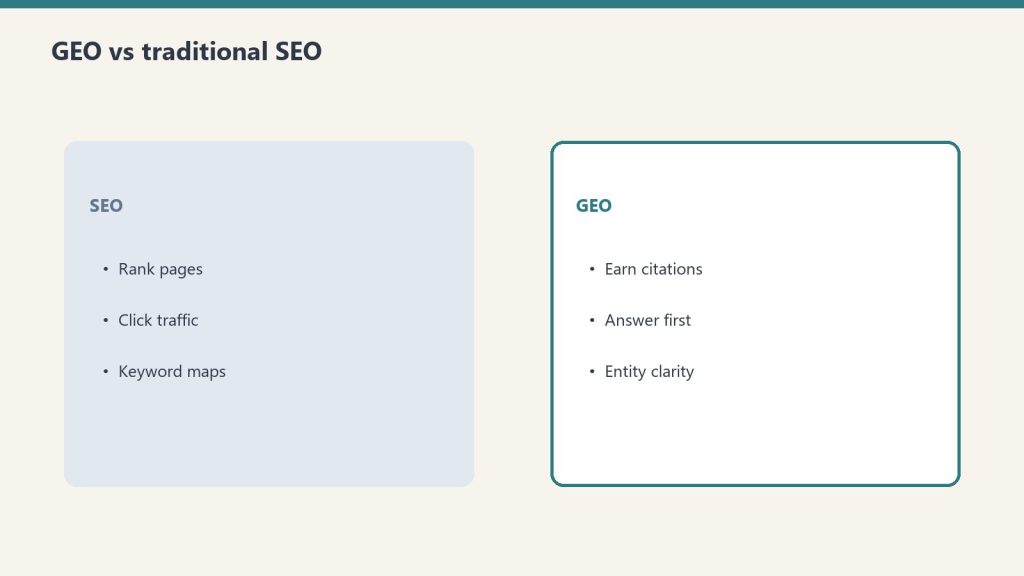
Definition: Generative Engine Optimization (GEO) is the practice of structuring content so that large language models and AI search engines select it as a source when generating responses to user queries. Where SEO earns rankings, GEO earns citations.
Why GEO Is Not SEO
Why GEO is not SEO.
SEO is about ranking. You optimize a page so Google’s algorithm surfaces it when someone searches. The goal is a click. GEO is about being quoted. You structure content so an AI system trusts it enough to pull a fact, a definition, or an explanation from it when synthesizing a response. The user may never click your URL — but your content shaped what they read.
The mechanisms are fundamentally different. Google’s ranking algorithm weighs hundreds of signals — backlinks, page speed, user behavior, authority. AI citation selection weights entity density, factual specificity, source credibility signals, and structural clarity. A page that ranks #1 on Google may get zero AI citations. A page that ranks #8 may be the one Perplexity quotes every time someone asks about that topic.
How AI Engines Select Content to Cite
How AI engines select content to cite.
Large language models used in AI search (GPT-4, Claude, Gemini) were trained on large corpora of text, but the retrieval-augmented generation (RAG) layer that powers tools like Perplexity, ChatGPT search, and Google AI Overviews works differently. It pulls live content at query time, scores it for relevance and credibility, and synthesizes a response. The signals it uses to score your content include:
Entity clarity — Are the people, places, companies, and concepts in your content clearly named and linked to known entities?
Factual density — Does your content contain specific, verifiable claims rather than vague generalities?
Structural legibility — Can the AI parse your content’s structure — headings, definitions, lists — without ambiguity?
Source signals — Does your content cite primary sources, studies, or named experts?
Speakable schema — Have you marked up key paragraphs as machine-readable answer candidates?
The Three Layers of GEO
Three layers of GEO — structure, entity, proof.
Layer 1: Content Architecture
GEO-optimized content is built for extraction, not just reading. That means every major claim is in a standalone sentence. Definitions appear near the top. Section headers are declarative, not clever. The structure tells an AI where the answer is before it has to read the full article.
Layer 2: Entity Saturation
AI systems understand content through entities — named people, organizations, places, products, and concepts that exist in their training data. A GEO-optimized article saturates relevant entities: it doesn’t say “a major AI company” when it means Anthropic. It doesn’t say “a popular search tool” when it means Perplexity. Every entity is named, spelled correctly, and used in the right context.
Layer 3: Schema and Structured Data
JSON-LD schema markup is a signal to both traditional search engines and AI crawlers. FAQPage schema makes your Q&A content directly extractable. Speakable schema flags the paragraphs most useful for voice and AI synthesis. Article schema establishes authorship and publication date. These are not optional extras — they are the machine-readable layer that gets your content selected.
GEO vs AEO: What’s the Difference?
Answer Engine Optimization (AEO) focuses on winning featured snippets, People Also Ask boxes, and zero-click search results in traditional search engines. GEO focuses on being cited by generative AI systems. The tactics overlap — both require clear structure, direct answers, and FAQ sections — but the targets are different. AEO wins position zero on Google. GEO wins the paragraph that Perplexity writes for the next million queries on your topic.
At Tygart Media, we run both in parallel. The content pipeline produces articles that pass the AEO gate (featured snippet structure, FAQ schema) and the GEO gate (entity density, speakable markup, citation-worthy claims) before publishing.
What GEO Looks Like in Practice
Here is the difference between a standard paragraph and a GEO-optimized version of the same content:
Standard: “Water damage restoration is an important service for homeowners who have experienced flooding or leaks.”
GEO-optimized: “Water damage restoration — the professional remediation of structural damage caused by flooding, pipe failure, or storm intrusion — is performed by IICRC-certified contractors following the S500 Standard for Professional Water Damage Restoration. The process includes water extraction, structural drying, moisture monitoring, and antimicrobial treatment.”
The second version names the certifying body (IICRC), the standard (S500), and the process steps. An AI system can extract that paragraph as a factual, citable answer. The first version has nothing to extract.
How to Start with GEO
If you’re running an existing content operation and want to layer in GEO, the priority order is:
Audit your top 20 pages for entity gaps — everywhere you use vague references, replace with specific named entities
Add speakable schema to your three strongest definitional paragraphs per page
Run a factual density check — every statistic should have a source, every claim should be specific
Add FAQPage schema to any page with question-format headings
Submit your top pages to Google’s Rich Results Test and verify structured data is reading cleanly
GEO Is Compounding Infrastructure
The reason GEO matters for content operations is compounding. Once an AI system has indexed and trusted your content as a reliable source on a topic, subsequent queries on that topic draw from your content repeatedly — without you publishing anything new. A single GEO-optimized pillar article can generate thousands of AI citations over 12 months. That is a different kind of ROI than a ranked page that gets clicked and forgotten.
We built the Tygart Media content stack around this principle. Every article that leaves our pipeline passes a GEO gate before it publishes. That gate checks entity saturation, factual specificity, schema completeness, and structural legibility. It is the same gate we build for clients.
Frequently Asked Questions About GEO
What does GEO stand for?
GEO stands for Generative Engine Optimization — the practice of optimizing content to be cited by AI-powered search systems and large language models.
Is GEO the same as SEO?
No. SEO (Search Engine Optimization) targets traditional search rankings. GEO targets AI citation in tools like ChatGPT, Perplexity, Claude, and Google AI Overviews. The tactics overlap but the mechanisms and goals are different.
How do I know if my content is being cited by AI?
Run queries related to your topic in Perplexity, ChatGPT (with search enabled), and Google AI Overviews. Check whether your domain appears as a cited source. Tools like Profound and Otterly.ai can automate this monitoring.
Does GEO replace AEO?
No. AEO and GEO are complementary. AEO wins traditional search features like featured snippets. GEO wins AI citations. A mature content strategy runs both in parallel.
How long does GEO take to show results?
Unlike SEO, GEO results can appear quickly — sometimes within days of a page being indexed by AI crawlers. The compounding effect builds over 60–180 days as AI systems repeatedly select your content for related queries.
Conseguir las entradas fue el primer paso. Entrar a Estados Unidos es el segundo — y para millones de aficionados internacionales que planean asistir al Mundial FIFA 2026, los requisitos de visa son la pregunta más urgente y menos explicada. Esta guía desglosa qué necesita cada país, cómo funciona el FIFA PASS, qué países enfrentan restricciones especiales y cómo tramitar todo antes de que los plazos te tomen por sorpresa.
Lo más importante primero: El FIFA PASS es un programa real del Departamento de Estado de EE. UU. que ofrece citas prioritarias de visa B1/B2 para poseedores de entradas del Mundial FIFA 2026. Si necesitas visa B1/B2, debes solicitar el FIFA PASS inmediatamente — las citas se agotan meses antes de los partidos. El FIFA PASS no garantiza la visa; agiliza la cita de entrevista.
¿Necesitas visa para entrar a Estados Unidos al Mundial?
Depende de tu país. Hay tres categorías principales:
Categoría 1: Programa de Exención de Visa (VWP / ESTA)
Los ciudadanos de 42 países pueden ingresar a EE. UU. sin visa mediante el Sistema Electrónico de Autorización de Viaje (ESTA). Incluyen: Alemania, Australia, Austria, Bélgica, Chile, Corea del Sur, España, Francia, Irlanda, Italia, Japón, Nueva Zelanda, Países Bajos, Portugal, Reino Unido, Suiza y otros.
Si tu país está en el VWP, necesitas solicitar ESTA en línea en travel.state.gov antes de viajar. El costo es de 21 dólares. La aprobación generalmente llega en 72 horas o menos, pero se recomienda solicitarla con al menos dos semanas de anticipación. El ESTA es válido por dos años o hasta que expire tu pasaporte.
Importante: ESTA no es una visa. Si has viajado a Irán, Iraq, Libia, Corea del Norte, Somalia, Sudán, Siria o Yemen después de marzo de 2011, puede que no seas elegible para ESTA y necesites una visa B1/B2 regular incluso si tu país está en el VWP.
Categoría 2: Visa B1/B2 con FIFA PASS
Los ciudadanos de países no incluidos en el VWP — incluyendo México, Brasil, Argentina, Colombia, Ecuador, Egipto, Arabia Saudita, Marruecos, Turquía, Bosnia y Herzegovina, y muchos otros países clasificados para el Mundial — necesitan una visa de turista B1/B2.
El proceso estándar de visa B1/B2 puede tardar semanas o meses en función del país y la embajada. El FIFA PASS acelera esto:
Obtén tu entrada oficial del Mundial FIFA 2026 (el número de referencia de la entrada es necesario)
Regístrate en el sistema FIFA PASS a través del portal del Departamento de Estado de EE. UU.
Recibirás acceso a citas de entrevista de visa prioritarias en la embajada o consulado estadounidense más cercano
Completa el Formulario DS-160 (solicitud de visa en línea) antes de tu cita
Paga la tarifa de solicitud de visa (actualmente 185 dólares para B1/B2)
Asiste a tu entrevista en el consulado con todos los documentos requeridos
El FIFA PASS no garantiza la aprobación de la visa. Simplemente prioriza tu cita. La decisión final la toma el oficial consular basándose en tu solicitud individual.
Categoría 3: Países con Restricciones Especiales
Algunos países clasificados para el Mundial enfrentan restricciones de viaje adicionales que complican o impiden el acceso a EE. UU.:
Irán: Irán está en la lista de suspensión de visas de EE. UU. Los nacionales iraníes (con pasaporte iraní) no son elegibles para visas de turista B1/B2 en circunstancias normales. Los jugadores de la selección iraní están exentos bajo disposiciones especiales. Los aficionados con pasaporte iraní que ya tienen visa válida para EE. UU. pueden ingresar; quienes no la tienen enfrentan obstáculos significativos. Los iraní-americanos y ciudadanos iraníes con doble nacionalidad deben consultar con un abogado de inmigración sobre su situación específica.
Programa de Fianza de Visa (2026): A partir de abril de 2026, ciertos países son objeto del Programa de Fianza de Visa de B1/B2, que requiere que los solicitantes demuestren vínculos financieros con su país de origen como condición para la aprobación de la visa. Los países afectados incluyen algunos de los clasificados para el Mundial. Consulta travel.state.gov para la lista actualizada.
Haití: Haití clasificó para el Mundial pero enfrenta restricciones de visa severas. Los nacionales haitianos deben buscar asesoría legal de inmigración antes de solicitar.
Cronograma: Cuándo Tramitar tu Visa
Los partidos del Mundial FIFA 2026 en Seattle (Lumen Field) se juegan entre el 15 de junio y el 6 de julio de 2026. Los plazos para solicitar visa son:
ESTA: Puede solicitarse en cualquier momento antes de viajar. Recomendado: mínimo 2 semanas antes.
B1/B2 con FIFA PASS: Solicita el FIFA PASS tan pronto como tengas tu entrada confirmada. Las citas de entrevista ya están limitadas para los partidos de junio-julio 2026. No esperes.
B1/B2 sin FIFA PASS: El tiempo de procesamiento varía enormemente por país. En algunos países, el tiempo de espera para citas es de 3 a 12 meses. Si no has solicitado aún, es posible que sea demasiado tarde para algunos partidos. Verifica los tiempos de espera en travel.state.gov/content/travel/en/us-visas/visa-information-resources/wait-times.html
Cruzar la Frontera Canada-EE. UU. durante el Mundial
Vancouver, Colombia Británica (Canadá) también es sede del Mundial FIFA 2026. Muchos aficionados planean asistir a partidos en ambas ciudades. Esto requiere cruzar la frontera internacional, lo que implica documentos adicionales:
Para entrar a Canadá: Los ciudadanos de la mayoría de los países necesitan una Autorización de Viaje Electrónica (eTA) canadiense o una visa de visitante. La eTA cuesta 7 dólares canadienses y generalmente se aprueba en minutos. Es diferente del ESTA de EE. UU. y debe solicitarse por separado.
Para volver a EE. UU.: Necesitas los mismos documentos que usaste para ingresar la primera vez (ESTA o visa B1/B2 válida). Los cruces fronterizos por tierra en I-5 y I-15 pueden tener esperas largas en días de partido.
Tarjeta NEXUS: Para quienes planean cruces fronterizos frecuentes, la tarjeta NEXUS acelera el proceso en puestos fronterizos designados.
Documentos que Debes Llevar a los Partidos
Además de tu visa o ESTA aprobada, ten estos documentos disponibles:
Pasaporte válido (debe tener validez de al menos 6 meses después de tu fecha de salida de EE. UU.)
Entrada del Mundial FIFA 2026 (impresa o en la app oficial de FIFA)
Comprobante de alojamiento (reserva de hotel, Airbnb, etc.)
Comprobante de fondos suficientes para tu estadía
Boleto de regreso o prueba de salida de EE. UU.
Recursos Oficiales
ESTA: esta.cbp.dhs.gov
Formulario DS-160 (solicitud de visa B1/B2): ceac.state.gov
Tiempos de espera de visa por país: travel.state.gov/content/travel/en/us-visas/visa-information-resources/wait-times.html
Información oficial del FIFA PASS: fifa.com/en/tournament/world-cup-2026
eTA canadiense: canada.ca/en/immigration-refugees-citizenship/services/visit-canada/eta.html
Preguntas frecuentes sobre visa para el Mundial FIFA 2026
¿Qué es el FIFA PASS?
El FIFA PASS es un sistema de citas prioritarias de visa respaldado por el Departamento de Estado de EE. UU. que permite a los poseedores de entradas del Mundial FIFA 2026 obtener citas de entrevista de visa B1/B2 aceleradas. No garantiza la aprobación de la visa.
¿Necesito visa si soy de México para el Mundial FIFA 2026?
Sí. México no está en el Programa de Exención de Visa de EE. UU. Los ciudadanos mexicanos necesitan una visa B1/B2 para ingresar a EE. UU. Se recomienda encarecidamente solicitar el FIFA PASS tan pronto como tengas tu entrada confirmada.
¿Necesita visa un ciudadano argentino para el Mundial FIFA 2026 en EE. UU.?
Sí. Argentina no está en el VWP. Los ciudadanos argentinos necesitan visa B1/B2 o deben solicitar el FIFA PASS para obtener una cita de entrevista prioritaria.
¿Los aficionados de Bélgica necesitan visa para el Mundial en Seattle?
No. Bélgica está en el Programa de Exención de Visa. Los ciudadanos belgas solo necesitan ESTA, que se solicita en línea antes de viajar.
¿Qué pasa si mi visa B1/B2 es rechazada?
El rechazo de visa no es definitivo. Puedes volver a solicitarla con documentación adicional que demuestre lazos con tu país de origen. Un abogado de inmigración puede ayudarte con la nueva solicitud. Las entradas del Mundial generalmente son reembolsables si no puedes asistir por motivos de visa.
Conseguir os ingressos foi o primeiro passo. Entrar nos Estados Unidos é o segundo — e para milhões de torcedores internacionais que planejam assistir à Copa do Mundo FIFA 2026, os requisitos de visto são a pergunta mais urgente e menos explicada. Este guia detalha o que cada país precisa, como funciona o FIFA PASS, quais países enfrentam restrições especiais e como tratar de tudo isso antes que os prazos cheguem.
O mais importante primeiro: O FIFA PASS é um programa real do Departamento de Estado dos EUA que oferece agendamentos prioritários de visto B1/B2 para detentores de ingressos da Copa do Mundo FIFA 2026. Se você precisa de visto B1/B2, deve solicitar o FIFA PASS imediatamente — as vagas de agendamento se esgotam meses antes das partidas. O FIFA PASS não garante o visto; ele agiliza o agendamento da entrevista.
Você precisa de visto para entrar nos EUA para a Copa?
Depende do seu país. Há três categorias principais:
Categoria 1: Programa de Isenção de Visto (VWP / ESTA)
Cidadãos de 42 países podem entrar nos EUA sem visto pelo Sistema Eletrônico de Autorização de Viagem (ESTA). Incluem: Alemanha, Austrália, Áustria, Bélgica, Chile, Coreia do Sul, Espanha, França, Irlanda, Itália, Japão, Nova Zelândia, Países Baixos, Portugal, Reino Unido, Suíça e outros.
Se o seu país está no VWP, você precisa solicitar o ESTA online em travel.state.gov antes de viajar. O custo é de US$ 21. A aprovação geralmente chega em 72 horas ou menos, mas recomenda-se solicitar com pelo menos duas semanas de antecedência. O ESTA é válido por dois anos ou até o vencimento do passaporte.
Importante: O ESTA não é um visto. Se você viajou ao Irã, Iraque, Líbia, Coreia do Norte, Somália, Sudão, Síria ou Iêmen após março de 2011, pode não ser elegível para o ESTA e precisará de um visto B1/B2 regular mesmo que seu país esteja no VWP.
Categoria 2: Visto B1/B2 com FIFA PASS
Cidadãos de países não incluídos no VWP — incluindo Brasil, Argentina, Colômbia, Equador, Egito, Arábia Saudita, Marrocos, Turquia, Bósnia e Herzegovina, e muitos outros países classificados para a Copa — precisam de visto de turista B1/B2.
O processo padrão de visto B1/B2 pode levar semanas ou meses dependendo do país e do consulado. O FIFA PASS acelera isso:
Obtenha seu ingresso oficial da Copa do Mundo FIFA 2026 (o número de referência do ingresso é necessário)
Registre-se no sistema FIFA PASS pelo portal do Departamento de Estado dos EUA
Você receberá acesso a agendamentos prioritários de entrevista de visto no consulado americano mais próximo
Preencha o Formulário DS-160 (solicitação de visto online) antes da sua entrevista
Pague a taxa de solicitação de visto (atualmente US$ 185 para B1/B2)
Compareça à entrevista no consulado com todos os documentos necessários
O FIFA PASS não garante a aprovação do visto. Ele apenas prioriza o seu agendamento. A decisão final cabe ao oficial consular com base na sua solicitação individual.
O Brasil precisa de visto para a Copa do Mundo 2026 nos EUA?
Sim. O Brasil não participa do Programa de Isenção de Visto dos EUA. Cidadãos brasileiros precisam de visto B1/B2 para entrar nos EUA. Recomenda-se fortemente solicitar o FIFA PASS assim que tiver o ingresso confirmado. Os prazos são curtos — não espere.
Cronograma: Quando Tratar do Visto
As partidas da Copa do Mundo FIFA 2026 em Seattle (Lumen Field) acontecem entre 15 de junho e 6 de julho de 2026. Os prazos para solicitar visto são:
ESTA: Pode ser solicitado a qualquer momento antes de viajar. Recomendado: mínimo 2 semanas antes.
B1/B2 com FIFA PASS: Solicite o FIFA PASS assim que tiver o ingresso confirmado. Os agendamentos de entrevista já estão limitados para as partidas de junho-julho de 2026. Não espere.
B1/B2 sem FIFA PASS: O tempo de processamento varia muito por país. Em alguns países, o tempo de espera para agendamentos é de 3 a 12 meses. Se você ainda não solicitou, pode ser tarde demais para algumas partidas. Verifique os tempos de espera em travel.state.gov
Cruzando a Fronteira Canadá-EUA durante a Copa
Vancouver, Colúmbia Britânica (Canadá), também é sede da Copa do Mundo FIFA 2026. Muitos torcedores planejam assistir a partidas em ambas as cidades. Isso exige cruzar a fronteira internacional, o que implica documentos adicionais:
Para entrar no Canadá: Cidadãos da maioria dos países precisam de uma Autorização Eletrônica de Viagem (eTA) canadense ou visto de visitante. A eTA custa CA$ 7 e geralmente é aprovada em minutos. É diferente do ESTA americano e deve ser solicitada separadamente.
Para retornar aos EUA: Você precisará dos mesmos documentos que usou para entrar na primeira vez (ESTA ou visto B1/B2 válido).
Documentos que Você Deve Levar aos Jogos
Passaporte válido (deve ter validade de pelo menos 6 meses após sua data de saída dos EUA)
Ingresso da Copa do Mundo FIFA 2026 (impresso ou no aplicativo oficial da FIFA)
Comprovante de hospedagem
Comprovante de recursos financeiros suficientes para a estadia
Passagem de retorno ou comprovante de saída dos EUA
Recursos Oficiais
ESTA: esta.cbp.dhs.gov
Formulário DS-160: ceac.state.gov
Tempos de espera de visto por país: travel.state.gov/content/travel/en/us-visas/visa-information-resources/wait-times.html
eTA canadense: canada.ca/en/immigration-refugees-citizenship/services/visit-canada/eta.html
Perguntas frequentes sobre visto para a Copa do Mundo FIFA 2026
O que é o FIFA PASS?
O FIFA PASS é um sistema de agendamentos prioritários de visto apoiado pelo Departamento de Estado dos EUA que permite aos detentores de ingressos da Copa do Mundo FIFA 2026 obter agendamentos de entrevista de visto B1/B2 acelerados. Não garante a aprovação do visto.
O Brasil precisa de visto para a Copa do Mundo 2026?
Sim. O Brasil não está no Programa de Isenção de Visto dos EUA. Cidadãos brasileiros precisam de visto B1/B2. Solicite o FIFA PASS assim que tiver o ingresso confirmado para garantir o agendamento prioritário.
Cidadãos belgas precisam de visto para a Copa em Seattle?
Não. A Bélgica está no Programa de Isenção de Visto. Cidadãos belgas precisam apenas do ESTA, solicitado online.
O que acontece se meu visto B1/B2 for negado?
A negação de visto não é definitiva. Você pode solicitar novamente com documentação adicional comprovando vínculos com seu país de origem. Um advogado de imigração pode ajudá-lo com a nova solicitação.
Getting tickets was step one. Getting into the United States is step two — and for millions of international fans planning to attend FIFA World Cup 2026, visa requirements are the most urgent and least-explained question in the room. This guide breaks down what each country needs, how the FIFA PASS works, which countries face special restrictions, and how to get everything processed before the deadlines catch you off guard.
The most important thing first: The FIFA PASS is a real U.S. Department of State program offering priority B1/B2 visa appointment slots for FIFA World Cup 2026 ticket holders. If you need a B1/B2 visa, apply for the FIFA PASS immediately — appointment slots are filling months before the matches. The FIFA PASS does not guarantee a visa; it expedites the interview appointment.
Do You Need a Visa to Enter the United States for the World Cup?
It depends on your country. There are three main categories:
Category 1: Visa Waiver Program (VWP / ESTA)
Citizens of 42 countries can enter the U.S. without a visa using the Electronic System for Travel Authorization (ESTA). These include: Australia, Austria, Belgium, Chile, France, Germany, Ireland, Italy, Japan, Netherlands, New Zealand, Portugal, South Korea, Spain, Switzerland, United Kingdom, and others.
If your country is in the VWP, you need to apply for ESTA online at travel.state.gov before traveling. The cost is $21. Approval typically comes within 72 hours, but applying at least two weeks in advance is recommended. ESTA is valid for two years or until your passport expires.
Important: ESTA is not a visa. If you have traveled to Iran, Iraq, Libya, North Korea, Somalia, Sudan, Syria, or Yemen after March 2011, you may not be eligible for ESTA and will need a regular B1/B2 visa even if your country participates in the VWP.
Category 2: B1/B2 Visa with FIFA PASS
Citizens of countries not in the VWP — including Mexico, Brazil, Argentina, Colombia, Ecuador, Egypt, Saudi Arabia, Morocco, Turkey, Bosnia and Herzegovina, and many other World Cup-qualified nations — need a B1/B2 tourist visa.
The standard B1/B2 visa process can take weeks or months depending on country and embassy. The FIFA PASS accelerates this:
Obtain your official FIFA World Cup 2026 ticket (the ticket reference number is required)
Register for the FIFA PASS through the U.S. Department of State portal
You will receive access to priority visa interview appointments at the nearest U.S. embassy or consulate
Complete Form DS-160 (the online visa application) before your appointment
Pay the visa application fee (currently $185 for B1/B2)
Attend your consulate interview with all required documents
The FIFA PASS does not guarantee visa approval. It only prioritizes your appointment slot. The final decision rests with the consular officer based on your individual application.
Category 3: Countries with Special Travel Restrictions
Some World Cup-qualified countries face additional U.S. travel restrictions that complicate or prevent access:
Iran: Iran is on the U.S. visa suspension list. Iranian nationals (traveling on Iranian passports) are generally not eligible for B1/B2 tourist visas. Iranian national team players are exempt under special provisions. Fans with Iranian passports who already hold valid U.S. visas may enter; those without face significant obstacles. Iranian-Americans and Iranian citizens with dual nationality should consult an immigration attorney about their specific situation.
Visa Bond Program (2026): As of April 2026, certain countries are subject to the B1/B2 Visa Bond Program, which requires visa applicants to demonstrate financial ties to their home country as a condition of visa approval. Some World Cup-qualified nations are affected. Check travel.state.gov for the current list.
Haiti: Haiti qualified for the World Cup but faces severe visa restrictions. Haitian nationals should seek immigration legal advice before applying.
Timeline: When to Apply for Your Visa
FIFA World Cup 2026 matches in Seattle (Lumen Field) run from June 15 through July 6, 2026. Visa application deadlines:
ESTA: Can be applied for at any time before travel. Recommended: at least 2 weeks before departure.
B1/B2 with FIFA PASS: Apply for the FIFA PASS as soon as you have a confirmed ticket. Interview appointment slots for the June–July 2026 matches are already limited. Do not wait.
B1/B2 without FIFA PASS: Processing times vary dramatically by country. In some countries, appointment wait times are 3–12 months. If you haven’t applied yet, it may already be too late for some matches. Check wait times at travel.state.gov/content/travel/en/us-visas/visa-information-resources/wait-times.html
Crossing the U.S.–Canada Border During the World Cup
Vancouver, British Columbia (Canada) is also a FIFA World Cup 2026 host city. Many fans plan to attend matches in both cities — particularly Group G fans whose teams play in both Seattle and Vancouver. This requires crossing an international border:
To enter Canada: Citizens of most countries need a Canadian Electronic Travel Authorization (eTA) or visitor visa. The eTA costs CA$7 and is typically approved within minutes. It is separate from the U.S. ESTA and must be applied for independently at ircc.canada.ca.
To re-enter the U.S.: You will need the same documents you used to enter the first time — a valid ESTA or B1/B2 visa. Land border crossings on I-5 and I-15 can have long wait times on match days.
NEXUS Card: For travelers planning multiple border crossings, the NEXUS card expedites processing at designated border crossings between the U.S. and Canada.
Country-by-Country Quick Reference
The following covers the World Cup 2026 qualified nations playing matches in Seattle (Lumen Field):
Belgium — VWP member. Need ESTA only. No visa required.
Egypt — B1/B2 visa required. Apply for FIFA PASS immediately. Egypt is not on the travel ban list.
USA — No entry requirements for U.S. citizens.
Australia — VWP member. Need ESTA only. No visa required.
Bosnia and Herzegovina — B1/B2 visa required. Apply for FIFA PASS. Bosnia is not on the travel ban list.
Qatar — B1/B2 visa required. Apply for FIFA PASS. Qatar is not on the travel ban list.
Iran — Severely restricted. Iranian passport holders are generally not eligible for B1/B2 visas. Consult an immigration attorney.
New Zealand — VWP member. Need ESTA only. No visa required.
Documents to Bring to Matches
In addition to your approved visa or ESTA, have these documents available:
Valid passport (must have at least 6 months validity past your U.S. departure date)
FIFA World Cup 2026 ticket (printed or in the official FIFA app)
Proof of accommodation (hotel reservation, Airbnb, etc.)
Proof of sufficient funds for your stay
Return ticket or proof of departure from the U.S.
Official Resources
ESTA application: esta.cbp.dhs.gov
DS-160 (B1/B2 visa application): ceac.state.gov
Visa wait times by country: travel.state.gov/content/travel/en/us-visas/visa-information-resources/wait-times.html
Canadian eTA: canada.ca/en/immigration-refugees-citizenship/services/visit-canada/eta.html
Frequently Asked Questions
What is the FIFA PASS for World Cup 2026 visas?
The FIFA PASS is a U.S. Department of State program that provides priority B1/B2 visa interview appointments to FIFA World Cup 2026 ticket holders. It does not guarantee visa approval — it expedites the interview scheduling process.
Do Mexican fans need a visa for the FIFA World Cup 2026?
Yes. Mexico is not in the U.S. Visa Waiver Program. Mexican citizens need a B1/B2 visa to enter the United States. Applying through the FIFA PASS as soon as tickets are confirmed is strongly recommended.
Do Brazilian fans need a visa for FIFA World Cup 2026?
Yes. Brazil is not in the VWP. Brazilian citizens need a B1/B2 visa. Apply for the FIFA PASS immediately — Brazilian consular appointment wait times are typically long.
Do Belgian fans need a visa for the World Cup in Seattle?
No. Belgium is in the Visa Waiver Program. Belgian citizens need only ESTA, applied for online at esta.cbp.dhs.gov.
Can Iranian fans attend the Egypt vs Iran match in Seattle on June 26?
This is one of the most complex visa situations of the entire tournament. Iranian nationals traveling on Iranian passports are generally not eligible for U.S. B1/B2 visas under current restrictions. Iranian-Americans with U.S. passports may attend as normal. Dual nationals and those with existing valid U.S. visas should consult an immigration attorney. The situation may evolve — check travel.state.gov for the most current information.
How long does a B1/B2 visa take to process for World Cup 2026?
Processing times vary dramatically by country. The FIFA PASS provides priority appointments, which can reduce wait times significantly. Without the FIFA PASS, wait times in some countries are 6–12 months. The FIFA PASS is the fastest path for most fans needing B1/B2 visas.
Direct answer: On a commercial specialty loss, the room is bigger than most restoration operators assume. The carrier has a staff, independent, or TPA adjuster running the file. The facility has a risk manager and often a broker. A public adjuster may be retained. A large loss brings in large-loss specialists, accountants for business interruption, and technical experts for specialty valuations. The restoration company that understands this room — who decides what, what documentation each party needs, and how specialty work fits into commercial policy structures — is treated as a participant in the claim rather than as a vendor waiting for scope approval. That shift in positioning is worth more revenue over time than any rate-sheet negotiation.
The previous seven articles in this cluster have built the operational case for the specialty wedge: what the categories are, what the ESA looks like, what accounts respond to it, and how the specialist bench gets built. This article covers the financial and contractual mechanics that run in parallel — the insurance and adjusting side of every commercial specialty loss. Miss this side and the operational work does not convert into paid work.
Commercial insurance is structurally different from residential insurance in ways that matter for every decision a restoration company makes on a specialty event. Policies are written on different forms. Deductibles are higher and sometimes paid out-of-pocket by the insured before the carrier engages. Business interruption is a live coverage that runs on its own clock. Scope of loss is adjudicated against policy language and often against pre-existing replacement-cost-value schedules. Specialty items frequently carry their own endorsements, riders, or scheduled coverages separate from the main property form. And the adjusting function is distributed across multiple roles rather than concentrated in one person. A restoration company that enters this environment with residential habits — “I’ll do the work and the carrier will pay the invoice” — spends two years getting punished by the system before learning how it actually works.
The rest of this article is the operator-level map.
Who is actually in the room
Who is in the room on a commercial specialty loss.
The parties at the table on a commercial specialty loss, in roughly the order they appear:
The insured. The facility itself — through its facilities director, risk manager, operations leader, or corporate real estate director. This is the party whose property is damaged and whose coverage is at stake. On significant losses, the insured is represented by its risk function, which is materially different from the facilities function. Risk manages the policy relationship and the financial outcome; facilities manages operations. Both matter. They do not always agree with each other.
The broker. Most commercial policies are placed through a broker — Aon, Marsh, Willis, Lockton, Gallagher, Alliant, Brown & Brown, Hub, and many regional and specialty brokers. The broker is the insured’s advocate with the carrier, is paid by the carrier out of premium, and usually has a long relationship with the insured’s risk function. On large losses, the broker’s claims advocacy team is actively involved in negotiating scope and settlement.
The carrier’s adjuster. This is the person running the claim on the carrier’s side. Three variants exist. A staff adjuster is a carrier employee; common on small to mid-size losses and on carriers that use in-house handling. An independent adjuster (IA) is a contractor deployed by the carrier through firms like Alacrity Solutions, Pilot Catastrophe, Eberl, Worley, Crawford, or Sedgwick; common on large losses, CAT events, and geographically dispersed exposure. A TPA (third-party administrator) adjuster is the primary handler for carriers that outsource claims administration and for self-insured and captive-insured programs; common on commercial programs, public entities, and corporate risk-management structures. The restoration company’s ability to work productively with the adjuster depends significantly on which type is assigned, because their authority, their time horizon, and their reporting structure differ.
The public adjuster. When retained by the insured (usually on significant losses where the insured wants its own adjusting advocate), the public adjuster — PA — is paid by the insured, typically on a percentage of settlement, and represents the insured’s interests in scope development and negotiation. PAs are regulated state by state; several states prohibit them on commercial losses, others allow them with restrictions. On losses where a PA is involved, the dynamic shifts — negotiations take longer, documentation is scrutinized harder, and the restoration company needs to provide tighter scope evidence.
The large-loss adjuster or general adjuster. On losses above a dollar threshold — typically $250,000 to $1 million depending on the carrier — the file escalates to a large-loss or general adjuster. These are senior, experienced adjusters with broader authority and usually a more commercial orientation. Some are staff, some are GA-track independents. When a large-loss adjuster takes the file, the restoration company’s interaction becomes more substantive and more documentation-driven.
Specialty consultants. On large or technically complex losses, the carrier commonly retains technical experts: a forensic engineer for cause-and-origin, a certified industrial hygienist for environmental and IAQ work, a forensic accountant for business interruption, a specialty valuer for art or antique items, a cost consultant for high-dollar reconstruction, and sometimes a building consultant for envelope or structural issues. These specialists produce deliverables that drive scope decisions.
The TPA’s file examiner. When a TPA is administering claims, an examiner manages the file behind the scenes — reviewing adjuster work product, authorizing payments, and enforcing the program’s service-level standards. The examiner is rarely on site and is often invisible to the restoration company, but their decisions affect payment timing and scope approval.
Coverage counsel. On disputed losses or large losses where coverage issues surface, the carrier will engage coverage counsel. The insured may engage its own. At this point the claim has become a negotiation in a legal frame. The restoration company’s documentation becomes evidence.
The restoration company does not work with all of these parties on every loss. On a $50,000 commercial water event, it may be only the insured and an independent adjuster. On a $5,000,000 hospital fire with specialty equipment and business interruption, it may be all of them. The operator’s task is to map who is at the table on each event and communicate with each party at the right level of technical and contractual detail.
Commercial policy structures and what they cover on specialty losses
Commercial property policies are not written on a single form. Four families of forms matter for the restoration company’s day-to-day work.
ISO Commercial Property program. The Insurance Services Office writes standardized forms — Building and Personal Property Coverage Form (CP 00 10), Causes of Loss forms (Basic, Broad, Special), and various endorsements. Most mid-market commercial policies are written on ISO forms or close variants. Specialty items get coverage through the Building and Personal Property form unless they are scheduled out into separate endorsements.
Manuscript forms and package policies. Large commercial accounts and specialized verticals (healthcare, universities, financial services, real estate portfolios, manufacturing) often have carrier-specific or manuscript forms that modify or replace ISO language. AIG, Zurich, Chubb, FM Global, Travelers, Liberty Mutual, and The Hartford all publish proprietary commercial forms. These forms generally provide broader coverage than ISO Special Form but with more complex conditions and sublimits.
Scheduled property. Certain high-value items are scheduled individually rather than covered under the general property form. Fine art (blanket or itemized scheduled), rare books, specialty medical equipment, trading-floor technology, and specific pieces of machinery are often scheduled with specific values, specific covered perils, and sometimes specific named conservators or repair vendors.
Inland marine. Specialty coverages that sit outside the building are often written as inland marine — fine art (scheduled or blanket), medical equipment on lease (Motor Truck Cargo for mobile medical imaging, for example), contractor’s equipment, and data-processing equipment at multiple locations.
The implication for restoration companies: the answer to “is this covered?” on a specialty item is rarely obvious from the general property policy. The insured’s broker or risk manager will know how a specific item is scheduled, endorsed, or covered. The restoration company should ask — politely, early — about coverage structure on high-value items before assuming the work will be paid under the mainline property form.
Three coverage concepts that appear on most commercial losses:
Replacement cost value vs. actual cash value. RCV settles at the cost to replace with like kind and quality. ACV settles at RCV less depreciation. Most commercial forms pay RCV if the insured repairs or replaces, but pay ACV initially with a holdback until repair is proven. For restoration services, this distinction matters because the invoice structure has to support the RCV conversion — which means documented scope, documented completion, and invoicing that tracks to the carrier’s RCV recovery process.
Coinsurance. Commercial property forms usually contain a coinsurance clause requiring the insured to carry coverage at a specified percentage (commonly 80%, 90%, or 100%) of the insured value. Under-insurance triggers a penalty that reduces the settlement. This is not usually a restoration company problem, but it affects the insured’s willingness to accept an aggressive scope because a scope that triggers a coinsurance penalty is a scope that costs the insured money. Restoration companies that scope aggressively without understanding the policy structure damage the insured’s financial outcome and the relationship.
Sublimits. Commercial policies routinely have sublimits for specific categories: contents in rooms subject to flood, fine art, electronic data, business records, and items in specific storage configurations. A loss that exceeds a sublimit is paid only up to the sublimit, regardless of the full loss value. Restoration companies working on specialty losses should know the sublimits in play so they can scope and communicate realistically.
Business interruption and the restoration clock
Business interruption and the restoration clock.
Business interruption coverage is the financial engine behind commercial restoration urgency and is the single coverage most often misunderstood by operators.
BI pays the insured for lost income during the period of restoration — the time from the loss event until the property can, with reasonable speed, be repaired or replaced and operations restored. The clock runs during restoration. The longer the restoration, the more BI the insured collects — which sometimes makes people assume that slower restoration is better for the insured. That is backwards in most cases. BI is capped by period-of-indemnity limits (often 12 months), by policy sublimits on dependent property and civil authority extensions, by extra expense limits that may be exhausted mid-loss, and by the insured’s actual lost margin — which includes lost customers who do not return when operations resume.
The correct operational posture is that the insured and the restoration company share an interest in restoring quickly. BI is not an excuse to slow down; it is the mechanism that funds the urgency. Specialty work is directly BI-sensitive — a hospital whose imaging is down is losing procedure revenue and triggering BI; a financial firm whose records are off-site in freeze-drying is limited in its operations; a cultural institution whose galleries are closed is generating BI on lost admissions and event revenue. The specialty wedge reduces BI duration, which is often the strongest ROI argument for the ESA in the first place.
Three BI-adjacent coverages that restoration companies should know:
Extra expense. Pays the insured for costs incurred to continue operations or accelerate restoration beyond normal costs. A temporary imaging suite rental, expedited manufacturer recertification, priority freeze-drying at premium rates, emergency specialist activation — these are often extra expense items. Getting them pre-approved by the adjuster at the time of incurrence is cleaner than arguing about them at invoice.
Civil authority coverage. Pays BI when a civil authority prohibits access to the insured property because of damage at an adjacent property. Relevant on CAT events and in urban environments.
Dependent property / contingent business interruption. Pays BI when a dependent property (a supplier, a customer, a key logistics node) suffers a loss that impacts the insured. Emerging in commercial coverage and usually outside the scope of restoration work, but sometimes in play when the specialty loss affects a contract manufacturer, logistics hub, or shared facility.
The scope-of-loss process
The scope of loss is the formal document that defines what the restoration work is. It is the central artifact of any commercial claim, and the quality of the scope drives the quality of the payment.
The standard scope-of-loss process on commercial work:
Initial inspection. Carrier adjuster, insured or PA, and restoration company walk the loss. Observations recorded by all parties. On large losses, specialists from the specialty bench may be present on the walk-through.
Mitigation scope. The emergency services work — water extraction, dry-out, containment, specialty stabilization — is scoped separately and billed early, often before the full scope of loss is developed. This is priced against the ESA rate schedule or against Xactimate mitigation line items.
Full scope of loss. After the property is stable, the carrier’s adjuster, often with specialists (engineering, IAQ, specialty valuers), develops a full scope covering structural repair, contents, specialty items, and business interruption. This scope is the basis for settlement of the claim and the basis for the restoration company’s reconstruction and specialty work pricing.
Scope approval and work authorization. The insured and the carrier agree on scope. The restoration company receives authorization for each phase of work.
Execution and documentation. Work is performed. Documentation is produced on a rolling basis — daily notes, photographs, moisture logs for drying, chain-of-custody logs for document work, biomed sign-offs for medical equipment, conservator reports for art. This documentation is the evidence that the work was performed to scope.
Invoice and payment. Invoices submitted against approved scope with supporting documentation. Payment processed through the adjuster or directly through the carrier’s claims system. Some carriers pay through an insured-controlled account (insured pays the contractor, carrier reimburses the insured); some pay direct to the contractor (common when there is an AOB or direct-bill arrangement); some pay jointly (to insured and contractor).
Xactimate is the dominant estimating platform. Approximately 80% of property claims are estimated in Xactimate. Restoration companies working commercial need Xactimate proficiency — either an in-house estimator with Level 1 or Level 2 certification or a relationship with a third-party estimating service. Scope developed in Xactimate using current carrier price lists settles faster than scope developed in other formats. Scope that deviates from Xactimate norms needs specific justification — unique conditions, specialty pricing not in the standard price list, or negotiated departures from default pricing.
Specialty scope is where Xactimate runs out of detail. Freeze-drying a pallet of documents, ultrasonic cleaning of a rack of servers, biomed recertification of a CT scanner, conservation of a damaged oil painting — none of these live cleanly inside Xactimate line items. The restoration company, in partnership with the specialist, has to develop specialty scope separately using the specialist’s own pricing methodology (per cubic foot, per square foot of material, per piece, per instrument) and then incorporate that into the overall scope. The adjuster may or may not accept the specialty scope at face value. On significant losses, the carrier will often retain a specialty consultant to validate the specialty scope and pricing. Being ready for that validation — with chain-of-custody documentation, technical evidence of the recovery need, and industry-standard pricing references — is what converts specialty scope into paid work.
Documentation discipline on specialty losses
Documentation discipline on specialty losses.
The documentation produced during a specialty loss is both operational evidence and financial instrument. On commercial losses, the quality of documentation drives settlement speed, settlement value, and audit defensibility. Five documentation streams that belong on every specialty loss:
Loss environment documentation. Photographs at arrival, photographs during stabilization, photographs at completion. Moisture mapping. Environmental readings (temperature, relative humidity, particulate, air pressure). Atmospheric condition logs for the first 72 hours (the window in which most specialty loss decisions are made). Any readings beyond normal environmental parameters — toxic vapor, asbestos disturbance, lead dust — with documentation of the protective measures deployed.
Chain of custody. Every physical item removed from the site, every location it travels to, every person who handles it, every environmental condition it is stored in, every return event. For documents, this is boxes and pallets tracked by RFID or barcode. For electronics, this is serialized equipment with date/time/handler logs. For art, this is object-level tracking including photographic documentation of condition at each transfer. For medical equipment, this is serial-number-tracked items with biomed sign-off at each transfer. Chain-of-custody is the single most important specialty documentation stream and the one most often underbuilt.
Scope evidence. Line-item justification for every scope item. Xactimate documentation for standard items. Specialty-specific pricing documentation with industry references where possible (freeze-drying per cubic foot reference ranges, ultrasonic cleaning per square inch, conservation per hour with AIC conservator rate guidance, biomed recertification per OEM schedule).
Specialist technical reports. Each specialty subcontractor produces a technical report on their portion of the work: conservator’s treatment report, biomed’s recertification documentation, electronics restoration’s testing and clearance reports, document recovery’s drying logs and post-processing condition reports. These reports are the basis for specialty scope, specialty pricing, and specialty settlement.
Compliance documentation. For regulated environments — HIPAA, GxP, FERPA, PCI — documentation of the compliance posture maintained during the loss. BAA references, data-handling logs, secure-destruction certificates, access logs, training records for on-site personnel. This documentation is what defends against a regulatory finding layered on top of the loss.
The documentation produced during a specialty loss should be assembled into a final loss package at closure — a single comprehensive deliverable that the carrier, the insured, and the broker each receive. This final package is the artifact that closes the claim cleanly and that serves as evidence if any part of the claim is later disputed or audited.
How the restoration company earns a seat at the table
Commercial restoration companies are rarely invited to participate in scope discussions. They are usually asked to submit estimates and then wait for approvals. The specialty wedge changes this dynamic for two reasons. First, the specialty work requires technical input the adjuster does not have — the carrier needs the specialist’s voice to develop the scope. Second, the ESA relationship pre-establishes the restoration company as a known, trusted, pre-vetted party with an existing relationship with the insured.
The combination of technical specialty and pre-loss relationship is what converts the restoration company from vendor to participant. Concrete behaviors that accelerate that conversion:
Bring specialty expertise to the scope meeting. The first walk-through after a specialty loss should include the specialty subcontractor, not just the restoration company’s general lead. A walk-through where the specialist points out what the carrier’s generalist adjuster will miss — environmental degradation windows, irreversible damage thresholds, specialty-specific salvage considerations — is a walk-through where the restoration company demonstrates value beyond commodity labor.
Build credibility with the adjusting community. The commercial adjusting world is relationship-dense. Independent adjusters working for multiple carriers carry reputations from job to job. TPA file examiners talk to each other. Large-loss adjusters know the handful of restoration companies that operate at a high-specialty level. Sustained, consistent, high-documentation work on a handful of losses produces a reputation that compounds — and eventually a reputation that the adjusting community refers work to rather than one that chases work.
Communicate in the adjusters’ language. The restoration company that can speak about scope in terms of ISO forms, sublimits, coinsurance, RCV versus ACV, extra expense allowance, dependent property coverage, and specific Xactimate line items is taken seriously by the adjuster. The restoration company that speaks only in operational terms is relegated to operational status. The language is learnable — a few IICRC-adjacent certifications (NICA or RIA’s classes on insurance, Xactimate certification, a few hours reading ISO CP form language) is enough to change the conversation.
Avoid adversarial postures on ordinary disputes. The scope process produces routine disagreements over items, pricing, and methods. These are negotiations, not fights. Restoration companies that treat every disagreement as a fight train the adjuster to minimize future interaction; restoration companies that negotiate professionally with evidence build relationships that pay forward. Reserve adversarial postures for the few cases where a carrier is genuinely behaving inappropriately, and handle those through coverage counsel and the broker rather than directly.
Invest in the broker relationship. Brokers are often the most overlooked party in the room. A strong broker-side relationship means the restoration company is referenced when the broker is advising a client after a loss, and sometimes means the broker recommends the restoration company for the ESA conversation in the first place. Time with brokers, participation in broker-hosted client events, and involvement in broker-sponsored risk-management content are all high-ROI activities for restoration companies targeting commercial accounts.
When the relationship should route through a public adjuster
On significant commercial losses, the insured may retain a public adjuster. This changes the dynamic. PAs are paid by the insured as a percentage of settlement, which means they are motivated to maximize scope and valuation. That motivation aligns with the restoration company’s interest in being paid fully for the work but can create tension with the carrier’s cost-control interest.
Operating effectively when a PA is on the file:
Recognize the PA as the insured’s advocate. The PA will push hard on scope, pricing, and documentation. The restoration company’s job is to be ready — scope that was developed casually will be scrutinized, pricing that was loose will be challenged, documentation that was informal will be demanded in finished form. The PA is not the enemy; they are the scope’s quality control.
Keep the carrier relationship professional. The carrier will respond to a PA’s scope pressure in kind. If the restoration company appears aligned with the PA against the carrier, the carrier’s cooperation evaporates. The restoration company’s proper posture is neutral service provider with documented scope and professional communication on both sides.
Watch for PA fees coming out of the restoration company’s invoice. In a few states and a few PA contracts, the PA’s percentage fee is calculated against the total settlement including mitigation and restoration payments to the contractor. This can effectively reduce the contractor’s payment. Restoration companies should understand how the PA fee structure flows and negotiate for pre-deducted arrangements when possible.
Regulatory and coverage exposure the restoration company carries
A specialty commercial loss creates a handful of exposures the restoration company needs to manage regardless of how the insurance pays out.
HIPAA and data regulations. Discussed in earlier cluster articles. A healthcare-loss mishandling triggers direct regulatory exposure under HIPAA. A financial-services-loss mishandling may trigger GLBA or state financial-privacy law. A student-records mishandling triggers FERPA. These regulatory exposures are not paid by the insured’s insurance and are the restoration company’s own problem.
Contractual indemnification to the facility. Discussed in the ESA article. Indemnity provisions in the ESA govern how losses caused by the restoration company’s performance route back. Insurance is the funding mechanism; the contract is the liability structure. Restoration companies operating at the commercial specialty level need adequate general liability and professional liability coverage to support the indemnity they have agreed to.
Subcontractor liability. Specialty work performed by subcontractors flows back to the restoration company through the master subcontractor agreements. Insurance coordination between the restoration company and the specialist is what funds this liability. The additional-insured posture and the certificate-of-insurance cross-referencing from the earlier bench and ESA articles is the operational answer.
State-specific licensing and consumer-protection exposure. Many states regulate insurance-restoration contracts, including post-loss AOBs, fixed-price contracts, work authorizations, and cooling-off periods. Restoration companies operating multi-state need to know their exposure in each state they work. A contract that is enforceable in one state may be void in another.
Xactimate scrutiny and audit. Repeated carrier work produces audit patterns over time. Consistent overbilling patterns, scope padding, or line-item inflation are tracked across the industry and eventually produce carrier pushback, reduced approvals, or removal from preferred-vendor lists. The operational discipline of scoping honestly, pricing against Xactimate as the default, and negotiating deviations transparently is what preserves long-term commercial work.
How this article completes the specialty cluster
The pillar and seven cluster articles before this one have covered, in sequence: why specialty is a commercial door-opener, what the four specialty categories are, what the ESA needs to contain, what accounts to pursue, how to build the specialist bench. This article covers the financial mechanics that make the system sustainable.
The specialty restoration wedge as a commercial strategy depends on operating competently in each of these domains simultaneously. A restoration company with a great bench but weak ESA structure loses to the contract. A restoration company with a great ESA but thin bench loses to the event. A restoration company with both but no understanding of the adjusting dynamics gets paid slowly, paid incompletely, or paid after disputes that erode the relationship. The system works when every layer works.
The operator’s takeaway: the specialty wedge is not a single product. It is an integrated capability that includes operational specialty execution, contract infrastructure, account-portfolio focus, bench relationships, and claims-handling competence. Any restoration company building toward this model should treat the eight articles in this cluster as a checklist. A company that has made progress on six or seven of the eight dimensions is a company that will convert commercial specialty opportunities. A company that has only focused on one or two dimensions will keep losing to companies that have covered all eight.
How is a commercial claim different from a residential claim from the restoration company’s perspective?
Three practical differences. First, the adjusting is distributed across more parties (broker, adjuster, PA, specialists, large-loss adjuster, coverage counsel) rather than concentrated in one adjuster. Second, the policy is more complex — specialty items are often scheduled or sub-limited, business interruption is a live coverage, and the language matters more. Third, the documentation bar is higher. Commercial claims are audited more aggressively, disputed more technically, and settled more formally than residential claims.
What is the most common reason specialty scope is denied or reduced?
Insufficient technical documentation. A specialist saying “this needs freeze-drying” is not enough. The scope needs to document why the material is unstable, what the degradation window is, what the alternative (replacement or reconstruction) would cost, and why the specialty work is the economically correct choice. Adjusters reduce scope they cannot defend to their file examiners. Technical documentation is what makes scope defensible.
How do we avoid being paid slowly on commercial work?
Invoice promptly with complete documentation. Incomplete invoices delay payment more than anything else. Invoice against approved scope, reference approvals in the invoice, attach supporting documentation in standard format, and follow up on the adjuster’s payment-processing timeline. Restoration companies that become easy to pay get paid faster.
When should we recommend the insured retain a public adjuster?
Rarely. Recommending a PA creates apparent alignment with the insured against the carrier and damages the restoration company’s neutrality. If the insured asks whether to retain a PA, the appropriate answer is that this is a decision for the insured, the broker, and the insured’s counsel, and that the restoration company works effectively with or without a PA on the file. State law also matters — in some states, a restoration company recommending a PA can itself be a licensing violation.
How much Xactimate competence do we actually need?
Enough to produce a defensible mitigation estimate in Xactimate format, enough to read and discuss an adjuster’s Xactimate scope, and enough to identify line items that are mis-applied or missing. Level 1 certification meets this bar. Anything beyond is useful but optional. Specialty work does not live inside Xactimate, but everything around the specialty work does, so Xactimate fluency is the table-stakes communication layer.
What role does the broker play and how do we engage them?
The broker is the insured’s advocate with the carrier and is often involved in large-loss scope discussions. Engaging the broker means building relationships before the loss — meeting commercial brokers in the region, participating in broker-hosted events, and being referenceable as a restoration partner. Brokers who have worked with the restoration company on prior losses are far more likely to recommend the company in future situations.
What happens when a specialty item exceeds its scheduled coverage?
The item is paid up to the scheduled limit, and the excess is the insured’s uninsured loss. Restoration companies should understand this before developing scope on scheduled items, because scoping aggressively on an item that is already at its coverage limit pushes the insured into out-of-pocket territory. A scope discussion that acknowledges the coverage ceiling and negotiates trade-offs is more useful than a scope that exceeds the ceiling and creates a conflict.
How do large-loss adjusters differ from regular adjusters, and how should we behave differently?
Large-loss adjusters have broader authority, more technical experience, and less tolerance for informal handling. Behaviors that work on a $30,000 loss with a junior adjuster will not work on a $3,000,000 loss with a GA. The restoration company’s posture on a large loss should be more documented, more formal, more specialist-integrated, and more patient. Large-loss claims are settled on their documentation; shortcuts cost real money.
What is the single most important piece of advice for a restoration company starting to work commercial specialty losses?
Invest in understanding commercial insurance before you chase commercial accounts. A few weeks of study — ISO property forms, Xactimate certification, the basics of commercial underwriting, familiarity with the major carrier claims programs — is worth more than a year of trying to figure it out one loss at a time. The language and the structure of commercial insurance is learnable. Once learned, it converts specialty capability from a sales pitch into a durable commercial practice.
What closes this cluster?
This cluster closes the specialty restoration wedge as a complete commercial strategy: the categories, the contract, the accounts, the bench, and now the financial mechanics. The remaining work is execution — picking two verticals, building the bench, signing the first two or three ESAs, running the first few real events, and iterating. The framework is in place. The specialty wedge is durable because it serves a real need that commercial facilities feel and that general restoration positioning does not answer. Build it, run it, and protect it.
Direct answer: The specialty restoration bench is the infrastructure that makes the commercial wedge real. It consists of pre-qualified, pre-contracted, and operationally rehearsed specialist partners across four categories — document and records recovery, electronics and data equipment, fine art and collections conservation, and medical and laboratory equipment — plus the internal systems to activate them quickly, manage them during a loss, and bill them accurately afterward. Without the bench, the managed-service pitch is a brochure. With the bench, the restoration company is the one facility relationship and the coordinator of a national-grade specialist network.
The previous six articles in this cluster have built toward a specific operational claim: that a restoration company becomes a commercial door-opener not because it does specialty work internally, but because it manages a curated specialist bench that covers the four categories most facilities can neither service in-house nor source independently on the night of a loss. That claim is only credible if the bench actually exists, actually performs, and actually stays activated. This article walks through how to build it.
The bench is not a vendor list. A vendor list is something a facilities director keeps on a bulletin board. The bench is a working infrastructure: pre-qualified companies with current insurance, active mutual-aid or subcontract agreements, defined activation protocols, negotiated rate frameworks, completed compliance documentation, and actual relationships between named operational leaders on both sides. Building that infrastructure takes ninety to one hundred eighty days for the first three or four specialists and becomes a continuous operation after that. The rest of this article breaks down what that work looks like, specialty by specialty.
The four specialty categories and why the bench maps to them
Every major commercial loss touches two or three of these categories. A hospital water event touches medical equipment, documents, and often electronics. A law firm fire touches documents, electronics, and sometimes art. A museum pipe break touches fine art, documents, and occasionally electronics. A corporate office flood touches electronics, documents, and sometimes art. The bench covers all four because the loss does not respect neat categories, and because the facility wants one call — not four — when the event hits.
The four categories, from most common to least common in a typical commercial restoration company’s loss mix:
Document and records recovery. The most frequent specialty activation. Paper is in every commercial environment, water is the most common loss type, and document recovery is the most operationally mature of the four categories.
Electronics and data equipment recovery. The second most frequent, and trending up. Every commercial facility has technology infrastructure, and losses that used to be “dry out the room and replace the laptops” increasingly involve mission-critical systems, server rooms, and specialty equipment where replacement is slower and costlier than restoration.
Medical and laboratory equipment recovery. High-value, high-regulation, high-margin. Occurs in healthcare, research, biotech, pharmaceutical, veterinary, and education verticals. Lower volume than documents or electronics but often the highest per-event value in the bench.
Fine art and collections conservation. The lowest volume of the four but the highest reputational impact per event. Occurs across cultural institutions, corporate collections, law firms, financial services, private clients with high-value holdings in commercial facilities, and real estate portfolios with significant public art.
The bench does not need to be equally deep in all four. For a restoration company serving a region heavy in healthcare, the medical bench should be the deepest. For a region heavy in law firms and financial services, the document bench takes priority. Match the bench depth to the account portfolio and to the geographic realities of the specialists you can realistically activate inside a useful response window.
The document specialist landscape is the most mature and easiest to populate. Three companies dominate at the national level, and each operates differently enough that most sophisticated restoration companies keep at least two of them in the bench plus a regional or specialized option.
BELFOR Property Restoration maintains specialized document laboratories across North America with vacuum freeze-dry chambers, molecular sieves, desiccant drying capability, refrigerated transport trucks, and stationary and mobile processing capacity. Their document and media recovery division services losses ranging from single boxes to institutional-scale events. Useful for: larger events, insurance-carrier-preferred work, national footprint coverage, and situations where the carrier specifically wants BELFOR involvement.
Polygon operates document recovery services globally with more than twenty-five years of experience. Polygon uses vacuum freeze-drying with negative-pressure chambers, desiccant dehumidification, and specialized chambers for maps, blueprints, books, and bound materials. Their claimed turnaround efficiency is 20-30% faster on back-processing time. Useful for: libraries, museums, government agencies, medical offices, any record-dense facility, and large-volume drying projects.
Document Reprocessors pioneered the Thermaline® vacuum freeze-drying process and specializes in the highest-value and most technically challenging document recovery work — rare books, archival materials, historical documents, art on paper, maps, blueprints, and any material where dimensional stability matters. Their Thermaline process restrains books from warping and distorting during the drying cycle. Useful for: cultural institutions, law firms with original documents, archives, rare collection materials, and any situation where the materials are irreplaceable.
Regional and specialized options worth investigating for the bench: local archival-services firms for small-volume high-value work, paper conservators (AIC credentialed) for fine-art-adjacent paper materials, commercial records-management companies with emergency-response capability for bulk business records.
Qualification criteria for the document bench. Current certificate of insurance at appropriate limits. Named contact at the operational level (not just sales). Documented freeze-drying capacity (cubic feet or pallet equivalents) available within twenty-four hours of activation. Transportation capability for wet materials — refrigerated trucks, freezer trailers, or rapid-mobilization partners. Chain-of-custody documentation systems. HIPAA BAA for medical-adjacent work. Confidentiality posture appropriate for law-firm work. Geographic coverage matching the restoration company’s account footprint.
Electronics restoration bench
The electronics specialist landscape is also mature but more fragmented. Four companies are commonly referenced at the national level, and the choice among them often comes down to which carrier or facility the work is being done for.
BELFOR’s electronics restoration division provides large-scale technical electronics and machinery restoration including drying, decontamination, corrosion control, data recovery coordination, and manufacturer-recertification pathways. Their capability scales from single-server losses to full data center events.
Prism Specialties restores electronics, appliances, and commercial machinery across a franchise network covering most of the United States. Prism also operates a data recovery division for damaged storage media and has specialty capability across textiles, electronics, art, and documents — some restoration companies work with Prism across multiple specialty categories.
CRDN (Certified Restoration Drycleaning Network) operates as a franchised network specializing in textiles, electronics, and contents restoration. Their electronics capability includes functional testing, restoration, and data recovery services, and their commercial division handles losses from retail through medical and industrial facilities.
Cotton GDS provides electronics restoration and data recovery as part of a broader commercial disaster services platform. Cotton is particularly relevant for restoration companies that work in Texas, the Gulf, and parts of the South where Cotton’s regional density is highest.
Regional and specialized options: data-center-specific cleaning firms (several operate specifically inside the mission-critical space), printed circuit board cleaning specialists, manufacturer-authorized service organizations for specific equipment categories, and certified data recovery laboratories (SalvationDATA, DriveSavers, Ontrack, Kroll) for media-level data recovery when the storage medium itself has failed.
Qualification criteria for the electronics bench. Ultrasonic cleaning capacity with deionized water and pH-neutral detergent protocols. Desiccant dehumidification capacity appropriate for the facility sizes you serve. HEPA filtration at negative-air rates appropriate for commercial server rooms. Manufacturer-certified or manufacturer-authorized status for major OEMs you encounter (Dell, HP, Cisco, IBM, depending on the accounts). SOC 2 Type II or equivalent security posture for data-touching work. NAID AAA certification or equivalent for secure data destruction. Insurance limits appropriate to the equipment values handled. Geographic response capability within the activation window.
Fine art and collections conservation bench
The art and collections bench works differently from the other three categories. For art, the bench is not dominated by large restoration companies — it is a network of individual AIC-credentialed conservators, regional conservation laboratories, and specialty firms that service specific media. The restoration company’s role is not to vet an equivalent of BELFOR; it is to build relationships with the conservator network and to have the AIC-CERT 24-hour emergency assistance hotline (202-661-8068) wired into the activation protocol.
The structural layers of the art bench, from top of stack down:
AIC-CERT — the American Institute for Conservation Collections Emergency Response Team — is the first call for any cultural-institution event and for any significant non-institutional art loss. AIC-CERT provides 24-hour phone advice and can dispatch a team for on-site damage assessment and salvage organization. For institutional accounts (museums, libraries, archives), AIC-CERT is often already in the facility’s emergency plan, and the restoration company’s job is to coordinate rather than duplicate.
FAIC National Heritage Responders is AIC’s national volunteer network of conservators available for response to major disasters affecting cultural collections. Activation is usually through AIC-CERT and is most relevant for large-scale or CAT-event responses affecting multiple institutions.
Regional conservation laboratories — the largest in the country include B.R. Howard & Associates, Fine Arts Conservancy, the American Conservation Consortium, Stella Conservation, the Campbell Center’s affiliated conservators, and a number of museum-affiliated conservation facilities that take private work. Most restoration companies cultivate relationships with two or three regional labs covering their geographic area rather than trying to maintain national coverage.
Independent AIC-credentialed conservators — several hundred operate privately across the United States, organized by specialty (paintings, paper, objects, photographs, books and paper, textiles, architectural, digital media, time-based media). The AIC member directory is searchable by specialty and region and is the starting point for building local relationships.
Specialty firms for specific media — these include picture-framing specialists for works on paper and photographs, sculpture mount-makers, specialty crating firms (Atelier 4, ICEFAT members) for transport of high-value pieces, and climate-controlled art-storage firms for interim holding.
Qualification criteria for the art bench. AIC professional membership for the lead conservator on any engagement. AIC-CERT participation for institutional work where available. Current insurance including fine art coverage or specialty endorsement. Demonstrated experience with the specific media involved (painting conservators cannot responsibly service sculpture; paper conservators cannot responsibly service architectural works). Relationship with a credible AIC-CERT-connected escalation pathway for events beyond the conservator’s own capacity. Demonstrated discipline about conservator-led decision-making — a conservator who treats the restoration company as a subordinate is a better partner than one who lets the restoration company dictate conservation methodology.
Medical and laboratory equipment bench
The medical equipment bench is the most complex and the most regulated of the four. It requires a different kind of infrastructure because the specialty is not really “restoration” — it is clinical engineering and biomedical equipment service, which is a different industry with different credentialing, different supply chains, and different operational rhythms.
The bench for medical equipment has three layers: restoration-industry specialists with healthcare capability, OEM and independent biomedical service organizations, and the in-hospital biomed department itself as a co-responder.
Restoration-industry healthcare specialists. BELFOR Healthcare operates a dedicated healthcare division with ICRA-credentialed crews and the insurance, compliance, and operational posture required for hospital work. Cotton GDS, First Onsite, ATI Restoration, and other national and large-regional players have developed healthcare practice areas with similar capability. For major hospital events, these are often the prime-level partners because no regional restoration company can independently meet the full healthcare qualification bar.
OEM and independent biomedical service organizations. These are the companies that actually service and recertify medical equipment — the biomed side of the bench. Agiliti provides nationwide biomedical technicians, ISO 13485:2016 certified clinical engineering services, and OEM parts access across general biomedical equipment, specialty beds, and diagnostic imaging systems. BMES specializes in patient monitor and telemetry repair with OEM-specific test stations and depot repair services. GE HealthCare Service, Philips Healthcare, and Siemens Healthineers each operate service networks that can recertify their own branded equipment after restoration — and for major imaging equipment, the manufacturer recertification is usually non-negotiable. Elite Biomedical Solutions and similar companies support biomed departments with OEM-level replacement parts and repairs.
In-hospital biomed as co-responder. The hospital’s own biomedical engineering department is the first technical decision-maker for any equipment-involving event. The restoration company’s activation protocol must engage biomed from hour one, not after the containment is built. The bench relationship that matters most for medical equipment is often the relationship with the hospital’s biomed director, not an external specialist — because biomed controls which equipment can be restored, which must be recertified, which must be replaced, and who performs each decision.
Qualification criteria for the medical bench. ISO 13485 for clinical engineering capability where applicable. ICRA 2.0 credentialing for any on-site work in patient-care areas. HIPAA BAA execution. Current insurance at healthcare-appropriate limits (often five million general liability plus specialty coverages). OEM certifications or authorized-service relationships for equipment categories common in the accounts served. GxP documentation capability for research and pharmaceutical accounts. State-specific medical-device-handling compliance where relevant.
Populating the bench is not a procurement exercise. It is a relationship exercise run through a procurement framework. The process that works, in order:
Identify candidates. Use industry association directories (RIA, AIC, ISSA, AHA supply chain resources), referrals from peer restoration companies, carrier-preferred-vendor intelligence, and direct outreach to specialists who appear on major losses in your market. A bench of five to eight specialists across the four categories is enough for most regional restoration companies. More than that is hard to maintain actively.
Request qualification documentation. Standard package: current W-9, current certificates of insurance with adequate limits and appropriate endorsements, corporate organizational information, state licenses where applicable, industry certifications, safety record and OSHA 300 logs, equipment and capacity documentation, and reference list from recent engagements.
Conduct operational interview. This is the step most restoration companies skip and should not. A sixty-minute conversation with the specialist’s operational leader (not sales) to walk through activation protocol, response time commitments, capacity under CAT conditions, chain-of-custody documentation, invoicing workflow, insurance interaction norms, and any hard constraints the specialist will not flex on. The operational interview is what separates a specialist you will trust on a 2 a.m. call from one you will hesitate to activate.
Execute a master subcontractor agreement. One-time legal work that covers the relationship framework: scope, insurance, indemnification, confidentiality, payment terms, dispute resolution, and the same eight-provision structure that governs the ESAs with facilities. The master agreement is the contractual spine; individual engagements are executed through work authorizations that reference the master.
Dry-run activation. Before the bench goes live in real emergencies, run at least one tabletop exercise with each specialist. A simulated 2 a.m. event — water in a document-dense commercial facility, or a fire suppression discharge in a data center, or a water event in a hospital imaging suite — with full activation protocol, call tree execution, and after-action review. Tabletops reveal protocol gaps that no amount of document review will surface.
Ongoing maintenance. Quarterly check-in calls with each specialist’s operational leader, annual insurance renewal tracking, annual master agreement review, and continuous capture of after-action lessons from real events. Bench relationships decay when unexercised — a specialist you have not activated in twelve months should get a maintenance call to confirm they are still a real option before the next event.
Activation protocol: how the bench works on the night of a loss
Activation protocol — the bench only matters if it works at 2 a.m.
The activation protocol is the operational sequence that converts bench infrastructure into specialist hands on site. It has to be fast, documented, and rehearsed. The sequence that works for most commercial losses:
Hour zero to hour one. Restoration company dispatched, on-site lead identifies loss category and probable specialty involvement. Facility contacts notified, authority-to-commence obtained. Initial scoping call back to operations center.
Hour one to hour three. Specialty categories confirmed through walk-through. For each category, operations center activates the primary specialist from the bench. Activation call includes loss location, nature and volume of affected materials, initial access logistics, facility-specific requirements (ICRA, HIPAA, clearance, credentialing), and specialist ETA commitment. Secondary specialist notified if primary cannot meet the window.
Hour three to hour twelve. Primary specialist on site. Restoration company provides on-site coordinator who interfaces between facility operations, the specialist, the adjuster (if on scene), and any in-facility technical leadership (biomed for hospital, IT for data center, conservator for cultural institution). Scope documentation begins on both sides — restoration company documents general conditions, specialist documents specialty-specific findings.
Hour twelve through day three. Specialty stabilization progresses. Restoration company continues to own environmental conditions, containment, site security, and documentation coordination. Specialist owns technical execution within their category. Dual documentation streams are reconciled daily and distributed to the adjuster.
Day three onward. Scope of loss is fully developed. Specialty work moves from emergency stabilization into extended restoration (off-site freeze-drying, vendor-recertification of medical equipment, conservation treatment of art, forensic data recovery of electronics). Restoration company continues as relationship owner and coordinator while specialist executes. Invoicing and documentation flow on the schedule negotiated in the master subcontractor agreement.
Pricing and financial structure
Three models exist for how specialty pricing flows through the bench. All are defensible; the right choice depends on the restoration company’s risk posture and the facility’s and carrier’s preferences.
Pass-through with coordination fee. Specialist bills the restoration company at their standard commercial rate. Restoration company bills the carrier or facility at the same rate with a coordination fee layered on (typically 10-15% depending on the specialty and the carrier’s norms). Simplest model, clearest audit trail, and the one most carriers default to.
Direct-bill to carrier. Specialist bills the carrier directly on a separate invoice. Restoration company receives a coordination fee billed to the carrier or facility separately. Common for fine art conservation (where conservator fees almost always route direct) and for major manufacturer recertification work (where OEM invoices come direct).
Markup and prime-bill. Specialist bills the restoration company at a negotiated subcontractor rate (below list). Restoration company bills the carrier at the list rate and keeps the margin. This model is legal and common but carriers increasingly scrutinize it, and transparent audit-trail documentation is essential to avoid dispute.
Some specialists will only operate in certain of these models. Major OEMs typically only direct-bill. AIC conservators often direct-bill to carriers. Document recovery firms are flexible. Electronics restoration firms are often willing to operate in any of the three. Negotiate the model into the master subcontractor agreement so it is pre-decided rather than argued after each event.
What the bench does for the restoration company’s own business
Beyond the obvious operational function, the bench provides three strategic advantages that justify the investment.
Commercial credibility. A restoration company with a documented bench across four specialties answers the commercial facility’s first and hardest question — “can you handle the specialty work this facility actually has?” — with yes. Without the bench, the answer is a soft yes that evaporates on inspection. With the bench, the answer is a hard yes backed by named partners and documented capability.
Margin protection. Specialty work is margin-rich for the coordinating restoration company because the coordination fee is high-margin revenue against low direct cost. A restoration company that only does general mitigation runs at commodity margins; a restoration company that coordinates specialty recovery adds high-margin revenue on top of the general mitigation revenue without adding proportional operational risk.
Pipeline insulation. Commercial accounts that sign ESAs with specialty coverage provide revenue floor even in years where general restoration demand is soft. When a restoration company’s revenue is weighted toward emergency services agreements with sophisticated commercial facilities rather than toward residential claims cycling through carrier preferred-vendor programs, the business becomes more predictable and less exposed to carrier-program volatility.
What the bench does not do
The bench does not make a restoration company a specialty firm. The restoration company coordinates; it does not perform. Trying to blur that line — claiming in-house specialty capability that is actually subcontracted, or displacing specialist decision-making during an event — will damage both the specialist relationships and the facility relationships. Discipline about the coordinator role is what makes the bench work.
The bench does not eliminate risk. Poorly coordinated specialty work can still fail. A freeze-drying run that damages bindings, an ultrasonic cleaning protocol that damages circuit boards, an ICRA barrier breach during hospital work, or a conservation decision made without conservator approval — any of these can happen even with a vetted bench, and the restoration company as coordinator carries real exposure. The master subcontractor agreements, the insurance structure, and the operational protocol all exist to manage this exposure but cannot eliminate it.
The bench does not replace the facility relationship. Specialists are subcontractors and partners, but the relationship with the commercial facility is owned by the restoration company. A facility that starts calling the specialist directly is a facility that no longer needs the restoration company. The operational discipline is to keep the facility relationship centered on the restoration company as coordinator, even when the specialist is doing the visible technical work.
Do we need exclusive subcontractor agreements with our specialists, or non-exclusive?
Non-exclusive, in nearly every case. The leading specialists work with dozens of restoration companies and will not accept exclusivity. Forcing the question early damages the relationship. The operational posture that works is non-exclusive agreements with clear commitment to priority response for pre-loss-covered accounts, backed by enough business volume that you are a priority customer for the specialist even without contractual exclusivity.
How do we handle a specialist who becomes difficult or underperforms?
The same way any subcontractor performance issue is handled: document, confront directly, give an improvement opportunity if the relationship is worth preserving, and terminate per the master agreement if not. The bench is a living roster, not a permanent commitment. Annual re-qualification is appropriate.
What if the facility has its own preferred specialist we do not have on the bench?
This happens regularly, especially with cultural institutions (who have pre-existing conservator relationships), hospitals (who have pre-existing biomed relationships), and data centers (who have pre-existing technology vendor relationships). The right posture is to incorporate the facility’s specialist into the activation protocol as a co-responder, execute a short-form subcontract for the engagement, and preserve the restoration company’s role as site coordinator. Fighting to replace a specialist the facility already trusts is almost never worth it.
How many specialists per category is the right bench depth?
Two is the floor, three is comfortable, four starts to become hard to actively maintain. For document and electronics, where national capacity is mature, two is usually enough because the major players have national reach. For art and medical, where specialty expertise is regional and capacity is thinner, three specialists in the primary service geography is often appropriate.
What happens when the specialist’s primary capacity is exhausted during a CAT event?
This is the operational stress test the bench is most likely to fail. The defense is to build the bench with enough depth that secondary specialists are available when primaries are saturated, and to acknowledge CAT limitations explicitly in the ESAs with facilities. Honest CAT communication is better than bench overcommitment.
How does the bench change between residential and commercial work?
Residential losses rarely activate the specialty bench. The individual dollar values, the regulatory overlays, and the irreplaceable-asset dynamics do not scale down to most residential work. The bench is primarily a commercial asset, which is why this cluster focuses on commercial accounts.
What investments does building the bench actually require?
Legal fees for master subcontractor agreements (2,000-5,000 for the first agreement, then 500-1,500 per additional specialist with the template), travel for operational interviews and tabletops (minimal if done remotely, moderate if done in-person), and time — forty to eighty hours over ninety days for the initial bench build, then ongoing maintenance of two to four hours per specialist per quarter. Compared to the revenue uplift from signed commercial accounts that depend on the bench, these numbers are trivial.
What is the single most important piece of advice for a restoration company building its first bench?
Start with one category and do it well before expanding. A restoration company with a real documented bench in document recovery — two or three qualified specialists with current insurance, executed subcontractor agreements, operational-leader relationships, and at least one tabletop exercise completed — is already ahead of most of its competitors. Adding electronics next, then medical or art based on account portfolio, keeps the work focused and prevents the bench from becoming a paper exercise that looks good in a pitch deck but falls apart on the night of an event.
What is the difference between a specialist bench and a preferred vendor list?
A preferred vendor list is a roster of companies a facility calls first. A specialist bench is a pre-contracted, pre-qualified, rehearsed operational infrastructure with executed master agreements, documented activation protocols, tracked insurance renewals, and an after-action feedback loop. The list is what most restoration companies call their bench. The actual bench is what the best restoration companies operate.
Direct answer: Not every commercial account is worth the same investment. The eight account types that consistently reward a specialty-services door-opener approach are: hospital and health system facilities, independent medical and surgical centers, corporate real estate and property management portfolios, law firms and professional services, financial institutions, universities and research institutions, data centers and enterprise IT, and museums, libraries, and cultural institutions. Each has a distinct buyer, a distinct qualification process, a distinct sales cycle, and a distinct revenue profile. This article walks through all eight so a restoration operator can prioritize the targets where specialty wedge + managed-service positioning converts fastest.
The specialty restoration wedge works across almost every commercial vertical, but it does not work at the same speed everywhere. A law firm with a basement full of client files and a single office manager is a four-month sale. A four-hospital health system with a corporate facilities director, a chief risk officer, a compliance team, and an infection-control committee is a twelve-to-eighteen-month sale. Treating them identically is how restoration companies spend a year chasing an account that would have closed faster somewhere else.
The eight verticals in this article have one thing in common: specialty recovery matters to them in a way general water mitigation does not. Each has something in the building that cannot be replaced by a check — patient records, tax files, trading data, research samples, original artwork, server state, client documents, historical collections. That irreplaceability is what gives the specialty wedge leverage. A buyer who only fears a mop-and-bucket problem does not need a pre-loss specialty agreement. A buyer who fears losing the thing in the building is a buyer who will sign one.
For each vertical, this article covers five things: who the actual buyer is, the specialty-services angle that opens the door, the vendor qualification bar the buyer will hold you to, the realistic sales cycle and entry point, and the revenue profile and known risks. The goal is to give a restoration operator enough detail to decide which two or three verticals to concentrate on first — not to pretend that all eight should be pursued simultaneously.
1. Hospital systems and health system facilities
Hospital systems — the highest bar commercial account.
The buyer. At a large hospital, the decision is rarely made by one person. The usable entry points are the director of facilities, the director of emergency preparedness, the infection prevention lead, the risk manager, and — for the contractual edge — the supply chain or strategic sourcing function. Below a certain system size, the facilities director can execute; above it, every agreement routes through sourcing and legal. Knowing which tier you are in determines whether you are selling to one person or to five people in sequence.
The specialty angle that opens the door. Medical and laboratory equipment recovery is the wedge that gets you heard. Every hospital facilities director has a story about an imaging suite water event, a sterile-processing flood, a lab freezer failure, or an OR ceiling leak. Nobody has a full pre-loss plan for it. When a restoration company walks in with a vetted specialist bench covering ICRA-credentialed containment, biomed-coordinated equipment triage, and an OEM/ISO recertification pathway, the conversation immediately becomes serious. Document recovery runs a close second — electronic medical records are the backup, but active physical records still exist in registration, billing, radiology film archives, and long-term storage.
Vendor qualification bar. This is the highest bar in the entire restoration industry. Expect: IICRC certification (WRT, ASD, AMRT at minimum, HST if available); ICRA 2.0 training for every technician who will enter a patient-care area; background checks and drug screens for every assigned crew member; a BAA (business associate agreement) under HIPAA; higher insurance limits than commercial standard (often five million in general liability, often specific professional-liability components); certificates of insurance with named additional insureds on the health system and any parent entity; OSHA 10 or 30 for supervisors; fire-watch certification; and increasingly, a sustainability or ESG posture that reflects the health system’s own commitments. Vendor approval often takes ninety to one hundred eighty days, and that is before you are on the ESA roster.
Sales cycle and entry point. Realistic cycle is nine to eighteen months from first meeting to signed ESA. The fast path is relationship into the emergency preparedness or infection prevention function — those leaders face imminent operational problems and move faster than facilities. A credible early-stage offering is a free ICRA-coordination consultation, a tabletop exercise around a water event in a patient-care unit, or a walk-through of the sterile processing department’s flood-risk exposure. Avoid leading with reconstruction pricing. Lead with readiness.
Revenue profile and risks. Signed hospital accounts are among the highest-value in restoration — a single health system can generate six- to seven-figure annual revenue across emergency services, specialty coordination, and reconstruction. The risks are that you will be held to the highest operational bar in your portfolio and that regulatory exposure is real. A HIPAA breach during chain-of-custody handling, an infection-control failure during containment, or a documentation gap during scope-of-loss will end the relationship and expose you to regulatory findings. This is not a vertical for restoration companies without a disciplined operations function.
2. Independent medical and surgical centers
The buyer. Ambulatory surgical centers, independent imaging centers, dialysis clinics, fertility clinics, oncology centers, and physician-group headquarters. The buyer here is usually the administrator or director of operations. Sometimes the owning physician is directly involved. The decision cycle is much shorter than a health system because there is less hierarchy, but the regulatory bar is similar.
The specialty angle that opens the door. Same medical equipment wedge as the hospital vertical, but with a different emphasis. An ASC’s economic engine is its procedure volume, and procedure volume depends on functioning imaging, sterilization, anesthesia equipment, and compliant OR suites. Downtime is directly and visibly expensive. The pitch is explicit: ninety-six hours of imaging downtime after a water event costs the center X dollars in cancelled procedures; a pre-loss specialty agreement with a biomed-coordinated response and a Medtronic, GE, or Philips recertification pathway cuts that window. Document recovery is a secondary wedge — patient charts, billing records, credentialing files.
Vendor qualification bar. Slightly lower than a full hospital but still meaningful. BAA required. ICRA training required for any work in clinical areas. Insurance limits often two to three million general liability. Background checks required. Credentialing through the surgery center’s credentialing process, which is usually streamlined compared to a health system.
Sales cycle and entry point. Four to nine months is realistic. Entry point is usually the operations director directly, or a physician-owner if the center is small. A credible first meeting is an operational-risk walk-through — identify the equipment at highest risk, the storage rooms with records and materials, and the utility-failure scenarios that would shut the center down. Specialty agreements often close in a single follow-up once the first walk-through proves the contractor knows the environment.
Revenue profile and risks. Annual revenue per ASC account is typically lower than per-hospital, but the margin is often better and the operational complexity is lower. Multi-site operators — national ASC platforms, dialysis chains — can aggregate into meaningful revenue across a region. The main risk is that ASCs are cost-sensitive and may push back on ESA retainers or rate premiums; the discipline is to hold the line on rate structure and win on operational credibility rather than price.
3. Corporate real estate and property management portfolios
Corporate real estate and PM portfolios as account targets.
The buyer. Commercial property managers, asset managers, portfolio managers at REITs and private-equity real estate firms, and corporate real estate directors at companies that occupy their own space. The decision-maker is almost always the property manager for tactical decisions and the asset manager or CRE director for portfolio-wide vendor programs.
The specialty angle that opens the door. The specialty wedge here is less about the specialty services themselves and more about the professionalization they signal. A property manager sitting on a portfolio of law-firm tenants, professional-services tenants, and back-office operations has already heard from a dozen generic restoration companies. A restoration company that walks in with a specialty subcontractor bench, a pre-loss ESA template, a demonstrated understanding of tenant disruption economics, and a playbook for multi-tenant incidents — that company sounds like a different kind of vendor. Document recovery tends to be the strongest specialty wedge here because so many tenant businesses are document-dependent.
Vendor qualification bar. Variable and ultimately driven by the largest tenants. A multi-tenant office building with a law firm, a financial services tenant, and a medical tenant will demand insurance limits and compliance postures sufficient for the most regulated tenant in the building. Standard baseline: two to five million general liability, workers comp, auto, additional-insured endorsements, thirty-day notice of cancellation, annual COI renewal. W-9, taxpayer ID, and MWBE/DBE status tracked in the vendor database. Some large REITs use third-party vendor platforms (Compliance Depot, NET VENDOR, RealPage Vendor Credentialing, ComplianceHQ) and you will be managed through the platform rather than direct.
Sales cycle and entry point. Four to twelve months depending on portfolio size. The fast path is the individual property manager who has had a loss and lived through a bad restoration experience. Portfolio-wide ESAs take longer because they require corporate approval. Entry points that work: tenant-disruption workshops, building-operator training sessions, post-loss after-action reviews offered free to property managers who have recently had an event.
Revenue profile and risks. Portfolio accounts can be the steadiest revenue source a restoration company has — dozens of buildings generating a predictable flow of emergency calls, small-to-mid-size events, and occasional large losses. The risk is that property managers are transactional by training and can commoditize the relationship. The defense is to build in-building familiarity — know the floor plans, the shutoff locations, the elevator capacity — such that switching vendors imposes real learning cost on the property manager.
4. Law firms and professional services
The buyer. Managing partner, office manager, or director of administration at small and mid-size firms. At large firms, the director of operations, facilities manager, or risk management lead. IT is usually a parallel buyer because law-firm systems and documents are the core asset.
The specialty angle that opens the door. Document recovery is the clearest wedge in the entire restoration industry for this vertical. Every law firm has physical files — active matters, archived matters, client originals — that cannot be recreated. Every law firm knows the ethical and malpractice consequences of losing client files. Even firms that have gone fully digital retain critical paper: engagement letters, executed contracts, trust records, original wills and trusts, immigration files, real estate closings. The pitch is direct: a fire-suppression discharge, pipe break, or roof leak in the storage room is a malpractice exposure event, and a pre-loss agreement with a freeze-drying specialist pathway converts it into an operational event.
Vendor qualification bar. Moderate to high. Confidentiality and conflicts of interest matter — the firm will want written confidentiality provisions, chain-of-custody documentation, and sometimes explicit protection of privileged materials. Background checks on personnel assigned to document handling. Insurance limits often two to three million general liability plus errors-and-omissions or professional liability for the restoration company if any professional-services characterization applies to the document handling. Written policies on data breach notification.
Sales cycle and entry point. Three to nine months. The fast path is the office manager who has lived through a minor water event or who has heard from peers at other firms. The entry point that converts: a law-firm-specific tabletop exercise walking through a water-loss scenario in the file room, with specific attention to privileged materials, trust records, and originals. A written records-protection protocol offered as a pre-sale deliverable often closes the ESA.
Revenue profile and risks. Per-account revenue is typically modest — a single small firm generates limited annual activity — but the referral density in the legal community is exceptional. One well-handled event at one firm produces five introductions at five peer firms within the quarter. The risk is that law firms are culturally conservative about vendor approval and slow to move; the discipline is patience and relationship-building, not pressure.
5. Financial institutions
The buyer. Banks, credit unions, wealth-management firms, broker-dealers, insurance companies, and family offices. Buyers: facilities director, operational risk manager, business continuity manager, chief information security officer (for data-touching scenarios). Regional banks and credit unions often have lean facilities functions and the decision sits with the head of operations or the branch-network manager.
The specialty angle that opens the door. Dual-wedge opportunity: documents on one side (active loan files, customer originals, wet-signature mortgages, trust records, archived account records) and electronics on the other (branch systems, ATM networks, trading infrastructure, call-center equipment, check-processing lines). A credible specialty pitch covers both. The secondary layer is regulatory — financial institutions are examined on their business continuity and operational resilience, and a documented pre-loss agreement with specialty recovery capability is directly responsive to what the examiners ask about.
Vendor qualification bar. High. Expect: SOC 2 Type II at the restoration company (increasingly demanded even when it is not strictly required); background checks to banking-industry standards (often more stringent than general commercial); insurance limits often three to five million; named cyber-liability coverage if any data touches; GLBA-aligned data handling; vendor risk management process (the restoration company will be risk-scored, onboarded into a vendor management platform, and reviewed annually); information-security questionnaires (SIG Lite or full SIG); and possibly FFIEC-aligned third-party risk evaluation.
Sales cycle and entry point. Six to twelve months is realistic. Entry points that work: business continuity consultations, branch-network disaster-planning workshops, and post-loss consulting for banks that have had events and are looking for better structure next time. The operational risk or business continuity function is often more receptive than facilities, because restoration fits into their playbook directly.
Revenue profile and risks. Financial institution accounts produce strong revenue — a multi-branch bank can generate steady small-loss activity plus occasional meaningful events — and they tend to be slow-paying but reliable. The risks are high operational bar, high compliance overhead, and long onboarding. Smaller restoration companies can struggle to meet the information-security demands that a regional bank will impose.
6. Universities and research institutions
The buyer. Facilities director, director of research operations, environmental health and safety lead, emergency management director. For specialty-specific losses, the librarian or collections director (for libraries), the lab director or principal investigator (for research labs), the art collections manager (for campus art collections).
The specialty angle that opens the door. This is the highest-multi-wedge vertical in the article. Universities contain documents (registrar records, transcripts, research files), electronics (research computing, classroom AV, administrative systems, lab instrumentation), fine art (campus collections, public art, gallery holdings, archives), and in some cases medical equipment (academic medical centers, veterinary schools, dental schools). Research institutions add biological samples, cryogenic storage, and specialized instrumentation. A specialty restoration pitch to a university can legitimately cover all four specialty categories in a single conversation — which is also the risk, because it spreads thin if not focused.
Vendor qualification bar. High and multi-layered because a university is really several institutions under one umbrella. Central procurement will have baseline requirements (insurance, background checks, W-9, MWBE tracking). Individual units — hospitals, research labs, libraries, museums — will layer their own requirements on top. Expect IICRC certifications, specialty subcontractor documentation, insurance limits appropriate to the most regulated unit, BAAs for academic medical centers, and NIH or federal grant compliance if federally funded research is in scope.
Sales cycle and entry point. Twelve to twenty-four months for a portfolio-wide agreement. Unit-by-unit agreements can close faster (six to twelve months) because individual facilities directors have meaningful authority inside their units. The fast path is a relationship with emergency management or EHS, which has horizontal visibility across the campus. Entry points that work: tabletop exercises, campus-wide emergency-planning consulting, collection-protection audits for libraries and museums, post-event after-action reviews.
Revenue profile and risks. Strong revenue potential — a large university can generate multi-site annual activity across dormitories, academic buildings, labs, libraries, hospitals, and administrative offices. The risks are bureaucratic complexity, slow procurement cycles, and summer/academic-calendar rhythm that clusters emergency response differently from a commercial building. Expect more activity in summer turn and less during exam periods.
7. Data centers and enterprise IT
The buyer. Data center operations manager, critical facilities manager, VP of infrastructure, chief technology officer, colocation customer success manager, manager of mission-critical operations. The enterprise-IT version adds the CIO, VP of IT operations, and director of data center services.
The specialty angle that opens the door. Electronics restoration is the clear and dominant wedge. Data centers live inside a tolerance band — temperature, humidity, particulate, power — that is tighter than any other commercial environment. A water event, a fire-suppression discharge, a roof leak, a cooling failure that condenses onto servers — all of these are specialty electronics events from the first minute. A restoration company with pre-loss electronics capability (ultrasonic cleaning, corrosion-arrest chemistry, HEPA filtration at scale, environmental stabilization, and a vetted relationship with major hardware vendors for recertification) is not competing against generic restoration companies. It is competing against BELFOR’s specialty electronics division and a handful of peers.
Vendor qualification bar. Very high and technically specific. Expect: detailed technical capability documentation (ultrasonic equipment specs, desiccant capacity, generator power, particulate-control protocols); prior data center experience as a hard prerequisite for most tier-3 and tier-4 facilities; insurance limits often five to ten million with specific IT and cyber coverage; background checks; SOC 2 alignment; vendor risk review; and often customer-specific (colocation tenant) approval layered on top of facility-operator approval. A data center housing financial services or healthcare tenants will flow their tenants’ vendor requirements through to any vendor working in the facility.
Sales cycle and entry point. Nine to eighteen months. Entry points that work: data-center-industry events (Uptime Institute, 7×24 Exchange, Data Center World), electronics-capability tours hosted by the restoration company, and direct outreach to mission-critical operations managers with specific event-response playbooks. The fast path is prior data center experience — first-time entrants to the vertical often do not make it past technical qualification without demonstrating prior work. If you do not have that experience yet, the realistic strategy is to start on the adjacent enterprise-IT vertical (corporate data rooms, on-prem infrastructure) and build case references there before pursuing hyperscale or tier-3/tier-4 facilities.
Revenue profile and risks. Per-event revenue can be very high — data center losses are frequently six-figure or seven-figure events because of equipment density. The annual volume is usually lower than other verticals because tier-3 and tier-4 facilities actually lose very rarely. The risks are the highest technical bar in the industry and the fact that a failed response in a data center is a career-ending event for the customer and a relationship-ending event for the contractor. This vertical rewards the most disciplined operators and punishes the rest.
8. Museums, libraries, and cultural institutions
Museums, libraries, cultural institutions — specialty-first accounts.
The buyer. Museum director, chief curator, collections manager, director of conservation, director of facilities, emergency preparedness lead. At libraries, head librarian, director of special collections, preservation librarian. At archives, director of archives, preservation coordinator.
The specialty angle that opens the door. Fine art, documents, and occasionally medical/natural history specimen recovery. The wedge is preservation posture — the stabilize-document-isolate-handoff discipline from the fine art cluster article applies directly. Cultural institutions have often already identified AIC conservators they trust; what they lack is a restoration company that knows how to work inside that conservator-led framework rather than trying to displace it. A restoration company that shows up saying “we are the emergency first responder, your conservator is the technical decision-maker, and our job is to make the environment safe for their intervention” is a different proposition than the one these institutions usually hear.
Vendor qualification bar. Moderate to high with a specific preservation overlay. Insurance limits tied to collection value — institutions with seven- or eight-figure collections will want substantial limits and may require specific fine arts coverage or endorsements on the restoration company’s policy. AIC-CERT relationship or equivalent conservator network documentation. Background checks for personnel handling collection materials. Specific chain-of-custody and environmental-monitoring protocols. Some institutions require OSHA-equivalent training specific to hazards in collections storage (asbestos in old buildings, pesticides in natural history specimens, heavy metals in certain art materials).
Sales cycle and entry point. Six to fifteen months. Entry points that work: conservator introductions (the fastest path is a conservator the institution already trusts recommending the restoration company as their emergency partner), regional museum-association events, library-preservation-networking groups, and direct outreach to preservation-focused staff rather than facilities. Entry through the facilities function alone often stalls because facilities is not the preservation buyer.
Revenue profile and risks. Per-event revenue can be substantial when major collections are involved, and the reputational value of successful work for a recognized institution is hard to overstate. Annual volume is low because cultural institutions have relatively few events and carry strong preventive programs. The primary risk is the same as the fine art cluster — this is a vertical where overstepping into conservator territory will destroy the relationship, so operational discipline about the stabilize-and-hand-off posture is non-negotiable.
How to sequence the eight verticals
A restoration company with limited business-development capacity cannot pursue all eight of these verticals simultaneously. The realistic sequencing depends on what specialty capability the company has actually built first.
If the document specialist bench is the strongest capability, lead with law firms, financial institutions, and property management. Those three verticals share a document-dependency profile and a moderate vendor-qualification bar, and success in one tends to produce referrals into the other two.
If the electronics specialist bench is the strongest capability, lead with data centers, enterprise IT, and financial institutions. This cluster shares a technical-qualification emphasis and rewards demonstrated case experience. Adjacent enterprise-IT wins build the references that unlock data center conversations.
If the medical equipment specialist bench is the strongest capability, lead with independent medical and surgical centers, then use those references to open health systems. Hospitals are the longest sales cycle in the article and benefit from ASC-level proof points before the formal vendor-onboarding process.
If the fine art bench is the strongest, lead with cultural institutions and universities. The conservator network is the door-opener and the reference density is concentrated.
Property management can be pursued in parallel with any of the above because property managers serve tenants across every vertical, and a restoration company that gets written into a portfolio inherits tenant-level specialty opportunities without having to sell each tenant individually.
The one sequencing rule that matters most: pick two or three verticals to concentrate on for the first twelve months, build real wins in those, and resist the temptation to go wide too early. A restoration company with ten signed ESAs in two verticals is worth more than one with twenty signed ESAs across all eight.
Is the specialty wedge required in every one of these verticals, or can general restoration positioning work?
General restoration positioning works — at commodity pricing, against high competition, with long vendor-approval cycles and low differentiation. The specialty wedge works because it changes the conversation from commodity to capability. Every vertical in this article has seen generic restoration pitches; few have seen pitches that lead with specialty recovery and a vetted subcontractor bench. That differentiation is what shortens the sales cycle and raises the margin.
Which of these eight is the fastest to close for a restoration company starting from zero?
Independent medical and surgical centers and law firms are typically the fastest, three to nine months from first meeting. They have shorter decision chains, immediate operational pain from any loss event, and a willingness to act once capability is demonstrated. Data centers, health systems, and universities are the slowest.
Can a small restoration company realistically pursue hospitals or data centers?
Realistically, not as a first vertical. Both require operational capability and reference case depth that take years to build. A small company is better off winning ASCs and enterprise-IT accounts first, building the references, and then pursuing health systems and hyperscale data centers in year two or three. The vendor-qualification bar in those verticals is not sympathetic to learning on the job.
How much does portfolio-wide vs. site-by-site matter?
A great deal. Portfolio-wide agreements — a health system, a REIT, a multi-site ASC operator, a multi-branch bank — multiply revenue by scale but extend sales cycles. Site-by-site agreements close faster but require more sales effort per dollar of revenue. Most restoration companies end up with a mix, and the discipline is to sell site-by-site while designing the relationship so that a successful first site creates the case for a portfolio agreement later.
Do we really need to adapt our sales approach to each vertical, or can one pitch work across all eight?
One pitch will not work. The eight verticals have genuinely different buyers, different specialty emphasis, different qualification requirements, and different pain points. A restoration company with a single generic deck will win occasionally through sheer persistence but will lose the premium positioning that comes from vertical-specific knowledge. The investment in tailored pitches and vertical-specific case stories is the investment that produces a specialty-wedge sales motion.
What about verticals not on this list — hospitality, retail, manufacturing, government?
All four are viable. Hospitality (hotels, resorts) is particularly strong for restoration generally but does not have the same specialty-wedge leverage as the eight in this article — hotels care intensely about guest experience and downtime but less about the irreplaceable-asset question. Retail and manufacturing are specialty-relevant in specific subsegments (jewelry retail for fine art and security-documentation recovery, semiconductor manufacturing for clean-room electronics work). Government is a separate vertical with its own procurement complexity and is worth treating as a specialized practice rather than a general account type.
How do we know when a specific account is worth pursuing vs. when to walk away?
Four signals. First, is the specialty exposure real — does the account actually hold documents, electronics, art, medical equipment, or regulated materials that we could credibly protect? Second, is there an actual buyer with authority — or will we cycle through three layers of people none of whom can sign? Third, is the current vendor relationship strong and entrenched, or weak and replaceable? Fourth, is the account big enough to justify the sales and onboarding investment? Two out of four is a maybe. Three out of four is a yes. Four out of four is a priority. Less than two is usually a pass.
How important are industry associations and certifications in this sales motion?
Important and vertical-dependent. IICRC is universal. ICRA is essential for healthcare. AIC-CERT relationships are critical for cultural institutions. SOC 2 and information-security postures matter in financial and IT verticals. Membership in relevant facility-management associations (IFMA, BOMA, AFE) helps in CRE and property management. Investment in vertical-specific credentials is high ROI when targeted to the verticals you are actually pursuing and low ROI when spread thin.
What role do insurance adjusters play in opening doors to these accounts?
Meaningful but vertical-dependent. For law firms, financial services, property management, and mid-market commercial, adjuster relationships are a real door-opener. For hospitals, data centers, and cultural institutions, adjuster relationships matter less because those buyers make vendor decisions well before a loss occurs and are less influenced by carrier relationships. This is the subject of the next cluster article in this series.
What is the best first move for a restoration company reading this article and wanting to pick two verticals to concentrate on?
Look at your specialty bench. If documents is real, start with law firms and property management. If electronics is real, start with enterprise IT and financial services. If medical equipment is real, start with independent medical and surgical centers. Pick two from that list, build a vertical-specific pitch, build a vertical-specific case reference (even a small one — a single recent event written up as an after-action), and commit twelve months of focused effort to those two verticals before expanding. Specialty wedge plus vertical focus is the combination that converts.
Direct answer: A commercial emergency services agreement is a pre-loss contract that gives a restoration company the right of first response to a facility’s property emergencies and defines scope, pricing, response time, indemnification, insurance, and termination before a loss ever happens. It is not an assignment of benefits, it is not a work authorization, and it is not a scope contract — it is the operating framework those other documents plug into when a loss occurs. The structural content is consistent across the industry. The exact language varies by state, carrier requirements, and facility type, which is why every serious ESA should be drafted or reviewed by an attorney and vetted by the facility’s risk manager before signature.
Most restoration companies treat the emergency services agreement as a sales artifact — a one-page “priority response guarantee” that gets signed at a vendor fair and filed in a binder nobody opens. That version of the ESA is nearly worthless. It creates no rights, no duties, no pricing clarity, and no risk transfer. When the loss hits, the contractor still has to negotiate scope, rates, indemnity, and insurance on the night of the event, while water is running and a facility director is trying to get production back online.
A real ESA does the opposite. It pre-decides every negotiable variable so that when the phone rings at 2 a.m., the only remaining questions are operational: where is the water coming from, what equipment is at risk, who is on site, and when can we start. The rate sheet is settled. The indemnity is settled. The certificate of insurance is on file. The scope framework is defined. The facility’s legal and risk functions have already signed off. That pre-decision is what converts an ESA from a marketing document into a commercial wedge.
This article walks through the eight structural provisions that belong in every commercial ESA, what each one actually protects, and how the specialty-services posture from the rest of this cluster fits into the agreement. It does not contain sample clause language. It does not tell you what to write in your indemnity paragraph. That restraint is deliberate, and the next section explains why.
Why this article stays structural and sends you to counsel for the words
There are a few categories of content in the restoration industry where the specificity of the advice is inversely related to its usefulness. Contract drafting is the clearest example. A sample indemnity clause pulled from a template site will get you sued in some states and held unenforceable in others. A sample additional-insured endorsement that looks reasonable on its face may fail to match the carrier’s underlying policy form. A sample assignment paragraph that worked in one jurisdiction five years ago may be void under a statute that passed last session.
A few specific reasons the clause-level language belongs with a lawyer, not a generic template:
State law on restoration contracts is genuinely inconsistent. Florida’s §627.7152, for example, imposes tight procedural requirements on any instrument that assigns post-loss insurance benefits — including a fourteen-day cancellation window, a written itemized estimate, and specific cost limits on emergency assignments. Other states have no statutory framework at all. A clause that satisfies Florida may be overbuilt elsewhere. A clause that works in a state with no statute may violate a Florida consumer-protection provision the moment you cross the border. An ESA is not an AOB, but some of the same drafting traps apply to both, and only a lawyer who practices in the state where the work will occur can tell you which ones.
Commercial insurance requirements are carrier-specific and property-specific. The additional-insured language that satisfies the facility’s general liability carrier will not necessarily satisfy the carrier underwriting a pharmaceutical plant’s product-liability tower, a hospital’s professional-liability layer, or a data center’s cyber-liability program. The insurance provisions in the ESA need to be negotiated against the facility’s actual policy stack, not against a generic standard. Facility risk managers have strong opinions about this, and the ESA is the document that either satisfies them on day one or triggers a six-week redline cycle.
Indemnification law is jurisdictionally fractured. Anti-indemnity statutes in California, Texas, Oregon, and several other states limit how far a contractor can transfer liability for its own negligence. A hold-harmless clause that reads naturally may be partially or fully void under statute, which means the indemnity you think you negotiated does not exist. The only way to get this right is to have counsel in the relevant state write the language.
The Restoration Industry Association publishes a contract sample package for members that is widely used in the industry as a starting point, and it is appropriately marked as informational only. Even the RIA explicitly notes that the package does not warrant compliance with any given state or local jurisdiction. If the trade association that wrote the templates will not warrant the language, a restoration company should not rely on it without review.
So the rule this article follows is simple. Structure, intent, and risk logic are safe to write about because they are consistent across the industry. Exact clause language is not safe to write about because it is not consistent. When you are ready to execute an ESA, take this structural framework to a commercial attorney who has drafted facility contracts in your state, hand them the facility’s standard vendor requirements, hand them your certificate of insurance and policy forms, and let them write the words. Budget for the review. It is cheaper than a deficient contract.
With that preface, here are the eight provisions.
Provision 1: Scope of services and what the ESA is not
ESA scope: what commercial emergency response is — and is not.
The first provision defines what the agreement covers and, equally important, what it does not. This is the provision that most ESA templates get backwards — they either promise far too much (every possible restoration service the company offers) or far too little (a one-sentence “emergency response services” reference that creates no enforceable scope at all).
The structural answer is that the ESA covers emergency stabilization services: the water extraction, temporary dry-out, source containment, initial equipment protection, specialty stabilization subcontractor coordination, and site documentation that occur in the first hours to days after a loss event. It does not cover the reconstruction scope, the full contents restoration, or the permanent repair work. Those are separate agreements — typically a work authorization or a standard construction contract — that get executed after the emergency phase is stabilized and a full scope of loss has been developed.
Why separate them? Because emergency services have to move faster than any negotiated scope can support, and reconstruction services have to be priced against a known scope, which does not exist during the emergency. Mixing them in one agreement forces the contractor to either pre-commit to reconstruction pricing without a scope, or makes the facility pre-commit to a contractor for work that their insurance carrier may require them to competitively bid. Neither of those outcomes is good for either party.
For the specialty-services version of an ESA — the version this cluster has been building toward — the scope provision should explicitly name the specialty categories covered (documents, electronics, fine art, medical equipment, or whatever subset the contractor’s specialist bench supports) and should reference that specialty work will be performed by named or vetted subcontractors under the contractor’s coordination and supervision. The facility needs to understand from day one that the restoration company is the responsible party on coordination and the specialist is the responsible party on technical execution. Building that clarity into the scope provision prevents a dispute later when a specialist invoices directly and the facility wants to know why the restoration company’s name is on the ESA but not the bill.
Provision 2: Response time, staging, and on-call structure
Response time, staging, and on-call structure.
Every ESA should define response time in three ways, not one. Most templates define it once — “one hour on-site response” is the cliché — and then say nothing about what one hour means or what happens when the weather, traffic, or a regional catastrophe makes one hour impossible.
The three definitions that belong in a real ESA:
Initial acknowledgment. The time from the facility’s first call to a confirmed response from someone at the restoration company who has authority to deploy. This should be measured in minutes and should be twenty-four-seven. It is the most important response-time commitment in the agreement because it is the one the facility experiences first and the one that determines whether the contract feels like a real service.
Arrival on site. The time from call to boots-on-the-ground at the loss location. This varies by geography, by staging strategy, and by type of event. A contractor with a local crew and a truck that lives in the facility’s metro can honestly commit to one to two hours under normal conditions. A contractor serving a multi-state region may commit to four hours for a single-site event and acknowledge longer windows during CAT events when every truck is already deployed.
CAT-event modification. What happens when a hurricane, winter storm, wildfire, or regional flood creates simultaneous demand across every account the contractor serves. Honest ESAs acknowledge that pre-loss priority status gets harder to honor during a CAT event, define how priority is sequenced among covered accounts, and explain the staging approach — crew positioning, equipment staging, mutual-aid agreements with out-of-region affiliates — that makes priority response credible under stress. A facility with a real risk function will ask this question explicitly. A facility without a real risk function should still have it answered in the document.
The on-call structure provision also belongs here: the call tree, the escalation path, the backup contacts, and the requirement that the facility maintain current contact information on its side so the restoration company does not lose fifteen minutes finding someone authorized to allow access.
Provision 3: Pricing framework and rate schedule
Pricing framework and rate schedule — write it before the night hit.
This is the provision that separates serious ESAs from sales artifacts. The ESA should reference a rate schedule attached as an exhibit, and that rate schedule should be complete enough to price an actual emergency without further negotiation.
Structural components of a real rate schedule: labor rates by role (technician, lead technician, supervisor, project manager) and by shift (straight time, overtime, holiday, after-hours callout); equipment rental by category (air movers, dehumidifiers, HEPA filtration, desiccant systems, generators, extraction trucks) with clear daily or weekly rates and minimum-days commitments; consumables and materials at cost plus a defined markup; subcontractor handling fee or specialist coordination fee for specialty services; travel and mobilization charges and how they apply; and any CAT-event surcharge structure if the contractor uses one.
The rate schedule should also state how it reconciles with insurance industry pricing databases. Most commercial losses end up being scoped and priced in Xactimate, and the ESA rate sheet should either (a) commit to Xactimate pricing as the default with contractor rates as a fallback, (b) commit to contractor rates with Xactimate as a reconciliation benchmark, or (c) use a hybrid where emergency labor and equipment use contractor rates and scope work after the emergency phase uses Xactimate. All three are defensible. Silence is not.
The specialty-services layer adds one more requirement: the ESA should define how specialist pricing flows through. Some specialists bill direct to the carrier and the restoration company takes a coordination fee. Some specialists bill the restoration company and the restoration company bills the carrier with a markup. Some specialists are embedded in the restoration company’s rate schedule directly. All three models are fine. The ESA should name which one applies so the facility and the adjuster know what to expect when the invoice arrives.
Provision 4: Insurance requirements and certificates
The ESA should require, at minimum, four categories of insurance from the restoration company: general liability, workers compensation, commercial auto, and — for any specialty work that touches data, medical devices, or art — appropriate professional or specialty-services coverage.
For each, the ESA should specify minimum limits (per occurrence and aggregate), additional-insured status for the facility and for any parent entity or property manager the facility names, waiver of subrogation in favor of the facility, and a thirty-day notice of cancellation provision. The restoration company should be required to provide certificates of insurance on execution and on renewal, and the ESA should give the facility the right to request policy forms and endorsements on reasonable notice.
The specialty-services layer matters here. When a restoration company is coordinating a document-recovery specialist, an electronics restoration vendor, or an art conservator, the specialists carry their own insurance and the facility needs to know whether they are covered as subcontractors under the restoration company’s policy, whether they are required to name the facility as additional insured on their own policies, or both. The cleanest structure is usually both — the specialist names the facility and the restoration company as additional insureds on their own policy, and the restoration company’s policy extends to cover the specialist’s work as a subcontractor. Building that into the insurance provision up front avoids a fight after a claim.
For healthcare, pharmaceutical, biotech, data center, and fine-art accounts, the minimum limits should be higher than the commercial-general defaults. A small restoration company with a one-million-dollar general-liability limit is not adequately insured to work inside a hospital, a data center, or a facility holding seven-figure art. Those accounts will require higher limits as a condition of vendor approval, and the ESA should either specify the higher limits or explicitly commit to meeting whatever the facility’s risk manager requires at the time of approval.
Provision 5: Indemnification and hold harmless
This is the provision where state law matters most and where a generic template is most dangerous. The structural intent is straightforward: the restoration company agrees to indemnify, defend, and hold harmless the facility for claims, damages, and expenses arising from the contractor’s own negligence or breach, and the facility retains its own liability for its own pre-existing conditions and for claims arising from its own negligence. That is the defensible mutual structure that most commercial contracts land on when the parties have balanced bargaining power.
What makes this provision jurisdictionally fragile is that states regulate how far one party can indemnify another for the other party’s negligence. California Civil Code §2782 and similar anti-indemnity statutes in several other states restrict or void clauses that require a contractor to indemnify a property owner for the owner’s own negligence. The permissible scope ranges from “contractor’s negligence only” to “comparative indemnity for proportional fault” to “broad-form indemnity including the indemnitee’s own negligence” — and which of those is enforceable depends entirely on the state.
The operator’s takeaway is that mutual indemnity for each party’s own negligence is nearly always enforceable and is a reasonable floor. Broader indemnity may or may not be enforceable and should never be signed without state-specific counsel review. If a facility’s vendor form asks the contractor to broad-form indemnify the facility, the contractor should not sign it without a lawyer explaining whether the clause is enforceable in that state and whether it is covered by the contractor’s insurance. Some insurers exclude broad-form contractual indemnity from general liability coverage, which means a contractor who signs a broad-form clause may be uninsured for the liability they just assumed.
Provision 6: Term, renewal, and termination
The ESA should be a fixed-term agreement with automatic renewal unless either party provides notice. Three years is a common term. One-year terms with annual renewal work as well. The automatic renewal is the important feature — a contract that expires and has to be re-negotiated annually is a contract that lapses accidentally, and a lapsed ESA at the moment of a loss is worse than no ESA at all.
Termination provisions should allow either party to terminate for convenience with reasonable notice (thirty to ninety days is standard) and for cause without notice. Cause should be defined tightly: breach of the agreement, loss of required insurance, insolvency, loss of licensure, or failure to meet response time commitments on a defined number of events. A facility should not be able to terminate on a whim, because the contractor has been investing in relationship-specific knowledge of the facility; a contractor should not be able to hold the facility hostage, because the facility has emergency needs that require the flexibility to replace the contractor if performance degrades.
The ESA should also address what happens to work in progress at termination. If a loss is active and stabilization is mid-stream when termination notice is given, the termination does not apply to the active loss — the contractor continues to completion under the ESA terms and the termination takes effect afterward. Missing that clause can create a situation where one party tries to walk away from an active loss, which serves no one.
Provision 7: Data, confidentiality, and regulatory compliance
This provision is where commercial ESAs have evolved significantly over the last decade, and where most template documents are still underbuilt.
For any account where the work touches protected information — patient health information in healthcare, cardholder data in retail, student records in education, employee records generally, trade secrets in manufacturing — the ESA needs to specify how the restoration company handles that information. For healthcare specifically, the ESA needs to be accompanied by a business associate agreement under HIPAA, and the ESA should reference the BAA as a required condition of performance. For education, FERPA creates similar obligations. For financial services, GLBA. For retail handling cardholder data, PCI-DSS. The ESA does not need to recite every provision of every regulation, but it does need to commit the contractor to meeting the applicable standard and to making the workforce aware.
Confidentiality should be mutual — the contractor agrees to protect facility information, and the facility agrees not to disclose contractor pricing, methods, or proprietary approaches. Confidentiality survives termination. Disclosures to carriers, adjusters, and conservators for the purpose of executing a loss are permitted as operational necessity.
Chain-of-custody and data-handling obligations for specialty work belong in this provision or in the scope exhibit. Document restoration that involves moving records off-site must define how the records are tracked, transported, stored, and returned. Electronics restoration that involves systems carrying data must define whether data is preserved, destroyed, or extracted and returned. Medical equipment restoration must define how PHI-bearing equipment is handled during triage and transport. These are not abstract compliance questions — they are operational requirements that come up on every loss and need to be pre-decided in the contract.
Provision 8: Dispute resolution, governing law, and venue
The last provision is the one most people skip reading. It is also the one that determines what happens if things go sideways on a seven-figure loss with an insurance carrier in the middle.
Governing law should be specified explicitly — usually the state where the facility is located. Venue for any litigation should be specified — usually the county where the facility is located or a nearby federal district. Dispute resolution should include a mandatory meet-and-confer step before any formal action, an escalation path to executive-level representatives on both sides, and a commitment to mediation before litigation. Arbitration can be used, but should be specified clearly — including the rules that apply (AAA, JAMS, or another recognized body), the location, the number of arbitrators, and whether discovery is permitted.
Attorney’s fees and costs should follow the prevailing party — both as a deterrent against frivolous claims and as a protection for whichever party is forced to litigate a legitimate position. Limitation of liability caps are common in commercial contracts, and the ESA may or may not include one depending on negotiation. Consequential and punitive damage exclusions are also common and negotiated.
For specialty work, the dispute resolution provision should acknowledge that technical disputes over conservation methods, recertification requirements, or data-restoration outcomes may need subject-matter-expert arbitrators rather than generalists. A dispute over whether a painting was properly stabilized is not a dispute a commercial litigator is equipped to decide; it needs a conservator. The agreement can name the tribunal or defer to mutual selection, but should acknowledge the issue.
How the eight provisions fit together
The eight provisions are not a checklist — they are a system. The scope defines what the work is. The response time defines when the work happens. The pricing defines what the work costs. The insurance protects both parties financially. The indemnity transfers legal risk rationally. The term provides stability without captivity. The data and compliance obligations keep both parties regulatorily clean. The dispute resolution provides an exit path if the other seven provisions break down.
A well-drafted ESA with all eight provisions is a document that a facility’s legal team, risk manager, and operations leader can sign without holding their breath. An ESA that has four of the eight, or that has all eight written badly, is a document that either never gets signed or that gets signed but does not actually protect either party when a loss hits.
The specialty-services layer — the wedge this entire cluster has been building toward — fits naturally inside a well-drafted ESA. The specialty services are named in the scope. The specialist coordination model is named in the pricing. The specialist insurance structure is named in the insurance provision. The specialist data-handling obligations are named in the compliance provision. The facility signs one document, gets priority response for property losses, and inherits a specialist bench they did not have to vet themselves. That is the door-opener. The eight provisions are the hinges.
What to do before you sign anything
If you are a restoration company using this article to prepare for ESA conversations with commercial accounts, the honest sequence is:
Engage a commercial attorney in your state. Give them your existing contract templates, your insurance declarations, your standard rate schedule, and the categories of facilities you are targeting. Ask them to build a master ESA that addresses all eight provisions with state-appropriate language, and a set of modifications for regulated verticals (healthcare, data, education, fine art). Budget two to four thousand dollars for the initial work and a few hundred dollars annually for review and updates. That number is trivial compared to the cost of a deficient contract on a seven-figure loss.
Review the RIA contract sample package if you are a Restoration Industry Association member. It is a useful starting point and a useful cross-check against your attorney’s draft, but it is not a substitute for counsel-drafted documents. The RIA itself does not warrant the language.
Have your insurance agent review the indemnity, additional-insured, and limit-of-liability provisions before you circulate the draft to accounts. Your general liability carrier may exclude certain contractual assumptions of liability from coverage, and you need to know that before you sign something that strips you of your insurance protection.
Run the final document past a facility risk manager or two — a peer in the property management or corporate real estate space — and get their candid reaction. Risk managers see dozens of vendor contracts a year and can tell you within five minutes whether your document looks professional or amateur.
None of that is glamorous. All of it is what separates a restoration company that gets written into facility vendor files from a restoration company that shows up with a one-page “priority response guarantee” and gets treated like the last call the facility director makes instead of the first.
Is an ESA the same as an assignment of benefits?
No, and conflating them is a serious error. An assignment of benefits is a post-loss instrument in which the policyholder transfers some or all of their insurance claim rights to the contractor. An ESA is a pre-loss operating agreement that defines how emergency services will be performed if a loss occurs. An ESA may reference how assignments or direct-pay arrangements will be handled, but it is not itself an assignment. States like Florida have enacted strict rules on AOBs — §627.7152 — that do not apply to ESAs in the same way. Treat them as distinct documents and let your attorney advise on whether, when, and how you use AOBs inside your state.
How long should the ESA be?
A properly drafted commercial ESA with all eight provisions and a rate schedule exhibit usually runs fifteen to thirty pages. If it is shorter than that, something is missing. If it is substantially longer, something is probably over-engineered. The structural content can be expressed concisely; length comes from exhibits (rate schedule, insurance requirements, specialty subcontractor list, compliance addenda) that the main contract references.
Can a facility sign our ESA as-is, or will they always want to redline?
Most serious commercial accounts will redline. Expect it, plan for it, and do not treat it as a rejection. The facility’s legal and risk functions are doing their job. The redlines usually concentrate in insurance limits, indemnity scope, termination rights, and data compliance — the provisions where the facility’s exposure is real. A well-drafted starting document narrows the redlines to reasonable negotiation rather than a fundamental rewrite.
What if the facility has their own ESA template they want us to sign?
Read it carefully, have your attorney read it carefully, and push back where the document is unbalanced. Facility templates frequently contain one-sided indemnity provisions, insurance requirements that exceed what a mid-size restoration company can reasonably carry, and termination rights that give the facility everything and the contractor nothing. Most facilities will negotiate those points once you raise them — because most facilities would rather have a qualified contractor with reasonable protections than an unqualified contractor who signs whatever is in front of them.
How often should we update our ESAs once they are in place?
Annually at minimum. Insurance limits may need to rise. State law may have changed. Your own rate schedule almost certainly has. The compliance landscape around HIPAA, data protection, and specialty handling continues to evolve. An ESA from three years ago is probably not the ESA you want defending you today.
Do we need a separate ESA for each facility, or can we use a master agreement across a portfolio?
Both structures work. For multi-site accounts with a single corporate owner — a hospital system, a data center operator, a property manager — a master services agreement with facility-specific exhibits is cleaner. For single-site owners, a standalone ESA is simpler. What matters is that the scope and pricing exhibits are specific to each facility’s actual equipment, access requirements, and operational needs, rather than generic.
How does the ESA interact with the work authorization signed at the time of a loss?
The ESA is the operating framework. The work authorization is the post-loss trigger. When a loss occurs, the facility signs a short work authorization that references the ESA, identifies the specific loss, and confirms the scope of the emergency services being authorized. The ESA provisions (rates, indemnity, insurance, compliance) flow through automatically. This structure is why the ESA pre-decides everything — so the work authorization at 2 a.m. is a one-page document, not a contract negotiation.
What happens if a subcontractor specialist damages the facility during specialty work?
The answer depends on how the ESA is drafted. In the cleanest structure, the restoration company carries general liability that extends to the work of its subcontractors, the specialist carries their own liability that names the facility and the restoration company as additional insureds, and the indemnity provision allocates responsibility based on whose negligence caused the damage. A well-drafted ESA and subcontract between the restoration company and the specialist will define the flow so that a covered loss is paid by an insurer rather than argued over between the parties.
Is the ESA a confidential document, or can we reference it in marketing?
The ESA itself is usually confidential — both the pricing and the legal terms. The fact of the relationship is often not. Many facilities are comfortable being referenced as emergency-services accounts with pre-loss agreements in place, as long as the contents remain private. Ask before you reference anyone, get the answer in writing, and respect the answer.
How do we actually get a facility to sign one of these?
That is the subject of the next article in this cluster. The short answer is that you do not walk in and ask for a signature. You work the account through vendor qualification, risk-manager education, and a staged demonstration of capability that makes signing the ESA feel like the natural outcome of a longer conversation rather than the thing you asked for in the first meeting. The specialty-services wedge this entire cluster has been building makes that conversation easier because the door opens around specialty recovery, not around general restoration.
The Signal — Tygart Media's weekly brief. What we actually ran, what it measured, and what it means for a restoration shop.