Category: Everett Government

City council, mayor, public policy, bond measures, and civic issues.

  • Everett Transit Wants Your Input on Where Its Maintenance Base Should Go — Three Sites Are on the Table

    Quick answer: Everett Transit is studying three potential sites for a new maintenance, operations and administrative facility — its current Cedar Street base in Port Gardner, and two relocation options in Riverside and Lowell. Public comment is open from April 16 through May 17, 2026, with in-person open houses at Everett Station on April 29 and 30 from 5–7 p.m. The agency says its current facility is too small for the growing electric-bus fleet and the city’s coming light-rail transit demand.

    If you ride the bus in Everett — or even if you don’t — Everett Transit is making one of the bigger long-term infrastructure decisions the city has on its plate this year, and the public comment window is open right now.

    The agency announced on April 13 that it has launched a formal site study for its maintenance, operations and administrative facility, sometimes shortened in city documents to “MOAB.” It’s the building where buses get parked, charged, repaired, dispatched and scheduled. It’s also where the people who keep Everett Transit running — drivers, mechanics, planners, schedulers — actually work.

    Right now, that whole operation runs out of one site at 3225 Cedar Street, in the Port Gardner neighborhood. Everett Transit says it has outgrown that footprint, and the agency needs a plan that can carry it through the next phase of growth: a fleet that is already half-electric, a city whose population keeps climbing, and a Sound Transit Link light-rail line that is expected to reshape transit demand in north Snohomish County by the end of the next decade.

    What Everett Transit Is Actually Studying

    The site study, conducted with consulting firm Perteet Inc., is comparing three options:

    • Option 1 — Expansion at the existing Cedar Street site. This option keeps the maintenance base in Port Gardner at 3225 Cedar Street, where it has been for years. Expansion would mean building out additional capacity on or adjacent to the property the agency already owns and uses.
    • Option 2 — Relocation to the Everett Point Industrial Center. This site sits at 4001 Railway Avenue, in the Riverside neighborhood on the city’s working waterfront industrial corridor.
    • Option 3 — Relocation to industrial property at 4225 South 3rd Avenue. This site is in the Lowell neighborhood in south Everett, also zoned for industrial use.

    A larger, modernized facility would provide updated space for fleet storage, vehicle maintenance, dispatch operations, employee parking and administrative offices. Critically, it would also include the charging infrastructure Everett Transit needs for an electric-and-hybrid bus fleet that is already running at scale — and that the agency expects will keep growing.

    About 50 percent of Everett Transit’s fleet is currently battery-electric. The remainder is hybrid buses or buses running on low-emission diesel. Charging an all-electric or near-all-electric fleet requires significantly more dedicated electrical infrastructure than a traditional diesel bus base, and that’s a big driver of why the agency says the current Cedar Street facility no longer fits the operation it has become.

    Why This Matters Even If You Never Ride the Bus

    Maintenance bases aren’t usually the kind of civic project that makes the front page. They’re not stadiums, they’re not waterfront restaurants, and they’re not light-rail stations. But the location of a transit operations base affects more than just transit riders.

    For one thing, Everett Transit is one of the larger municipal operations in the city. It runs fixed-route service seven days a week, plus paratransit service for residents with disabilities, and it owns and operates Everett Station — Snohomish County’s largest multimodal transportation hub. Where the agency parks its fleet, charges its buses and runs its dispatch operation has ripple effects on traffic patterns, employment in the surrounding neighborhood, and the long-term industrial mix of whichever site ends up hosting it.

    For another, this is a project Everett Transit will fund out of its own budget, not the city’s general fund. Everett Transit is supported by a separate stream — local sales tax dedicated to transit, plus state and federal grant funding. So while this isn’t a project that competes directly with police, fire or parks dollars, it’s still a long-term capital decision that will shape the agency’s costs and capacity for the next several decades.

    Finally, this study is happening at the same moment that Everett and Community Transit are talking publicly about consolidating their service into one network. That conversation is on a separate track and has its own timeline — but it’s the backdrop. Whatever facility Everett Transit ends up building or expanding will likely matter to whichever agency runs the buses in Everett ten years from now.

    Where to Submit Public Comment

    Everett Transit has built out an unusually wide set of channels for residents to weigh in on the site decision. The formal public comment period runs April 16 through May 17, 2026.

    Online open house. Everett Transit’s online open house is live from April 17 through May 17 at everetttransit.org/MOAB. The online format walks through the three sites, the agency’s evaluation criteria, and a comment form for residents who can’t make it to an in-person event.

    In-person open house events. Two in-person open houses are scheduled at Everett Station, 3201 Smith Avenue, in the Dan Snow Room on the 4th floor:

    • Wednesday, April 29, 5–7 p.m.
    • Thursday, April 30, 5–7 p.m.

    Open house format means you can drop in at any point during the two-hour window — no formal program, no required arrival time. Project staff are on hand to walk people through site renderings and answer questions.

    Public briefings. Everett Transit is also presenting the site study at three public meetings during the comment window:

    • Transportation Advisory Committee — Wednesday, April 16, 8 a.m., Everett Public Works, Spada Conference Room, 3200 Cedar Street
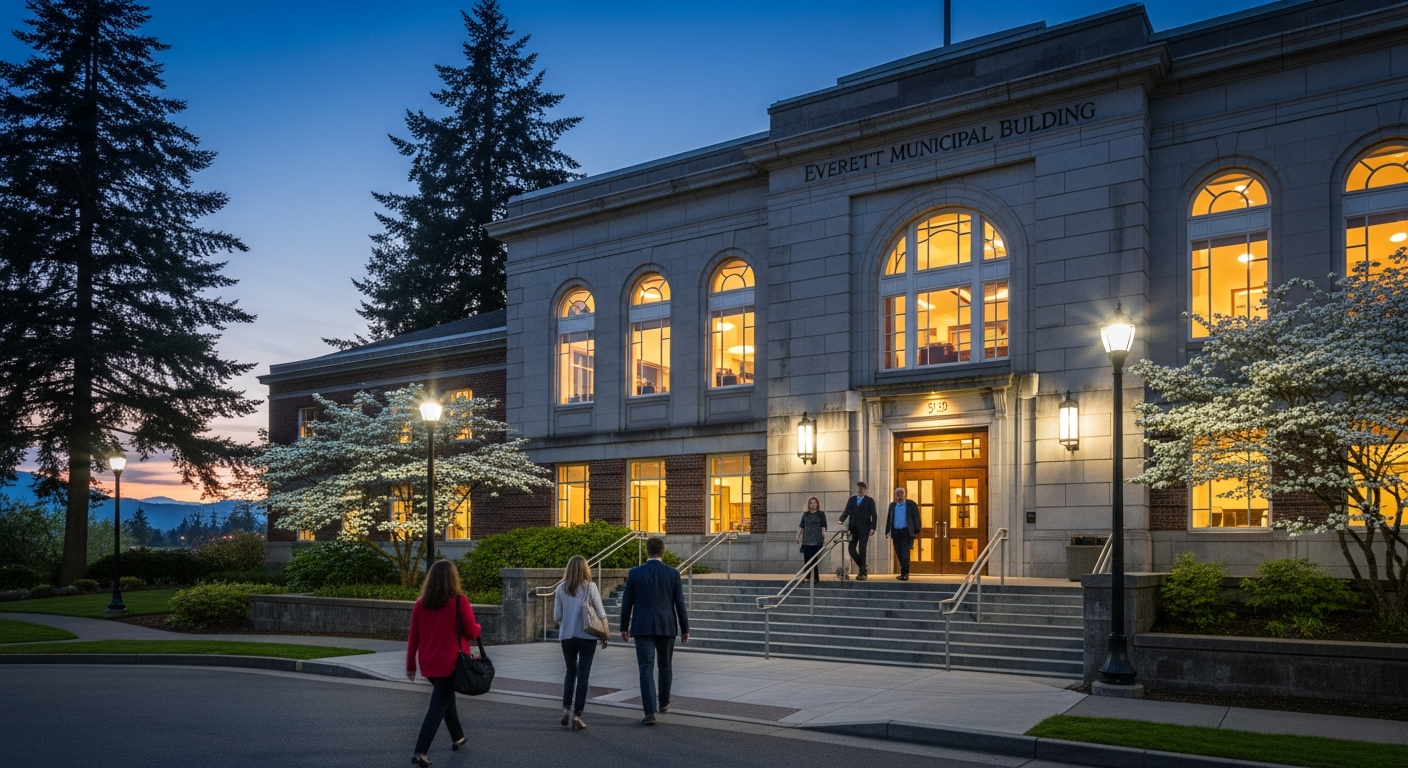
    • Everett Council of Neighborhoods — Monday, April 27, 4 p.m., Everett Municipal Building, 5th Floor, 2930 Wetmore Avenue
    • Everett City Council — Wednesday, April 29, 12:30 p.m., William E. Moore Historic City Hall/Police North Precinct, 3002 Wetmore Avenue

    The city council briefing on April 29 is the one most directly tied to the eventual decision. Council members do not vote on the site study at that briefing, but it’s the meeting where the public study is formally walked through for the elected body that will eventually have to weigh in on facility funding and any zoning or land-use approvals.

    What Happens After May 17

    The May 17 close of public comment doesn’t mean a decision is imminent. The site study itself is one input into a longer process. After the comment window closes, Everett Transit and Perteet are expected to publish a summary of public feedback, refine the site evaluation, and bring recommendations forward to city leadership in subsequent meetings.

    There is no announced date yet for a final site selection. The agency has framed this study as the foundation for a longer planning process that will need additional design work, environmental review, and funding decisions before anything is built.

    If you want to be notified when those next steps come, the agency is collecting contact information through the online open house, and Everett Transit’s main website at everetttransit.org posts updates on agency planning.

    The Bigger Picture

    Everett’s transit infrastructure is in a transitional period. The city is preparing for light-rail service. Its fleet has gone heavily electric. The conversation with Community Transit about a possible service consolidation is moving forward. And the demand for transit in north Snohomish County keeps climbing.

    A new maintenance base might not be the most glamorous part of that picture, but it’s the part that determines whether the rest of the system can actually scale. Buses need somewhere to charge. Mechanics need somewhere to work. Dispatch needs somewhere to run from. Where Everett puts that operation — and how big it builds it — is one of the more consequential infrastructure choices the city will make this year.

    The window to weigh in is open now. It closes May 17.

    Frequently Asked Questions

    What is the Everett Transit MOAB site study? It’s a formal study — conducted by Everett Transit with consulting firm Perteet Inc. — comparing three potential sites for the agency’s maintenance, operations and administrative facility. The agency is choosing between expanding its current Cedar Street site or relocating to one of two industrial properties on the waterfront or in Lowell.

    When is the public comment period? April 16 through May 17, 2026.

    Where can I submit comments online? At everetttransit.org/MOAB. The online open house is live from April 17 through May 17.

    When are the in-person open houses? Wednesday, April 29 and Thursday, April 30, both from 5–7 p.m. at Everett Station, 3201 Smith Avenue, Dan Snow Room (4th Floor).

    Will the Everett City Council vote on this in April? No. The April 29 city council meeting is a public briefing, not a vote. A formal council decision on facility funding or land use would come later in the process.

    Does this affect the city’s general fund or property taxes? No. Everett Transit is funded separately through local sales tax dedicated to transit and grant funding — not through the city’s general fund. This project does not compete with police, fire or parks budgets for funding.

    How does this connect to the Everett Transit / Community Transit consolidation talks? Those are separate conversations on separate timelines. The site study moves forward regardless. But whatever facility ends up getting built will likely matter to whichever agency operates buses in Everett over the long term.

    Why does the agency say it needs a new facility? Three reasons: the fleet has grown, the city is growing, and the shift to electric buses requires significantly more charging infrastructure than a traditional diesel base. About half of Everett Transit’s fleet is already battery-electric.

  • The Civic Watcher’s Guide to the 2026 Dual Charter Reviews: How to Track, Engage With, and Shape Both Everett’s and Snohomish County’s Review Processes

    For Everett residents who follow local government closely: 2026 is the year to engage with both charter reviews. The City of Everett and Snohomish County are running concurrent review processes that will produce ballot items shaping local government structure for the next decade. Here’s the civic watcher’s guide to participating.

    The Stakes: Why Charter Reviews Matter More Than Typical Ballot Items

    Charter reviews operate at a different level than typical ballot measures. A standard ballot measure asks voters to approve or reject a specific policy — a levy, a bond, a zoning change. A charter amendment changes the rules under which all future policy decisions get made. That leverage is why civic organizations, advocacy groups, and political parties tend to invest heavily in charter review outcomes. A single charter amendment on council district boundaries can change which council members get elected for decades. A single amendment on citizen initiative rights can change what kinds of policy questions ever reach a ballot in the first place.

    Tracking Both Commissions Simultaneously

    The practical challenge for civic watchers in 2026 is that both reviews are running in parallel, which means twice the meetings, twice the public comment windows, and twice the ballot items. The standard approach among experienced civic participants is to track both commission websites, subscribe to both meeting agenda notifications, and build a calendar of public hearing dates that covers the full year. Most commission meetings are held in the evenings to accommodate working residents. Recordings are generally made available within a week of each meeting — a practical option for watchers who can’t attend live.

    The Coalition Landscape

    Several local civic organizations are actively engaged with one or both reviews. The League of Women Voters of Snohomish County typically publishes educational materials on charter amendments and hosts candidate and issue forums. Local neighborhood associations — including associations in Northwest Everett, Bayside, and the Port Gardner neighborhood — have in past charter cycles submitted joint comments on issues affecting their areas. Watchers who want to amplify their individual voice should consider joining or coordinating with one of these organizations. Coordinated comments from multiple residents on the same issue carry materially more weight than isolated individual submissions.

    Specific Items Worth Watching in 2026

    At the city level, watchers should track any recommendation on council district boundaries, the mayor-council relationship, citizen initiative thresholds, and open meetings and public records language. At the county level, watch for recommendations on council districts, the county executive’s role, civil rights and non-discrimination language in the charter preamble, and any procedural changes to county contracting. Each of these is live in 2026 to varying degrees, and the specific language of whatever amendments emerge will determine how the reforms actually function in practice.

    Writing Effective Public Comment

    Public comment on charter review items is most effective when it is specific, references particular charter sections, and ties the recommendation to a concrete outcome. Comments that say “I support reform” are less useful to commissioners than comments that say “I support amending Section X to require Y, because it would produce Z outcome in my neighborhood.” Comments can be submitted in writing before meetings and delivered orally at public hearings. Both channels are part of the record. For civic watchers planning to submit comments on multiple items, a clean spreadsheet tracking which commission, which section, which hearing, and which outcome you support is a practical organizing tool.

    After the Ballot: The Implementation Phase

    Charter amendments that pass don’t take effect instantly. Each amendment has an implementation timeline specified in the ballot language or derived from state law — some take effect at the next election cycle, some require enabling ordinances from the council, and some require procedural changes at the Snohomish County Elections office. Watchers who engaged with the amendment campaign should plan to engage with implementation — that’s typically where the hardest details get settled, and where civic attention often drops just when it matters most.

    Related Coverage From Tygart Media’s Exploring Everett Series

  • The 2026 Dual Charter Review: How Everett and Snohomish County Are Rewriting Their Constitutional Documents at the Same Time, and What Ballot Items Voters Will See Next

    Quick Answer: In 2026, both the City of Everett and Snohomish County are running active charter review processes — parallel, independent efforts that could reshape how local government works in the Everett area for the next decade. Charter reviews are the mechanism by which the foundational documents of local government get examined and, where voters approve, amended. The Everett review is looking at city council structure, mayoral authority, and citizen engagement processes. The county review is examining county council districts, the executive role, and the charter’s civil rights language. Both processes will produce ballot items that Everett-area voters will decide on in 2026 and 2027.

    What a Charter Is and Why It Matters

    A local government charter is the constitutional document for a city or county — the top-level rulebook that defines how the government is structured, what powers the council and executive have, and how citizens can petition, vote on, and change policy. The City of Everett operates under a charter adopted by voters and amended periodically. Snohomish County is one of only a handful of Washington counties that operates under a home-rule charter rather than the default county commission structure, which means voters there have direct authority to reshape county government in ways that voters in most Washington counties don’t.

    Charter reviews happen on a schedule set by each charter. The City of Everett’s charter calls for periodic review by a commission of appointed or elected residents whose job is to study the current charter, hold public hearings, and recommend amendments for the ballot. Snohomish County’s charter similarly provides for periodic review. In 2026, both review processes are running concurrently — a rare alignment that means Everett-area voters could see charter-related ballot items from both jurisdictions in the same election cycle.

    The City of Everett Charter Review in 2026

    The City of Everett’s 2026 charter review commission is actively working through the city’s charter section by section. The issues most frequently discussed in public sessions include the structure of city council representation (districts versus at-large, and the size of the council), the relationship between the mayor and the city council, the process by which citizens can propose ballot measures, and the charter’s language around open meetings and public records. These are foundational questions: the outcomes could determine whether Everett continues with its current strong-mayor structure, whether council districts are redrawn, and whether new citizen engagement mechanisms are added.

    Practical impact for Everett residents depends on which recommendations make it to the ballot and which voters approve. A charter amendment that restructures council districts could change which council member represents a given neighborhood. An amendment expanding citizen initiative rights could make it easier for residents to put policy questions directly to voters. An amendment changing mayoral authority could reshape how big-ticket decisions like the Everett Transit merger, waterfront development, and public safety policy get made. Residents who want to shape these outcomes should track charter commission meeting agendas and public hearings — both are the primary public input channels before recommendations go to the ballot.

    The Snohomish County Charter Review in 2026

    Snohomish County’s 2026 charter review is running in parallel at the county level. The county’s charter review commission was seated in 2025 and has been holding public sessions across the county — including in Everett, Lynnwood, Edmonds, and Arlington — to gather input on the items under consideration. The issues most often raised include county council district boundaries, the county executive’s role, language on citizen advisory boards, charter provisions for civil rights and non-discrimination, and procedural questions about how the county contracts and procures services.

    For Everett residents specifically, the county charter review matters because Snohomish County delivers services that overlap directly with city life: the Sheriff’s Office provides patrol services in unincorporated areas just outside Everett and contracts for regional services inside Everett; the county court system handles felonies, family law, and civil cases for Everett residents; and county-wide programs like the Assessor’s Office, Public Health, and the Elections Division touch every Everett household. Amendments to the county charter can change the terms of any of those relationships.

    Where the Two Reviews Overlap and Where They Don’t

    The city and county charter reviews are legally independent — neither has authority over the other, and the ballot items they produce will be voted on separately. But the practical effects overlap in important ways. Both reviews are examining citizen engagement mechanisms, so amendments from either or both could change how residents interact with local government. Both are examining district boundaries, so residents could see changes to the geographic units that define their council and commission representation. And both are happening in a political environment where trust in local government, housing policy, public safety, and civil rights are active debates — meaning the charter questions are being asked against a backdrop of real policy stakes.

    Where they diverge: the city charter review is focused on Everett-specific governance questions and its outcomes affect only Everett residents. The county charter review’s outcomes affect all 800,000+ Snohomish County residents. That asymmetry matters for turnout and for which issues get the most attention at public hearings.

    How Residents Participate

    Both charter review processes run on public input. The standard channels are: attending charter commission meetings (both reviews post agendas in advance), submitting written comments through the commission’s public portal, testifying at public hearings, participating in neighborhood-level information sessions held throughout the review period, and, ultimately, voting on whatever recommendations reach the ballot. Residents who want to influence specific outcomes should identify the commissioners representing their area, attend at least one session, and submit written comments on the issues they care about.

    The Timeline: When Ballot Items Appear

    Both reviews are working toward ballot items that could appear in 2026 and 2027 elections. The exact timing depends on when each commission finalizes recommendations and when those recommendations clear procedural requirements for ballot placement. Snohomish County Elections will publish the final ballot composition for each election cycle roughly 90 days before the election. Voters should expect to see at least some charter-related items in the November 2026 general election, with additional items potentially carrying over to 2027 depending on how the commissions pace their work.

    Frequently Asked Questions About the 2026 Charter Reviews

    Are the city and county charter reviews the same process?

    No. They are independent. The City of Everett’s review examines the city charter. The Snohomish County review examines the county charter. They happen to be running concurrently in 2026, but they produce separate ballot items and are decided by voters separately.

    Can charter reviews change everything about local government?

    In theory, yes, within state and federal law. In practice, charter reviews produce amendments — not full replacements. Voters decide each amendment separately.

    How do I know who my charter review commissioners are?

    The City of Everett publishes its charter review commission roster on the city website. Snohomish County does the same. Both include contact information for commissioners.

    What happens if I don’t vote on charter items?

    Charter amendments require majority voter approval to pass. If you don’t vote, you don’t shape the outcome, but the amendments don’t fail automatically — they pass or fail based on votes cast.

    Do these reviews affect Everett Transit, the waterfront, or other current issues?

    Indirectly, yes. Charter amendments can change how the city council and mayor make decisions on these items, which can affect outcomes. They don’t directly legislate on transit or waterfront policy, but they shape the rules under which those decisions are made.

    Related Coverage From Tygart Media’s Exploring Everett Series

  • Snohomish County’s Charter Review Is on November’s Ballot Too — Here’s What Commissioners Are Weighing

    What is the Snohomish County Charter Review Commission, and what’s on the table this year?
    The commission is an elected, once-a-decade body of 15 commissioners who review the county’s constitution and can recommend changes to the November ballot. This cycle, they are weighing making the County Executive and County Council seats nonpartisan, and whether to write a budget-funding mandate for core county offices — like the sheriff, prosecutor, and assessor — directly into the charter. The commission held a public meeting on the Snohomish County campus in Everett on April 22 and plans to finalize proposals by the end of May.

    Everett voters will see at least two charter reviews on their November 2026 ballot.

    One belongs to the City of Everett, run by a volunteer committee appointed by the mayor and city council. The other belongs to Snohomish County — a separate body with separate commissioners and separate proposals, all of them touching how the county government itself is elected and funded. Because every Everett resident is also a Snohomish County resident, both sets of questions will land in the same ballot envelope in November.

    The county’s Charter Review Commission held a public meeting on April 22 at 5:30 p.m. in the Jackson Board Room on the 8th floor of the Snohomish County Campus at 3000 Rockefeller Avenue in Everett. It is one of a series of spring meetings the commission has scheduled in Lake Stevens, Everett, Arlington, and Mountlake Terrace to take feedback on its draft proposals before finalizing recommendations.

    How the county review is different from Everett’s

    The biggest structural difference is how commissioners arrive on the body. Everett’s Charter Review Committee is appointed by the mayor and city council from a volunteer applicant pool. Snohomish County’s Charter Review Commission is elected. County voters picked commissioners on the November 2025 ballot, in a once-in-a-decade race that rarely draws the attention of bigger contests but directly determines who writes the proposals residents will vote on a year later.

    The commission has 15 seats, with members drawn from across the five county council districts. Their only job is this review. When the cycle ends, the commission dissolves. The next one convenes around 2035.

    As with Everett’s committee, the commission cannot change the charter by itself. It can only recommend changes. The proposals it adopts go to the Snohomish County Council for additional public hearings, and then to the county auditor to be placed on the November general election ballot. Voters have the final say.

    Proposal one: make county elections nonpartisan

    The most attention-grabbing proposal on the table would remove party labels from Snohomish County’s top elected offices. Under the draft, the County Executive, each County Council position, and the County Prosecutor would appear on the ballot without a Republican or Democratic designation.

    The commission voted 11-4 in a March working session to keep the nonpartisan concept alive — enough support to carry the idea into the April public hearings but not a final recommendation. The commissioners who voted to keep it moving argued that county-level administration is largely about services — roads, public safety, courts, elections — that do not break down along partisan lines the way state or federal policy does. Commissioners who voted against it argued that party labels give voters useful information about a candidate’s general priorities, especially in down-ballot races where most voters know little about the individual candidates.

    If the commission’s final recommendation goes forward and voters approve it, Snohomish County would join a handful of other Washington counties and most Washington cities in electing local officials without party labels. The change would not affect state legislators, federal officeholders, or statewide races — just the county offices named in the charter.

    Proposal two: a budget mandate for core county offices

    A second proposal, raised by County Treasurer Brian Sullivan, would write a funding priority directly into the county charter. Under Sullivan’s request, elected leaders would be required to fully fund a set of core county services first in the county budget — before discretionary spending gets allocated.

    The core offices under the proposal are the county Assessor, Sheriff, Prosecuting Attorney, Treasurer, County Clerk, and Superior Court. “Fully funded” in this sense means each department is funded enough to perform its duties required by law.

    Supporters frame the proposal as a fiscal guardrail. If the general fund tightens in a future downturn, the argument goes, a charter-level mandate would protect basic functions like criminal prosecution, property assessment, and court operations from being cut first. Critics raise the opposite concern: locking funding priorities into the charter limits what a future County Council can do when budgets get tight, and could force cuts to services not on the protected list — public health programs, parks, planning — that residents also rely on.

    The commission has been evaluating the proposal through April and has not yet voted on a final version.

    Why Everett residents should pay attention

    Snohomish County’s government sits on Rockefeller Avenue in downtown Everett. When the County Council votes, it votes a few blocks from Everett City Hall, in the same building where the Charter Review Commission meets. Decisions about how the county is governed land directly on Everett residents because Everett is the county seat and its largest city — roughly 115,000 of the county’s 850,000 residents live here.

    The nonpartisan ballot question in particular would change something Everett voters see every November: whether the names next to county executive or county council come with a (D) or (R) attached. For Everett voters used to looking at those labels before deciding, the change would be visible immediately.

    The budget mandate is less visible but more consequential. Snohomish County runs programs Everett residents use regularly, from the Sheriff’s Office that supports some unincorporated areas around the city, to the Superior Court where serious criminal cases are heard, to the Assessor whose valuations drive every Everett property tax bill. Changing how the county has to budget those offices would change how every other county service competes for the remaining dollars.

    How residents can weigh in

    The commission’s meetings are open to the public and posted on the Charter Review Commission page at snohomishcountywa.gov/3520/Charter-Review-Commission. The April meetings across the county are part of the commission’s final listening period before it moves to adopt recommendations.

    The commission has said it expects to take action on all proposals by the end of May. That timeline would send final recommendations to the Snohomish County Council for additional public hearings through early summer, then to the county auditor’s office for ballot preparation. Voters would see the questions on their November 3, 2026 general election ballot.

    As with Everett’s city charter review, residents who want a say need to engage now. Once the ballot text is set by the auditor’s office in late summer, the proposals become up-or-down votes — no amendments, no changes to language, just yes or no on each question.

    Frequently Asked Questions

    Who is on the Snohomish County Charter Review Commission?

    The commission has 15 elected commissioners representing the county’s five council districts. Voters elected them on the November 2025 ballot. The commission convenes for one review cycle and dissolves afterward.

    How is this different from Everett’s own Charter Review Committee?

    Everett’s committee reviews the Everett city charter and is appointed by the mayor and city council. The Snohomish County commission reviews the county charter and is elected by county voters. Both bodies can send amendments to the November 2026 ballot, but they operate separately and deal with different documents.

    What does “nonpartisan” mean on a ballot?

    It means no party affiliation appears next to the candidate’s name on the ballot. Candidates still hold personal political views and can be endorsed by parties, but the ballot itself does not identify them as Republican, Democrat, or any other party.

    Which county offices would be affected if the nonpartisan proposal passes?

    Under the draft version, the County Executive, each County Council position, and the County Prosecutor would become nonpartisan. Other offices, including the sheriff and assessor, are already nonpartisan under current state law or would remain unchanged.

    What is the Treasurer’s budget mandate proposal?

    The proposal, raised by County Treasurer Brian Sullivan, would require the county to fully fund six specified offices — Assessor, Sheriff, Prosecuting Attorney, Treasurer, County Clerk, and Superior Court — before allocating money to other programs in the budget. “Fully funded” means enough to meet each office’s legally required duties.

    When will the final ballot language be set?

    The commission plans to adopt recommendations by the end of May 2026. After that, the County Council holds its own public hearings, and the county auditor receives the ballot text in the late summer. Questions appear on the November 3, 2026 general election ballot.

    How do residents submit input to the commission?

    The commission accepts testimony at its public meetings and also accepts written comments. The Charter Review Commission page at snohomishcountywa.gov/3520/Charter-Review-Commission has the meeting schedule, contact information, and instructions for submitting comments electronically.

    Deeper Coverage in the Exploring Everett Series

    For a more comprehensive treatment of the issues raised in this article, see:

  • Everett’s Charter Review Is Underway — Here’s How Residents Shape What Goes on the November Ballot

    What is Everett’s charter review, and why does it matter?
    Everett’s charter is the city’s constitution — the document that lays out how the mayor, council, and city departments work. Every decade, a 15-person volunteer committee reviews it and can send changes to the November ballot, where voters have the final say. The 2026 Charter Review Committee held its most recent public hearing on April 18 and is gathering resident input now. Any amendments Everett voters approve in November 2026 would reshape the city’s governance for the next ten years.

    Most Everett residents have never read the city’s charter. That is not unusual — most cities’ charters sit in municipal code and rarely come up in everyday conversation. But the charter is the document that decides who can be mayor, how many council members there are, whether they run by district or at-large, when residents vote on levies, and how the city manages its own finances.

    And every ten years, Everett gives voters a chance to change it.

    That process is happening right now. The 2026 Charter Review Committee — 15 volunteer residents appointed by the mayor and city council — has been meeting since earlier this year to review the charter, take public testimony, and draft recommended changes. The committee held a public hearing on April 18 at Walter E. Hall Park. Any amendments the committee recommends will need a council vote to reach the ballot, and then a majority of Everett voters to take effect.

    What the charter actually controls

    The charter is not the same as the municipal code. The municipal code is the big book of day-to-day rules — zoning, parking, noise ordinances. The charter is smaller and more structural. It answers questions like:

    • Is Everett a strong-mayor city or a council-manager city?
    • How many council members sit on the council?
    • Do they represent districts, the whole city, or both?
    • What are the term lengths for mayor and council?
    • How does the city handle its own initiative and referendum process?
    • What boards and commissions must exist?

    The last time Everett reviewed its charter was 2016. The biggest structural change residents have seen since then came from a separate voter decision in November 2018, when Everett switched from an all-at-large council to a mix of five district seats plus two at-large seats. That change did not come from a charter review — it came from an earlier ballot measure — but it is exactly the kind of question a charter review would take up.

    How the 2026 committee was put together

    Applications to serve on the committee closed in December 2025. In January 2026, the mayor and city council together designated 14 members. A 15th seat is chosen by the committee itself after it first convenes. Members are unpaid volunteers who commit to months of meetings.

    The committee works through two phases. First, members review each section of the current charter and flag potential changes. Second, they take public input, draft final recommendations, and vote on each one. An amendment only moves forward if a majority of committee members vote for it. The recommendation then goes to the Everett City Council, which can either send it to the ballot or decline.

    Only voters approve the final change. The council cannot amend the charter on its own.

    What the April 18 public hearing was for

    The hearing at Walter E. Hall Park on April 18 ran from 11 a.m. to 1 p.m. in the Olympic View Room. The format was a standard public comment hearing: residents sign up, the committee listens, comments become part of the official record. The committee had already scheduled an earlier hearing in late March at the Evergreen Branch of the Everett Public Library, 9512 Evergreen Way, to make sure residents in both halves of the city had a chance to speak.

    Public hearings are the most visible part of the process, but they are not the only way to submit input. The committee has also accepted written comments electronically. The city posts committee meeting agendas and minutes on the Agenda Center at everettwa.gov/AgendaCenter, and the Charter Review Committee has its own landing page at everettwa.gov/630/Charter-Review-Committee.

    What happens between now and November

    The timeline is tight. For amendments to reach the November 3, 2026 general election ballot, the committee has to finish its work, the council has to schedule and hold its own public hearings, and the county auditor’s office has to receive the ballot text on time. That typically means the committee’s final recommendations need to land with council by midsummer, with council action by August or early September.

    Residents who missed the April 18 hearing still have time to weigh in. Committee meetings continue to be open to the public, and the city accepts written comments through the Charter Review Committee page. Once the committee finalizes recommendations, the council’s hearings will be separate opportunities for public testimony — another round of chances for residents to speak before the ballot is set.

    Why Everett residents should pay attention

    Charter amendments are the rare civic decision that the city council cannot make alone. Most ordinances — last month’s fair labor rules, the utility tax debate, the 2026 budget — move through council votes without ever reaching voters directly. The charter is different. Residents decide.

    That means what shows up on the November ballot is shaped by who bothers to testify right now. If a resident wants the mayor’s term shortened, the council expanded, initiative signature thresholds lowered, or a new board created to oversee a specific city function, the Charter Review Committee is the body that can put that on the ballot. If no one raises it during this window, it does not make the 2026 ballot — and the next chance is 2036.

    For a city the size of Everett — population roughly 115,000 and still growing — a decade is a long time to wait. The city that votes on this charter in November will be a different city by 2036. Boeing’s 737 North Line will be at full production. Sound Transit’s Link light rail is projected to reach Paine Field around 2037. The Millwright District and the downtown stadium will be built out. The charter that residents send forward this year will govern how Everett’s institutions respond to all of it.

    Frequently Asked Questions

    When was Everett’s charter last reviewed?

    The last Charter Review Committee met in 2016. Everett typically reviews its charter about once every ten years.

    Who is on the 2026 Charter Review Committee?

    The committee has 15 members. The mayor and city council designated 14 of them in January 2026 from an applicant pool. The 15th seat was chosen by the committee itself at its first meeting. Members are unpaid volunteers serving a one-time term tied to this review cycle.

    Do voters get the final say on charter changes?

    Yes. The committee recommends changes. The council can put those changes on the ballot. Only Everett voters can actually amend the charter, by majority vote in the November 2026 general election.

    How can residents submit input now?

    The committee accepts public testimony at its scheduled hearings and also accepts written comments. The Charter Review Committee page at everettwa.gov/630/Charter-Review-Committee has the most current contact information, meeting schedule, and links to submit comments electronically.

    Is Everett’s charter review the same as Snohomish County’s?

    No. Snohomish County has its own Charter Review Commission with its own elected commissioners, reviewing the county charter. That body is separate from Everett’s city committee and considers different proposals — including, this cycle, whether county executive and council seats should be nonpartisan. Everett voters will see both sets of questions on the November ballot if both bodies send recommendations forward.

    When is the next chance to amend the charter after 2026?

    Not until the next decennial review, which would be expected around 2036. Individual council members can theoretically propose charter amendments outside of a review cycle, but the organized, public, committee-driven review only happens about once a decade.

    Deeper Coverage in the Exploring Everett Series

    For a more comprehensive treatment of the issues raised in this article, see:

  • Will the Everett EMS Levy Raise My Property Taxes? A 2026 Homeowner’s Guide to the August 4 Ballot Measure

    The one calculation you actually need

    If you own a home in Everett, here is the only calculation that matters for the August 4 EMS levy: take your home’s assessed value, divide by 1,000, and multiply by $0.14 (the increase from $0.36 to $0.50 per $1,000). That is your extra annual EMS levy if the measure passes.

    • Home assessed at $400,000: about $56 per year more ($4.67/month)
    • Home assessed at $500,000: about $70 per year more ($5.83/month)
    • Home assessed at $600,000: about $84 per year more ($7.00/month)
    • Home assessed at $750,000: about $105 per year more ($8.75/month)
    • Home assessed at $1,000,000: about $140 per year more ($11.67/month)

    The city’s published estimate is approximately $80 per year for the average Everett homeowner, which tracks closely with the median assessed value in the city.

    Where to find your assessed value

    Your home’s assessed value is printed on the most recent property tax statement you received from Snohomish County. It is also searchable online through the Snohomish County Assessor’s property lookup — you can type in your address and pull up the assessment history. Assessed value is set by the county, not the city, and is generally updated annually.

    Assessed value is different from market value. It is the number the county uses for tax purposes. In practice it tends to track market value over time but with a lag, and your property tax bill is calculated against the assessed figure, not the market figure.

    Why the EMS rate drops on its own every year

    If you have lived in Everett for a while, you may have noticed that the city has voted on EMS levy restorations in 2010, 2018, and now 2026. That is not because the city keeps asking for more. It is because of Washington state’s 1% property tax cap, set by Initiative 747 in 2001.

    Under that cap, a regular property tax levy can grow by no more than 1% per year statewide, regardless of how fast property values or service costs rise. Over time, the effective rate slowly drifts below the ceiling voters originally approved. For the Everett EMS levy, that original ceiling is $0.50 per $1,000, approved in 2000. The current rate — $0.36 — is what’s left after roughly 25 years of that 1% drift and two previous resets.

    A lid lift restores the rate to the previously approved ceiling. It does not create a new tax. It does not authorize any rate above $0.50 per $1,000. It is, in budget terms, a reset button voters get to push.

    What your extra $70 to $100 per year actually buys

    The EMS levy funds about 78 firefighter-paramedic positions inside the Everett Fire Department, according to city documents. These are the people who respond when you call 911 for a medical emergency:

    • A family member having a heart attack
    • A neighbor who has fallen and can’t get up
    • A kid with a severe allergic reaction
    • A car crash on I-5 or Evergreen Way
    • An overdose or mental health crisis

    The overwhelming majority of Everett Fire Department call volume is medical, not fire. For most urban residents, the EMS side of a fire department is the side they are statistically most likely to interact with in their lifetime.

    When you pay property tax, a portion of that goes to the EMS levy, which in turn pays the salaries and equipment of the paramedic crew that rolls into your driveway when you call 911.

    How this interacts with your other property tax line items

    Your Snohomish County property tax statement has multiple line items. EMS is one of them. Others include the state school levy, local school bonds and levies, city general fund levy, county levy, port district, and various smaller special-purpose levies.

    The EMS lid lift only affects the EMS line. It does not change any other line on your statement. It does not raise the general city levy, the school levy, or any special assessment you may have.

    If the measure passes, your 2027 statement would show the higher EMS line. All other lines would move according to their own rules.

    Renters: this affects you too, indirectly

    If you rent in Everett rather than own, you don’t pay property tax directly. But landlords typically factor their full operating costs — including property tax — into rent over time. For a single-family rental assessed at $500,000, the $70 annual increase works out to roughly $6 per month in underlying cost pressure. Whether any individual landlord passes that along depends on the rental market at renewal time.

    The practical read for renters: it’s probably worth voting on a measure that affects your city’s emergency medical response, regardless of how the property tax math touches you.

    What passing vs. failing would mean for you, specifically

    If it passes: Your 2027 property tax statement has a slightly higher EMS line — about $70 to $100 more for most Everett homeowners. The Everett Fire Department continues to fund its current 78 firefighter-paramedic positions with a more stable funding base. 911 response stays at current levels.

    If it fails: The current $0.36 rate stays. But the EMS fund faces a gap that has to be closed somehow. The three realistic paths: reduced EMS service levels (longer response times, fewer staffed units), a cost shift into Everett’s general fund (which is already projecting a $14 million gap in 2027), or a revised ballot measure in a later election. None of those options leave your property tax picture entirely untouched in the medium term.

    How to actually vote

    Ballots for the August 4, 2026 primary typically mail to registered voters around mid-July. You can mail your ballot back or drop it in any Snohomish County ballot drop box. You can also register to vote, update your registration, or check your registration status through the Snohomish County Auditor’s office.

    Only registered voters who live inside Everett city limits vote on this measure. If you live in unincorporated Snohomish County or in a neighboring city, this specific measure is not on your ballot.

    Frequently Asked Questions

    How do I calculate what I’ll actually pay if the Everett EMS levy passes?

    Take your home’s assessed value, divide by 1,000, and multiply by $0.14 (the rate increase from $0.36 to $0.50 per $1,000). That’s your extra annual EMS levy. A $500,000 home pays about $70 more per year.

    Where do I find my assessed value?

    On your most recent Snohomish County property tax statement, or through the Snohomish County Assessor’s online property lookup by address.

    Does the EMS lid lift raise my other property tax line items?

    No. It only affects the EMS levy line. The state school levy, local school levies, city general fund, county levy, and special district levies are governed by separate rules and separate votes.

    If I rent, does this affect me?

    Not directly on a tax bill — renters don’t pay property tax. But landlords generally factor property tax into rent over time. The rough pressure for a $500,000 rental is about $6 per month in underlying cost.

    When would the new rate show up on my statement?

    The 2027 property tax year, which bills in early 2027.

    Is there any cap on how high the rate can go?

    Yes. The measure cannot authorize any rate higher than $0.50 per $1,000, which Everett voters originally approved in 2000. If the measure passes, the rate goes from $0.36 to $0.50 and stops.

    Can my property tax bill still change in other ways?

    Yes — your assessed value can change annually, other levies can be voted on, and school bonds can pass or expire. This measure only governs the EMS line.

    Is there any scenario where the EMS levy raises my taxes more than $0.14 per $1,000?

    Not through this measure. The ceiling of $0.50 per $1,000 is binding. The only way a higher rate would apply is if voters approved a separate, future measure authorizing one — which is not what is on the August 4 ballot.

  • The Everett EMS Levy on the August 4, 2026 Ballot: A Complete Homeowner and Voter Guide to the Lid Lift, the $80 Question, and What It Actually Funds

    The short version of the August 4 ballot measure

    On April 22, 2026, the Everett City Council voted to send a property tax levy lid lift for emergency medical services to the August 4, 2026 primary ballot. The measure would restore Everett’s EMS levy rate from $0.36 per $1,000 of assessed value back to the $0.50 per $1,000 cap that Everett voters originally authorized in 2000. That is the entire measure, in one sentence.

    This guide breaks the measure down in plain English: what a “levy lid lift” actually is, what your household would pay, what the money funds, why it is on the ballot yet again, and what happens if it passes or fails.

    The $0.36-versus-$0.50 math in plain English

    Washington property tax rates are expressed in dollars per $1,000 of assessed value. Everett’s current EMS levy rate is $0.36 per $1,000. The measure would restore it to $0.50 per $1,000.

    For a home assessed at $500,000, the math is straightforward:

    • Current rate ($0.36 per $1,000): 500 × $0.36 = $180 per year in EMS levy
    • Proposed rate ($0.50 per $1,000): 500 × $0.50 = $250 per year in EMS levy
    • Difference: $70 per year, or about $5.83 per month

    The city estimates the average Everett homeowner would pay approximately $80 more per year. The exact dollar figure depends on your assessed value, which you can find on your most recent Snohomish County property tax statement.

    Renters do not pay property tax directly but may see the cost reflected in rents over time. Commercial property owners also pay the levy and may pass costs along to tenants.

    What “levy lid lift” actually means

    A levy lid lift is a ballot measure that asks voters for permission to raise a regular property tax levy back up to a previously authorized ceiling. It is not a new tax. It does not authorize a rate higher than what voters have already approved in a prior election.

    The reason lid lifts exist is a 2001 state initiative, I-747, that capped year-over-year growth in regular property tax levies at 1% statewide, regardless of how fast property values or service costs rise. For a service like EMS — where labor, medical supplies, and call volume all outpace 1% inflation in most years — that ceiling gradually erodes the effective rate. A lid lift resets it.

    What the 78 firefighter-paramedic positions actually do

    The EMS levy funds roughly 78 firefighter-paramedic positions inside the Everett Fire Department, according to city documents presented to the City Council on April 22. These are the people who arrive when an Everett resident calls 911 for:

    • A heart attack, stroke, or other medical emergency
    • A car crash with injuries
    • A fall or medical event at home
    • An overdose or mental health crisis
    • A workplace injury
    • A fire with injured occupants

    The Everett Fire Department responds to thousands of medical calls per year. Medical calls make up the overwhelming majority of total call volume for most urban fire departments nationally, and Everett fits that pattern. When people picture a fire department, they picture fire trucks going to fires. In reality, most of what the department does every shift is emergency medicine.

    Why the levy is on the ballot again — the 2000/2010/2018/2026 pattern

    Everett voters have approved EMS levy lid lifts multiple times over the past 25 years. Each time, voters have restored the rate back to the $0.50 cap originally authorized in 2000:

    • 2000: Voters approved a permanent EMS levy at $0.50 per $1,000 of assessed value.
    • 2010: Voters approved a lid lift restoring the rate to $0.50 after state law had allowed it to drift downward.
    • 2018: Voters approved another lid lift restoring the rate to $0.50.
    • 2026: The current measure, scheduled for the August 4 primary ballot.

    The roughly eight-year rhythm of these votes is a direct consequence of the 1% cap — the rate drifts downward, costs rise faster than 1%, and at some point the math no longer works without a reset.

    What Everett Fire Chief Dave DeMarco told the council

    Everett Fire Chief Dave DeMarco addressed the City Council on April 22 in support of the measure. His framing is worth reading carefully because it is the clearest public statement of why the measure is on the ballot now.

    “The fund has remained solvent throughout this period of extraordinary growth, also a global pandemic and increasing demands for service,” DeMarco told the council. “However, to remain stable and meet the growing emergency medical services needs of our community, the restoration of the levy is necessary.”

    Two things to notice there. First: the EMS fund is not in crisis today. It is solvent. The case is about remaining stable going forward, not plugging an immediate hole. Second: call volume is higher than it was in 2018, when voters last restored the rate, and labor plus medical supply costs have risen in that time.

    What happens if the measure passes

    If the measure passes on August 4, the $0.50 per $1,000 rate would take effect in the 2027 property tax year. Homeowners would see the higher line item on their 2027 property tax statements. The Everett Fire Department would continue to fund the roughly 78 firefighter-paramedic positions and would have a more stable funding base to handle continued call-volume growth.

    The passage of the lid lift does not, by itself, add new paramedic positions. It restores the funding that the existing staffing model depends on.

    What happens if the measure fails

    If the measure fails, the current $0.36 rate would remain in place. The city would face a funding gap inside the EMS fund, which would need to be closed one of three ways:

    • Reduce EMS service levels. Fewer staffed units, longer response times, reduced coverage, or consolidation of stations. This is the option city officials most often warn about in lid lift campaigns and the one voters typically react to most strongly.
    • Shift costs to Everett’s general fund. The general fund is already projecting a $14 million gap in 2027, according to Mayor Cassie Franklin’s 2026 State of the City address. Shifting EMS costs into that fund would deepen the existing gap and force cuts to other city services — parks, libraries, streets, and planning.
    • Return to the ballot. The city could ask voters again, possibly with a revised measure, at a later election.

    How the EMS levy fits into Everett’s 2027 budget picture

    The EMS levy is a separate, voter-approved fund. It does not directly close Everett’s projected $14 million 2027 general fund gap. But the two pictures are connected.

    If the EMS levy fails, rising medical-response costs could eventually spill over into the general fund, compounding the existing gap. This is why the same 2026 budget conversation that surfaced the EMS levy also surfaced regional fire authority discussions and a potential library regionalization — all of those are structural options for handling the same underlying pressure.

    The EMS levy is the first of Everett’s 2026-era budget levers to actually reach a ballot. It is not the last.

    Who can vote on this measure

    Registered voters who live inside the City of Everett are eligible to vote on this measure. Voters outside Everett city limits — even elsewhere in Snohomish County — do not vote on this measure. If you are not sure whether your address is inside city limits, the Snohomish County Auditor’s office can confirm.

    Ballots typically mail to registered voters roughly three weeks before election day. A simple majority (50% plus one) is required for the lid lift to pass.

    Frequently Asked Questions

    When is the Everett EMS levy on the ballot?

    August 4, 2026 primary ballot. Ballots typically mail to registered voters about three weeks before election day.

    How much will the EMS levy cost me if it passes?

    The city estimates an average Everett homeowner would pay approximately $80 more per year. The exact amount depends on your home’s assessed value, because the rate is charged per $1,000 of assessed value. A home assessed at $500,000 would pay about $70 more per year.

    Is this a new tax?

    No. Everett voters originally authorized the $0.50 per $1,000 rate in 2000. The 2026 measure is a levy lid lift that restores the rate back to that previously authorized cap. It does not create a new tax and does not authorize a rate higher than $0.50.

    What does the EMS levy pay for?

    Emergency medical services provided by the Everett Fire Department — ambulance, paramedic, and medical first-response calls. The levy currently funds approximately 78 firefighter-paramedic positions.

    Why is this the third time Everett has voted on the $0.50 rate?

    Washington state law caps regular property tax levy growth at 1% per year, even when costs and property values rise faster. That cap, set by Initiative 747 in 2001, pushes the effective rate below the voter-approved ceiling over time. A lid lift is required to reset it. Everett voters previously approved lid lifts in 2010 and 2018.

    What happens if the EMS levy fails?

    The current $0.36 rate remains in place. The city would face a funding gap inside the EMS fund, which would need to be closed by reducing service levels, shifting costs to the general fund, or returning to the ballot with a revised measure.

    Does this affect Everett’s $14 million 2027 general fund gap?

    Not directly. The EMS levy is a separate, voter-approved fund. But if it fails, rising medical-response costs could eventually spill over into the general fund and deepen the existing gap.

    Who is eligible to vote?

    Registered voters who live inside the City of Everett. Voters outside city limits do not vote on this measure. A simple majority is required to pass.

    When would the new rate take effect if it passes?

    The 2027 property tax year. Homeowners would see the higher line item on their 2027 property tax statements.

  • For Everett Business Owners: What SB 6002 and the Reactivated Flock Network Mean for Your Cameras, Your Parking Lot, and Your Liability

    As an Everett business owner, do SB 6002 and the city’s reactivated Flock network change anything for your own security cameras or parking lot ALPR system? Yes. The Driver Privacy Act regulates ALPR use across private entities too — not just the city’s 68-camera Flock network. If your business operates any camera that reads license plates (parking lots, self-storage facilities, auto dealerships, apartment complexes), SB 6002 imposes a 21-day data retention cap, requires law enforcement to obtain a warrant before getting your data, prohibits you from selling or trading that data, and blocks you from positioning cameras where they’d capture traffic at sensitive locations. That’s a material compliance lift that many private-lot operators haven’t absorbed yet.

    The Private-Entity Provisions You Probably Missed

    Most SB 6002 media coverage has focused on the public-sector story — cities reactivating Flock networks, the Public Records Act exemption, the Everett May 14 hearing. The law’s private-entity provisions got less attention but hit a lot more Everett businesses.

    If your business operates any camera that captures license plates as a routine function, SB 6002 applies. That includes:

    • Paid-parking operators using plate-based entry/exit (Ace, SP+, and similar vendors serve downtown Everett).
    • Apartment complexes and condominium associations using Flock or equivalent ALPR systems for gated access, visitor management, or package theft investigation.
    • Self-storage facilities using plate readers at entry gates.
    • Auto dealerships using plate capture on lot-exit cameras.
    • Any private business with security camera systems whose software extracts plate data.

    Your Four Compliance Buckets

    1. 21-Day Retention Cap

    Whatever plate-read data your business collects, you now have to delete within 21 days of capture — unless it’s tied to an active investigation or legitimate business need defined in statute. For apartment complexes retaining a year of plate logs “in case” of future incident, that retention window collapses. You’ll need a written retention policy and automatic deletion workflow.

    2. Warrant Requirement for Law Enforcement Access

    If the Everett Police Department — or any Washington law enforcement agency — asks you for plate data, SB 6002 now requires them to present a warrant. Voluntary cooperation no longer clears the legal threshold. For property managers and security contractors used to handing over footage on request, that’s a procedural shift. Your first question on any law-enforcement inquiry should be whether a warrant is attached.

    3. Ban on Sale or Sharing of ALPR Data

    SB 6002 prohibits buying and selling ALPR data. Any business relationship that involved monetizing plate data — sharing with debt collectors, insurance investigators, skip-tracers, marketing vendors — is no longer permissible. Review any third-party data-sharing contracts that touch license plate data and unwind the ones that don’t fit within the law’s permitted-use carveouts.

    4. Sensitive-Location Placement Restrictions

    Your cameras cannot be positioned to capture traffic at or around immigration-related facilities, reproductive healthcare facilities, schools, places of worship, courts, or food banks. If your business is near any of these locations — a parking lot adjacent to a school, a property near a church, a storage facility next to a food bank — you’ll need to audit camera angles and either reposition or disable plate-reading functionality for cameras pointed at the protected areas.

    Why This Affects Everett Specifically

    Everett’s downtown has a higher density of sensitive locations than many Snohomish County cities — multiple houses of worship clustered around Hewitt Avenue, the county courts at 3000 Rockefeller Avenue, the Volunteers of America food bank on Broadway, reproductive healthcare facilities serving a regional catchment, and a dense public school footprint across the city. For businesses operating parking lots, storage, or multifamily housing in those corridors, the camera-placement review under SB 6002 is substantial.

    What You Should Do in the Next 30 Days

    • Inventory your cameras. Confirm which of your cameras have plate-reading functionality (many modern security cameras do by default).
    • Map camera locations against SB 6002’s sensitive-location list. Any camera with line-of-sight to a school, house of worship, reproductive healthcare site, immigration facility, court, or food bank needs attention.
    • Set retention to 21 days. Automate deletion of plate data older than 21 days unless tied to a documented investigation.
    • Review third-party data-sharing contracts. Unwind any contract that involves selling, trading, or commercially exploiting plate data.
    • Update your law-enforcement response protocol. Warrant required before sharing plate data.
    • Post signage. Consumer-facing signage that explicitly discloses ALPR use supports informed-consent defenses under Washington privacy tort law and is considered best practice under SB 6002’s transparency framework.

    Frequently Asked Questions

    Does SB 6002 apply to my business’s security cameras?

    SB 6002 applies to any camera system that captures and processes license plate data. If your cameras are plate-reading (many modern systems are by default, even when that’s not the marketed feature), the law’s private-entity provisions apply.

    How long can I keep plate data from my parking lot or apartment complex?

    SB 6002 caps retention at 21 days unless data is tied to an active investigation or meets a specific statutory carveout. Routine retention beyond 21 days is no longer permissible.

    If Everett Police ask me for plate data from my lot, do I have to give it to them?

    Under SB 6002, law enforcement must obtain a warrant before receiving ALPR data from a private entity. You should not voluntarily provide plate data in response to an informal request; wait for the warrant.

    What happens if my camera is angled toward a school or house of worship?

    SB 6002 prohibits ALPR placement at or around sensitive locations including schools and places of worship. Cameras with line-of-sight to protected areas need to be repositioned, disabled, or have their plate-reading functionality turned off. Non-compliance carries legal consequences under the law’s enforceable accountability provisions.

    Can I still sell plate data to insurance investigators or debt collectors?

    No. SB 6002 bans the buying and selling of ALPR data outright.

    Do I need to notify customers that I’m using ALPR cameras?

    SB 6002 does not impose an explicit consumer-notification mandate on private operators, but it includes transparency requirements for operators and establishes enforceable accountability measures. Consumer-facing signage disclosing ALPR use is considered best practice and supports defenses under Washington privacy tort law.

    Related Exploring Everett Coverage for Business Owners

  • What Everett’s Reactivated Flock Cameras Actually Mean for You as a Resident: Privacy, Data, and the Lines SB 6002 Draws

    As an Everett resident, what do the reactivated Flock cameras actually do to your privacy? The short version: 68 ALPR cameras placed on arterial roads across Everett scan passing license plates and log the time and location of each scan. Before February 2026 there was no state-level rulebook limiting how long that data could be held, where cameras could be placed, or who could buy the data. Now there is. SB 6002 — the Driver Privacy Act, signed March 30, 2026 — caps data retention at 21 days, bans sale of ALPR data, requires warrants for law enforcement to get ALPR data from private companies, blocks camera placement near immigration, reproductive healthcare, schools, houses of worship, courts, and food banks, and exempts the footage from public records requests so anyone can’t file for your plate data. The tradeoff is that the cameras themselves are back on.

    What the 68 Cameras Do When You Drive By

    Flock Safety ALPR cameras work like this: they capture a photo of each passing vehicle, extract the license plate using computer vision, and log the plate, the time, and the camera’s location into a searchable database. That’s the basic loop. When a police department runs a plate lookup — during a stolen-vehicle investigation, a missing-persons search, or an active criminal investigation — they can query the Flock database and see everywhere that plate has been captured across the camera network.

    For an ordinary driver living in Everett, that means that if your vehicle passes any of the 68 cameras on your regular commute — say, heading to work along Evergreen Way or moving through downtown on Hewitt Avenue — a log entry is created each time. Under SB 6002’s 21-day retention cap, those entries are deleted after three weeks unless tied to an active investigation.

    What Changed About Your Privacy Under SB 6002

    Before SB 6002, a Washington resident could file a public records request for ALPR footage — exactly what the February 2026 Snohomish County ruling said was required. That sounds like a privacy win, but it actually worked the opposite way: if your plate data is public record, anyone — a stalker, an abusive ex-partner, a private investigator with a grudge — could request it. SB 6002’s Public Records Act exemption closes that door.

    What SB 6002 also does:

    • 21-day retention cap. No more indefinite storage.
    • Warrant requirement for private-entity data. Police can’t just call Flock and ask for a plate’s history without court oversight.
    • No sale of ALPR data. The data can’t be monetized or traded.
    • Sensitive-location ban. Cameras can’t be placed where they’d capture traffic at immigration facilities, reproductive healthcare sites, schools, places of worship, courts, or food banks.
    • Audit and transparency requirements. Independent auditing with legal consequences for agency or vendor violations.

    Where the Cameras Are and Aren’t

    The city has not released a public, plot-by-plot map of its 68 Flock camera locations. What’s known: cameras are sited on arterial roads and high-volume intersections chosen for traffic throughput. Under SB 6002, Everett needs to review its camera placements against the statute’s sensitive-location list — so any cameras that were inadvertently capturing traffic at or around a school, house of worship, or reproductive healthcare facility would need to be repositioned or removed. The city has not publicly released a post-SB 6002 audit of the 68 camera locations.

    What You Can and Can’t Find Out About Your Own Plate

    Under SB 6002 and before the May 14 hearing clarifies the pre-law ruling’s status, this is roughly where Everett sits:

    • Public records request for your own plate’s scan history: unlikely to be granted under SB 6002’s new exemption.
    • Discovery in an active legal matter (e.g., you’re charged, or you’re a plaintiff in a civil suit): ALPR data remains obtainable through discovery, not public records.
    • Flock’s own consumer-facing transparency portal: Flock Safety has been rolling out opt-in transparency portals in some jurisdictions. Everett’s status on that program has not been publicly announced.

    The May 14 Hearing — What Residents Should Watch

    The Superior Court hearing on May 14, 2026 addresses Everett’s April 3 motion to vacate the February ruling. Three outcomes matter to residents:

    • Judge vacates the February ruling: ALPR data is fully protected going forward under SB 6002, and the dispute ends.
    • Judge rules SB 6002 applies only prospectively: any ALPR data captured before March 30, 2026 could still be subject to disclosure under the older ruling — meaning a narrow window of pre-law scans could be publicly accessible. This is the most complicated outcome.
    • Judge denies the motion: Everett would likely appeal while continuing to operate the cameras, or pause again while the legal question is escalated.

    Frequently Asked Questions

    Can I find out if my license plate has been captured by Everett’s Flock cameras?

    Under SB 6002, ALPR footage is exempt from the Public Records Act, so a standard public records request is unlikely to return your plate history. In active legal proceedings where ALPR data is relevant, it remains obtainable through formal discovery.

    How long does Everett keep my license plate scan data?

    SB 6002 caps ALPR retention at 21 days. After that, data must be deleted unless it’s tied to an active investigation.

    Can Everett police share my plate scan history with federal immigration agencies?

    SB 6002 imposes significant limits. The law prohibits camera placement at or near immigration-related facilities, bans the sale of ALPR data, and requires warrants for law enforcement to obtain ALPR data from private vendors. The statute is designed to limit downstream use of Washington ALPR data by federal agencies acting outside state privacy protections, though the precise enforcement mechanics will be tested in practice.

    Where are the 68 Flock cameras in Everett?

    The city has not released a public, plot-by-plot map of its camera locations. Cameras are sited on arterial roads and high-volume intersections across Everett. SB 6002 prohibits camera placement at or around immigration facilities, reproductive healthcare sites, schools, houses of worship, courts, and food banks — so any cameras found to be near those locations must be repositioned or removed.

    What should I do if I think a Flock camera is placed illegally near a school or house of worship?

    SB 6002 includes enforceable accountability measures with legal consequences for agency or vendor violations. The first step is typically to contact the Everett Police Department and the City Clerk’s office to file a complaint referencing SB 6002’s sensitive-location provisions. The ACLU of Washington has also indicated it intends to monitor compliance.

    Does SB 6002 mean I can’t sue if my data is misused?

    No — the Public Records Act exemption limits public disclosure but does not eliminate legal remedies for misuse. SB 6002 explicitly includes enforceable accountability measures, and private tort remedies for misuse of personal data remain available under general Washington privacy law.

    Related Exploring Everett Coverage

  • Everett’s Flock Camera Network and Washington’s Driver Privacy Act: The Complete 2026 Guide to the Pause, the Law, and the May 14 Hearing

    Why are Everett’s Flock license plate cameras back on? On April 22, 2026, the City of Everett confirmed it had reactivated its 68-camera Flock Safety automated license plate reader (ALPR) network after Governor Bob Ferguson signed Senate Bill 6002 — the Driver Privacy Act — on March 30, 2026. SB 6002 exempts ALPR footage from the state Public Records Act, reversing the practical effect of a February 2026 Snohomish County Superior Court ruling that had forced Everett to pause the entire network. Most cameras came back online April 7. A Superior Court hearing on May 14, 2026 will test whether the pre-law February ruling still stands, even though the underlying statute has changed.

    The Short Version of a Long Story

    Everett’s Flock camera saga has four chapters:

    • Chapter 1 — Deployment. Everett Police Department deployed 68 Flock Safety ALPR cameras across the city over 2023–2024 as a stolen-vehicle, missing-person, and major-crime investigation tool. The cameras read license plates of passing vehicles, tag time and location, and retain data for a set period.
    • Chapter 2 — The Public Records Lawsuit. In February 2026, a Snohomish County Superior Court judge ruled that Everett’s ALPR footage qualifies as a public record under Washington’s Public Records Act (RCW 42.56). Under that reading, anyone could file a public records request and obtain license-plate scan data — a result the city said was incompatible with operating the system, since disclosing plate data would let anyone track anyone else.
    • Chapter 3 — The Pause. Everett turned off the Flock network in February 2026. Stanwood, Edmonds, Mountlake Terrace, and Redmond made similar decisions around the same time.
    • Chapter 4 — SB 6002 and the Reactivation. Washington’s legislature passed Senate Bill 6002, the Driver Privacy Act, in the 2026 session. Gov. Ferguson signed it on March 30, 2026. Everett filed a motion April 3 asking the court to vacate the February ruling in light of the new law. The city restarted the cameras on April 7.

    What SB 6002 — the Driver Privacy Act — Actually Does

    SB 6002 is a Washington state law that simultaneously tightens privacy protections on ALPR use and exempts ALPR data from public records disclosure. It’s structured as a trade: law enforcement retains the investigative tool, but under new statewide guardrails.

    Key provisions:

    • 21-day retention cap. ALPR data must be deleted within 21 days unless tied to an active investigation.
    • Warrant requirement for private-entity data. Law enforcement cannot obtain ALPR data from private entities without a warrant.
    • Ban on sale of ALPR data. Buying and selling ALPR data is prohibited.
    • Sensitive-location prohibition. ALPR cameras may not be positioned to capture data at or around immigration-related facilities, reproductive healthcare facilities, schools, places of worship, courts, and food banks.
    • Public Records Act exemption. ALPR footage is now explicitly exempt from public disclosure under the Public Records Act — the provision that enabled Everett and similar cities to reactivate their networks.
    • Audit and transparency requirements. Regular auditing and transparency reporting, with enforceable accountability measures carrying legal consequences for agency or vendor violations.

    What Happens on May 14

    The May 14, 2026 Superior Court hearing was originally scheduled to address the February ruling that forced the pause. The legal question now is whether that ruling survives SB 6002. Everett’s motion argues that the new Public Records Act exemption renders the February ruling moot. The opposing parties — including the plaintiff who originally sought the ALPR data as public record — can argue the February ruling applied to data captured before SB 6002’s effective date and should still require disclosure.

    Three outcomes are possible:

    • The judge vacates the February ruling — the clearest win for the city and ends the specific dispute.
    • The judge rules SB 6002 applies prospectively, preserving the pre-law ruling on pre-law data but not on anything captured after March 30.
    • The judge denies the motion — forcing the city either to continue operating under partial disclosure exposure or pause again while appealing.

    How the 68 Cameras Are Deployed

    Everett’s Flock network is sited on arterial roads and high-volume intersections across the city, with typical camera placements chosen for traffic throughput rather than neighborhood surveillance. Police department public materials have described the system’s primary use cases as stolen vehicle recovery, Amber and Silver Alert searches, missing-persons cases, and major-crime investigation. Flock’s own white papers emphasize plate-reading speed and hotlist matching against state and federal databases.

    Under SB 6002, camera placements near sensitive locations (immigration facilities, reproductive healthcare, schools, houses of worship, courts, food banks) have to be reviewed. Everett has not publicly released a camera-by-camera audit of its 68-camera network against the new statute’s sensitive-location list, though the law’s compliance window allows time for that review.

    Why This Everett Story Matters Statewide

    Everett is one of the largest Washington cities that had its ALPR system forced offline by the February Public Records ruling. Its reactivation playbook — file a motion to vacate, cite SB 6002, restart the cameras while awaiting a hearing — is the template other paused Washington cities are likely to follow. Stanwood has publicly announced reactivation. Edmonds, Mountlake Terrace, and Redmond are each making their own decisions about whether and when to turn systems back on. The May 14 Everett hearing is effectively a test case for every Washington city still waiting on a ruling.

    Frequently Asked Questions

    When did Everett turn its Flock cameras off and when did they come back on?

    Everett paused its 68-camera Flock ALPR network in February 2026 after a Snohomish County Superior Court judge ruled the footage qualified as a public record. Most cameras came back online April 7, 2026, after Gov. Bob Ferguson signed SB 6002 on March 30.

    What is SB 6002, the Driver Privacy Act?

    SB 6002 is a 2026 Washington state law that regulates automated license plate reader use, requires a 21-day data retention cap, prohibits sale of ALPR data, bans camera placement at sensitive locations including immigration facilities and reproductive healthcare, and exempts ALPR footage from the state Public Records Act.

    How many Flock cameras does Everett have?

    Everett’s Flock Safety network is made up of 68 ALPR cameras positioned on arterial roads and high-volume intersections across the city.

    What does the May 14 Superior Court hearing decide?

    The May 14, 2026 hearing addresses Everett’s April 3 motion to vacate the February Superior Court ruling that had forced the ALPR network offline. The court will decide whether SB 6002’s Public Records Act exemption nullifies that earlier ruling, or whether pre-law data remains subject to disclosure.

    Can I still file a public records request for Flock camera footage in Everett?

    Under SB 6002, ALPR footage is now exempt from the Washington Public Records Act. Public records requests for Flock camera data are unlikely to be granted. The May 14 hearing will clarify whether any data captured before March 30, 2026 remains subject to the older ruling.

    How long does Everett keep Flock camera data?

    SB 6002 requires ALPR data to be deleted within 21 days of capture unless the data is tied to an active investigation. Everett’s retention policy must comply with that statewide 21-day cap.

    What sensitive locations are protected from Flock camera placement under SB 6002?

    SB 6002 prohibits ALPR camera placements that capture data at or around facilities related to immigration matters, reproductive healthcare, schools, places of worship, courts, and food banks.

    Are other Washington cities reactivating their Flock cameras too?

    Yes. Stanwood has publicly announced reactivation. Edmonds, Mountlake Terrace, and Redmond — each of which had shut down ALPR systems during 2025 or early 2026 — are each making their own reactivation decisions. Everett’s May 14 hearing is the closest-watched test case.

    Related Exploring Everett Coverage