Q: When will Everett vote on the utility tax?
A: The Everett City Council is scheduled to hold the final vote on CB 2605-27 (utility tax) and CB 2605-26 (utility rates) on May 27, 2026. First reading is May 13. If both ordinances pass, the new rate structure takes effect August 1, 2026.
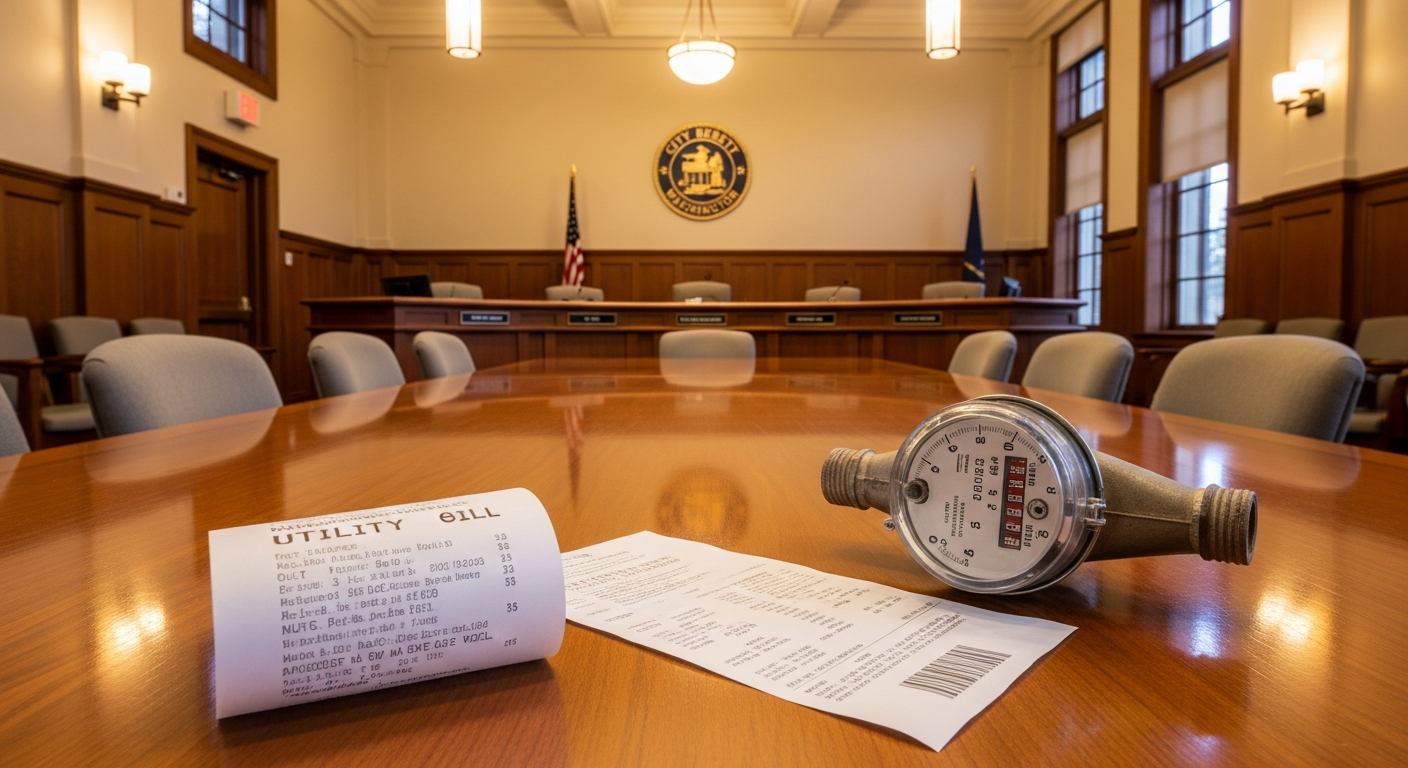
The ordinances that would replace Everett’s 6% water-and-sewer payment with a 12% utility tax — and update the rate tables to match — are officially on Wednesday’s City Council agenda. Two companion bills, CB 2605-27 and CB 2605-26, go to first reading at 6:30 p.m. on May 13 at City Hall, 3002 Wetmore Ave.
If both advance through three readings without amendment, the final vote lands May 27. Rate changes would take effect August 1, 2026 — about 11 weeks away. Here’s what each bill does and why it matters to your water bill.
The Two Bills, Explained
CB 2605-27: The Utility Tax Ordinance
This bill replaces the City’s existing 6% payment in lieu of taxes (PILOT) — a mechanism in place since a June 1, 1983 City Council resolution — with a 12% utility tax on the City’s water and sewer utility (Fund 401).
The legal distinction matters: the PILOT was an internal transfer between city departments. A utility tax is a formal statutory charge under RCW 35.22.195 that shows up directly in rate calculations. The rate is doubling and the structure is changing simultaneously.
According to the ordinance cover sheet, Finance Director Mike Bailey is the contact. The purpose, stated plainly in the bill: “to impose a 12% utility tax on the City’s water and sewer utility for the purpose of increasing revenue available for core City services.”
CB 2605-26: The Rate Amendments
This is the bill most residents will see on their monthly statement. It amends Everett’s established utility rates for 2025 through 2028 to account for the new utility tax, plus a $1 increase to the base filtration rate to allow the utility to retire some existing filtration debt ahead of schedule.
The rate table in the ordinance shows what single-family sewer customers would pay each year:
| Period | Single Family Sewer (Monthly) |
|---|---|
| 2025 | $104.04 |
| 2026 Jan–July | $118.49 |
| 2026 Aug–Dec | $126.78 (if approved) |
| 2027 | $141.99 |
| 2028+ | $158.51 |
The August 2026 jump — from $118.49 to $126.78 — is roughly $8.29 more per month on sewer alone for a single-family home. Water and filtration rates are also amended; the full tables are in the ordinance. The City has previously estimated the total combined impact of the utility tax change at approximately $10.74 per month for a typical residential customer.
Note: the bill’s rate table states that monthly charges “include Surface Water Quality Protection and Enhancement and the current state and city utility tax” — meaning the new rates are designed to be all-in figures once both ordinances pass.
Why This Is Happening
Everett is facing what city documents call a structural budget challenge: the cost of providing core services is growing faster than revenues. The projected 2027 general fund deficit has been pegged at approximately $14 million. The utility tax and rate changes are one lever the city is pulling to address it.
Other levers under active discussion include potential regionalization of fire services through a regional fire authority (RFA), Sno-Isle library regionalization, a new levy lid lift, and annexation of the Mariner neighborhood — most of which require voter approval. The utility tax does not: it is a council-authorized charge under state law.
The PILOT mechanism has been in place since 1983. Moving to a formal utility tax aligns Everett’s structure with how other Washington cities handle internal utility revenue transfers.
What Happens Next
The legislative timeline for both bills:
- May 13: Briefing and 1st Reading (both bills)
- May 20: 2nd Reading (CB 2605-26 public hearing also scheduled May 20)
- May 27: 3rd and Final Reading — action vote on both ordinances
Between now and May 27, residents can submit written public comments to the Everett City Council at council@everettwa.gov or by mail to 2930 Wetmore Ave., Suite 9A, Everett, WA 98201. Remote speakers can register via everettwa.gov/speakerform at least 30 minutes before each meeting.
What Residents Should Know
- No voter approval required. Unlike a levy lid lift, this is a council-only vote. There is no ballot measure.
- Two bills, one outcome. CB 2605-27 (tax) and CB 2605-26 (rates) are companion ordinances. Both need to pass for the full rate structure to work as designed.
- Outside-city customers are also affected. Everett operates a regional water system serving customers across much of Snohomish County. The rate ordinance covers outside-city rates as well.
- The filtration rate increase is separate. The $1 base filtration increase included in CB 2605-26 accelerates debt retirement — a distinct financial item bundled into the same bill.
- This has been in the works since at least April. The proposal first surfaced publicly in the City’s spring budget discussions and has been anticipated since the City disclosed its fiscal gap earlier this year.
What To Do Next
- Read the bills: CB 2605-27 and CB 2605-26 are available in the May 13 agenda packet at everettwa.gov/AgendaCenter.
- Comment in writing: Email council@everettwa.gov before May 20 to ensure comments reach members ahead of the final vote.
- Attend or watch: City Hall, 3002 Wetmore Ave., Wednesdays at 6:30 p.m. Live stream at YouTube.com/EverettCity.
- Register to speak remotely: everettwa.gov/speakerform, at least 30 minutes before the meeting.
- Questions about the ordinance: Finance Director Mike Bailey at mbailey@everettwa.gov.
Frequently Asked Questions
What is the utility tax rate being proposed?
CB 2605-27 proposes a 12% utility tax on the City’s water and sewer utility, replacing the existing 6% payment in lieu of taxes (PILOT) that has been in place since 1983.
When would the new rates take effect if approved?
August 1, 2026, per CB 2605-26.
Does this require voter approval?
No. A utility tax is a council-authorized charge under state law (RCW 35.22.195). The City Council votes on it; it does not go to a public ballot.
How much will this add to a typical bill?
The City has estimated approximately $10.74 per month for a typical residential customer. The rate ordinance shows single-family sewer rates going from $118.49 to $126.78 in August 2026 — about $8.29 more per month on that line alone. Water and filtration rate changes are in the full ordinance.
Why is the City doing this now?
Everett projects a roughly $14 million general fund deficit in 2027. The utility tax is one of several revenue-side measures under discussion. Unlike a levy lid lift or annexation vote, it doesn’t require voter approval — making it one of the faster-moving options available to the council.
Who does this affect beyond Everett city limits?
Everett operates a regional water system that serves customers across much of Snohomish County. The rate ordinance covers outside-city customer rates as well as city customers.
Is there a public hearing?
Yes — a public hearing on the rate ordinance (CB 2605-26) is scheduled for May 20, alongside the 2nd reading. Written comments can also be submitted to council@everettwa.gov at any time before the May 27 vote.
Leave a Reply