Author: William Tygart

  • Radon Laws in Utah: Testing, Disclosure & Mitigation Rules

    Radon Laws in Utah: Testing, Disclosure & Mitigation Rules

    The Short Answer

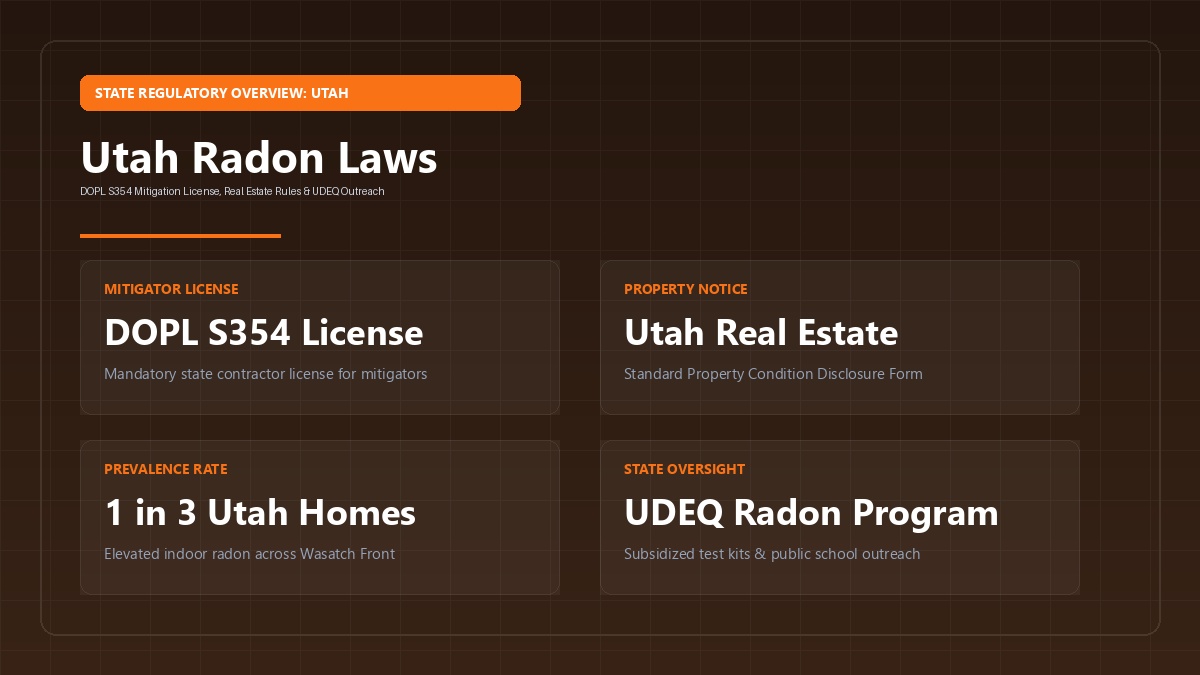
    Utah regulates radon through professional contractor licensing for mitigators, standardized real estate disclosures, and targeted public health testing initiatives. Under Utah Division of Professional Licensing (DOPL) regulations, contractors installing radon mitigation systems must hold a valid state contractor license, specifically the S354 Radon Mitigation Contractor specialty license or general building credentials. Residential home sellers are required under standard Utah Real Estate Commission forms to disclose known environmental hazards, including historical radon tests. Testing reveals that approximately one in three Utah homes tests above the EPA action level, driven by uranium-bearing granitic and volcanic geology.

    Testing Requirements

    Radon testing is voluntary for private single-family homeowners and residential landlords in Utah; state law does not compel existing property owners to test indoor air prior to occupancy or sale. Similarly, Utah statutes do not mandate routine radon testing in public or private K-12 school buildings, though the Utah Department of Environmental Quality (UDEQ) Indoor Radon Program actively partners with local school districts and the Utah State Board of Education to conduct voluntary school screening following ANSI/AARST commercial building protocols.

    Real-Estate Disclosure

    Real estate disclosure is governed under general Utah contract law and the Utah Real Estate Commission approved Seller’s Property Condition Disclosure form (authorized under Utah Code Title 57). Sellers of residential real property are legally obligated to disclose known material defects affecting property value or habitability. Section 11 of the standardized disclosure form explicitly questions whether the seller is aware of any past radon testing, the test results, or the presence of an active or passive radon mitigation system. While the disclosure form requires truthful reporting of historical test records, it does not mandate pre-closing testing, leaving testing contingencies to contract negotiation.

    Mitigator & Tester Certification

    Contractor licensing is mandatory in Utah for individuals and businesses installing radon mitigation systems. Under Utah Code Title 58, Chapter 55 and Utah Administrative Code R156-55a, contractors performing mitigation must hold an active license from the Utah Division of Professional Licensing (DOPL). Specifically, DOPL establishes the S354 Radon Mitigation Contractor classification (or recognizes general building contractors B100/R100). To obtain the S354 license, applicants must demonstrate active national certification through the National Radon Proficiency Program (NRPP) or the National Radon Safety Board (NRSB). For individuals performing measurement or testing only, DOPL does not require a specialty contractor license, but UDEQ strongly recommends NRPP or NRSB certification.

    New Construction

    Radon-resistant new construction is governed under the Utah State Construction and Fire Codes Act (Utah Code Title 15A), which adopts the International Residential Code (IRC). While IRC Appendix F (Radon Control Methods) is included within model codes, Utah has not enacted a blanket statewide mandate forcing passive RRNC in all new single-family homes. Instead, adoption of Appendix F is left to local municipal and county building departments. Several high-risk municipalities and jurisdictions along the Wasatch Front and mountain resort valleys (such as Park City and Summit County) enforce passive radon rough-ins under local ordinances.

    Radon Zones & the Action Level

    According to the EPA Map of Radon Zones and UDEQ geological surveys, Utah features complex mountainous terrain with significant radon potential. Several central and eastern counties—including Carbon, Duchesne, Grand, Piute, Sanpete, Sevier, and Uintah—are designated as EPA Zone 1 (High Potential), where predicted average screening levels exceed 4.0 pCi/L. Widespread Zone 2 (Moderate Potential, 2.0 to 4.0 pCi/L) counties cover the densely populated Wasatch Front, including Salt Lake, Utah, Davis, and Weber counties, where state surveys indicate approximately 33 percent of tested homes exceed 4.0 pCi/L. UDEQ adopts the federal action level benchmark of 4.0 pCi/L. For complete county classifications, visit our EPA Radon Zone Map guide.

    The State’s Radon Program

    The state regulatory and educational authority is the Utah Department of Environmental Quality Radon Program, operating within the Division of Waste Management and Radiation Control. UDEQ coordinates statewide public education, tracks testing data, and partners with testing laboratories to provide subsidized, low-cost short-term and long-term test kits to Utah residents. Homeowners and industry professionals can order test kits and verify licensed S354 contractors through the official UDEQ Radon Program portal or by contacting program staff at 801-536-0200.

    Sources & Limits

    This regulatory guide is provided for educational and informational purposes only and does not constitute formal legal, building code, or engineering counsel. Contractor licensing classifications and local building codes are subject to administrative update. Real estate buyers, sellers, landlords, and contractors should verify current rules directly with the Utah Division of Professional Licensing, UDEQ, or a qualified attorney.

    Official Sources: Utah Code Title 58, Chapter 55; Utah Administrative Code R156-55a; Utah Department of Environmental Quality (Division of Waste Management and Radiation Control); U.S. Environmental Protection Agency.

    To compare Utah’s contractor licensing model with other Western states, explore our master guide to radon regulations across the United States or inspect the EPA Radon Zone Map.
  • Radon Laws in North Carolina: Testing, Disclosure & Mitigation Rules

    Radon Laws in North Carolina: Testing, Disclosure & Mitigation Rules

    The Short Answer

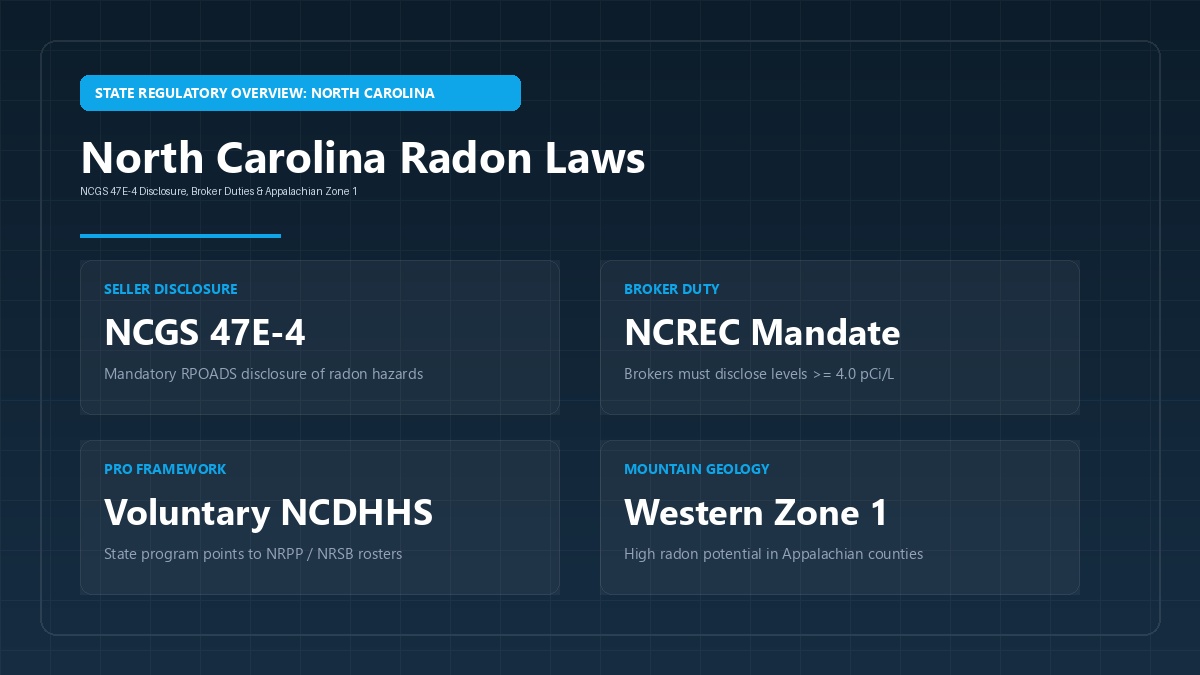
    North Carolina regulates radon primarily through real estate seller disclosures and licensed broker affirmative disclosure duties, alongside public health outreach. Under North Carolina General Statutes (NCGS) § 47E-4, residential property sellers must deliver a standardized disclosure statement disclosing known environmental hazards, including radon gas. North Carolina does not currently operate a mandatory state licensing board for radon testers or mitigators, officially referring consumers to national NRPP and NRSB registries. Furthermore, licensed real estate brokers have an independent legal duty under Real Estate Commission rules to disclose known radon levels of 4.0 pCi/L or higher as a material fact.

    Testing Requirements

    Indoor radon testing is voluntary for private single-family homeowners and residential landlords in North Carolina; the state imposes no statutory mandate compelling property owners to test existing residential dwellings prior to lease execution or sale. In addition, North Carolina statutes do not require routine radon testing in public or private K-12 school buildings or licensed commercial childcare facilities, though the North Carolina Department of Health and Human Services (NCDHHS) actively promotes voluntary school and daycare screening following EPA protocols.

    Real-Estate Disclosure

    Real estate disclosure is codified under the North Carolina Residential Property Disclosure Act, NCGS Chapter 47E. Under NCGS § 47E-4, residential property owners must complete and provide a Residential Property and Owners’ Association Disclosure Statement (RPOADS) to prospective buyers prior to contract acceptance. The form explicitly requires the seller to disclose knowledge of any hazardous or toxic substances, specifically including radon gas, past test results, and installed mitigation systems. Crucially, under North Carolina Real Estate Commission (NCREC) licensing rules, real estate brokers have an independent affirmative legal obligation to discover and disclose material facts; if a broker has actual knowledge that a property has tested at or above 4.0 pCi/L, they must disclose that information to prospective purchasers regardless of what the seller marks on the form.

    Mitigator & Tester Certification

    North Carolina has no mandatory state licensing program for radon measurement or mitigation contractors, per the North Carolina Department of Health and Human Services Radiation Protection Section, verified November 2026. While Session Law 2023-91 authorized NCDHHS to develop certification standards, the state currently maintains no independent licensing exam or regulatory board. NCDHHS officially recommends that consumers hire professionals certified through the National Radon Proficiency Program (NRPP) or the National Radon Safety Board (NRSB). Contractors must comply with local municipal building and electrical trade permits when installing mitigation fans.

    New Construction

    Radon-resistant new construction is not mandated statewide under the North Carolina State Residential Code. While model codes like the International Residential Code Appendix F contain specifications for passive sub-slab suction systems, North Carolina has not adopted Appendix F as a mandatory statewide requirement for new residential construction. Local jurisdictions or individual builders may adopt passive radon reduction techniques voluntarily, which is common in western mountain communities with elevated soil gas emissions.

    Radon Zones & the Action Level

    According to the EPA Map of Radon Zones, North Carolina exhibits a sharp geographical divide. The Appalachian Mountain and Upper Piedmont counties in western North Carolina—including Buncombe (Asheville), Henderson, Watauga (Boone), Cherokee, Mitchell, and Alleghany—are designated as EPA Zone 1 (High Potential), where predicted average indoor screening levels exceed 4.0 pCi/L. Central Piedmont counties (such as Wake and Mecklenburg) fall primarily within Zone 2 (Moderate Potential, 2.0 to 4.0 pCi/L), while coastal plain counties are classified as Zone 3 (Low Potential, < 2.0 pCi/L). NCDHHS enforces the federal action level benchmark of 4.0 pCi/L. For regional county classifications, consult our EPA Radon Zone Map guide.

    The State’s Radon Program

    The state regulatory and educational authority is the North Carolina Radon Program, housed within the Radiation Protection Section of the Division of Health Service Regulation at NCDHHS. The program provides public education, maintains county-level risk maps, and distributes low-cost test kits to North Carolina residents. Homeowners and industry professionals can order test kits, access educational materials, and review nationally certified contractor directories via the official NCDHHS Radon Program portal or by contacting program staff at 919-814-2250.

    Sources & Limits

    This regulatory guide is provided for educational and informational purposes only and does not constitute formal legal, building code, or engineering counsel. State disclosure laws and broker licensing standards are subject to regulatory updates. Real estate buyers, sellers, landlords, and contractors should verify current rules directly with NCDHHS or a licensed North Carolina real estate attorney.

    Official Sources: North Carolina General Statutes § 47E-4; North Carolina Real Estate Commission (NCREC); North Carolina Department of Health and Human Services (NCDHHS); U.S. Environmental Protection Agency.

    To evaluate how North Carolina’s broker disclosure standards compare with other states, consult our comprehensive guide to radon regulations across the United States or inspect the EPA Radon Zone Map.

  • Radon Laws in Montana: Testing, Disclosure & Mitigation Rules

    Radon Laws in Montana: Testing, Disclosure & Mitigation Rules

    The Short Answer

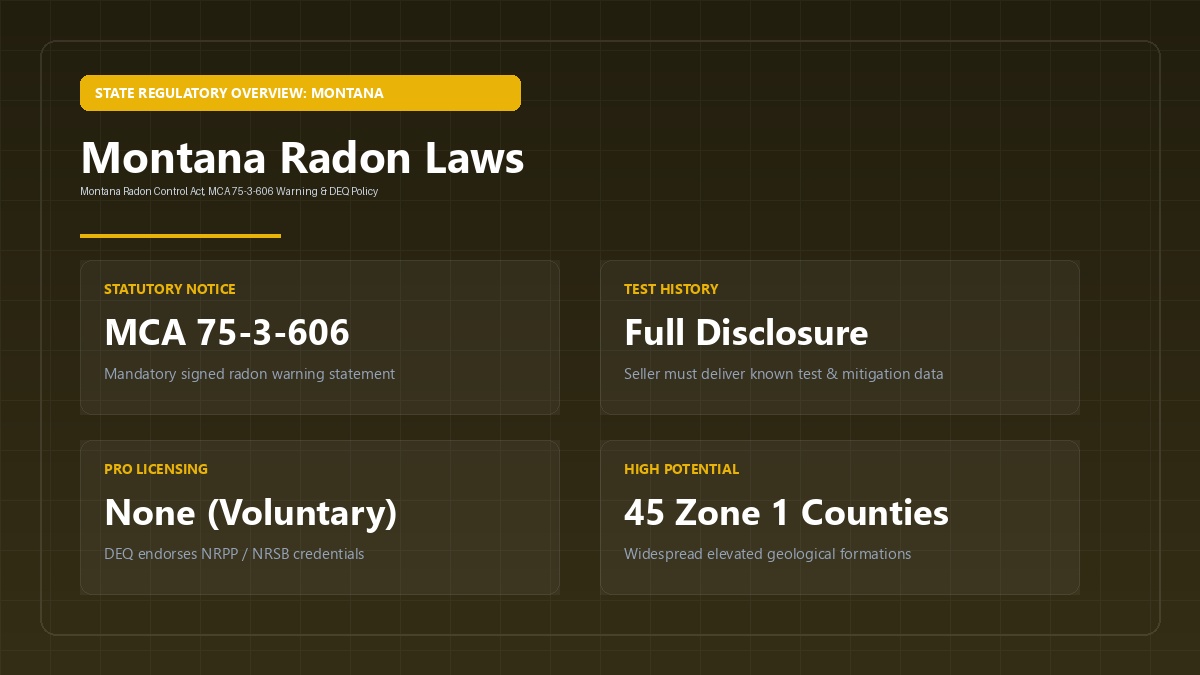
    Montana regulates radon primarily through a strict statutory real estate warning and disclosure mandate codified in the Montana Radon Control Act. Under Montana Code Annotated (MCA) § 75-3-606, residential real estate transactions must incorporate a mandatory verbatim statutory warning statement signed by the purchaser, accompanied by copies of any available radon test results or mitigation records. Montana does not license radon testers or mitigators through a state licensing board, directing consumers to national NRPP and NRSB certification registries. Geologically, Montana is heavily elevated, with 45 of its 56 counties designated as EPA Zone 1.

    Testing Requirements

    Indoor radon testing is voluntary for private residential homeowners and landlords under Montana law; the state does not compel owners of existing single-family dwellings or rental properties to test indoor air. In addition, Montana statutes do not mandate routine radon testing in public or private K-12 school buildings or commercial child care centers, although the Montana Department of Environmental Quality (DEQ) strongly encourages school administrators to test voluntarily using standardized EPA and ANSI/AARST protocols.

    Real-Estate Disclosure

    Real estate disclosure is strictly mandated under the Montana Radon Control Act, Montana Code Annotated (MCA) §§ 75-3-601 to 75-3-607. Under MCA § 75-3-606, prior to or contemporaneously with executing any contract for the purchase and sale of residential real property, the seller must provide the buyer with a document containing a specific, verbatim statutory radon warning statement in prominent lettering. The buyer must sign an acknowledgment confirming receipt of the notice. Furthermore, if the property has ever been tested for radon or has undergone mitigation treatments, the seller must deliver copies of all available test reports and mitigation documentation. The statute requires disclosure of known conditions, but does not obligate sellers to conduct new testing.

    Mitigator & Tester Certification

    Montana has no state licensing requirement for radon measurement technicians or mitigation contractors, per the Montana Department of Environmental Quality, verified November 2026. The state maintains no state-administered regulatory board or licensing exam for radon professionals. Instead, the Montana DEQ officially directs homeowners, builders, and real estate professionals to hire contractors certified through the National Radon Proficiency Program (NRPP) or the National Radon Safety Board (NRSB). Contractors must adhere to local municipal trade and electrical permits when installing vent fans or running electrical wiring.

    New Construction

    Montana does not enforce a statewide mandatory building code requiring passive Radon-Resistant New Construction (RRNC) in all new residential construction. While the Montana Department of Labor and Industry Building Codes Program oversees statewide building codes, model appendices like IRC Appendix F are not universally mandated for single-family residential construction across the state. However, individual local jurisdictions (such as Missoula, Bozeman, and Helena) and custom builders frequently adopt passive soil-gas ventilation practices voluntarily due to the state’s severe radon risk.

    Radon Zones & the Action Level

    According to the EPA Map of Radon Zones, Montana possesses exceptional geological radon risk: 45 out of 56 counties are classified as EPA Zone 1 (High Potential), where predicted average indoor screening levels exceed the federal action level of 4.0 pCi/L. The remaining 11 counties are designated as Zone 2 (Moderate Potential, 2.0 to 4.0 pCi/L); zero Montana counties are classified as low-risk Zone 3. Montana DEQ enforces the federal action level benchmark of 4.0 pCi/L, while advising that mitigation be considered between 2.0 and 4.0 pCi/L. For county-level geological maps, visit our EPA Radon Zone Map guide.

    The State’s Radon Program

    The official state educational and technical agency is the Montana Department of Environmental Quality Radon Program, based within the Energy and Indoor Air Programs. Montana DEQ provides technical guidance to homeowners, coordinates with county health departments, and offers subsidized, low-cost short-term test kits through authorized testing laboratories. Montana residents can order test kits, review county testing statistics, and locate certified contractors through the official Montana DEQ Radon Program portal or by calling the DEQ program office at 406-444-6697.

    Sources & Limits

    This regulatory guide is provided for educational and informational purposes only and does not constitute formal legal, building code, or engineering counsel. State statutory disclosure requirements and local building codes are subject to legislative amendment. Property buyers, sellers, landlords, and contractors should verify current rules directly with the Montana Department of Environmental Quality or a licensed Montana attorney.

    Official Sources: Montana Code Annotated §§ 75-3-601–75-3-607; Montana Department of Environmental Quality (DEQ); U.S. Environmental Protection Agency (Map of Radon Zones).

    To compare Montana’s statutory disclosure rules with other states across the nation, consult our master guide to radon regulations across the United States or inspect the EPA Radon Zone Map.
  • Radon Laws in Wisconsin: Testing, Disclosure & Mitigation Rules

    Radon Laws in Wisconsin: Testing, Disclosure & Mitigation Rules

    The Short Answer

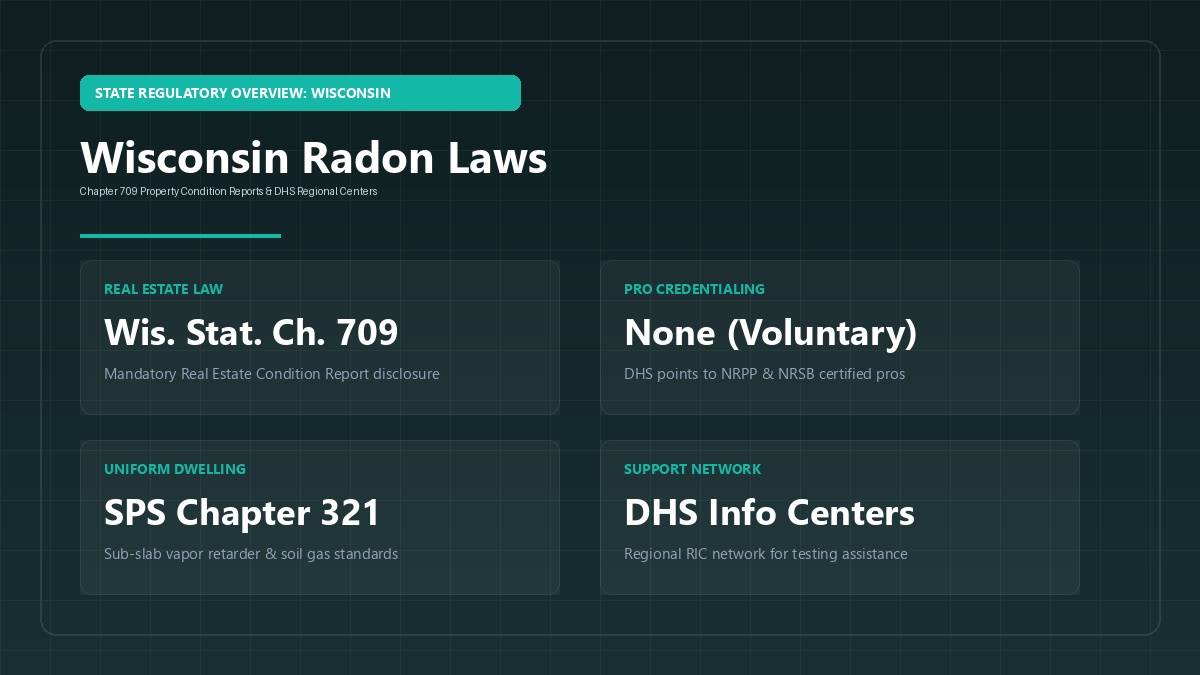
    Wisconsin regulates radon primarily through mandatory real estate condition disclosures and public health education coordinated through a statewide network of regional information centers. Under Wisconsin Statutes Chapter 709, residential sellers must complete a statutory Real Estate Condition Report disclosing known environmental hazards, including historical radon test results and installed mitigation equipment. Wisconsin does not operate a direct state licensing program for radon mitigators or testing specialists, pointing consumers to national NRPP and NRSB certification registries. In residential construction, the Wisconsin Uniform Dwelling Code mandates foundation sealing and sub-slab moisture barriers that provide passive soil-gas protection.

    Testing Requirements

    Indoor radon testing is voluntary for private single-family homeowners and residential landlords in Wisconsin; the state does not compel property owners to test existing dwellings prior to occupancy or sale. Similarly, Wisconsin statutes do not mandate routine radon testing in public or private K-12 school buildings or commercial child care facilities, though the Wisconsin Department of Health Services (DHS) and local public health divisions actively encourage school administrators to test voluntarily using ANSI/AARST school measurement protocols.

    Real-Estate Disclosure

    Real estate disclosure is governed by Wisconsin Statutes Chapter 709 (§§ 709.01 to 709.08). Under Wis. Stat. § 709.02, sellers of residential real estate (1 to 4 dwelling units) must deliver a completed Real Estate Condition Report (RECR) to prospective buyers within 10 days of accepting a purchase offer. The statutory disclosure form specifically requires sellers to disclose known environmental defects, including elevated radon gas levels, prior test reports, and whether an active or passive mitigation system is installed on the property. Failing to disclose known radon defects exposes sellers to statutory rescission rights and financial liability, though the law does not compel sellers to test untested homes.

    Mitigator & Tester Certification

    Wisconsin has no state licensing requirement for radon measurement technicians or mitigation contractors, per the Wisconsin Department of Health Services, verified November 2026. The state maintains no state-administered radon licensing board or regulatory credential. Instead, Wisconsin DHS officially directs homeowners, buyers, and local building officials to hire professionals certified through the two national proficiency programs recognized by the EPA: the National Radon Proficiency Program (NRPP) and the National Radon Safety Board (NRSB). Contractors must comply with local municipal building and electrical trade permits when modifying foundations or wiring mitigation fans.

    New Construction

    Construction standards in Wisconsin are governed by the Uniform Dwelling Code (UDC), codified in Wisconsin Administrative Code SPS Chapter 321. While SPS Chapter 321 does not universally mandate continuous passive radon vent pipes statewide, it enforces stringent sub-slab moisture and soil-gas retarder standards—including granular base courses and 6-mil polyethylene vapor membranes—alongside foundation waterproofing requirements that limit soil gas infiltration. Furthermore, individual municipalities and tribal jurisdictions (such as Forest County Potawatomi) have adopted model codes such as IRC Appendix F requiring complete passive radon-resistant new construction.

    Radon Zones & the Action Level

    According to the EPA Map of Radon Zones, Wisconsin features extensive EPA Zone 1 (High Potential) coverage across southern, eastern, and central counties—including Dane (Madison), Waukesha, Rock, Dodge, and Fond du Lac—where predicted average screening levels exceed 4.0 pCi/L. Remaining northern and western counties fall within Zone 2 (Moderate Potential, 2.0 to 4.0 pCi/L). Wisconsin DHS enforces the federal EPA action level of 4.0 pCi/L, noting that approximately one in three tested Wisconsin homes exhibits concentrations above this threshold. For complete geological risk details, visit our EPA Radon Zone Map guide.

    The State’s Radon Program

    The state’s official public health initiative is the Wisconsin Department of Health Services Radon Program, administered in partnership with local public health agencies through a network of 16 regional Radon Information Centers (RICs). The RIC network provides local testing advice, distributes subsidized test kits, and assists residents with interpreting test scores. Homeowners and contractors can locate their nearest regional information center and order test kits through the official Wisconsin DHS Radon Program portal or by calling the state radon line at 608-266-1120.

    Sources & Limits

    This regulatory summary is provided for educational and informational purposes only and does not constitute formal legal, building code, or engineering guidance. Statutory disclosure mandates and dwelling codes are subject to legislative amendment. Real estate buyers, sellers, landlords, and contractors should verify current rules directly with the Wisconsin Department of Health Services or a licensed real estate attorney.

    Official Sources: Wisconsin Statutes Chapter 709; Wisconsin Administrative Code SPS Chapter 321; Wisconsin Department of Health Services (DHS); U.S. Environmental Protection Agency.

    To examine how Wisconsin’s regulatory approach compares to other states, consult our comprehensive guide to radon regulations across the United States or inspect the EPA Radon Zone Map.

  • Radon Laws in Connecticut: Testing, Disclosure & Mitigation Rules

    Radon Laws in Connecticut: Testing, Disclosure & Mitigation Rules

    The Short Answer

    Connecticut enforces a comprehensive radon regulatory regime that combines statutory credentialing mandates, periodic public school testing, and mandatory real estate disclosures. Under Connecticut General Statutes (CGS) § 20-420, it is unlawful for any contractor to perform radon mitigation without holding active national certification (NRPP or NRSB) and registration as a Home Improvement Contractor with the Department of Consumer Protection. Public schools are mandated under CGS § 10-220(d) to be evaluated for radon before January 1, 2008 and every three years thereafter. Residential sellers must disclose known radon test records under CGS § 20-327b, and the state building code requires radon-resistant construction in designated high-risk jurisdictions.

    Testing Requirements

    Connecticut mandates indoor radon testing in sensitive educational facilities. Under CGS § 10-220(d), local and regional boards of education are statutorily required to conduct periodic indoor air quality assessments, including radon testing, in every public school building (grades K-12), repeating evaluations at least once every three years following Connecticut Department of Public Health (DPH) and EPA protocols. Child day care centers licensed by the Office of Early Childhood must also undergo testing prior to initial licensure and periodic renewal. For private single-family homes and general residential rental properties, radon testing remains voluntary under state law.

    Real-Estate Disclosure

    Residential property transactions are governed by Connecticut General Statutes § 20-327b. Before a purchase contract is finalized, sellers of residential real estate (1 to 4 units) must provide prospective buyers with a written Residential Property Condition Disclosure Report prescribed by the Department of Consumer Protection. The statutory report includes explicit questions concerning whether the seller has knowledge of any radon testing, the most recent test scores, and whether an active or passive radon mitigation system is installed on the property. Sellers must disclose known historical data, though they are not statutorily compelled to commission new tests.

    Mitigator & Tester Certification

    Contractor credentialing is strictly enforced under CGS § 20-420 and CGS § 19a-14b. No person or business may advertise or perform radon mitigation services in Connecticut without providing proof of active national certification through either the National Radon Proficiency Program (NRPP) or the National Radon Safety Board (NRSB), and maintaining an active Home Improvement Contractor (HIC) registration with the Department of Consumer Protection (DCP). Under CGS § 19a-14b, the Connecticut Department of Public Health maintains and publishes the official registry of qualified mitigation and measurement professionals operating in the state.

    New Construction

    Radon-resistant construction is integrated into the Connecticut State Building Code, which incorporates the International Residential Code (IRC) Appendix F. Builders constructing new one- and two-family dwellings in designated high-potential municipalities (primarily within EPA Zone 1 regions such as Middlesex and Fairfield counties) must install passive radon-resistant features during initial construction. Required techniques include sub-slab aggregate or soil-gas collectors, 6-mil polyethylene membranes, sealed perimeter expansion joints, and a routed vertical vent pipe terminating above the roofline.

    Radon Zones & the Action Level

    The EPA Map of Radon Zones designates Fairfield and Middlesex counties in Connecticut as EPA Zone 1 (High Potential), where predicted average indoor screening levels exceed 4.0 pCi/L. The remaining counties—including Hartford, New Haven, New London, Litchfield, Tolland, and Windham—fall within Zone 2 (Moderate Potential, 2.0 to 4.0 pCi/L). Connecticut DPH establishes the state action level at the federal standard of 4.0 pCi/L, while advising that mitigation be considered for levels between 2.0 and 4.0 pCi/L to reduce lifetime radiation exposure. For comprehensive regional classifications, review our EPA Radon Zone Map guide.

    The State’s Radon Program

    The official regulatory and public health authority is the Connecticut Department of Public Health Radon Program, housed within the Environmental Health and Drinking Water Branch. The DPH Radon Program publishes the statewide contractor roster, provides protocol oversight for school testing under CGS § 10-220(d), and distributes public education and subsidized test kits through local health departments. Homeowners, school administrators, and contractors can access official lists and ordering information via the Connecticut DPH Radon Program portal or by calling 860-509-7367.

    Sources & Limits

    This regulatory guide is provided for educational and informational purposes only and does not constitute formal legal, building code, or engineering counsel. Statutory credentialing requirements and school testing rules are subject to legislative amendment. Real estate buyers, sellers, landlords, and contractors should verify current rules directly with the Connecticut Department of Public Health or a qualified real estate attorney.

    Official Sources: Connecticut General Statutes §§ 20-420, 19a-14b, 10-220(d), 20-327b; Connecticut State Building Code Appendix F; Connecticut Department of Public Health; U.S. Environmental Protection Agency.

    To compare Connecticut’s statutory standards with neighboring states, consult our complete guide to radon regulations across the United States or inspect the EPA Radon Zone Map.

  • Radon Laws in Michigan: Testing, Disclosure & Mitigation Rules

    Radon Laws in Michigan: Testing, Disclosure & Mitigation Rules

    The Short Answer

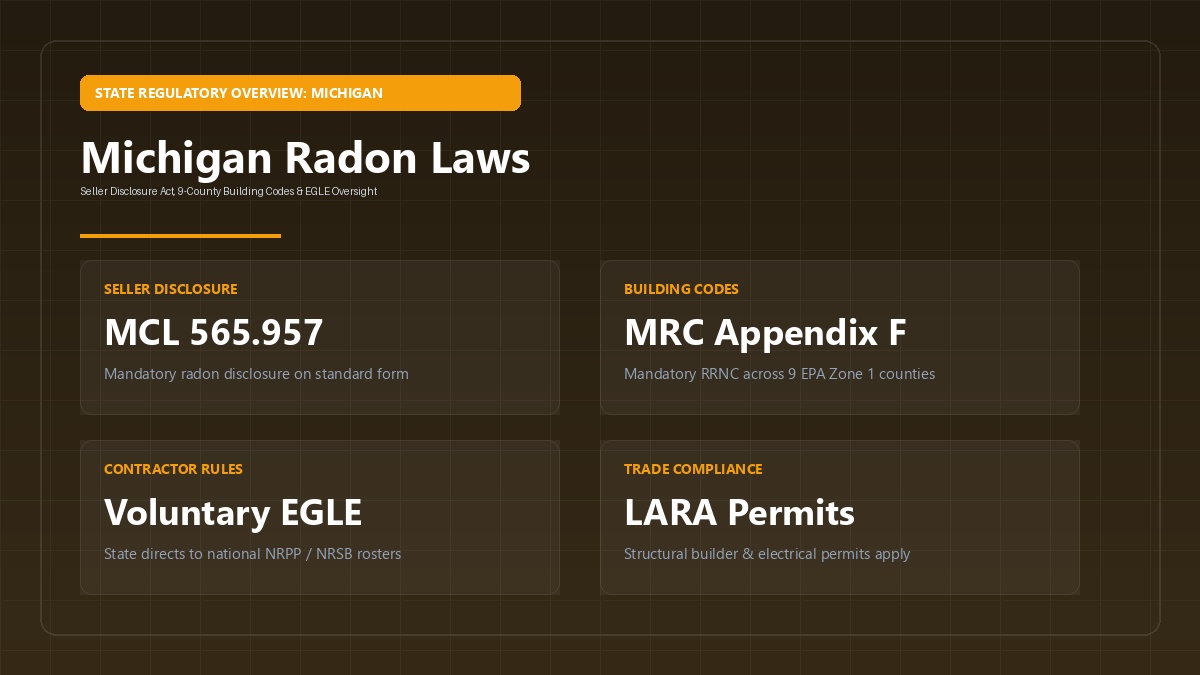
    Michigan regulates radon primarily through mandatory real estate seller disclosures and targeted residential building code requirements in high-risk counties. Under the Michigan Seller Disclosure Act (MCL § 565.957), residential home sellers must complete a statutory disclosure statement disclosing known environmental hazards, including radon gas and historical test data. Michigan does not license radon testers or mitigators through a dedicated state radon board, instead directing the public to national NRPP and NRSB certification registries. In new residential construction, the Michigan Residential Code enforces mandatory passive radon-resistant construction across nine southern EPA Zone 1 counties.

    Testing Requirements

    Indoor radon testing is voluntary for private single-family homeowners and residential landlords in Michigan; state law does not compel property owners to test existing residential dwellings prior to leasing or sale. Similarly, Michigan does not impose a statewide statutory mandate requiring regular radon screening in public K-12 schools or licensed childcare facilities, although the Michigan Department of Environment, Great Lakes, and Energy (EGLE) and local health departments actively encourage voluntary school testing using standardized EPA protocols.

    Real-Estate Disclosure

    Real estate disclosure is codified under the Michigan Seller Disclosure Act, Michigan Compiled Laws (MCL) §§ 565.951 to 565.966. Under MCL § 565.957, sellers of residential real property (1 to 4 units) must deliver a completed Seller’s Disclosure Statement to prospective buyers before executing a binding purchase agreement. Section 10 of the statutory form specifically requires the seller to disclose knowledge of any environmental hazards on the property, explicitly listing radon gas alongside lead, asbestos, and underground tanks. While sellers must truthfully disclose known historical test results or installed mitigation systems, the act does not require sellers to perform testing as a condition of sale, leaving testing contingencies to purchase agreements.

    Mitigator & Tester Certification

    Michigan has no direct state licensing requirement specifically for radon mitigators or testing contractors, per the Michigan Department of Environment, Great Lakes, and Energy, verified November 2026. EGLE does not administer an independent state radon licensing exam or board. Instead, EGLE officially recommends that property owners hire contractors who maintain active national certifications through the National Radon Proficiency Program (NRPP) or the National Radon Safety Board (NRSB). However, contractors installing mitigation systems must comply with Michigan Department of Licensing and Regulatory Affairs (LARA) trade regulations, obtaining residential builder or maintenance and alteration licenses and local electrical permits for fan wiring.

    New Construction

    Radon-resistant new construction is mandatory in designated regions under the Michigan Residential Code (incorporating IRC Appendix F). Michigan mandates passive radon-resistant new construction (RRNC) techniques—including gas-permeable aggregate or soil-gas matting, 6-mil polyethylene ground retarders, foundation sealing, and a continuous vertical vent pipe—across nine designated EPA Zone 1 counties: Branch, Calhoun, Cass, Hillsdale, Jackson, Kalamazoo, Lenawee, St. Joseph, and Washtenaw. In all other Michigan counties, RRNC remains voluntary unless adopted by local municipal ordinance.

    Radon Zones & the Action Level

    According to the EPA Map of Radon Zones, Michigan contains nine EPA Zone 1 (High Potential) counties located in the southern tier, where predicted average indoor screening levels exceed the national action level of 4.0 pCi/L. Central and northern Lower Peninsula counties and parts of the Upper Peninsula are classified as Zone 2 (Moderate Potential, 2.0 to 4.0 pCi/L) or Zone 3 (Low Potential, < 2.0 pCi/L). EGLE enforces the federal EPA action level benchmark of 4.0 pCi/L, advising that mitigation systems be installed when indoor levels meet or exceed 4.0 pCi/L. For complete county breakdown, consult our EPA Radon Zone Map guide.

    The State’s Radon Program

    The state regulatory and educational authority is the Michigan Department of Environment, Great Lakes, and Energy (EGLE) Radon Program, managed within the Remediation and Redevelopment Division. EGLE provides technical assistance, coordinates with local health departments, maintains public information on certified contractors, and helps residents purchase low-cost short-term and long-term test kits. Homeowners can order test kits and access educational resources through the official EGLE Radon Program portal or by calling the state radon hotline at 800-723-6642 (800-RADON-GAS).

    Sources & Limits

    This regulatory guide is provided for educational and informational purposes only and does not constitute formal legal, building code, or engineering counsel. State statutory disclosure requirements and building codes are subject to legislative amendment. Property buyers, sellers, landlords, and contractors should verify current rules directly with EGLE or a qualified Michigan real estate attorney.

    Official Sources: Michigan Compiled Laws § 565.957; Michigan Residential Code Appendix F; Michigan Department of Environment, Great Lakes, and Energy (EGLE); U.S. Environmental Protection Agency.

    To review how Michigan’s policies compare with other jurisdictions, explore our nationwide guide to radon regulations across the United States or inspect the EPA Radon Zone Map.

  • Radon Laws in Vermont: Testing, Disclosure & Mitigation Rules

    Radon Laws in Vermont: Testing, Disclosure & Mitigation Rules

    The Short Answer

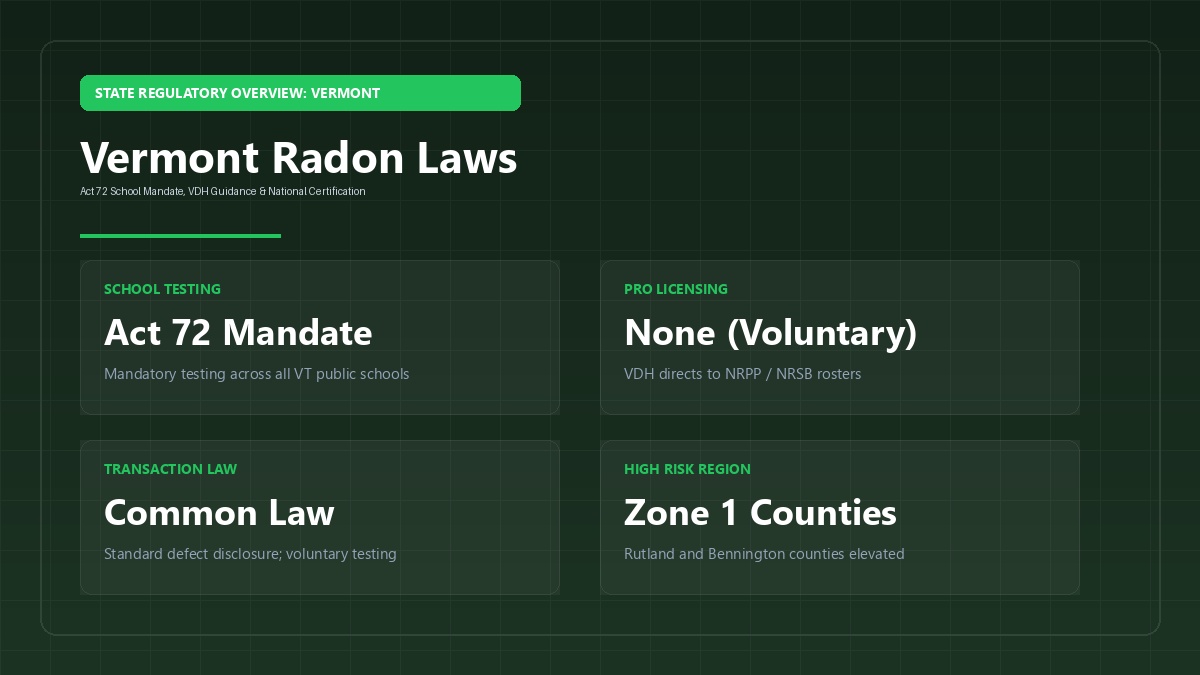
    Vermont regulates radon primarily through targeted institutional testing mandates and comprehensive public health outreach, while maintaining a voluntary framework for residential transactions. Under Act 72 (passed in 2021), Vermont mandated radon testing across all public school buildings statewide. The state does not operate a direct licensing program for radon mitigators or testing contractors, relying instead on national credentialing through the NRPP and NRSB. In residential real estate, Vermont operates without a standalone statutory radon disclosure act, relying on common-law defect disclosure principles and contractual inspection contingencies.

    Testing Requirements

    Vermont enforces one of the most explicit public school testing statutes in New England. Under Section 12 of Vermont Act 72 (codified in Title 18), all public school supervisory unions and school districts were required to complete radon testing in all regularly occupied classrooms and educational spaces. Testing must be conducted in accordance with ANSI/AARST protocol for schools and large buildings, with elevated results requiring remediation planning. For private single-family homes and standard rental properties, radon testing remains voluntary under state law, although the Vermont Department of Health (VDH) urges all landlords and homeowners to test regularly, noting that approximately one in seven Vermont homes exceeds actionable levels.

    Real-Estate Disclosure

    Vermont does not have an explicit state statute mandating a standalone radon disclosure statement or forcing residential sellers to deliver pre-contract radon warning notices, per the Vermont Department of Health, verified November 2026. Real estate transactions in Vermont are guided by common-law principles governing the disclosure of known material latent defects and standard Vermont Association of Realtors (VAR) Seller’s Property Information Reports. If a seller or their real estate broker has actual knowledge of historical elevated radon test results or defective mitigation equipment, concealing that information can create common-law liability for fraudulent nondisclosure. Testing contingencies are routinely negotiated in purchase and sales agreements.

    Mitigator & Tester Certification

    Vermont has no state licensing requirement for radon mitigators or measurement contractors, per the Vermont Department of Health Radon Program, verified November 2026. The state maintains no state-administered licensing board or professional examination for radon contractors. Instead, the Vermont Department of Health officially advises consumers, school administrators, and property managers to hire contractors who hold active credentials from the National Radon Proficiency Program (NRPP) or the National Radon Safety Board (NRSB), and who comply with ANSI/AARST residential and large-building technical standards.

    New Construction

    Vermont does not enforce a statewide mandatory building code requiring passive Radon-Resistant New Construction (RRNC) in all new single-family residential dwellings. While the Vermont Residential Building Energy Standards (RBES) regulate air leakage, insulation, and ventilation efficiency, passive radon vent stacks and sub-slab membranes are not universally mandated for private single-family construction. However, the Vermont Department of Health and local environmental groups strongly advocate for voluntary passive pipe rough-ins during construction to prevent expensive retrofits later.

    Radon Zones & the Action Level

    According to the EPA Map of Radon Zones, Vermont presents varied geological potential across its counties. Rutland and Bennington counties in southwestern Vermont are designated as EPA Zone 1 (High Potential), where predicted average indoor screening levels exceed the national action level of 4.0 pCi/L. The remaining counties—including Chittenden (Burlington), Washington (Montpelier), and Windham—are designated as Zone 2 (Moderate Potential, 2.0 to 4.0 pCi/L) or Zone 3. VDH adopts the EPA action level of 4.0 pCi/L, while advising that homeowners consider mitigation between 2.0 and 4.0 pCi/L. For county-level geological details, visit our EPA Radon Zone Map guide.

    The State’s Radon Program

    The state’s official public health initiative is the Vermont Department of Health Radon Program, based within the Environmental Health Division. VDH provides technical assistance, educational toolkits for schools and child care centers, and distributes free radon test kits to Vermont residents through its online order system. Homeowners and facility operators can request a free test kit, submit samples to the Vermont Department of Health Public Health Laboratory, and obtain certified contractor guidance via the official Vermont Health Radon Program portal or by emailing radon@vermont.gov.

    Sources & Limits

    This regulatory guide is provided for educational and informational purposes only and does not constitute formal legal, building code, or engineering counsel. State statutes and school testing mandates are subject to legislative amendment. Property buyers, sellers, landlords, and contractors should verify current rules directly with the Vermont Department of Health or a licensed Vermont attorney.

    Official Sources: Vermont Act 72 (2021) § 12; Vermont Department of Health (Environmental Health Division); U.S. Environmental Protection Agency.

    To examine how Vermont’s regulatory approach compares to other states, consult our comprehensive guide to radon regulations across the United States or inspect the EPA Radon Zone Map.

  • Radon Laws in Kentucky: Testing, Disclosure & Mitigation Rules

    Radon Laws in Kentucky: Testing, Disclosure & Mitigation Rules

    The Short Answer

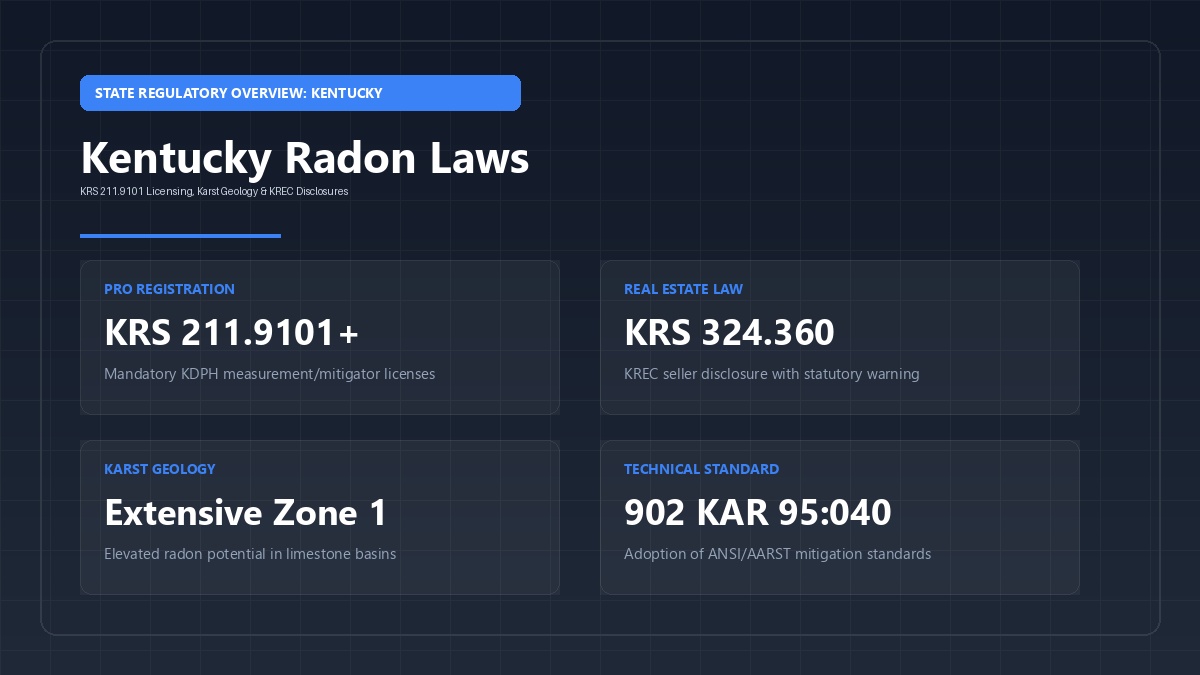
    Kentucky regulates radon through mandatory professional credentialing and codified real estate disclosure. Under Kentucky Revised Statutes (KRS) §§ 211.9101 through 211.9135, all individuals and businesses providing radon measurement, mitigation, or laboratory services for fee must be officially registered and licensed with the Kentucky Cabinet for Health and Family Services (CHFS). Residential home sellers are required under KRS § 324.360 to disclose known radon test records and mitigation equipment using a standardized condition disclosure form that contains statutory health warnings. Due to extensive karst limestone topography, elevated indoor radon levels are widespread across central and western Kentucky.

    Testing Requirements

    Indoor radon testing is voluntary for private single-family homeowners and residential landlords in Kentucky. State law does not require existing residential properties to undergo mandatory testing prior to lease execution or occupancy. In addition, Kentucky does not currently mandate radon testing in public or private school buildings or commercial child care facilities by statute, although the Kentucky Department for Public Health (KDPH) strongly recommends that school districts and daycare centers conduct routine baseline screening using licensed measurement specialists adhering to ANSI/AARST standards.

    Real-Estate Disclosure

    Property transaction disclosures are governed by KRS § 324.360 and Kentucky Real Estate Commission (KREC) administrative regulations (201 KAR 11:121). In residential transactions involving licensed real estate licensees, the seller must complete the Seller’s Disclosure of Property Condition form prior to contract acceptance. The form mandates that sellers disclose any prior radon testing conducted on the premises, provide historical test scores, and state whether an active or passive radon mitigation system is installed. The KREC disclosure form explicitly incorporates mandatory statutory warning text advising prospective purchasers that radon is a radioactive gas presenting lung cancer risks and recommending independent professional testing.

    Mitigator & Tester Certification

    Professional licensing is mandatory in Kentucky under KRS §§ 211.9101 to 211.9135 and administrative regulation 902 KAR 95:040. Anyone offering radon measurement, mitigation, or laboratory analysis for compensation must be registered biennially with the Cabinet for Health and Family Services. To qualify for state registration, individuals must hold current national proficiency certification from either the National Radon Proficiency Program (NRPP) or the National Radon Safety Board (NRSB), adhere to ANSI/AARST standard operating procedures, maintain liability insurance, and submit mandatory semi-annual activity reports to the state radon coordinator.

    New Construction

    Kentucky has not enacted a blanket statewide mandate requiring Radon-Resistant New Construction (RRNC) in all new residential buildings. The Kentucky Residential Code (KRC), based on the International Residential Code, includes Appendix F (Radon Control Methods), but adoption is largely left to local building code enforcement departments or voluntary implementation by builders. However, in regions with intense karst development (such as the Bluegrass and Pennyroyal regions), many local planning commissions and progressive homebuilders voluntarily incorporate passive sub-slab suction systems during initial foundation pours.

    Radon Zones & the Action Level

    The EPA Map of Radon Zones classifies much of Kentucky—including the central Bluegrass region (Fayette County/Lexington), north-central counties (Jefferson County/Louisville), and south-central karst basins (Warren County/Bowling Green)—as EPA Zone 1 (High Potential), where indoor levels frequently exceed the federal action level of 4.0 pCi/L. Eastern Appalachian counties and western coalfield basins are primarily designated as Zone 2 (Moderate Potential, 2.0 to 4.0 pCi/L). KDPH adopts the EPA action level of 4.0 pCi/L, strongly urging mitigation for test results at or above this threshold. For complete geological zone details, explore our EPA Radon Zone Map guide.

    The State’s Radon Program

    The official state regulatory and educational authority is the Kentucky Department for Public Health Radon Program, housed within the Radiation, Food and Safety Branch of the Cabinet for Health and Family Services. KDPH maintains the official statewide registry of registered measurement and mitigation contractors, tracks regional screening data, and coordinates with local health departments to distribute free or discounted short-term test kits to Kentucky residents. Homeowners and industry professionals can verify credentials and access test kits via the official CHFS Radon Program website or by contacting program staff at 502-564-4856.

    Sources & Limits

    This regulatory summary is published for educational and informational purposes only and does not constitute formal legal, building code, or engineering guidance. Statutory licensing rules and real estate disclosure requirements are subject to regulatory updates. Real estate buyers, sellers, landlords, and contractors should verify current rules directly with the Kentucky Department for Public Health or qualified legal counsel.

    Official Sources: Kentucky Revised Statutes §§ 211.9101–211.9135, § 324.360; 902 KAR 95:040; 201 KAR 11:121; Kentucky Cabinet for Health and Family Services; U.S. Environmental Protection Agency.

    To see how Kentucky’s registration rules compare across the nation, visit our master guide to radon regulations across the United States or inspect the EPA Radon Zone Map.
  • Radon Laws in Ohio: Testing, Disclosure & Mitigation Rules

    Radon Laws in Ohio: Testing, Disclosure & Mitigation Rules

    The Short Answer

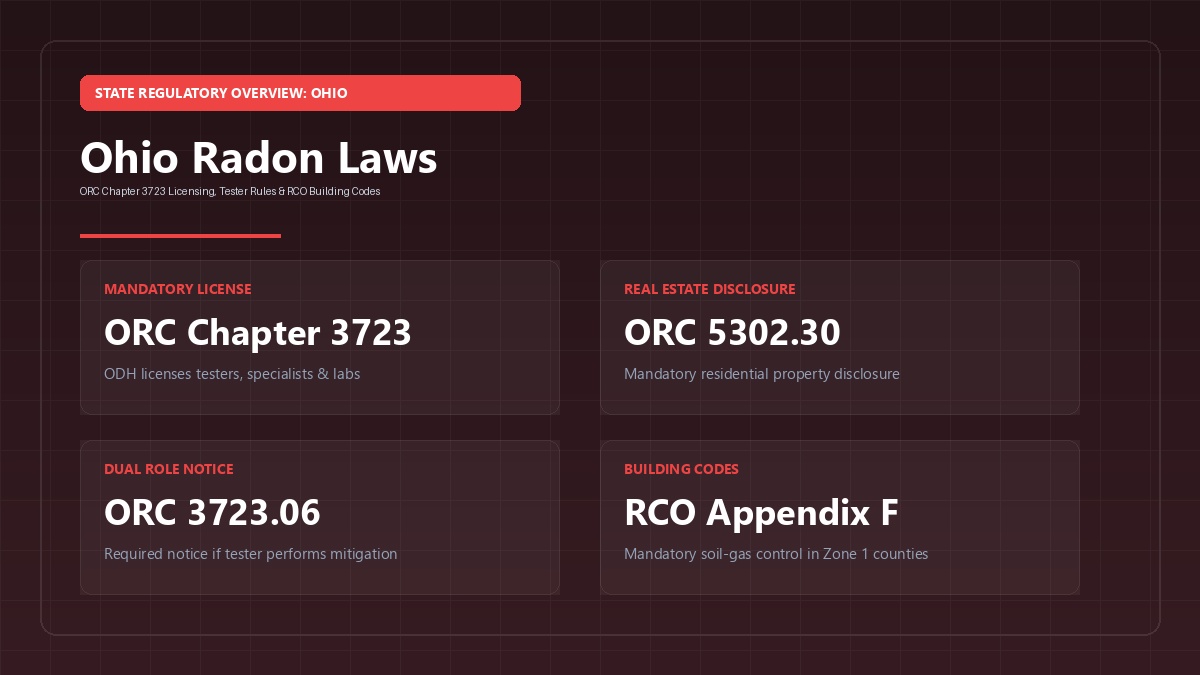
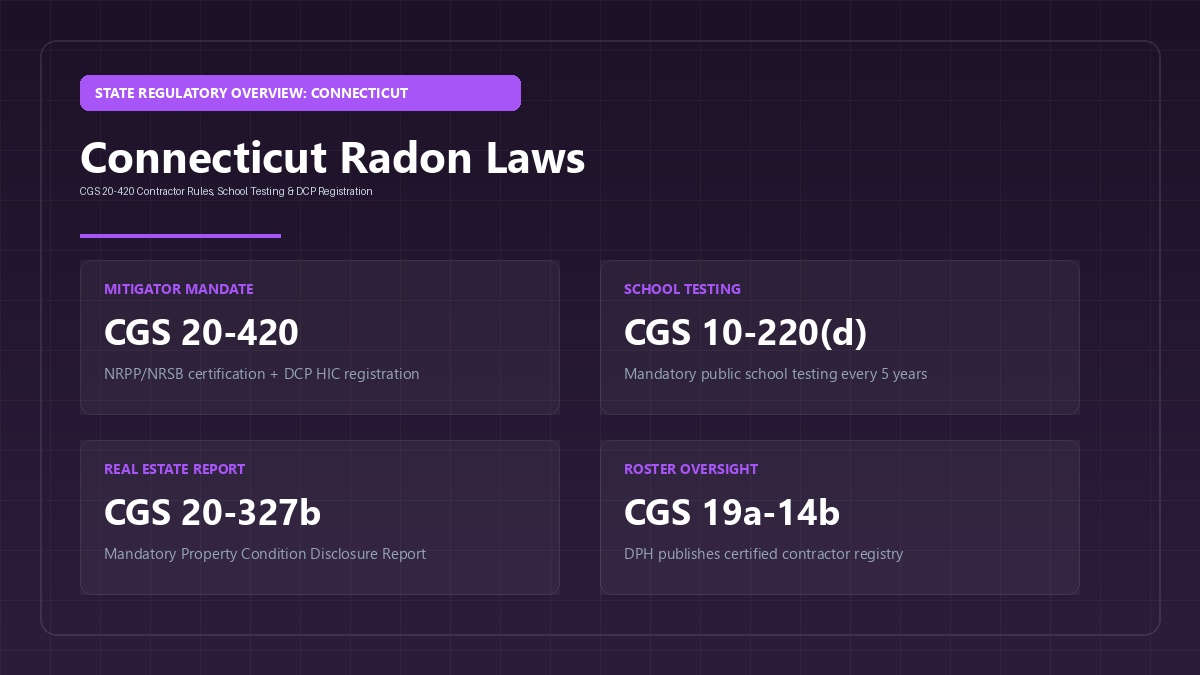
    Ohio enforces a rigorous statutory framework governing radon, featuring mandatory state licensing for all commercial radon professionals and codified residential real estate disclosure. Under Ohio Revised Code (ORC) Chapter 3723, any individual or company performing radon testing, mitigation, or laboratory analysis for compensation must hold an active state license issued by the Ohio Department of Health (ODH). Residential property sellers must disclose known radon hazards under ORC § 5302.30, and contractors who conduct testing and subsequent mitigation on the same building are bound by strict dual-involvement consumer protection disclosures. Furthermore, Ohio’s residential building code mandates passive radon-resistant construction in designated high-risk counties.

    Testing Requirements

    Radon testing is voluntary for private single-family homeowners and residential landlords under Ohio law; the state does not compel property owners to test existing private dwellings. Similarly, Ohio statutes do not impose a universal mandatory testing requirement on public or private K-12 schools, although the Ohio Department of Health actively encourages local school districts to conduct voluntary testing using certified professionals. When testing is performed in commercial transactions or institutional facilities, it must be conducted by an ODH-licensed radon tester or specialist adhering to Ohio Administrative Code (OAC) Chapter 3701-69.

    Real-Estate Disclosure

    Real estate disclosure is governed under Ohio Revised Code § 5302.30 and the Ohio Department of Commerce Residential Property Disclosure Form. Sellers of residential real property (1 to 4 dwelling units) must complete and deliver the disclosure form to prospective purchasers prior to signing a binding purchase contract. Section E of the statutory form specifically requires the seller to disclose actual knowledge of environmental hazards, including radon gas, past testing reports, and the presence of any active or passive radon mitigation systems. In addition, under ORC § 3723.06, if a licensed professional provides testing or advice and subsequently contracts to perform mitigation on the same property, the mitigation agreement must include a conspicuous written disclosure warning the consumer of this dual role and highlighting the benefits of second opinions and long-term confirmation tests.

    Mitigator & Tester Certification

    Commercial licensing is strictly mandatory in Ohio under ORC Chapter 3723 and OAC Chapter 3701-69. It is unlawful for any person to perform radon testing, offer mitigation services, or operate a radon laboratory for compensation without an active license from the Ohio Department of Health. ODH establishes four distinct license categories: Radon Tester, Radon Mitigation Specialist, Radon Mitigation Contractor, and Radon Laboratory. Applicants must complete approved training courses, pass a national certification examination administered by the NRPP or NRSB, submit comprehensive quality assurance plans, and maintain required commercial liability insurance. Unlicensed practice constitutes a criminal misdemeanor under ORC § 3723.99.

    New Construction

    Radon-resistant new construction is regulated under the Residential Code of Ohio (RCO), administered by the Ohio Board of Building Standards. RCO Appendix F (Radon Control Methods) mandates passive radon control systems—including sub-slab aggregate, 6-mil polyethylene soil-gas retarders, and routed vertical PVC vent pipes—in all new residential dwellings constructed in designated EPA Zone 1 counties. Builders in Zone 1 jurisdictions must install these passive measures during initial framing, providing homeowners with a ready pathway for fan activation if post-occupancy testing reveals elevated concentrations.

    Radon Zones & the Action Level

    The EPA Map of Radon Zones designates Ohio with extensive EPA Zone 1 (High Potential) coverage across central, southwestern, and northeastern counties—including Franklin (Columbus), Hamilton (Cincinnati), Montgomery (Dayton), and Stark counties—where predicted average screening levels exceed 4.0 pCi/L. Remaining northwestern and southeastern counties fall within Zone 2 (Moderate Potential, 2.0 to 4.0 pCi/L). ODH adopts the national EPA action level of 4.0 pCi/L, advising immediate active mitigation for readings at or above 4.0 pCi/L and recommending mitigation consideration between 2.0 and 4.0 pCi/L. For detailed regional analysis, review our EPA Radon Zone Map guide.

    The State’s Radon Program

    The state regulatory and educational body is the Ohio Department of Health Radon Education and Licensing Program, operating within the Bureau of Environmental Health and Radiation Protection. The program administers professional licensing, conducts field enforcement audits, manages the public registry of licensed contractors, and coordinates public education. Ohio homeowners can order discounted test kits and verify contractor credentials through the official ODH Radon Program website or by calling the licensing bureau at 614-644-2727.

    Sources & Limits

    This regulatory guide is provided for educational and informational purposes only and does not constitute formal legal, architectural, or professional engineering advice. Statutory licensing requirements, real estate disclosure mandates, and building codes vary by jurisdiction and are subject to regulatory updates. Real estate buyers, sellers, landlords, and contractors should verify current rules directly with the Ohio Department of Health or legal counsel.

    Official Sources: Ohio Revised Code Chapter 3723, § 5302.30; Ohio Administrative Code Chapter 3701-69; Residential Code of Ohio Appendix F; Ohio Department of Health; U.S. Environmental Protection Agency.

    To evaluate how Ohio compares with other state regulatory models, consult our nationwide guide to radon regulations across the United States or review the EPA Radon Zone Map.

  • Radon Laws in North Dakota: Testing, Disclosure & Mitigation Rules

    Radon Laws in North Dakota: Testing, Disclosure & Mitigation Rules

    The Short Answer

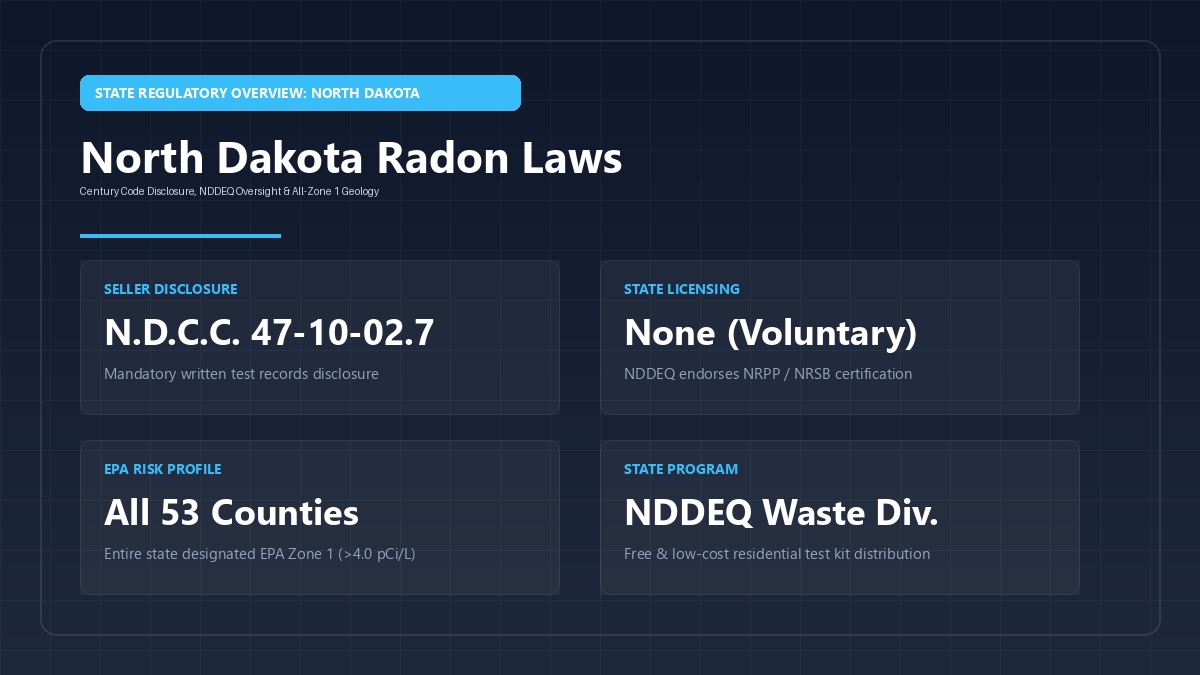
    North Dakota regulates radon primarily through real estate transaction transparency and environmental public health education rather than direct state contractor licensing. Under North Dakota Century Code § 47-10-02.2, residential real estate sellers must provide written disclosures detailing any known radon concentrations, prior test reports, and existing mitigation systems before signing a purchase agreement. The state does not operate an independent licensing program for radon mitigators or testing specialists, officially directing consumers to nationally certified professionals. Geologically, North Dakota faces exceptionally high radon potential, with the U.S. Environmental Protection Agency classifying all 53 counties as EPA Zone 1.

    Testing Requirements

    Radon testing is voluntary for private residential homeowners and landlords in North Dakota; the state imposes no statutory mandate requiring testing in existing single-family dwellings or private rental properties. Similarly, North Dakota law does not mandate routine radon testing in public or private K-12 school buildings or licensed commercial childcare facilities. However, the North Dakota Department of Environmental Quality (NDDEQ) strongly encourages testing across all residential buildings, noting that elevated indoor levels are widespread throughout the state due to glacial till deposits containing radium and uranium.

    Real-Estate Disclosure

    Real estate disclosure is codified under North Dakota Century Code (N.D.C.C.) § 47-10-02.2. Before completing a binding purchase agreement for residential real property, the seller must deliver a written disclosure statement disclosing whether the property has ever been tested for radon gas and the specific results of any such tests. Furthermore, if a radon mitigation system or soil-gas depressurization equipment has been installed on the premises, the seller must disclose its operational status and provide copies of any available inspection records. While the statute requires truthful disclosure of known conditions, it does not compel sellers to conduct new testing prior to closing, leaving testing contingencies to contract negotiations.

    Mitigator & Tester Certification

    North Dakota has no state licensing requirement for radon measurement technicians or mitigation contractors, per the North Dakota Department of Environmental Quality, verified November 2026. The state maintains no state-administered regulatory board or credentialing registry for radon professionals. Instead, the NDDEQ officially directs homeowners, builders, and real estate professionals to hire contractors certified through the two national proficiency programs recognized by the EPA: the National Radon Proficiency Program (NRPP) and the National Radon Safety Board (NRSB). Contractors performing structural alterations or electrical wiring during fan installations must comply with local municipal building and electrical trade permits.

    New Construction

    North Dakota has not enacted a mandatory statewide building code requiring passive or active Radon-Resistant New Construction (RRNC) systems in new residential structures. Building code adoption and enforcement operate under local municipal and county jurisdiction across the state. While individual cities (such as Fargo and Bismarck) may adopt model building standards such as the International Residential Code (IRC) Appendix F at local discretion, there is no universal state mandate forcing homebuilders to install passive sub-slab suction pits or vertical vent pipes.

    Radon Zones & the Action Level

    According to the EPA Map of Radon Zones, North Dakota is one of the few states in the nation where all 53 counties are designated as EPA Zone 1 (High Potential), indicating predicted average indoor radon screening concentrations exceeding the national action level of 4.0 picocuries per liter of air (pCi/L). State health surveys confirm that over 60 percent of tested North Dakota basements exceed 4.0 pCi/L. The NDDEQ advises property owners to install active mitigation systems if indoor radon levels equal or exceed 4.0 pCi/L, and to consider remediation if levels range between 2.0 and 4.0 pCi/L. For comprehensive regional risk analysis and county classifications, explore our EPA Radon Zone Map guide.

    The State’s Radon Program

    The state’s official public health initiative is the North Dakota Department of Environmental Quality Radon Program, administered under the Division of Waste Management. The program provides educational resources, technical guidance, and distributes free or subsidized short-term radon test kits to North Dakota homeowners while supplies last. Residents can request test kits, access county-level screening data, and review EPA mitigation guidance directly through the NDDEQ Radon Program portal or by contacting the division office at 701-328-5166.

    Sources & Limits

    This regulatory guide is provided for educational and informational purposes only and does not constitute formal legal, building code, or engineering counsel. State statutory disclosure requirements and local municipal building codes are subject to legislative amendment. Property buyers, sellers, landlords, and contractors should verify current rules directly with the North Dakota Department of Environmental Quality or a licensed real estate attorney.

    Official Sources: North Dakota Century Code § 47-10-02.2; North Dakota Department of Environmental Quality (Division of Waste Management); U.S. Environmental Protection Agency (Map of Radon Zones).

    For national comparative analysis and federal benchmarks, return to our master overview of radon regulations across the United States or inspect the EPA Radon Zone Map.