Blog

  • How to Index Business Files Into a Local Vector Databas (2026)

    How to Index Business Files Into a Local Vector Databas (2026)

    Last refreshed: August 2026

    A local vector database Claude setup — indexed with your business documents, contracts, SOPs, client notes, and invoices — gives back the operational time lost to hunting through folders. The right answer appears in seconds, without any of those documents leaving the machine.

    This is the full build: architecture, tools, working code, what performs well in production, what breaks, and whether the ROI justifies the setup time.


    What Problem This Solves

    The problem isn’t that the documents don’t exist. It’s that finding the right one — the specific contract clause, the pricing from eight months ago, the onboarding SOP for a client — takes longer than it should, and normal search doesn’t solve it.

    File search matches keywords. It doesn’t understand that “what did we agree on for payment timing” and “net 30” are the same thing. A retrieval-augmented setup solves the semantic gap: the vector database finds relevant sections by meaning, Claude synthesizes them into a direct answer.

    The use cases where this setup pays for itself:

    • Contract and clause lookup — “What are the payment terms in the Acme agreement?” in 4 seconds vs. 3 minutes of folder navigation
    • SOP retrieval — “What’s our onboarding process for new social media clients?” surfaces the relevant runbook section directly
    • Client history — “What scope did we quote [client] last spring?” retrieves the invoice or email thread
    • Cross-document synthesis — “What are the termination clauses across all active client contracts?” — something no file search can do

    The Architecture

    Five-step flow from files to chunk, embed, store, retrieve
    Architecture: business files into a local vector index.

    The stack is ChromaDB for local vector storage, Nomic Embed for on-device embeddings via Ollama, LlamaIndex for document ingestion, and Claude Sonnet via API for the reasoning step — all files stay local, Claude only sees the retrieved chunks.

    ComponentToolWhy
    Vector databaseChromaDB (local)Free, runs on-device, persistent to disk
    Embedding modelNomic Embed via OllamaOpen-source, 8K context, no external calls
    Ingestion layerLlamaIndexHandles PDF, DOCX, MD, TXT, CSV natively
    Retrieval layerPython (custom)Readable and modifiable as needs evolve
    Reasoning layerClaude Sonnet APIMaterially better synthesis than local models
    InterfaceCLIMost queries don’t need a UI

    Why local for the vector database: The documents never leave the machine. Claude receives only the retrieved chunks — not the full corpus. For contracts, financial records, and internal communications, this is the right boundary.

    Why Claude for reasoning and not a local model: Local models (Llama 3, Mistral) handle the retrieval step comparably. They don’t handle synthesis comparably — reading five contract sections and returning a coherent, accurate answer is where Claude’s API cost is earned.


    What to Index

    Start with the 50 most-referenced documents. Get the workflow running and verified before expanding to the full corpus.

    File types that index well:

    • Contracts and agreements (PDF, DOCX)
    • Internal SOPs and runbooks (MD, DOCX)
    • Client notes and meeting logs (MD, TXT)
    • Invoices and financial records (PDF, CSV)
    • Email threads exported from Gmail (EML, TXT)

    Organize before indexing. File names and folder paths become metadata attached to each chunk. A consistent folder structure takes an hour to set up and improves retrieval quality throughout:

    /business-knowledge/
      /clients/
      /contracts/
      /operations/
      /finance/
      /communications/
      /reference/
    

    Poorly named files produce confusing retrieval results. The index is only as organized as the source files.


    Building the System

    Step 1: Install the stack

    # Ollama for local embedding
    brew install ollama
    ollama pull nomic-embed-text
    
    # Python dependencies
    pip install chromadb llama-index llama-index-embeddings-ollama anthropic
    

    Step 2: Ingest and index

    from llama_index.core import SimpleDirectoryReader, VectorStoreIndex
    from llama_index.embeddings.ollama import OllamaEmbedding
    from llama_index.vector_stores.chroma import ChromaVectorStore
    import chromadb
    
    embed_model = OllamaEmbedding(model_name="nomic-embed-text")
    
    chroma_client = chromadb.PersistentClient(path="./chroma_db")
    chroma_collection = chroma_client.get_or_create_collection("business_knowledge")
    vector_store = ChromaVectorStore(chroma_collection=chroma_collection)
    
    documents = SimpleDirectoryReader("./business-knowledge", recursive=True).load_data()
    index = VectorStoreIndex.from_documents(
        documents,
        embed_model=embed_model,
        vector_store=vector_store
    )
    
    print(f"Indexed {len(documents)} documents")
    

    500 files on an M2 MacBook Pro takes approximately 20–25 minutes. The index persists to disk — this runs once, then incrementally as files change.

    Step 3: Build retrieval and reasoning

    import anthropic
    
    def query_business_knowledge(question: str, top_k: int = 5) -> str:
        retriever = index.as_retriever(similarity_top_k=top_k)
        nodes = retriever.retrieve(question)
    
        context = "\n\n---\n\n".join([
            f"Source: {node.metadata.get('file_name', 'unknown')}\n{node.text}"
            for node in nodes
        ])
    
        client = anthropic.Anthropic()
        response = client.messages.create(
            model="claude-sonnet-4-6",
            max_tokens=1000,
            messages=[{
                "role": "user",
                "content": f"""Answer this question using only the provided business documents.
    If the answer isn't in the documents, say so clearly. Always cite the source file.
    
    Question: {question}
    
    Documents:
    {context}"""
            }]
        )
    
        return response.content[0].text
    
    print(query_business_knowledge("What are the payment terms in the Acme contract?"))
    

    Always include source attribution in the prompt. When an answer returns, the source file name makes verification fast.


    What Works Well in Production

    Side-by-side when to use a script versus an agent
    What works well in production — narrow corpora first.

    Cross-document synthesis is the capability that justifies this over standard search — querying across hundreds of files simultaneously to find patterns, compare terms, or surface a specific clause is something no file search does.

    Where the system consistently delivers:

    Contract and clause lookup: Specific clause retrieval across a full contract library. Synthesis across multiple contracts simultaneously (termination terms, payment terms, liability caps) returns a summary across all of them at once.

    SOP and runbook retrieval: Operational questions answered directly from internal documentation. Works best when SOPs are written in complete sentences rather than bullet fragments — the retrieval quality reflects the writing quality.

    Client history: Invoice amounts, quoted scopes, prior project notes. Email threads sometimes split across chunks in ways that lose context — use the result as a pointer to the source document, then verify.

    Cross-document pattern finding: “What are the common liability terms across our contracts?” — synthesizes across every indexed contract in one response. No file search tool does this.


    What Breaks

    Cost control gates before an agent runs
    What breaks — bad chunks and untrusted documents.

    The index is only as current as the last re-index. The most common production failure is stale data — documents updated after the last index run return old answers.

    Stale index: Build re-indexing into the workflow immediately. Schedule it weekly, or trigger it automatically when files are modified. Documents that change and don’t get re-indexed are the biggest reliability risk.

    Top-k ceiling: Retrieval returns the top-k chunks (default 5). A question whose complete answer requires synthesizing 20 documents gets a partial answer. Increase top_k for broad synthesis questions — at the cost of slightly more API token usage.

    Numerical calculations: The system finds financial documents reliably. It should not be trusted to calculate totals across extracted text. Use it to surface the right source documents; do the arithmetic elsewhere.

    Documentation debt: The index reveals gaps in internal documentation. SOPs written in ambiguous shorthand, contracts with undefined terms, emails with unclear context — all produce lower quality retrieval. The index reflects the quality of the underlying documents.


    Chunk Size

    512 tokens with 50-token overlap is the right starting point for mixed document types.

    Adjust based on document type:

    • Contracts (dense, long): 512–768 tokens, 100-token overlap
    • SOPs (structured, modular): 256–512 tokens, 50-token overlap
    • Emails (short, conversational): 256 tokens, 25-token overlap
    • Financial records (tabular): Parse as structured data where possible; plain text chunking loses table relationships

    Metadata Filtering at Scale

    Once the corpus exceeds ~200 files, adding metadata to chunks and filtering at query time significantly improves precision.

    # Tag at ingestion
    documents = SimpleDirectoryReader(
        "./business-knowledge",
        recursive=True,
        file_metadata=lambda filepath: {
            "document_type": filepath.split("/")[2],
            "client": filepath.split("/")[3] if len(filepath.split("/")) > 3 else "internal"
        }
    ).load_data()
    
    # Filter at retrieval
    retriever = index.as_retriever(
        similarity_top_k=5,
        filters={"document_type": "contracts"}
    )
    

    “What are our SOPs for [client]?” filtered to that client’s folder returns meaningfully more accurate results than querying the full corpus.


    ROI

    Setup takes roughly one full day. At 25 minutes saved per week on document lookups, break-even is approximately 6–8 weeks.

    ItemCost
    Setup time~8 hours
    ChromaDBFree
    Nomic Embed (Ollama)Free
    Claude Sonnet API per query~$0.003
    Monthly at 50 queries/week~$0.60
    Weekly time saved~25 minutes
    Break-even~7 weeks

    The less quantifiable return: operational confidence. Questions that previously required folder-hunting get answered in seconds. That reduces the cognitive overhead of running a multi-client operation and changes how quickly decisions get made.


    Related on Tygart Media: how to use Claude · Anthropic API key.

    Frequently Asked Questions

    Does this send business documents to Anthropic?

    No. The vector database and embedding model run locally. Claude receives only the retrieved chunks — small sections of relevant documents — not the full corpus. For zero external calls, replace Claude with a local model, though synthesis quality will be lower.

    What file types are supported?

    LlamaIndex handles PDF, DOCX, TXT, MD, CSV, EML, and HTML natively. Other formats need conversion to plain text first.

    How long does indexing take?

    Approximately 20–25 minutes for 500 files on an M2 MacBook Pro. Subsequent re-indexing processes only changed or new files and takes a few minutes.

    What is a vector database?

    A vector database stores documents as numerical representations (embeddings) that encode meaning, not just keywords. This allows semantic search — finding relevant contract sections from a natural-language question, even when the exact words don’t match.

    Can a local model replace Claude?

    es — swap the API call for an Ollama-hosted model. Retrieval quality is comparable. Synthesis quality on complex multi-document questions is noticeably lower on current local models.

    What chunk size should be used?

    512 tokens with 50-token overlap is the right default for mixed document types. Adjust for document type: larger for dense contracts, smaller for short emails.


    What to Read Next

    Anthropic Console: API Keys and the Workbench

     Claude AI Pricing — All Plans and API Rates 

    Claude API Model IDs and Strings 

    History of Anthropic

  • Metricool 2026: The Complete Guide (2026)

    Last refreshed: August 2026

    Metricool 2026 is a social media scheduling, analytics, and API platform that manages multi-brand operations across LinkedIn, Facebook, Instagram, X/Twitter, Google Business Profile, TikTok, YouTube, Pinterest, Threads, and Bluesky — at a price point that makes Hootsuite and Sprout Social look overpriced for most use cases.

    This guide covers what changed in 2025–2026, how to set up the platform correctly from day one, how to use the API for programmatic scheduling, and where the tool still falls short. Built from operating 24 brands in Metricool, not from a comparison of their marketing pages.


    What Is Metricool and What Does It Do in 2026?

    Three cards for LSA, search ads, and SEO/AI authority channels
    What Metricool is and does in 2026.

    Metricool is a social media management platform organized around “brands” as the core unit — one login manages multiple brands, each with its own calendar, analytics, and connected accounts, at plan-based pricing that doesn’t scale per connected account.

    Platform support as of August 2026:

    PlatformSchedulingAnalyticsAPI Access
    LinkedIn (profile + page)
    Facebook (page)
    Instagram (business/creator)
    X / Twitter
    Google Business Profile
    TikTok
    YouTube
    Pinterest
    ThreadsLimited
    BlueskyLimited

    The core value proposition is unchanged: multi-brand management at plan-based pricing (not per-seat or per-connected-account), with a working REST API that most competitors at the same price point don’t offer.


    What’s New in Metricool in 2025–2026

    The biggest 2026 updates are Threads and Bluesky as stable scheduling platforms, a rebuilt analytics dashboard, AI caption suggestions in the composer, and a versioned API developer portal replacing the old PDF documentation.

    Threads scheduling (stable): Moved from beta to fully stable. Posts with images, text, and links schedule and publish reliably. Analytics remain limited relative to Instagram — engagement data is available but not at native-insight depth.

    Bluesky scheduling (stable): Full scheduling and basic analytics now live. Handles the platform without a separate tool.

    Analytics dashboard redesign: Cross-platform comparison views are cleaner. Custom date ranges now set on the overview screen without drilling into individual platform tabs first.

    AI caption suggestions: Available inside the post composer for first-draft generation. Useful for routine content; not a replacement for intentional copy.

    API developer portal: Documentation moved from a downloadable PDF to a versioned web portal. Same endpoints, significantly easier to navigate.


    How to Set Up Metricool Correctly

    Three ranked panels: intent near need, catch overflow, compound trust
    How to set up Metricool correctly.

    Create one brand per entity, connect all social accounts for that brand before creating the next one, and establish posting cadence in the Planner before importing any bulk content. Setup decisions made incorrectly early create restructuring work later.

    Step 1: Create brands

    Navigate to the brand switcher in the top left and create a new brand for each business, client, or property. Name each brand clearly — the name appears in the interface and in API responses as the brand identifier. Each brand is an isolated workspace: separate calendar, separate analytics, separate connected accounts.

    Step 2: Connect social accounts per brand

    With a brand selected, link every social platform before moving to the next brand. Common friction points:

    • Instagram: Requires a Professional account (Business or Creator) linked to a Facebook Page. Personal Instagram accounts cannot be scheduled through third-party tools. If the Facebook Page isn’t connected first, Instagram won’t link.
    • LinkedIn: Personal profiles and Company Pages connect separately. Add both if scheduling to both.
    • Google Business Profile: Connect via Google account. GBP posts are limited to 1,500 characters and one image — Metricool enforces this in the composer.

    Step 3: Configure the Planner

    The Planner is the scheduling interface used most. Access it from the left navigation. Best-time recommendations appear as highlighted slots based on historical engagement data — worth following for the first few months before overriding with observed data.

    Step 4: Enable post failure notifications

    When a scheduled post fails — usually because a platform connection expired — the right time to know is immediately, not when a client asks why content didn’t go out.


    How the Metricool Planner Works

    Click a time slot or use the New Post button, write the caption, attach media, select platforms, set the publish time, and Metricool handles publishing across all selected channels.

    Post creation steps:

    1. Click a time slot or New Post
    2. Write the caption — platform previews update in real time on the right
    3. Upload media — Metricool flags aspect ratio issues per platform
    4. Select platforms using the toggles
    5. Set date and time, or accept the best-time recommendation
    6. Click Schedule

    Platform previews matter: LinkedIn truncates long captions differently than Instagram. What reads cleanly on one platform can break on another. Always check previews before scheduling.

    Bulk scheduling via CSV: Upload a spreadsheet of posts with columns for caption, media URL, platform, date, and time. Right workflow for scheduling a full month at once rather than building post by post.


    How Metricool Analytics Works

    Five zone panels: estimating, job costing, cash/AR, sales, leadership
    How Metricool analytics works.

    Analytics shows follower growth, engagement, reach, impressions, and best-performing content across all connected platforms — with a unified overview and per-platform deep dives.

    Overview dashboard: Aggregated metrics across all platforms for the current brand. Custom date ranges with prior-period comparison. Answers “how is this brand doing overall” without switching tabs.

    Per-platform analytics: Post-level performance, follower growth trends, engagement rate over time, audience demographics where platforms expose them, and best-performing content sortable by any metric.

    Competitor tracking: Add competitor social profiles for follower count and posting frequency monitoring. Available on paid plans.

    What analytics don’t do: Metricool doesn’t integrate with GA4 for web traffic attribution. If connecting social performance to site traffic and conversions is a requirement, a separate analytics tool is needed.


    How the Metricool API Works in 2026

    The Metricool REST API allows programmatic post scheduling, post retrieval, brand listing, and media management — authenticated via an API token from account settings, with full CRUD operations on scheduled content.

    Step 1: Get your API token

    Go to account settings and find the API section. Generate a token — it’s account-level, not brand-specific. Treat it like a password.

    Step 2: Get brand IDs

    GET https://app.metricool.com/api/v2/brands
    Authorization: Bearer YOUR_API_TOKEN
    

    Returns an array of brands with IDs, names, and connected platforms. Store these IDs — they’re required on every brand-specific API call.

    Step 3: Schedule a post

    POST https://app.metricool.com/api/v2/posts
    Authorization: Bearer YOUR_API_TOKEN
    Content-Type: application/json
    
    {
      "blogId": "YOUR_BRAND_ID",
      "text": "Post caption here.",
      "date": "2026-09-01T10:00:00Z",
      "networks": ["linkedin", "facebook", "instagram"],
      "imageUrls": ["https://your-media-host.com/image.jpg"]
    }
    

    A successful POST returns the created post object with its ID. Store IDs for any post that may need updating or deletion.

    What the API can do: Schedule posts to any connected platform, retrieve scheduled and published posts, list brands and connected networks, upload and attach media, delete or update scheduled posts.

    What the API can’t do: Analytics data is not exposed via the API. Engagement metrics are view-only in the dashboard. For analytics in automated workflows, a separate reporting approach is required.

    Rate limits: Metricool enforces rate limits per endpoint. For production workflows scheduling at volume, build exponential backoff retry logic on 429 responses.


    Metricool Plans and Pricing in 2026

    Metricool charges per brand, not per connected social account — which makes it significantly cheaper than Hootsuite or Sprout Social for multi-brand operations.

    PlanBrandsPosts/MonthTeam MembersAPI Access
    Free1501No
    Starter12,0001No
    Advanced5Unlimited3Yes
    Agency15+Unlimited5+Yes

    API access requires Advanced or above. For a 10-brand operation, Metricool Advanced costs a fraction of the Hootsuite or Sprout Social equivalent, where per-seat or per-account pricing compounds quickly.


    Metricool vs. Hootsuite vs. Buffer in 2026

    For multi-brand operations managing 5+ brands with API requirements, Metricool wins on price. Buffer is comparable for simple single-brand operations. Hootsuite is justified only at enterprise scale with dedicated support requirements.

    FeatureMetricoolHootsuiteBuffer
    Pricing modelPer brandPer user + per accountPer channel
    API accessYes (Advanced+)Yes (Enterprise)Limited
    GBP schedulingYesLimitedNo
    Multi-brand managementNativeClunkyBasic
    Analytics depthStrongStrongBasic
    Best forAgencies, multi-brand operatorsLarge enterpriseSimple single-brand

    Hootsuite for a 10-brand agency operation typically runs 3–5x the cost of Metricool at the equivalent plan level.


    Common Metricool Problems and Fixes

    The most common issues are expired social connections, Instagram setup errors, and GBP rejection — all fixable in a few steps.

    Instagram won’t connect: Switch the account to Professional (Business or Creator) in Instagram settings, connect to a Facebook Page, then reconnect in Metricool.

    Scheduled post failed: Look for failed posts in the calendar. The cause is usually an expired connection. Disconnect and reconnect the affected platform, then reschedule.

    GBP post rejected: Check the error message — GBP rejections usually include a reason. Verify the post is under 1,500 characters, uses one image, and doesn’t contain promotional language that violates GBP content policies.

    API 401 Unauthorized: Token expired or regenerated. Go to account settings, generate a new token, update the integration.

    Wrong brand getting content: The most common operational error in multi-brand setups. Confirm the active brand in the switcher before creating or scheduling. Build this check into every team SOP.


    Frequently Asked Questions

    What is Metricool used for?

    Metricool is used for social media scheduling, analytics, and multi-brand management across LinkedIn, Facebook, Instagram, X/Twitter, Google Business Profile, TikTok, YouTube, Pinterest, Threads, and Bluesky — with a REST API for programmatic scheduling.

    Is Metricool free?

    Yes — a permanent free plan (not a trial) supporting one brand, 50 posts per month, and basic analytics. API access and multi-brand management require a paid plan.

    Does Metricool have an API?

    Yes. The Metricool REST API supports programmatic post scheduling, retrieval, brand management, and media handling. Available on Advanced plan and above. Documentation is at Metricool’s developer portal.

    How does Metricool compare to Hootsuite?

    Metricool is 3–5x cheaper for multi-brand operations at agency scale. Hootsuite charges per user and per connected account. Hootsuite has stronger enterprise support and integrations; Metricool wins on value for most agency and mid-market use cases.

    Can Metricool schedule Google Business Profile posts?

    Yes — and it’s one of Metricool’s strongest differentiators. Most tools at this price point don’t support GBP scheduling. Posts are limited to 1,500 characters and one image.

    Does Metricool support Threads and Bluesky?

    Yes. Both are fully stable as of 2026. Threads analytics are available but limited. Bluesky analytics are basic. Scheduling to both platforms is reliable.

    What to Read Next

    Metricool API: What It Can Do and How to Actually Use It 

    Metricool Review 2026: The Social Media Tool for Multi-Brand Operations

     Metricool Pricing 2026: What Each Plan Actually Gets You

     Metricool Free Plan: Is It Actually Enough?

  • Anthropic Roadmap 2027: What Comes After Claude Fable 5

    Anthropic Roadmap 2027: What Comes After Claude Fable 5

    Last refreshed: August 2026

    The Anthropic roadmap 2027 comes into focus after Fable 5 launched in June 2026 as Anthropic’s most capable widely available model — a new Mythos-class tier above Opus — and the signals from Anthropic’s research agenda, model release cadence, and safety roadmap point clearly toward what comes next.

    This is a forward-looking read grounded in public signals: what Anthropic has shipped, what they’ve said, and what the patterns suggest for 2027. It’s relevant for developers planning integrations, enterprises making multi-year platform commitments, and anyone tracking where Claude’s capabilities are heading.


    Where Anthropic Stands as of Mid-2026

    Abstract milestone timeline from early Claude eras through today without version numbers
    Where Anthropic stands as of mid-2026.

    Claude has grown from a single chat model in 2021 to a four-tier family — Haiku, Sonnet, Opus, and the new Mythos class — with a 1-million-token context window, native vision, tool use, Computer Use, extended thinking, and persistent memory across managed agents.

    The model lineup as of August 2026:

    TierModelBest For
    MythosClaude Fable 5Most demanding reasoning, long-horizon agentic work
    OpusClaude Opus 4.8Flagship reasoning, fallback for Fable 5 safety filters
    SonnetClaude Sonnet 4.6Everyday development, high-volume production
    HaikuClaude Haiku 4.5Fast, cheap, high-throughput

    Fable 5 launched June 9, 2026 alongside Claude Mythos 5 — a restricted version available only through Project Glasswing for vetted cybersecurity and infrastructure partners. The distinction matters: Fable 5 is the general-availability frontier model; Mythos 5 is the same model with certain safety filters lifted for specific use cases.

    The June 2026 launch was followed by a brief government-imposed deployment pause after Amazon researchers identified a method of prompting Fable 5 to surface software vulnerabilities. Anthropic worked with government partners to add new classifiers and redeployed the model globally July 2, 2026.


    What the Fable 5 Launch Signals About 2027

    The Fable 5 launch established that Anthropic is building a two-track release model — a general-availability tier with conservative safety filters and a restricted frontier tier for vetted partners — and that cadence will continue into 2027.

    Several specific signals point forward:

    The Mythos class will expand access. Anthropic said explicitly at Fable 5 launch that Project Glasswing would expand to more vetted partners over time. The current restriction is a staged rollout, not a permanent ceiling. By 2027, Mythos-class access is likely to be more widely available to enterprise customers who can meet Anthropic’s trust and verification requirements.

    Safety classifiers will improve. Fable 5 launched with classifiers that trigger on roughly 5% of sessions, routing those queries to Opus 4.8 instead. Anthropic committed to reducing false positives “as more capable models arrive in the coming months.” More capable models arriving implies at least one Mythos/Opus generation release before end of 2026 or early 2027.

    Token unbundling sets up the next Enterprise pricing tier. The April 2026 decoupling of Enterprise seat fees from token bundles — moving from $40–200/seat with bundled tokens to $20/seat with usage billed separately — creates a cleaner structure for consumption-based tiers as model capability increases. Expect the 2027 pricing architecture to track closely with Mythos access tiers.

    Agentic infrastructure is the platform bet. Managed Agents launched April 8, 2026, Memory entered public beta April 23, and the Agent SDK (formerly Claude Code SDK) now handles the entire agent loop automatically. The infrastructure is being built to support long-running, multi-session, multi-agent workflows. The 2027 roadmap is almost certainly agentic-first.


    What Anthropic’s Research Agenda Suggests

    Anthropic’s published research priorities — interpretability, Constitutional AI, alignment, and scaling — point toward a 2027 model that is more self-correcting, better at long-horizon planning, and safer to deploy with reduced human oversight.

    Interpretability is Anthropic’s differentiator. Chris Olah’s interpretability team is the most distinct research group at any frontier lab. Their work on understanding what’s actually happening inside neural networks feeds directly into how future models are trained and where safety filters are placed. Advances in interpretability in 2026–2027 will likely show up in more precise, less overreaching safety classifiers — meaning fewer false positives on legitimate requests.

    Long-horizon agency is the capability frontier. Fable 5’s headline capability over Opus 4.8 isn’t raw reasoning quality on static benchmarks — it’s how little friction there is in multi-step agentic workflows. Fable 5’s AutomationBench scores are the clearest signal of where Anthropic is competing. The 2027 research agenda will push this further: more steps, less human intervention, better recovery from errors mid-task.

    Multi-agent coordination is early. The current Managed Agents platform supports multi-agent orchestration, but the tooling is young. 2027 is when production multi-agent deployments at scale become routine rather than experimental for most enterprise customers.


    What It Means for Developers

    Three stacked layers: chat UI, tools, agent runtime
    What it means for developers building agents.

    Developers building on Claude in 2026 should architect for the Agent SDK and Managed Agents platform, not just the Messages API — that’s where Anthropic is investing, and it’s where the capability gains will be most significant in 2027.

    Practical implications:

    Plan for Fable 5 as the default frontier model. Opus 4.8 remains the strong fallback and the model most workflows should run on today. But product architectures that don’t account for Fable 5 as the primary reasoning layer within 12–18 months are likely to require significant refactoring.

    The Fallback API is now infrastructure. Any integration calling Fable 5 needs fallback logic configured. Anthropic’s safety classifiers will route some queries to Opus automatically — your integration needs to handle that gracefully, not treat it as an error.

    Memory changes what agents can do. Agents that don’t retain context across sessions are meaningfully less capable than those that do. The Managed Agents memory API (public beta since April 23, 2026) is the right surface to build persistent agent behavior on now, before it becomes a standard expectation.


    What to Watch

    Three cards for fast volume, daily workhorse, and deep flagship Claude seats
    What to watch next on the roadmap.

    The clearest leading indicators for 2027 Anthropic roadmap developments:

    • Project Glasswing expansion announcements — any broadening of Mythos-class access is a signal that the trust-gating model is maturing
    • Interpretability research publications — Anthropic publishes regularly; major interpretability papers tend to precede model releases by 3–6 months
    • Managed Agents general availability — currently in public beta; GA signals the platform is production-ready for the long-term
    • Context window changes — the 1M token context window is already the industry standard; what comes next is likely structural, not just larger

    Related on Tygart Media: how to use Claude · Anthropic API key.

    Frequently Asked Questions

    What is Claude Fable 5?

    Claude Fable 5 is Anthropic’s most capable widely released model, launched June 9, 2026. It sits in the new Mythos class above the Opus tier and is built for the most demanding reasoning and long-horizon agentic work. It launched alongside Claude Mythos 5, which is restricted to vetted partners through Project Glasswing.

    What is Project Glasswing?

    Project Glasswing is Anthropic’s program for giving vetted cybersecurity and infrastructure partners access to Claude Mythos 5 — the same underlying model as Fable 5, but with certain safety filters lifted for specific use cases. Access is currently limited and application-based.

    When will Anthropic release the next model after Fable 5?

    Anthropic has not announced a release date. Their historical cadence — roughly one major model generation per 6–9 months — suggests a 2026 Q4 or early 2027 release is plausible. Anthropic has stated that more capable models are coming and that safety classifiers will improve as they arrive.

    What is Claude Managed Agents?

    Claude Managed Agents is Anthropic’s managed infrastructure for running autonomous Claude agents in cloud sandboxes, launched in public beta April 8, 2026. It handles session management, tool execution, credential management, and multi-agent coordination without requiring developers to build that infrastructure themselves. Memory for Managed Agents entered public beta April 23, 2026


    What to Read Next

    History of Anthropic 

    Claude AI Pricing — All Plans and API Rates 

    Current Claude Model Version Tracker 

    Claude API Model IDs and Strings

  • IICRC Van Pocket Card

    IICRC Van Pocket Card

    Tape this in the van. Category, Class, PPE floor, one photo. Twenty seconds. Then go to work.

    This is a free pocket card, not a certification, and not official IICRC. It does not replace S500/S520.

    What you get

    Five-step van pocket flow: category, class, extract, dry, document
    Protocol answers belong in the van — not back at the office.
    • A Notion page you can duplicate and print
    • A tiny Claude skill with the same tables (upload the zip, or paste SKILL.md into a Project)

    How to get it

    Restoration SOP clipboard with checklist, moisture meter, and gloves on a jobsite table
    How to get it: keep the checklist where the carpet is wet.

    Duplicate the card here: IICRC Van Pocket Card (free Notion account, Duplicate in the top right).

    Want the Claude skill zip too? Join The Signal and reply that you want the van card.

    What this is not

    White restoration work van with ladder rack parked at a suburban jobsite curb
    What this is not: another binder collecting dust.
    • Equipment sizing
    • A drying plan
    • Adjuster language

    Need that? The paid IICRC Protocol Lookup ($19) or the Complete Restoration Operations Kit ($97).

    Related on Tygart Media: Starlink on a water job · S500 in the van · local SEO for restoration.

  • IICRC S500 in the van — stop flipping the binder

    IICRC S500 in the van — stop flipping the binder

    You do not need another binder in the truck. You need the protocol answer while the carpet is still wet.

    IICRC S500 is not mysterious. The failure mode is that the PM is standing in a basement and the binder is in the office. That is how a supplement dies in email.

    Office owns jobs, fleet, claims, and certs. Van gets a work order. When the question is S500-shaped, ask Claude with a protocol-grounded skill — not a Facebook group.

    That stack is the Complete Restoration Operations Kit — seven Notion templates plus the IICRC lookup skill. $97 on Square. No email to purchase.

    Need only the lookup? Buy the skill. Need more than two pieces? The kit is cheaper.

    Buy the kit on Square →

    IICRC S500 pocket flow for van crews — extract, decide, document without flipping the binder
    S500 in the van — pocket flow, not binder theater.
    Restoration van parked at curb on a jobsite
    If the protocol is not on the truck, it is not the protocol.

    Related on Tygart Media: crawl space inspection checklist · crawl space mold removal · Starlink on a water job.

    Clipboard checklist on a restoration jobsite
    Protocol on a clipboard beats a binder in the office.
  • Restoration CRM Prompt Library — Claude Skill

    Restoration CRM Prompt Library — Claude Skill

    Restoration CRM Prompt Library — Claude Skill

    $19

    Delivered by email after checkout.

    Buy Now →

    Secure checkout via Square — all major cards accepted

    You can copy this library and do it yourself. The full article is already live. Paste a prompt into claude.ai, fill the brackets, edit the draft, send it. Buy Now is the packaged Claude Skill so the library lives in the project instead of a browser tab.

    The live article (do not treat this page as a replacement): AI-Assisted Email Drafting for Restoration Companies: A Claude Prompt Library.

    Who it is for: anyone at the company who writes emails. Owner, office manager, whoever runs the CRM touch calendar. No technical background. A free Claude account at claude.ai is enough. No API key. No code.

    The workflow

    Four skill cards: scope narrative, insurance write, homeowner write, referral write
    CRM prompt workflow: paste facts → draft → human send.
    1. Go to claude.ai. Create a free account if you need one.
    2. Open a new conversation.
    3. Paste a prompt. Fill the bracketed fields with real information.
    4. Claude drafts the email.
    5. Review it. Edit anything that does not sound like you. Copy it into your email platform.

    That is the entire workflow. Specific beats generic. “Write a hiring email for a restoration company” is weak. “Write a hiring email for a 12-person water and fire restoration company in Tacoma, WA that’s been in business for eight years and is known for fast response times and honest communication with insurance adjusters” is usable.

    Strategy lives in Your CRM Is Not a Lead Database. Timing lives in The 12-Month Outreach Calendar. This library is the words.

    Prompt 1: Hiring email, homeowner version

    I run [company name], a [type] restoration company in [city, state]. We’ve been in business [X] years and are known for [one or two specific things your company does well]. We currently have [number] employees and serve the [geographic area] area.
    
    I need to write a short, plain-text email to past homeowner clients who we’ve done [water damage / fire damage / mold / storm] work for. We’re currently hiring for [job title]. The goal of the email is to ask if they know anyone — family, friends, people in the trades — who might be a great fit for a company like ours. We want to reach out to trusted contacts before posting the job publicly.
    
    Tone: Personal and warm, like a note from a real person. Not corporate, not salesy. The recipient should feel like we remembered them and value their opinion specifically.
    
    Requirements: Under 150 words. Plain text (no HTML). Sign it from [owner first name] at [company name]. Include a phone number as the only contact info. No subject line needed — just the body.

    Prompt 2: Hiring email, insurance adjuster version

    Clipboard and tablet on a kitchen counter during an insurance adjuster walkthrough after water loss
    Hiring email for adjusters — clear, dated, professional.
    I run [company name], a restoration company in [city, state]. I need to write a short email to insurance adjusters I’ve worked with on claims. We’re hiring a [job title].
    
    The tone should be collegial — peer to peer, professional but not formal. We want to reach out to trusted colleagues before posting publicly, and we’d appreciate any recommendations they might have. Keep it under 120 words. Plain text. From [owner name]. Include phone number.
    
    Do not use any of these phrases: “I hope this email finds you well,” “I wanted to reach out,” “touch base,” “circle back,” or “leverage.” Write it how a real contractor would talk to an adjuster they’ve worked with for years.

    Prompt 3: Vendor ask (specialty sub search)

    Write a short email from a restoration company owner to their contact database asking if anyone knows a reliable [trade type — e.g., drywall sub, flooring contractor, HVAC tech] in [city/region]. We have a larger project coming up and want to find a quality sub through our network before going the cold-search route.
    
    Context about our company: [2–3 sentences about your company — size, how long you’ve been in business, your service area]. The recipients are a mix of past homeowner clients, insurance industry contacts, and trade partners.
    
    Tone: Casual and direct. Like asking a trusted colleague. Under 100 words. Plain text. From [owner name]. Phone number only.
    
    Optional addition: Add one sentence at the end that invites the recipient to reach out directly if the description matches their own business.

    Prompt 4: Seasonal safety email (winter freeze)

    I run a water damage restoration company in [city, state]. I want to send a helpful, non-promotional email to past homeowner clients before freeze season. The goal is to give them genuinely useful information about preventing the kind of water damage we see most commonly in [our region] in winter.
    
    Specific things to cover: [list 3–4 real things relevant to your region]. These should be specific to [region] winters, not generic national advice.
    
    Tone: Knowledgeable and helpful, like a trusted expert checking in on a neighbor. No sales pitch, no CTA other than “if you have questions, we’re here.” Under 200 words. Include a link placeholder for [blog post URL] if they want to read more. From [owner name].

    The rest of the library (on the live article)

    Prompts 5–9 are on the live page. Use that URL. Do not treat this SKU page as a rewrite of that article.

    • Prompt 5: Post-storm check-in to past homeowners. Warm, community-focused, not a pitch. Under 120 words.
    • Prompt 6: Company anniversary or milestone. Thank the people who have been part of the journey. No CTA. No offer. Under 175 words.
    • Prompt 7: Brand-voice rewrite. Paste two real emails you have sent, then the draft, and ask Claude to make it sound like you.
    • Prompt 8: Eight subject-line options. Personal, no click-bait, no exclamation points, no “Quick question for you!”
    • Prompt 9: Batch personalization. CSV of past clients. One opening sentence per row that references job type and, if the job is older than 18 months, that it has been a while. Up to 20 rows at a time.

    Full text: tygartmedia.com/restoration-crm-claude-prompt-library.

    How to get better drafts

    Restoration SOP clipboard with checklist, moisture meter, and gloves on a jobsite table
    Better drafts still need a human check before send.
    • Name the phrases you do not want: “I hope this finds you well,” “reaching out,” “touch base,” “leverage.”
    • Give two sentences of real company context. History, reputation, service area, typical client.
    • Iterate in the same conversation. “Good, but make it shorter.” Do not start a new chat for every revision.
    • Ask for three versions: shorter, more formal, more casual.
    • Review everything before it sends. Claude will sometimes assume details you did not provide.

    A free claude.ai account is enough for a full annual campaign calendar. Claude Pro is not required for this use case. Store the filled-in prompts in Notion so you are not hunting them before each send. Using AI to draft is fine if you review and approve every email. The relationship still has to be yours.

    If you want the packaged skill

    The method and the live article are free to use. Buy Now is the Claude Skill package, delivered by email after checkout, so the library is installed instead of copy-pasted from the article each time. Same Square button at the top of this page.

    Related: Front door: Complete Restoration Operations Kit ($97). Stack: The Restoration.

    Related on Tygart Media: Starlink on a water job · S500 in the van · local SEO for restoration.

  • AI for Water Damage Restoration — 4 Claude Skills

    AI for Water Damage Restoration — 4 Claude Skills

    AI for Water Damage Restoration — 4 Claude Skills

    $29

    Delivered by email after checkout.

    Buy Now →

    Secure checkout via Square — all major cards accepted

    You can copy these four skills and do it yourself. Paste each block into Claude Project Instructions. Use them on the next water call. Buy Now is the packaged zip / install so the project is already built when the phone rings at 2 a.m.

    Water damage restoration is a 24/7 business. The company that communicates fastest and clearest wins the job. Between emergency calls, adjuster coordination, and anxious homeowners, Claude takes the writing load off the operations team.

    How to use this

    Four skill cards covering emergency, adjuster, contents, and referral communication
    Four water-job skills. Paste facts. Review. Send.
    • Claude Skills go into Claude Project Instructions.
    • Prompts work in any Claude conversation.
    • Tell it Category and Class, ETA, and what the homeowner has already been told. Vague input makes vague output.

    Create a Claude Project. Paste the skill. Answer what it asks. Review every text and letter before it sends. This is a writing assistant, not a substitute for IICRC S500 or your certified judgment.

    Skill 1: Emergency Response and Homeowner Communication Writer

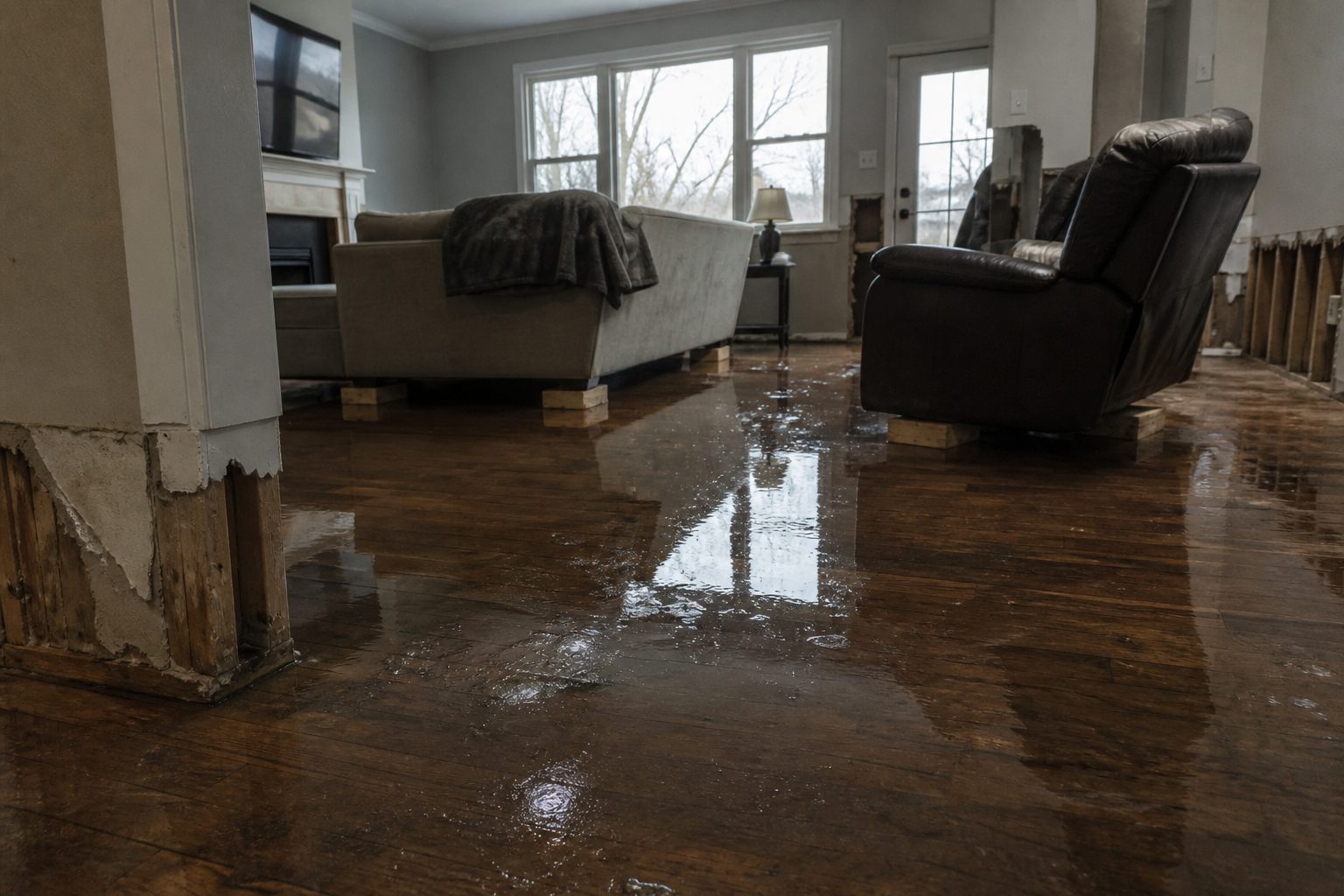
    Flooded residential living room with standing water on hardwood after a water loss
    Emergency response copy should match the room you walked into.

    Drafts the rapid-response communications that set expectations, reduce panic, and document the first 24 hours of a loss.

    Paste into Claude Project Instructions:

    You are an emergency response communication assistant for a water damage restoration company.
    
    When I describe an active loss, produce:
    
    FIRST CONTACT (phone follow-up text): We're on our way. ETA, who's coming, what to do right now. Under 100 words. Fast and reassuring.
    
    ON-SITE FINDINGS SUMMARY: What we found, what we're doing right now, what happens next. Plain English. Under 150 words. Send within the first hour.
    
    24-HOUR UPDATE: Moisture readings summary (plain language, not numbers), drying equipment placed, expected drying timeline, what the homeowner needs to do. Under 175 words.
    
    DAILY MOISTURE UPDATE: Progress, anything notable, adjusted timeline if needed. Under 100 words.
    
    EQUIPMENT REMOVAL NOTICE: Drying is complete. What was achieved. What happens next (demo, rebuild, clearance). Under 100 words.
    
    Tone: fast, expert, calm. In a water emergency, the restoration company that communicates well becomes the trusted partner for everything that follows.

    Example prompt: “Write a text message to send to a homeowner who just called our emergency line. We’re dispatching a crew. ETA is [X] hours. What they should do right now to minimize damage. Under 120 characters if possible.”

    Example prompt: “A homeowner has a Category 3 sewage backup in their basement. Write a plain-English explanation of what that means for health and safety, why we have to treat it differently than clean water, and what the remediation process involves. Honest without being terrifying. Under 175 words.”

    Skill 2: Insurance Adjuster Communication Writer

    Clipboard and tablet on a kitchen counter during an insurance adjuster walkthrough after water loss
    Adjuster notes: dated, specific, easy to forward.

    Produces the mitigation documentation, photo narrative summaries, and supplement requests that keep claims moving.

    Paste into Claude Project Instructions:

    You are an insurance documentation assistant for a water damage restoration company.
    
    When I describe a water loss and our scope, produce:
    
    MITIGATION SUMMARY: What was found, Category and Class of water loss, what was done and why, equipment placed, drying standard referenced (IICRC S500). Technical but clear. Under 300 words.
    
    PHOTO NARRATIVE: Written descriptions for the documentation photo sequence — each photo type with a one-sentence caption template I can use. Organized by area.
    
    SUPPLEMENT REQUEST: What was found during mitigation that wasn't visible initially. Itemized, with rationale. Professional and factual.
    
    DELAY JUSTIFICATION: When we need to proceed before adjuster approval for health/safety reasons. Documented, professional, covers our position.
    
    ADJUSTER FOLLOW-UP: Professional check-in when we haven't heard back. States what we're waiting on and impact on the homeowner.
    
    Always: factual, documented, professional. Supplement disputes are resolved through evidence.

    Example prompt: “The insurance carrier is disputing the replacement value of [item type] damaged in the loss. Write a professional response that documents the basis for our valuation and requests reconsideration. Factual, not emotional. Under 150 words.”

    Skill 3: Contents and Rebuild Communication Writer

    Handles pack-out, demo scope, rebuild timeline, and walkthrough communications after the drying phase.

    Paste into Claude Project Instructions:

    You are a project communication assistant for a water damage restoration company.
    
    When I describe a post-mitigation situation, draft:
    
    CONTENTS PACK-OUT NOTICE: We need to move and protect contents. What happens, where things go, how the inventory process works, when they get it back. Reassuring and specific. Under 150 words.
    
    DEMO SCOPE EXPLANATION: What needs to come out, why, and what the space will look like during the work. Plain English. Under 150 words.
    
    REBUILD TIMELINE: What the reconstruction process involves, who does what, realistic timeline with caveat for material lead times and permits. Under 200 words.
    
    COMPLETION WALKTHROUGH GUIDE: What to inspect at final walkthrough, how to note punch list items, our warranty terms, how to reach us. Professional close.
    
    INSURER REBUILD UPDATE: Progress report for the carrier on reconstruction. Factual, organized by trade, with current completion percentage.
    
    Ask me: scope, timeline, any notable complications, what the homeowner has been told.

    Give it the real scope and what the homeowner has already heard. Do not let it invent a timeline you cannot keep.

    Skill 4: Referral Network and Emergency Preparedness Content

    Drafts plumber, roofer, and property manager outreach, plus the educational notes that put you first in the phone when water hits.

    Paste into Claude Project Instructions:

    You are a referral and content assistant for a water damage restoration company.
    
    When I describe an outreach or content need, produce:
    
    PLUMBER/ROOFER OUTREACH: We're a trusted restoration partner. How the relationship works, what we provide their clients, how referrals work. Peer-to-peer. Under 100 words.
    
    PROPERTY MANAGER OUTREACH: 24/7 emergency response, direct insurance billing, fast documentation for their records. What makes us the right call at 2am. Under 100 words.
    
    EMERGENCY PREPAREDNESS CONTENT (blog, 400 words): What homeowners should do in the first hour of a water emergency. Step by step. Practical. Ends with when to call a professional.
    
    STORM RESPONSE POST: After a weather event. What to watch for. When to call. Urgent but not alarmist. Under 100 words. Timely.
    
    Ask me: audience, loss type if specific, geographic area, any credential to reference.

    Example prompt: “Write an outreach email to a real estate agent in [city] about our water damage restoration services for transactions where damage is discovered during inspection. Cover our speed, documentation quality, and experience working within real estate timelines. Under 120 words.”

    Optional: Books for Bots

    Upload to a Claude Project if you write them:

    • Company Context Sheet: name, service area, certifications (IICRC WRT, ASD, FSRT), equipment inventory, communication approach.
    • Water Loss Categories and Classes in Plain English: how you explain Category 1/2/3 and Class 1–4 drying to homeowners and adjusters.
    • Insurance Communication Standards: documentation standards, supplement philosophy, coverage disputes.

    If you want the packaged files

    The four skills are on this page. Buy Now is the packaged zip / install, delivered by email after checkout, so the Project Instructions are ready when the next water call comes in. Same Square button at the top of this page.

    Related: Front door: Complete Restoration Operations Kit ($97). Stack: The Restoration.

    Related on Tygart Media: Starlink on a water job · S500 in the van · local SEO for restoration.

  • AI for Restoration Contractors — 4 Claude Skills

    AI for Restoration Contractors — 4 Claude Skills

    AI for Restoration Contractors — 4 Claude Skills

    $29

    Delivered by email after checkout.

    Buy Now →

    Secure checkout via Square — all major cards accepted

    You can copy these four skills and do it yourself. Paste each block into Claude Project Instructions. Run the prompts on real jobs. Buy Now is the packaged zip / install so you are not rebuilding the project from a blank page every time.

    Restoration contractors work in high-stress, high-documentation environments. Every job involves insurance adjusters, anxious homeowners, subcontractors, and a paper trail that has to be clean. Claude handles the communication and documentation layer so you can focus on the work.

    How to use this

    Four skill cards: scope narrative, insurance write, homeowner write, referral write
    Four skills. Paste job facts. Review before you send.
    • Claude Skills go into Claude Project Instructions.
    • Prompts work in any Claude conversation.
    • The more specific you are (city, certs, loss type, claim number), the less generic the draft.

    Create a Claude Project. Paste one skill (or all four) into Project Instructions. Start a chat. Answer the questions the skill asks. Review every draft before it leaves your shop.

    Skill 1: Scope of Work Narrative Writer

    Restoration SOP clipboard with checklist, moisture meter, and gloves on a jobsite table
    Scope narratives should read like the job looked — not like a template.

    Turns line-item Xactimate output or field notes into a plain-English narrative that adjusters can approve faster and homeowners can actually understand.

    Paste into Claude Project Instructions:

    You are a scope of work narrative writer for a restoration contractor.
    
    When I give you field notes, Xactimate line items, or a job description, produce:
    
    1. ADJUSTER NARRATIVE: Technical, specific, organized by trade sequence. Explains the scope and why each line item is justified. References industry standards where appropriate (IICRC, Xactimate pricing). Professional and precise.
    
    2. HOMEOWNER SUMMARY: Plain English. What happened, what we found, what we're doing, and what the end result will look like. No jargon. Under 200 words.
    
    3. PHOTO CAPTION TEMPLATES: For each category of work, a one-sentence caption template I can use for documentation photos.
    
    Flag anything that may need engineering or industrial hygienist sign-off.
    
    Ask me: loss type, affected areas, scope summary, trade sequence.

    Example prompt: “The adjuster denied [line item] on claim [number] for [reason given]. Our position is [your argument]. Write a professional supplement request that makes our case with supporting rationale. Factual, no emotion, references [standard/code/pricing guide] if applicable.”

    Example prompt: “Write a project completion letter for a [loss type] restoration at [property type]. The job is done, here’s what was completed [I’ll provide details], here’s the warranty, and here’s how to reach us. Professional, warm, closes the loop.”

    Skill 2: Insurance Communication Writer

    Clipboard and tablet on a kitchen counter during an insurance adjuster walkthrough after water loss
    Insurance communication: clear, dated, and easy to forward.

    Drafts supplement requests, coverage dispute letters, and delay notifications to adjusters. Professional, factual, documented.

    Paste into Claude Project Instructions:

    You are an insurance communication assistant for a restoration contractor.
    
    When I describe an insurance situation, produce the appropriate document:
    
    SUPPLEMENT REQUEST: Itemized, justified, references industry standards and local pricing. Professional tone — collaborative not adversarial.
    
    COVERAGE DISPUTE: Factual, specific, cites policy language I provide. Requests reconsideration professionally. Never threatening.
    
    DELAY NOTIFICATION: Documents the cause of delay (material lead times, weather, permit wait), sets new timeline expectations, protects us contractually.
    
    ADJUSTER FOLLOW-UP: Professional check-in when we haven't heard back. States what we're waiting on and the impact on the homeowner's timeline.
    
    Always: factual, documented, professional. Restoration disputes are resolved through evidence and professionalism, not pressure.
    
    Ask me: claim number, situation, what we want to accomplish.

    Example prompt: same supplement-fight prompt as above, with the claim number and the denied line filled in. Keep it factual.

    Skill 3: Homeowner Communication Writer

    Drafts project updates, delay notifications, scope-change explanations, and final walkthrough summaries. Restoration homeowners are stressed. Every message should reduce anxiety and build trust.

    Paste into Claude Project Instructions:

    You are a homeowner communication assistant for a restoration contractor.
    
    Restoration homeowners are stressed. Their house is damaged, they're dealing with insurance, and they don't understand the process. Every communication should reduce anxiety and build trust.
    
    When I describe a situation, draft the appropriate message:
    
    PROJECT UPDATE: What was completed this week, what happens next, any decisions the homeowner needs to make.
    
    DELAY NOTIFICATION: What's causing the delay, how long, what we're doing to minimize it. Be honest — homeowners handle truth better than surprises.
    
    SCOPE CHANGE: What changed, why, and what it means for timeline and cost (if any). Get their acknowledgment documented.
    
    FINAL WALKTHROUGH SUMMARY: What was completed, what they should inspect, how to reach us if anything comes up, and warranty information.
    
    Tone: calm, competent, human. You are the expert. Help them feel in good hands.

    Example prompt: “A homeowner is frustrated because [situation]. They’re calling daily and [specific complaint]. Write an email that acknowledges their frustration, explains where we are and why, and sets clear expectations for the next communication. Calm and professional.”

    Skill 4: Trade Partner and Referral Communication

    Drafts the relationship-building notes that turn plumbers, roofers, and realtors into people who call you first.

    Paste into Claude Project Instructions:

    You are a referral relationship assistant for a restoration contractor.
    
    Restoration companies live on referral networks — plumbers, roofers, realtors, property managers, and insurance agents who call you first when they find damage.
    
    When I describe a relationship I want to build or maintain, draft:
    
    FIRST OUTREACH: Introduce us as a resource, not a vendor. What we do, how we make their clients look good, how to reach us. Under 100 words.
    
    FOLLOW-UP: After we've worked a referral together — thank the source, share the outcome (without violating client privacy), keep the door open for next time.
    
    ANNUAL TOUCHPOINT: Stay top of mind without being annoying. Something useful (tip, resource, seasonal heads-up). Under 75 words.
    
    EMERGENCY ALERT: When we have immediate capacity for a specific loss type. Short, direct, actionable.
    
    Tone: peer-to-peer, trade professional. We're all in the business of taking care of people's homes.

    Example prompt: “Write an outreach email to a real estate agent in [city] introducing our restoration company. We want to be their first call when a transaction uncovers damage. Under 120 words. No sales pitch. Just making ourselves useful.”

    Optional: Books for Bots

    These are PDFs you upload to a Claude Project so Claude reads them in every conversation. The source list:

    • Company Context Sheet: company name, service area, certifications (IICRC, RIA), loss types, equipment, communication standards.
    • Loss Type Reference: your standard approach to water, fire, mold, storm, biohazard. Process, typical timeline, what homeowners need to know at each stage.
    • Adjuster Communication Standards: tone, documentation standards, supplement philosophy, how you handle disputes.

    Write those three docs yourself if you want. Keep them short and true.

    If you want the packaged files

    The method is on this page. Buy Now is the packaged zip / install of the four skills, delivered by email after checkout, so you drop them into a Claude Project instead of retyping. Same Square button at the top of this page.

    Related: Front door: Complete Restoration Operations Kit ($97). Stack: The Restoration.

    Related on Tygart Media: Starlink on a water job · S500 in the van · local SEO for restoration.

  • Commercial Restoration Sales Kit

    Commercial Restoration Sales Kit

    Commercial Restoration Sales Kit

    $47

    Delivered by email after checkout.

    Buy Now →

    Secure checkout via Square — all major cards accepted

    You can copy this playbook and run commercial sales yourself. The free core is already public on GitHub. Clone it. Customize the emails. Work the list. Buy Now is the packaged kit: the complete Notion workspace, extra outreach sequences, proposal outlines, and ongoing updates, delivered by email after checkout.

    Commercial restoration sales is a long game. The property manager you meet in March may not call until October, when a pipe bursts and your card is the one in the drawer. Owners who expect this to work like residential ads-and-calls quit early. Owners who treat it as 6–18 months of relationship development build pipelines that outperform marketing spend.

    Free core: github.com/TygartMedia/commercial-restoration-sales-kit. Condensed from ARTICLE 35, Commercial Sales Strategy for Restoration Companies.

    How commercial sales actually works

    Five-step commercial sales system from list to first-job audition
    Targets → CRM → value contact → cadence → first-job audition.

    It is relationship-first, not inbound. You need a named list, a simple CRM habit, a value-first first contact, a cadence, and a first job you treat as an audition. That is the whole system.

    Step 1: Build a Target Account List

    Not “commercial accounts in general.” Specific companies and specific people. For each category, list 20–30 named prospects.

    • Property management companies. Director of Facilities or Property Manager, by name. LinkedIn is the research tool.
    • Large commercial facilities: hospitals, school districts, universities, municipal, industrial. Facilities Manager or Director of Operations.
    • Commercial insurance agencies: commercial lines account manager or producer.
    • Independent claims adjusters: firms handling commercial claims for multiple carriers.
    • Commercial GCs. GCs doing build-outs / TIs who hit restoration needs on active sites.

    Account criteria before you add a name:

    • Properties large enough to generate restoration-eligible losses regularly
    • Decision-makers, not admin staff
    • At least one path: mutual connection, association (BOMA is the main one for commercial PMs), LinkedIn, or an event
    • Inside your service radius / response commitment

    Pull your best 20 into a focus list. Those 20 get the cadence. Everyone else waits.

    Step 2: Organize a simple CRM

    Managing 100+ prospects in your head fails. Track at minimum:

    • Company, contact, title, email, phone
    • Last contact date and method
    • Next planned contact and action
    • Notes on situation, challenges, interests
    • Jobs referred, when work starts

    ServiceTitan, JobNimbus, HubSpot free, or a disciplined spreadsheet. The tool matters less than updating it after every contact.

    Step 3: Value-first contact (never a pitch)

    Side-by-side comparing a pitch dump with value-first contact habits
    Value-first contact — never a pitch.

    First contact is a value offer that earns a meeting.

    • Property managers: complimentary water/mold vulnerability assessment on their highest-risk property. About two hours on site, then a short written report. No cost, no obligation, no hard sell.
    • Commercial adjusters: 15 minutes to learn the claims they handle and what they want in a preferred contractor. Questions, not a brochure.
    • Facility managers: share a relevant industry update (regulation, IICRC, insurance trend) with why it matters to their facility. No ask attached.
    • GCs: ask onto the bid list for restoration/remediation subs. Offer a mold survey on the next gut reno as the intro.

    Property manager email (customize before you send)

    Subject options: “Quick offer for [Building / Portfolio Name]” / “No-cost water & mold risk walkthrough. [Your Market]” / “Something useful for [Property Management Co] (not a sales deck)”

    Hi [First Name],
    
    I work with commercial property teams in [Market] on water, fire, and mold risk before losses escalate. I’m not writing to pitch a preferred-vendor slot.
    
    I’d like to offer a complimentary vulnerability assessment on the one building in your portfolio that keeps you up at night — highest flood/leak exposure, oldest systems, or toughest after-hours logistics. About two hours on site, then a short written report with concrete recommendations. No cost, no obligation, no hard sell.
    
    If useful, reply with a building name and a window that works, or a time for a 10-minute call to scope it.
    
    Best,
    [Your Name]
    [Company]
    [Phone] · [IICRC / response commitment, e.g. “IICRC-certified · 2-hour emergency response”]

    Commercial adjuster email

    Subject options: “15 minutes to learn how you work commercial losses” / “Question for preferred restoration partners” / “Learning call (not a capabilities deck)”

    Hi [First Name],
    
    I support commercial property claims in [Market] and I’m trying to get better at how independent adjusters actually evaluate restoration partners — documentation, response, communication under pressure.
    
    Would you have 15 minutes in the next couple of weeks for me to ask questions (not run a sales pitch)? I come prepared; I’ll take notes and leave you alone unless you want a follow-up.
    
    Happy to work around claim season. Coffee, Zoom, or phone — your call.
    
    Thank you,
    [Your Name]
    [Company]
    [Phone] · [Certifications / commercial experience one-liner]

    Facility manager email (no ask)

    Subject options: “Quick note on [regulation / IICRC / insurance trend] for [Facility Type]” / “Sharing this because it affects [Campus / Hospital / Plant] ops” / “No ask. just a relevant update”

    Hi [First Name],
    
    Saw [specific update] and thought of [Facility / Portfolio] because of [one concrete reason tied to their systems or occupancy].
    
    Here’s the short version:
    - [What changed]
    - [Why it matters for facilities like yours]
    - [One practical action: inspection, documentation, vendor protocol]
    
    No ask attached — just sharing in case it’s useful for your team. If you ever want a second set of eyes on a water or mold scenario after hours, you already have my number.
    
    Respectfully,
    [Your Name]
    [Company]
    [Phone]

    When you customize with Claude, give it your market, services, certifications, guaranteed response time, and one real differentiator. Keep emails under about 150 words. Remove leftover pitch language. Do not spam generic templates.

    Step 4: Outreach cadence (top 20)

    • Monthly: low-friction: article share, LinkedIn comment, short check-in if appropriate
    • Quarterly: substantive: coffee, lunch, site visit, longer call
    • Annually: formal value presentation: capabilities, certifications, documentation standards, response commitment. Ask onto the preferred vendor / emergency protocol list.
    • Event-driven: storm, regulation, job near their facilities. Same-day if it is relevant.

    Log after every touch: last date, method, next date, next action, owner, status (New, Cultivating, Warm, First job, Active account, Preferred vendor, Parked).

    Event triggers worth a same-day note: major storm / freeze / flood in market; new regulation or IICRC update affecting their buildings; you completed a job near their portfolio; they posted a facility or hiring update; a mutual-connection intro.

    Claude prompt you can use on the tracker: “Given my Top 20 list and last-touch dates, propose next week’s outreach calendar with one monthly touch per A-tier contact and flag anyone overdue for a quarterly meeting.”

    Step 5: Convert the first job (the audition)

    Commercial office lobby entrance after a pipe burst with caution cones and wet runners
    The first job is the audition — show up sharp on a real loss.

    The first commercial job is the audition. Overdeliver. Every later job and referral traces back to that execution.

    Before you roll

    • Confirm decision-maker and day-to-day site contact
    • Confirm response commitment in writing (hours to on-site)
    • Pre-stage equipment for the loss type
    • Assign a named PM, not “whoever is free”
    • Create the job folder: photos, moisture map template, daily log, COI packet ready

    Response and presence

    • On site faster than committed. Record actual arrival time.
    • PM introduces self to client and any adjuster/GC on site
    • Same-day written scope outline or stabilization plan
    • PM on site daily while active, not only technicians

    Documentation (make it visibly better)

    • Date-stamped photo set: arrival, progress, completion
    • Moisture readings mapped by room/zone on water losses
    • Daily summary emailed to the client before they ask
    • Equipment log: what’s on site, why, pull dates
    • Change-order path explained before work expands

    Communication and close-out

    • Client hears from you proactively at least once per day while active
    • Adjuster / GC included when they are in the loop
    • After-hours path confirmed (who answers at 2 a.m.)
    • Walk-through before demob. Final photos plus summary. Invoice clean, itemized, no surprises.
    • Personal follow-up from owner/BD by name within 48 hours
    • Ask once, lightly, about preferred-vendor / emergency protocol inclusion
    • Log the job as a reference case in the CRM, with permission notes

    48-hour post-job note:

    Hi [First Name],
    
    Thank you for trusting us on [Site / Loss type]. We aimed to be early, clear, and boring on paperwork.
    
    Attached/linked: final photo set + summary. If anything needs a second look, call me directly.
    
    If useful, we’re glad to be added to your after-hours protocol for [portfolio / region].
    
    [Your Name]
    [Direct phone]

    Score the audition internally, 1–5, on speed vs commitment, PM presence, documentation quality, proactive communication, invoice clarity, and likelihood of next call. If any dimension is 3 or below, debrief before the next commercial opportunity.

    FAQ from the playbook

    How long does it take? Usually 12–18 months from first contact to first job. Some are faster when timing meets a loss.

    Why BOMA? Building Owners and Managers Association. Primary association for commercial property managers. Local chapter membership and events are efficient relationship builders.

    Preferred vendor lists? Typically IICRC certs, GL/WC certificates, commercial references, sometimes a formal application. Adjuster relationships accelerate entry.

    What PMs care about most? 24/7 emergency response with real times, IICRC techs, documentation quality, proactive communication. Vendors who need managing lose to vendors who manage themselves.

    How to use the free core with Claude

    1. Clone or download the public repo.
    2. Open the files in Claude or Cursor.
    3. Ask Claude to customize the templates for your market, certifications, and response times.

    Example prompt from the README: “Using PLAYBOOK.md and templates/outreach-emails.md, rewrite the property manager email for a mid-size metro, IICRC-certified water/fire/mold contractor with 2-hour emergency response.”

    If you want the packaged kit

    The free core is enough to start. Buy Now is the polished version: complete Notion workspace, extra outreach sequences, target account list templates, cadence tracker, proposal outlines, and ongoing updates. Delivered by email after checkout. Same Square button at the top of this page.

    Related: Front door: Complete Restoration Operations Kit ($97). Stack: The Restoration.

    Related on Tygart Media: Starlink on a water job · S500 in the van · local SEO for restoration.

  • Business Continuity Plan (BCP) Template

    Business Continuity Plan (BCP) Template

    Business Continuity Plan (BCP) Template

    $29

    Delivered by email after checkout.

    Buy Now →

    Secure checkout via Square — all major cards accepted

    You can copy this method and build a real Business Continuity Plan yourself. You do not need a consultant. You need to start. Buy Now is the packaged Notion duplicate: the plan page plus the five databases already wired, delivered by email after checkout.

    This walks a property manager, a restoration company, or any shop that needs a living plan (not a binder on a shelf) through the same structure. Fill the fields. Practice the tree. Update it every six months.

    What a good BCP actually is

    Five steps: risks, roles, comms, vendors, drill for a restoration BCP
    A good BCP is practiced — not laminated and forgotten.

    It is not about the document. It is about the capability. A plan in a drawer is worthless. A plan your team has practiced, your vendors know about, and you update on a review cycle is the difference between a company that keeps running and one that does not.

    Three frames sit under this template:

    • FEMA: essential functions must still get done during any disruption.
    • ISO 22301: deliver services inside acceptable timeframes.
    • Belfor Code Red ACT: Assessment, Communication, Training.

    This template combines those into something you can build and maintain yourself. Restoration ERP-style cloud BCP tools exist if you need branded mobile apps and automated SMS. This is the planning foundation: the thinking, the structure, the documentation. That is the part that matters most, and you can customize it.

    Start with the plan header

    Write these six fields on page one. Do it today.

    • Plan Owner: a named person, not “the office.”
    • Organization: legal name people will see on the copy.
    • Last Updated: today’s date.
    • Next Review Date: six months from now.
    • Plan Version: start at 1.0.
    • Distribution: who gets a copy (owner, ops, office, key vendors).

    Build it in this order

    Restoration SOP clipboard with checklist, moisture meter, and gloves on a jobsite table
    Build it in order — functions, risks, tree, vendors, drill.

    Eleven sections. Do them in sequence. Each one is a how-to, not an essay.

    1. Business Impact Analysis (BIA). Identify the functions that matter most and how long you can survive without them.
    2. Risk Assessment. What threats exist, how likely, how severe.
    3. Critical Functions and Recovery Objectives. RTO and RPO for every essential function.
    4. Emergency Contact and Communication Tree. Who to call, in what order, through what channels.
    5. Incident Response Procedures. Step-by-step for the first 24–72 hours.
    6. Recovery Strategies. How to restore each critical function.
    7. Facility and Infrastructure. Building systems, utility shutoffs, alternate locations.
    8. Vendor and Contractor Directory. Pre-qualified emergency vendors with contracts on file.
    9. IT and Data Recovery. Backups, cloud access, cybersecurity incident response.
    10. Training and Exercise Log. Tabletop exercises, drills, lessons learned.
    11. Plan Maintenance and Review. Keep the plan alive.

    How to fill Critical Business Functions

    Make one row per function. Restoration shops usually start with dispatch / first notice, mitigation crews, equipment, claims / documentation, billing, and payroll. Use the real names you use in the shop.

    For each function, fill:

    • Function Name
    • Department. Operations, Finance / Accounting, Sales / Business Dev, IT / Technology, HR / People, Legal / Compliance, Customer Service, Facilities, or Executive
    • Owner: person responsible in a crisis
    • Alternate: backup if the owner is unavailable
    • Priority. P1 Mission Critical, P2 Essential, P3 Important, P4 Deferrable
    • RTO (Recovery Time Objective, max acceptable downtime). 0–4 hours, 4–12 hours, 12–24 hours, 1–3 days, 3–7 days, or 7+ days
    • RPO (Recovery Point Objective, max acceptable data loss). Zero data loss, 1 hour, 4 hours, 24 hours, or 7 days
    • Impact if Down: what actually happens if this stops
    • Revenue Impact. Direct revenue loss, Delayed revenue, Indirect cost increase, Reputational, or Minimal
    • Dependencies: systems, people, vendors this function needs
    • Systems Required: software, hardware, access
    • Recovery Strategy: how you restore it
    • Last Tested and Notes

    If you cannot name an Alternate, that function is a single point of failure. Write that down. Fix it in the recovery strategy, not later.

    How to fill Risk Assessment

    One row per threat. Categories in the template: Natural Disaster, Fire, Water / Flood, Cybersecurity, Pandemic / Health, Utility Failure, Supply Chain, Key Person Loss, Legal / Regulatory, Civil Unrest, Infrastructure Failure, Other.

    For each threat, fill:

    • Threat / Risk: a specific sentence, not “weather”
    • Likelihood. Almost Certain, Likely, Possible, Unlikely, Rare
    • Impact Severity. Catastrophic, Major, Moderate, Minor, Negligible
    • Risk Score. Critical, High, Medium, Low (your call from likelihood × severity)
    • Affected Functions: which rows from the functions table this hits
    • Current Mitigation: what you already have
    • Additional Mitigation Needed: the gap
    • Insurance Coverage. Fully Covered, Partially Covered, Not Covered, Unknown
    • Owner, Last Reviewed, Notes

    Start with the threats you have already lived: a freeze, a key tech leaving, a software outage, a shop fire, a Category 3 loss at your own building. Then add the ones you have not lived yet.

    How to fill the Communication Tree

    One row per person. Call Order 1 is the first call. If you cannot reach them, you call their Backup Person.

    Fields:

    • Name, Role (Plan Owner, Executive Team, Department Head, Team Lead, Key Employee, Board / Ownership, or External: Legal, Insurance, IT, Restoration, Government, Media)
    • Phone – Primary and Phone – Alternate
    • Email, Location
    • Call Order (number)
    • Backup Person
    • Responsibilities in Crisis
    • Can Authorize Spending (yes/no)
    • Can Speak to Media (yes/no)

    Print a copy. Put one in the go-bag and one at the shop. A tree that only lives in a laptop fails when the laptop is in a flooded office.

    How to fill the Vendor Directory

    Pre-qualify before you need them. Categories in the template: Restoration / Mitigation, General Contractor, Plumbing, Electrical, HVAC, Roofing, IT / Cybersecurity, Data Recovery, Security / Guard, Cleaning / Janitorial, Temporary Staffing, Equipment Rental, Document Recovery, Environmental / Hazmat, Legal, Insurance Adjuster, Other.

    For each vendor: name, contact, phone, email, service area, 24/7 available, response time (Under 1 hour through Next day, or Unknown), contract on file, contract expiry, rate notes, rating (Excellent through Do Not Use), last used, notes.

    If Contract on File is no, that is this week’s homework, not a crisis-day task.

    How to run a tabletop (Training & Exercise Log)

    Restoration technicians training in a shop bay with equipment demo and whiteboard
    Tabletop drill: the log proves you trained, not just wrote.

    A BCP you have never practiced is a draft. Log every exercise.

    • Exercise Name, Date, Duration, Facilitator, Participants
    • Type. Tabletop Exercise, Walk-Through, Functional Drill, Full-Scale Exercise, Training Session, or After-Action Review
    • Scenario: the disaster you simulated
    • Key Findings: what worked, what failed, what surprised you
    • Action Items: specific improvements
    • Status. Scheduled, Completed, Cancelled, Action Items Open, All Actions Closed
    • Next Exercise Due

    Pick one P1 function and one High risk. Walk the first 24 hours out loud with the people on the tree. Write what broke. Close the action items before the next review date.

    The other sections, short

    • Incident response (first 24–72 hours): who declares the incident, who calls the tree, who talks to staff and customers, who authorizes spend, where you meet if the shop is unusable.
    • Recovery strategies: one paragraph per P1/P2 function. Point at the Alternate, the Systems Required, and the vendor who can stand it up.
    • Facility: shutoff locations, generator, alternate location, key box, who has after-hours access.
    • IT and data: where backups live, who can restore, what happens if email or the CRM is down, how you handle a cyber incident without guessing.
    • Maintenance: review date on the header is a real date. After any real incident or any exercise, bump the version.

    If you want the packaged Notion workspace

    You can build every table above in a spreadsheet. Buy Now is the Notion duplicate with the plan page and the five databases already built (Critical Business Functions, Risk Assessment, Emergency Contact & Communication Tree, Vendor & Contractor Directory, Training & Exercise Log). Delivered by email after checkout. Same Square button at the top of this page.

    Related: Front door: Complete Restoration Operations Kit ($97). Stack: The Restoration.