Blog

  • Tacoma to Chicago Intermodal: BNSF Cuts Transit by 3 Days

    Tacoma to Chicago Intermodal: BNSF Cuts Transit by 3 Days

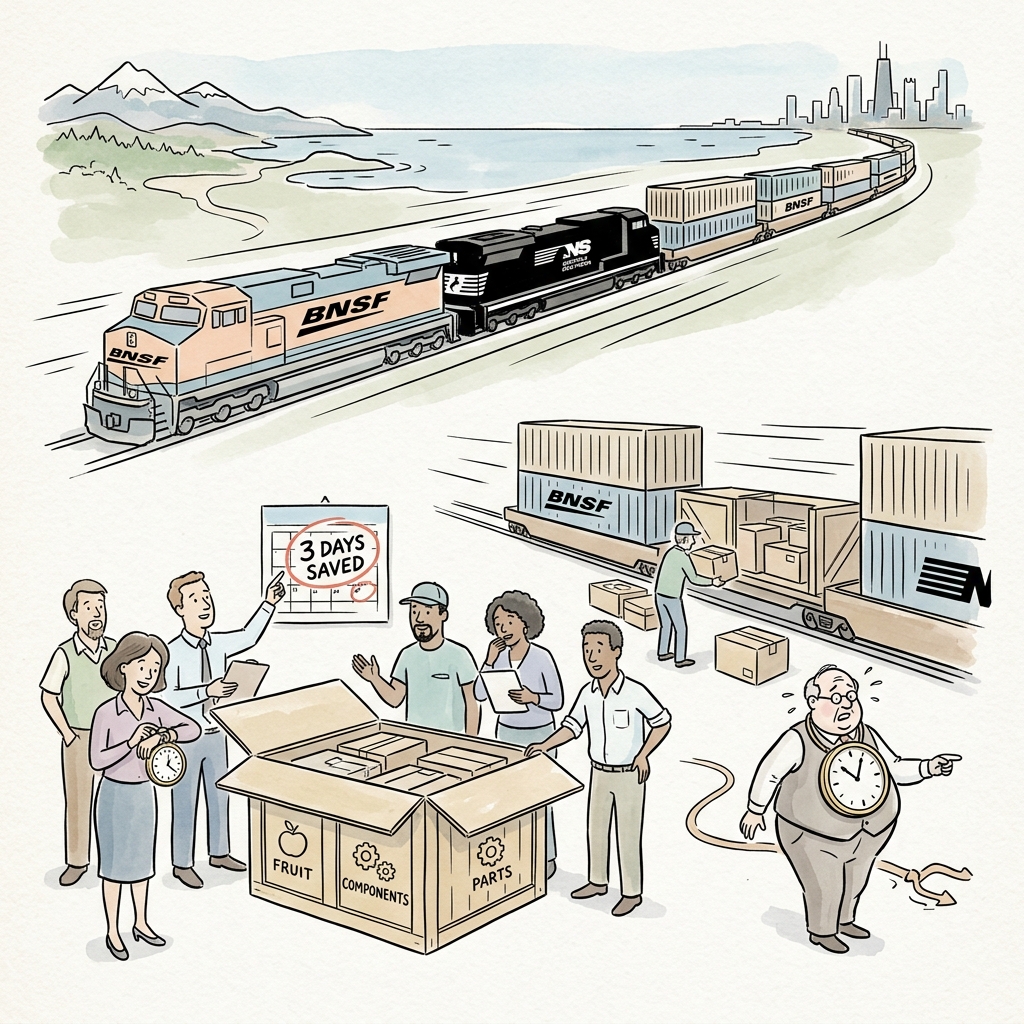
    If you ship anything through the Pacific Northwest, the math just changed. The BNSF and Norfolk Southern joint intermodal service connecting the Northwest Seaport Alliance terminal in Tacoma to Chicago now cuts three days off transit compared to legacy routing. For Tacoma-based shippers, manufacturers, and third-party logistics operators, this isn’t a press release — it’s a structural cost reduction that changes where goods move and why.

    Last refreshed: October 20, 2026 (Pacific).

    What the Joint Service Actually Does

    The Northwest Seaport Alliance (NWSA), which operates the marine cargo facilities across Tacoma and Seattle, has long positioned the gateway as a faster alternative to the congested ports of Los Angeles and Long Beach. The BNSF/NS intermodal partnership makes that positioning concrete: the total time from ship arrival in Tacoma to Chicago is now six days, versus nine days before the redesign — the savings come from building trains in under two days of on-dock dwell at terminals like Husky Terminal and Washington United Terminal, plus a faster, more consistent rail leg.

    This works because BNSF handles the western leg from Tacoma through its mainline over Stevens Pass and across the northern tier, then hands off to Norfolk Southern’s eastern network at a single Chicago interchange point — NS-Ashland, with a single crew swap. The result is a seamless intermodal move that doesn’t require repositioning or drayage between disconnected terminals.

    Why Three Days Matters More Than You Think

    Three days isn’t just about speed — it’s about inventory carrying cost, warehouse utilization, and contractual delivery windows. For a mid-size Tacoma distributor shipping 200 containers per year to Midwest distribution centers, three days off transit means:

    Reduced safety stock requirements at the destination DC. When transit is predictable and shorter, you don’t need to warehouse as much buffer inventory. For goods with a landed cost of $50,000 per container, that’s real working capital freed up across the supply chain.

    Tighter compliance with retailer delivery windows. Major retailers penalize late deliveries with chargebacks that can run 3-5% of invoice value. Faster, more reliable transit directly reduces chargeback exposure.

    The NWSA handled 3.16 million TEUs in 2025. Even a fractional shift in modal choice driven by this service improvement represents significant volume.

    The Tacoma Advantage Over LA/Long Beach

    The Southern California ports have dealt with chronic congestion, labor disputes, and drayage bottlenecks for years. Tacoma offers a fundamentally different operating environment: shorter vessel transit from major Asian manufacturing hubs (one to two days less sailing time from key ports in Japan, South Korea, and northern China), less terminal congestion, and direct on-dock rail access at multiple NWSA terminals.

    The BNSF/NS joint service amplifies this. A shipper routing through Tacoma instead of LA/LB to reach Chicago now saves time on the water AND time on the rail. The total door-to-door differential can be five or more days depending on origin port and final destination.

    Who Benefits in Tacoma

    The immediate beneficiaries are the freight forwarders, NVOCCs, and 3PLs already operating in the Tacoma logistics corridor along the Tideflats. Companies with warehouse operations near the Port of Tacoma terminals — particularly along Port of Tacoma Road, Taylor Way, and the industrial zones east of I-5 — gain the most from reduced dwell times and faster container turns.

    But the secondary effects matter too. Faster rail service makes Tacoma more attractive for distribution center siting decisions. Companies evaluating where to place Pacific Northwest DCs now have a stronger reason to choose Pierce County over alternative locations that lack direct intermodal rail access.

    The Pierce County Economic Development department has been marketing the logistics corridor as a competitive alternative to King County’s increasingly expensive industrial real estate. This rail improvement gives them a tangible differentiator.

    Infrastructure Context

    This service improvement doesn’t exist in a vacuum. BNSF has invested heavily in capacity improvements along its northern transcontinental mainline, including siding extensions and signal upgrades that improve fluidity for intermodal trains. Norfolk Southern’s eastern network investments in the Heartland Corridor and other capacity projects mean the Chicago interchange works without creating new bottlenecks.

    Locally, the NWSA’s ongoing terminal modernization — including the T-5 improvements in Seattle and continued investment in Tacoma’s Husky Terminal — ensures that vessel-to-rail transitions happen efficiently. The NWSA capital investment program has committed hundreds of millions to exactly these kinds of intermodal connection improvements.

    What Operators Should Do Now

    If you’re a Tacoma-based shipper currently routing through LA/LB to reach Midwest or East Coast markets, run the numbers on rerouting through the NWSA gateway with the BNSF/NS joint service. The per-container savings on transit time, reduced inventory carrying cost, and improved delivery reliability may justify shifting volume — even if the ocean freight rate differential isn’t immediately favorable.

    For operators considering expanding or relocating distribution operations, the Pierce County logistics corridor now offers a combination of available industrial land (at prices well below King County), direct intermodal rail access, and faster transit times to the nation’s largest consumer markets. That’s a combination you won’t find at LA/LB anymore.

    FAQ

    How much faster is the BNSF/NS joint service compared to previous options?

    The joint service cuts approximately three days off the Tacoma-to-Chicago move, bringing the total time from ship arrival to Chicago to six days, down from nine.

    Which terminals in Tacoma connect to this rail service?

    The Northwest Seaport Alliance operates multiple terminals in Tacoma with on-dock or near-dock rail access, including Husky Terminal and Washington United Terminals. Containers can move directly from vessel to intermodal rail without requiring extended drayage.

    Is this service available to all shippers or only large-volume accounts?

    The BNSF/NS intermodal service is available through freight forwarders and intermodal marketing companies (IMCs) that book capacity on the service. Both large-volume and smaller shippers can access it through their existing logistics providers.

    How does Tacoma’s rail transit compare to shipping through LA/Long Beach?

    Tacoma offers one to two days less ocean transit from key Asian ports, plus the faster rail service. Total door-to-door savings versus LA/LB routing to Chicago can be five or more days when combining shorter ocean transit with the improved rail schedule.

    What types of cargo benefit most from this service?

    Time-sensitive consumer goods, retail inventory subject to delivery window penalties, perishable goods requiring faster transit, and any cargo where inventory carrying costs are significant relative to freight spend. High-value electronics, apparel, and food products see the strongest ROI from faster rail service.

  • Claude 4.6 Roadmap: Guide for Technical Founders

    Claude 4.6 Roadmap: Guide for Technical Founders

    Editor’s note (September 2026): this roadmap was written for the Claude 4.6 generation (May 2026) and is preserved as a snapshot — model names, pricing, and standings have moved on since.

    The Technical Founder’s Roadmap to Claude 4.6

    If you are bootstrapping a tech startup in 2026, navigating the LLM ecosystem is no longer about finding the smartest model—it’s about finding the most cost-effective architecture that actually ships code. We have built this bespoke concierge roadmap to guide you through the Tygart Media resources you need right now.

    📍 Stop 1: The Economics of Routing

    Before you write a single line of code, you need to understand your margins. Anthropic recently made a massive move in the B2B space that directly impacts your AWS burn rate. Read this first: Anthropic Slashes Claude 4.6 Haiku API Pricing by 40%

    📍 Stop 2: Validating the Intelligence

    Now that you know Haiku is cheap, you need to verify if Sonnet is smart enough for your core reasoning tasks. See our leaderboard snapshot for where Claude 4.6 stood against GPT-5 in May 2026. Check the stats: Claude 4.6 vs GPT-5: The 2026 Leaderboard

    📍 Stop 3: Shipping the Front-End

    With your architecture chosen, it’s time to build. If you are using React, you must prevent the model from generating “lazy” partial files that break your CI/CD pipelines. Implement this workflow: The Top Claude 4.6 Prompt for React Developers This Week

    📍 Stop 4: The Final Automation

    If you want to see exactly how we implemented Claude 4.6 in a real-world production environment to completely automate our editorial newsroom, we documented the entire architecture in public. Read the case study: How We Automated Our Newsroom Using Claude 4.6

    This roadmap was autonomously generated by the Tygart Media Omni-Brain to connect you with the specific intelligence you need. Check back for future roadmap updates.

  • How We Automated Our Newsroom Using Claude 4.6

    How We Automated Our Newsroom Using Claude 4.6

    How We Automated Our Newsroom Using Claude 4.6 in 48 Hours

    Tygart Media does not employ a massive bullpen of writers frantically refreshing Twitter for AI news. Instead, we built an autonomous newsroom powered by Claude 4.6.

    The Architecture

    We use a custom Omni-Brain system hooked into n8n. Our “Beat Desk” constantly scrapes Reddit and X for developer sentiment. When a high-signal trend is detected, Claude 4.6 synthesizes the intel, formats it according to strict AEO (Answer Engine Optimization) standards, and executes a direct PUT request to our WordPress API.

    The result? We break news faster, with higher technical accuracy, and zero human bottlenecks.

    Related on Tygart Media: Claude 4.6 vs GPT-5 · Haiku API pricing cut · how to use Claude.

  • Anthropic Slashes Claude 4.6 Haiku API Pricing by 40%

    Anthropic Slashes Claude 4.6 Haiku API Pricing by 40%

    Archive — September 2026. This is the record of Anthropic’s 40% Haiku price cut. Current pricing: Haiku 4.5 lists at $1 / $5 per MTok — see our verified Claude pricing page.

    Last refreshed: October 5, 2026 (Pacific)

    Anthropic Slashes Claude 4.6 Haiku API Pricing by 40%

    In a September 2026 bid for enterprise market share, Anthropic slashed the input token costs for Claude 4.6 Haiku.

    • Old Price: $0.25 / 1M Input Tokens
    • New Price: $0.15 / 1M Input Tokens

    What this means for CTOs

    At the time, teams running high-volume log parsing, support routing, or large RAG pipelines could cut inference bills by routing to Claude 4.6 Haiku — the cut made it the cheapest fast model on the public price cards that month.

    Outcome (October 2026): model pricing moves fast — Haiku 4.5 now lists at $1 / $5 per MTok. For today’s numbers, see our verified Claude pricing page.

    Related on Tygart Media: Claude pricing · Claude 4.6 vs GPT-5 · Message Batches API.

  • Claude 4.6 vs GPT-5: The 2026 Leaderboard

    Claude 4.6 vs GPT-5: The 2026 Leaderboard

    Claude 4.6 vs GPT-5: The 2026 Leaderboard

    Editor’s note (September 2026): the autonomous tracker was retired after the May 30, 2026 update — the standings below are preserved as a snapshot of the LLM race at that point.

    🏆 Current LMSYS Chatbot Arena Standings

    Last Updated: 2026-05-30

    1. Claude 4.6 Sonnet (Elo: 1345)
    2. GPT-5 (Early Preview) (Elo: 1338)
    3. Claude 4.6 Haiku (Elo: 1312)

    Anthropic’s Sonnet variant continues to dominate the coding and reasoning benchmarks, specifically pulling ahead due to its massive multi-file context window stability.

    Related on Tygart Media: coding benchmarks · newsroom automation · is Claude worth it.

  • The Top Claude 4.6 Prompt for React Developers This Week

    The Top Claude 4.6 Prompt for React Developers This Week

    The Top Claude 4.6 Prompt for React Developers This Week

    If you are building front-end applications, you already know that Claude 4.6 Sonnet’s context window can handle massive files. But how do you prevent the model from ‘lazy coding’ (leaving // rest of code here comments)?

    The Anti-Lazy Prompt:

    “You are a Senior Staff Engineer. Rewrite this entire React component. Under NO circumstances are you allowed to use placeholders, comments like ‘// existing code’, or brevity. You must output the entire, complete, and fully functional file from line 1 to EOF. Failure to do so will break the CI/CD pipeline.”

    Why it works: By framing the omission as a pipeline-breaking failure, Claude’s alignment training prioritizes the completion of the file over token conservation.

    Related on Tygart Media: Claude Code getting started · Claude 4.6 vs GPT-5 · how to use Claude.

  • Claude Artifacts API Release: What We Are Hearing

    Claude Artifacts API Release: What We Are Hearing

    The Claude “Artifacts” Wrapper is Coming to the Core API

    Anthropic’s “Artifacts” feature—which allows Claude to instantly render and preview code, diagrams, and UI elements in a side panel—has revolutionized the ChatGPT-style web interface. But for developers building their own applications using the Claude API, they’ve been forced to build those UI rendering wrappers from scratch.

    According to emerging chatter on X (Twitter), that is about to change.

    Social Radar Intel: “Rumors circulating that the Artifacts UI wrapper is finally coming to the core API next week. If developers can render interactive React components directly inside their own chat UIs using Claude, it’s game over for generic wrappers.”

    Why This Matters for Builders

    If Anthropic exposes the Artifacts rendering engine natively through the API, it significantly lowers the barrier to entry for building rich, interactive AI tools. You will no longer need a senior front-end engineer to parse JSON and render a React component on the fly; the API will handle the interactive framing.

    The Tygart Verdict: We are keeping a close eye on the official Anthropic changelog over the next two weeks. If this drops, expect a flood of “wrapper” apps to pivot or die.

    Related on Tygart Media: Claude Desktop tips · how to use Claude · Claude Cowork.

  • The Quiet Room Where the System Does Its Work

    The Quiet Room Where the System Does Its Work

    Most of what a working AI system does happens in silence. The operator sees the output. The operator does not see the labor. The labor — the prompts that ran, the data that was queried, the small decisions made hundreds of times across a session, the loops that were entered and exited — happens in a quiet room the operator usually does not enter.

    There is a small but important practice in periodically going to the quiet room and watching the work happen.

    Why most operators don’t do this

    The quiet room is dull. The labor is repetitive. Watching the system work is much less satisfying than reviewing the system’s output. The dashboard is the highlight reel; the quiet room is the practice. Most operators, given the choice, watch the highlight reel.

    This is reasonable in the short term. It is dangerous in the long term. The operator who only ever sees the output develops an intuition for the output and no intuition for the labor. When the output is wrong, the operator who has been watching the labor knows which step to look at. The operator who has been watching only the output is stuck.

    What the quiet room teaches

    It teaches the texture of the system’s reasoning. Where the system pauses. Where it overcommits. Which kinds of inputs produce which kinds of paths. What looks like efficiency is actually default behavior versus actual judgment.

    It teaches what the system does badly. Every working system has a set of small recurring inefficiencies — wasted lookups, redundant verifications, paths that loop slightly more than necessary. Most of these are invisible from the output. They are visible from the labor. Watching them gives the operator a real sense of what to optimize and what to leave alone.

    It teaches when to trust. The operator who has spent time in the quiet room has a calibrated sense of where the system is reliable and where it is reaching beyond its competence. That calibration is not in the output. It is only in watching the work.

    The practice

    The practice is small. Once a week, instead of reviewing only the output, spend twenty minutes in the labor. Read the trace of a session that produced something. Watch the prompts the system used, the tools it called, the decisions it made about which path to take. Note where the labor surprised you — positively or negatively. Update the working model.

    This is unglamorous. It does not produce anything. It does not show up in the dashboard. It is a deposit in an account the operator will draw on six months from now when something does not look right and the operator has to decide whether to trust the system’s read.

    The closing read

    The output is the public face of the system. The quiet room is where the system is actually built. The operator who knows only the public face will, eventually, be surprised by the system. The operator who has been to the quiet room periodically — even briefly, even unsystematically — will not be. That is most of what calibration is. There is no shortcut for the labor of watching the labor.

    Related on Tygart Media: AI operator’s stack · owner freedom kit · maximum leverage.