Blog

  • Tacoma Link T Line: Ridership, Extensions & Development

    Tacoma Link T Line: Ridership, Extensions & Development

    Last refreshed: October 20, 2026 (Pacific).

    The T Line Is No Longer a Curiosity — It’s a Commuter Artery

    When Sound Transit opened the Hilltop extension on September 16, 2023, it doubled the T Line’s reach overnight. The 2.4-mile addition stretched light rail from downtown Tacoma into the Stadium business district and up into the Hilltop neighborhood, adding seven new stations to what had been a modest 1.6-mile starter line running from the Tacoma Dome to the Theater District.

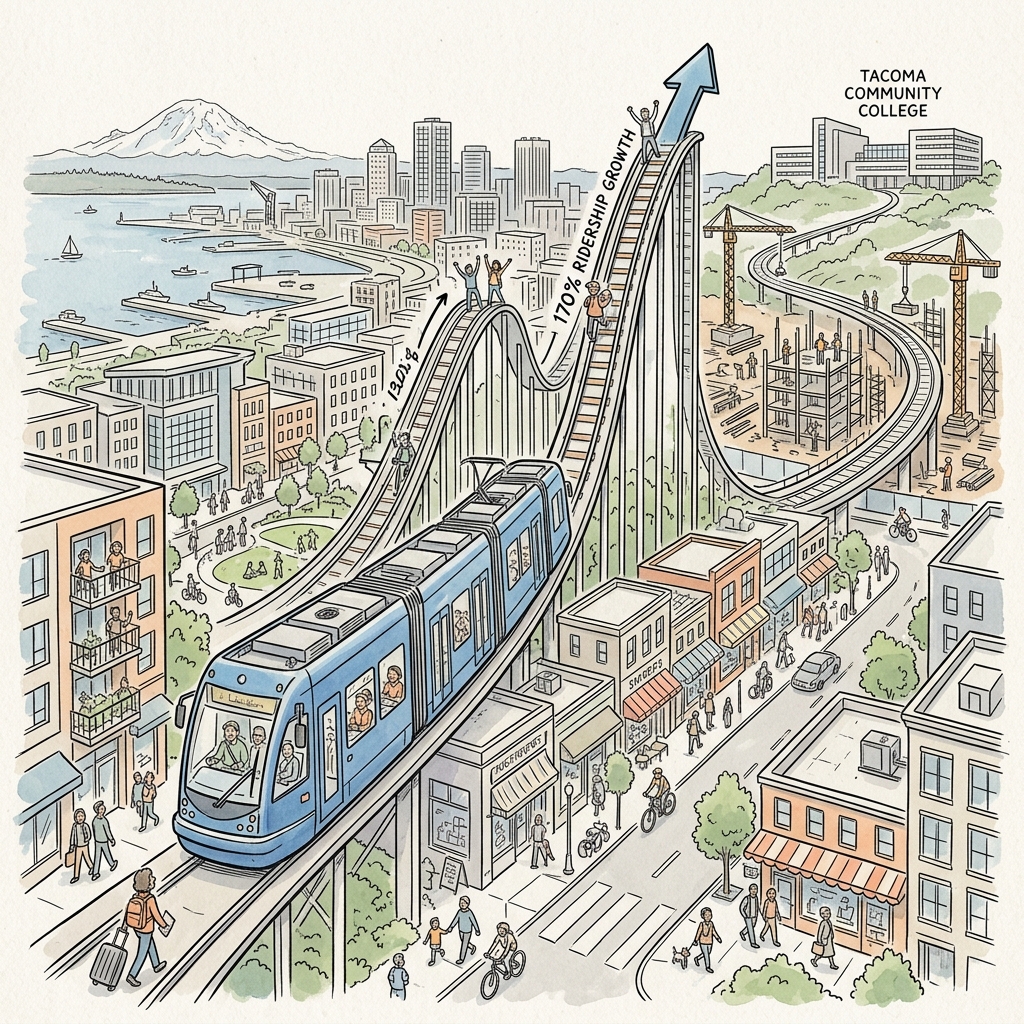
    The ridership numbers tell the story. Weekday boardings averaged 3,907 in 2025 — more than double the roughly 1,500 a day the starter line drew before the extension. The T Line carried 1,147,409 total passengers in 2025, according to Sound Transit’s ridership tracker.

    I ride this line. I watch the cars fill up at the Stadium District station at 7:45 a.m. and empty out near Tacoma General at shift change. This isn’t a novelty — it’s infrastructure that people depend on.

    The Current Station Map: 12 Stops Across 4 Miles

    The T Line now runs 12 stations along its 4-mile corridor, from Tacoma Dome Station in the south to St. Joseph Station in Hilltop in the north. Key stops include Old City Hall (Commerce Street), Union Station, South 25th Street, and the Stadium District — each one anchoring a distinct neighborhood commercial node.

    Trains run Monday through Friday from 5 a.m. to 10 p.m., Saturdays from 7:20 a.m. to 10 p.m., and Sundays from 10 a.m. to 6 p.m. Fares are simple — $2 for adults, $1 for reduced-fare riders, and free for youth 18 and under. The T Line ran fare-free from 2003 until the Hilltop extension opened in September 2023, when fares began.

    The TCC Extension: Six More Stations, 8.4 Total Miles

    The next phase is the Tacoma Community College (TCC) T Line Extension, which will add six new stations and extend the line from its current Hilltop terminus south and west to TCC. When complete, the T Line will stretch 8.4 miles with 18 stations — a legitimate urban transit network, not a demonstration project.

    Sound Transit’s current opening forecast is 2043: in May 2026 the Board adopted an updated ST3 System Plan that moved the TCC extension from its earlier 2039 target to 2043 to bring the agency’s long-term financial outlook into balance. Early planning and design work launches in 2027, and the agency is looking for ways to accelerate the timeline. The extension will connect residential neighborhoods in South Tacoma and the west side to the existing downtown and Hilltop corridor, opening new development potential along the route.

    The Tacoma Dome Link: Regional Connection Coming 2035

    The bigger play is the Tacoma Dome Link Extension, which will connect the T Line to the regional Link light rail system running south from Seattle and through Federal Way. The current timeline has this opening in 2035, which would make Tacoma a one-seat ride from SeaTac Airport and downtown Seattle.

    For operators and developers watching this market, that 2035 date matters. It’s when Tacoma stops being “south of Seattle” and starts being “on the Link.” The property value implications along the corridor are significant — and they’re already being priced in by institutional buyers along Pacific Avenue and in the Stadium District.

    What the Corridor Means for Development

    Every T Line station is a potential transit-oriented development node. The City of Tacoma’s MFTE program already incentivizes multifamily construction in these zones, and the combination of light rail access plus tax exemption is a powerful draw for housing developers.

    The Hilltop extension has already catalyzed visible change. The corridor along Martin Luther King Jr. Way has seen new restaurant openings, mixed-use projects, and a noticeable uptick in foot traffic. The Stadium District, always a strong residential neighborhood, now has the transit access to justify denser commercial uses.

    This is the operating thesis for Tacoma’s next decade: build transit, zone for density, attract capital. The T Line is the physical manifestation of that thesis, and it’s working.

    Frequently Asked Questions

    How many people ride the Tacoma T Line?

    The T Line carried 1,147,409 total passengers in 2025, with weekday boardings averaging 3,907 — more than double the pre-extension level — according to Sound Transit’s performance tracker.

    Is the Tacoma T Line free to ride?

    No. The T Line ran fare-free until the Hilltop extension opened on September 16, 2023; since then adults pay $2, reduced-fare riders pay $1, and youth 18 and under ride free. Trains run from 5 a.m. to 10 p.m. on weekdays, with reduced hours on weekends.

    When will the TCC extension open?

    Sound Transit’s current opening forecast for the TCC T Line Extension is 2043, under the updated ST3 System Plan the Board adopted in May 2026. The extension will add six new stations including a stop at Tacoma Community College, bringing the total system to 8.4 miles and 18 stations.

    When will Tacoma connect to the Seattle Link light rail?

    The Tacoma Dome Link Extension is targeted for 2035. This will connect the T Line to the regional system, enabling direct light rail travel from Tacoma to SeaTac Airport and downtown Seattle.

    What stations does the T Line currently serve?

    The T Line serves 12 stations along a 4-mile corridor from Tacoma Dome Station to St. Joseph Station in Hilltop, including stops at Union Station, Old City Hall, South 25th Street, and the Stadium District. The full station list is available on Sound Transit’s website.


  • Hilltop Cultural Markers: Preserving Tacoma’s Black History

    Hilltop Cultural Markers: Preserving Tacoma’s Black History

    The Hilltop neighborhood is getting something it’s needed for a long time: permanent public art and cultural markers that acknowledge the community’s history without sanitizing it. The project involves multiple commissioned installations along Martin Luther King Jr. Way and adjacent blocks, designed to tell Hilltop’s story through the voices of the people who actually lived it. Here’s what’s happening, what residents are saying, and why it matters beyond aesthetics.

    Last refreshed: October 20, 2026 (Pacific).

    What the Project Is

    The Hilltop public art and cultural markers initiative is a City of Tacoma-supported effort to install permanent art pieces, cultural markers, and interpretive elements throughout the Hilltop neighborhood — historically Tacoma’s primary Black community and a neighborhood that has experienced significant change through decades of displacement, disinvestment, and more recently, rapid gentrification driven by Sound Transit light rail construction and associated development.

    The installations are being developed through a community-engaged process, with local artists, longtime residents, cultural organizations, and the Hilltop Action Coalition providing input on themes, locations, and artistic direction. This isn’t a top-down public art program where the city commissions pieces and installs them — it’s designed to be community-driven at every stage.

    The Historical Context

    You can’t understand this project without understanding what Hilltop has been and what it’s becoming. For decades, the neighborhood centered around MLK Way was the heart of Tacoma’s Black community — home to churches, barbershops, soul food restaurants, community organizations, and the daily life of a neighborhood that existed largely outside the attention of Tacoma’s whiter, wealthier neighborhoods.

    The neighborhood experienced serious challenges with drug activity and violence in the 1980s and 1990s — a period that shaped external perceptions but doesn’t define the community’s full story. Residents who lived through that era describe both the hardship and the solidarity, the community institutions that held people together even in difficult times.

    The Hilltop Tacoma Link Extension — connecting Hilltop to downtown via light rail along MLK Way — brought massive infrastructure construction through the neighborhood’s commercial core and accelerated gentrification that was already underway. Property values rose, longtime businesses faced displacement, and demographic change accelerated. The cultural markers project exists in direct response to this change: an acknowledgment that the neighborhood’s history belongs to the people who made it, not to the new arrivals who benefit from it.

    What Residents Are Saying

    Community feedback on the project has been broadly positive with specific concerns about execution and authenticity. Based on reporting from public meetings and community forums documented through Tacoma’s Office of Arts and Cultural Vitality:

    Longtime residents and community elders express strong support for permanent recognition of Hilltop’s Black cultural heritage. The sentiment is clear: this neighborhood’s story matters, it’s at risk of being erased by demographic change, and physical markers are a way to ensure it persists even as the community evolves.

    Some residents express concern about performative recognition — the idea that art installations become a substitute for addressing material displacement rather than a complement to anti-displacement policy. The question being raised in community forums: “Is this art instead of affordable housing, or in addition to it?”

    Local artists involved in the project describe it as an opportunity to work at scale and in public space, which is rare for Tacoma-based artists of color. The commissions represent meaningful professional opportunities in addition to their cultural significance.

    Younger residents — including those who moved to Hilltop more recently — generally express appreciation for learning neighborhood history they weren’t previously aware of. The markers serve an educational function for newer community members.

    The Installations

    The project includes multiple components distributed along MLK Way and surrounding blocks. While specific pieces are in various stages of completion and installation, the overall program includes permanent sculptural works, ground-level markers with interpretive text, wall murals commissioned from local and regional artists, and integration with the light rail station areas to ensure transit riders encounter the neighborhood’s story.

    Themes identified through community engagement include: the migration stories of Black families who came to Tacoma for military and industrial employment, the commercial and social life of MLK Way in its prime, the cultural institutions (churches, lodges, community organizations) that anchored neighborhood life, and the ongoing resilience of a community navigating rapid change.

    Why This Matters Beyond Art

    Public art and cultural markers are often dismissed as nice-to-have amenities. In Hilltop’s case, they serve a more urgent function: they’re physical assertions of belonging in a neighborhood where belonging is being contested by market forces. When a longtime Black community is being demographically transformed by an influx of higher-income residents drawn by transit access and relative affordability compared to Seattle, the question of whose neighborhood this is becomes material, not philosophical.

    The markers say: this community was here. These people built something. That history has value and permanence regardless of who owns the real estate now. For a city wrestling with how to manage growth without erasing the communities that growth displaces, Hilltop’s public art program is a partial answer — imperfect, but tangible.

    For Tacoma more broadly, the project demonstrates something important about how the city handles neighborhood identity during change. It’s not enough to build light rail through a historically Black neighborhood and call it progress. The infrastructure investment must be accompanied by cultural investment that honors what was there before the cranes arrived.

    What’s Next

    Additional installations are in various stages of fabrication and planning. The project continues to engage community members through the City of Tacoma’s arts programs and through the Hilltop Action Coalition’s ongoing advocacy work. Residents interested in providing input or participating can contact the Office of Arts and Cultural Vitality or attend Hilltop Action Coalition community meetings.

    The real test will be whether the cultural markers survive and remain relevant as the neighborhood continues to change — whether they become living landmarks that new and old residents alike engage with, or historical footnotes that people walk past without understanding. That outcome depends on continued community engagement, maintenance funding, and the broader question of whether Tacoma can grow without losing the communities that made it interesting in the first place.

    FAQ

    What is the Hilltop public art and cultural markers project?

    A City of Tacoma-supported initiative to install permanent public art, cultural markers, and interpretive elements throughout the Hilltop neighborhood that acknowledge and preserve the area’s history as Tacoma’s primary Black community, developed through a community-engaged process.

    Where are the installations located?

    Installations are distributed along Martin Luther King Jr. Way and adjacent blocks in the Hilltop neighborhood, including integration with Sound Transit light rail station areas. The corridor runs through Hilltop’s historic commercial and cultural core.

    How was the community involved in the project design?

    The project was developed through community engagement with longtime residents, local artists, cultural organizations, community elders, and the Hilltop Action Coalition. Themes, locations, and artistic direction were shaped by community input rather than imposed by city planners.

    What themes do the installations address?

    Themes include the migration stories of Black families who came to Tacoma for military and industrial employment, the commercial and social life of MLK Way in its prime, anchoring cultural institutions, and community resilience through decades of change including recent gentrification.

    How can residents get involved?

    Residents can engage through the City of Tacoma’s Office of Arts and Cultural Vitality, attend Hilltop Action Coalition community meetings, or contact the project coordinators directly through the city’s community and economic development department.

  • Bridge Point Tacoma 2M: Construction & Pre-Lease Update

    This is the construction status update for Bridge Point Tacoma 2M as of late May 2026. Four buildings on the former Kaiser Aluminum site in Tacoma’s Tideflats — here’s where each one stands in terms of construction progress, shell completion, tenant improvements, and pre-lease activity. If you’re tracking industrial development in Pierce County, this is your dashboard.

    Project Overview

    Bridge Development Partners‘ Bridge Point Tacoma 2M represents approximately 2.5 million square feet of modern Class A logistics space across four buildings on the remediated former Kaiser Aluminum smelter site along the Hylebos Waterway. The project is the largest speculative industrial development in Pierce County history and one of the largest on the West Coast in this development cycle.

    Building A — The Anchor

    Building A is the largest structure in the complex at approximately 1.1 million square feet. This is a cross-dock logistics facility designed for high-throughput distribution operations with 36’+ clear height, extensive dock positions on both sides, and trailer parking sufficient for major 3PL or e-commerce fulfillment operations.

    Construction status: Building A’s shell is complete with the concrete tilt-up walls, steel structure, and roof system all in place. Site work including parking, truck courts, and stormwater management is substantially complete. Tenant improvement work depends on specific occupant requirements — the building is being marketed for single-tenant occupancy given its scale, though multi-tenant configurations are possible.

    Pre-lease status: Given the confidential nature of active negotiations on buildings of this scale, specific tenant identity remains undisclosed. Buildings of this size typically transact with national or multinational logistics operators, major retailers, or 3PLs serving multiple client accounts.

    Building B

    Building B provides approximately 600,000 square feet of logistics space — sized for regional distribution operations, import/distribution companies, or multi-tenant occupancy with several tenants in the 100,000-300,000 SF range.

    Construction status: Shell complete. The building features the same Class A specifications as Building A — modern clear heights, LED lighting, ESFR sprinkler systems, and contemporary dock configurations. Exterior landscaping and site improvements are in final stages.

    Pre-lease status: Active marketing with reported strong interest from logistics tenants serving the Northwest Seaport Alliance gateway. Pierce County’s position as the primary industrial growth market in the Puget Sound region continues to drive inquiry activity.

    Building C

    Building C provides approximately 450,000 square feet — the mid-size option in the complex. This building type appeals to growing regional operators that have outgrown 100,000-200,000 SF facilities but don’t need the scale of Buildings A or B.

    Construction status: Shell substantially complete. Final punch list items, site grading completion, and landscape installation in progress. The building is ready for or very near tenant improvement commencement upon lease execution.

    Pre-lease status: This is the sweet spot size for the Pierce County market — large enough for meaningful operations but small enough that multiple qualified tenant prospects exist in the market at any given time. Competition for this size range is strong given limited new supply delivery of modern spec product.

    Building D

    Building D is the smallest in the complex at approximately 400,000 square feet, though “smallest” is relative — this is still a substantial logistics facility by any market standard.

    Construction status: Shell complete. This building was among the first to finish construction given its relatively smaller scale. Site work and final improvements are complete or in final stages.

    Pre-lease status: Buildings in this size range historically lease fastest in the Pierce County market because the tenant pool is deepest — growing companies, regional operations, and multi-facility operators all compete for 300,000-500,000 SF options.

    Construction Timeline and Delivery

    The overall construction timeline for Bridge Point Tacoma 2M began with site preparation and remediation completion, followed by vertical construction commencing in phases. The development has progressed through 2024-2026 with buildings delivered or delivering on a rolling basis as shell construction completes.

    Tenant improvements typically require 3-6 months after lease execution depending on complexity (racking systems, specialized mechanical, office build-out requirements). Prospective tenants can expect occupancy within 4-8 months of signed lease for most configurations.

    Market Position

    Bridge Point Tacoma 2M is the defining project for Pierce County’s next era of industrial growth. It validates institutional capital’s confidence in the market, establishes a new standard for building quality in the submarket, and provides the large-format modern space that the Puget Sound logistics sector needs but has lacked south of King County.

    The development’s success — measured by lease-up velocity and the caliber of tenants it attracts — will influence future development decisions across the Tideflats and broader Pierce County industrial corridor. Early indications suggest the market is absorbing this new supply at healthy rates, confirming the demand thesis that justified speculative development at this scale.

    FAQ

    How many buildings are in Bridge Point Tacoma 2M?

    Four buildings totaling approximately 2.5 million square feet, ranging from approximately 400,000 SF (Building D) to 1.1 million SF (Building A).

    What is the current construction status as of May 2026?

    All four building shells are complete or substantially complete. Site work, landscaping, and final improvements are in various stages of completion across the complex. Buildings are ready for or approaching readiness for tenant improvement commencement.

    What are the building clear heights?

    All buildings feature 36’+ clear height — the modern Class A logistics standard required by contemporary distribution, e-commerce fulfillment, and 3PL operations that utilize high-bay racking systems.

    How long from lease signing to occupancy?

    Typical tenant improvement timelines run 3-6 months depending on complexity, putting total time from lease execution to occupancy at approximately 4-8 months for most configurations.

    Who is the developer?

    Bridge Development Partners, a Chicago-based firm and one of the largest private industrial real estate developers in the United States. Their commitment to speculative development at this scale in Tacoma reflects institutional confidence in Pierce County’s industrial market fundamentals.

  • Tacoma Business Relocation: The Case for Pierce County

    Tacoma Business Relocation: The Case for Pierce County

    If you’re running a business somewhere expensive, somewhere congested, somewhere that stopped working for operators like you — and you’ve started thinking about where else you could be — let me make the case for Tacoma. Not the tourism-board version. The operator’s version. The version that talks about power costs, permitting timelines, talent pipelines, and why your dollar goes further here than almost anywhere else on the West Coast.

    Last refreshed: October 20, 2026 (Pacific).

    The Cost Structure

    Start with the basics. Office space in Tacoma’s CBD runs $22-$32 per square foot full-service — versus $38-$55+ in Seattle, $50-$80 in San Francisco, and comparable ranges in Portland’s Pearl District. Industrial space in Pierce County leases at $12-$16 NNN versus $16-$22 in King County. Electricity from Tacoma Power runs approximately 10 cents per kWh versus 16+ cents nationally.

    These aren’t marginal differences. For a 50-person company occupying 10,000 SF of office space, the rent differential alone is $100,000-$200,000 per year versus Seattle. That’s a hire. That’s a marketing budget. That’s margin you keep instead of handing to a landlord.

    The Talent Reality

    Pierce County has 925,000+ residents — this isn’t a small town. The labor market includes University of Washington Tacoma graduates, Pacific Lutheran University alumni, Clover Park Technical College’s skilled trades pipeline, and approximately 7,000 service members annually transitioning out of Joint Base Lewis-McChord through the Transition Assistance Program.

    The talent isn’t just available — it’s different in composition from what you find in Seattle. Less tech-sector concentration, more manufacturing, logistics, healthcare, trades, and professional services. If your business needs people who show up, do physical work, manage complex operations, or serve customers face-to-face, the Pierce County labor market delivers.

    Salary expectations are typically 15-25% below equivalent Seattle roles (adjusted for lower cost of living), which means your fully-loaded labor cost drops meaningfully without reducing employee quality of life. A $75,000 salary in Tacoma buys the same lifestyle as $95,000-$100,000 in Seattle once you account for housing, taxes, and commute costs.

    The Infrastructure

    Tacoma sits on I-5 between Seattle and Olympia. Sea-Tac International Airport is 25 miles north. The Northwest Seaport Alliance operates one of the largest container port complexes on the West Coast directly in Tacoma’s Tideflats. Sound Transit’s T Line streetcar runs within Tacoma, and the regional 1 Line now reaches Federal Way (the extension opened December 6, 2025) — but there is no direct light-rail ride from Tacoma to Sea-Tac or Seattle yet: the Tacoma Dome Link Extension is currently targeted for 2035, and express buses bridge the gap in the meantime.

    For logistics and distribution businesses, the port proximity is obvious. But even for non-logistics companies, the transportation connectivity means you’re not isolated — you have airport access, passenger rail (Amtrak Cascades stops in Tacoma), and highway connectivity to the entire I-5 corridor from Vancouver BC to Portland.

    Tacoma Power’s 88% non-emitting generation mix and 10¢/kWh rate means your Scope 2 emissions reporting looks great without buying RECs, and your power bill stays flat while competitors in gas-dependent markets watch their costs fluctuate with commodity prices.

    The Regulatory Environment

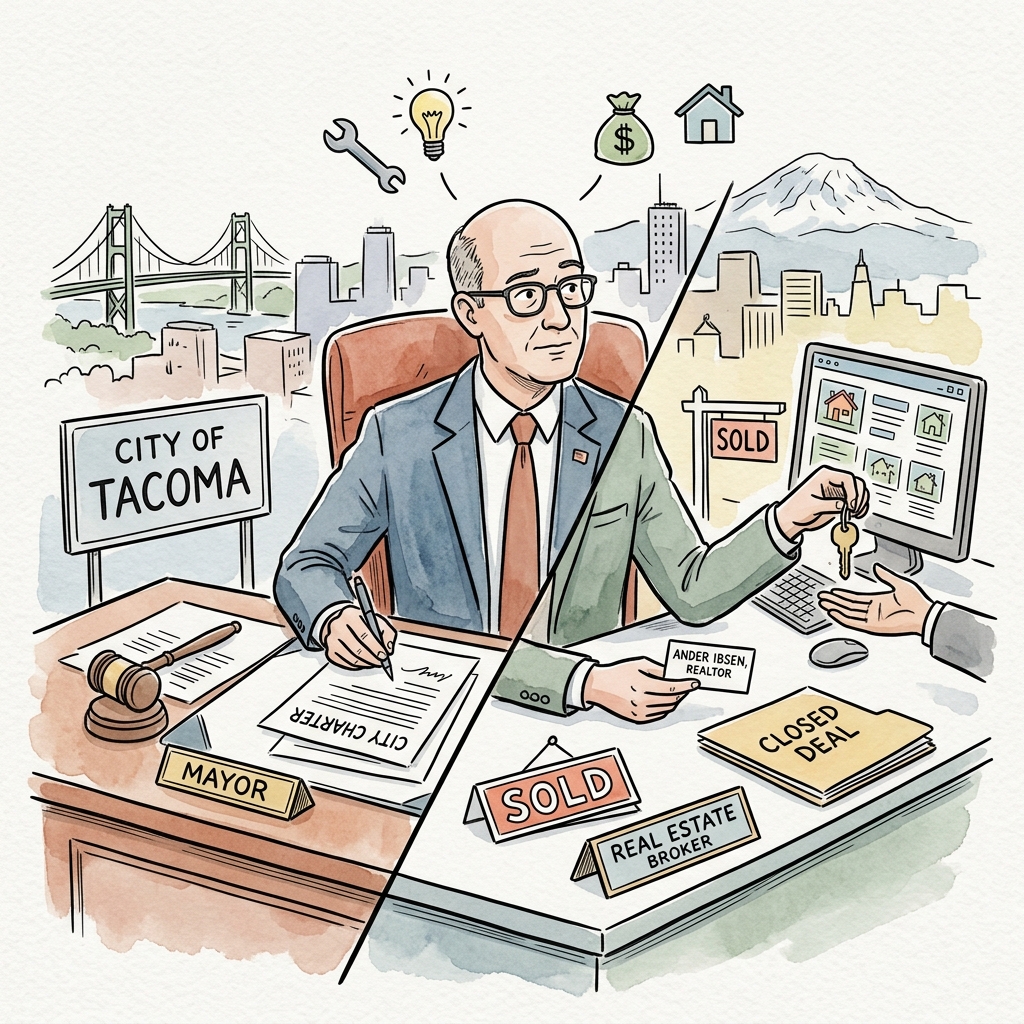
    Tacoma’s current administration under Mayor Anders Ibsen — a working commercial real estate broker — has prioritized reducing permitting friction and supporting business investment. This isn’t an anti-regulation stance; it’s a practical orientation that recognizes development as economic development rather than a problem to be managed.

    Washington State has no income tax (personal or corporate). The B&O tax structure is relatively straightforward compared to states with complex corporate income tax regimes. Property taxes in Pierce County are competitive with the region — not the lowest in the state, but significantly below King County for equivalent assessed values.

    The Quality of Life

    This matters for recruiting and retention. Tacoma has become a legitimate restaurant and arts city over the past decade — not trying to be Seattle, but developing its own identity. The Tacoma Art Museum, Museum of Glass, Point Defiance Park, and a growing brewery/restaurant scene give employees reasons to live here rather than commute from here.

    Housing costs are real but manageable. Home prices in Pierce County remain well below King County — Tacoma’s median listing price was $530,000 in September 2026 (Realtor.com), with desirable neighborhoods above that, versus $800,000-$1,000,000+ for comparable homes in Seattle. Your employees can actually buy houses here, which matters for retention in ways that compensation alone can’t solve.

    The Honest Assessment

    Is Tacoma perfect? No. The homelessness challenges visible in parts of downtown and along I-5 are real and ongoing. Some neighborhoods have deferred infrastructure maintenance. The national brand recognition isn’t Seattle — if your business model depends on prestige signaling, that matters. And while diversity of talent exists, certain specialized tech roles are harder to fill locally than in Seattle proper.

    But for operators who optimize on fundamentals — cost structure, talent availability, infrastructure access, regulatory predictability, and quality of life for employees — Tacoma’s combination is hard to beat on the West Coast. This is a city where the math works, the government wants you here, and the workforce shows up ready.

    I live here. I run businesses here. The advantages I’m describing aren’t theoretical — they show up in my operating costs, my hiring pipeline, and my quality of life every single month. If you’re considering the move, the door is open.

    FAQ

    How much cheaper is office space in Tacoma compared to Seattle?

    Office space in Tacoma’s CBD runs $22-$32 per square foot full-service compared to $38-$55+ in Seattle’s core. For a 10,000 SF office, that’s $100,000-$200,000 in annual savings on rent alone.

    Does Washington State have an income tax?

    No. Washington has no personal or corporate income tax. Businesses pay the B&O (Business & Occupation) tax based on gross receipts, which is relatively straightforward compared to states with complex corporate income tax structures.

    How far is Tacoma from Sea-Tac Airport?

    Sea-Tac International Airport is approximately 25 miles north of downtown Tacoma, accessible via I-5 (30-45 minutes depending on traffic). There is no direct light-rail ride from Tacoma yet — the 1 Line’s southern terminus is Federal Way, and the Tacoma Dome Link Extension is targeted for 2035 — so transit riders use express buses from Tacoma Dome Station in the meantime.

    What industries are strongest in Tacoma/Pierce County?

    Logistics and distribution (port-related), healthcare, military/defense services, manufacturing, construction trades, professional services, and a growing technology sector. The economy is notably more diversified than Seattle’s tech-heavy concentration.

    What is the average home price in Tacoma versus Seattle?

    Tacoma’s median listing price was $530,000 in September 2026, with desirable neighborhoods running higher, compared to $800,000-$1,000,000+ for comparable homes in Seattle. This means employees can realistically achieve homeownership, which significantly improves retention.

  • Bridge Point Tacoma 2M: Leasing 2.5M SF Industrial Space

    Bridge Point Tacoma 2M: Leasing 2.5M SF Industrial Space

    Bridge Point Tacoma 2M is the largest speculative industrial development in Pierce County history. Four buildings. 2.5 million square feet of Class A logistics space. Developed by Bridge Industrial on a 160-acre former BNSF Railway assemblage at 5802 S. Burlington Way in South Tacoma. If you’re tracking where institutional capital is deploying in the Pacific Northwest industrial market, this is the signal — and the leasing activity tells you exactly why.

    Last refreshed: October 20, 2026 (Pacific).

    The Project Scale

    Bridge Point Tacoma 2M consists of four buildings ranging from approximately 324,000 to 961,000 square feet, totaling approximately 2.5 million SF of modern logistics and distribution space. The development sits on 160 acres at 5802 S. Burlington Way in South Tacoma, assembled from 19 parcels Bridge Industrial bought from BNSF Railway in 2021 — one of the last large-scale infill development opportunities in the South Sound industrial market.

    Bridge Industrial, based in Chicago, is one of the largest private industrial developers in the United States. Their decision to deploy capital at this scale in Tacoma — on a speculative basis, meaning without pre-lease commitments for the majority of space — reflects institutional confidence in Pierce County’s industrial demand fundamentals.

    Why This Site, Why Now

    The former BNSF Railway site offered something increasingly rare in the Puget Sound industrial market: a large contiguous parcel with industrial zoning, port proximity, rail access potential, and highway connectivity via I-5. The site had sat vacant and in disrepair for several years; Bridge committed to maintaining the environmental remediation performed before its acquisition — and any future remediation the project required — to prepare the land for modern industrial reuse.

    The timing aligns with several demand drivers: e-commerce fulfillment requirements continuing to grow, reshoring and nearshoring trends creating new demand for West Coast distribution space, and the Northwest Seaport Alliance’s position as a gateway for trans-Pacific trade. Companies need large-format, modern logistics buildings close to the port — and the supply of such buildings in Pierce County has been constrained for years.

    Who’s Leasing and Why

    While specific tenant names on some buildings remain confidential pending formal announcements, the leasing activity at Bridge Point Tacoma 2M reflects the broader tenant profile driving Pierce County industrial demand: third-party logistics providers (3PLs) serving e-commerce fulfillment, import/distribution companies using the NWSA gateway, food and beverage distributors serving the Pacific Northwest market, and building materials/home improvement distributors.

    These tenants are drawn by the combination of port proximity (containers can dray from NWSA terminals to Bridge Point in under 30 minutes), competitive lease rates relative to King County ($12-$16 NNN in Pierce versus $16-$22+ in Kent Valley/SeaTac), and the modern building specifications (40′ clear height, extensive trailer parking, cross-dock capability) that contemporary logistics operations require.

    The Northwest Seaport Alliance cargo volumes support the demand thesis: the gateway handled 3.16 million TEUs in 2025, and its role as a trans-Pacific trade gateway supports continued distribution operations in the adjacent industrial corridors.

    Market Context

    That speculative bet was placed in a tighter market than the one that followed: Puget Sound industrial vacancy climbed to a record 11.5% in Q1 2026 (Savills) as a wave of new deliveries — Bridge Point Tacoma 2M among them — outpaced absorption, and vacancy in Pierce County’s large buildings has run higher still. Lease-up of the new supply, not scarcity, is now the market’s central story.

    Competing industrial markets in the region — primarily Kent Valley, Auburn, and Sumner/Puyallup — are either built out (limited large-parcel availability) or priced at premiums that push cost-sensitive logistics tenants south into Pierce County. Bridge Point’s South Tacoma location gives it strong port access compared to inland alternatives while offering modern specs that older industrial buildings can’t match.

    What This Means for Tacoma

    A 2.5 million SF industrial development of this caliber generates hundreds of permanent jobs — warehouse workers, logistics coordinators, maintenance staff, management — plus the construction employment during build-out. The tax base expansion from assessed property values in the hundreds of millions of dollars supports municipal services and infrastructure investment.

    More strategically, Bridge Point Tacoma 2M signals to the national industrial real estate community that Pierce County is a legitimate institutional-grade market. When a developer of Bridge’s caliber puts this much capital into a market on a speculative basis, other institutional investors take notice. It validates Tacoma’s position in the regional industrial hierarchy and attracts follow-on investment in supporting services, infrastructure, and additional development.

    For operators already in Tacoma’s industrial ecosystem — trucking companies, freight brokers, equipment rental firms, staffing agencies, food service operators — 2.5 million SF of new logistics space means 2.5 million SF of new potential customers arriving in their market.

    FAQ

    How large is Bridge Point Tacoma 2M?

    The development consists of four buildings totaling approximately 2.5 million square feet of Class A industrial/logistics space, making it the largest speculative industrial development in Pierce County history.

    Where is Bridge Point Tacoma 2M located?

    The development sits on a 160-acre former BNSF Railway assemblage at 5802 S. Burlington Way in South Tacoma, minutes from the NWSA port terminals with direct access to I-5.

    What are the building specifications?

    The buildings feature modern Class A logistics specifications including 40′ clear height, extensive trailer parking, cross-dock capability, and building sizes ranging from approximately 324,000 to 961,000 square feet to accommodate various tenant requirements.

    How do Pierce County industrial lease rates compare to King County?

    Pierce County industrial space typically leases at $12-$16 per square foot NNN, compared to $16-$22+ in King County’s Kent Valley and SeaTac industrial markets — a significant cost advantage for logistics operators that need large-format space.

    Who is Bridge Industrial?

    Bridge Industrial is a Chicago-based firm and one of the largest private industrial real estate developers in the United States. Their decision to develop 2.5 million SF speculatively in Tacoma reflects institutional-level confidence in Pierce County’s industrial demand fundamentals.

  • Tacoma Power Rates: 10-Cent Electricity & 88% Clean Grid

    Tacoma Power Rates: 10-Cent Electricity & 88% Clean Grid

    Tacoma Power charges approximately 10 cents per kilowatt-hour. Seattle City Light charges around 14 cents. The national average is above 16 cents. For any business where power is a meaningful operating cost — data centers, manufacturing, cold storage, EV charging, cannabis cultivation, food processing — Tacoma’s municipal utility rate is a structural competitive advantage that compounds every month you operate here. Welcome to the 10-Cent City.

    October 2026 rate check: Tacoma Power’s approved 2025–2026 biennial budget raised system-average power rates 6.5% in 2025 and again in 2026, and a further 6.3% residential increase has been proposed for 2027–2028. The average residential rate now sits around 11 cents per kWh — still roughly a third below the national residential average — and commercial and industrial averages remain in the same low band the rest of this page describes.

    Last refreshed: October 20, 2026 (Pacific).

    The Rate Advantage Is Real and Durable

    Tacoma Power is a division of Tacoma Public Utilities, a customer-owned municipal utility that has served the city since 1893. Because it’s municipally owned rather than investor-owned, Tacoma Power doesn’t need to generate returns for shareholders — its mandate is reliable service at cost. This structural difference explains why rates have remained consistently below both regional IOUs and the national average for decades.

    The rate advantage isn’t a temporary promotional offer or an introductory teaser. It reflects the underlying cost structure of Tacoma Power’s generation portfolio, which is dominated by low-cost hydroelectric resources. When your fuel cost is essentially gravity and water — resources that don’t fluctuate with natural gas prices or coal markets — your delivered cost of electricity stays flat while competitors’ costs ride commodity cycles.

    88% Non-Emitting Generation

    According to Tacoma Power’s published generation mix data, approximately 88% of the utility’s power supply comes from non-emitting sources — primarily hydroelectric generation from facilities on the Skokomish, Nisqually, and Cowlitz river systems. The remaining generation comes from market purchases and a small amount of natural gas peaking capacity.

    For companies with ESG commitments, Scope 2 emissions reporting requirements, or customers who demand clean energy supply chains, Tacoma Power’s generation mix solves the problem without requiring the purchase of Renewable Energy Certificates (RECs) or corporate Power Purchase Agreements (PPAs). Your electricity is already 88% clean by default — no additional cost, no complex procurement, no greenwashing risk.

    Washington State’s Clean Energy Transformation Act (CETA) requires all utilities to achieve 100% clean electricity by 2045, with intermediate targets of 80% by 2030. Tacoma Power is already essentially compliant with the 2030 target today — years ahead of schedule and without the rate increases that other utilities will impose on customers to fund their transitions.

    Who Benefits Most From the 10-Cent Rate

    The power cost advantage is universal, but it’s most impactful for energy-intensive operations. Consider the math for a few scenarios common to Tacoma’s industrial base:

    A mid-size data center consuming 5 MW of continuous load uses approximately 43.8 million kWh annually. At Tacoma’s rate versus the national average, that’s roughly $2.6 million in annual savings — enough to fund additional infrastructure investment, hire more staff, or simply improve margins.

    A cold storage facility operating 200,000 SF of refrigerated warehouse space at the Port of Tacoma corridor might consume 3-5 million kWh annually for refrigeration alone. The rate differential versus competing locations translates to $200,000-$300,000 per year in reduced operating cost.

    Manufacturing operations — particularly metals, plastics, and food processing — see similar advantages. Any process involving electric motors, heating elements, or compressed air systems runs cheaper in Tacoma than in virtually any other major metro on the West Coast.

    Reliability and Capacity

    Cheap power means nothing if it’s unreliable. Tacoma Power maintains strong reliability metrics, with the utility consistently performing above national averages for System Average Interruption Duration Index (SAIDI) and System Average Interruption Frequency Index (SAIFI). The utility’s infrastructure investment program continues to underground lines, upgrade substations, and modernize the grid.

    For large-load customers, Tacoma Power has the capacity to serve major new loads through its existing system infrastructure. The utility works directly with economic development prospects on service planning for large facilities, including dedicated substations where load justifies the investment.

    The Site Selection Differentiator

    When companies run site selection analyses for new facilities, power cost ranks in the top three factors for any energy-intensive operation. Tacoma’s combination of low cost (10¢/kWh), clean generation (88% non-emitting), reliable delivery, and available capacity makes it competitive with locations like the Columbia Basin that have traditionally dominated cheap-power site searches.

    But unlike remote eastern Washington locations, Tacoma offers urban infrastructure: proximity to the Port, an international airport (Sea-Tac) within 25 miles, a deep labor pool, and the services and amenities that employees expect. You don’t have to choose between cheap power and a functional business environment — in Tacoma, you get both.

    The Pierce County Economic Development Board actively markets the power cost advantage to prospects in data centers, advanced manufacturing, cold chain logistics, and other energy-intensive sectors. It’s one of the strongest “hard” differentiators in the county’s economic development toolkit — a verifiable, persistent, structural cost advantage that doesn’t depend on incentive packages or tax breaks.

    FAQ

    What is Tacoma Power’s average electricity rate?

    Tacoma Power charges approximately 10 cents per kilowatt-hour for commercial and industrial customers, significantly below the national average of 16+ cents/kWh and below Seattle City Light’s rate of approximately 14 cents/kWh.

    What percentage of Tacoma Power’s electricity is from clean sources?

    Approximately 88% of Tacoma Power’s generation comes from non-emitting sources, primarily hydroelectric facilities. This exceeds Washington State’s 2030 clean energy target of 80% and eliminates the need for additional REC purchases or corporate PPAs for most Scope 2 reporting.

    Is Tacoma Power a private or public utility?

    Tacoma Power is a customer-owned municipal utility, a division of Tacoma Public Utilities. Because it doesn’t generate investor returns, its rates reflect actual cost of service rather than shareholder expectations, which is why rates remain structurally below investor-owned utility averages.

    Can Tacoma Power handle large new electrical loads?

    Yes. Tacoma Power has available system capacity for major new loads and works directly with economic development prospects on service planning, including dedicated substations for facilities that justify the infrastructure investment.

    How does Tacoma’s power cost compare for data centers specifically?

    A 5 MW data center consuming 43.8 million kWh annually saves approximately $2.6 million per year at Tacoma’s rate versus the national average. Combined with clean generation for Scope 2 compliance, this makes Tacoma competitive with traditional data center markets in eastern Washington and Oregon.

  • Aviation Maintenance School: Clover Park Technical College

    Aviation Maintenance School: Clover Park Technical College

    There’s an aerospace maintenance program in Lakewood, Washington that most people outside the South Sound have never heard of — and it’s producing some of the most job-ready aviation technicians in the country. Clover Park Technical College’s aviation maintenance technology program holds FAA Part 147 certification, feeds directly into Boeing, Alaska Airlines, and MRO shops across the Pacific Northwest, and trains its students at CPTC’s South Hill Campus in Puyallup, in the same county as Joint Base Lewis-McChord’s McChord Field. This is one of Tacoma’s most significant but least discussed workforce advantages.

    Last refreshed: October 20, 2026 (Pacific).

    What Clover Park Actually Offers

    Clover Park Technical College (CPTC) runs a comprehensive aviation maintenance technology program that leads to both Airframe and Powerplant (A&P) certificates — the FAA credentials required to work on commercial aircraft. The program operates under FAA Part 147 certification, meaning its curriculum meets federal standards for aviation maintenance training.

    The combined A&P degree runs eight quarters — about two years — while the individual Airframe and Powerplant certificates run five quarters each. Students work on actual aircraft engines, airframes, and avionics systems in dedicated hangar facilities at the South Hill Campus in Puyallup. The hands-on hours satisfy FAA experience requirements, allowing graduates to sit for their certification exams immediately upon completion.

    The Employment Pipeline

    Aviation maintenance is one of those fields where demand consistently exceeds supply. Boeing’s 2026 Pilot & Technician Outlook projects a need for 728,000 new maintenance technicians globally over the next 20 years. Domestically, the aging out of the current maintenance workforce (average age above 50 in many shops) creates thousands of openings annually that training programs struggle to fill.

    Clover Park graduates feed into multiple employment channels: Boeing’s Everett and Renton facilities (commercial aircraft production and modification), Alaska Airlines’ maintenance operations at Sea-Tac, regional MRO (Maintenance, Repair, and Overhaul) facilities throughout the Pacific Northwest, and military aviation contractors. Starting salaries for newly-certified A&P mechanics in the Puget Sound region typically range from $55,000-$75,000, with experienced technicians earning $80,000-$120,000+.

    The JBLM Connection

    Clover Park’s proximity to JBLM creates a natural talent funnel that few other aviation programs can match. Service members separating from the 62nd Airlift Wing (which operates C-17 Globemasters out of McChord Field) and rotary-wing maintenance personnel often have thousands of hours of military aviation maintenance experience but lack the FAA civilian certifications required for commercial employment.

    CPTC’s program accepts military training and experience for credit where applicable, allowing veterans to complete their A&P certification in compressed timeframes. Combined with GI Bill benefits that cover tuition and provide housing allowances, the financial barrier to entry is near zero for qualified veterans.

    This military-to-civilian aviation maintenance pathway is one of the cleanest workforce transitions available — service members with relevant MOS codes (Military Occupational Specialties) are essentially converting military credentials to civilian equivalents, not starting from scratch.

    Why This Matters for Tacoma’s Economy

    Aviation maintenance is a high-wage, high-skill trade that creates stable middle-class employment. Unlike tech-sector jobs that can be done remotely or offshored, aircraft maintenance requires hands-on-metal work performed in regulated facilities. These jobs stay local by definition.

    For Pierce County’s economic development strategy, Clover Park’s aviation program represents exactly the kind of workforce infrastructure that attracts and retains aerospace employers. When companies evaluate where to locate MRO facilities or aviation services operations, the availability of trained technicians is the primary site selection factor. Tacoma/Lakewood can offer a pipeline — not just one-time recruitment, but continuous output of qualified candidates year after year.

    The broader Clover Park Technical College system also feeds into related fields — manufacturing technology, welding, electrical systems, and industrial maintenance — creating a comprehensive skilled trades ecosystem that supports aerospace and advanced manufacturing employers.

    The Best School You’ve Never Heard Of

    Clover Park doesn’t have the brand recognition of Embry-Riddle or Purdue’s aviation programs. It doesn’t market nationally. But for employers in the Pacific Northwest who need A&P mechanics, it’s the pipeline — and it’s been quietly producing qualified technicians for decades while most economic development conversations focus on four-year degrees and tech sector employment.

    In an economy that increasingly values credentials and practical skills over generic bachelor’s degrees, programs like CPTC’s aviation maintenance technology represent the actual infrastructure of workforce development. Not theory, not policy papers — students in hangars, working on engines, earning certifications that translate directly to $70K+ jobs.

    If you’re in aerospace, aviation services, or MRO and you’re not recruiting from Clover Park, you’re leaving talent on the table. And if you’re considering Pierce County for aviation-adjacent operations, this program is one of the strongest reasons the workforce math works here.

    FAQ

    What certifications does Clover Park’s aviation program provide?

    The program leads to FAA Airframe and Powerplant (A&P) certificates under Part 147 certification. These are the federal credentials required to perform maintenance on commercial aircraft, and graduates can sit for certification exams immediately upon program completion.

    How long does the aviation maintenance program take?

    The combined A&P degree runs eight quarters (about two years), and the individual Airframe and Powerplant certificates run five quarters each. Students with prior military aviation maintenance experience may be able to receive credit that compresses the timeline.

    What are starting salaries for A&P mechanics in the Puget Sound?

    Newly-certified A&P mechanics in the Puget Sound region typically start at $55,000-$75,000 annually. Experienced technicians with specializations earn $80,000-$120,000+, with Boeing and airline maintenance positions at the higher end of that range.

    Can military veterans use GI Bill benefits for this program?

    Yes. Clover Park Technical College is approved for GI Bill benefits, which cover tuition costs and provide monthly housing allowances. Veterans with relevant military aviation maintenance experience may also receive credit that shortens their program timeline.

    Where do Clover Park aviation graduates typically get hired?

    Major employers include Boeing (Everett and Renton facilities), Alaska Airlines maintenance operations, regional MRO facilities throughout the Pacific Northwest, military aviation contractors, and general aviation maintenance shops. Demand consistently exceeds supply of qualified A&P mechanics in the region.

  • JBLM Talent Pipeline: Tacoma’s Hidden Workforce Advantage

    JBLM Talent Pipeline: Tacoma’s Hidden Workforce Advantage

    Every year, approximately 7,000 service members cycle through the Transition Assistance Program (TAP) at Joint Base Lewis-McChord. They’re leaving active duty with security clearances, leadership experience, technical certifications, and the kind of disciplined work ethic that hiring managers say they want but can’t find. Most Tacoma employers don’t even know this talent pipeline exists — and the ones who do aren’t doing enough to capture it.

    Last refreshed: October 20, 2026 (Pacific).

    The Scale of JBLM’s Talent Output

    Joint Base Lewis-McChord is the largest military installation on the West Coast and one of the most deployable in the U.S. military. It’s home to I Corps, the 7th Infantry Division, 1st Special Forces Group, the 62nd Airlift Wing, and dozens of smaller units. The base population — active duty, reservists, civilian employees, and family members — exceeds 100,000 people.

    The roughly 7,000 annual TAP participants represent a fraction of total base population, but they’re a highly concentrated talent cohort: mid-career professionals (typically ages 25-45) with verified backgrounds, many holding active security clearances, and most possessing technical skills in logistics, information technology, mechanical systems, healthcare, aviation, or communications.

    According to Department of Defense transition data, approximately 60% of separating service members intend to remain within 50 miles of their last duty station. For JBLM, that means the majority of these 7,000 annual transitioners plan to stay in the Tacoma/Pierce County/South Sound region. They’re not theoretical talent — they’re your future employees, and they’re already here.

    What TAP Participants Bring to the Table

    Military-to-civilian skill translation has always been the core challenge, but the skills themselves are substantial. A Staff Sergeant (E-6) with eight years of service has typically managed teams of 8-20 people, maintained multi-million dollar equipment, operated under strict compliance and documentation requirements, and demonstrated sustained performance under high-pressure conditions.

    More specifically relevant to Tacoma’s economy: JBLM’s unit composition produces heavy concentrations of logistics and supply chain professionals (critical for the Port of Tacoma corridor), IT and cybersecurity specialists (relevant to the growing tech-adjacent sector), healthcare workers (medics, nurses, and admin staff), and skilled trades (HVAC, electrical, vehicle maintenance, and construction).

    The WorkForce Central (Pierce County’s workforce development council) has programs specifically designed to help employers connect with transitioning military talent, but utilization rates remain low among small and mid-size businesses.

    The Security Clearance Advantage

    This might be the most undervalued asset in the entire pipeline. A current Top Secret or Secret clearance takes 6-18 months and tens of thousands of dollars to obtain through the investigation process. Transitioning service members bring active clearances that remain valid for a period after separation — for defense contractors, government agencies, and the growing number of civilian companies working in regulated environments, this is an immediate cost savings and time-to-productivity advantage.

    Pierce County hosts multiple defense contractors and government-adjacent firms that require cleared personnel. For these employers, each TAP cycle at JBLM represents a fresh cohort of pre-cleared candidates they don’t have to sponsor through investigation.

    Why Tacoma Employers Are Missing This

    The gap between available military talent and local employer engagement has several causes. Many Tacoma businesses — particularly in sectors like construction, logistics, and professional services — don’t have established military hiring pipelines. They recruit through Indeed, word of mouth, and staffing agencies, completely bypassing the base-adjacent talent ecosystem.

    The TAP program itself, while improved from its early iterations, still defaults to resume-writing workshops and generic career fairs rather than direct employer matching. Service members going through TAP often don’t know which local companies are hiring for roles that match their skills, and local companies don’t know when clearance-holding logistics specialists or IT professionals are becoming available.

    What Smart Operators Are Doing

    The companies winning this talent competition are the ones engaging early — before separation, during the 12-month transition window. Programs like the DoD SkillBridge initiative allow service members to intern with civilian employers during their final 180 days of active duty, essentially providing six months of “free” labor (the military continues to pay their salary) while giving the employer a trial period with a potential permanent hire.

    Local employers including logistics companies along the Port corridor, healthcare systems like MultiCare and Virginia Mason Franciscan Health, and trades contractors have begun developing SkillBridge partnerships with JBLM. But the program is underutilized relative to its potential — there’s room for dozens more Pierce County employers to participate.

    The veteran employment ecosystem in Pierce County also includes organizations like American Corporate Partners, Hire Heroes USA, and the Washington State Department of Veterans Affairs employment programs, all of which serve as connectors between transitioning talent and local employers.

    The Economic Development Angle

    For Tacoma’s economic development positioning, JBLM’s annual talent output is a competitive advantage that few metros can match. When a company evaluates where to locate operations, workforce availability is typically the number-one or number-two factor. Tacoma can offer something unique: a reliable, annually-replenishing pipeline of disciplined, technically-skilled, pre-screened professionals who want to stay local.

    This isn’t a one-time recruitment effort — it’s a structural feature of the labor market that refreshes every year as new service members transition out. For workforce-dependent industries like logistics, healthcare, manufacturing, and professional services, this annual infusion of talent reduces one of the biggest barriers to growth: finding qualified people.

    FAQ

    How many service members transition out of JBLM annually?

    Approximately 7,000 service members go through the Transition Assistance Program (TAP) at Joint Base Lewis-McChord each year, representing a concentrated cohort of mid-career professionals with technical skills and leadership experience.

    What percentage of transitioning service members stay in the Tacoma area?

    Department of Defense data indicates approximately 60% of separating service members intend to remain within 50 miles of their last duty station, meaning the majority of JBLM transitioners plan to stay in Pierce County/South Sound.

    What is the SkillBridge program and how can employers participate?

    DoD SkillBridge allows service members to intern with civilian employers during their final 180 days of active duty while the military continues paying their salary. Employers get a six-month trial with a potential permanent hire at zero salary cost during the internship period.

    What skills do JBLM separating service members typically have?

    JBLM produces heavy concentrations of logistics/supply chain professionals, IT/cybersecurity specialists, healthcare workers, skilled trades (HVAC, electrical, construction), aviation maintenance technicians, and leadership-experienced managers across all fields.

    How do security clearances benefit local employers?

    Active security clearances cost $10,000-$100,000+ and 6-18 months to obtain. Transitioning service members bring active clearances that remain valid after separation, providing immediate value to defense contractors and government-adjacent firms without sponsorship costs.

  • Mayor Anders Ibsen: A Broker’s Impact on Tacoma Business

    Mayor Anders Ibsen: A Broker’s Impact on Tacoma Business

    Tacoma has a mayor who still holds an active real estate license. Anders Ibsen isn’t a career politician who studied policy in grad school — he’s a working broker who understands cap rates, entitlement risk, and why a six-month permitting delay kills a deal’s internal rate of return. For operators trying to build, develop, or expand in Tacoma, this matters more than any policy white paper.

    Who Anders Ibsen Actually Is

    Ibsen was elected Mayor of Tacoma in November 2025 (certified results) and was sworn in on January 6, 2026. Before that, he served two terms on the Tacoma City Council representing District 1 (North End, Old Town, the waterfront) from 2012 to 2019. The city describes him as a longtime realtor, home appraiser, and managing broker, which means he’s personally experienced the friction points of development from the private-sector side.

    According to City of Tacoma official records, Ibsen has consistently prioritized housing production, economic development, and streamlining city processes that create barriers to investment. This isn’t performative — it comes from direct experience watching deals fall apart because of bureaucratic delay.

    Why a Broker-Mayor Changes the Permitting Environment

    Most city executives come from law, public administration, or community organizing backgrounds. They understand policy intent but not execution friction. A mayor who has personally waited for a conditional use permit, who has explained to a client why their timeline slipped by four months, who has watched carrying costs eat project margins while plans sat in review — that mayor understands what’s actually broken in the development pipeline.

    Under Ibsen’s leadership, the Planning and Development Services department has been directed to reduce friction in the permitting process. This includes expanded pre-application conferences (so developers know what they’re dealing with before spending money on full plan sets), clearer checklists for common project types, and an emphasis on parallel review rather than sequential review for multi-department permits.

    The Practical Implications for Business

    If you’re pulling permits in Tacoma right now, here’s what the Ibsen administration means practically:

    First, there’s genuine executive-level interest in removing process bottlenecks. When the mayor’s office gets feedback that a particular review step is creating unnecessary delay, it gets attention — not because of political pressure but because the mayor personally understands the cost of delay in dollar terms.

    Second, the administration views development as economic development rather than a necessary evil to be managed. This philosophical orientation filters down through department heads and line staff. The default posture is “how do we make this work” rather than “what reasons can we find to slow this down.”

    Third, Ibsen’s real estate background means he speaks the same language as operators. When developers bring concerns to the mayor’s office, they don’t have to translate from business terms to policy terms. The conversation starts at a level of shared understanding that’s rare in municipal government.

    Housing Production Focus

    One of Ibsen’s central priorities is housing production — getting more units built, faster, at various price points. Pierce County’s housing shortage is well-documented: population growth has consistently outpaced housing construction for years, driving up rents and home prices for working families.

    The City Council, under Ibsen’s influence, has advanced zoning reforms including middle housing allowances in previously single-family zones, consistent with Washington State HB 1110 requirements. These reforms don’t just allow density — they’re designed to make density financeable by ensuring that the permitting path for duplexes, triplexes, and fourplexes is clear and predictable.

    What This Means for Tacoma’s Competitiveness

    Cities compete for development capital. Every dollar has options — it can go to Tacoma, to Lakewood, to Federal Way, to Olympia, or out of state entirely. The permitting environment is one of the top three factors (along with land cost and market demand) that determines where development capital deploys.

    Having a mayor who personally understands this competition — who knows that a developer choosing between two sites will pick the one with the faster, more predictable entitlement path — gives Tacoma a structural advantage. It’s not that Tacoma’s permitting is perfect (no city’s is), but the direction of travel is clearly toward less friction, faster timelines, and more predictable outcomes.

    For operators already in Tacoma, this means your expansion plans face a friendlier environment than they would have five years ago. For operators considering Tacoma, it means the city is actively working to earn your investment rather than passively accepting whatever happens to show up.

    FAQ

    What is Mayor Anders Ibsen’s professional background?

    Anders Ibsen is a longtime realtor, home appraiser, and managing broker who served two terms on the Tacoma City Council (2012–2019) before being elected Mayor in November 2025. He was sworn in on January 6, 2026. His professional background gives him direct understanding of development economics, permitting friction, and investment timelines.

    How has the permitting process changed under Ibsen’s administration?

    The administration has expanded pre-application conferences, created clearer checklists for common project types, and emphasized parallel review rather than sequential review for multi-department permits, all aimed at reducing process friction and timeline uncertainty.

    What housing reforms has Tacoma implemented recently?

    Tacoma has advanced middle housing zoning reforms allowing duplexes, triplexes, and fourplexes in previously single-family zones, consistent with Washington State HB 1110. These reforms create clear, predictable permitting paths for missing middle housing development.

    Is Tacoma’s permitting faster than Seattle’s?

    While direct comparison depends on project type and complexity, Tacoma’s smaller scale, less overburdened review staff, and current administration’s pro-development orientation generally result in faster, more predictable permitting timelines for comparable project types.

    What should developers know before starting a project in Tacoma?

    Take advantage of the pre-application conference process — it’s genuinely useful in Tacoma, not just a formality. Engage Planning and Development Services early, be clear about your project timeline, and you’ll find a staff orientation that defaults to problem-solving rather than gatekeeping.

  • Tacoma Office Vacancy vs Seattle: The Adaptive Reuse Play

    Here’s a number that should get every commercial real estate operator’s attention: Tacoma’s central business district office vacancy sits at approximately 18.5%, while Seattle’s downtown vacancy has ballooned past 35%. If you’re an investor, a value-add fund, or an adaptive reuse developer, Tacoma’s cost basis tells a completely different story than what you’ll find 30 miles north — and the spread is widening.

    The Vacancy Gap Is Structural, Not Cyclical

    Seattle’s office market collapse isn’t a blip. The combination of remote work permanence at major tech employers, the departure of companies like Amazon shifting workers to other metros, and a 2019-era construction pipeline that delivered millions of square feet into a market that no longer needs them has created a structural oversupply problem. The City of Seattle’s own economic data shows office-dependent foot traffic downtown remaining 30-40% below pre-pandemic levels.

    Tacoma is different. The CBD never had the same concentration of tech-sector office tenants that drove Seattle’s bubble. Tacoma’s tenant base is more diversified: government agencies (federal, state, county, and city offices), healthcare systems, law firms, financial services, and the military-adjacent professional services sector tied to Joint Base Lewis-McChord. These are tenants that require in-person operations and aren’t going fully remote.

    The Cost Basis Story

    According to data from CoStar and local brokerage reports, Class B office space in Tacoma’s CBD trades at $150-$250 per square foot — roughly 40-60% below comparable Seattle CBD product. Lease rates follow the same pattern: $22-$32 per square foot full-service in Tacoma versus $38-$55+ in Seattle’s core.

    For adaptive reuse operators, this cost basis creates a fundamentally different project math. Converting a 50,000 SF Class B office building to mixed-use (ground floor retail, upper floors residential or creative office) in Tacoma means acquiring the asset at a fraction of what the same conversion costs in Seattle, while serving a market with genuine demand for housing and experiential retail.

    The City of Tacoma Planning and Development Services department has been actively encouraging adaptive reuse through streamlined permitting for conversions and the Multi-Family Tax Exemption (MFTE) program that provides 8-12 year property tax exemptions for qualifying residential projects in designated areas including downtown.

    What’s Already Converting

    Tacoma’s adaptive reuse wave isn’t theoretical — it’s happening. The Stadium District and downtown core have seen multiple conversions of older office and commercial buildings to residential, boutique hospitality, and mixed-use projects over the past five years. The economics work because the acquisition cost is low enough that conversion costs (typically $80-$150 PSF for office-to-residential depending on mechanical systems) still produce viable total project costs.

    The Tacoma downtown submarket benefits from genuine walkability, proximity to the University of Washington Tacoma campus, Sound Transit Link light rail connectivity, and a restaurant/entertainment scene that has matured significantly since 2018. These are the demand drivers that make conversions pencil — tenants and residents actually want to be there.

    Why the Spread Will Widen

    Seattle’s vacancy problem is self-reinforcing. As buildings empty, ground-floor retail suffers, which reduces foot traffic, which makes remaining tenants less likely to renew. The tax base erodes, leading to service cuts that further reduce downtown’s attractiveness. Seattle’s CBD is entering a doom loop that will take years to stabilize.

    Tacoma, conversely, has natural demand floors. Pierce County government operations aren’t leaving downtown. The federal courthouse isn’t relocating. The healthcare systems serving South Sound aren’t going remote. This institutional demand provides a vacancy floor that Seattle’s tech-dependent market lacks.

    Additionally, Pierce County population growth continues to outpace available housing supply, creating sustained residential conversion demand. The Puget Sound Regional Council projects continued in-migration to Pierce County through 2040, driven by relative affordability compared to King County.

    The Operator Playbook

    For CRE operators looking at Tacoma, the playbook is straightforward: acquire Class B or C office assets in the CBD or Stadium District at current basis ($150-$250 PSF), evaluate adaptive reuse feasibility (the City’s permitting team is responsive and experienced with conversions), and target the residential/mixed-use end state that the market actually demands.

    The risk is low relative to Seattle. You’re not buying at a $400+ PSF basis hoping that tech workers return to offices. You’re buying at a basis that works even if the property stays partially office — and becomes highly profitable if you convert to the higher-demand use.

    Tacoma isn’t Seattle’s cheaper alternative. It’s a market with better fundamentals, lower basis, diversified demand, and a local government that actively supports adaptive reuse. The 18.5% vs 35.6% vacancy spread is the headline, but the real story is what it tells you about where the smart money should deploy next.

    FAQ

    What is Tacoma’s current CBD office vacancy rate compared to Seattle?

    Tacoma’s central business district office vacancy sits at approximately 18.5%, while Seattle’s downtown vacancy exceeds 35%. This spread reflects structural differences in tenant composition rather than a temporary market fluctuation.

    What incentives does Tacoma offer for adaptive reuse projects?

    The City of Tacoma offers the Multi-Family Tax Exemption (MFTE) program providing 8-12 year property tax exemptions for qualifying residential projects in designated areas, streamlined permitting for office-to-residential conversions, and an experienced planning department that actively supports adaptive reuse development.

    What does Class B office space cost in Tacoma versus Seattle?

    Class B office space in Tacoma’s CBD trades at approximately $150-$250 per square foot, which is 40-60% below comparable Seattle CBD product. Lease rates in Tacoma run $22-$32 per square foot full-service versus $38-$55+ in Seattle’s core.

    Why is Tacoma’s vacancy rate more stable than Seattle’s?

    Tacoma’s tenant base is diversified across government agencies, healthcare systems, law firms, and military-adjacent professional services — sectors that require in-person operations and aren’t adopting full remote work. This creates a natural demand floor that Seattle’s tech-dependent market lacks.

    What types of adaptive reuse projects work best in Tacoma’s market?

    Office-to-residential conversions and mixed-use projects (ground floor retail, upper floors residential or creative office) show the strongest economics. The low acquisition basis ($150-$250 PSF) combined with conversion costs of $80-$150 PSF produces viable total project costs in a market with genuine housing demand.