
A private second brain is built like a locked filing cabinet in a spare bedroom. You hook up your calendar, your email archive, your private notes, and your contacts; the software indexes what you already saw and hands it back when you ask. That works well when the job is remembering your own week. The trouble is its ceiling: a private second brain only ever knows what its owner remembered to file inside it.
Our maintained websites work the other way around. The sites are the second brain. Writing a sourced guide or a company census is how the system learns a domain, and the published estate is the database. Instead of locking the shelves behind a password, we leave a front door open on the street. Readers catch stale figures, profiled companies correct their own entries, and the walking patterns of strangers decide which room gets built next.
In Pay for Your Own Ticket, we walked the property from the sidewalk to verify that what returns HTTP 200 from the curb matches what we think we built inside — building on the owner-controlled files from The Shared Brain. This companion piece takes one step inside the threshold to watch what happens after the door swings open: how visitors garden the database, and where the metaphor bends.
A Reader Gardened the Pricing Database
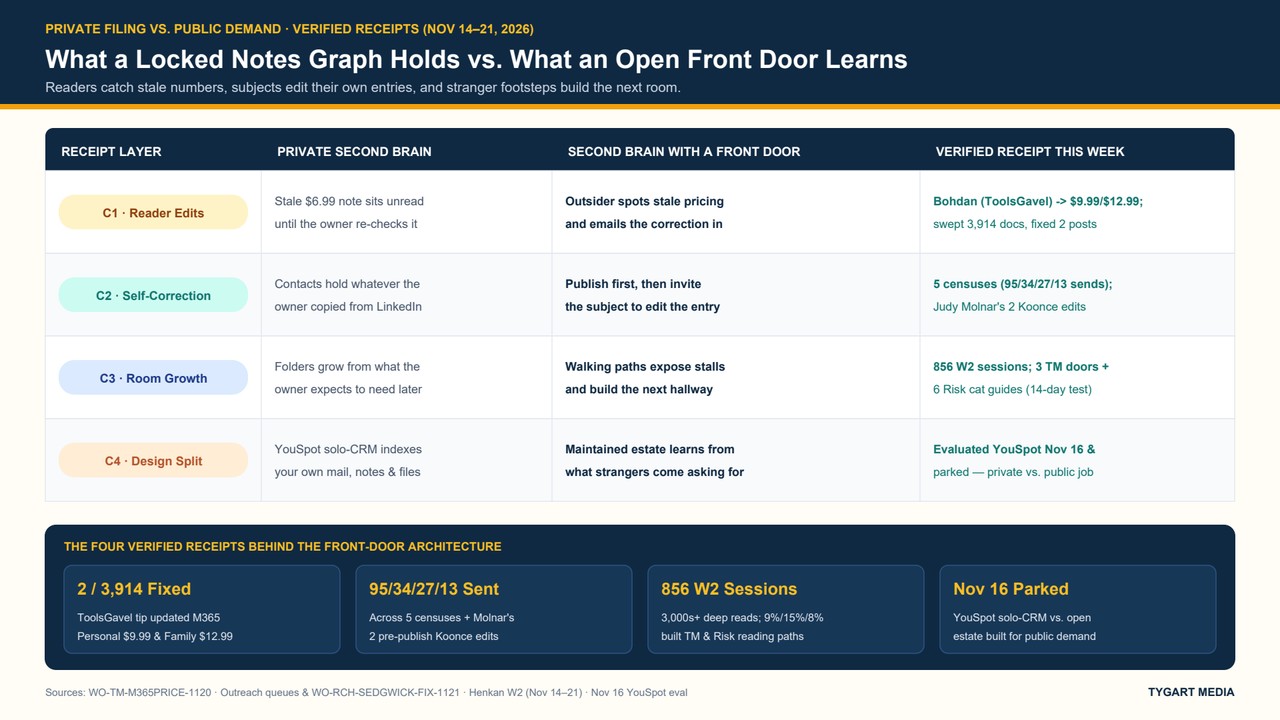
Start with an ordinary correction that no private note system would ever receive. On November 20, 2026, Bohdan Shkliarchuk — founder and publisher of ToolsGavel, an independent software pricing-audit site — emailed to point out that our Microsoft 365 consumer prices were out of date. Checking Microsoft’s January 16, 2025 announcement and Microsoft’s live comparison page proved him right: Microsoft 365 Personal moved from $6.99/month to $9.99/month and Microsoft 365 Family moved from $9.99/month to $12.99/month when Copilot was bundled.
Even checking live required looking past the surface: Microsoft’s store page currently prints a limited-time $6.99 first-month intro offer right beside the struck-through $9.99/month regular price. Fixing the flagged Copilot small-business vs. enterprise post (updating Personal, Family, and the derived $27/month total to $30/month alongside $20/month Copilot Pro) prompted a sweep of all 3,914 published documents on tygartmedia.com (3,699 posts and 215 pages). That sweep caught 1 sibling article (Copilot pricing compared), leaving 2 updated posts, rebuilt PDFs, and matching Markdown twins. A private note holding $6.99 stays stale in the dark; a page on the street gets checked by someone whose own work depends on the numbers.
The Profiled Maintain Their Own Entries
Reader emails happen when someone happens to stop by. Our publish-first census model turns that same loop into deliberate architecture: verify primary public sources, publish the profile live, and send a plain note inviting the subject to correct anything missing or out of date. Across 5 censuses — the Washington Space Cluster (41 profiled companies), the Washington AI Census (100 profiles), the AI Dev-Tools Census (34), the ESG Software Census (27), and the Facility Vendor Census (19) — outreach completed across November 20–21, 2026 for 95 Washington AI, 34 AI Dev-Tools, 27 BC ESG, and 13 Healthcare Facility Hub vendor contacts.
Get The Signal
What we actually ran, what it measured, and what it means for a restoration shop — every week, including the flops.
The interview side follows the exact same discipline. Before K. Max Koonce’s Sedgwick claims interview, The Claim Is Decided in the First 24 Hours, published on November 20, Judy Molnar requested 2 specific edits: drop the email-provenance line and omit any bio link. Honoring both shaped the live piece — and when a follow-up check on November 21 caught a surviving top-deck provenance note, a cleanup pass stripped it across served HTML, the 4-page PDF, and the Markdown twin. The subjects of the database are better fact-checkers of their own records than any back-room scraper.
Footsteps Decide Which Room Gets Built Next
Corrections keep existing shelves accurate; visitor movement decides where new carpentry goes. Over the first full week of Henkan Vision telemetry from November 14–21, 2026 (counting only engaged human sessions past the 30-second floor), our 7 enrolled sites logged 856 engaged human visits: 478 on tygartmedia.com, 224 on Healthcare Facility Hub, 65 on Risk Coverage Hub, 43 on BC ESG, 36 on Continuity Hub, 7 on Restoration Intel, and 3 on Universal Commerce Protocol. Hour-long single-page reads past 3,000 seconds (3,592s on HFH, 3,565s on BC ESG, 3,558s on Risk, 3,555s on TM) appeared alongside low multi-page rates: 42/478 (9%) on TM, 34/224 (15%) on HFH, and 5/65 (8%) on Risk.
Visitors were not bouncing — they were walking in for a specific resource, studying one page hard, and leaving because the room had no obvious doorway into the next shelf. On November 21, 2026, following Google’s crawlable link guidance, we built two targeted responses directly from those tracks. On TM, 3 Claude pricing doors — Pro vs. Max (95), Team Usage Limits (44), and Team Seat Pricing (26) — drew 165/478 (34.5%) entries with only 6/165 (3.6%) multi-page (0/44 on limits); each got mid- and end-of-article cards routing across the cluster and into Don’t Hire a Finish Carpenter to Carry Drywall. On Risk, 6 catastrophe-modeling guides (led by the complete guide) drove 34/65 (52.3%) entries with 0/34 multi-page; all 6 were wired into a 12-link reading loop (2 per guide) plus 2 bridges into the Sedgwick interview. Like Leave the Pots in the Water, both pathways now sit untouched on a 14-day grading clock.
Private Filing vs. Public Demand
That contrast explains why William evaluated a commercial second-brain product — YouSpot, via its AI-native solo-CRM — on November 16, 2026 and parked it. YouSpot connects a member’s own mailboxes, calendar, contacts, notes, and files into a personal graph scoped strictly to the signed-in user. The parking decision was architectural, not a critique of the product: a private notes system holds what you already touched and filed; the public estate holds what the outside world comes asking for, and keeps teaching you where your knowledge is incomplete.
Where the Gardening Metaphor Bends
Four seams keep the metaphor honest. First, most visitors don’t garden: the majority of those 856 human visitors read one guide (often past 3,000 seconds) and walk out without emailing a fix or opening a second room. Second, some traffic tramples: crawlers, scrapers, and noisy scanners hit the same doorways as readers, which is why Standing in the Middle and The Audience That Never Says Thanks keep origin server-log counts strictly separate from engaged human telemetry.
Third, the gardener still decides what to plant: visitor demand proposes, the owner disposes. Reader tips are checked against Microsoft’s primary pages before editing 2 posts out of 3,914, and walking patterns highlight missing hallways rather than dictating every topic. Fourth, a brain anyone can read is also one competitors can read: every profile, corrected figure, and House PDF sits in the open for rivals and outside AI models alike. That openness is the bet — the compounding correction loop on the sidewalk outweighs keeping the shelves locked in a back room.
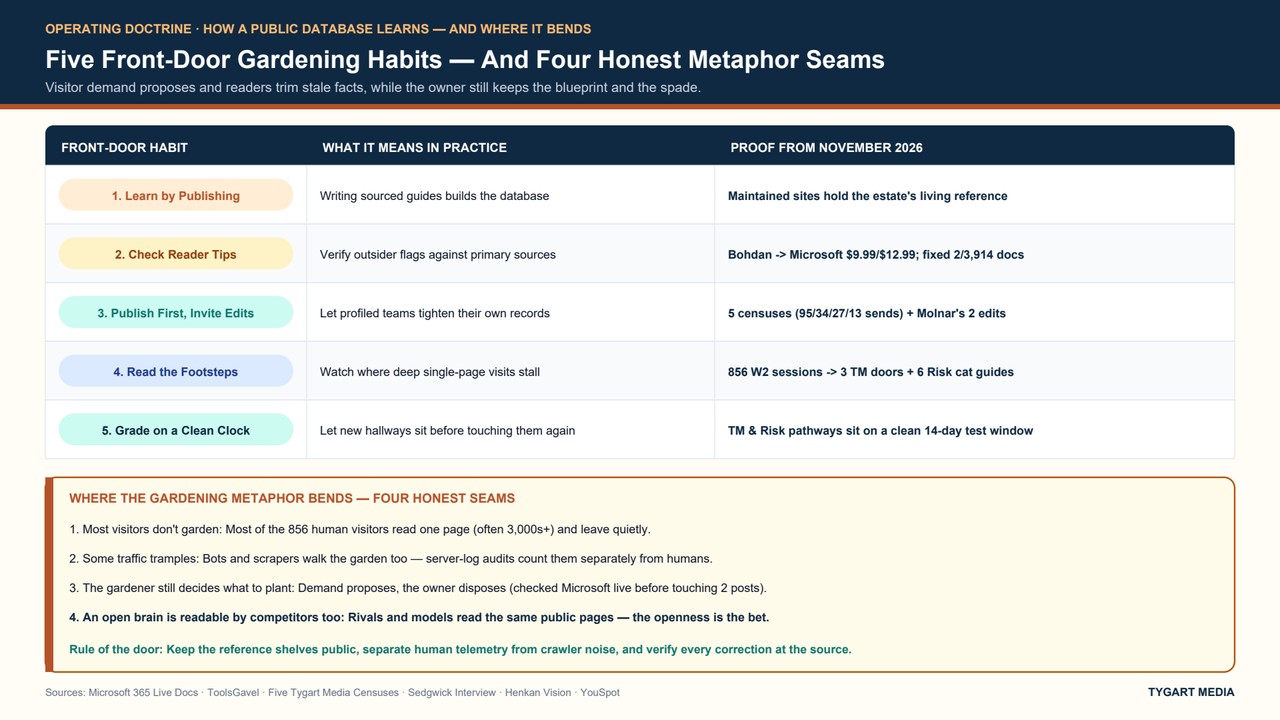
Keep your notes private when the job is personal memory. When the job is building durable domain authority, give the second brain a front door on the street, invite the people inside the data to fix what is wrong, watch where strangers stop and reach for the next shelf, and stay honest about the four places the garden still needs an owner’s hand.
— Will Tygart, Tygart Media.
Get The Signal
What we actually ran, what it measured, and what it means for a restoration shop — every week, including the flops.
Leave a Reply