
What Maestro Builds
Maestro AI, Inc. builds software designed to give engineering organizations visibility into how AI coding agents are used and whether that usage produces durable code. On its official website, the company presents two connected products: VibeCheck, focused on coding-agent visibility and spend tracking, and Maestro, focused on engineering intelligence and team outcomes.
VibeCheck connects to coding-agent sessions across Claude Code, Codex, and Cursor to show where token consumption and estimated agent spend go. Rather than leaving token bills disconnected from engineering work, VibeCheck groups agent sessions by the feature, bug fix, or migration they supported—mapping each shipped initiative to its session count, token volume, pull requests, and estimated agent spend. The product also models team-by-team return on investment by comparing combined payroll and agent spend against landed pull requests (defined on the site as merged changes still remaining in the main branch 30 days later).
In an April 2026 essay titled "Engineering intelligence is dead.", co-founders Justin Cranshaw and William Cheng laid out the product thesis behind Maestro: legacy metrics such as pull-request counts, story points, cycle time, and DORA dashboards measure output artifacts rather than actual engineering work, and break down when AI agents allow developers to generate large volumes of pull requests in a single afternoon without necessarily improving codebase quality.
- VibeCheck (Coding Agent Visibility): Tracks session volume, token usage, and estimated spend across Claude Code, Codex, and Cursor.
- Initiative-level attribution: Groups agent sessions by shipped engineering initiative so leaders can connect AI spend to features, fixes, and migrations.
- Landed-PR economics: Evaluates payroll plus agent spend per pull request that remains merged in the main branch after 30 days, highlighting teams where agent adoption improves or degrades efficiency.
- Maestro (Engineering Intelligence): Pairs agent telemetry with outcome-oriented visibility into what engineering teams accomplished.
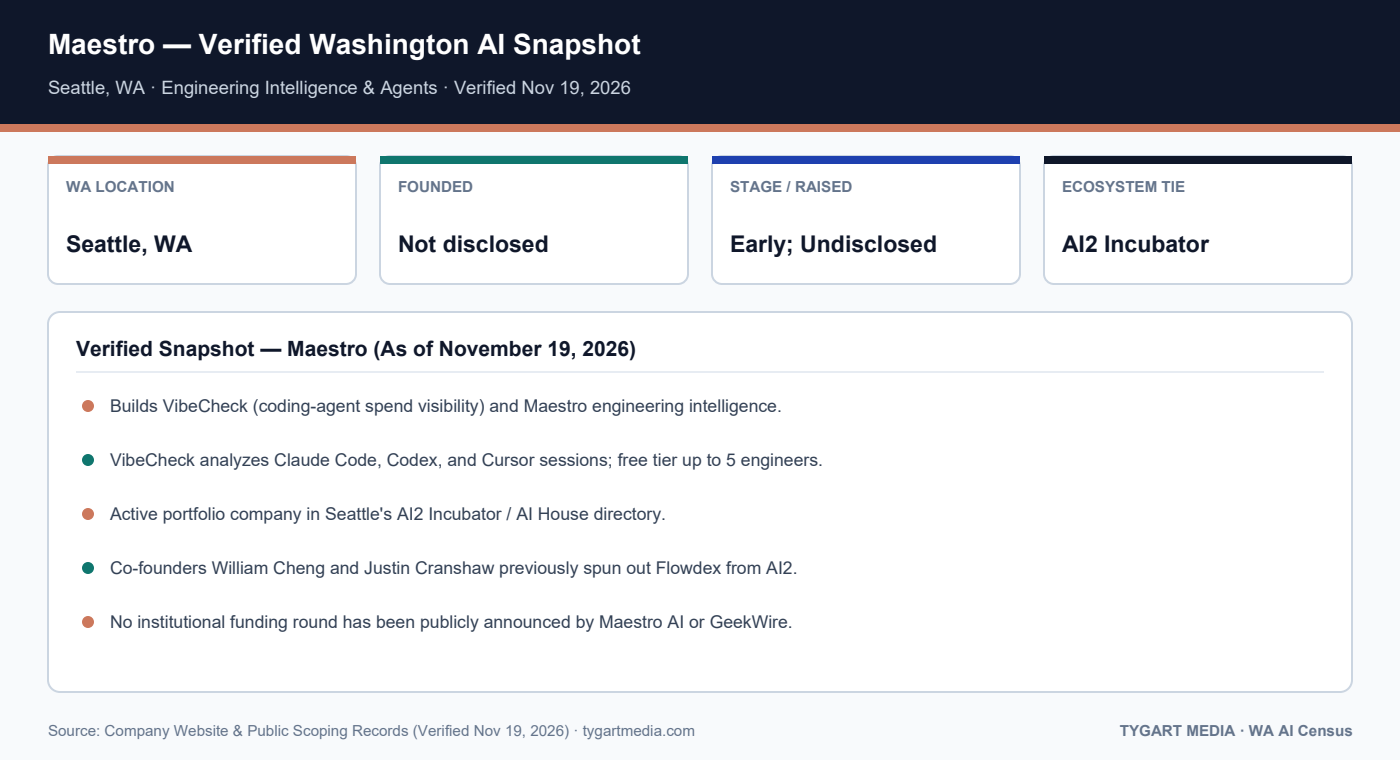
| Field | Verified Record (As of Nov 19, 2026) |
|---|---|
| Company | Maestro (Maestro AI, Inc.) |
| Official Website | https://www.getmaestro.ai/ |
| Washington HQ | Seattle, WA |
| Other WA Footprint | AI2 Incubator / AI House (Seattle, WA) |
| Founded | Not publicly disclosed (founders spun out prior AI2 venture Flowdex in May 2022; Maestro privacy policy effective March 6, 2023) |
| Founders / Leadership | William Cheng (Co-founder & CEO), Justin Cranshaw (Co-founder & CPO) |
| Stage | Incubator / Early-stage |
| Announced Funding | Not publicly disclosed (no institutional funding round publicly announced by the company or GeekWire) |
| Team Size | Not publicly disclosed |
| Primary Ecosystem Ties | AI2 Incubator / AI House (Seattle, WA); Microsoft Research alumni founders |
Washington Footprint and Leadership
Maestro is based in Seattle and listed as an active, non-acquired portfolio company on the AI House / AI2 Incubator companies directory, where it is described as creating "actually useful engineering insights for teams." Its legal entity is Maestro AI, Inc., per its published privacy policy (effective March 6, 2023; last updated September 25, 2026).
The company was co-founded by William Cheng (Co-founder & CEO) and Justin Cranshaw (Co-founder & CPO), whose roles are confirmed directly on Maestro's April 2026 manifesto. Both founders are Microsoft Research alumni and former entrepreneurs-in-residence at Seattle's Allen Institute for AI (AI2) Incubator. Before building Maestro's engineering-intelligence platform, Cheng and Cranshaw spun out an AI note-management startup called Flowdex from AI2 in May 2022, as reported by GeekWire. Because primary filings do not specify a single public founding year separating Flowdex from the Maestro brand transition, the company's founding year is listed as not publicly disclosed.

Products, Users, and Public Traction
Maestro builds for engineering leaders, software development teams, and technology organizations managing growing monthly coding-agent bills across multiple AI development tools. On getmaestro.ai, VibeCheck advertises self-serve onboarding with a free tier for up to 5 engineers, alongside a "Book a demo" path for larger organizations.
Named customers, paid seat counts, and revenue figures are not publicly disclosed in verified company or press sources. Although the homepage includes a customer-usage section heading and interactive product mockups illustrating monthly spend and cost-per-PR comparisons, no public customer case studies or verified enterprise logos appear in scraped text, and headcount is not publicly disclosed.
Funding, Stage, and Place in Washington's AI Landscape
No institutional funding round has been publicly announced by Maestro AI or GeekWire. The company's verified institutional affiliation in public records is Seattle's AI2 Incubator / AI House, which continues to list Maestro among its active, independent portfolio companies as of November 19, 2026.
Within Seattle's developer-tools ecosystem, Maestro addresses the measurement and financial-governance layer of AI-assisted software engineering. As local startups and enterprises adopt multi-agent coding tools, VibeCheck sits downstream of code generators—focusing on whether higher token spend and pull-request volume actually translate into durable shipped code rather than churn.
Related Washington AI Profiles & Tygart Media Context
- CodeChimp — Seattle AI Profile
- GLACIS — Seattle AI Profile
- Claude Code vs Cursor in 2026: An Honest Comparison for Developers Who Ship
- You Don't Have a Token Problem. You Have a Habits Problem.
Verified Primary Sources
- Maestro AI / VibeCheck Official Website
- Maestro AI Manifesto — Engineering Intelligence is Dead (Apr 2026)
- Maestro AI Privacy Policy
- AI2 Incubator / AI House Portfolio Directory
- GeekWire — Founders' Prior AI2 Spinout Flowdex (May 17, 2022)
Get The Signal
What we actually ran, what it measured, and what it means for a restoration shop — every week, including the flops.
Leave a Reply