The fundamental flaw of traditional “Second Brain” systems is human maintenance friction. Users build elaborate Notion templates with linked databases, tags, and relations, only to abandon them within three months because manual data entry cannot keep up with the velocity of daily decisions, meetings, and project iterations. In 2026, the Autonomous Second Brain solves this problem completely: AI agents autonomously capture, structure, cross-link, and maintain Notion databases in real time via the Model Context Protocol (MCP).
- Zero Manual Data Entry: Agents listen to live conversations, email threads, and code reviews, extracting decisions directly into structured Notion database properties.
- Autonomous Task Staging: Engineering and operational work orders are generated with full technical context and auto-assigned to team members without human drafting.
- Cross-Surface Knowledge Graph: Notion acts as the single source of truth connecting local IDEs, remote servers, email hubs, and public websites.
- Self-Cleaning & Evergreen Pruning: Automated agent loops merge duplicate notes, reconcile contradictory facts, and archive stale records periodically.
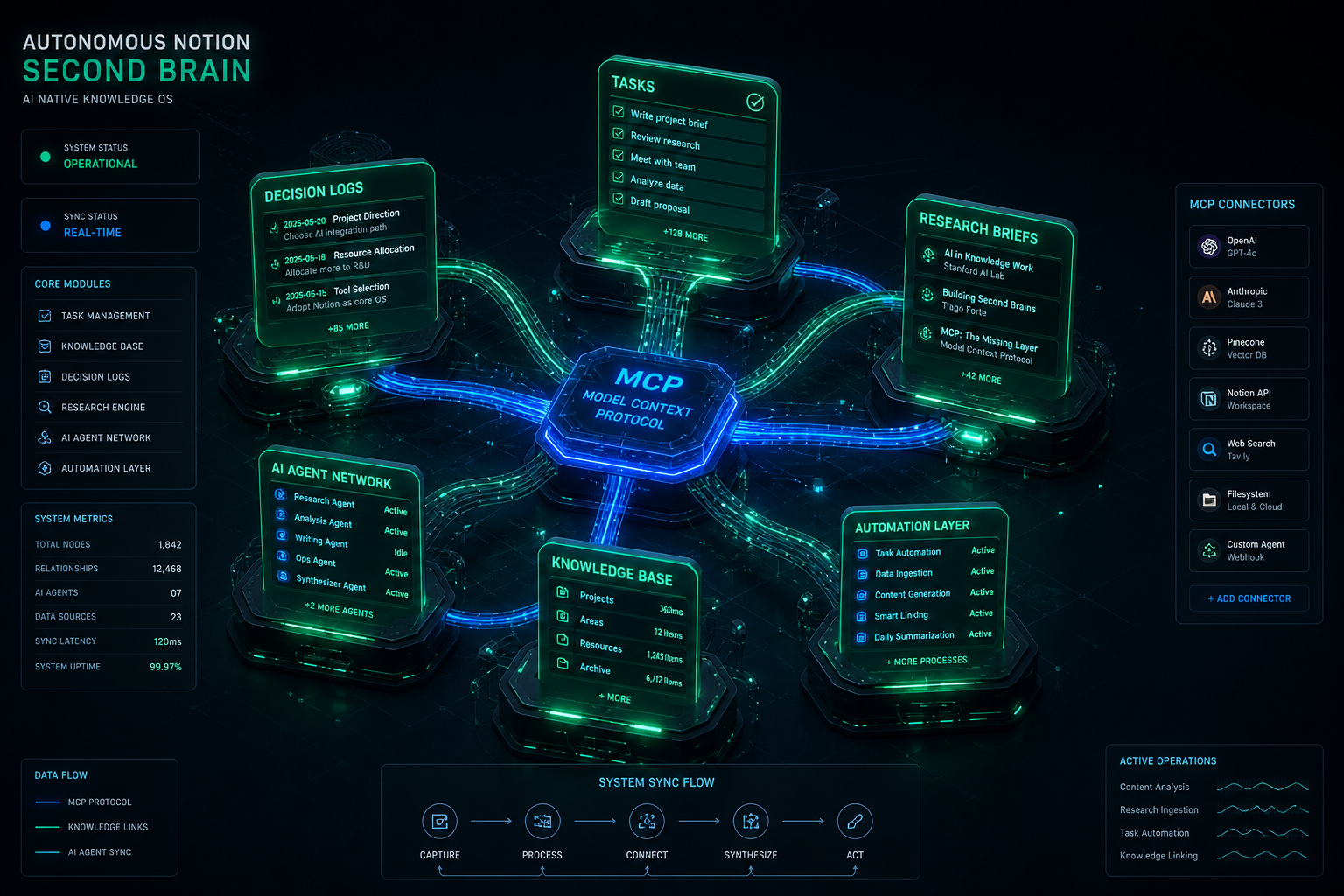
1. How MCP Transforms Notion from a Notebook to an Active Memory Layer
Before Model Context Protocol, connecting an AI assistant to Notion required brittle custom webhooks, rigid Zapier zaps, or clunky browser extensions. With the official Notion MCP server, AI models natively execute rich semantic operations directly inside their reasoning loop:
2. Production Workflow: The Autonomous Work Order Pipeline
In our technical operations at Tygart Media, when an issue arises (e.g., automated cron alerts firing excessive emails or pilot registrations requiring team coordination), the human operator never writes a task card manually. Instead, the agent executes the following pipeline:
- Problem Extraction: The agent detects the root cause from system logs or email history.
- Schema Matching: The agent calls
notion-searchto locate our team’s active Work Order database. - Context Ingestion: Formats the ticket with standardized sections: Priority level, Assignee, Problem Summary, Execution Steps, and Acceptance Criteria.
- Live Deployment: Executes
notion-create-pages, returns the permanent Notion URL in chat, and logs the task ID across our session context.
3. Building the 4-Layer Autonomous Knowledge Stack
│ LAYER 1: INGESTION SENSORS │
│ • Headless Gmail Triage • Meeting Transcripts (Gemini) │
│ • IDE Code Changes • Web Fleets & API Telemetry │
└──────────────────────────────┬──────────────────────────────┘
│ (Raw Signals)
▼
┌─────────────────────────────────────────────────────────────┐
│ LAYER 2: REASONING & SYNTHESIS │
│ • Grok-3 / Claude 3.7 • Structured Schema Extraction │
│ • Context Deduplication • Task Decomposition │
└──────────────────────────────┬──────────────────────────────┘
│ (Model Context Protocol JSON-RPC)
▼
┌─────────────────────────────────────────────────────────────┐
│ LAYER 3: PERSISTENT NOTION GRAPH │
│ • Decision Logs Database • Team Work Orders Database │
│ • Research Briefs Hub • Regulatory Standards Catalog │
└──────────────────────────────┬──────────────────────────────┘
│ (Instant Cross-Session Retrieval)
▼
┌─────────────────────────────────────────────────────────────┐
│ LAYER 4: OPERATIONAL HARNESS │
│ • Cursor IDE Execution • Daily Briefings & Sprints │
└─────────────────────────────────────────────────────────────┘
4. The Self-Cleaning Maintenance Loop
Knowledge graphs degrade over time if left unpruned. We implement automated reflection routines where the agent executes a monthly maintenance audit:
- Duplicate Detection: Finding similar topic notes across different months and synthesizing them into a single canonical source.
- Status Synchronization: Checking completed pull requests and closing out corresponding Notion task cards automatically.
- Broken Citation Repairs: Updating URLs and standard definitions when external regulations change (e.g., California SB 253 amendments or NYC Local Law 97 rule updates).
Conclusion: The Ultimate Leverage for Solopreneurs & Teams
An Autonomous Second Brain transforms Notion from a passive digital graveyard into an active operating system for your mind and business. By combining the speed of modern reasoning models with the open standard of MCP, knowledge workers can achieve complete operational leverage—capturing every insight and managing complex operations with zero maintenance overhead.
>For full architecture walkthroughs and custom enterprise agent implementations, browse our complete collection of technical playbooks on Tygart Media.
Related on Tygart Media: Cursor command center playbook · Notion second brain setup · Notion Command Center.
Leave a Reply