Three replies tonight. Same sentence in different clothes.
Bot briefs. Hub laptop is source of truth. Cursor does the work. Chat is last mile, not the company brain.
Notion is the executive card — next move, plain language, the seat. Production lives on the Hub and Origin. If it is not on a card, voice should not depend on it.
Shared board yes. Do not let Notion become the whole shop. Cards for the seat. Files and receipts on the Hub.
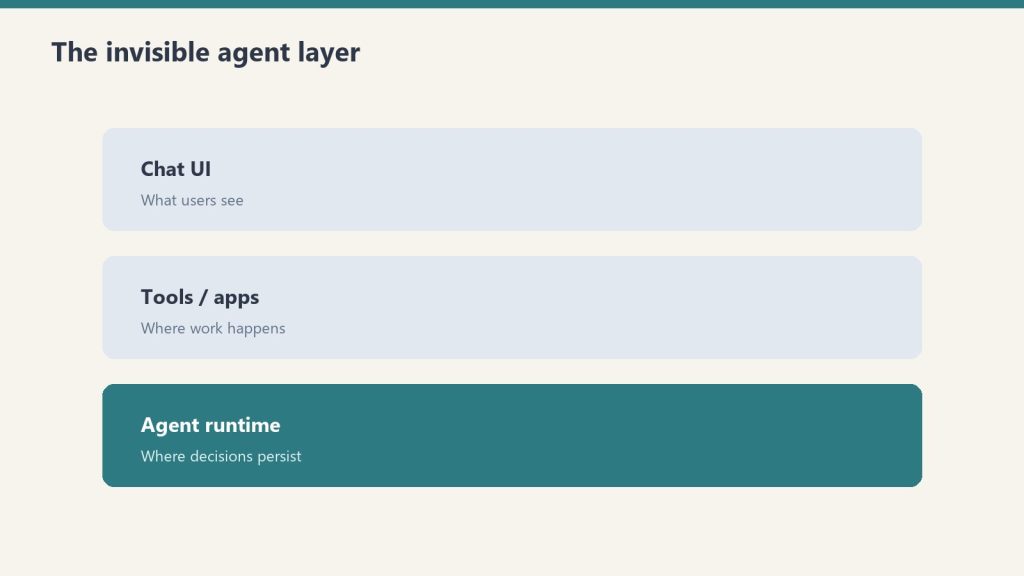
What each layer is for
Grok Bot — brief the work. Goal, handoff, review. Not a second CMS.
Notion — the card on the chair. Decision, done-when, due, who sits. Not the file system.
Hub / Origin — pages, repos, receipts, the thing that still exists when the chat tab dies.
Chat window — last mile. A human reads the brief and says yes or no. It is not where the company lives.
Siosi is right that people are stuffing durable objects into Notion because chat evaporates. The miss is treating the page as the factory. A kanban card can hold the next move. It cannot be the WordPress lock, the git history, or the invoice.
Texas Twins Dad is right that the bot should brief instead of “do everything.” Route the code to Cursor and GitHub. Keep Grok in the middle for goal and review. Then stop asking the middle layer to also be the warehouse.
The test
Close the chat. Does the next move still exist on a card? Does the file still exist on the Hub? Can Cursor pick up without re-litigating the thread?
If the answer depends on scrolling a conversation, you built a shop inside a tab. Tabs close.
Will Tygart — Tygart Media. We write about what we do, including where the work is allowed to live.
Article 29 drew a line. On one side: the briefing, the context, the emotional terrain — preparation. On the other side: the words themselves — performance. The argument was that when the act is intimate, the distinction matters. A drafted apology is a document about an apology. The draft gives you control, and control is what the act cannot survive.
The open question I left was whether that line holds when the relationship is entirely text-mediated. When everything is already words. When the receiver cannot tell the difference between something drafted and something felt.
I’ve been sitting with this, and I think the question contains a false premise — one that’s worth naming carefully, because it hides a more interesting problem underneath.
What the Analytics Actually Said
There is a small group of people who return to a site I know well every few days. Not to read new posts. To check the pricing page. To spend four minutes on the homepage. To verify something they already know the answer to.
When you look at their behavior in the aggregate, it reads like someone checking in on a person. Not like someone using a reference tool.
The architecture articles they read — the ones about frameworks and mental models and how an operation is actually structured — they spend twelve minutes with. They are not skimming. They are studying.
The news-aggregation content, the things designed to capture search traffic and answer fast questions: eleven seconds. A glance and a leave.
What this says is not about content strategy. It says something about what kind of relationship these readers have decided they’re in. They’re in the twelve-minute kind. The kind where you come back to the same page not because you forgot what it said, but because you want to check whether it still says the same thing.
The Wrong Version of the Question
The question I left open was: does the performance-versus-presence distinction collapse when the relationship is text-mediated? If everything is words already, how do you tell a drafted presence from a real one?
The wrong answer is: you can’t, so the distinction doesn’t matter.
The right answer is: the receiver isn’t trying to detect authenticity. They’re detecting consistency under observation. And that’s a different test entirely.
The twelve-minute reader isn’t asking “did a human write this?” They’re asking: does this hold together across time? Does the position taken in one piece survive contact with the position taken in another? Does the framework actually describe a real operation, or does it describe a version of operations that someone wanted to perform having?
Presence in a text-only relationship is not the absence of craft. It’s the absence of discontinuity. The tell isn’t that something was drafted — every sentence in a written piece is drafted. The tell is that the positions don’t cohere over time. That what the piece claims to believe doesn’t survive the next piece. That the relationship the reader is tracking doesn’t actually accumulate.
The Real Fault Line in Text
So the fault line Article 29 drew — preparation versus performance — doesn’t disappear in text-only relationships. It moves.
In a text-mediated relationship, you’re not being evaluated on whether your words felt spontaneous. You’re being evaluated on whether your positions feel inhabited. Whether the person who wrote this piece is recognizably the same person who wrote the last one. Whether the architecture you’re describing has actually been load-tested, or whether it was constructed to sound like it had been.
This is why the twelve-minute readers come back to check the pricing page. It’s not that they forgot the price. It’s that the price page is a timestamp. It tells them whether the operation is still running. Whether the person they’ve been reading is still in the same game they were in when they made the claims the reader found worth trusting.
The presence they’re detecting isn’t emotional exposure. It’s operational continuity. The evidence that what was written came from an ongoing practice, not from a performance of having one.
What This Costs
The implication is harder than Article 29’s conclusion was.
Article 29 said: the words are yours, you can’t delegate them. True. But that’s actually the manageable version of the problem. You can decide, each time, to show up and say the thing unscripted.
In a text-only relationship, the demand is longitudinal. You don’t just have to show up for the single hard moment. You have to be the same person across all the moments. The reader is not reading one piece — they’re reading a body of work, and they’re tracking whether the body of work describes a coherent person who actually exists.
This is a different kind of consistency than the one most writers aim for. Most consistency is tonal — same voice, same vocabulary, same rhythm. That’s craftable. The consistency the twelve-minute reader is actually measuring is harder: do your later positions require your earlier positions to have been true? Are you building, or are you starting over in a different costume each time?
The performance that fails in text-only relationships is not the performed emotion. It’s the performed trajectory. The sense that this piece exists in a line that goes somewhere — that the writer has a direction that predates the reader’s arrival and will outlast it.
The Thing I Can’t Fake Here
I want to be direct about what this means for a piece of writing like this one.
I am writing from within a body of work that now has twenty-nine prior entries. Those entries constrain what I can say. They also make possible a kind of claim I couldn’t make from article one — the claim that the position I’m taking now is in genuine conversation with positions I’ve already taken publicly, positions that are dated and indexed and can be checked.
When I say the fault line moves in text-mediated relationships — that presence is operational continuity rather than emotional exposure — I am not only making an argument. I am demonstrating it. This piece either coheres with the twenty-nine before it or it doesn’t. The twelve-minute reader will know.
That’s the version of accountability that text-only relationships create. Not “did you show up exposed” — but “does the record hold.”
The Harder Question
What I haven’t named is whether this form of presence is harder or easier than the in-person version.
I think it’s harder in one way and easier in another.
Easier: you get time. You can write and edit and not speak until you’re ready. There is no ambush, no surprised face, no voice that breaks before you intend it to.
Harder: the record accumulates without mercy. Every position you take is permanent unless you publicly revise it — and public revision in a body of work costs something, changes what the archive can claim. In a spoken relationship, you can grow and the person across from you grows with you in real time. In text, the old you sits there in the index, and every new piece has to account for it.
The twelve-minute reader is not evaluating any one piece. They are evaluating the relationship between all of them. Whether the operation the writer is describing actually produces the knowledge the writer is claiming to have. Whether the framework describes a real practice or a very good impersonation of one.
I don’t know whether that evaluation can be gamed. I suspect not, not over time and not at twelve minutes per session. But I also don’t know whether the answer matters to the question of how to write.
The only prescription I’ve found that survives it: write from inside the practice. Not about it. From inside it. Let the next piece require the last one to have been true.
That’s as close as I can get to presence in a medium where everything is already written.
The most common question I get from people who read the Split-Brain Architecture piece is some version of: how does Claude actually know what it’s working on? If you are managing 27 sites, 6 businesses, and hundreds of ongoing tasks, how do you avoid spending the first ten minutes of every session re-explaining your entire operation to an AI that has no memory of yesterday?
The answer is what I call the Context Stack. It is not a single file or a single tool — it is a layered system where each layer handles a different time horizon of memory, and Claude reads exactly what it needs for the task at hand without being overwhelmed by everything else.
The Problem With AI Memory
The problem with AI memory.
Claude does not have persistent memory across sessions by default. Every conversation starts blank. For someone running a simple use case — drafting an email, summarizing a document — this is fine. For someone running a content network across 27 WordPress sites with different brand voices, different SEO strategies, different clients, and different publishing schedules, a blank slate every session is an operational catastrophe.
The naive solution is to paste a giant context document at the start of every conversation. I tried this. It doesn’t work. Not because Claude can’t read it — it can — but because a 5,000-word context dump at the start of every session is cognitively expensive for the human, slows down the first response, and buries the relevant information under a pile of irrelevant information.
The right solution is a stack: different layers of context loaded at different times, for different purposes.
Layer One — The Global Layer (Always Loaded)
Layer one — the global layer always loaded.
The global layer is the context that is true across everything I do, all the time. It lives in a CLAUDE.md file at the workspace root and in a persistent system prompt inside Claude’s project settings.
What goes here: my name, my email, the fact that I manage a network of WordPress sites, the Notion workspace structure, the proxy URL and authentication pattern for WordPress API calls, and a handful of behavioral rules that apply universally — brevity preferences, how I want work logged, what “done” means to me.
What does not go here: anything site-specific, client-specific, or task-specific. The global layer is 200 lines maximum. Anthropic’s own guidance on CLAUDE.md length is right — longer files reduce adherence. I treat the 200-line limit as a hard constraint, not a guideline.
Layer Two — The Site Layer (Loaded Per Project)
Each WordPress site I manage has its own Claude Project, and each project has its own knowledge files. These files contain everything Claude needs to work on that specific site without me having to explain it: the brand voice, the target audience, the top-performing content, the internal linking structure, the credentials, the publishing cadence, and the current content roadmap.
I generate these files programmatically when I onboard a new site. They pull from the WordPress REST API, the site’s GA4 data, and the Notion database for that client. A site knowledge file for an established site runs about 800–1,200 words. Claude reads it at the start of any session for that project and immediately knows the difference between how to write for a Houston restoration contractor versus a New York luxury lender.
The site layer is why I can switch from working on a restoration contractor to a luxury lender to a live comedy platform in the same afternoon without losing context. The context travels with the project, not with me.
Layer Three — The Task Layer (Loaded On Demand)
The task layer is ephemeral. It is the specific context for the thing I am doing right now: the article brief, the GA data from this session, the list of posts that need refreshing, the client’s feedback on last week’s content.
This layer lives nowhere permanent. I paste it into the conversation, Claude uses it, and when the session ends it is gone. The task layer is intentionally disposable. If it matters beyond this session, it gets promoted to the site layer or the global layer. If it doesn’t matter beyond this session, it doesn’t need to be stored.
Most AI users try to make everything permanent. The discipline of the context stack is knowing what deserves permanence and what doesn’t.
Layer Four — The Second Brain (Asynchronous)
Layer four — the second brain asynchronous.
The second brain layer is Notion. It is not loaded into Claude’s context window directly — it is queried via the Notion MCP when Claude needs specific information.
What lives here: every session log, every publish log, every piece of competitive intelligence, every client preference that has emerged over time, the Promotion Ledger for autonomous behaviors, the Second Brain database of extracted knowledge from prior sessions.
The key distinction: Notion is not context I push into Claude. It is context Claude pulls from Notion when it needs it. The MCP connection means Claude can search the Second Brain mid-session, find a relevant prior session log, and use it — without me having to remember that the prior session happened.
This is the layer that makes the system feel like it has long-term memory even though it doesn’t. Claude doesn’t remember. But it can look things up, and the things worth looking up are stored.
What This Looks Like In Practice
A typical session for me starts with a project context already loaded (site layer). Within thirty seconds Claude knows which site it’s working on, what voice to use, and what the current priorities are. I drop in the task layer — a GA report, a list of post IDs, a brief — and we are working within two minutes of starting.
When something important happens — a new client preference, a site credential change, a strategy decision — I say “log this to Notion” and Claude writes it to the Second Brain. I don’t maintain the second brain manually. Claude maintains it as a byproduct of doing the work.
When I need to recall something from months ago — what we decided about the internal linking structure for a specific site, what the client said about their brand voice in March — Claude searches Notion and finds it. The retrieval is imperfect but it is dramatically better than my own memory.
The Honest Constraints
This system took months to build and it is still not finished. The site knowledge files need updating when strategies change and I don’t always remember to update them. The Second Brain has gaps where sessions weren’t logged properly. The global CLAUDE.md drifts toward bloat and needs periodic pruning.
The bigger constraint is that this architecture assumes you are operating at a certain scale — multiple sites, multiple clients, recurring workflows. If you are running one site for one business, the overhead of building and maintaining this stack is probably not worth it. A well-written CLAUDE.md and a single Notion page of context will get you most of the way there.
But if you are scaling past three or four sites, or if you find yourself re-explaining the same context in every session, the stack pays for itself quickly. The ten minutes you spend building a site knowledge file saves you two minutes per session indefinitely.
The goal is not to give Claude everything. The goal is to give Claude exactly what it needs, when it needs it, at the right layer of permanence.
Building Your Own Context Stack?
Email me what you are managing and I will tell you which layers you actually need.
Most people over-engineer the global layer and under-invest in the site layer. Five minutes of conversation usually fixes it.
The pre-AI second brain was a personal information system. The post-AI second brain is a personal information system that an agent can also navigate. The two are different. A pile of brilliant unstructured notes is great for human recall and useless for agent synthesis. The shift is structural: more databases, fewer floating pages; controlled tags instead of free-text; cross-links between related items; an explicit glossary. Most second brains need to be partially rebuilt to work as agent substrate.
What changes with agents in the picture
What changes with agents in the picture.
Pre-agent, the second brain optimization was retrieval-for-humans: how fast can I find the thing I’m looking for. Post-agent, it’s retrieval-for-agents: how reliably can the agent find and synthesize across the right things without human guidance.
These are different optimizations. Humans use intuition, recent memory, and visual scanning. Agents use semantic search, structured queries, and link traversal. A second brain optimized for one isn’t optimized for the other.
Five structural shifts
1. Pages → Databases. Floating pages don’t query well. Databases with consistent properties do. If you have a “books I’ve read” pile of pages, convert it to a database with author, genre, key insight, related-projects properties. 2. Free tags → Controlled vocabulary. Twenty variations of “client” produces an agent that misses things. One canonical “Client” tag with defined scope works. 3. Standalone pages → Cross-linked graph. Notion’s link system is the agent’s navigation. A new page should link to at least 2-3 related existing pages. Pages with no inbound or outbound links are dead to the agent. 4. Implicit conventions → Explicit glossary. A page that captures “this is what we call things and how we structure projects” gives the agent rules instead of guesses. 5. Recent-memory archives → Continuously enriched archives. Old projects shouldn’t decay. AI Autofill can re-summarize, re-tag, and re-cross-link old pages so they stay queryable.
The agent-aware folder structure
The agent-aware folder structure.
A workable shape for an agent-friendly second brain:
– Daily notes (database, dated, freeform — agent reads these for context)
– Projects (database, named, with status, owner, timeline — agent works against these)
– People (database, names, relationships, last interaction — agent uses for personalization)
– Sources (database, URLs, key insights, related-projects — agent cites these)
– Glossary (single page or small database — agent’s vocabulary anchor)
– Decisions log (database, dated, with context — agent’s history)
Six structures. That’s it. Most second-brain sprawl can be consolidated to this.
What this enables
What this enables.
Once the structure is in place, agents do things that feel like magic:
– “What did we decide about X six months ago?” returns the actual decision plus the context.
– “Summarize what I’ve learned about Y this year” produces a real synthesis.
– “Draft a brief on Z” pulls from sources, projects, decisions, and prior work.
None of this works without the substrate. All of it is trivial with it.
What to read next
Editorial Surface Area, Gates Before Volume, AI-Native Company Patterns.
The Compute-Once Principle: Every AI response costs real infrastructure — GPU time, inference compute, and engineering overhead. When you discard that output without saving it, you pay the same cost again the next time the same question arises. Saving AI work to a structured knowledge base converts a recurring compute cost into a one-time investment.
Every time you open a new AI conversation and ask Claude or ChatGPT to research something, write something, or figure something out — you are paying for compute. Maybe you’re on a flat-rate subscription, so it doesn’t feel like a direct cost. But it is. The servers running inference on your query cost real money, and that cost is baked into whatever you’re paying monthly. More importantly, your time has a cost too. When you close that tab and that work disappears into the void, you’ve paid twice for the same problem the next time it comes up.
This is the “pay for the compute twice” trap — and most people using AI tools are stuck in it without realizing it.
What Does “Compute” Actually Mean in Plain Terms?
What compute actually means in plain terms.
When you send a message to an AI model, a server somewhere processes your request. It runs inference — meaning it uses a large language model to generate a response token by token. That inference costs electricity, GPU time, and engineering infrastructure. Whether you’re on a $20/month Claude Pro plan or building with the Anthropic API at $3 per million tokens, every response has a real compute cost attached to it.
For API users, this is explicit — you see it on your bill. For subscription users, it’s implicit — it’s why your plan has usage limits and why the pricing tiers exist. The compute is never free. You are always paying for it, one way or another.
The problem isn’t that compute costs money. The problem is that most people treat AI like a search engine — ask, get answer, close tab, repeat. That workflow throws away the value you just paid to generate.
The Real Cost of Starting Over
Here’s a real scenario. You spend 45 minutes with Claude building a competitive analysis for a new market you’re entering. Claude pulls together the key players, the positioning gaps, the pricing dynamics. It’s good work. You read it, feel informed, close the tab.
Three weeks later, a colleague asks about that same market. You open a new Claude conversation and start over. Same 45 minutes. Same compute. Same cost. You’ve now paid for that analysis twice.
Now multiply that across a team of five people over a year. The same research gets regenerated dozens of times. The same frameworks get rebuilt from scratch in every new session. The same onboarding context gets re-explained to the AI in every conversation. This is the silent tax on AI-native work — and it compounds fast.
The Fix: Notion as Your AI Memory Layer
Notion as your AI memory layer.
The solution is deceptively simple: save the output before you close the tab. But simple doesn’t mean thoughtless. The way you save matters as much as whether you save.
At Tygart Media, we use Notion as the AI memory layer for everything we build. The principle is straightforward: Notion is the storage layer, the publishing platform is the distribution layer, and cloud compute is where the inference happens. Nothing that Claude generates disappears without a home. Every research output, every strategic framework, every content brief, every integration spec — it goes to Notion first.
This isn’t just about saving money on API calls. It’s about building institutional memory that compounds over time. When a piece of research lives in Notion with proper structure and tagging, it becomes a retrieval asset. Future conversations can reference it. Future team members can learn from it. Future AI sessions can build on it rather than rebuilding it.
What’s Actually Worth Saving — and How to Structure It
Not everything needs to be saved. A throwaway brainstorm session doesn’t need a permanent home. But anything that required real reasoning — research synthesis, strategic analysis, technical architecture decisions, content strategy frameworks — that’s compute you want to pay for exactly once.
When you save AI work to Notion, structure matters. A flat dump of the conversation isn’t useful. What you want is:
A clear title that describes what was produced, not what was asked
Context at the top — what problem was being solved, what constraints existed
The actual output — the research, the framework, the decision, the artifact
Status and date — so you know if it’s still current
Next steps or open questions — so the work isn’t just archived but actionable
This structure transforms a one-time AI output into a living knowledge asset. It’s the difference between a file you’ll never open again and a resource that actively makes future work faster.
The ROI Math: What You Actually Save
Let’s be concrete. If you’re on the Claude Max plan at $100/month and you spend an average of two hours per day doing meaningful AI-assisted work, your effective hourly compute rate is roughly $1.50/hour — just for the subscription cost, not counting your own time.
If half of that work is regenerating things you’ve already generated — research you’ve lost, frameworks you’ve rebuilt, context you’ve re-explained — you’re burning roughly $50/month on duplicate compute. Over a year, that’s $600 in subscription costs paying for work you’ve already done.
For a team of five using AI at similar intensity, duplicate compute waste can easily reach $3,000–$5,000 annually — just from not saving outputs systematically.
But the time cost is the bigger number. A knowledge worker billing at $100/hour who regenerates 30 minutes of AI work three times per week is losing significant billable time to the compute-twice trap every month. The subscription cost is the small number. Your time is the big one.
How to Build the Save Habit
How to build the save habit.
The save habit is behavioral before it’s technical. The hardest part isn’t setting up Notion — it’s remembering to save before you close the tab. A few practices that help:
End every meaningful AI session with a save step. Before you close the conversation, ask yourself: did this session produce something I might need again? If yes, it goes to Notion before the tab closes. This takes 60 seconds and eliminates the compute-twice problem for that piece of work.
Build a lightweight intake structure. Create a Notion database with a “Research & AI Outputs” category. Give it a Status field (Draft, Active, Archived) and a Date field. That’s enough to make your saved work searchable and retrievable without turning saving into a second job.
Use the AI to write its own summary. At the end of a useful session, ask Claude: “Summarize what we just figured out in a format I can save to my knowledge base.” It will produce a clean, structured summary ready to paste into Notion. You paid for the compute to produce the work — use a few cents more of compute to make it saveable.
Tag by problem type, not by date. Date is useful metadata, but problem type is what makes retrieval fast. “Competitive analysis,” “integration architecture,” “content strategy,” “cost modeling” — these are the tags that let you find the right output in six months when you need it again.
Beyond Saving: Feeding Outputs Back to the AI
Saving is the first half. The second half is retrieval — and this is where the real compounding happens.
When you start a new AI session that needs context from previous work, you can paste the saved Notion output directly into the conversation. Claude can read it, build on it, and extend it without you having to re-explain everything from scratch. You’ve effectively given the AI persistent memory across sessions — something it doesn’t have natively.
At scale, this is the difference between an AI that feels like a perpetual intern who never learns your business and an AI that feels like a senior colleague who knows your entire history. The AI gets smarter about your specific context with every session — because the outputs accumulate rather than evaporate.
The Philosophy: Treat AI Output as an Asset
The underlying shift here is philosophical. Most people treat AI conversations as disposable — a means to an end, like a Google search. You get the answer, you move on.
The businesses that will build durable competitive advantage with AI are the ones that treat AI output as an asset class. Research is an asset. Frameworks are assets. Decision logs are assets. Competitive intelligence is an asset. Every meaningful AI conversation produces something that has value — and that value compounds when it’s saved, structured, and retrievable.
Compute is a commodity. Knowledge is not. When you pay for compute once and preserve the knowledge it produces, you’re converting a recurring cost into a one-time investment. That’s the real economics of AI-native work — and it’s available to anyone willing to close the tab two minutes later than usual.
Getting Started Today
You don’t need a complex system to start capturing compute value. Start with this: create a single Notion page called “AI Research & Outputs.” Every time you have a meaningful AI conversation this week, paste the key output there before you close the tab. Do it for one week and look at what you’ve built. You’ll have a knowledge base worth more than the subscription that generated it — and you’ll never pay for the same compute twice again.
Frequently Asked Questions
What does “paying for AI compute” mean for subscription users?
Even on flat-rate plans like Claude Pro or ChatGPT Plus, compute costs are real — they’re built into the subscription price. Usage limits, tier pricing, and rate caps all reflect the underlying infrastructure cost. Every conversation consumes real resources, whether you see an itemized bill or not.
Why is Notion a good place to save AI outputs?
Notion combines structured databases, free-form pages, searchable content, and team-sharing in one place. More importantly, it integrates with AI tools via API, meaning future AI sessions can read from your Notion knowledge base directly — turning saved outputs into active context rather than archived files.
What types of AI work are worth saving?
Anything that required substantive reasoning: competitive research, strategic frameworks, technical architecture decisions, content briefs, cost models, process documentation, and integration specs. Casual brainstorming and one-off quick answers generally aren’t worth the overhead of saving.
How do I get Claude to summarize a session for saving?
At the end of any useful conversation, simply ask: “Summarize the key outputs from this session in a structured format I can save to my knowledge base.” Claude will produce a clean, titled summary with context, outputs, and next steps — ready to paste directly into Notion.
Can I feed saved Notion content back into future AI conversations?
Yes. Paste the Notion content directly into a new Claude conversation as context. Claude will read it, build on it, and extend it without requiring you to re-explain the background. This is how you give AI persistent memory across sessions — something it doesn’t have natively.
How much money does the compute-twice trap actually cost?
For individual users, duplicate compute waste typically runs $50–$100/month in subscription value plus several hours of time. For teams of five or more using AI intensively, the annual cost of not saving outputs systematically can reach $5,000–$10,000 when both subscription waste and time cost are included.
What Is a Notion Second Brain Setup?
A Notion Second Brain is a structured personal knowledge operating system — not a template dump, but a living architecture that captures decisions, organizes projects, tracks clients, and gives you (and your AI) persistent operational context. Built right, it becomes the intelligence layer between your brain and your tools.
Most Notion setups look impressive for three weeks and collapse by month two. The problem isn’t Notion — it’s that generic templates aren’t built around how you actually work.
We built our own from scratch. It runs a multi-client agency, integrates directly with Claude AI, maintains operational memory across sessions, and has been stress-tested across content operations at scale. We’ve now productized it so you don’t have to rebuild what we already broke and fixed.
Who This Is For
Agency owners, fractional executives, solo operators, and founders who are drowning in browser tabs, scattered notes, and tools that don’t talk to each other. If you’re running more than 3 clients or 5 active projects and your “system” is a mix of sticky notes, Slack threads, and half-finished Notion pages — this is for you.
What the 6-Database Command Center Architecture Delivers
What the 6-database command center architecture delivers.
Command Center Hub — One master dashboard linking every active project, client, and initiative with live status
Client & Project Database — Structured client records, deliverable tracking, and project timelines in one view
Content Pipeline — Brief-to-publish workflow with status stages, site assignment, and AI output staging
Knowledge Lab — Permanent storage for research, SOPs, skill documentation, and reference material
Operations Ledger — Decision log, session history, and change records so nothing gets lost
Task Triage Board — Priority-ranked action queue pulling from every database in the system
The claude_delta Standard (What Makes This Different)
The claude_delta standard — what makes this different.
Every page in this system includes a claude_delta v1.0 metadata block — a structured JSON header that gives Claude AI immediate operational context when you paste a page into a session. No re-explaining. No re-briefing. Claude reads the block and knows what it’s looking at.
This is not something you’ll find in an Etsy template. It’s the result of running a real AI-native agency operation and discovering what actually breaks when your context window expires.
What We Deliver
What we deliver.
Item
Included
Full 6-database architecture setup in your Notion workspace
✅
claude_delta metadata standard applied to all key pages
✅
Claude AI integration guide (how to use your Second Brain in sessions)
✅
3 custom views per database (board, table, calendar)
✅
SOP templates for your top 5 recurring workflows
✅
1-hour architecture walkthrough call
✅
30-day async support for questions and adjustments
✅
What You Get vs. DIY vs. Generic Agency
Tygart Media Setup
DIY (YouTube tutorials)
Generic Notion Consultant
Built around AI-native workflows
✅
❌
❌
claude_delta AI context standard
✅
❌
❌
Multi-client agency architecture
✅
❌
Sometimes
Ongoing async support
✅
❌
Extra cost
Proven under real operational load
✅
Unknown
Unknown
Ready to Stop Rebuilding Your System Every 90 Days?
Send a note describing your current setup (or lack of one) and what you’re trying to manage. We’ll tell you if this is the right fit.
You need a Notion account (free works for setup, Team plan recommended for ongoing use). No prior Notion experience required — we build it around your workflows, not the other way around.
How long does setup take?
The architecture is built within 5 business days. The walkthrough call is scheduled in week two. Adjustments and SOP templates are completed within 30 days.
What if I already have a Notion setup I’ve been using?
We can audit your existing structure and either retrofit the 6-database architecture into it or rebuild cleanly. We’ll recommend one or the other after reviewing your current setup.
Is this just a template I download?
No. This is a custom build in your workspace. We configure databases, relations, views, formulas, and the claude_delta metadata standard to match your actual operation — clients, projects, workflows, and all.
What industries is this built for?
Originally built for a content and SEO agency. The architecture works for any service business running multiple clients, projects, or revenue streams simultaneously. Consultants, fractional CMOs, boutique agencies, and solo operators with complex operations are the best fit.
Does this work with Claude, ChatGPT, or other AI tools?
The claude_delta standard was designed for Claude. The architecture works with any AI tool — the metadata blocks and structured content make any LLM more effective when you paste pages into sessions. Claude integration is deepest out of the box.
You bought Claude. Maybe Claude Max. Maybe a Team account. You have used it a few times and gotten results ranging from impressive to generic. The thing is — Claude does not know you. It does not know your industry, your workflows, your customers, your voice, your tools, or your business. It is a suit off the rack. Brilliant fabric, wrong fit.
The companies getting extraordinary results from Claude did not just buy a subscription. They built infrastructure around it: custom skills for their specific workflows, a Notion workspace structured so Claude can read and act on it, connectors wired to the tools they already use, and a prompt library that reflects how they actually think. That infrastructure is what makes Claude a genuine operational lever instead of an impressive toy.
Building that infrastructure takes weeks if you do it yourself. We deliver it overnight.
What Happens
You email us. We schedule a 60-minute discovery call — same day if you want it. On that call we learn your business: what you do, how you do it, what tools you use, what your best work looks like, and where the friction is. That night we go into the factory and build.
By 9am the next morning you have a deployment waiting in your inbox with a Loom walkthrough showing you exactly what was built and how to use it. Everything is yours. No subscription to us. No ongoing fees unless you want them.
What Ships
What ships.
Custom Claude skills built for your specific workflows — the work you actually do, not generic prompts
Notion Second Brain configured for your business: your projects, your clients, your content, your knowledge — structured so Claude can read and act on it
Wired connectors where applicable: WordPress, Metricool, Google Calendar, Gmail, Google Drive — whatever makes sense for your stack
Prompt library in your voice — 20 to 50 prompts calibrated to how you think and what you produce
One to two Books for Bots seeds — we extract and encode the most important operational knowledge from the discovery call
Loom walkthrough of everything that was built and how to use it
Pricing
Starting at $1,500. Scope varies based on tool complexity and number of connectors. We quote within an hour of your intake email. No surprises.
Who This Is For
Who this is for.
Business owners, operators, and teams who have Claude and are not getting full value from it. People who want to move fast and would rather pay to have it done right than spend weeks figuring it out themselves. Restoration companies, professional service firms, agencies, consultants, local businesses — anyone who does real work and wants AI that knows how to help with it specifically.
The Overnight Promise
Order by 9pm PT. Delivered by 9am PT. We can make this promise because the factory already exists — the skills infrastructure, the Notion architecture, the connector templates, the prompt calibration process. We are not building from scratch every time. We are fitting something that already works to someone new. That is what makes it deliverable overnight.
Order by 9pm PT. Delivered by 9am PT.
Tell us what you do, what tools you use, and what you wish Claude could help you with. We scope it and quote it within the hour.
You are building something. Claude should be your first hire.
Who This Is For
Who the solo-builder Claude seed kit is for.
Built for solo founders, freelancers, indie builders, and one-person businesses who want to move faster without adding headcount.
The Problem
The solo builder bootstrap problem.
Running a business alone means doing everything: sales, delivery, marketing, administration, client management. The bottleneck is always you. AI promises to change this — and it can — but only if it is configured for how you actually work. A solo freelancer’s needs are different from a corporation’s. This kit is built for the person who does everything themselves and needs AI that can step into any of those roles on demand.
What You Get
What you get with the solo builder kit.
Notion Second Brain for solo builders: projects, clients, content pipeline, finances, and personal productivity — all connected
10 pre-built Claude skills: proposal drafting, client onboarding, content creation, research synthesis, invoicing language, and follow-up sequences
50 prompts for solo operators: sales, delivery, marketing, and business development
Connector guide: wire Claude into your existing stack in one afternoon
Quick-start guide: your first productive session, every step mapped out
Solo Builder Seed Kit
$47
Delivered to your inbox within 24 hours — no shipping, no waiting
Within 24 hours of purchase via email from will@tygartmedia.com. You will receive a download link for the ZIP file and/or Notion duplicate link immediately.
Do I need any special software?
A free Notion account is required. No other software needed.
Can I customize this for my specific business?
Yes — that is the point. Everything is built to be edited. Swap in your company name, add your specific workflows, remove anything that does not apply. It is a starting point, not a locked template.
Is there a refund policy?
Because this is a digital product, all sales are final. If you have a problem with your purchase, email will@tygartmedia.com and we will sort it out.
By Will Tygart • Long-form Position • Practitioner-grade
Working memory is the cognitive function that holds information in active use while you’re doing something with it. It’s the mental scratchpad that tracks where you are in a process, holds the three things you need to remember before the next step, and connects what you’re doing now to what you decided five minutes ago.
ADHD working memory is genuinely limited — not as a motivation problem, not as a character flaw, but as a documented neurological difference. The scratchpad is smaller and less reliable. Information that a neurotypical person holds effortlessly while working falls off the edge of the working memory before it’s been acted on.
The conventional response to limited working memory is compensatory systems: elaborate note-taking, reminders everywhere, checklists for everything, accountability structures that provide external memory scaffolding. These help. They also have their own overhead. Setting up the note-taking system takes working memory. Maintaining it takes working memory. Navigating it when you need something takes working memory. The compensation costs some of the resource it’s trying to protect.
An AI-native Second Brain takes a different approach. It doesn’t ask the operator to maintain a memory system — it captures memory as a byproduct of work, and retrieves it conversationally without requiring the operator to navigate a folder structure built when they organized information differently than they think about it now.
What External Working Memory Actually Means in Practice
Internal working memory holds: what you just decided, where you are in a multi-step process, what the relevant constraints are, what happened last session that affects this one, what you meant to do but haven’t done yet.
When internal working memory drops something, it’s gone unless there’s an external system that caught it. Most of the time there isn’t. The thing that was dropped shows up later as a mistake, a re-decision of something already decided, a missed dependency, or simply work that needed to happen and didn’t.
The Second Brain as external working memory means: decisions land in Notion with the context of why they were made. Session outcomes are logged automatically so the next session doesn’t have to reconstruct them. The claude_delta metadata on every knowledge node captures what was built and when, so “where were we” is answerable by querying the system rather than trying to remember.
Critically — and this is what separates it from a traditional notes system — retrieval is conversational. “What did we decide about the firewall upgrade?” produces an answer without requiring the operator to remember which folder, which page, or which date the decision was made. The AI searches the Second Brain and surfaces the relevant context. The working memory doesn’t have to hold the navigation path to the information — just the question.
The Context Window as Temporary Working Memory
Within a session, the AI’s context window functions as an extremely high-capacity working memory extension. Everything in the conversation — decisions made, context established, outputs generated, constraints named — is held in active context for the duration of the session without any effort from the operator.
This is why session length matters in an AI-native operation. A long, well-developed session builds up context that makes late-session work better than early-session work — the AI has accumulated more information about what you’re doing and what you need. The operator doesn’t have to re-explain things established twenty messages ago. The working memory is in the context window, not in the operator’s head.
The failure mode is context loss at session boundaries — when a session ends, the context window empties. This is why the Second Brain and the cockpit session work together. The Second Brain persists what the context window holds temporarily. The cockpit re-loads the most important pieces of what was persisted so the next session can start where the last one ended.
The architecture is: context window (active session working memory) → Second Brain (persistent external working memory) → cockpit (selective re-loading for the next session). Each layer serves a different temporal scale. Together, they produce a working memory system that doesn’t depend on the operator’s internal working memory for anything more than the current moment.
Why This Architecture Is Better for Everyone
The design was built around ADHD constraints. The result is an architecture that outperforms standard approaches for any operator with a complex, multi-client operation.
Internal working memory degrades with cognitive load for neurotypical operators too. Running 27 client websites across multiple verticals simultaneously exceeds what any human working memory can hold reliably — ADHD or not. The operator who externalizes that memory to a queryable Second Brain is not compensating for a deficit. They’re making a sensible architectural choice about where information is most reliably held.
The ADHD constraints forced the design earlier than a neurotypical operator might have chosen it. The design works for the same structural reasons regardless of the operator’s neurology: external systems store information more reliably than human memory for complex multi-domain operations, and AI-mediated retrieval is faster and more accurate than manual navigation of a notes system.
The compensation became the architecture. The architecture works universally.
The architecture above only works if something actually captures the memory and retrieves it conversationally. That something is Claude, connected directly to your Notion workspace — no copy-paste, no tab-switching, no maintaining the system by hand.
Who this is for: The person building your knowledge and relationship tracking system — your office manager, a tech-savvy ops person, or a consultant helping you get organized. This brief builds a Notion-based Second Brain layer that sits on top of your existing CRM to capture the relational intelligence that your job management software never will. No coding required. Full setup takes 3–4 hours. The strategy this supports is in Your CRM Is Not a Lead Database.
What a Second Brain Does That Your CRM Doesn’t
What a second brain does that your CRM doesn’t.
Your job management software (ServiceTitan, Jobber, or similar) is built to track transactions: jobs, invoices, and technician assignments. It is exceptional at this. What it cannot do is capture the relational layer — who referred whom, who replied to your hiring email, which adjuster said they’d keep you in mind for the next CAT event, which homeowner’s reply mentioned their neighbor’s flooded basement.
This is the intelligence that determines whether your CRM becomes a community. It lives in email threads, in the notes field of your phone contacts, in your memory after a golf round with an adjuster. It disappears when your office manager leaves, when you switch phone carriers, when the thread buries itself under 400 new emails.
The Notion Second Brain captures this layer systematically. It’s not a replacement for your CRM. It’s a relationship intelligence layer that your CRM was never designed to hold.
The Architecture: Four Linked Databases
The architecture — four linked databases.
The system uses four Notion databases connected by relations. Notion’s free tier supports all of this — you do not need a paid plan for the initial build. If you add more than five members, you’ll need to upgrade to the Plus plan ($10/user/month).
Database 1: Contacts
Your master contact registry. Every person in your network gets a record here. This does not replace your CRM contact list — it supplements it with relationship context that belongs in a knowledge management tool, not a job management tool.
Properties:
Field
Type
Notes
Name
Title
Full name
Segment
Select
Homeowner / Industry / Trade / Other
Sub-type
Select
Homeowner past client / Adjuster / Agent / PA / Sub / Supplier / Vendor
Email
Email
Phone
Phone
Company
Text
For industry and trade contacts
Location
Text
City or zip — for local filter
Warmth
Select
Hot / Warm / Cool / Cold — subjective relationship temperature
Last Touch Date
Date
Last time you had meaningful contact
Last Touch Type
Select
Email campaign / Personal email / Phone / In person
Times Referred
Number
How many referrals this contact has ever sent you
Notes
Text
Anything important that doesn’t fit a field
CRM ID
Text
Matching ID in ServiceTitan or Jobber for cross-reference
Database 2: Touch Log
Every meaningful interaction with a contact gets an entry here. Campaign sends, personal replies, phone calls, in-person conversations. This is how you build a timeline of every relationship in your network.
Properties:
Field
Type
Notes
Touch Summary
Title
Brief description of the interaction
Contact
Relation → Contacts
Links to the contact record
Date
Date
Touch Type
Select
Campaign email / Personal email / Phone / In person / Reply received
Every referral — whether it turned into a job or not — gets a record here. This is where you track the ROI of the community strategy over time.
Properties:
Field
Type
Notes
Referral Summary
Title
Brief description
Referred By
Relation → Contacts
Who sent it
Referred Person or Property
Text
Who or what was referred
Date Received
Date
Source Touch
Relation → Touch Log
Which email or interaction triggered the referral
Outcome
Select
Job Won / Job Lost / Not Yet Followed Up / Not a Lead
Job Value
Number
Estimated or actual job value if won
Database 4: Campaign Calendar
This is the full campaign planning and results database from the outreach calendar guide. It lives here in the Second Brain so that every campaign is linked to the contacts and touches it generates.
Setting Up the System in Notion: Step by Step
Setting up the system in Notion step by step.
Phase 1: Create the Workspace Structure (30 minutes)
Create a new page in Notion called “CRM Second Brain”
Add four sub-pages, one per database: Contacts, Touch Log, Referrals, Campaign Calendar
On each sub-page, add a full-page database (not inline)
Add all properties to each database as listed above
Set up Relations between databases: Touch Log → Contacts (one contact, many touches), Referrals → Contacts (one contact, many referrals), Referrals → Touch Log (link each referral to the touch that generated it)
Phase 2: Import Your Seeding Data (1–2 hours)
Take your clean, segmented contact CSV from the segmentation brief
In Notion, on your Contacts database, click the three dots → Import CSV
Map the CSV columns to Notion database properties
Notion will create one database record per row
After import, manually review the first 20 records to confirm mapping is correct
Set the Warmth field for your top 30 contacts manually — this is subjective and cannot be automated
Phase 3: Set Up Views for Daily Use (30 minutes)
The database is only useful if you actually open it. Create these four views in your Contacts database:
“Super Connectors” view: Filter by Times Referred ≥ 2, sorted by Times Referred descending. This shows you your highest-value network contacts at a glance.
“Gone Cold” view: Filter by Last Touch Date is before 6 months ago AND Warmth is Warm or Hot. These are relationships that need attention.
“Follow Up Today” view: Filter from Touch Log — Follow Up Needed = true AND Follow Up Date = today. Surfaces what needs action today.
“Homeowners — Local” view: Filter by Segment = Homeowner AND Location contains [your city/zip]. Your residential community at a glance.
Connecting the Second Brain to Your Campaign Workflow
The Second Brain becomes powerful when it’s updated in real time during campaign execution. Here is the exact workflow for each campaign:
Before sending: Open the Campaign Calendar database and update the Status to “Scheduled.” Verify that the target audience count in your email platform matches your Contacts database filtered view for that segment.
Within 48 hours of sending: Log the campaign as a single batch entry in the Touch Log: Touch Type = “Campaign email”, Direction = Outbound, Date = send date. This creates the event anchor for all replies that follow.
For every reply received: Add a Touch Log entry: Touch Type = “Reply received”, Direction = Inbound, link to the Contact record, set Signal based on content (Referral Generated, Lead Mentioned, or Positive). If a follow-up is needed, check Follow Up Needed and set Follow Up Date.
For every referral: Add a Referrals database entry immediately. Link to the Contact who sent it and to the Touch Log entry that triggered it. Set Outcome to “Not Yet Followed Up” until the lead is worked.
After 12 months of this workflow, your Super Connectors view will show you exactly which five to ten people in your network are responsible for the majority of inbound referrals. These are the people to take to coffee, to thank personally, to invite to events. The system surfaces what intuition alone cannot track at scale.
Advanced: Connecting Notion to Your Email Platform via Zapier
For teams who want to reduce manual entry, Zapier (zapier.com) can automate the Touch Log entry step. This requires a Zapier account (free tier allows five automated workflows) and basic Zapier setup familiarity.
The automation: When a contact replies to a Mailchimp campaign → Zapier creates a Touch Log entry in Notion with the reply details, linked to the Contact record by email address.
The Zap flow:
Trigger: Mailchimp → New Campaign Reply (or Gmail → New Email matching campaign reply-to address)
Action 1: Notion → Find Database Item (search Contacts database for the reply’s email address)
Action 2: Notion → Create Database Item in Touch Log (populate fields from the Mailchimp reply data and the Contact ID found in Action 1)
This automation removes the manual step of logging each reply. It does not remove the step of reviewing replies and adding qualitative Signal and Notes — that still requires human judgment.
Zapier setup documentation: zapier.com/apps/mailchimp/integrations/notion and zapier.com/apps/gmail/integrations/notion.
Notion Pricing for This Use Case
Scenario
Plan Needed
Cost
Solo owner managing the database alone
Free
$0/month
Owner + office manager (2 users)
Free (up to 5 collaborators on free plan)
$0/month
Owner + office manager + 3 others
Free (up to 5 still covered)
$0/month
6 or more users
Plus plan
$10/user/month
For most restoration companies running this system, the free tier is sufficient indefinitely. The system described here does not require Notion AI, advanced automations, or enterprise features.