Related on Tygart Media: second-brain architecture · Notion second brain setup · Notion Command Center.
The 60-second version
The honest framing is uncomfortable: Custom Agents handle the work that historically required junior operational staff. Status reports, intake processing, lead enrichment, weekly digests, calendar prep, recurring deliverables. AI-native companies don’t add agents alongside that work — they replace that work with agents and reassign the humans to what humans actually do better. Editorial judgment. Client relationships. Strategic decisions. Handling exceptions. The org chart shifts. Pretending it doesn’t is denial.
What roles change first
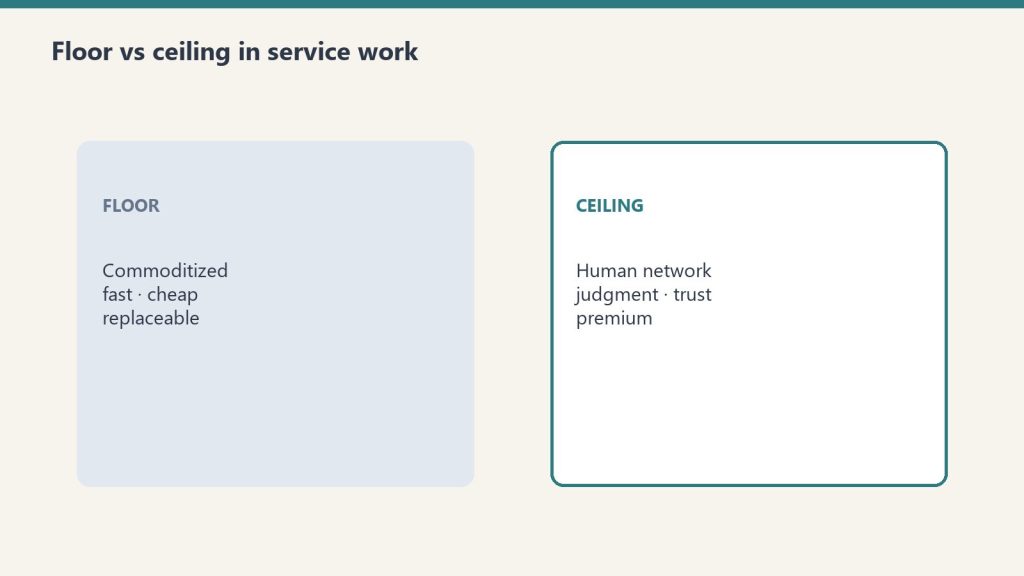
Five roles where the work compresses fastest:
– Coordinator/admin work — meeting scheduling, calendar prep, follow-up tracking. Largely automatable.
– Junior analyst work — data pulls, report generation, basic synthesis. Largely automatable.
– First-tier intake — categorizing inbound leads, support tickets, content submissions. Largely automatable.
– Status communication — weekly updates, project digests, standup notes. Largely automatable.
– Documentation upkeep — keeping wikis, runbooks, and SOPs current. Largely automatable with Autofill + agents.
This isn’t a prediction; it’s already happening in operator-led companies that have built Custom Agents for these workflows.
What roles get more important
The same shift makes other roles more valuable:
– Editorial leadership — defining voice, judgment, standards. Agents follow standards; they don’t write them.
– Relationship work — sales relationships, client management, partnerships. Humans signal humanity.
– Exception handling — the 5% of cases that don’t fit the agent’s pattern. This becomes the human’s whole job.
– System design — building the agents, prompts, skills, and workflows themselves. The new ops role.
– Strategic work — deciding what the company should do, not how to do it.
The new org shape

A simple four-layer pattern:
1. Agent operators — humans who design, monitor, and improve agent workflows
2. Exception handlers — humans who catch what agents can’t handle
3. Relationship leads — humans who own external-facing work that requires being human
4. Strategists — humans who decide what to do
Notice what’s missing: layers of middle management whose primary job was coordinating between doers. Agents reduce coordination overhead because they don’t need it.
How to transition
For most operators, the shift looks like:
– Stop hiring for roles where agents could do 70% of the work. Build the agent instead.
– Reassign current staff toward exception handling, relationship work, and editorial judgment.
– Invest in agent operator skills — prompt design, workflow design, rubric design.
– Compress the org chart. Fewer layers, broader roles, sharper accountability.
This is a multi-year shift, not a quarter. But the operators who start now have years of compounding advantage over those who delay.
The risk
The risk is reorganizing too fast and losing institutional knowledge that lived in the eliminated roles. Agents don’t pick up tribal knowledge automatically. The transition needs to capture what departing staff knew and encode it in the second brain so the agents can use it.
What to read next
Editorial Surface Area, Second-Brain Architecture, ROI Math, When Not to Use a Notion Agent.
Leave a Reply