Tag: Public Transit

Regional public transportation, light rail systems, commuter transit, and transit-oriented development.

  • Dome District Tacoma Desk: Transit & Freighthouse Square

    The Dome District is transit first: Tacoma Dome, Freighthouse Square, Link, Sounder, and the Pierce Transit Bus Shop. Last checked August 29, 2026.

    The district

    City listing: Neighborhood Business Districts (Dome). Cross-district profile: tacomabusinessdistricts.com.

    Tacoma Dome Station / Bus Shop — 505 E. 25th Street. Passes, ORCA, most Pierce Transit lost-and-found, Link lost-and-found. Hours and phone tree: Transit desk.

    City desks that still apply

    Longer ride context: Transit guide.

  • Tacoma transit desk: Pierce Transit, Link, ORCA

    Three agencies touch a Tacoma trip: Pierce Transit (bus), Sound Transit (Link and Sounder), ORCA (the card). Copilot mixes their phones. Last checked November 2, 2026. Routes change; use the trip planner for a time point.

    Pierce Transit

    Main: (253) 581-8000 · Toll-free: 1-800-562-8109 · Relay 711
    Contact

    Phone tree that matters:

    • Press 1 — SHUTTLE (paratransit): reservations, cancellations, eligibility, travel training
    • Press 2 — bus customer service. Then 1 for trip planning, 2 for ORCA

    Customer Service Center / Bus Shop
    505 E. 25th Street, Tacoma, WA 98421 (Tacoma Dome Station)
    Phone: 6:30 a.m.–6:30 p.m.
    Lobby: 7 a.m.–6 p.m.
    Holiday hours slip. Passes, ORCA, most lost-and-found for Pierce Transit buses.

    Live detours also show in Transit app, Google Maps, and Apple Maps. Still call 581-8000 if the app is lying.

    Sound Transit — Link and Sounder

    Rider line: 1-888-889-6368 (TTY 711), Monday–Friday 8 a.m.–6 p.m.
    soundtransit.org

    Link lost-and-found in Tacoma: Customer Service Center at Tacoma Dome Station (same 505 E. 25th shop). Sounder lost-and-found: 888-889-6368, Sounder option, then lost and found. Do not call 311 about a backpack on the train.

    ORCA

    Regional card line: 1-888-988-6722 · TTY 711 · Non-English: 800-823-9230
    Hours: Monday–Friday 8 a.m.–5 p.m.
    myORCA.com and the myORCA app. Value loaded online can take up to 24 hours to hit the card. New cards by mail: several business days.

    Buy or reload in person at the Pierce Transit Bus Shop during lobby hours. Android can keep the card in Google Wallet.

    Longer route context: Tacoma Public Transit guide. City phones: Civic Desk.

  • Pierce County Transit: Summer Updates & World Cup Routes

    Pierce County Transit: Summer Updates & World Cup Routes

    # Pierce County Transit Gears Up for Summer: New Routes, World Cup Connections, and Future Growth

    Pierce County’s transit landscape is buzzing with activity as summer approaches, bringing with it a series of service adjustments, new seasonal routes, and initiatives aimed at enhancing regional connectivity. From dedicated World Cup transportation to fare-free days and long-term expansion plans, both Pierce Transit and Sound Transit are working to keep residents moving efficiently across Tacoma and beyond.

    ## Pierce Transit’s Summer Service Enhancements

    Pierce Transit is rolling out several key updates designed to improve rider experience and cater to seasonal demands. Beginning June 7, 2026, slight service adjustments will be implemented on Routes 3 and 206, reflecting ongoing efforts to optimize the network [Source: piercetransit.org]. These minor tweaks aim to fine-tune schedules and ensure reliable service for daily commuters.

    ### Gig Harbor Waterfront Connector Launches

    A notable addition to Pierce Transit’s summer offerings is the new Waterfront Connector service. Running from June 12 through August 23, 2026, this seasonal route will provide convenient transportation between Uptown and Downtown Gig Harbor [Source: piercetransit.org]. This initiative is particularly beneficial for residents and visitors looking to explore Gig Harbor’s vibrant waterfront without the hassle of parking, supporting local businesses and tourism during the peak summer months.

    ### Fan Zone Express for World Cup Celebrations

    With the World Cup bringing major soccer matches to Seattle, Pierce Transit is stepping up to ensure fans in Pierce County can join the excitement. Starting June 12th, the agency will operate a dedicated Fan Zone Express service. This special route is designed to transport attendees directly to World Cup activities hosted by the Puyallup Tribe, in partnership with the City of Tacoma and Pierce County [Source: piercetransit.org]. The Fan Zone Express offers a seamless way to “park once, hop on Pierce Transit’s Fan Zone Express service, and ride straight into the roar of the crowd,” making it an “easiest, smoothest way to enjoy every match-day moment” [Source: piercetransit.org]. This service will be crucial for the FIFA World Cup matches, including Belgium vs. Egypt on June 15 and USA vs. Australia on June 19, for which Sound Transit will also be providing service to Seattle Stadium [Source: soundtransit.org].

    ### Fare-Free Initiatives and Community Engagement

    Pierce Transit has also been proactive in promoting transit use and community well-being. To kick off Ride Transit Month, all Pierce Transit services were fare-free on June 1, 2026 [Source: piercetransit.org]. This initiative encourages new riders to experience public transportation and highlights its benefits. Furthermore, in response to anticipated high temperatures, Pierce Transit offered free rides to cooling centers on June 2, 2026, demonstrating its commitment to public safety and community support [Source: piercetransit.org].

    Looking ahead, the public has been invited to weigh in on the Pierce Transit Growth Plan, with opportunities for feedback provided as recently as May 26 [Source: piercetransit.org]. This ongoing dialogue ensures that future service expansions and improvements align with the needs and priorities of Pierce County residents. The agency’s 2025 Annual Report, available for review, details over 45 years of positive impact in the community, showcasing how its services support customers [Source: piercetransit.org].

    ## Sound Transit’s Regional Reach and Future Plans

    Sound Transit continues to play a pivotal role in connecting Tacoma with the wider Puget Sound region, with ongoing service and ambitious long-term plans.

    ### Light Rail and Sounder Updates

    Sound Transit’s Link light rail and Sounder train services are vital arteries for regional commuters. Current alerts indicate ongoing service adjustments for the Link light rail (Lynnwood – Downtown Redmond line) and the Sounder train (Everett – Seattle and Seattle – Lakewood/Tacoma lines) [Source: soundtransit.org]. ST Express bus routes, including 522, 560, 574, 577, 578, 586, 590, 592, 594, and 595, also have service alerts, advising riders to check for updates [Source: soundtransit.org]. These alerts are a regular part of managing a complex transit system and highlight the importance of checking Sound Transit’s website for real-time information before travel.

    ### ST3 Vision and Tacoma Extension

    The future of regional transit, particularly for Tacoma, is heavily tied to the Sound Transit 3 (ST3) program. Sound Transit is actively working to address a projected $34.5 billion future funding gap through 2046, which is critical for delivering the voter-approved ST3 vision [Source: soundtransit.org]. This ambitious program includes significant light rail extensions, notably to West Seattle, Ballard, Tacoma, and Everett, as well as new service between South Kirkland and Issaquah [Source: soundtransit.org]. The Tacoma light rail extension is a cornerstone of this plan, promising to further integrate Pierce County into the regional transit network and provide enhanced connectivity for residents and businesses.

    The Sound Transit Board of Directors is regularly meeting to make key decisions regarding budgets, environmental reviews, and project baselines for scope, schedule, and budget [Source: soundtransit.org]. Upcoming meetings, such as the Community Oversight Panel Meeting on June 10 and the System Expansion Committee Meeting on June 11, underscore the ongoing governance and planning efforts for these major infrastructure projects [Source: soundtransit.org].

    ## WSDOT’s Role in Regional Connectivity

    The Washington State Department of Transportation (WSDOT) provides essential infrastructure and information that complements public transit services, particularly for those traveling by car or ferry within and out of Pierce County.

    ### Ferry Services and Roadway Information

    WSDOT offers comprehensive resources for various travel modes, including cars, trucks, ferries, and public transit [Source: wsdot.wa.gov]. For ferry users, real-time alerts, live cameras, current wait times, and boarding statuses are available for Washington State Ferries [Source: wsdot.wa.gov]. The Point Defiance / Tahlequah route is particularly relevant for Pierce County residents connecting to Vashon Island [Source: wsdot.wa.gov].

    For drivers, WSDOT provides real-time alerts, live cameras, current travel times, and bridge and road restrictions for major routes like I-5 and I-705, which are critical for Tacoma commuters [Source: wsdot.wa.gov]. These tools are invaluable for planning commutes and understanding traffic conditions, especially with ongoing construction and seasonal changes.

    The combined efforts of Pierce Transit, Sound Transit, and WSDOT illustrate a concerted push to enhance mobility and connectivity across Pierce County and the broader Puget Sound region. From localized service adjustments and seasonal routes to long-term light rail expansions, the focus remains on providing accessible, efficient, and sustainable transportation options for all.

    —

    ## Frequently Asked Questions About Pierce County Transit

    ### Q1: What are the key service adjustments Pierce Transit is making this summer?
    A1: Pierce Transit is making slight service adjustments to Routes 3 and 206 starting June 7, 2026. Additionally, a new Waterfront Connector service between Uptown and Downtown Gig Harbor will run from June 12 through August 23, 2026. [Source: piercetransit.org]

    ### Q2: How can I use public transit to attend World Cup events?
    A2: Pierce Transit is offering a Fan Zone Express service starting June 12th to transport attendees to World Cup activities hosted by the Puyallup Tribe in partnership with the City of Tacoma and Pierce County. Sound Transit will also provide service to Seattle Stadium for specific FIFA World Cup matches. [Source: piercetransit.org, soundtransit.org]

    ### Q3: Were there any fare-free days recently, and why?
    A3: Yes, Pierce Transit services were fare-free on June 1, 2026, to mark the beginning of Ride Transit Month. Additionally, free rides to cooling centers were offered on June 2, 2026, due to high temperatures in the Puget Sound area. [Source: piercetransit.org]

    ### Q4: What are Sound Transit’s long-term plans for light rail expansion in Tacoma?
    A4: Sound Transit’s ST3 program includes a light rail extension to Tacoma, among other areas like West Seattle, Ballard, and Everett. The agency is working to address a projected $34.5 billion funding gap through 2046 to deliver this voter-approved vision. [Source: soundtransit.org]

    ### Q5: Where can I find real-time traffic and ferry information for Pierce County?
    A5: The Washington State Department of Transportation (WSDOT) website provides real-time alerts, live cameras, current travel times, and bridge and road restrictions for major roadways like I-5 and I-705. It also offers real-time alerts, wait times, and boarding statuses for Washington State Ferries, including the Point Defiance / Tahlequah route. [Source: wsdot.wa.gov]

    —
  • Stream Community Line: Pierce Transit’s Tacoma Expansion

    Stream Community Line: Pierce Transit’s Tacoma Expansion

    For most of the last decade, the big transit story in Pierce County was supposed to be steel: light rail creeping south, a Bus Rapid Transit corridor with its own dedicated lanes muscling up Pacific Avenue. The reality landing in Tacoma in 2026 is quieter, cheaper, and arguably more useful to the people who actually ride. Pierce Transit’s Stream Community Line now runs all the way into downtown Tacoma — and it tells you almost everything about how transit in this county is going to grow for the rest of the decade.

    If you commute the Pacific Avenue spine between Spanaway and downtown, drop a kid at a school served by a free youth ORCA pass, or just want to understand where your transit tax dollars are going, here’s the operator’s-eye view of what changed, what’s coming June 7, and why the bus — not the train — is doing the heavy lifting.

    What the Stream Community Line Actually Is

    The Stream Community Line is enhanced bus service running the Tacoma–Spanaway corridor, and as of the March 29, 2026 service change it was extended into downtown Tacoma with new stops at Pacific Avenue & 14th Street, Pacific Avenue & 19th Street, and Commerce Street Station. It’s a partnership with MultiCare, and it runs weekdays during the morning and evening rush.

    The selling point is time. By skipping lower-demand stops and using transit-signal priority — technology that holds a green light or shortens a red when a bus approaches — Stream cuts at least 14 minutes off the trip compared to the existing local Route 1, according to Pierce Transit’s own service materials. For a corridor where the alternative is sitting in single-occupancy traffic on Pacific, 14 minutes each way is real money in time and fuel.

    Route 1 itself didn’t get left behind. The same March service change added eight new northbound and ten new southbound weekday trips on Route 1 (6th Ave–Pacific Ave), per Pierce Transit, so riders who need every stop still get more frequent local service while Stream handles the express layer on top.

    Why It’s “Stream” and Not Bus Rapid Transit

    Here’s the part longtime Pierce County residents will remember differently. Stream is what’s left of a much larger ambition. Pierce Transit spent years planning a true Bus Rapid Transit line on the Route 1 corridor — dedicated bus lanes, station platforms, the works — to deliver fast, reliable service up and down Pacific Avenue at all hours, not just at rush.

    That plan came apart in 2023. As The Urbanist reported, updated cost estimates pushed the dedicated-lane BRT project out of reach, with the latest figure pegged at roughly $311 million. Rather than abandon the corridor, the agency pivoted to “enhanced” service: signal priority and stop consolidation instead of poured concrete and condemned lanes. It’s a pragmatic downgrade — you get most of the speed benefit without the capital cost or the years of construction fights over who gives up a travel lane.

    Whether that’s a smart compromise or a missed opportunity depends on who you ask. Transit advocates wanted the permanent infrastructure; budget hawks wanted the restraint. What’s not in dispute is that the bus reached downtown in 2026 and the BRT didn’t.

    The June 7 Service Change: What Riders Should Know

    Pierce Transit adjusts service a few times a year, and the next round lands June 7, 2026. The changes are modest but worth a glance if you ride these routes:

    Route 3 (Lakewood–Tacoma): Southbound trips will no longer travel on S. 19th St between Market St. and Jefferson Ave., continuing on Jefferson Ave. instead. No stops or schedules are affected — it’s a routing cleanup.

    Route 101 (Gig Harbor Waterfront Connector): The seasonal Connector returns for the summer, running Fridays, Saturdays, and Sundays around Gig Harbor. As with all Pierce Transit service, riders 18 and younger ride free.

    Route 206 (Pac Hwy/Tillicum/Madigan): Northbound trips toward Lakewood Transit Center are getting daily schedule adjustments — relevant for the JBLM-adjacent communities of Tillicum and the Madigan corridor.

    Fan Zone Express: Starting June 12, Pierce Transit’s Fan Zone Express will offer free rides connecting fans to international soccer match watch parties tied to the summer’s marquee events. It’s a short-run promotional service, but it signals how the agency uses buses to move crowds around big regional moments.

    Spanaway: A New Hub, and a Temporary Hole

    The corridor’s anchor at the south end got a major upgrade in 2025. The Spanaway Transit Center opened in August 2025 — Pierce Transit’s first new public transit facility since the Tacoma Dome Station opened in 1998, according to coverage of the agency’s 2025 milestones. Phase One came in around $13.2 million and added 38 park-and-ride stalls, with a planned Phase Two expected to bring roughly 250 more.

    That facility matters because park-and-ride capacity is the unglamorous bottleneck on suburban transit. A fast bus down Pacific is only useful if you can leave your car somewhere when you board. Spanaway’s expansion — and the broader park-and-ride priorities in the agency’s long-range plan — is the supply side of the ridership equation.

    There’s a near-term complication, though. Because of Pierce County’s 208th Street East Sewer Extension project, the Spanaway Transit Center was temporarily closed effective April 27 for an expected 13 weeks, and during that window Route 1 and the Stream Community Line are not serving the Spanaway Transit Center. If you board at the south end of the corridor, check Pierce Transit’s alerts before you head out — temporary stops are in place, but the hub itself is offline through roughly late July.

    Ridership: The Numbers Behind the Investment

    Service changes only make sense if people are riding, and Pierce Transit’s recovery from the pandemic trough has been steady. The agency logged 7,039,888 boardings in 2025, running an 84% on-time performance rate against an 85% target, per its annual reporting. By the first quarter of 2026 the system was carrying roughly 26,700 riders on a typical weekday. Its 2025 annual report frames the bus side of the operation at just under 7 million rides, alongside hundreds of thousands of Rideshare and SHUTTLE paratransit trips.

    Those aren’t boom-era numbers, but they’re a recovery — and they’re concentrated on exactly the kind of all-day, working-rider corridors that Stream and the beefed-up Route 1 are built to serve. The strategy traces back to the agency’s Bus System Recovery Plan, launched in summer 2023, which rebuilt service around evening and weekend demand and higher frequency on core routes rather than simply restoring the old 2019 timetable.

    Fares: Who Rides Free in Pierce County

    One reason ridership holds up is that a meaningful share of riders pay nothing. Thanks to Washington’s 2022 Move Ahead Washington package, all youth ages 18 and under ride Pierce Transit for free. State employees who work in Pierce, King, and Snohomish counties can also commute free by bus or train. For everyone else, ORCA LIFT offers a 50% discount on adult fares for qualifying households based on federal poverty guidelines. Pierce Transit also ran a system-wide fare-free day on June 1 to kick off Ride Transit Month.

    The takeaway for households doing the math: between free youth passes and ORCA LIFT, a Spanaway-to-downtown family commute can cost far less than the fuel and parking it replaces — which is the case Pierce Transit is implicitly making with every Stream trip that beats Route 1 by a quarter hour.

    The Seattle Question and the JBLM Reality

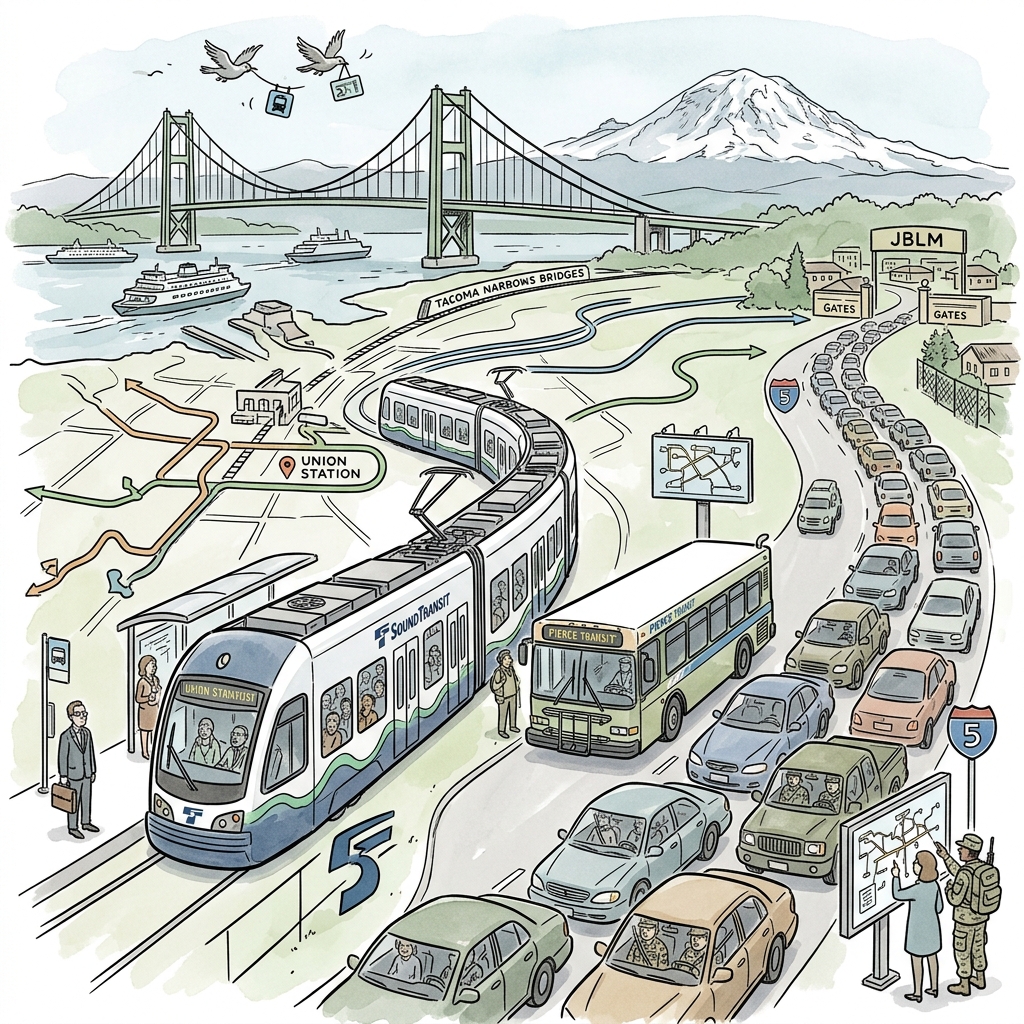
    Pierce County transit doesn’t end at the county line. Sound Transit operates the regional connections — the T Line streetcar in downtown Tacoma, Sounder commuter rail and ST Express buses north toward Seattle — while Pierce Transit runs the local network that feeds those regional spines. The handoff between the two systems is where the daily Tacoma-to-Seattle commute actually happens, and where Joint Base Lewis-McChord’s enormous workforce shapes peak-hour demand on the I-5 corridor through Lakewood and Tillicum.

    That’s the larger backdrop to the Stream decision. Pierce County’s transit dollars are finite, the dedicated-lane BRT proved unaffordable, and the agency is now placing its bets on faster buses, better hubs, and frequency where the riders already are. Its Destination 2045 long-range plan sketches further growth — park-and-ride expansion, zero-emission buses, higher-frequency trunk service — if and only if operating funding grows. Pierce Transit has also opened public comment on its growth plan, so residents who want a say in what comes after Stream have a window to weigh in.

    From where I sit, the Stream Community Line is the honest version of Pierce County transit: not the train everyone pictured, but a bus that’s now 14 minutes faster down the corridor where the most people live and work. That’s not a consolation prize. For a county that needs to move workers more than it needs ribbon-cuttings, it might be the better deal.

    Frequently Asked Questions

    What is the Pierce Transit Stream Community Line?

    The Stream Community Line is enhanced weekday bus service running between Tacoma and Spanaway along the Pacific Avenue corridor. As of the March 29, 2026 service change, it extends into downtown Tacoma with stops at Pacific Avenue & 14th Street, Pacific Avenue & 19th Street, and Commerce Street Station. It uses transit-signal priority and skips lower-demand stops to save at least 14 minutes compared to local Route 1 service.

    Why didn’t Pierce Transit build a Bus Rapid Transit line on Pacific Avenue?

    Pierce Transit originally planned a true BRT line with dedicated bus lanes on the Route 1 corridor, but the project’s cost estimate rose to roughly $311 million and the dedicated-lane plan fell apart in 2023. The agency pivoted to the Stream Community Line — “enhanced” service using signal priority and stop consolidation rather than dedicated infrastructure — to capture most of the time savings at a fraction of the capital cost.

    Is the Spanaway Transit Center open right now?

    The Spanaway Transit Center, which opened in August 2025, was temporarily closed effective April 27, 2026 for an expected 13 weeks due to Pierce County’s 208th Street East Sewer Extension project. During the closure, Route 1 and the Stream Community Line do not serve the transit center, though temporary stops are in place. Riders should check Pierce Transit alerts before traveling.

    Who rides Pierce Transit for free?

    All youth ages 18 and under ride free, funded by Washington’s 2022 Move Ahead Washington package. State employees working in Pierce, King, and Snohomish counties also ride free. Income-qualifying riders can use ORCA LIFT for a 50% discount on adult fares. Pierce Transit also held a fare-free day on June 1, 2026 to launch Ride Transit Month.

    What is changing in the June 7, 2026 service change?

    Route 3 (Lakewood–Tacoma) southbound trips reroute from S. 19th St to Jefferson Ave. with no stop or schedule changes; the seasonal Route 101 Gig Harbor Waterfront Connector returns Fridays through Sundays; Route 206 northbound trips toward Lakewood Transit Center get daily schedule adjustments; and the free Fan Zone Express begins June 12 to connect fans to summer soccer events.

  • Sea-Tac Airport Guide: Parking, Light Rail & Travel Tips

    Sea-Tac Airport Guide: Parking, Light Rail & Travel Tips

    Last verified: June 1, 2026. Rates and schedules at Seattle-Tacoma International Airport (SEA) change periodically — we re-verify this guide regularly, but always confirm time-sensitive details (TSA wait times, flight status, live parking availability) at the official links below before you travel.

    Sea-Tac at a glance

    • Airport parking: SEA garage, 11,000+ stalls. General parking runs about $37–$47/day (≈$222/week); Floor 4 is reservable “Terminal Direct.” Official rates & reservations →
    • Cheapest way downtown: Sound Transit Link light rail, about $3.50, ~35–45 min to downtown Seattle. SeaTac/Airport Station →
    • Uber / Lyft pickup: 3rd floor of the parking garage (rows G–J). Rideshare pickup →
    • Cell phone waiting lot: S. 170th St (across from Doug Fox), ~200 free spaces with WiFi.
    • TSA wait times: check the free MyTSA app/site. Flight status: your airline or the Port of Seattle SEA site.

    Parking at Sea-Tac

    The SEA Airport Garage sits directly across from the terminal and holds more than 11,000 vehicles, making it the most convenient option for most travelers. According to the Port of Seattle, the airport adjusts parking rates annually to keep pace with inflation and local taxes, so treat the figures here as a current snapshot and confirm before you park.

    Garage rates and options

    • General parking (garage floors 1–3 and 5–8): roughly $37–$47 per day, with a standard weekly rate around $222.
    • Terminal Direct (Floor 4): a reservable, guaranteed space closest to the skybridges. Book ahead through the official SEA reservation system — this is the move during holiday peaks when the garage fills.

    Off-airport and budget options

    Independent off-site lots near the airport (along International Boulevard and S. 170th St) advertise daily rates well below the garage, typically with free shuttle service to the terminal. Compare total cost including shuttle time; for short trips the garage often wins on convenience, while multi-day trips favor off-airport or Link light rail.

    Cell phone waiting lot (free)

    Picking someone up? Use the free cell phone waiting lot on S. 170th Street, directly across from Doug Fox Parking. It has about 200 spaces and free WiFi, and lets you wait off-roadway until your traveler is actually at the curb — far cheaper and calmer than circling the drives.

    Getting to and from Sea-Tac

    Link light rail (the value pick)

    Sound Transit’s 1 Line connects the SeaTac/Airport Station to downtown Seattle and, via the network’s northern extensions, to neighborhoods well beyond. The station is about a 5-minute covered walk from the terminal, and a one-way fare to downtown runs about $3.50 with a travel time of roughly 35–45 minutes. From baggage claim, head to carousel 16, go up one floor to the skybridge level, cross Skybridge 6, and follow signs (a free electric shuttle runs between the garage and the light rail station).

    Rideshare, taxis, shuttles and town cars

    • Uber / Lyft (app-based rideshare): pickup is on the 3rd floor of the parking garage, in the designated zone around rows G–J. Drop-offs use the departures drive on the upper roadway.
    • Taxis and for-hire: available at the ground transportation island on the 3rd floor of the garage.
    • Shuttles and town cars: hotel shuttles, regional vans (to Tacoma, Olympia and beyond) and pre-booked town cars load at marked stalls on the ground transportation level.

    Driving and drop-off

    Departures (check-in) use the upper drive; arrivals (baggage claim) use the lower drive. Curbside is for active loading only — for any wait, use the free cell phone lot.

    Terminals, security and getting around

    SEA operates a single main terminal with concourses A–D and the North and South satellites, reached by the underground SEA Underground train. Allow extra time to reach satellite gates. For current security line conditions, check TSA wait times via the MyTSA tool rather than guessing — waits swing widely by time of day and season. TSA PreCheck and the SEA Spot Saver program can shorten the wait.

    Flight status, dining, services and lost & found

    • Flight status: confirm with your airline or the Port of Seattle SEA flight information board before heading to the airport.
    • Dining & shops: SEA has extensive pre- and post-security options across the concourses; see our companion Sea-Tac dining guide for a terminal-by-terminal breakdown.
    • Lost & found, WiFi, accessibility: free airport WiFi is available terminal-wide, and lost-item reports are handled through the Port of Seattle.

    Frequently asked questions

    How much does parking cost at Sea-Tac Airport?

    General parking in the SEA garage runs about $37–$47 per day, with a weekly rate around $222. Floor 4 offers reservable “Terminal Direct” parking, and off-airport lots advertise lower daily rates with shuttle service. Rates are adjusted annually, so confirm current pricing on the Port of Seattle parking page before you travel.

    What is the cheapest way to get to downtown Seattle from Sea-Tac?

    Sound Transit’s Link light rail is the cheapest reliable option — about $3.50 one way, roughly 35–45 minutes to downtown, departing from the SeaTac/Airport Station about a 5-minute walk from the terminal. It avoids traffic and parking entirely.

    Where do Uber and Lyft pick up at Sea-Tac?

    App-based rideshare pickups happen on the 3rd floor of the airport parking garage, in the designated zone around rows G–J. Follow the “App-Based Rideshare” signs from baggage claim up to the garage.

    Where is the Sea-Tac cell phone waiting lot?

    The free cell phone waiting lot is on S. 170th Street, directly across from Doug Fox Parking, with about 200 spaces and free WiFi. Wait there until your arriving passenger is at the curb rather than circling the airport drives.

    How early should I arrive at Sea-Tac for a flight?

    A common guideline is two hours before a domestic departure and three hours before international, but security waits at SEA vary widely. Check live TSA wait times with the MyTSA tool the morning of your flight, and add buffer during holiday peaks when the garage and checkpoints are busiest.


  • Tacoma Public Transit Guide: Routes, Rail & JBLM Commute

    Tacoma Public Transit Guide: Routes, Rail & JBLM Commute

    Last refreshed: October 20, 2026 (Pacific).

    Tacoma’s Two-System Transit Reality

    Tacoma is served by two distinct public transit agencies with overlapping but different missions. Pierce Transit handles local bus routes within Pierce County — the daily commute within Tacoma, connections to Lakewood, University Place, and neighborhood service. Sound Transit handles regional connections — the Sounder commuter rail to Seattle, the Tacoma Link light rail, and ST Express buses to King County.

    Understanding how they fit together is essential for anyone living or working in Tacoma without relying entirely on a car. And understanding their limitations is equally essential for anyone coming from a city with better transit coverage.

    Pierce Transit: Local Bus Network

    Pierce Transit operates approximately 35 fixed bus routes across Pierce County. The system is hub-and-spoke, centered on the Tacoma Dome Station (the main transfer point where Pierce Transit, Sound Transit, and Greyhound all connect) and the downtown Commerce Street corridor.

    High-frequency routes (15-minute headways during peak hours) include Route 1 (6th Avenue corridor), Route 2 (South Tacoma Way), Route 3 (Pacific Avenue), and Route 4 (Point Defiance). These form the backbone of the system and provide reasonable service for car-free living along those specific corridors.

    The honest assessment: outside the high-frequency routes, Pierce Transit operates on 30-60 minute headways that make transit impractical as a primary mode for most trips. Evening and weekend service is reduced further. If your origin and destination aren’t both on a frequent route, you’re likely looking at transfer times that double or triple the equivalent drive time.

    Pierce Transit ridership has recovered to approximately 75-80% of pre-pandemic levels as of recent reporting. The agency’s sales-tax rate has not changed since 2002. In July 2026 its board placed Proposition 1 on the November 3, 2026 ballot — a 0.3% sales-tax increase that would fund roughly 40% more service, with planned increases in frequency on key routes, later evening and weekend service, and new connections to developing areas. Voters decide this November.

    Sound Transit: Regional Rail and Light Rail

    Sounder S Line (Commuter Rail)

    The Sounder S Line runs from Lakewood through Tacoma Dome to Seattle’s King Street Station, with peak-direction service (northbound morning, southbound evening). Trip time from Tacoma Dome to King Street: approximately 60 minutes. Service frequency: trains depart every 20-30 minutes during peak commute windows.

    This is the commuter rail line that enables Tacoma residents to hold Seattle jobs — and it’s the transit service most responsible for Tacoma’s residential price appreciation. The monthly pass (included in ORCA regional passes) makes the cost roughly equivalent to gas and parking for driving, but with productivity time on the train.

    Limitations: Sounder runs primarily peak-direction during commute hours, with a single midday round trip. There is no regular evening or weekend Sounder service (special-event trains aside). If you need to get to Seattle outside of 6-9 AM or 3-7 PM, you’re using ST Express bus (slower) or driving.

    Tacoma Link T Line (Light Rail)

    The Tacoma Link T Line is a streetcar-style light rail running from the Theater District through downtown to the Hilltop neighborhood (extended 2023) and south to the Tacoma Dome Station. The T Line was fare-free until the Hilltop extension opened in September 2023 — it now charges a flat $2 adult fare ($1 reduced for ORCA LIFT, senior, and disabled riders; youth 18 and under ride free), so tap an ORCA card or buy a ticket before boarding.

    The T Line serves primarily as a downtown circulator connecting the main transit hub (Tacoma Dome), the government/business district (Union Station area), the entertainment district (Theater District), and Hilltop. It’s useful for moving within central Tacoma but doesn’t extend to residential neighborhoods beyond Hilltop.

    The JBLM Commute Reality

    Joint Base Lewis-McChord sits approximately 12 miles south of downtown Tacoma via I-5. It’s the largest military installation on the West Coast by personnel (over 40,000 military members plus civilians and contractors). The commute between Tacoma and JBLM is one of Pierce County’s defining traffic patterns.

    The I-5 corridor between Tacoma and JBLM (exits 116-127) experiences significant congestion during morning and evening commute hours. Southbound morning rush (7:00-8:30 AM) and northbound evening rush (4:00-6:00 PM) can add 20-40 minutes to what would otherwise be a 15-minute drive.

    Transit options for the JBLM commute: Sound Transit Route 592 runs at peak hours only between DuPont, Lakewood Station (adjacent to JBLM), and downtown Seattle. Pierce Transit Route 206 serves the Lakewood/JBLM area with connections to Tacoma Dome Station. However, transit is impractical for most JBLM-bound commuters because the base itself is enormous and not well-served by internal transit — you need a car once on base.

    Park-and-ride capacity is a constraint. The Lakewood Station and South Tacoma Station park-and-rides fill early on weekday mornings. Sound Transit is expanding capacity at several locations, but demand consistently outpaces supply.

    What’s Coming: ST3 and Pierce Transit Improvements

    Sound Transit’s ST3 expansion plan includes extending the Tacoma Link light rail further south (potentially to Tacoma Community College) and improving Sounder service frequency. These projects are in various stages of planning and construction — timelines have been pushed back from original estimates, which is the norm for major transit capital projects in the Puget Sound region.

    Pierce Transit’s service improvement plan — the package Proposition 1 would fund if voters approve it on November 3, 2026 — focuses on increasing frequency on existing routes rather than adding new routes. The goal is 15-minute service on 8-10 key corridors — making transit usable for more trip types than just peak-commute office workers.

    Frequently Asked Questions

    Is the Tacoma Link light rail free?

    No — not anymore. The Tacoma Link T Line was completely fare-free until the Hilltop extension opened in September 2023. It now charges a flat $2 adult fare ($1 reduced; youth 18 and under free) across the entire line, from Tacoma Dome Station through downtown to Hilltop and St. Joseph — tap an ORCA card or buy a ticket at the station.

    How long does the Sounder train take from Tacoma to Seattle?

    Approximately 60 minutes from Tacoma Dome Station to King Street Station in downtown Seattle. Trains run peak-direction only during commute hours — northbound morning (roughly 5:30-8:30 AM departures) and southbound evening (3:30-6:30 PM departures). Service is peak-focused, plus one midday round trip; there is no regular evening or weekend service.

    Does Pierce Transit go to JBLM?

    Pierce Transit Route 206 serves the Lakewood area adjacent to JBLM with connections to Tacoma Dome Station. However, transit access to JBLM itself is limited — the base is large and not well-served by internal transit, so most commuters need a car once on base. Sound Transit Route 592 also connects DuPont and Lakewood Station to downtown Seattle at peak hours.

    What are the park-and-ride options in Tacoma?

    Major park-and-rides include Tacoma Dome Station (largest, served by Sounder, ST Express, and Pierce Transit), South Tacoma Station, and Lakewood Station. All fill early on weekday mornings. Overflow parking is a persistent issue — arrive before 7:30 AM for guaranteed spots at Tacoma Dome.

    Is public transit in Tacoma good enough to live without a car?

    Possible but limiting. If you live and work on a high-frequency Pierce Transit route (Routes 1, 2, 3, or 4) and commute during peak hours, car-free living is feasible. For most other situations — evening trips, weekend errands, destinations off main corridors — you’ll find 30-60 minute headways frustrating. The system works for some lifestyles, not all.

  • Hilltop Tacoma Light Rail: 3 Years of Transformation

    Hilltop Tacoma Light Rail: 3 Years of Transformation

    The Neighborhood That’s Changing Fastest

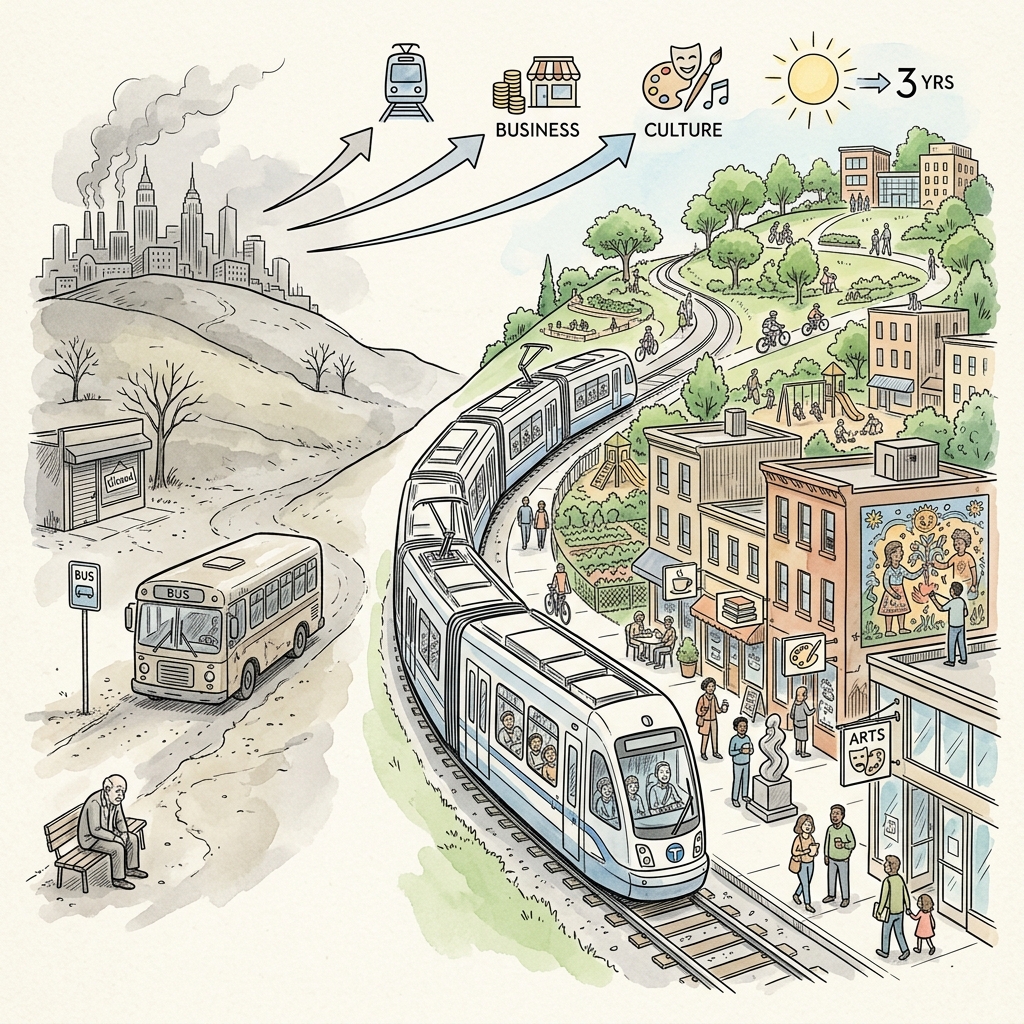
    Hilltop — the neighborhood centered around Martin Luther King Jr. Way and South 11th Street — has undergone more visible change in the past three years than any other part of Tacoma. The catalyst was the Tacoma Link Light Rail Hilltop Extension, which opened in 2023, connecting the neighborhood to downtown’s Theater District and the regional transit network for the first time.

    I’ve watched Hilltop for years now. The change isn’t subtle — new mixed-use buildings, restaurants that didn’t exist 36 months ago, and foot traffic patterns that simply weren’t there before the streetcar arrived. But Hilltop’s story is more complex than a simple gentrification narrative. The community has been intentional about what it wants to preserve.

    The Light Rail Impact

    Sound Transit’s Hilltop Tacoma Link extension added six new stations connecting MLK Jr. Way to the existing T Line that runs from the Theater District to the Tacoma Dome. The line runs at-grade (street level) along MLK Jr. Way, with stations at approximately every two blocks between Stadium Way and the St. Joseph Medical Center area.

    The extension cost approximately $275 million and was the most significant public infrastructure investment in Hilltop’s modern history. Per Sound Transit ridership data, the Hilltop stations have shown steady ridership growth since opening, though exact numbers fluctuate seasonally.

    What the light rail actually did to the neighborhood: it eliminated the perception of isolation. Hilltop is only about a mile from downtown Tacoma, but the steep grade and lack of convenient transit made it feel disconnected. Now you can step on at the Theater District station and be on MLK Jr. Way in 8 minutes, no car needed. That accessibility shift changed the calculus for businesses deciding where to open.

    New Businesses Along MLK Jr. Way

    The commercial corridor along Martin Luther King Jr. Way has seen notable openings in the past three years. New restaurants, coffee shops, and retail have filled spaces that were vacant for years in some cases. The mix is intentionally diverse — Black-owned businesses have been prioritized in several of the new mixed-use developments through community benefit agreements negotiated during the planning process.

    The City of Tacoma implemented a Hilltop Subarea Plan that includes anti-displacement measures: commercial rent stabilization incentives, facade improvement grants for existing businesses, and priority permitting for BIPOC-owned enterprises. Whether these measures are working at scale is debated on r/Tacoma regularly — the general sentiment is “better than nothing, not enough to prevent all displacement.”

    Cultural Investment and Community Anchors

    The cultural infrastructure investments in Hilltop have been significant. People’s Community Center, operated by Metro Parks Tacoma, underwent renovation and remains the neighborhood’s recreational anchor — gym, pool, meeting spaces, youth programming.

    The Hilltop Artists program, connected to the Tacoma glass arts tradition, continues operating its hot shop where youth learn glassblowing — one of the only free youth glass programs in the country. The Hilltop Action Coalition remains the primary community organizing body, maintaining neighborhood voice in development decisions.

    Public art installations along the light rail corridor were commissioned from local artists with deep Hilltop ties. The art reflects the neighborhood’s African American, Pacific Islander, and Latino history — stories that were at risk of being overwritten by new development without this intentional investment.

    Housing: What’s Built and What’s Coming

    Multiple mixed-use developments (residential above, commercial at ground level) have been completed or are under construction along the light rail corridor. Many used the City of Tacoma’s Multifamily Tax Exemption (MFTE) program which requires affordable units in exchange for property tax breaks.

    Typical unit mix in new Hilltop buildings: studios and one-bedrooms at market rate of $1,400-$1,800/month, with 20% of units income-restricted at 60-80% AMI levels. This is lower than comparable new construction in Seattle but still substantially above what long-term Hilltop residents were paying pre-development.

    The displacement tension is real and ongoing. Homeowners in the neighborhood have seen property values appreciate significantly — positive for them. Renters in older housing stock face pressure as landlords sell to developers. The community has pushed back successfully on some projects, less successfully on others.

    What’s Changed in Three Years: Honest Assessment

    Improved: Street safety perception (more foot traffic, better lighting along MLK), restaurant/retail options, transit access, building condition (fewer boarded-up storefronts), public art quality.

    Concerning: Rising rents displacing some long-term residents, construction disruption that lasted longer than promised, some locally-owned businesses replaced by newer operators without neighborhood history.

    Unchanged: Community pride and organizing capacity (strong before, strong now), economic diversity of residents (still more mixed-income than many changing neighborhoods), the essential character of Hilltop as a neighborhood with identity and voice.

    The next 2-3 years will determine whether Hilltop’s transformation results in a neighborhood that retains its character while gaining amenities, or whether it follows the common American pattern of cultural erasure through development. The structural protections in place are stronger than most cities attempt. Whether they’re strong enough is the open question.

    Frequently Asked Questions

    How do you get to Hilltop on the light rail?

    The Tacoma Link T Line connects downtown’s Theater District station to Hilltop via MLK Jr. Way. Board at any T Line station (Tacoma Dome, Union Station, Theater District) and ride to the Hilltop stations. The ride from Theater District to MLK/11th Street takes approximately 8 minutes. Service is fare-free on the entire T Line.

    Is Hilltop safe to visit?

    Hilltop has seen measurable improvement in crime statistics since the light rail brought increased foot traffic and business activity. Like any urban neighborhood, situational awareness applies — but the daytime commercial corridor along MLK Jr. Way is active, well-trafficked, and safe for visitors. The neighborhood is significantly different from its reputation of 15-20 years ago.

    What’s the history of Hilltop in Tacoma?

    Hilltop has been Tacoma’s primary African American neighborhood since the mid-20th century, shaped by the same redlining and restrictive covenants that created segregated neighborhoods across American cities. It’s also home to significant Pacific Islander and Latino communities. The neighborhood’s cultural identity is rooted in this history.

    Are there restaurants in Hilltop worth visiting?

    Yes — the dining options have expanded substantially since 2023. The MLK Jr. Way corridor now has restaurants ranging from soul food to Vietnamese to coffee/bakery concepts. The neighborhood is still developing its restaurant identity but already offers options you won’t find elsewhere in Tacoma.

    How has Hilltop changed since the light rail opened?

    Since the 2023 T Line extension opening: new mixed-use buildings completed, multiple new restaurants and retail opened, foot traffic increased significantly, property values appreciated 15-25%, and several vacant storefronts reactivated. The neighborhood is visibly different from three years ago while retaining its cultural anchors.


  • Tacoma to Chicago Intermodal: BNSF Cuts Transit by 3 Days

    Tacoma to Chicago Intermodal: BNSF Cuts Transit by 3 Days

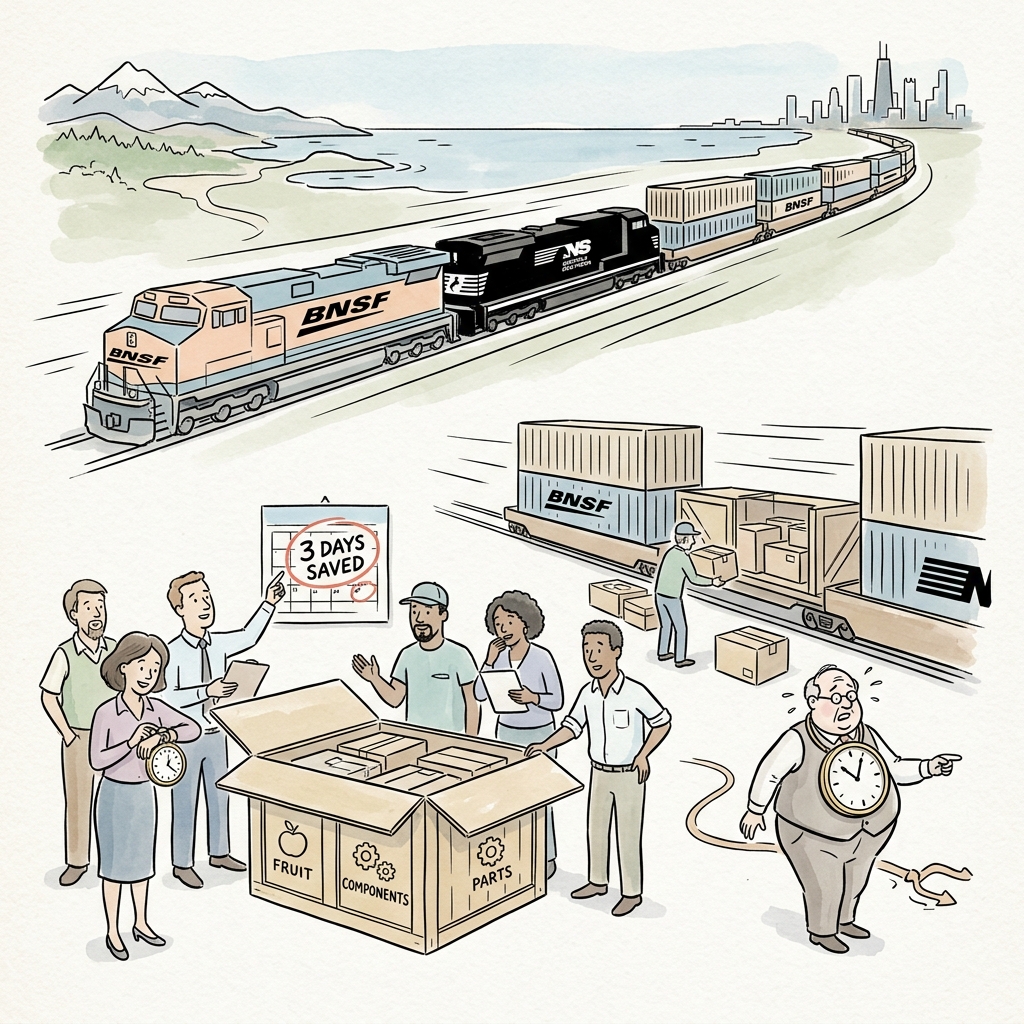
    If you ship anything through the Pacific Northwest, the math just changed. The BNSF and Norfolk Southern joint intermodal service connecting the Northwest Seaport Alliance terminal in Tacoma to Chicago now cuts three days off transit compared to legacy routing. For Tacoma-based shippers, manufacturers, and third-party logistics operators, this isn’t a press release — it’s a structural cost reduction that changes where goods move and why.

    Last refreshed: October 20, 2026 (Pacific).

    What the Joint Service Actually Does

    The Northwest Seaport Alliance (NWSA), which operates the marine cargo facilities across Tacoma and Seattle, has long positioned the gateway as a faster alternative to the congested ports of Los Angeles and Long Beach. The BNSF/NS intermodal partnership makes that positioning concrete: the total time from ship arrival in Tacoma to Chicago is now six days, versus nine days before the redesign — the savings come from building trains in under two days of on-dock dwell at terminals like Husky Terminal and Washington United Terminal, plus a faster, more consistent rail leg.

    This works because BNSF handles the western leg from Tacoma through its mainline over Stevens Pass and across the northern tier, then hands off to Norfolk Southern’s eastern network at a single Chicago interchange point — NS-Ashland, with a single crew swap. The result is a seamless intermodal move that doesn’t require repositioning or drayage between disconnected terminals.

    Why Three Days Matters More Than You Think

    Three days isn’t just about speed — it’s about inventory carrying cost, warehouse utilization, and contractual delivery windows. For a mid-size Tacoma distributor shipping 200 containers per year to Midwest distribution centers, three days off transit means:

    Reduced safety stock requirements at the destination DC. When transit is predictable and shorter, you don’t need to warehouse as much buffer inventory. For goods with a landed cost of $50,000 per container, that’s real working capital freed up across the supply chain.

    Tighter compliance with retailer delivery windows. Major retailers penalize late deliveries with chargebacks that can run 3-5% of invoice value. Faster, more reliable transit directly reduces chargeback exposure.

    The NWSA handled 3.16 million TEUs in 2025. Even a fractional shift in modal choice driven by this service improvement represents significant volume.

    The Tacoma Advantage Over LA/Long Beach

    The Southern California ports have dealt with chronic congestion, labor disputes, and drayage bottlenecks for years. Tacoma offers a fundamentally different operating environment: shorter vessel transit from major Asian manufacturing hubs (one to two days less sailing time from key ports in Japan, South Korea, and northern China), less terminal congestion, and direct on-dock rail access at multiple NWSA terminals.

    The BNSF/NS joint service amplifies this. A shipper routing through Tacoma instead of LA/LB to reach Chicago now saves time on the water AND time on the rail. The total door-to-door differential can be five or more days depending on origin port and final destination.

    Who Benefits in Tacoma

    The immediate beneficiaries are the freight forwarders, NVOCCs, and 3PLs already operating in the Tacoma logistics corridor along the Tideflats. Companies with warehouse operations near the Port of Tacoma terminals — particularly along Port of Tacoma Road, Taylor Way, and the industrial zones east of I-5 — gain the most from reduced dwell times and faster container turns.

    But the secondary effects matter too. Faster rail service makes Tacoma more attractive for distribution center siting decisions. Companies evaluating where to place Pacific Northwest DCs now have a stronger reason to choose Pierce County over alternative locations that lack direct intermodal rail access.

    The Pierce County Economic Development department has been marketing the logistics corridor as a competitive alternative to King County’s increasingly expensive industrial real estate. This rail improvement gives them a tangible differentiator.

    Infrastructure Context

    This service improvement doesn’t exist in a vacuum. BNSF has invested heavily in capacity improvements along its northern transcontinental mainline, including siding extensions and signal upgrades that improve fluidity for intermodal trains. Norfolk Southern’s eastern network investments in the Heartland Corridor and other capacity projects mean the Chicago interchange works without creating new bottlenecks.

    Locally, the NWSA’s ongoing terminal modernization — including the T-5 improvements in Seattle and continued investment in Tacoma’s Husky Terminal — ensures that vessel-to-rail transitions happen efficiently. The NWSA capital investment program has committed hundreds of millions to exactly these kinds of intermodal connection improvements.

    What Operators Should Do Now

    If you’re a Tacoma-based shipper currently routing through LA/LB to reach Midwest or East Coast markets, run the numbers on rerouting through the NWSA gateway with the BNSF/NS joint service. The per-container savings on transit time, reduced inventory carrying cost, and improved delivery reliability may justify shifting volume — even if the ocean freight rate differential isn’t immediately favorable.

    For operators considering expanding or relocating distribution operations, the Pierce County logistics corridor now offers a combination of available industrial land (at prices well below King County), direct intermodal rail access, and faster transit times to the nation’s largest consumer markets. That’s a combination you won’t find at LA/LB anymore.

    FAQ

    How much faster is the BNSF/NS joint service compared to previous options?

    The joint service cuts approximately three days off the Tacoma-to-Chicago move, bringing the total time from ship arrival to Chicago to six days, down from nine.

    Which terminals in Tacoma connect to this rail service?

    The Northwest Seaport Alliance operates multiple terminals in Tacoma with on-dock or near-dock rail access, including Husky Terminal and Washington United Terminals. Containers can move directly from vessel to intermodal rail without requiring extended drayage.

    Is this service available to all shippers or only large-volume accounts?

    The BNSF/NS intermodal service is available through freight forwarders and intermodal marketing companies (IMCs) that book capacity on the service. Both large-volume and smaller shippers can access it through their existing logistics providers.

    How does Tacoma’s rail transit compare to shipping through LA/Long Beach?

    Tacoma offers one to two days less ocean transit from key Asian ports, plus the faster rail service. Total door-to-door savings versus LA/LB routing to Chicago can be five or more days when combining shorter ocean transit with the improved rail schedule.

    What types of cargo benefit most from this service?

    Time-sensitive consumer goods, retail inventory subject to delivery window penalties, perishable goods requiring faster transit, and any cargo where inventory carrying costs are significant relative to freight spend. High-value electronics, apparel, and food products see the strongest ROI from faster rail service.

  • Sounder North Ending in 2033: Everett Transit Gap Impacts

    Sounder North Ending in 2033: Everett Transit Gap Impacts

    Q: Is Sound Transit ending the Sounder North train from Everett to Seattle?
    A: Under a proposal released May 7-8, 2026, yes — the Sounder N Line would end in 2033 as part of a package to close Sound Transit’s $34.5 billion budget gap. The Sound Transit Board votes May 28. If approved, Everett commuters would have no direct rail to Seattle until Everett Link opens, currently projected for 2037 at the earliest.

    Something that shapes how Everett grows, what rents downtown, and what office buildings can credibly pitch to tenants got a lot more uncertain this week: the commuter train connecting Everett to Seattle may stop running entirely in 2033.

    Under a proposal introduced by Sound Transit Board chair and Snohomish County Executive Dave Somers — the same Somers whose “spine-first” approach will spare Everett Link Extension from cuts — the Sounder N Line would cease operations as part of a package to close Sound Transit’s $34.5 billion budget shortfall. The Sound Transit Board votes on the full plan May 28 at the Ruth Fisher Board Room in Tacoma.

    If approved, the math is stark: Sounder N ends 2033. Everett Link opens no earlier than 2037, and more likely 2038-2041. That’s a four-to-eight-year window where Everett’s connection to downtown Seattle goes from a 30-40 minute train ride to whatever a bus on I-5 can manage.

    We think this gap deserves more attention than it’s getting.

    What Sounder North Actually Is — and Who Uses It

    The Sounder N Line runs four trains per day in each direction between Everett Station and King Street Station in Seattle, with stops in Mukilteo and Edmonds along the way. It’s been running since 2003 and was always designed as a bridge service — something to hold commuters over until light rail could do the job more efficiently.

    The problem is that bridge lasted longer than anyone planned, and ridership never fully recovered from the COVID-19 pandemic. As of April 2026, Sounder North carries roughly 565 rides per day. That’s across four trains. The math works out to about 70 passengers per train, on a service that costs Sound Transit significantly more per rider than any other line in the system.

    The Somers proposal is blunt about the calculus: when you’re $34.5 billion short, you don’t run a commuter train that 565 people a day use. You make hard choices. And Sound Transit’s position is that the Board can revisit the Sounder N decision if ridership meaningfully improves — but it won’t commit to that happening.

    The Transit Gap Is Real

    Here’s what makes this story specifically a Waterfront development story and not just a transit story: the gap in rail service lands squarely in the years when Everett’s biggest development bets are being placed.

    Millwright District Phase 2 — the 300-plus apartment homes and 120,000 square feet of Class-A office space being developed by LPC West on the Port’s 10-acre waterfront site — is being marketed as a connected, walkable, transit-adjacent workplace. That pitch works better with a train. It works less well when the nearest rail is a 20-30 minute bus ride to Lynnwood Link.

    The Waterfront Place commercial district — restaurants, hotels, marine businesses, two hotels, and the 266 apartments at Sawyer and Carling — has drawn Seattle-area visitors and employees partly because of that sense that Everett is part of the regional story. Rail connectivity is part of what makes that story credible to employers making lease decisions.

    The Everett Station District Alliance, which has spent years planning transit-oriented development around the future Everett Station light rail stop, operates on the assumption that the station will be active and desirable. A 4-8 year gap where the station is quiet changes the calculus on when to break ground and what to build.

    What’s Still Intact

    To be clear about what the Somers proposal does NOT do: it does not cut or delay the Everett Link Extension. That’s the crucial distinction. The light rail from Lynnwood to downtown Everett Station — all 16 miles of it — remains fully funded and on track. The May 28 vote is expected to confirm that the north-south spine gets built, all the way to Everett.

    That matters enormously for the long-term development story. What the ST3 plan fully funding Everett Link means is that developers, lenders, and employers planning 10-15 years out can bank on regional light rail connectivity. The uncertainty is only in the middle stretch — the years between Sounder’s end and Link’s opening.

    Sound Transit still holds negotiated rights with BNSF to run up to eight trains per day on the Sounder N corridor. Those rights have real value. Advocates are already asking whether ending the service prematurely forfeits leverage on that corridor — something the Board will likely hear about before May 28.

    The Bus Bridge That Would Fill the Gap

    The transit gap doesn’t mean no transit — it means slower transit. Community Transit’s express bus routes to Lynnwood Link will be the primary rail-adjacent option for Everett commuters after 2033. The Everett Transit and Community Transit merger announced in April 2026 is precisely the kind of service consolidation that should, in theory, strengthen bus frequency and reach in Snohomish County. Whether that merger’s integration timeline aligns with Sounder’s shutdown is a coordination question nobody has publicly answered yet.

    Mukilteo and Edmonds lose even more than Everett does. Both cities stop at the Sounder station but are not on the Everett Link Extension route. Once Sounder ends and Link opens, those communities have no direct rail connection at all — a point that’s likely to generate pushback from Mukilteo and Edmonds council members in the weeks before the May 28 vote.

    What We’re Watching

    The May 28 Sound Transit Board meeting is the most important transit vote for Everett since the ST3 package passed in 2016. The question isn’t whether Everett Link gets built — it does. The question is how the Board handles the years between, and whether ending Sounder North is the right tradeoff or a shortsighted cut that underserves a corridor during the exact years Everett is trying to grow.

    For the Snohomish County delegation to Sound Transit, this is the opening bid in a negotiation, not a final answer. The EASC DC Fly-In delegation that was in Washington this week was making the case for Everett infrastructure spending. Sounder North’s fate is now part of that same conversation.

    We’ll have the vote results here as they come out of the May 28 board meeting. In the meantime, if you commute on Sounder North and want to weigh in, Sound Transit is accepting written comment before the vote.

    Frequently Asked Questions

    When would Sounder North service end in Everett?

    Under the current Somers proposal, the Sounder N Line would end in 2033. The Sound Transit Board must approve the plan at its May 28, 2026 meeting for the timeline to be confirmed.

    What rail service would replace Sounder North in Everett?

    Nothing immediately. Everett Link Extension is expected to open between 2037 and 2041. In the interim, Community Transit express buses connecting to Lynnwood Link would be the primary transit option to Seattle.

    Does this affect the Everett Link Extension?

    No. The Somers proposal explicitly preserves the full 16-mile Everett Link Extension, from Lynnwood to downtown Everett Station. The transit gap only applies to the Sounder commuter rail service, not to the future light rail line.

    How does ending Sounder North affect downtown Everett property values?

    Transit-adjacent properties historically benefit from rail access. A multi-year gap in rail service could moderate growth in areas marketed as transit-connected, particularly near Everett Station. The long-term Everett Link commitment supports the development case, but the near-term transit gap creates uncertainty for office tenants and housing developers.

    Can the Sounder North decision be reversed?

    Sound Transit’s board can revisit the decision if ridership meaningfully improves or new funding sources emerge. Sound Transit also retains negotiated rights to run up to eight trains per day on the BNSF corridor — those rights could have future value if circumstances change.

  • Moving to Everett: How the Sound Transit Vote Impacts You

    Moving to Everett: How the Sound Transit Vote Impacts You

    If you are considering moving to Everett: The June 30, 2026 Sound Transit board vote is the single most consequential near-term decision for Everett’s long-term livability and property values. The Everett City Council voted unanimously April 29 to demand Sound Transit deliver the full 16-mile Everett Link Extension to downtown Everett Station. Here is what you need to understand about that vote before you decide where in greater Seattle to put down roots.

    Why the Sound Transit Vote Matters If You Are Moving to Everett

    People choosing between Everett, Bothell, Kirkland, Lynnwood, and other north Sound commuter cities in 2026 are making a 5–10 year bet on where each of those cities will be in 2030–2035. Transit infrastructure is one of the biggest inputs to that calculation. Lynnwood already has light rail. Bothell is on a Sound Transit express bus spine. Everett’s light rail future hinges on what Sound Transit’s board votes on June 30.

    If full delivery of the Everett Link Extension is confirmed, downtown Everett and the north Everett corridor will have direct light rail to Seattle, Bellevue, SeaTac, and the broader regional spine by 2037. That connectivity transforms Everett from a commuter city into a node on the regional network — with corresponding effects on housing demand, walkable development, and neighborhood investment along the station corridor.

    If the extension is truncated — stopping at SW Everett Industrial Center rather than downtown Everett Station — downtown Everett does not get light rail access on the current timeline. The economic development investment predicated on that connectivity ($7.7 billion, per Mayor Franklin’s April 23 letter) becomes uncertain. The calculus for buying or renting in downtown Everett versus Silver Lake or the suburbs changes meaningfully.

    Everett’s Position Heading Into June 30

    Everett has mounted a strong, unified advocacy campaign. The City Council voted unanimously April 29 to formally demand full delivery. Mayor Cassie Franklin sent her own letter April 23. Snohomish County Executive Dave Somers chairs the Sound Transit board — meaning the county’s own elected leader is the person responsible for managing the vote that determines the county’s light rail future. The politics are complex, but Everett’s case is substantively strong: the Everett Link Extension’s cost overruns are among the smallest in the ST3 package (approximately 5–10%), and the case for protecting Snohomish County from cost cuts driven by King County project overruns is documented and public.

    What This Means for Different Parts of Everett

    Downtown Everett and north Everett neighborhoods (Rucker Hill, Port Gardner, Broadway District): Directly served by the full extension. If light rail comes, these neighborhoods will be within walking distance of regional rail. If it is truncated, they remain bus-dependent for regional connectivity. For buyers or renters making a decision in 2026, this is the highest-stakes geography in Everett relative to the June 30 vote.

    South Everett neighborhoods (Silver Lake, Casino Road, Cascade View): The SW Everett Industrial Center station — which serves Paine Field and the southern employment cluster — is in the corridor that even a truncated extension would serve. South Everett commuters have somewhat more insulation from a truncation scenario than downtown Everett residents.

    Mariner neighborhood: Explicitly slated for its own station under the full extension. The Mariner annexation study (City Council approved the study in April 2026) adds another political dimension — Mariner residents would have stronger standing to demand transit service if they are incorporated into the city of Everett.

    What to Watch Before Deciding to Move to Everett

    June 30 is the key date. Watch the Sound Transit board meeting and vote. If the revised ST3 System Plan confirms full delivery of the Everett Link Extension to downtown Everett Station on the existing timeline, the case for buying or renting in downtown Everett and the north city is significantly strengthened. If the extension is truncated or delayed, reassess the downtown premium.

    Separately from light rail, Everett’s fundamentals in 2026 are strong: $1B+ waterfront redevelopment underway at the Port of Everett, the Boeing 737 North Line opening midsummer 2026 with 1,200+ orders, Naval Station Everett securing a new FF(X) frigate homeport bid, and the Snohomish County housing market offering meaningfully lower prices than King County at the same commute radius to Seattle. The light rail question is significant but not the only variable in the decision.

    Frequently Asked Questions for People Considering Moving to Everett

    Will Everett get light rail?

    The full Everett Link Extension — running 16 miles to downtown Everett Station — is in Sound Transit’s ST3 plan, approved by voters in 2016 and targeted for completion by 2037. Whether it is built in full depends on the June 30, 2026 Sound Transit board vote on the revised ST3 System Plan. Everett City Council and Mayor Franklin have both formally demanded full delivery.

    When would light rail reach downtown Everett?

    Under the current schedule, the Everett Link Extension opens in phases through 2037. The downtown Everett Station terminus is the final phase of that buildout.

    Is Everett a good place to live if I work in Seattle?

    Everett offers significantly lower housing costs than Seattle or Bellevue at a roughly 35-mile commute radius. Community Transit and Sound Transit express buses connect Everett to Seattle. If full Everett Link Extension is confirmed, light rail will provide a faster, more reliable connection by 2037. Snohomish County’s March 2026 median home price was $738,000 versus King County’s significantly higher comparable.

    What neighborhoods in Everett are closest to the planned light rail stations?

    The Everett Link Extension includes stations at Mariner, SW Everett Industrial Center (Paine Field area), and multiple downtown Everett stops including Everett Station. The corridor runs along the I-5 spine through south and central Everett before entering downtown.

    What else is happening in Everett that makes it worth considering?

    Everett has over $1 billion in active waterfront redevelopment at the Port, the Boeing 737 North Line opening in summer 2026 with 1,200+ airline orders, Naval Station Everett securing a new Navy frigate homeport bid, and a housing market priced significantly below King County. The city’s Imagine Everett comprehensive plan is built around transit-oriented density.

    Related: Complete Guide to the Council Letter and June 30 Vote | Moving to Everett: Sound Transit Vote Guide | Everett Housing Market 2026