This is the fourth article in the AI in Restoration Operations cluster under The Restoration Operator’s Playbook. It builds on why most projects fail, what to build first, and the source code frame.
The conversation no one in restoration is having yet
The most consequential shift in restoration economics over the next thirty-six months is also the topic that almost no one in the industry is discussing in any operational depth. The shift is the cost structure that emerges when a meaningful share of a restoration company’s operational work is done by AI agents running on managed infrastructure rather than by human staff or by traditional software.
The shift is not coming. It is here. The early-adopter companies have been operating in this cost structure for the last twelve months, and the second wave is coming online now. By the end of 2026, a competitive baseline will exist for what an AI-augmented restoration company looks like financially, and companies operating outside that baseline will start to feel the difference in their bid competitiveness, their margin profile, and their ability to take on growth.
This article is about the economics of that shift. The math is not complicated. The implications are large.
What an agent-assisted operation actually costs
Start with the cost of running a meaningful AI agent capability inside a restoration company in 2026. The cost has three components.
The first is the model usage cost. This is what gets paid to the AI provider for the actual inference — the tokens consumed, the requests made, the work the model does on the company’s behalf. For most restoration use cases, model usage cost runs in the range of a few cents per significant operation. A handoff briefing generation. A scope review pass. A photo organization run. A communication draft. Each of these costs pennies.
The second is the runtime cost when agents are executing autonomously rather than producing single outputs on demand. An agent that runs a multi-step task — pulling a file, organizing the documentation, generating the briefing, packaging it for the rebuild team — incurs runtime cost for the duration of its session. For restoration use cases, even complex agent sessions tend to cost low single digits of dollars at most.
The third is the operational cost of the human owners and reviewers. The senior operator who owns the AI capability. The person who reviews the outputs and feeds back corrections. The person who maintains the prompts and configurations. This is the largest of the three components by a wide margin and is often the only one that owners explicitly account for, because it is the one that shows up on payroll rather than on a separate line item.
The total cost per operation, when honestly accounted for, is meaningful but small. The economic significance comes not from the per-operation cost but from the volume.
The volume changes everything
A traditional restoration operation has a defined operational throughput per senior operator. A senior project manager can credibly run a certain number of jobs per month. A senior estimator can scope a certain number of files per week. A senior dispatcher can coordinate a certain number of mitigation responses per day. These throughput numbers are determined by the human operator’s working capacity and have not meaningfully changed in decades.
An agent-assisted operation has fundamentally different throughput characteristics for the work the agents handle. A handoff briefing generation that takes a human operator twenty minutes can be produced by an agent in under a minute. A scope review pass that takes a human estimator forty-five minutes can be produced by an agent in three minutes. A photo organization that takes a human technician thirty minutes can be done by an agent in ninety seconds. The human is still in the loop — reviewing, validating, correcting — but the operator is reviewing the agent’s output rather than producing the original work.
The economic implication is that a senior operator’s throughput on documentation and review work expands by a multiple. Not by ten percent or twenty percent. By a multiple. A senior estimator who previously could handle thirty files per week can, with appropriate agent assistance and a working review workflow, handle eighty or a hundred files per week, with comparable or improved quality, depending on the file mix and the maturity of the agent capability.
The cost of the agent capability supporting that estimator runs in the range of a few hundred dollars per month. The value of the additional throughput is in the tens of thousands of dollars per month at typical estimator productivity rates. The ratio is severe enough that the economics dominate the conversation about whether to invest, regardless of how the implementation cost is amortized.
What this does to bid competitiveness
The cost structure shift has direct implications for what restoration companies can afford to bid on competitive work.
A company running on traditional throughput economics has a certain unavoidable cost per job that includes the senior operator time required to produce the documentation, scope, communication, and review work the job requires. That cost sets a floor on the bid. Below that floor, the company loses money.
A company running on agent-assisted throughput economics has a meaningfully lower floor on the senior operator time required per job. The same senior team can be spread across more jobs without quality degradation, because the routine work has been compressed by orders of magnitude. The floor on what the company can profitably bid drops.
For the company doing the bidding, this looks like the ability to win more work at price points that previously would have been unprofitable. For the company being out-bid, this looks like an inexplicable competitive pressure where peers are taking work at numbers that should not pencil. The traditional company looks at the same numbers and assumes the competitor is buying market share unprofitably or providing inferior service. In the early days of the shift, that assumption is sometimes true. Within twelve to eighteen months it stops being true. The competitor is not buying market share. Their cost structure has shifted.
Companies that have not made the shift cannot match the bid without unacceptable margin compression. They start losing work at the margins of their territory, and the lost work is the most price-sensitive work, which means the work they are still winning is increasingly the high-touch, complex, strategically important work — which sounds fine until they realize they have lost the volume layer that used to fund their fixed overhead.
What this does to growth capacity
The same shift changes what growth looks like for a restoration company.
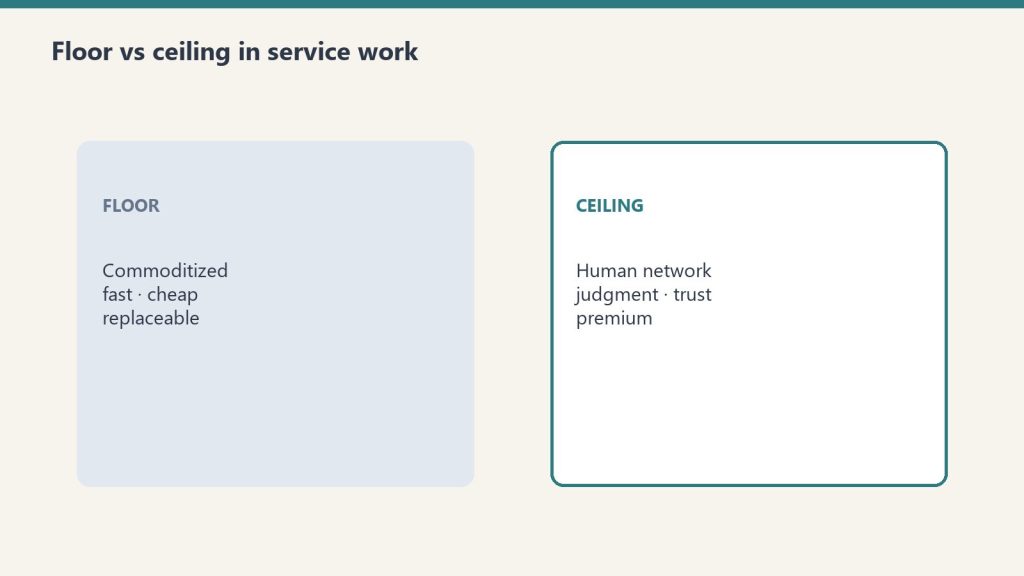
In a traditional operation, growth is gated by the company’s ability to add senior operational capacity. New service lines, new geographies, new account relationships, new program placements all require senior operators with the bandwidth and judgment to execute. Senior operational hiring is slow, expensive, and constrained by labor market availability. The company’s growth rate is essentially capped by its hiring capacity at the senior layer.
In an agent-assisted operation, growth is gated by a different constraint. The company’s existing senior operators can absorb significantly more operational throughput because the routine documentation and review work has been compressed. The constraint shifts from senior labor capacity to the speed at which the company can extend its captured operational standards into new contexts and the speed at which the senior team can review and validate the expanded throughput.
This does not mean growth becomes unconstrained. It means the constraint moves to a layer that the company has more direct control over than the labor market. A company that can extend its prep standard to a new geography can extend its operations to that geography faster than a company that has to hire and train senior operators in the new location. A company that can apply its captured judgment to a new service line can launch that service line faster than a company that has to recruit operators with the requisite experience.
The companies that have begun operating in this mode are growing in ways that competitors cannot easily explain. The growth is not coming from a marketing breakthrough or a particularly successful acquisition. It is coming from a structural change in how senior operational capacity scales.
What this does to margin profile
The clearest economic effect of the shift, at the company level, is the change in the long-run margin profile.
A traditional restoration company has a margin structure dominated by labor cost in the production of operational work. Senior operator time is the largest input on most jobs and the least compressible cost line. Margin improvements at the company level are primarily achieved through volume increases, pricing power, or supply chain optimization. The margin ceiling is structurally constrained.
An agent-assisted restoration company has a margin structure where senior operator time has been redirected from routine production to higher-value work. The senior team is doing more strategic activity per hour worked. The routine work that used to consume their time is being done at a fractional cost. The margin per job improves not because the company is cutting corners but because the per-job cost of producing the operational substrate has dropped.
Over a twenty-four to thirty-six month period, the margin profile of an agent-assisted operation pulls visibly ahead of the margin profile of a traditional operation in the same market. The pull-ahead is gradual but durable. By the time it becomes obvious in the financials, the gap is large enough that catching up requires more than a single-year investment program.
The honest risk picture
The economic shift is not without risk. The companies operating well in this new mode are managing several specific risks that owners considering the transition need to understand.
The first risk is over-reliance on the AI capability. A company that lets the agent handle a function entirely without continued human oversight will eventually experience a quality failure that costs more than all the throughput gains combined. The senior operator review workflow is not optional. The economics work because the human is still in the loop. Companies that try to push the human out of the loop in pursuit of further cost savings learn the lesson the expensive way.
The second risk is the brittleness of the captured judgment. The agent is only as good as the standard it is operating against. As conditions change — new construction styles, new carrier dynamics, new regulatory environments — the standard has to evolve, and the evolution requires continued investment. Companies that build the agent capability and then stop investing in the underlying standard see the agent quality drift over time.
The third risk is vendor concentration. Companies that build their entire operational substrate against a single AI provider’s specific platform are exposed to vendor pricing changes, capability changes, and continuity risk. The companies operating well in this mode tend to keep their captured standards in vendor-neutral form, so that the underlying judgment can be moved to a different runtime if the original vendor relationship deteriorates.
The fourth risk is the team’s relationship with the technology. A senior operator who has been told the AI is going to make their job easier will be disappointed if it makes their job different rather than easier. The framing of the transition with the team has to be honest about what is changing and what is not. Companies that mishandle this framing experience attrition at the senior layer that can wipe out the operational gains entirely, as discussed in the source code piece.
What owners should be doing about this in 2026
If you run a restoration company and you have not yet begun the transition to agent-assisted operations, the practical implication of the economic shift is that the cost of starting now is significantly lower than the cost of starting in eighteen months and the value of starting now is significantly higher.
The cost is lower because the infrastructure is mature, the patterns are documented, and the early-adopter mistakes have been made by other people. A company starting in 2026 can move faster and avoid more pitfalls than a company that started in 2024.
The value is higher because the bid competitiveness, growth capacity, and margin implications of the shift are now beginning to manifest in real markets. A company that begins building the capability now will start producing measurable economic effect within twelve to eighteen months. A company that waits will be entering the work at the same time competitors are starting to convert the capability into market position.
The starting point is the documentation acceleration work described in the previous article. The economic implications described here flow from the operational substrate that documentation work creates. Without the substrate, none of the economics materialize. With the substrate, all of them do.
The owners who recognize this and act on it now will be running a different kind of business in 2028. The owners who do not will be looking at their numbers in 2028 and trying to figure out what changed in the market. What changed will not be the market. What changed will be the cost structure of the companies they are competing against.
Next in this cluster: how to evaluate AI tools without getting fooled — the practical buyer’s framework for cutting through vendor noise and making decisions that hold up over time.
Leave a Reply