This is the first article in the AI in Restoration Operations cluster under The Restoration Operator’s Playbook. The previous cluster, Mitigation-to-Reconstruction Intelligence, sets up why operational discipline is now the central question. This cluster goes deep on what AI actually does inside that operational discipline — and what it cannot do.
The honest state of restoration AI in 2026

Walk any restoration trade show floor in the second half of 2025 or the first half of 2026 and the dominant theme on every booth is some version of artificial intelligence. AI-powered estimating. AI-driven scheduling. AI-augmented documentation. AI for dispatch, for adjuster communication, for moisture analysis, for content management, for drying calculations, for customer experience. Some of it is real. Most of it is rebranding of capabilities that existed two years ago. A small portion of it represents a genuine step change.
The owners walking the floor are presented with all of it as roughly equivalent — booth fronts and presentations make modest features look revolutionary and revolutionary capabilities look modest. What is actually happening underneath is that the industry is in the noisy middle of a real technology transition, and the noise is making it almost impossible for an operator to tell signal from sales pitch.
The honest state of the field is this. The infrastructure layer that makes serious AI deployment possible became a managed service in early 2026. The model capabilities have crossed thresholds in the last twelve months that genuinely matter for operational work. The handful of restoration companies that started building deliberately two or three years ago are now producing visible results. The much larger group that has tried to add AI to their operations through software purchases or pilot programs has, in most cases, very little to show for the money and time spent.
This article is about why that pattern exists. The next four articles in this cluster will be about what to do differently.
Get The Signal
What we actually ran, what it measured, and what it means for a restoration shop — every week, including the flops.
The shape of the failure
Restoration AI failures tend to look the same across companies. Different vendors, different use cases, different team compositions, but the pattern is consistent enough to describe.
The company identifies a problem that AI seems likely to help with. Often it is something high-profile and visible — initial customer intake, scheduling, estimate review, document generation. The company evaluates a few vendors, picks one, signs a contract, and runs an implementation that follows the vendor’s recommended deployment plan. The first ninety days produce a flurry of activity, training sessions, configuration work, and demo wins. The next ninety days produce friction as the tool encounters edge cases, the team discovers it does not handle the company’s actual workflow as cleanly as it handled the demo, and the senior operators start working around it. By month nine, the tool is technically still in use but practically marginal — a few people use a few features, the original sponsor has stopped championing it, and the executive team has quietly moved on to the next initiative.
The line item is still on the budget. The case study gets used in vendor marketing. The operational reality is that nothing has changed, except that the company is now slightly more cynical about AI than it was before the project started.
This pattern is not unique to restoration. It is the dominant pattern in operational AI deployments across most industries, including ones with much larger technology budgets than restoration has. The reasons it happens are predictable, and they are not the reasons the vendor explains in the post-mortem.
The first reason: no captured judgment to deploy
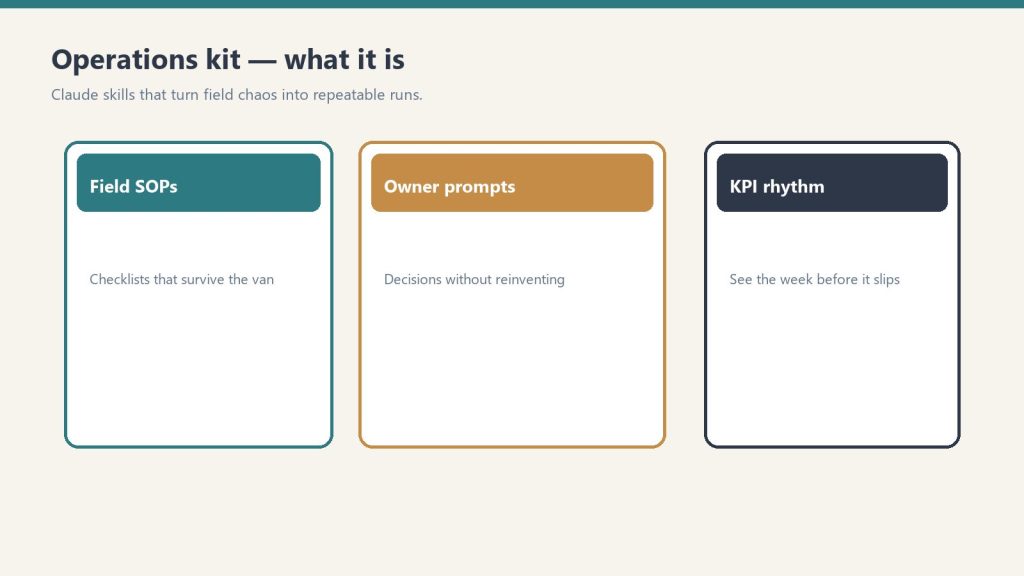
The most common reason restoration AI projects fail is that the company has not done the upstream work that would let any AI system actually contribute. AI tools are extraordinary at applying captured judgment to new situations. They are useless at inventing judgment that was never captured.
The companies that have failed AI deployments almost always failed at this layer. They bought a tool expecting it to encode the operational wisdom of their senior operators automatically, by exposure to data or by some species of magic. The tool, of course, did not do that. What it did was apply generic, internet-trained patterns to specific, restoration-specific situations, producing outputs that were correct in form, plausible in tone, and wrong in operational substance often enough to be unusable.
The senior operators in the company looked at the outputs, recognized them as wrong, and stopped trusting the tool. The tool’s hit rate dropped because the operators were not engaging with it. The vendor pointed at the low engagement as the implementation problem. The implementation team tried to drive engagement through training and mandate. None of it worked, because the underlying issue — the absence of captured judgment for the tool to apply — was never addressed.
This is the reason the prep standard discussion in the previous cluster matters so much for the AI conversation. A documented standard is captured judgment. It is the substrate that any AI system needs in order to produce outputs the senior team will trust. Companies that have invested in documenting their judgment can plug AI tools in and get force multiplication. Companies that have not done the documentation work cannot, regardless of which tool they buy or how much they spend.
This is also why the AI projects that have worked tend to be in companies that built operational documentation discipline first, often without explicitly thinking about AI. The documentation work made the AI work possible. The AI work then made the documentation work pay off in a way the company had not initially anticipated.
The second reason: optimizing the wrong layer
The second most common reason restoration AI projects fail is that they target the wrong operational layer.
The natural inclination of an operator looking at AI is to point it at the most visible, customer-facing problem. The intake conversation. The estimate. The customer email. These are the places where operators feel the pain most acutely, and they are also the places where AI demos look most impressive.
They are also the places where AI is most likely to produce results that range from disappointing to actively damaging. The customer-facing layer is the layer where a small error in tone, judgment, or accuracy is most expensive. It is also the layer where the AI tool has the least context — it does not know the customer, the property, the history, the carrier dynamics, or any of the situational specifics that an experienced operator would bring to the conversation.
The companies producing real results from AI are deploying it almost entirely in the operational middle layers, not the customer-facing top layer or the systems-of-record bottom layer. The middle layers are where the work of running the business happens — file review, scope analysis, scheduling logic, sub coordination, photo organization, documentation packaging, internal handoff briefings, training material generation. These are unglamorous capabilities. They are also the ones where a competent AI tool can demonstrably free up senior operator time and improve the quality of the operational substrate.
An AI tool that drafts a clean handoff briefing from the mitigation file for the rebuild estimator to review in thirty seconds is worth more, operationally, than an AI tool that drafts a customer-facing email. The handoff briefing tool removes thirty minutes of estimator time per job, every day, on every job. The customer email tool removes a small amount of friction on a small subset of communications and introduces a meaningful risk of a tone-deaf message going out under the company’s name. The first tool compounds. The second tool gets shut off after a bad incident.
The companies that have figured this out are not bragging about their AI deployments. They are quietly using AI as connective tissue between operational layers that already worked, and the senior team is feeling the difference in their workload without anyone outside the company necessarily noticing the change.
The third reason: no senior operator in the loop

The third reason restoration AI projects fail is that they are run as IT projects rather than operational projects.
An IT-led deployment optimizes for technical correctness, integration with existing systems, user adoption metrics, and vendor relationship management. None of those are the things that determine whether the tool produces operational value. The thing that determines operational value is whether the tool is producing outputs that a senior operator would have produced, at speed, with the same judgment.
That determination cannot be made by an IT team or by a vendor. It can only be made by the senior operator whose judgment is supposed to be the benchmark. If that operator is not in the loop on a daily or weekly basis, the tool drifts away from useful behavior and toward whatever the vendor’s defaults happen to be. By the time anyone notices, the tool is producing plausible-looking outputs that are not actually useful, and the operational team has stopped relying on them.
The companies that have made AI work have, in every case, embedded a senior operator in the deployment as the operational owner. Not as a sponsor. As the owner. The senior operator reviews the tool’s outputs, flags drift, requests adjustments, and is accountable for whether the tool is actually doing what it was bought to do. The owner’s name is on the project. The owner’s calendar reflects the commitment. When the tool produces a wrong output, the owner is the first to know and the first to drive the correction.
This is uncomfortable for senior operators, who already have full-time jobs running operations and who did not sign up to babysit a software tool. It is also non-negotiable. AI deployments without an embedded senior operational owner do not produce results, in restoration or in any other operational context. The companies pretending otherwise are making the same mistake every other industry made in their first wave of AI adoption.
The fourth reason: the wrong evaluation horizon
The fourth reason restoration AI projects fail is that they are evaluated on a horizon that does not match how AI actually delivers value.
Most AI tools produce a small benefit in their first few weeks of use, because the novelty creates engagement and the early use cases tend to be the simple ones. The benefit then plateaus or even regresses as the team encounters edge cases and the engagement drops. If the company is evaluating the tool at month three, the assessment will look mediocre.
The tools that compound — and AI tools either compound or fade — start to show real value around month six to nine, when the captured judgment from the team’s interaction with the tool starts to inform the tool’s behavior, when the team has built workflow habits around the tool’s strengths, and when the company has developed an internal language for what the tool is for and what it is not for. Companies that evaluate at month three see the plateau and cancel. Companies that commit to a twelve to eighteen month horizon and continue investing in the operator-tool collaboration see the compounding.
This horizon mismatch is one of the reasons most AI line items get killed. It is also one of the reasons the companies that persist past the awkward middle period end up with a meaningful operational advantage that is hard for newer entrants to replicate quickly.
What the few successful deployments have in common
The restoration companies that have produced visible results from AI in 2026 share a small number of characteristics. None of the characteristics are about the specific tools they bought. They are all about how the company approached the work.
The company had operational documentation discipline before they started the AI work. Either an existing prep standard, a structured set of training materials, a documented decision framework, or some equivalent body of captured operational wisdom that could serve as the substrate the AI tool would operate against.
The company targeted operational middle-layer use cases first, not customer-facing top-layer ones. The early wins were in things like file packaging, handoff briefing generation, scope review acceleration, training material drafting, and sub-coordination — boring internal capabilities that compounded into significant senior-operator time recovery.
The company embedded a senior operator as the day-to-day owner of the AI capability. That operator’s calendar reflected the commitment, and their judgment was the benchmark for whether the tool was producing value.
The company committed to a twelve to eighteen month horizon for evaluation, with the understanding that the awkward middle period was structural rather than a sign of failure.
The company invested in the feedback loop between operator and tool. When the tool produced a bad output, that became data that improved the next output. The loop was deliberate, not incidental.
The company avoided the trap of trying to deploy across the whole organization at once. The successful deployments started narrow, proved value in one operational layer, and then expanded based on what was working rather than on a master rollout plan.
None of these characteristics are about technology. They are about operational seriousness applied to technology. The companies that brought operational seriousness to the work got results. The companies that treated AI as a technology purchase did not.
Where this cluster is going
The remaining articles in this cluster will go deep on each of the patterns the successful deployments share. The next article will address the question every owner asks first: given limited time and budget, what should we actually build first? That question has a defensible answer in 2026, and it is not the answer most vendors are pitching.
The article after that will go deep on what it actually means to treat the senior operator as the source code for an AI deployment — not as a metaphor, but as a literal description of where the operational substance of the tool comes from. Then an article on the economics of agent-assisted operations, which is the most underdiscussed topic in restoration AI right now and the one that will determine which companies are still profitable in 2028. And finally an article on how to evaluate AI tools without getting fooled by demos, vendor pitches, or the noise that currently dominates the conversation.
The point of the cluster is not to recommend specific tools. Tools change every quarter. The point is to give restoration owners a durable mental model for thinking about AI deployments — one that will still be useful in 2027 and 2028, regardless of which vendors have come and gone in the meantime. Operators who internalize the model will make consistently better decisions about AI than operators who chase the current vendor cycle. The model is the asset.
Next in this cluster: what to actually build first when you have limited time and budget — and why the obvious answer is almost always wrong.
Get The Signal
What we actually ran, what it measured, and what it means for a restoration shop — every week, including the flops.
Leave a Reply