Last refreshed: October 20, 2026 (Pacific).
The Crown Jewel of Metro Parks Tacoma
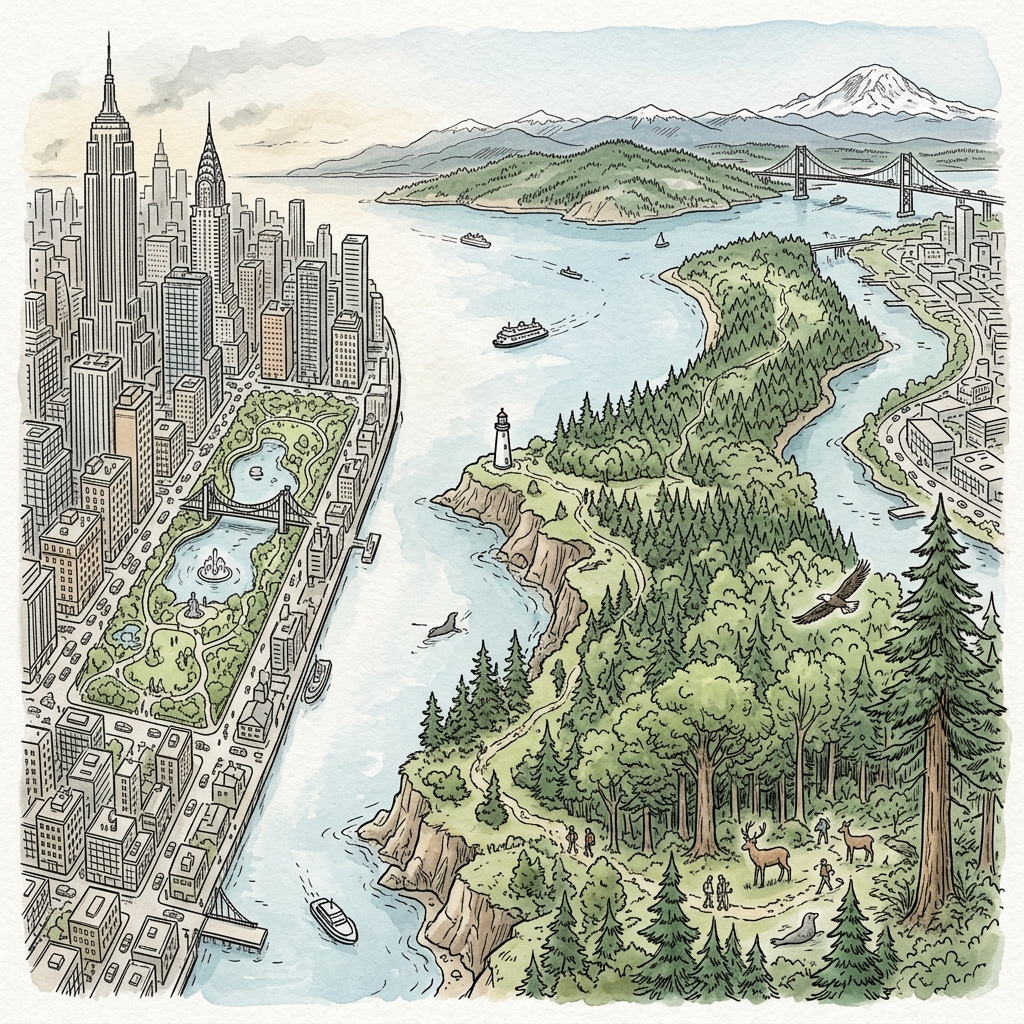
Point Defiance Park isn’t just Tacoma’s biggest park — it’s one of the largest urban parks in the United States at 760 acres, putting it in direct company with New York’s Central Park (843 acres) and San Francisco’s Golden Gate Park (1,017 acres). Managed by Metro Parks Tacoma, this peninsula park juts into the Puget Sound at the northern tip of the city, offering old-growth forest, waterfront beaches, formal gardens, and a zoo — all within a 15-minute drive of downtown.
I’ve lived in Tacoma long enough to stop taking Point Defiance for granted, but visitors from Seattle or Portland are consistently stunned that a park this size exists in a city of 220,000. The combination of dense second-growth and old-growth forest, saltwater shoreline, and maintained trails makes it functionally irreplaceable for Pierce County residents.
Five Mile Drive: The Signature Loop
The park’s most iconic feature is Five Mile Drive, a one-way scenic road that loops the park’s perimeter. Only its inner loop is open to vehicles. The outer loop — the scenic stretch around the point, with pullouts at viewpoints overlooking the Narrows, Vashon Island, and on clear days, the Olympic Mountains — was closed to motorized traffic permanently on May 20, 2022, after a geotechnical report confirmed ongoing bluff erosion and slope instability. The outer loop remains open to cyclists and pedestrians, and every park attraction (the Zoo, Fort Nisqually, Owen Beach, the gardens) is still reachable by car via the inner loop.
Key stops along Five Mile Drive include Owen Beach (the primary swimming and kayak launch beach), the Boathouse Marina, and multiple trailhead parking areas. The road itself was originally built in the 1890s and has been maintained as a scenic drive for over 130 years.
Trail Network: 15+ Miles of Maintained Paths
Point Defiance contains over 15 miles of maintained trails ranging from flat, paved waterfront paths to steep forest switchbacks. The most popular include:
Get The Signal
What we actually ran, what it measured, and what it means for a restoration shop — every week, including the flops.
Spine Trail — Runs the length of the park’s central ridge through old-growth Douglas fir. Relatively flat, well-maintained, about 3.5 miles one way. This is where Tacoma trail runners train before heading to Mount Rainier.
Inside Loop Trail — Follows the interior contour of the park with views of the Narrows Bridge. Moderate difficulty with some elevation change. Approximately 4.2 miles.
Owen Beach to Boathouse Trail — Flat waterfront path, fully paved, accessible. About 1.5 miles along the shoreline with bench seating and beach access points throughout.
Outer Loop Trail — The most challenging option, following the bluffs above the Sound. Some sections have significant drop-offs with cable railings. Views are exceptional on clear days.
Gardens and Botanical Features
The park maintains several formal garden spaces that operate seasonally. The Point Defiance Gardens complex includes a rose garden, dahlia test garden, Japanese garden, native plant garden, and herb garden. Peak season runs May through September, with the dahlia garden typically at its best in August and September. Admission to the gardens is free.
The old-growth forest itself is a botanical feature — several Douglas fir specimens exceed 200 feet in height and are estimated at 400-500 years old. The understory includes native sword fern, salal, Oregon grape, and red huckleberry. Metro Parks maintains an active restoration program removing invasive English ivy and Himalayan blackberry.
Zoo and Aquarium Access
Point Defiance Zoo & Aquarium sits within the park boundaries and is operated by Metro Parks Tacoma. It’s the only combined zoo and aquarium in the Pacific Northwest, with particular strength in Pacific Rim marine life, Asian species, and Pacific Northwest native wildlife. The zoo underwent a major renovation of its Pacific Seas Aquarium in recent years, adding a 35,000-gallon shark habitat.
Admission is separate from the park (which is always free). The zoo draws approximately 700,000 visitors annually, making it one of Pierce County’s highest-traffic attractions. Parking can overflow on summer weekends — locals know to arrive before 10 AM or after 3 PM.
Fort Nisqually Living History Museum
Also within the park boundaries, Fort Nisqually is a reconstructed Hudson’s Bay Company fur trading post from the 1850s. It’s the oldest historically documented European settlement site on Puget Sound. The two original buildings — the granary and factor’s house — are among the oldest surviving wooden structures in Washington State. Small admission fee; open Wednesday through Sunday during peak season.
Practical Information for Visitors
Point Defiance Park is open daily from 30 minutes before sunrise to 30 minutes after sunset. Vehicle access is via the Five Mile Drive inner loop (the outer loop has been closed to cars permanently since May 2022) and follows the same hours. There is no entrance fee for the park itself. Parking is free throughout, with major lots at Owen Beach, the Zoo, the Gardens, and Fort Nisqually.
The park is located at 5400 N Pearl Street, Tacoma, WA 98407. From I-5, take exit 132 (Highway 16 West) and follow signs to Point Defiance. From downtown Tacoma, head north on Pearl Street — the park is at the terminus.
Pierce Transit Route 10 provides bus service to the park entrance.
What Locals Know
Point Defiance is Tacoma’s outdoor living room. Early mornings on the Spine Trail are virtually empty — you’ll share the path with deer and the occasional coyote. The best sunset viewing is from the Narrows viewpoint on the car-free outer loop of Five Mile Drive. Owen Beach fills up by noon on summer weekends, but the boathouse area one mile north rarely reaches capacity.
For trail running, the Spine Trail to Outer Loop combination gives you about 7 miles with 600 feet of elevation gain — legitimate training terrain. Multiple r/Tacoma threads recommend this loop as the best run in Pierce County for the effort-to-scenery ratio.
The park hosts events year-round: the Point Defiance Flower and Garden Festival each June, cross-country running meets, and the Zoo’s seasonal programming. Metro Parks publishes a quarterly events calendar on their website.
Frequently Asked Questions
Is Point Defiance Park free to enter?
Yes. The park itself — including all trails, gardens, beaches, and Five Mile Drive — is completely free with no entrance fee. The Zoo & Aquarium and Fort Nisqually charge separate admission fees.
How does Point Defiance compare in size to Central Park?
Point Defiance Park is 760 acres compared to Central Park’s 843 acres — roughly 90% the size. However, Point Defiance contains significantly more natural forest and undeveloped terrain, with old-growth trees and natural shoreline that Central Park lacks.
Can you swim at Point Defiance Park?
Yes. Owen Beach is the primary swimming area with a gradual sandy entry into the Puget Sound. Water temperatures typically range from 48-55°F in summer. There is no lifeguard on duty — swimming is at your own risk.
Are dogs allowed in Point Defiance Park?
Dogs are allowed on-leash throughout most of the park, including trails and Five Mile Drive. There is a designated off-leash dog park area within the park boundaries. Leashed dogs are welcome at Owen Beach.
What’s the best time to visit Point Defiance Park?
For the fullest experience, visit between June and September when gardens are blooming and all facilities operate on extended hours. For solitude on trails, early mornings year-round or weekday visits during the off-season (October through March) offer near-empty paths. The forest trails remain accessible and beautiful in rain.
Get The Signal
What we actually ran, what it measured, and what it means for a restoration shop — every week, including the flops.
Leave a Reply