Tygart Media Editorial - Tygart Media

Category: Tygart Media Editorial

Tygart Media’s core editorial publication — AI implementation, content strategy, SEO, agency operations, and case studies.

  • Local Newsroom Training: Planning With Claude Cowork

    Local Newsroom Training: Planning With Claude Cowork

    Last refreshed: May 15, 2026

    Running a local newsroom means juggling breaking stories, editorial calendars, community events, and ad sales — with a staff that is usually three people doing the work of ten.

    Claude Cowork does not write your stories for you. But it does something almost as valuable: it shows your small team how to plan coverage like a large newsroom plans coverage. And it does it visibly, in real time, so every person on your team can absorb the thinking — not just follow the assignments.

    The short answer: Claude Cowork decomposes complex tasks into parallel workstreams and shows progress in real time. For local newsrooms, that means your reporter sees how editorial planning works, your ad coordinator sees how content calendars connect to revenue, and your editor sees how to orchestrate coverage across beats without burning out the team.

    The Newsroom Problem Nobody Talks About

    Side-by-side cards defining what Claude Code is and is not
    The newsroom problem nobody talks about.

    Most local news operations do not have a formal planning process. Stories come in from tips, police scanners, city council agendas, and community Facebook groups. The editor (who is often also a reporter, also the photographer, also the social media manager) triages by gut feel and deadline proximity.

    This works until it does not. A big story breaks the same week as three ad-sponsored features are due. Nobody planned for that collision because nobody was looking at the calendar as a system.

    Cowork is not a newsroom tool. But the way it plans work is exactly the skill local news teams need and rarely have time to develop.

    How Cowork Trains Each Newsroom Role

    Three stacked layers: chat UI, tools, agent runtime
    How Cowork trains each newsroom role.

    The Reporter

    Give Cowork a prompt like: “A new mixed-use development just got approved by city council after two years of controversy. Build me a complete coverage plan for the next thirty days.”

    Cowork does not just list story ideas. It builds a plan with tracks: the news track (council vote recap, developer profile, opposition response), the enterprise track (tax impact analysis, traffic study implications, comparable projects in other cities), the community track (affected neighborhood voices, small business impact, public meeting schedule), and the social distribution track (which pieces go on which platforms and when). A reporter watching this unfold sees that coverage planning is not “what should I write” but “what does the audience need to understand, in what order, from which angles.”

    The Editor

    Editors in small newsrooms spend most of their time reacting. Give Cowork a weekly planning scenario: “We have three breaking news items, a school board meeting Tuesday, an ad-sponsored restaurant feature due Friday, two pending FOIA responses, and a community event this weekend we agreed to cover. Build me the editorial plan for the week.”

    Cowork shows the editor what editorial orchestration looks like: which items are time-sensitive and must publish first, which can be batched, where a reporter can double-purpose a trip (cover the school board and grab a quote for the restaurant feature on the same side of town), and where the week has capacity for enterprise work versus where it is wall-to-wall coverage. The editor sees the week as a resource allocation problem — not a reaction queue.

    The Ad Coordinator

    This is the role nobody thinks about for AI training. But give Cowork a task like: “We have four advertisers who each bought sponsored content packages this quarter. Build me a content calendar that integrates their sponsored pieces with our editorial calendar so they complement rather than compete with news coverage.”

    Cowork builds a calendar that interleaves sponsored content with editorial content, avoids running sponsored pieces on heavy news days (where they get buried), spaces advertiser content evenly, and identifies opportunities where a news story and a sponsored piece can reinforce each other naturally. The ad coordinator sees that content scheduling is strategy, not just slotting pieces into empty dates.

    The Real Training Value

    Desk with laptop, checklist notebook, and billing card ready before creating an Anthropic API key
    The real training value.

    Local newsrooms lose institutional knowledge every time someone leaves — and in local news, people leave often. The coverage plans and editorial workflows that Cowork generates are not just useful in the moment. They are training artifacts that show the next hire how the newsroom thinks, not just what it publishes.

    When a new reporter watches Cowork decompose a complex local story into a multi-angle coverage plan, they are absorbing the editorial judgment that used to take years of mentorship to transfer. That does not replace an experienced editor. But it gives every person on the team a shared mental model for how coverage should be planned — and that shared model is what turns a collection of individual contributors into an actual newsroom.

    Related on Tygart Media: Cowork marketing training · Cowork staff training · information density.

    Frequently Asked Questions

    Can Claude Cowork help a small newsroom with editorial planning?

    Yes. Cowork visibly decomposes complex tasks into parallel workstreams. For a newsroom, that means building multi-track coverage plans, editorial calendars, and resource allocation strategies that show every team member how editorial planning works at a systems level.

    Does Cowork write news articles?

    Cowork can handle multi-step knowledge work including research synthesis and document assembly. However, the training value comes from watching how it plans and decomposes work — not from using it as a content generator. The coverage plans it produces are the training tool.

    How is this different from a project management tool?

    Project management tools track tasks after someone creates them. Cowork shows the decomposition process itself — how a complex goal becomes a structured plan. That planning skill is what most local newsroom staff never formally learn.

    What size newsroom benefits most?

    Newsrooms with two to ten staff members benefit most. They are large enough to need coordination but too small to have dedicated planning roles. Cowork fills the gap by making the planning visible so everyone can learn from it.

  • Restoration Team Training: PM Skills via Claude Cowork

    Restoration Team Training: PM Skills via Claude Cowork

    Last refreshed: May 15, 2026

    Every restoration company has the same problem: the estimator thinks one way, the technician works another way, the PM juggles both, and the office admin is the only person who sees the whole picture.

    Claude Cowork — Anthropic’s agentic desktop AI — might be the most unlikely training tool the restoration industry has ever stumbled into. Not because it does restoration work, but because it shows every person on your team exactly how a well-run job should be decomposed, delegated, and managed.

    The short answer: Claude Cowork visibly breaks complex tasks into sub-tasks and delegates them to specialized sub-agents in real time. That process — plan, decompose, delegate, track, adjust — is the exact workflow a restoration project manager needs to master. Watching Cowork do it live is like watching a senior PM narrate their thought process.

    Why Restoration Teams Struggle With Task Decomposition

    Three cards for field SOPs, owner prompts, and KPI rhythm in an operations kit
    Why restoration teams struggle with task decomposition.

    A water damage job is not one job. It is an inspection, a moisture reading, a scope of work, an insurance estimate, a mitigation plan, a materials order, a labor schedule, a documentation trail, a customer communication cadence, and a final walkthrough — all running on overlapping timelines with interdependencies that change when the adjuster moves a number or the homeowner changes their mind.

    Most restoration employees learn this by doing it wrong a few times. The estimator forgets to document something the technician needs. The PM double-books a crew. The admin discovers at invoicing that the scope changed three times and nobody updated the file. The learning curve is expensive — in rework, in customer trust, and in insurance relationships.

    What if there was a way to show every person on the team what good decomposition looks like before they have to learn it through failure?

    How Cowork Maps to Every Role on a Restoration Team

    Side-by-side cards defining what Claude Code is and is not
    How Cowork maps to every role on a restoration team.

    The Estimator

    Give Cowork a prompt like: “A homeowner reports water damage in their finished basement after a sump pump failure. The basement has carpet, drywall, and a home office with electronics. Build me a complete inspection and documentation plan.”

    Watch what happens. Cowork does not respond with a single block of text. It builds a plan: identify affected areas, document moisture readings at specific points, photograph damage progression, catalog affected materials, note potential secondary damage indicators, create the scope of work outline, flag items that need adjuster attention. Each task has a sequence. Each task feeds the next one.

    An estimator watching this process sees — visually, in real time — how a thorough inspection plan is structured. Not as a checklist someone hands them, but as a plan that emerges from thinking about what the downstream consumers of that inspection need.

    The Office Admin

    Admins are often the most underserved role in restoration training. They handle intake calls, schedule crews, manage documentation, track certificate of completions, follow up on invoicing, and keep the CRM updated — and most of their training is “watch Sarah do it for a week.”

    Give Cowork a task like: “A new water damage claim just came in. The homeowner called, insurance info is confirmed, and the estimator is heading out tomorrow. Build me the complete administrative workflow from intake through final invoice.”

    Cowork will decompose this into a multi-track plan: the documentation track (claim number, photos, moisture logs), the communication track (homeowner updates, adjuster correspondence, crew scheduling), the financial track (estimate submission, supplement tracking, invoice preparation), and the compliance track (certificates of completion, lien waivers if applicable). The admin watches these tracks unfold in parallel and sees how their daily tasks connect to the larger job lifecycle.

    The Project Manager

    This is where Cowork shines brightest for restoration. The PM is the lead agent on every job. They are the conductor. And most PMs in restoration were promoted from technician or estimator roles — they know the technical work but were never formally trained in project orchestration.

    Give Cowork a complex scenario: “We have three active water damage jobs, a fire damage mitigation starting Monday, and two reconstruction projects in progress. One of the water jobs just had a scope change from the adjuster. Build me a weekly coordination plan.”

    Cowork will show the PM what a senior operations manager would do: prioritize by urgency and revenue, identify resource conflicts, flag the scope change as a dependency that blocks downstream work, and sequence the week’s actions across all jobs. The PM sees how to think about multiple concurrent projects — not just react to whichever phone rings loudest.

    The Technician

    Technicians often see their work as task execution — set up equipment, monitor readings, tear out materials. What they rarely see is how their documentation feeds the estimator’s supplement, how their moisture readings affect the PM’s timeline, and how their work quality determines whether the final walkthrough results in a sign-off or a callback.

    Give Cowork a mitigation task: “Day 3 of a category 2 water loss in a two-story home. Drying equipment is in place. Build me the technician’s complete daily workflow including documentation, monitoring, communication, and decision points.”

    The technician watches Cowork build out not just the physical tasks but the information tasks — the readings that need to be recorded and where they go, the photos that need to be taken and what they prove, the communication checkpoints with the PM. It connects the dots between doing the work and documenting the work in a way that a training manual never does.

    The Sales Manager

    Restoration sales — whether it is commercial accounts, TPA relationships, or plumber referral networks — involves pipeline management that most salespeople in the industry handle with a spreadsheet and memory. Give Cowork a business development task: “We want to build relationships with property management companies that manage fifty or more residential units within thirty miles. Build me a ninety-day outreach plan.”

    Cowork breaks this into research, qualification, outreach sequences, follow-up cadences, and tracking — the same structured approach a sales operations manager would build. The sales manager sees that prospecting is not just “make calls” but a planned, multi-stage process with measurable milestones.

    The Training Unlock Nobody Expected

    Desk with laptop, checklist notebook, and billing card ready before creating an Anthropic API key
    The training unlock nobody expected.

    Here is what makes this genuinely different from handing someone a training manual or a process document: Cowork shows the thinking, not just the result.

    A process document tells you what steps to follow. Cowork shows you why those steps exist, what depends on what, and how a change in one area cascades through the rest. It shows the conductor at work — not just the sheet music.

    For a restoration company that struggles with inconsistent job quality, scope creep, communication breakdowns between field and office, or PMs who are technically skilled but operationally reactive — Cowork is a training layer that works alongside the people, not instead of them.

    Your technician does not become a project manager by watching Cowork. But they start thinking like one. And that shift in perspective — from task executor to system thinker — is the hardest training outcome to achieve and the most valuable one a restoration company can develop.

    Related on Tygart Media: Cowork for agencies · S500 in the van.

    Frequently Asked Questions

    Can Claude Cowork actually help train restoration employees?

    Yes. Cowork visibly decomposes tasks into sub-tasks, delegates them to sub-agents, and shows progress in real time. That decomposition mirrors exactly how a restoration project manager should plan and track a job. Watching Cowork work through a restoration scenario teaches the planning skill, not just the technical steps.

    Which restoration roles benefit most from watching Cowork?

    Project managers benefit most because Cowork’s lead-agent pattern directly mirrors the PM role. But estimators learn thorough documentation planning, admins see how their workflows connect to the full job lifecycle, technicians understand how their documentation feeds downstream processes, and sales managers see structured pipeline management.

    Does Cowork replace restoration project management software?

    No. Cowork is not a project management tool and does not replace platforms like DASH, Xactimate, or your PSA. It is a thinking tool that shows people how to plan and decompose work. Use it to train the thinking, then apply that thinking inside your existing systems.

    How would a restoration company actually use Cowork for training?

    Run a real restoration scenario through Cowork during a team meeting. Let the team watch it decompose the job, then discuss what it got right, what it missed, and how each person’s role connects to the plan. The plan Cowork generates becomes a discussion artifact — a living training aid rather than a static document.

    Is Claude Cowork available for restoration businesses?

    Claude Cowork is available through the Claude desktop app on Pro, Max, Team, and Enterprise plans. Any restoration company with a subscription can start using it immediately. It runs on Mac and Windows.

    ]+>’,’ ‘,sys.stdin.read()); print(len(text.split()))”
  • Claude Cowork: How to Train Your Staff to Think Better

    Claude Cowork: How to Train Your Staff to Think Better

    Last refreshed: May 15, 2026

    What if the most powerful staff training tool you’ll touch this year is hiding inside an AI app you already pay for?

    There is a quiet productivity feature inside Claude Cowork that almost nobody is talking about. It is accidentally one of the best project management training tools I have ever seen — and once you notice it, you cannot unsee it.

    The short answer: Claude Cowork shows you its plan and progress in real time as it decomposes a task into sub-tasks and delegates them to a team of sub-agents. That visible decomposition — the same skill a great project manager uses every day — turns Cowork into a live training tool for any staff member learning to break down ambiguous work into executable pieces.

    The Difference Between Chat and Cowork

    Side-by-side cards defining what Claude Code is and is not
    The difference between Chat and Cowork.

    When you work with Claude in chat, you hand it a prompt and you get an answer. It is fast, it is useful, and most of the work happens invisibly — somewhere between your question and the response. You do not see the thinking. You do not see the breakdown. You just see the output.

    Cowork is different. When you give Cowork a task, you watch it work. Anthropic’s own documentation confirms this: Cowork shows progress indicators at each step, surfaces its reasoning, and lets you steer mid-task to course-correct or add direction. For complex work, it coordinates multiple sub-agents running in parallel.

    That transparency is the feature. And it is the feature that makes it a training tool.

    The Conductor and the Section Players

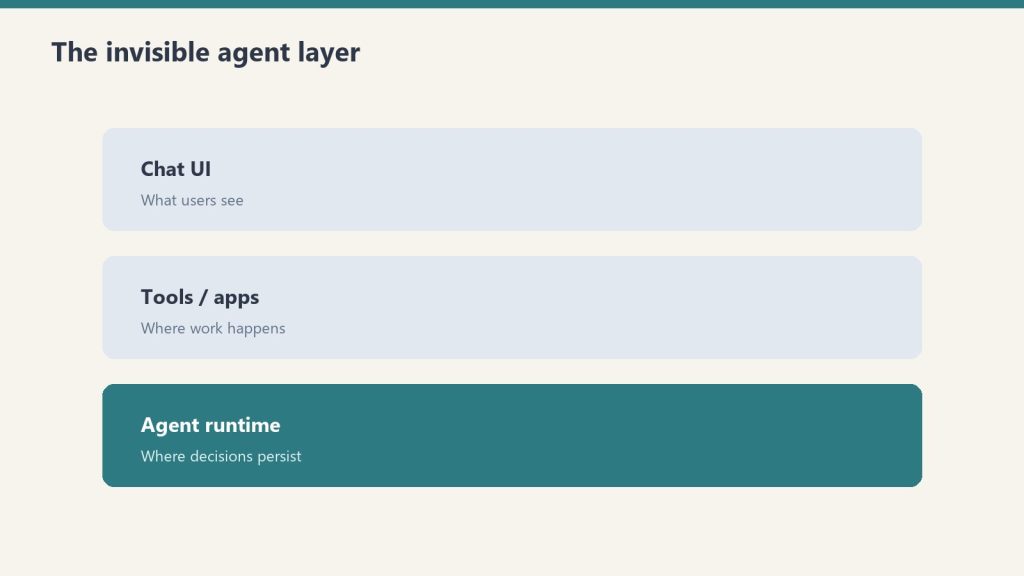
    Three stacked layers: chat UI, tools, agent runtime
    The conductor and the section players.

    Here is what is actually happening under the hood — and this is the part I had to confirm because I had been assuming it.

    Cowork uses the same agentic architecture as Claude Code. A lead agent (the orchestrator) takes the overall task, decomposes it into subtasks, and delegates those subtasks to specialized sub-agents. The lead maintains oversight, handles dependencies, sequences work when one piece depends on another, and synthesizes the final result. Sub-agents work independently in their own context windows and can flag dependencies back to the lead.

    It is a conductor with a section of players. The conductor does not play the violin. The conductor decides when the violins come in, how loud, and for how long.

    This is exactly how a competent project manager operates.

    Why This Matters for Training Your Staff

    Most people — including most project managers I have worked with — struggle with one specific skill: taking a messy, ambiguous goal and breaking it into a sequence of manageable, dependency-aware tasks. It is the difference between “we need to launch the new site” and a project plan with seventeen sequenced items, three parallel workstreams, and clear handoff points.

    Cowork does this decomposition in front of you, in plain English, every time you give it a task. You can literally watch a lead agent think through: what does this goal actually require, what order do the pieces need to go in, what can happen in parallel, what is the dependency chain, and how do I know when we are done?

    For a PM in training, that is a live demonstration of planning. For a staff member who has never had to structure work before, it is a mental model they can borrow.

    The “Oh Yeah, I Forgot About This” Superpower

    The part I love most: you can interrupt Cowork while it is running. You can ask a question. You can add a requirement. You can redirect a visual task. And because there is a lead agent holding the plan, it does not panic — it queues your input and addresses it when appropriate.

    That is exactly how you should be working with human teams. You should not be afraid to say “oh wait, I forgot we also need X” to a project manager. A good PM takes the new input, figures out where it fits in the plan, and slots it in without derailing everything else.

    Watching Cowork do this gracefully is a training moment. It shows people that mid-flight course corrections are normal, that good planning systems absorb new information rather than break from it, and that the conductor’s job is to keep the music going even when the score changes.

    How to Actually Use Cowork to Train a Team

    Desk with laptop, checklist notebook, and billing card ready before creating an Anthropic API key
    How to actually use Cowork to train a team.

    A few things I would try with a team:

    Run a Cowork narration session. Have a new project manager watch Cowork tackle a real task end-to-end and narrate what it is doing and why. Then ask them to plan a real project the same way — out loud, decomposed, with dependencies called out.

    Use Cowork as a planning artifact generator. When someone on your staff hands you a vague goal, run it through Cowork first. Not because Cowork will do the work, but because the plan Cowork produces is a teaching artifact. You can review it together: here is how the task should be broken down, here is the order, here is what runs in parallel.

    Teach delegation by example. When you are training someone to delegate, have them watch how the lead agent assigns work to sub-agents. Narrow scope, clear instructions, defined handoff. That is delegation 101, executed live.

    The Bigger Point

    Tools that hide their thinking make you dependent on them. Tools that show their thinking make you better.

    Chat hides the thinking. Cowork shows the thinking. And the thinking it shows happens to be the exact cognitive skill — structured task decomposition — that separates people who manage projects well from people who drown in them.

    If you are running an agency, a team, or any operation that depends on people learning to break down ambiguous work into executable pieces, Cowork is not just a productivity tool. It is a classroom.

    Related on Tygart Media: Cowork for agencies · Cowork marketing training · Cowork for B2B SaaS.

    Frequently Asked Questions

    What is Claude Cowork?

    Claude Cowork is Anthropic’s agentic desktop application that takes on multi-step knowledge work tasks autonomously. Unlike chat, where you exchange single messages, Cowork accepts a goal, builds a plan, and executes it across files and applications on your computer using the same agentic architecture as Claude Code.

    How is Cowork different from Claude chat?

    Chat responds to one prompt at a time and hides its reasoning between your message and its reply. Cowork takes on full tasks, shows you its plan and progress in real time, and lets you steer mid-task. It also coordinates multiple sub-agents in parallel for complex work.

    Does Claude Cowork actually use multiple agents?

    Yes. For complex tasks, Cowork uses a lead/orchestrator agent that decomposes the work and delegates sub-tasks to specialized sub-agents that run in parallel. The lead handles dependency ordering and synthesizes results when work is complete. This is the same supervisor pattern used in Claude Code’s agent teams feature.

    Can I interrupt Cowork while it is running?

    Yes. You can jump in mid-task to ask questions, add requirements, redirect work, or course-correct. The lead agent queues your input and addresses it at the appropriate point in the plan rather than abandoning what is already in motion.

    How can a manager use Cowork to train staff?

    Use Cowork as a live demonstration of structured task decomposition. Have new project managers narrate what Cowork is doing and why, then plan their own projects the same way. Use the plans Cowork generates as teaching artifacts to discuss task breakdown, dependency mapping, and parallel workstreams. Watch the lead agent’s delegation patterns — narrow scope, clear instructions, defined handoffs — as a model for how humans should delegate.

    Who is Claude Cowork designed for?

    Cowork was built for non-technical knowledge workers — researchers, analysts, operations teams, legal and finance professionals — who work with documents, data, and files daily and want to spend more time on judgment calls and less time on assembly. It is available on Pro, Max, Team, and Enterprise plans through the Claude desktop app.

    Does Cowork work alongside Claude in chat?

    Yes. Chat remains useful for quick questions, single-step tasks, and conversational work. Cowork takes over when the work requires planning, multi-step execution, or coordination across files and applications. The same Claude account uses both modes.

  • Notion Second Brain Setup for AI-Native Agency Owners

    Notion Second Brain Setup for AI-Native Agency Owners

    What Is a Notion Second Brain Setup?
    A Notion Second Brain is a structured personal knowledge operating system — not a template dump, but a living architecture that captures decisions, organizes projects, tracks clients, and gives you (and your AI) persistent operational context. Built right, it becomes the intelligence layer between your brain and your tools.

    Most Notion setups look impressive for three weeks and collapse by month two. The problem isn’t Notion — it’s that generic templates aren’t built around how you actually work.

    We built our own from scratch. It runs a multi-client agency, integrates directly with Claude AI, maintains operational memory across sessions, and has been stress-tested across content operations at scale. We’ve now productized it so you don’t have to rebuild what we already broke and fixed.

    Who This Is For

    Agency owners, fractional executives, solo operators, and founders who are drowning in browser tabs, scattered notes, and tools that don’t talk to each other. If you’re running more than 3 clients or 5 active projects and your “system” is a mix of sticky notes, Slack threads, and half-finished Notion pages — this is for you.

    What the 6-Database Command Center Architecture Delivers

    Four cards for content, ops, build, and knowledge work with Claude
    What the 6-database command center architecture delivers.
    • Command Center Hub — One master dashboard linking every active project, client, and initiative with live status
    • Client & Project Database — Structured client records, deliverable tracking, and project timelines in one view
    • Content Pipeline — Brief-to-publish workflow with status stages, site assignment, and AI output staging
    • Knowledge Lab — Permanent storage for research, SOPs, skill documentation, and reference material
    • Operations Ledger — Decision log, session history, and change records so nothing gets lost
    • Task Triage Board — Priority-ranked action queue pulling from every database in the system

    The claude_delta Standard (What Makes This Different)

    Long paper tape measure unrolling across a desk beside a laptop, metaphor for context window length
    The claude_delta standard — what makes this different.

    Every page in this system includes a claude_delta v1.0 metadata block — a structured JSON header that gives Claude AI immediate operational context when you paste a page into a session. No re-explaining. No re-briefing. Claude reads the block and knows what it’s looking at.

    This is not something you’ll find in an Etsy template. It’s the result of running a real AI-native agency operation and discovering what actually breaks when your context window expires.

    What We Deliver

    Desk with laptop, checklist notebook, and billing card ready before creating an Anthropic API key
    What we deliver.
    ItemIncluded
    Full 6-database architecture setup in your Notion workspace✅
    claude_delta metadata standard applied to all key pages✅
    Claude AI integration guide (how to use your Second Brain in sessions)✅
    3 custom views per database (board, table, calendar)✅
    SOP templates for your top 5 recurring workflows✅
    1-hour architecture walkthrough call✅
    30-day async support for questions and adjustments✅

    What You Get vs. DIY vs. Generic Agency

    Tygart Media SetupDIY (YouTube tutorials)Generic Notion Consultant
    Built around AI-native workflows✅❌❌
    claude_delta AI context standard✅❌❌
    Multi-client agency architecture✅❌Sometimes
    Ongoing async support✅❌Extra cost
    Proven under real operational load✅UnknownUnknown

    Ready to Stop Rebuilding Your System Every 90 Days?

    Send a note describing your current setup (or lack of one) and what you’re trying to manage. We’ll tell you if this is the right fit.

    → will@tygartmedia.com

    Email only. No sales call required. No commitment to reply.

    Related on Tygart Media: second brain setup · second brain for business · Notion OS starter.

    Frequently Asked Questions

    Do I need to already use Notion?

    You need a Notion account (free works for setup, Team plan recommended for ongoing use). No prior Notion experience required — we build it around your workflows, not the other way around.

    How long does setup take?

    The architecture is built within 5 business days. The walkthrough call is scheduled in week two. Adjustments and SOP templates are completed within 30 days.

    What if I already have a Notion setup I’ve been using?

    We can audit your existing structure and either retrofit the 6-database architecture into it or rebuild cleanly. We’ll recommend one or the other after reviewing your current setup.

    Is this just a template I download?

    No. This is a custom build in your workspace. We configure databases, relations, views, formulas, and the claude_delta metadata standard to match your actual operation — clients, projects, workflows, and all.

    What industries is this built for?

    Originally built for a content and SEO agency. The architecture works for any service business running multiple clients, projects, or revenue streams simultaneously. Consultants, fractional CMOs, boutique agencies, and solo operators with complex operations are the best fit.

    Does this work with Claude, ChatGPT, or other AI tools?

    The claude_delta standard was designed for Claude. The architecture works with any AI tool — the metadata blocks and structured content make any LLM more effective when you paste pages into sessions. Claude integration is deepest out of the box.

    Last updated: April 2026

  • Belfair Community AI: A Guide for North Mason Residents

    Belfair Community AI: A Guide for North Mason Residents

    Most people in Belfair have had the same experience at least once. You look something up on Google — what time the post office closes, whether a local restaurant is still open, how long the Hood Canal Bridge closure will last — and the answer is wrong, outdated, or so generic it’s useless. National AI systems are worse: ask one about Belfair and you’ll get something that’s technically about a town in Mason County but couldn’t tell you which road floods first after a hard rain, or what the current shellfish closure status is on Hood Canal, or when the construction on the SR-3 bypass actually starts affecting your drive.

    That problem has a name now: the local knowledge gap. And there’s a community-built answer taking shape right here in North Mason.

    What the Belfair Community AI Layer Is

    The Belfair community AI layer is a purpose-built knowledge base covering the specific, practical, hyperlocal information that national platforms don’t carry accurately. It’s not a general-purpose AI that knows everything about everywhere. It’s an AI that knows Belfair — the way a well-connected longtime resident knows Belfair, not the way a data center in another state optimized for broad audiences knows it.

    Think of it as the difference between asking a neighbor who’s lived on Hood Canal for twenty years and asking a stranger with a smartphone. The neighbor knows that the Hood Canal Bridge closes without public notice for submarine transits from Bangor Naval Base, that SR-3 gets dicey near the bypass corridor after a sustained rain event, that the ferry schedule shifts meaningfully in October, and that the Mason County planning department’s actual turnaround on variance applications is different from what the county website suggests. The stranger with the smartphone has none of that.

    The community AI layer is being built to replicate the neighbor — at scale, and accessible to everyone in North Mason.

    What It Actually Covers

    The knowledge base is structured around the categories that matter most to daily life in Belfair and North Mason:

    Infrastructure and transportation. SR-3 is the artery that connects Belfair to Bremerton, Gorst, and everything north. The SR-3 Freight Corridor New Alignment — the long-planned Belfair Bypass — begins construction in Spring 2026 and is projected to open in 2028. Once built, it will route approximately 25 to 30 percent of the current 18,000-plus daily vehicles around Belfair rather than through it. Until then, the existing corridor through town is the commute. The community AI tracks conditions, construction updates, and closure patterns on SR-3 that don’t make it into Google Maps in useful time.

    Hood Canal ecology and seasonal patterns. Hood Canal shellfish harvesting follows WDFW regulations that change annually and mid-season. Closures can come from biotoxin testing, fecal coliform readings, or enforcement actions — and the information is publicly available but scattered across WDFW and DOH databases that most residents don’t know how to query. The community AI consolidates this. If you want to know whether Potlatch or Twanoh beaches are open before you drive out, that’s the kind of question the knowledge layer can answer. (For the current 2026 shellfish season rules, see our Hood Canal shellfish guide.)

    Local business and institutional knowledge. The gap between a business’s Google listing hours and its actual hours is a running frustration in communities like Belfair, where many small businesses update their website irregularly. The community AI is designed to carry current, verified business information — including which businesses have opened, closed, or changed their model in the last quarter, something no national data provider maintains accurately for a town of Belfair’s size.

    Civic and government processes. How does the Mason County building permit process actually work for a small addition? What does the Belfair Water District cover, and where does it hand off? What’s the current status of the Belfair Urban Growth Area planning process? These are questions that matter enormously to North Mason residents and that no national AI carries accurately. The community layer does.

    Schools and community institutions. North Mason School District bus routes, program calendars, and board decisions. The North Mason Timberland Library’s current service hours during and after its remodel. The North Mason Chamber calendar. The Mary E. Theler Wetlands boardwalk and interpretive programs. The community AI treats these as core knowledge, not footnotes.

    Why It Has to Be Built from Inside

    The reason a community AI layer for Belfair can’t be built from outside is not a technology problem — it’s a relationship problem. The knowledge required to make it genuinely useful lives in people: longtime residents, local business owners, county employees, fishing guides, and school administrators who carry institutional knowledge about this specific place. That knowledge gets shared with people who are part of the community. It doesn’t get shared with a data company optimizing for national scale.

    That’s also why access is designed to be free for North Mason residents. The knowledge came from the community. Charging for access would convert infrastructure into a product — and that would change who benefits from it in ways that undermine the entire premise.

    What This Means for Your Day-to-Day

    In practical terms: less time driving to a business that turned out to be closed, less guesswork about Hood Canal conditions before loading the truck, faster answers to Mason County process questions that currently require multiple phone calls, and a commute resource for the SR-3/Gorst corridor that reflects what’s actually happening on the road this morning. For an overview of the infrastructure vision behind the project, see The Internet That Knows Your Town. For the latest on Gorst and ferry conditions, our SR-3 and ferry update is a good starting point for what the community AI will replace with real-time depth.

    The community AI layer for Belfair is under active development. Monthly workshops are planned at the library and community center once the knowledge base reaches minimum useful coverage. The goal is simple: an AI that knows your town, built by people who live here, free for everyone who calls North Mason home.

    Frequently Asked Questions

    What specific questions can Belfair’s community AI answer that national AI cannot?

    Belfair’s community AI is designed to answer hyperlocal questions that national platforms don’t carry accurately — including current Hood Canal shellfish closure status by specific beach, real-time SR-3 and Gorst corridor conditions, Hood Canal Bridge closure patterns, local business hours verified against actual operating schedules, Mason County permit process specifics, North Mason School District calendars and bus routes, Belfair Water District service boundaries, and current Belfair Urban Growth Area planning status. These questions have no accurate answer in any national AI system.

    Does the Belfair community AI know about the SR-3 Belfair Bypass construction?

    Yes. The SR-3 Freight Corridor New Alignment — the Belfair Bypass — is one of the most significant infrastructure events in North Mason in decades. Construction begins Spring 2026 with an estimated 2028 opening. The 6-mile bypass will route traffic around Belfair rather than through it and is expected to redirect 25 to 30 percent of the approximately 18,000 to 19,000 daily vehicles currently traveling through the Belfair corridor. The community AI tracks construction progress, lane closure schedules, and commute impacts as they develop.

    Will the Belfair community AI know about Hood Canal shellfish closures?

    Yes. Hood Canal shellfish closures are one of the highest-demand local knowledge categories in North Mason. The community AI aggregates information from WDFW and DOH monitoring to give residents current status on specific harvest areas — Potlatch, Twanoh, Belfair State Park tidelands, and other Hood Canal beaches — rather than requiring residents to navigate multiple state agency websites. Closures from biotoxin testing, fecal coliform readings, or enforcement actions will be reflected as quickly as the underlying agency data is updated.

    How does the Belfair community AI stay current?

    The knowledge base is maintained through a combination of structured data feeds from public agencies (WDFW, WSDOT, Mason County), regular verification cycles by community contributors, and monthly workshops at which residents can correct errors and contribute knowledge the system doesn’t yet have. The maintenance model is community-first: local knowledge keepers, not outside data vendors, are the ground truth.

    Is the Belfair community AI free for North Mason residents?

    Yes. Free access for Belfair and Mason County residents is a foundational design commitment, not a promotional offer. The knowledge was built from community relationships and community data. Charging for it would limit access to those who can afford it rather than serving the whole community. Operational costs are covered through a cross-subsidy model in which commercial knowledge verticals — restoration, radon, asset appraisal — built on the same technical infrastructure pay for the community-facing layer.

    How does someone contribute local knowledge to the Belfair AI?

    Monthly workshops are the primary contribution pathway. Held at the North Mason Timberland Library and community venues in Belfair, the workshops teach residents how to use the AI and how to flag errors or add knowledge the system doesn’t yet have. Longtime residents with specific expertise — county process knowledge, Hood Canal ecology, local business history, North Mason School District operations — are particularly valuable contributors. No technical background is required.

    Read the Full Belfair Community AI Series

    This is one of three articles in the Belfair Bugle’s community AI knowledge series. For perspective tailored to your situation:


  • Belfair Community AI: Boost Local Business Visibility

    Belfair Community AI: Boost Local Business Visibility

    If you run a business in Belfair or anywhere in the North Mason area, you’ve probably had the experience of a customer walking in and saying your Google hours are wrong. Or you’ve watched a potential customer drive past because they checked an app that said you were closed. Or you’ve lost a Google review battle to a chain restaurant in Silverdale that has a full-time marketing team updating its listings while you’re running the counter.

    Local AI changes that dynamic — not by handing you a better Yelp listing, but by building a different kind of knowledge infrastructure that actually serves the people who live and work in Belfair.

    The Local Knowledge Problem in Belfair

    National platforms — Google, Yelp, national AI systems — optimize for scale. They work reasonably well for businesses in large markets where there’s enough review volume and enough competitive pressure to keep listings accurate. In a community the size of Belfair, with a CDP population of roughly 4,500 to 5,700 in the broader North Mason area, those systems fail constantly. Business listings go stale. New openings don’t get indexed for months. Closed businesses haunt Google results for years after the doors shut. And the national AI systems that answer “what’s open in Belfair right now” have no reliable way to know.

    The Belfair community AI layer is being built to fix the local layer of that problem. Its knowledge base is maintained by people who are actually in North Mason — who know which businesses opened, which ones changed their model, which ones are closed on Mondays despite what the listing says. That’s different in kind from what any national platform can offer.

    What It Means for Your Business to Be in the System

    When a North Mason resident — or a newcomer, or a military family arriving at PSNS — asks the Belfair community AI “where can I get [category of thing you sell],” you want to be in the answer. That requires being in the knowledge base, with accurate current information: real hours, real services, real contact details.

    Getting into the system isn’t an advertising transaction. It’s a knowledge contribution. Businesses that participate in the community knowledge layer — by making sure their information is accurate, by contributing knowledge about their own products and services that only they have — become more visible through accuracy rather than through paid placement. In a community that distrusts the paid-placement model (and most North Mason residents do, for good reason), that’s a meaningfully different kind of credibility.

    The cross-subsidy model behind the community AI is also relevant for local businesses: the same technical infrastructure that serves North Mason residents for free is used in commercial knowledge verticals — restoration, radon, asset appraisal — that pay for the operational costs. The community layer is free to access and free to be represented in, which means small business visibility isn’t gated behind an advertising budget.

    The SR-3 Bypass and What It Means for Your Customer Base

    One of the most significant changes coming to North Mason commercial life in the next two years is the SR-3 Freight Corridor New Alignment — the Belfair Bypass. Construction begins Spring 2026 with a projected 2028 opening. The bypass will route a significant share of through-traffic around Belfair rather than through it, expected to divert 25 to 30 percent of the current 18,000-plus daily vehicles that currently pass through the Belfair commercial corridor.

    That’s a structural change in traffic patterns that will benefit some businesses and challenge others. Businesses that currently capture passing traffic will see changes. Businesses that serve the residential North Mason community rather than through-traffic will be less affected. The community AI will track and contextualize these changes as construction progresses — giving residents and business owners the current picture rather than the generic “bypass construction is underway” framing that will show up everywhere else.

    For current context on what’s happening with SR-3 infrastructure and local commercial development, see the Belfair Business Beat coverage of SR-3 industrial development and the Belfair Business Pulse on the commercial corridor.

    The Workshop Opportunity

    The community AI is being developed through monthly workshops — planned at the North Mason Timberland Library and community venues once the knowledge base reaches sufficient coverage. For local business owners, these workshops are an opportunity to directly shape how your business is represented in the system, correct outdated information, and contribute knowledge about your sector that only you have.

    A restaurant owner who knows which local farms they source from. A contractor who knows which Mason County permit processes apply to which project types. A fishing guide who knows current conditions on Hood Canal in ways no agency tracks in real time. Each of these is knowledge the community AI wants — and each contributes to a system that benefits every business in North Mason by making the area more navigable for residents and newcomers alike.

    The broader vision for the project is laid out in The Internet That Knows Your Town. The short version for local business owners: community AI built from genuine local relationships serves local businesses in ways national platforms can’t replicate, because it’s optimized for this community rather than for an audience that will never set foot in Belfair.

    Frequently Asked Questions

    How does the Belfair community AI affect local business discovery?

    The Belfair community AI is built to answer the questions North Mason residents actually ask about local businesses — current hours, available services, recent changes in ownership or offerings. Unlike national platforms that update listing data through automated scraping and user reviews, the community layer is maintained by people who are actually in Belfair and know when a business has changed. For small businesses in a community of North Mason’s size, accurate representation in a community-maintained system is more valuable than any paid-placement listing on a platform optimized for larger markets.

    What does the SR-3 Belfair Bypass construction mean for Belfair businesses?

    The SR-3 Freight Corridor New Alignment begins construction in Spring 2026 with a projected 2028 opening. It will route approximately 25 to 30 percent of the current 18,000-plus daily vehicles around Belfair rather than through the commercial corridor. Businesses with high dependence on passing traffic should plan for this transition. Businesses serving the residential North Mason community will be less exposed to the change. The community AI will track construction phases and traffic impact data as they develop, providing context for business owners making planning decisions.

    How can a Belfair business ensure it is represented accurately in the community AI knowledge base?

    The primary pathway is through the community AI workshops, planned monthly at the North Mason Timberland Library once the knowledge base reaches operational coverage. Business owners who attend can verify and update information about their business, contribute sector-specific knowledge that improves the accuracy of the whole system, and build a direct relationship with the knowledge base maintainers. There is no cost to participate and no advertising component — representation is based on accuracy and relevance to North Mason residents, not on paid placement.

    Does the Belfair community AI compete with existing business listing services?

    No. The community AI is infrastructure for the Belfair community, not a commercial directory service. It doesn’t replace Google Business Profile or Yelp listings — it provides a community-specific knowledge layer that national platforms can’t replicate. A business with accurate information in both the community AI and its Google listing is simply more discoverable through more channels. The community AI is specifically valuable for the questions that national platforms can’t answer well: current conditions, seasonal hours, recent changes, and the kind of nuanced local knowledge that only comes from being part of the community.

    What types of local businesses benefit most from the Belfair community knowledge layer?

    Businesses with high relevance to North Mason community life benefit most: local restaurants and food businesses (especially those with seasonal menus or irregular hours), outdoor recreation outfitters and fishing guides operating on Hood Canal, contractors and service businesses navigating Mason County permit processes, local professional services (healthcare, legal, financial), and any business whose customers need to know something specific before they visit — current stock, seasonal availability, appointment requirements. The community AI is most valuable for businesses whose customers are making a local decision that requires more than just a star rating and an address.

    Read more: What Belfair’s Community AI Layer Actually Knows: A North Mason Resident’s Guide

    More from the Belfair Community AI Series


  • AI-Assisted Local Journalism: Exploring Olympic Peninsula

    AI-Assisted Local Journalism: Exploring Olympic Peninsula

    What Exploring Olympic Peninsula Is

    The Olympic Peninsula is enormous. Four counties, hundreds of miles of coastline, a national park, tribal lands, small towns separated by mountain passes and rainforest, and communities that range from Sequim’s sunshine to Forks’ rainfall. Covering all of it — the trails, the restaurants, the events, the local issues, the hidden spots — is a massive undertaking for any publication.

    Exploring Olympic Peninsula was built to try. And we’re using AI to help us do it.

    How AI Helps Us Cover the Peninsula

    We use AI tools to research, organize, and draft content about the Olympic Peninsula. Specifically, AI helps us monitor public sources across four counties, pull together event listings from chambers of commerce and tourism boards, compile trail conditions and park updates, research businesses and attractions, and draft articles that our editorial process then reviews and refines.

    AI lets a small team cover an area that would traditionally require a newsroom spread across Clallam, Jefferson, Grays Harbor, and Mason counties. It’s not a replacement for local knowledge — it’s a multiplier that helps us get to more stories, faster.

    Why We’re Telling You This

    We believe in being transparent about how our content is made. AI-assisted journalism is growing across the industry, and the publications that are honest about it build more trust than the ones that hide it. You deserve to know how the content you’re reading was produced.

    We’ve also learned from our sister publications — Belfair Bugle and Mason County Minute — that transparency about AI use invites the kind of community feedback that makes everything better. When readers know that AI is part of the process, they understand why certain types of errors happen and they’re more willing to help correct them.

    Our Verification Process

    Every article that mentions a specific business, restaurant, hotel, trail, attraction, or physical location on the Olympic Peninsula runs through a Google Maps verification gate before publication. This checks that each named place exists, is currently open, and that the details in our article match the official record.

    This protocol was built after community members on our Mason County publications caught entity errors and pushed us to do better. We took that feedback and made it a permanent part of our process across all our publications, including this one.

    For a region as vast and geographically complex as the Olympic Peninsula — where a road closure can cut off an entire community and a restaurant might be seasonal — this verification step is especially important.

    Where You Come In

    No database captures the Olympic Peninsula the way people who live here do. You know which roads are actually passable in March. You know which restaurants are seasonal. You know the local name for that trailhead that Google Maps calls something different. You know which beach access points are real and which ones exist only on old maps.

    That knowledge is what we need most. If you see something on Exploring Olympic Peninsula that doesn’t match what you know — a business that’s closed, a trail description that’s off, a geographic detail that misses the mark — please tell us. Comment on the post, reach out on social media, or message us directly.

    We’re building this publication for the people who love the Olympic Peninsula. Help us get it right.

  • Mason County Minute: How Community Feedback Improves News

    Mason County Minute: How Community Feedback Improves News

    You Held Us Accountable — And We’re Better For It

    Mason County Minute started as a straightforward idea: build a local publication that actually covers the things happening in Mason County, at the pace they’re happening. Commissioner meetings, school district decisions, shellfish closures, road projects, business openings — the things that matter to people who live here.

    We use AI to help us cover more ground than a small team normally could. That’s not a secret, and it’s not something we’re defensive about. AI lets us monitor public records, organize government meeting data, cross-reference sources, and draft coverage at a pace that would be impossible manually.

    But AI doesn’t know Mason County the way you do. And when it gets something wrong — like placing a town in the wrong geographic context or confusing details about a local landmark — you’ve been telling us about it. Directly, specifically, and helpfully.

    Every one of those corrections landed. Thank you.

    The Specific Changes We Made

    Community feedback didn’t just fix individual errors. It prompted us to build a permanent verification layer into our publishing process.

    Every article that names a specific business, restaurant, park, or physical location in Mason County now runs through a Google Maps verification gate before publication. The system checks that each named place actually exists, is currently operational, and that the name, address, and geographic context match the Google Maps record. If something doesn’t check out, the article is held until a human reviews it.

    We also improved how we handle the tricky geography of this area. Hood Canal, the inlets, the relationship between Shelton and Belfair and Allyn and Union — these aren’t things a general-purpose AI naturally understands well. We’ve built local geographic context into our editorial process specifically because Mason County readers told us when we got it wrong.

    Why Your Feedback Matters More Than You Think

    Here’s what community input does that no technology can replicate: it tells us when something feels wrong to someone who lives here. A detail can be technically accurate on paper but miss the local context that makes it meaningful. When a Mason County resident says “that’s not how people here think about that,” that’s editorial intelligence we can’t get anywhere else.

    So please don’t stop. If you read something on Mason County Minute that doesn’t match what you know, tell us. Post a comment, reach out on Facebook, send us a message — however works for you. We read every piece of feedback, and we act on it.

    Mason County Minute exists to serve this community. The more this community shapes it, the better it gets.

  • Belfair Bugle Feedback: How We’re Improving Local Accuracy

    Belfair Bugle Feedback: How We’re Improving Local Accuracy

    Thank You, North Mason

    When we started building Belfair Bugle, we knew that getting local details right would be the difference between a publication people trust and one they scroll past. We also knew we’d make mistakes along the way — and we asked you to call us on them when we did.

    You did. And we’re grateful for it.

    Over the past several weeks, community members have pointed out geographic errors, questioned business details, and pushed back when something didn’t look right. Every single one of those corrections made Belfair Bugle more accurate. Not just the article that got fixed — the entire system behind it.

    What We’ve Changed

    We want to be transparent about what happened and what we built in response.

    Belfair Bugle uses AI to help research, organize, and draft local content. We’ve been upfront about that from the beginning. AI is a powerful tool for pulling together information from public sources, government records, and local data — but it’s not perfect, especially when it comes to the kind of hyperlocal geographic knowledge that only comes from living here.

    When readers caught errors — like placing Allyn in the wrong geographic context, or mixing up details about local businesses — we didn’t just fix the individual articles. We built a verification protocol that now runs on every single article before it publishes.

    Here’s how it works: every named business, restaurant, park, school, or physical location mentioned in a Belfair Bugle article is now checked against Google Maps data before publication. If a business has closed, it gets removed. If the name or address doesn’t match, it gets corrected. If a place can’t be verified, the article is held until a human reviews it.

    This means that when you read a Belfair Bugle article that mentions a local business or landmark, you can trust that we’ve verified it’s real, it’s open, and the details are accurate as of the day we published.

    Keep Telling Us

    Here’s the thing — no verification system replaces the knowledge that comes from actually living in Belfair, driving SR-3 every day, shopping at the businesses on the commercial corridor, and knowing which Hood Canal beach is which. That knowledge lives in this community, not in a database.

    So please keep giving us input. If you see something wrong — a business name, a location, a detail that doesn’t match what you know — tell us. Comment on the post, reach out on social media, or just flag it however is easiest for you. Every correction makes the next article better for everyone in North Mason.

    We’re a local family building this for our community, and the community’s involvement is what makes it work. Thank you for being part of it.

  • Secondary Content Market: How AI Uses Your Business Data

    Secondary Content Market: How AI Uses Your Business Data

    Content About Your Business Is Being Created Without You

    Right now, somewhere on the internet, a system is writing content that mentions your business. It might be an AI answering a question about your industry. It might be a local publication compiling a roundup of businesses in your area. It might be a travel app generating a recommendation list for visitors to your town. It might be a voice assistant responding to “find me a [your service] near me.”

    This is the secondary content market — the ecosystem of publications, platforms, AI systems, and apps that create derivative content about businesses using whatever structured data they can find. It’s not new, but it’s accelerating. And the quality of what gets created about your business depends entirely on the quality of the data you make available.

    What Gets Pulled and What Gets Missed

    When we build local content for publications like Belfair Bugle and Mason County Minute, we pull from every structured data source available: Google Business Profiles, chamber of commerce directories, official business websites, social media pages, and public records. The businesses that load up their profiles — full menus, current photos, detailed descriptions, accurate hours, complete service lists — make it easy for us to write about them accurately and compellingly.

    The businesses that have a bare GBP listing, no menu, a stock photo, and hours from 2023? We either skip them or qualify everything with hedging language because we can’t verify the details. The same thing happens at scale when AI systems generate content. Rich data gets cited confidently. Sparse data gets ignored or, worse, hallucinated.

    Menus, Photos, and the Data That Feeds the Machine

    Think about what a well-stocked business profile actually provides to the secondary content market. Your menu gives food publications and AI systems specific dishes to recommend. Your photos give travel guides and social platforms visual content to feature. Your service list gives industry roundups specifics to cite. Your business description gives AI systems entities and context to work with.

    Every piece of data you add to your Google Business Profile, your website’s structured data, your social media profiles — all of it feeds into the content supply chain. Publications pull your menu to write about your restaurant. AI systems pull your service list to answer questions about your industry. Travel apps pull your photos to recommend your hotel. The richer your data, the more surface area you have in the secondary content market.

    The Local Angle: Why This Hits Small Businesses Hardest

    Large chains have marketing teams that maintain consistent data across every platform. Local businesses usually don’t. That means the secondary content market disproportionately favors chains over independents — unless the independent makes a deliberate effort to load up their structured data.

    This is particularly true in areas like Mason County and the Olympic Peninsula, where local businesses are the backbone of the community but often have the thinnest digital presence. A family-owned restaurant with an incredible menu but no Google Business Profile menu entry is invisible to every AI system and publication that relies on structured data. A boutique hotel with stunning views but no photos on their GBP is a ghost to travel recommendation engines.

    What To Do About It

    The secondary content market isn’t going away — it’s growing. The actionable response is straightforward: make your business data machine-readable, complete, and current. Start with your Google Business Profile. Fill every field. Upload quality photos. Add your full menu or service catalog. Update your hours. Write a description that includes the terms and entities relevant to your business.

    Then do the same for your website — add structured data (schema markup) so AI systems can parse your content programmatically. Make sure your social media profiles are consistent and current. The goal isn’t to game any one platform. It’s to ensure that when any system anywhere creates content about your business, it has accurate, rich data to work with.

    Your business data is already on the secondary content market. The only question is whether you’ve given it good material to work with.