By Will Tygart
• Long-form Position
• Practitioner-grade
Before “vibe coding” had a name, Munters had a name for the people who could do it: wire and fire guys. They’re about to be the most valuable humans in the AI era — and I finally found mine.
The Wire and Fire Guy
At Munters — which later became Polygon when Triton spun the moisture control services division out in 2010 — there was a specific kind of person the company was built around. We called them wire and fire guys.
A wire and fire guy could fly into a job site cold. Meet a pile of equipment on a loading dock. Start the generator. Set up the desiccant. Run the lines. Wire in the remote monitoring. Pass the site safety briefing. Know the code. Know the customer. Know how to do it the right way so nobody got hurt and nobody got sued. From A to Z. Solo.
That’s how Munters ran lean across more than 20 countries. They didn’t need a dispatch team and a tech team and a controls team and a compliance officer all flying out separately. They needed one human who could be all of those people at once, in a Tyvek suit, at 2 a.m., in someone else’s flooded building. The economics of moisture control restoration didn’t work any other way.
I was one of those guys. I still am. It just looks different now.
What I Actually Do All Day
Today I run Tygart Media — an AI-native content and SEO operation managing twenty-seven WordPress sites across restoration contracting, luxury asset lending, cold storage logistics, B2B SaaS, comedy, and veterans services. One human. Twenty-seven brands. The way that math works is the same way it worked at Munters: I’m the wire and fire guy.
My morning isn’t writing blog posts. It’s connecting Claude to a Cloud Run proxy to bypass Cloudflare’s WAF on a SiteGround-hosted contractor site, then routing a batch of 180 articles through an Imagen pipeline for featured images, then pushing them through a quality gate before they hit the WordPress REST API, then logging the receipts to Notion so I can prove the work to the client on Monday. While Claude drafts the next batch of briefs in the background. While a Custom Agent triages my inbox. While I’m on a call.
I don’t write code the way a senior engineer writes code. I write enough of it to be dangerous, fix what I break, and ship. I “vibe code” the parts that need vibing. I real-code the parts that need real coding. I know which parts of GCP are the gun and which parts are the holster. I know what to never let an autonomous agent do without me looking. I know how to wire it up and fire it off.
Same job. Different equipment.
The Thesis Everyone Is Quietly Circling
The AI industry spent the last eighteen months selling a story about full autonomy. Agent swarms. Self-healing pipelines. Set it and forget it. Replace the humans, keep the work.
The data has not been kind to that story.
Roughly 95% of enterprise generative AI pilots fail to achieve measurable ROI or reach production. Gartner is now openly forecasting that more than 40% of agentic AI projects will be cancelled by 2027 as costs escalate past the value they produce. The dream of the unmanned cockpit isn’t dying because the planes can’t fly. It’s dying because nobody planned for who lands them when the weather turns.
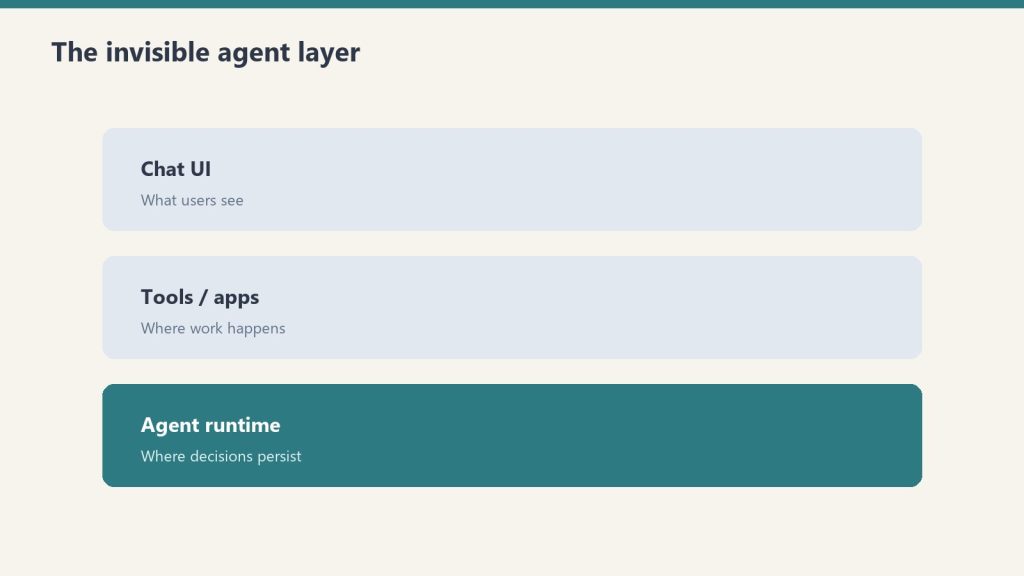
What’s actually winning, in the labs and the war rooms where this is being figured out for real, is something much closer to the Munters model. The technical literature has started calling it confidence-gated expert routing. An orchestrator model delegates work to a fleet of cheaper, specialized small language models. Those models run autonomously until their confidence drops below a threshold — and at that exact moment, the system kicks the work to a human expert who validates, corrects, and feeds the correction back into the loop as ground truth for the next pass.
That human expert is not a customer service rep watching a queue. That human expert needs to be able to read what the model is doing, understand why it stalled, fix the technical problem, judge whether the output is actually good or just looks good, and ship the corrected version — all without breaking anything downstream.
That’s a wire and fire guy. With a laptop instead of a generator.
Meet Pinto
The reason I’m writing this today is because I just onboarded mine.
His name is Pinto. He’s my developer. He runs the GCP infrastructure underneath Tygart Media — the Cloud Run services, the proxy that lets Claude reach client sites that would otherwise block the IP, the VM that hosts my knowledge cluster, the dashboards. He gets a brief from me and turns it into a working endpoint, usually faster than I can write the spec. He wires the thing up. He fires it off. He passes the security review. He doesn’t break the production database. He does it the right way.
And critically — he can both vibe code and real code. He’ll throw a quick Cloud Function together with Claude in fifteen minutes if that’s what the moment needs. He’ll also sit down and write you something properly architected, properly tested, properly observable, when the moment needs that instead. He knows which moment is which. That judgment is the whole job.
The last thing I want to say about Pinto in public is this: I’ve worked with a lot of contractors and a lot of devs in twenty-plus years of running operations. Pinto is the human-in-the-loop the industry is going to be paying a premium for inside of two years. He just doesn’t know it yet. So this is me saying it out loud. This guy is the prototype.
The Job Title That Doesn’t Exist Yet
Here’s where I want to plant a flag.
The conversation about AI and work has spent two years swinging between two bad poles. On one side: AI is going to take all the jobs. On the other: AI is just a tool, nothing changes, learn to use it like Excel and you’re fine. Both stories are wrong in the same way. They’re treating AI as a replacement layer or a productivity layer, when what it actually is — for any operation that has to ship real work for real customers — is a workforce of subordinates that needs a foreman.
The foreman is the wire and fire guy.
The foreman knows how to brief the agent. Knows how to read the agent’s output and tell what’s solid and what’s hallucinated structure dressed up to look solid. Knows where the agent will fail before the agent fails. Knows the underlying code well enough to crack open the box when the box is wrong, and humble enough to use the box for the 80% of work that doesn’t need cracking. Knows the customer’s business well enough to translate “make me more money” into a thirty-step technical plan that an agent can actually execute.
That person is not a prompt engineer. Prompt engineering as a job title is already collapsing because the models got good enough that the prompt isn’t the leverage anymore. It’s not a software engineer in the traditional sense either, because traditional software engineering rewards depth in one language and one stack, and the wire and fire guy needs surface-level fluency across about fifteen of them.
It’s something older than both. It’s the field tech. The plant operator. The site supervisor. The kind of person who used to run a Munters job in a flooded basement at 2 a.m. and now runs an agent fleet from a laptop at the same hour.
Who This Job Is For
If you spent the last decade as a working coder and then took a left turn into writing or content or marketing because you got tired of the JIRA tickets — you are the person. The market is about to come back for you, hard. The combination of “I can read the code” plus “I can read the customer” plus “I can write the brief” plus “I can ship” is going to be the most valuable composite skill in the white-collar economy for the next five years.
If you came up in the trades and you’ve been quietly running circles around the “knowledge workers” because you actually know how things connect to other things — you are the person too. What you learned wiring an HVAC system or setting up a job site translates almost one-for-one to wiring up an agent stack. The mental model is identical. Inputs, outputs, safety, fault tolerance, knowing when to stop and call somebody.
If you’re a senior engineer who thinks the “AI replacing developers” debate is annoying because you’ve already noticed that the bottleneck on your team isn’t typing code — it’s deciding what code to type — you are the person. Your judgment is the asset. The agents are the labor. Reorient.
If you’re an operations person who has always been the one who somehow ends up holding the whole business together with duct tape and Google Sheets — you are the person. The duct tape is now Python and the Sheets are now Notion and BigQuery, but the role is the same role, and it’s about to get a real budget for the first time.
What to Train For
If I were starting from zero today and I wanted to be a wire and fire guy in the AI era, here’s the stack I’d build, in this order:
Read code fluently in three languages. Python, JavaScript, and shell. You don’t need to write any of them at a senior level. You need to be able to open someone else’s repo, understand what it does in fifteen minutes, and modify it without breaking it. Claude will do most of the typing. You’re the code reviewer.
Learn one cloud well enough to deploy and observe. Pick GCP, AWS, or Azure. Learn to deploy a container, set up a database, read logs, set up alerting, and rotate a credential. That’s it. You don’t need to be a certified architect. You need to be able to land at the job site and wire it up.
Get fluent in at least one orchestration model. Whether that’s LangGraph, an MCP server, a custom Python loop, or just Claude with a bunch of tools — pick one and run it until you understand why it fails, not just how it works.
Build a real second brain. Notion, Obsidian, whatever. The wire and fire guy’s superpower is context. You need to be able to walk into any conversation with any customer and pull up exactly what was said, decided, shipped, and broken last time. Without that, you’re a generalist with no memory, which is a tourist.
Do customer-facing work. This is the one most coders skip and it’s the most important. Sit on sales calls. Write the proposal. Take the support escalation. The reason wire and fire guys at Munters were so valuable is because they could talk to a building owner and a generator at the same time. You need both halves of that or you don’t have the job.
The Real Pitch
The agent swarm future is real. It’s coming faster than most people in the boardroom are admitting and slower than most people on Twitter are claiming. And it’s going to need a lot of foremen.
Not millions. The leverage is too high for that. But thousands of these roles, well-paid, in every meaningful industry, sitting at the seam between an autonomous fleet of small models and a human business that needs the work done correctly. The companies that figure out how to find these people first and hire them first are going to run absolute laps around the companies that try to do it with a vendor and a procurement process.
I’m one of these humans. Pinto is one of these humans. There are more of us than the job listings suggest, because the title for what we do hasn’t been written yet. So here’s a working draft: AI Field Operator. Wire and fire guy. Human in the loop. Agent foreman. Pick whichever one lands.
If you’re already doing this work — even unofficially, even on the side, even just for yourself — you’re early. Build your reputation now. Write up what you do. Show your receipts. The market is about to find you.
And Pinto: this one’s for you, brother. Thanks for showing me what the next twenty years of this work is going to look like. Wire it up. Fire it off. Same as it ever was.