The Restoration Operator's Playbook - Tygart Media

Category: The Restoration Operator’s Playbook

Operational intelligence for restoration owners, GMs, and senior PMs. How the industry’s best companies are thinking about AI, talent, mitigation-to-rebuild handoffs, financial discipline, and end-in-mind operations through 2026 and beyond. Published by Tygart Media as industry intelligence — not marketing.

  • Closing Techniques for Restoration Sales: Emergency, Planned, and Commercial

    Closing Techniques for Restoration Sales: Emergency, Planned, and Commercial

    Closing in restoration sales is contextual. The technique that closes a 2am emergency water mitigation call at the kitchen table will not close a planned mold remediation project that involves comparison bids, and neither will close a commercial MSA negotiation. Effective restoration salespeople carry a small toolkit of closing techniques and the judgment to apply the right one to each situation.

    This article is part of our restoration sales playbook.

    The Assumptive Close (Emergency Mitigation)

    The assumptive close is the workhorse for emergency restoration sales. Rather than asking “Do you want to move forward?” — which invites delay — the rep transitions to logistics: “I’ll have the crew here in two hours with equipment. While we’re waiting, let me get this paperwork going so we can bill your insurance directly.” This works because in true emergencies the customer wants the problem solved, and the rep is simply removing friction.

    The assumptive close fails when the customer has not bought into the value yet — using it too early in the conversation triggers resistance.

    The Urgency Close (Time-Sensitive Damage)

    The urgency close uses the actual operational reality of restoration: secondary damage compounds rapidly. “If we wait another 24 hours, we’ll likely need to add demolition to the scope and the cost goes up significantly. Starting now keeps it contained at the current scope.” This works because it is true — restoration genuinely is time-sensitive — and reframes the decision as cost avoidance rather than spending.

    The Alternative Close (Commercial and Planned Work)

    The alternative close offers two acceptable paths rather than a yes/no decision: “Would you prefer we start Monday or next Wednesday?” or “Do you want us to handle the contents pack-out, or would you rather your team manage that piece?” This works because both options are progress; only refusal of the entire framing rejects the close.

    The Summary Close (Comparison Bid Situations)

    When the customer has explicitly mentioned getting other bids, the summary close walks back through everything that was just covered: “Let me make sure I have this right. You need [scope], you want it done by [date], you’re concerned about [issue], and you’re working with [insurance carrier]. Based on that, our scope at [price] covers everything we discussed and we can start [timeline]. Where does that leave us?” The summary creates a clear comparison framework against any competitor and surfaces remaining concerns directly.

    The Trial Close (Throughout the Conversation)

    Trial closes are temperature checks throughout the conversation rather than dedicated closing moves. Examples: “Does this scope match what you were thinking?” or “How does the timeline work for you?” These surface objections early when there is still room to handle them rather than letting concerns accumulate silently.

    The Pilot Close (Commercial New Logo)

    For commercial restoration sales, the pilot close shifts the decision from “do you want to give us all your work” to “would you give us one job to demonstrate our performance.” This dramatically reduces buyer risk and is often the only viable close for prospects without prior experience with the company. Successful pilots almost always lead to expanded relationships.

    When to Walk Away

    Sometimes the right close is no close. Walking away protects margin and reputation when: the customer demands pricing that puts the job below cost, the scope being requested is technically unsound (skipping critical drying or testing), the customer is signaling distrust that cannot be repaired, or the property condition is outside the company’s actual capability. Polite, confident exits (“I don’t think we’re the right fit for this project — best of luck”) preserve relationships for future opportunities.

    Frequently Asked Questions

    What is the most effective close in restoration sales?

    There is no single most effective close — different situations call for different approaches. The assumptive close dominates in emergency mitigation, the urgency close works for time-sensitive damage, the alternative close fits planned work, and the pilot close opens commercial accounts. The judgment to match technique to situation matters more than mastering any single close.

    How do I close without sounding pushy?

    Confidence comes from genuine belief that the recommendation is right for the customer. Salespeople who feel pushy usually do because they are not fully convinced of the value. Spending time deeply understanding the work and outcomes makes confident closing feel natural rather than aggressive.

    Should restoration salespeople create false urgency?

    No. Real urgency exists in most restoration scenarios — secondary damage, mold growth, structural compromise — and using it honestly is appropriate. Inventing urgency that does not exist erodes trust and damages the company’s reputation when the customer figures it out later.

    What do I do when the customer says “send me a quote and I’ll think about it”?

    Resist sending a quote and disappearing. Either close the conversation in person (“Let me walk you through it now while I’m here”), schedule a specific follow-up call within 24 hours, or politely surface the actual concern: “I’m happy to send something — what’s the main thing you’d want to think through?”

    How do I close commercial restoration deals when there is a buying committee?

    Identify the actual decision-maker and the influencers, present to all of them when possible, and propose a pilot engagement to demonstrate performance rather than pushing for an immediate MSA. Most commercial closes happen in stages over months — the goal of any single meeting is to advance to the next stage.


  • SEO for Restoration Companies: The Complete 2026 Playbook

    SEO for Restoration Companies: The Complete 2026 Playbook

    SEO for restoration companies is fundamentally a local search problem with a content moat layered on top. The difference between a restoration company that pulls 20 organic leads a month and one that pulls 200 is rarely talent — it is whether the technical foundation, the local signals, and the content engine are all running at the same time. This guide walks through each layer in the order it should be built.

    This article is part of our broader restoration marketing guide, which covers the full channel mix. Here we focus exclusively on organic search.

    Layer 1: The Technical Foundation

    Technical SEO for a restoration company website is straightforward but unforgiving. The site needs to load in under three seconds on mobile, have a clean URL structure, valid schema markup on every service page, and zero crawl errors. Modern Google does not need much hand-holding on technical issues, but it will quietly demote sites that consistently fail Core Web Vitals or have broken canonical tags.

    The minimum technical checklist for a restoration site includes mobile-first responsive design, HTTPS across every URL, an XML sitemap submitted to Google Search Console, schema markup for LocalBusiness and Service on relevant pages, and structured data for FAQs where they appear. A content delivery network and image optimization to WebP usually handle most speed concerns.

    Layer 2: On-Page SEO

    Restoration service pages are where most ranking battles are won or lost. Each core service — water damage, fire damage, mold remediation, smoke damage, biohazard, contents — needs its own dedicated page, not a list on a single services page. Each page should target a primary keyword in the title tag, H1, and first paragraph, then expand into 1,200-2,000 words of substantive content covering the process, what causes the damage, the insurance process, the company’s certifications, and a strong call to action.

    The most-overlooked on-page lever is internal linking. Service pages should link to relevant blog content, location pages, and case studies. The link graph signals to Google which pages matter most.

    Layer 3: Local SEO and Map Pack Dominance

    Map pack rankings for “[service] [city]” queries drive a substantial share of restoration leads. Three signals matter most: proximity (Google measures distance from the searcher to the business), prominence (review volume, link authority, mentions), and relevance (does the business profile clearly match the query).

    The local SEO checklist starts with a fully optimized Google Business Profile — accurate categories, complete services list, Q&A answered, weekly posts, regular geo-tagged photo uploads, and a steady review cadence with thoughtful responses. Citations across major directories (BBB, Yelp, Angi, HomeAdvisor, Houzz, industry-specific sites) reinforce NAP consistency. Service area businesses should specify their service area carefully rather than listing every city in the region.

    Layer 4: City and Neighborhood Pages

    For restoration companies serving multiple cities, individual city pages are the single highest-leverage SEO investment after the core service pages. A page titled “Water Damage Restoration in [City Name]” with 800-1,500 words of locally relevant content — neighborhoods served, common local water damage causes, local building stock, response times to specific zip codes — will routinely outrank both national franchises and competitors using doorway pages.

    The trap to avoid is templating. Google detects city pages that are 90% identical with only the city name swapped. Each page needs genuinely unique content sections.

    Layer 5: Content Marketing for Authority

    Beyond service and city pages, ongoing blog content builds topical authority. The highest-ROI content topics for restoration companies tend to be insurance process guides (“how does a homeowners insurance water damage claim work”), cause-of-loss explainers (“what causes a Category 3 water loss”), and homeowner education (“what to do in the first 24 hours after a flood”). These pieces capture top-of-funnel search volume and convert through internal linking back to service pages.

    Layer 6: Link Building

    Restoration link building is hard because most of the natural backlink opportunities — directory citations, BBB profiles, association memberships — are easily replicated by competitors. Sustainable link advantages come from local press coverage of community involvement, sponsorships of local events with a website link, partnerships with adjacent service providers (plumbers, real estate firms) that produce mutual link exchanges, and occasionally guest content on restoration industry publications.

    Frequently Asked Questions

    How long does SEO take to work for a restoration company?

    Local map pack movement on long-tail and branded queries often happens within 30-90 days of a serious GBP optimization push. Competitive head terms in major metros usually require 12-18 months of consistent work. The first leads from organic search typically arrive within 90 days for a well-executed program.

    Do I need to write a separate page for every city I serve?

    Yes, if you want to rank for “[service] [city]” queries in those cities. A single services page cannot effectively rank for dozens of city-modified queries. Each meaningful market should have its own dedicated, locally relevant page.

    Is link building still important for restoration SEO?

    Yes, but the bar has lowered for local-intent queries where proximity and reviews carry more weight than backlinks. For competitive head terms and informational content meant to attract top-of-funnel traffic, backlink authority remains a significant ranking factor.

    Should a restoration company use AI to write SEO content?

    AI tools can speed up drafting and outlining but unedited AI content tends to underperform on commercial keywords because it lacks the operator-specific detail Google’s helpful content systems reward. The most effective use is AI-assisted drafting reviewed and rewritten by someone with domain expertise.

    What is the most common SEO mistake restoration companies make?

    Treating SEO as a one-time setup project rather than an ongoing program. Rankings decay without consistent content, citation maintenance, review velocity, and link building. Companies that invest for six months and then stop usually lose most of their gains within a year.


  • Restoration Sales CRM and Pipeline Operations

    Restoration Sales CRM and Pipeline Operations

    Sales operations is the difference between a restoration company that grows on individual heroics and one that grows on system. Without CRM discipline, defined pipeline stages, weekly reporting cadence, and clean handoffs between sales and production, even talented salespeople cannot scale the business. With those systems in place, average salespeople produce above-average results because the operating environment supports them.

    This article is part of our restoration sales playbook.

    CRM Selection

    The CRM landscape for restoration companies splits into general-purpose systems (HubSpot, Pipedrive, Salesforce) and restoration-specific platforms (DASH, Encircle, ServiceTitan, Restoration eAcademy CRM, others). Each has trade-offs.

    General-purpose CRMs offer flexibility and strong sales features but require customization for restoration workflows. Restoration-specific platforms offer pre-built workflows and integrations with Xactimate and accounting systems but often have weaker sales functionality.

    For most restoration companies under $5M, a well-configured general-purpose CRM (HubSpot or Pipedrive) paired with restoration-specific job management software produces better results than trying to make a single tool do both jobs.

    Pipeline Stage Definitions

    Clear pipeline stage definitions make sales reporting useful. A workable residential restoration pipeline structure: New Lead → Appointment Set → Estimate Completed → Authorization Pending → Authorization Signed → In Production → Closed-Won. Each stage needs an explicit definition (what makes a lead “Appointment Set” vs “New Lead”) and an explicit advancement criterion.

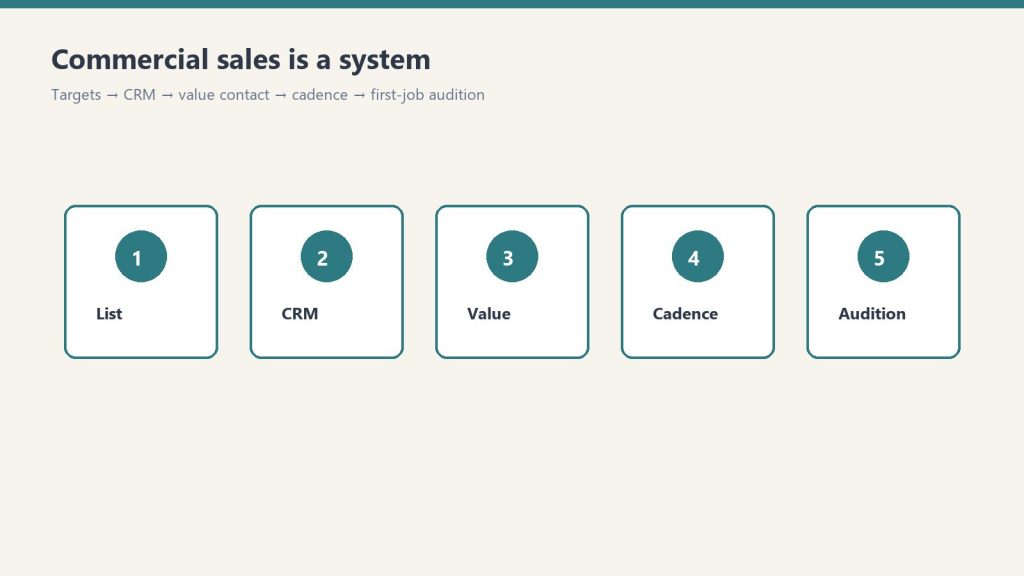
    For commercial restoration, pipeline stages need to be longer-cycle: Suspect → Prospect → Qualified Conversation → Capability Presented → Pilot Discussed → MSA Negotiation → MSA Signed → Account Active. The longer cycle requires more granular stages so management can see where deals are stuck.

    Sales Activity Tracking

    Activity tracking matters because revenue is a lagging indicator. Leading indicators that should be tracked daily or weekly: appointments set, appointments held, estimates delivered, follow-up calls and texts completed, and authorization signatures collected. Reps who are missing revenue targets are usually missing activity targets weeks earlier — fixing the activity issue is faster than waiting for revenue to recover.

    Lead Source Attribution

    Every lead in the CRM needs a clean source field — Google Ads, LSA, organic, referral (with sub-source), lead vendor (with vendor name), repeat customer, etc. Without clean attribution, marketing budget allocation is guessing. The most common CRM hygiene failure is sloppy lead source data, which makes ROI analysis impossible.

    Weekly Sales Reporting

    The weekly sales report that drives behavior includes: leads received and lead-to-appointment conversion, appointments held and appointment-to-estimate conversion, estimates delivered and estimate-to-close rate, average ticket size by rep and by lead source, and pipeline value by stage with weighted forecast. The report should be reviewed by the sales team together every week, not buried in an email.

    Sales-to-Production Handoff

    The handoff from sales to production is where many restoration companies leak quality. Clean handoff requires standardized scope documentation, customer expectations clearly captured (timeline, communication preferences, special concerns), insurance information complete, and a defined moment when ownership transfers from sales to production with explicit acknowledgement from both sides.

    Sloppy handoffs produce production surprises, customer complaints, and over-budget jobs. Sales should be partially accountable for production outcomes through compensation structure to align incentives.

    Frequently Asked Questions

    What CRM do most restoration companies use?

    The CRM mix in restoration is fragmented. Common choices include HubSpot, Pipedrive, ServiceTitan, DASH, Encircle, and various restoration-specific platforms. There is no dominant industry standard. The right choice depends on company size, technical sophistication, and existing tool stack.

    How often should sales pipeline be updated in the CRM?

    Pipeline data should be updated daily by reps and reviewed weekly in management meetings. CRM data that is updated less than weekly produces unreliable forecasting and obscures emerging issues until they become critical.

    Should restoration sales reps own data entry or have admin support?

    Most restoration sales operations run more efficiently when reps own their own data entry, supported by mobile-friendly CRM tools that reduce friction. Outsourcing data entry to admin staff creates lag, errors, and accountability gaps. The exception: lead intake admins handling inbound calls and routing.

    What sales metrics matter most for restoration?

    The leading indicators that matter most are appointment-to-estimate conversion, estimate-to-close rate, average ticket, and lead source ROI. Lagging indicators like total revenue and gross profit by rep matter for compensation and forecasting but rarely surface fixable issues in time to course-correct.

    How do I get my sales team to actually use the CRM?

    CRM adoption is driven by three things: tools that are mobile-friendly and fast (no clunky desktop-only systems), management cadence that uses CRM data in every weekly meeting (so reps know it matters), and compensation tied to deals that exist in the CRM (no CRM record, no commission credit). Without all three, adoption stays low.


  • Restoration Google Ads: How Profitable Operators Run PPC

    Restoration Google Ads: How Profitable Operators Run PPC

    Google Ads is the channel where most restoration companies either build or lose their marketing program. Run well, paid search produces a predictable flow of high-intent water damage and fire damage leads at a cost per acquisition that supports the unit economics of the business. Run poorly, it incinerates marketing budget faster than any other channel in the stack. The difference is rarely talent — it is structure, discipline, and tracking.

    This article covers the operational mechanics of running Google Ads for a restoration company. For the broader marketing context, see our restoration marketing guide.

    Why Restoration Google Ads Are Hard

    Two structural challenges make restoration PPC tougher than most home service categories. First, click costs on emergency restoration keywords are among the highest in Google Ads — competitive metros routinely see cost per click in the double digits for terms like “water damage restoration” and “emergency flood cleanup.” Second, lead quality varies wildly. A “water damage” search at 2pm on a Tuesday is often a homeowner researching options, while the same search at 11pm during a storm is almost always a real emergency.

    Profitable restoration PPC requires architecture that separates these intents and bids accordingly.

    Campaign Architecture That Works

    The structure that consistently outperforms in restoration accounts uses tightly themed campaigns split by service line and intent stage. A typical structure might include: emergency water damage (highest bids, call-only ads, after-hours dayparting), planned water mitigation (lower bids, form fills acceptable), fire damage, mold remediation, biohazard, contents and pack-out, and reconstruction.

    Within each campaign, single-keyword ad groups (SKAGs) or tightly themed ad groups outperform broad themed groups in this category because of how varied the search query intent is. “Burst pipe water damage” and “ceiling water stain” deserve different ads.

    Bidding and Budget Strategy

    Restoration Google Ads accounts typically perform best on either Maximize Conversions with a target CPA cap or Manual CPC with portfolio bidding. Smart Bidding strategies need 30-50 conversions per month per campaign to learn effectively, which most restoration accounts do not have at the campaign level. Pooling conversions through a portfolio bid strategy across related campaigns is one workaround.

    Budget should be concentrated rather than spread thin. A restoration company spending $3,000 per month on Google Ads will almost always get better results from a single campaign focused on the highest-intent emergency terms than from spreading $300 across ten different services.

    Ad Copy That Converts Restoration Leads

    The highest-converting restoration ad copy emphasizes three things in this order: response time (“On-site in 60 minutes”), credibility (IICRC certified, BBB rated, years in business), and risk reversal (free estimates, work directly with insurance, 24/7 availability). Generic “water damage experts” copy underperforms specific, operational claims.

    Call-only ads on emergency keywords often outperform standard text ads with a website destination, because the customer wants to call now, not browse a site. After-hours dayparting that switches all campaigns to call-only between 6pm and 7am captures emergency demand efficiently.

    Geo-Targeting Discipline

    Sloppy geo-targeting is the most common reason restoration accounts hemorrhage budget. The default radius targeting setting in Google Ads is too generous for most restoration businesses. Tighter zip-code-level or hyperlocal radius targeting around the actual service area, combined with location bid adjustments that bid up on high-value zip codes and bid down on low-value ones, often cuts cost per lead by 30-50%.

    Call Tracking and Conversion Setup

    Restoration leads come in primarily by phone, and Google Ads accounts that do not import call conversions are flying blind. Every account needs Google Forwarding numbers configured, call extensions enabled, and call conversions imported into the bidding algorithm. Pairing this with a third-party call tracking platform (CallRail, CTM, or WhatConverts) for call recording and lead scoring closes the attribution loop.

    Negative Keywords: The Hidden Performance Lever

    The single most effective ongoing optimization in restoration accounts is aggressive negative keyword work. Common waste sources include “DIY,” “free,” “how to,” “training,” “course,” “jobs,” competitor brand names (unless deliberately bidding on them), and product searches like “water damage paint.” A mature restoration account typically has a negative keyword list in the thousands.

    Frequently Asked Questions

    What is a good cost per lead for restoration Google Ads?

    Cost per lead varies enormously by metro, service line, and lead quality definition. Emergency water damage leads in major metros often run between $80 and $250, while less competitive markets and services can come in well below that. Cost per acquisition for a closed job is the more important number to track.

    Should I bid on competitor brand names?

    Bidding on competitors can be profitable if the competitor brand has high search volume and your offer is genuinely competitive, but it tends to invite reciprocal bidding and increases costs across the category. Most restoration companies get better ROI from defending their own brand terms aggressively than from attacking competitors.

    Do Performance Max campaigns work for restoration?

    Performance Max can work for restoration companies with mature conversion data and strong creative assets, but it generally underperforms tightly structured Search campaigns for emergency-intent restoration queries because it gives up control of placement and audience targeting.

    How do I keep Google Ads from running during business off-hours when no one can answer?

    Use ad scheduling to either pause campaigns or significantly reduce bids during hours when no one can answer the phone. Even better, set up after-hours call routing so that emergency calls reach an answering service or on-call technician, since most restoration revenue happens outside 9-to-5.

    How long should I run a Google Ads test before deciding it works?

    Restoration Google Ads campaigns generally need at least 30-60 days of meaningful spend to produce statistically reliable performance data. Killing a campaign after two weeks of poor performance is a common mistake that prevents accounts from finding their winners.


  • Restoration Local Service Ads (LSAs): The Operator’s Guide

    Restoration Local Service Ads (LSAs): The Operator’s Guide

    Google Local Service Ads have quietly become one of the most important lead sources for water damage and restoration companies in nearly every major metro. They appear above traditional paid search results, carry the Google Guaranteed badge, and bill on a per-lead basis rather than per-click — which fundamentally changes the unit economics. For restoration operators willing to clear the verification process, LSAs typically produce a lower cost per qualified lead than any other paid channel.

    This guide is part of our broader restoration marketing series and pairs with our deeper Google Ads guide.

    What LSAs Are and Why They Matter

    Local Service Ads are pay-per-lead listings shown at the very top of Google’s search results for service-related queries. They display a business name, rating, location, and Google Guaranteed badge. Customers tap to call directly. The advertiser pays only when a qualifying lead arrives, not for clicks. For restoration, where intent is overwhelmingly bottom-funnel, this model aligns better with operator economics than CPC.

    The Google Guaranteed program adds a customer protection layer. If a job goes wrong, Google will reimburse the customer up to a stated cap. This builds trust with cold homeowners and improves close rates on inbound LSA calls compared to standard search ads.

    Getting Verified: The Real Barrier

    The friction in LSAs is the verification process. Restoration businesses must pass background checks for owners and field staff, provide proof of business license, supply current general liability and workers compensation insurance, and verify business identity. The process commonly takes 2-6 weeks. Most competitors never complete it. That barrier is exactly why LSAs work — limited supply of verified businesses keeps cost per lead down.

    Categories That Apply to Restoration

    The most relevant LSA categories for restoration companies include water damage services, fire damage restoration, mold remediation, and reconstruction. Selecting the right categories — and limiting them to services the company actually performs and wants to grow — controls lead mix.

    Bidding Modes

    LSAs offer two bidding approaches: Max Per Lead (manual control over what you pay per lead) and Maximize Leads (Google optimizes spend within a weekly budget). Most restoration accounts get better results from Max Per Lead bidding combined with active monitoring, because Maximize Leads tends to chase volume at the expense of lead quality during the early months when there is not enough data for the algorithm to learn.

    The Lead Dispute System

    The lead dispute process is the single most underused lever in LSA management. Google credits leads that meet specific criteria for being unqualified — wrong service, outside service area, spam, customer never responded, or duplicate. A disciplined operator who disputes every legitimately bad lead can recover 10-25% of monthly LSA spend. Most companies never bother and simply pay for the noise.

    Disputes must be filed within a specific window (currently within 30 days of the lead) and require clear documentation of why the lead did not qualify.

    Reviews: The Ranking Lever

    LSA placement within the listing carousel is heavily influenced by Google review volume and rating. Companies with 100+ reviews and a 4.7+ rating consistently outrank lower-volume competitors even when bidding less. Review velocity matters as well — a steady stream of new reviews signals an active business.

    Lead Quality and What to Expect

    LSA leads tend to skew slightly lower-intent than Google Ads call extensions because the LSA system promises a callback, which lowers the barrier to inquire. Restoration companies should expect close rates on LSA leads in a different range than direct emergency calls — calibrating sales process accordingly is part of running the channel well.

    LSAs vs. Google Ads: Which Comes First?

    For restoration companies starting paid search, the sequencing question matters. The conventional answer for most metros: GBP optimization first (free), then LSAs (lower CAC and high signal value once verified), then Google Ads (more control, more scale, but higher cost per lead). Mature accounts run all three simultaneously and use Google Ads to capture the search inventory LSAs do not reach.

    Frequently Asked Questions

    How much do Local Service Ads cost for restoration companies?

    LSA cost per lead for restoration varies significantly by metro and category but typically ranges from roughly $30-$150 per lead, with major metros and water damage categories at the higher end. Because pricing is per-lead, the more meaningful number is cost per closed job.

    How long does Google Guaranteed verification take?

    Most restoration businesses complete verification in 2-6 weeks, though delays from background check vendors can push that longer. Having all license, insurance, and ownership documents ready before applying speeds the process considerably.

    Can I run LSAs and Google Ads at the same time?

    Yes, and most established restoration companies do. The two channels complement each other — LSAs capture top-of-page visibility for verified businesses while Google Ads provide more control over keyword targeting, ad copy, and audience. Running both expands total addressable inventory.

    Why are some of my LSA leads unqualified?

    Some unqualified lead volume is structural to any pay-per-lead channel. The remedy is not to abandon LSAs but to dispute every legitimately bad lead, refine service area and category settings, and build a phone process that disqualifies non-fits quickly without burning calls.

    Do LSAs work for commercial restoration?

    LSAs are primarily a residential lead channel. Commercial water damage and fire damage leads do come through LSAs occasionally but the volume is small. Commercial restoration marketing relies more heavily on relationships, MSAs, and account-based outreach than on consumer search ads.


  • Restoration Content Marketing: Building an Authority Engine

    Restoration Content Marketing: Building an Authority Engine

    Content marketing in the restoration industry is widely misunderstood. Most restoration companies that try it produce a dozen generic blog posts, see no leads, and quit. The companies that succeed treat content as a system — a steady cadence of pieces designed to capture specific search demand, build topical authority, and feed every other channel in the marketing stack.

    This article is part of our restoration marketing guide and focuses on the content layer specifically.

    Why Content Marketing Works for Restoration

    Three dynamics make content marketing especially powerful for restoration companies. First, the customer base is information-hungry — homeowners dealing with water damage, fire, or mold are actively researching what to do, what to expect, and how insurance works. Second, the competitive content set is weak. Most restoration company blogs are abandoned or filled with low-effort posts written by SEO vendors who have never set foot in a damaged building. Third, the search demand is durable — questions about smoke damage cleanup or insurance claim processes do not go out of style.

    A restoration company that publishes 4-8 substantive, operator-informed pieces per month will generally outrank franchise giants on long-tail informational queries within 12-18 months.

    The Three Content Types That Drive Restoration Leads

    1. Insurance and Claims Process Content

    Homeowners search constantly for help understanding water damage claims, smoke damage adjusting, mold coverage exclusions, depreciation, and supplements. Content that explains these processes clearly — written by people who actually deal with adjusters — captures high-intent traffic and converts well because the reader is in the middle of an active loss.

    2. Cause-of-Loss and Process Education

    Articles explaining the difference between Category 1, 2, and 3 water losses, how mold actually grows behind drywall, what soot does to electronics, and how dehumidification works build topical authority and earn backlinks from other industry publications. These pieces also answer the questions adjusters and homeowners ask in person.

    3. Localized Educational Content

    Pieces tied to specific local conditions — “Common causes of basement flooding in [metro],” “What to do when a pipe freezes in [city]” — combine search demand with local relevance. They support map pack rankings and give city service pages something useful to internally link to.

    Formats That Convert

    Long-form written articles in the 1,200-2,500 word range remain the workhorse format for restoration content marketing. Video pieces — particularly walkthrough videos of actual job sites or process explanations — perform well on YouTube and embed naturally into blog posts. Downloadable PDFs (insurance claim checklists, water damage timelines) work well as lead magnets but should not be the primary content investment.

    The format that almost never works for restoration: short-form blog posts under 600 words. They neither rank nor convert.

    Cadence and Production

    The minimum viable content cadence for a restoration company serious about organic growth is one substantive article per week. Below that, the compounding effect does not materialize. Above 8 pieces per month, quality usually starts to slip unless the operator has invested in either a full-time writer or a specialist agency.

    The production model that works best for most restoration companies is a domain-expert interview process — a writer interviews the owner, a senior project manager, or a lead estimator for 30-45 minutes per piece, then drafts the article from the transcript. This captures the operational nuance that AI-only or vendor-only content lacks.

    Distribution Beyond the Blog

    Content that lives only on a company blog leaves most of its value on the table. The same article should be repurposed into LinkedIn posts for B2B reach, short videos for social, email newsletter sends to the past customer and adjuster lists, and citations in proposals and email signatures. A piece that takes 6 hours to produce should generate 30+ derivative assets.

    Measuring Content Performance

    The leading indicators for restoration content marketing are organic sessions per piece, average position for target keyword, internal link clicks to service pages, and email captures. The lagging indicator that actually matters is closed jobs attributable to organic content — measured through clean attribution from first-touch organic visit through to revenue in the CRM.

    Frequently Asked Questions

    How long does content marketing take to produce restoration leads?

    The first organic leads from a serious content program typically begin to arrive within 4-6 months, with meaningful volume in the 9-12 month window. The compounding effect — where the body of work begins generating significant traffic and leads without much new investment — usually takes 18-24 months to materialize.

    Can AI write restoration content?

    AI tools can help with drafting and outlining, but unedited AI content tends to underperform on commercial restoration topics because it lacks the operator-specific detail that distinguishes useful content from filler. The best workflow uses AI to accelerate writing then has a domain expert revise heavily.

    How much does restoration content marketing cost?

    A serious in-house content program typically runs $4,000-$15,000 per month depending on cadence, formats, and whether video is included. Specialist restoration content agencies generally fall in a similar range. The cheapest viable approach — owner-written content one hour per week — works for some operators but rarely produces enough volume to compound.

    Should I gate my content behind email capture?

    For most restoration companies, gating high-intent informational content hurts more than it helps because it suppresses organic traffic and rankings. Reserve gating for genuinely valuable downloadable resources where the email is worth the friction.

    What topics should a restoration company never write about?

    Generic SEO filler — “10 tips for choosing a contractor,” “what is water damage” — rarely ranks or converts. Topics outside the company’s actual service offering also waste effort. Stick to questions actual customers and adjusters ask, written from genuine operational expertise.


  • Restoration Social Media Marketing: What Actually Works

    Restoration Social Media Marketing: What Actually Works

    Social media is the channel where restoration company marketing budgets go to die unless someone is paying attention. The platforms reward consistency more than creativity, the algorithms change quarterly, and the gap between social activity and closed jobs is harder to measure than search or LSAs. But for the operators who get it right, social produces meaningful brand lift, recruiting wins, B2B reach, and a steady drip of residential leads.

    This guide walks through which platforms matter for restoration, what to post, and how social fits into the rest of the marketing stack. For the broader strategic context, see our restoration marketing guide.

    Why Most Restoration Social Fails

    The typical restoration company social account posts before-and-after job photos with a generic caption two or three times a week, then wonders why it does not produce leads. The failure mode is consistent: posting without strategy, no platform-specific content, no paid amplification, and no measurement loop. Social can absolutely work for restoration — but only when the operator commits to a real production cadence, picks the right platforms, and treats it as a system rather than an afterthought.

    Platform-by-Platform Fit

    Facebook

    Facebook remains the most useful platform for residential restoration in most markets. Local community group engagement, Facebook Marketplace presence, and paid Facebook Ads targeting homeowners by geography are the three highest-leverage uses. Organic reach on a business page is essentially zero — paid amplification is required for the platform to matter.

    Instagram

    Instagram works well for restoration brand building, recruiting, and adjacent-service partnerships (real estate agents, designers, plumbers). Reels showing job site work, time-lapses of dry-out setups, and process explainers tend to outperform polished promotional content. Instagram is rarely a direct lead source for restoration but matters for credibility when prospects search for the company.

    LinkedIn

    LinkedIn is the highest-ROI social platform for commercial restoration and B2B business development. Property managers, facility managers, risk managers, brokers, and TPA contacts all spend meaningful time on LinkedIn. A consistent posting cadence from the owner or commercial sales lead, combined with targeted outreach to local property management firms, produces real pipeline. Most restoration companies dramatically underinvest here.

    YouTube

    YouTube works as a long-tail SEO and authority channel rather than a daily-engagement platform. Videos demonstrating the dry-out process, walking through fire damage cleanup, or explaining insurance claims rank for years and embed into blog content. The production bar is higher than other platforms but the asset life is much longer.

    TikTok

    TikTok produces wildly variable results for restoration. A small number of restoration companies have built large followings with raw job-site footage and educational content. Most accounts gain little traction. Worth experimenting with if the operator already produces video content for other platforms — not worth a dedicated investment otherwise.

    Content Types That Perform

    Across platforms, certain content types consistently outperform others for restoration companies: time-lapse job site videos, before-and-after walk-throughs with voiceover explaining the process, “what happens in the first 24 hours” educational pieces, owner or technician POV videos explaining a specific aspect of the work, and customer testimonials filmed at the completed job site. Pure promotional content (logo graphics, holiday greetings, generic safety reminders) generally underperforms.

    Paid Social for Restoration

    Paid social is where restoration social marketing actually produces measurable results. Facebook and Instagram Ads targeting homeowners in specific zip codes with video creative around water damage prevention or what to do during a storm produce both top-of-funnel awareness and direct lead form fills. LinkedIn Ads targeting facility manager and property manager titles in specific metros work for commercial pipeline.

    The budget threshold for paid social to matter is generally $1,500-$3,000 per month per platform. Below that, frequency is too low to generate meaningful results.

    Recruiting Through Social

    Often overlooked: social media is one of the most effective recruiting channels for restoration technicians and project managers. Content showing crew culture, training programs, equipment, and career paths attracts the labor pool that restoration companies struggle to recruit through traditional channels.

    Measurement and Attribution

    Social attribution is harder than search but not impossible. UTM-tagged links, dedicated landing pages for paid social campaigns, and post-call lead source questions all help. The most useful question is not “how many leads did social generate” but “what role does social play in our overall marketing mix” — which usually shows up as influencing search and direct traffic rather than producing first-touch leads.

    Frequently Asked Questions

    Which social platform should a restoration company start with?

    For residential-focused restoration, Facebook and Instagram together are usually the right starting point. For commercial-focused restoration, LinkedIn is the highest-leverage starting platform. YouTube makes sense once the company is already producing video content for other channels.

    How often should a restoration company post on social media?

    The minimum viable cadence is generally 3-5 posts per week per platform. Below that, audiences disengage. The cap is whatever the operator can sustain at quality — burnout from over-posting is more common than under-posting.

    Do I need a separate person to run social media?

    For companies under roughly $5M in revenue, social media is usually best handled by a part-time hire or a specialized agency rather than a full-time in-house role. Above that, a dedicated marketing coordinator who handles social, email, and content together becomes a worthwhile investment.

    Can social media produce direct restoration leads?

    Paid social — particularly Facebook and Instagram Ads — produces direct residential leads in most markets. Organic social rarely produces direct emergency restoration leads but does support brand recognition that improves conversion rates on other channels.

    Is it worth posting before-and-after job photos?

    Yes, but with operator commentary that explains what was done and why, and with attention to customer privacy and consent. A photo with no context is a wasted post; the same photo with a 90-second video explanation of the work performed is one of the highest-performing content types in restoration social.


  • Commercial Restoration Lead Generation: How Operators Win Larger Accounts

    Commercial Restoration Lead Generation: How Operators Win Larger Accounts

    Commercial restoration lead generation operates on completely different mechanics than residential. The buyer is a facility manager, property manager, risk manager, or broker. The decision cycle is months, not minutes. The contract structure is often an MSA or preferred vendor agreement rather than a one-off job. Companies that try to win commercial work using residential lead-gen tactics consistently fail — and companies that crack the offline relationship game build durable, high-margin pipelines that compound for years.

    This article is part of our broader restoration lead generation master guide, which sits above this piece in the hub-and-spoke architecture.

    Why Commercial Lead Generation Is Different

    Three structural realities define commercial restoration lead generation. First, the buying decision is rarely emergency-driven in the same way residential is — even after a loss occurs, the property manager almost always has a vendor list and goes to it before searching online. Second, the deal sizes are larger but the cycle to first revenue is much longer. Third, the relationship, once established, often produces multi-year recurring revenue rather than a single transaction.

    The implication: commercial lead generation requires consistent, patient, account-based work — the opposite of the rapid-response model that drives residential.

    The Five Channels That Drive Commercial Restoration Leads

    1. Property Management Firm Relationships

    National and regional property management firms manage hundreds or thousands of properties across portfolios. Becoming a preferred vendor for one mid-sized firm can produce more revenue than a year of residential paid search. The relationship-building cycle includes targeted outreach, on-site visits, lunch-and-learns, and demonstration of response capability through small initial jobs.

    2. TPA and Carrier Preferred Vendor Programs

    Third-party administrators and insurance carriers maintain preferred vendor networks that route claims to approved restoration companies. Programs like Contractor Connection, Code Blue, Crawford Contractor Connection, and direct carrier networks (State Farm Premier Service, Allstate Catastrophe Network, etc.) produce consistent commercial volume for vendors who pass the qualification gauntlet. The friction is real — pricing concessions, performance metrics, and reporting requirements — but for many operators the volume is worth it.

    3. Insurance Broker and Risk Manager Outreach

    Commercial insurance brokers and corporate risk managers control the loss runs for the buildings they insure. Building relationships with brokers — through industry events (RIMS, IIABA chapter meetings, broker firm visits) — creates an upstream referral channel that competitors cannot easily replicate.

    4. Facility Manager Networks

    Local IFMA chapters, BOMA chapters, and facility management trade groups concentrate the exact buyers commercial restoration companies need to reach. Active chapter involvement — sponsoring events, presenting at meetings, holding board positions — builds the kind of trust that gets a company onto a vendor list.

    5. Direct Account-Based Outreach

    Targeted outreach to specific buildings, hospitals, schools, and corporate campuses through LinkedIn, email, and in-person visits closes the loop. The outreach motion that works is patient and educational — sharing case studies, response guarantees, and capability documents over months — not transactional.

    The MSA Game

    The most valuable commercial relationships are formalized as Master Service Agreements (MSAs) that pre-position the restoration company as the default vendor when a loss occurs. Negotiating MSAs requires legal sophistication, performance guarantees, and often pre-positioned equipment or response commitments. The investment is substantial, but a portfolio of MSAs with major property owners is the closest thing to recurring revenue in restoration.

    Sales Cycle and Pipeline Management

    Commercial restoration sales cycles routinely run 6-18 months from first conversation to first job. Pipeline management requires CRM discipline that most restoration companies lack — tracking conversations, follow-ups, lunch meetings, MSA negotiation stages, and qualification touchpoints across dozens of prospects simultaneously.

    The companies that consistently win commercial work treat business development like a long-cycle B2B sales motion, not like residential lead generation.

    Frequently Asked Questions

    How long does it take to build a commercial restoration pipeline?

    Most restoration companies need 18-36 months of consistent commercial business development before the pipeline becomes self-sustaining. The first MSA or major property management vendor approval often takes 12-18 months from first contact.

    Are TPA programs worth it for commercial restoration?

    For most mid-sized restoration companies, TPA programs are a meaningful volume source despite the pricing pressure and reporting requirements. Larger operators with strong direct accounts often phase down TPA work as direct relationships replace it. Smaller operators usually need TPA volume to fill the calendar.

    What is the typical close rate on commercial restoration leads?

    Once a relationship is established and a loss occurs, close rates on commercial restoration opportunities are very high. The challenge is not closing — it is becoming the vendor of choice before the loss happens.

    Should a residential restoration company expand into commercial?

    Expansion into commercial requires different sales talent, different equipment, different insurance coverage, and patient capital to fund a long sales cycle. Companies that try to bolt commercial onto a residential operation without those investments usually fail. The successful path is dedicated commercial sales hires and at least 18 months of runway.

    What is the most overlooked commercial lead source?

    Plumbing companies and mechanical contractors who service commercial buildings see water losses before anyone else and often refer to a trusted restoration vendor. Building deep relationships with the local commercial plumbing community is one of the highest-leverage and most-overlooked commercial lead-gen tactics.


  • Exclusive vs Shared Restoration Leads: Which Model Actually Pays

    Exclusive vs Shared Restoration Leads: Which Model Actually Pays

    Every restoration company eventually faces the same lead-buying decision: pay more for exclusive leads or pay less per lead and compete with two or three other companies for the same homeowner. The marketing on both sides is loud and the math is rarely shown. This article walks through the actual unit economics, the operational implications, and the conditions under which each model wins.

    This is part of our restoration lead generation guide, which covers the full channel mix.

    What the Two Models Actually Mean

    Exclusive restoration leads are sold to a single restoration company. The lead vendor delivers the contact information, ideally with intent verification, and no other restoration company in the area receives that lead. Pricing is higher per lead — often $150-$400 for water damage in major metros.

    Shared restoration leads are sold to multiple companies simultaneously, typically 3-5. The first to call usually wins. Pricing per lead is lower — often $40-$120 — but close rates are dramatically lower because of the race-to-call dynamic.

    The Math That Matters

    The right comparison is not cost per lead — it is cost per closed job. A shared lead at $60 with a 10% close rate produces a closed job at $600 in lead acquisition cost. An exclusive lead at $250 with a 30% close rate produces a closed job at $833. In this example, the shared lead model actually wins on raw acquisition cost, but the calculation flips when sales overhead, time-to-call requirements, and lead quality drift are factored in.

    The true cost per closed job calculation must include: cost per lead, sales labor required to work the lead (much higher for shared leads because of the race), close rate, and average revenue per closed job.

    Close Rate Differences

    Industry observation suggests close rates on exclusive restoration leads typically run 25-40% for well-run operations. Shared leads close rates typically run 8-15% for the same operators. The variance is driven primarily by speed-to-call — the company that calls a shared lead within 60 seconds typically wins, while leads called after 5 minutes have already been claimed by a competitor.

    Operational Requirements for Each Model

    Exclusive leads work best for restoration companies with normal sales cadence and a focus on lead quality over volume. The slower pace allows thoughtful qualification and a normal sales conversation.

    Shared leads require an entirely different operation — dedicated dispatchers monitoring lead feeds, automated SMS responses, parallel call attempts, and the operational discipline to call within seconds. Companies that buy shared leads without this infrastructure typically waste their budget.

    Lead Quality Drift

    Both models suffer from lead quality drift over time as vendors expand sourcing to meet volume commitments. The mitigation is the same: weekly lead-by-lead review, vendor-by-vendor close rate tracking, and willingness to pause or kill underperforming sources quickly.

    Hybrid Approaches

    Most mature restoration operations use a mix — some exclusive leads for the steady baseline, shared leads to fill capacity gaps, with channel-by-channel performance tracked weekly. Pure single-source dependence (whether exclusive or shared) creates fragility.

    Which Model Fits Which Operator

    Companies under roughly $2M in revenue without dedicated dispatch capability usually get better results from exclusive leads or LSAs than from shared lead vendors. Companies above $5M with mature dispatch operations often run profitable shared lead programs alongside exclusive sources. Solo operators almost always lose money on shared leads.

    Frequently Asked Questions

    Are exclusive restoration leads worth the higher price?

    For most restoration companies without 24/7 dispatch infrastructure, exclusive leads produce a lower true cost per closed job despite the higher per-lead price. The dispatch infrastructure required to compete on shared leads is meaningful and not free.

    What is a reasonable close rate on shared restoration leads?

    Mature operations with fast dispatch typically close 8-15% of shared leads. Operations without dedicated dispatch usually close in low single digits. Anything above 20% on shared leads is exceptional and probably a function of low local competition rather than skill.

    How do I track which lead source is actually profitable?

    Tag every lead in the CRM with its source, track close rate and average revenue per closed job by source, and calculate cost per closed job rather than cost per lead. Review weekly and reallocate budget away from underperforming sources.

    What is the biggest mistake restoration companies make with lead vendors?

    Buying leads at scale without operational capacity to work them properly. A flood of cheap shared leads with a slow phone process produces low close rates and quickly burns marketing budget while damaging the company’s reputation through delayed responses.

    Should I buy leads at all if I have organic traffic?

    Lead buying complements rather than replaces organic and direct channels. Most healthy restoration operations have a portfolio that includes organic, paid search, LSAs, and one or two lead vendors — with each channel measured independently.


  • Plumber and Adjuster Referral Programs for Restoration Companies

    Plumber and Adjuster Referral Programs for Restoration Companies

    The most profitable lead source for almost every successful restoration company is also the cheapest: referrals from plumbers, adjusters, property managers, and real estate agents. A single deeply embedded referral relationship can produce more revenue than a full year of paid search, with no cost per lead and a close rate that approaches 100%. And yet most restoration companies invest almost nothing in this channel because it is harder, slower, and less measurable than buying leads.

    This article is part of our restoration lead generation master guide, which sits above this piece in the cluster architecture.

    Why Referrals Work

    Referral leads carry pre-built trust. The customer has already been told “use these guys, they are good” by someone they trust. Close rates are extraordinarily high. Price sensitivity is lower. The relationship is repeat — a plumber who refers one job will refer many more if the experience is good.

    The economics are also dramatically better than paid channels. A plumber referral relationship that produces 10 jobs per year at an average revenue of $8,000 is worth $80,000 in revenue with essentially zero variable acquisition cost.

    The Four Referral Sources That Matter Most

    1. Plumbers

    Plumbers see water losses before anyone else. They are often the first call on a burst pipe, slab leak, or sewer backup, and they are typically asked by the homeowner “who do I call for the cleanup?” Building deep relationships with the plumbing community in your service area is the single highest-leverage offline lead-gen activity in restoration.

    What works: regular in-person visits to plumbing shops, lunch deliveries to plumbing teams, ride-alongs with key plumbers to job sites, joint marketing materials, and clear referral processes that make it easy for the plumber to hand off the customer.

    2. Insurance Adjusters

    Independent adjusters and staff carrier adjusters often have informal vendor preferences they recommend to insureds. Building adjuster relationships is slower and more nuanced than plumber relationships because of regulatory sensitivities around steering, but the volume from a strong adjuster network is substantial.

    What works: continuing education events, IICRC class hosting, professional respect on every shared job, fast and clean documentation, and zero tolerance for any practice that could be perceived as kickbacks or steering.

    3. Property Managers

    Both residential and commercial property managers control vendor decisions for properties under management. A single multi-family property management company can produce dozens of jobs per year. These relationships are built through reliability, response time, transparent pricing, and clean documentation.

    4. Real Estate Agents

    Real estate agents encounter water damage and mold during inspections regularly. Agents who refer a trusted restoration company to clients facing pre-sale or pre-purchase remediation can produce a steady, low-volume but high-margin lead flow.

    The Mechanics of a Referral Program

    Most restoration companies “do referrals” by hoping plumbers will remember them. Mature operations build structured referral programs with named relationship owners, regular cadence of visits and check-ins, joint co-marketing assets, and clean tracking of referral source in the CRM.

    The cadence that works is roughly weekly touch with top-tier referral partners — coffee, donuts, lunch, ride-alongs, or job-site visits — and monthly or quarterly check-ins with second-tier partners.

    Compensation and Compliance

    Direct cash kickbacks for referrals are illegal in most jurisdictions for insurance-related work and ethically problematic everywhere. The legitimate ways to build referral relationships include reciprocal referrals (sending plumbing work back to plumbing partners), co-branded marketing, jointly hosted events, and reliable professionalism that makes the referrer look good to their customer.

    Tracking and Measurement

    Referral lead tracking should be table stakes in the CRM. Every job needs a referral source field. Top referrers should be reviewed monthly and recognized publicly through thank-you notes, holiday gifts, and small reciprocal gestures. Companies that track referrals carefully consistently grow them; companies that do not see them quietly atrophy.

    Frequently Asked Questions

    How do I get plumbers to refer water damage jobs?

    Show up consistently in person, build genuine professional relationships, make their lives easier (fast response when they call, clean handoffs, no over-promising), and reciprocate when possible by referring plumbing work back to them. Most plumber referral relationships are built over months, not in a single sales meeting.

    Is it legal to pay referral fees in restoration?

    The answer depends on jurisdiction and whether the referred work involves insurance claims. Cash referral fees on insurance-related work are illegal in most states. Marketing co-op arrangements, reciprocal referral structures, and gifts within reasonable thresholds are typically allowed. Always verify with local counsel.

    How long does it take to build a productive plumber referral network?

    Productive referral relationships with individual plumbers typically take 6-18 months of consistent presence to mature. Building a network of 10-20 active referring plumbers across a service area usually takes 2-3 years of sustained relationship work.

    What about online review platforms — do they replace traditional referrals?

    Reviews and offline referrals serve different functions. Reviews influence cold prospects who find you through search; referrals deliver warm prospects who already trust the recommender. Both matter, but the close rate and lifetime value of a referral lead is typically much higher than a review-driven lead.

    Should I have a dedicated business development person for referral relationships?

    Companies above roughly $3M in revenue typically benefit from a dedicated business development hire whose entire job is referral relationship building. Below that, the owner usually owns this work — and ironically, owner-driven referral building often outperforms agency or hired representation because the relationships are with the actual decision-maker.