Google will let two businesses share an address when they are actually two businesses: separate legal entities, separate tax IDs, separate phones, separate staff, separate categories, signage a customer could find. A handyman who also does water heaters does not get a second pin. Fake suite numbers do not create a second address. Virtual offices do not count.
Restoration shops try this constantly. One warehouse. Two listings: “ABC Water Mitigation” and “ABC Reconstruction.” Same trucks, same CSR, Suite B invented in the dashboard. That is two service lines under one company. Google’s version of that example is the handyman who wanted a pin for AC and a pin for water heaters.
What actually qualifies
A legally separate rebuild company with its own EIN, phone, and crew — not a DBA on the same mitigation LLC.
A second market with a real office, real staff during posted hours, and reviews from that place.
Departments that the public can walk into as distinct operations. A warehouse aisle labeled Rebuild is not a Vision Center.
Service-area businesses get watched harder. Two restoration listings from one hidden address, overlapping zips, same people answering both numbers, is how shops earn a hard suspension. The listing disappears. The reviews and photos go with it. Reinstatement is a request, not a right.
Put water, mold, fire, and rebuild on one honest pin and on separate pages of one site. If you truly bought a second company, keep that company’s name and pin — that is a different article. Do not manufacture the second company in GBP.
A 30-year local name carries branded Google searches, reviews tied to that string, pin history, citations, the phone number people still have in a notes app, and referrals that start with “call these guys.” Wipe it on day one and the shop looks like it opened last month.
Restoration add: adjusters and property managers do not update their vendor list because you bought new truck wraps. They call the name that last sent a clean moisture map. Matching vans are a bad trade for that file.
Keep the domain, the number, and the Google profile where they sit. If the parent brand has to show, use a bridge: “[Old Name], a [Parent] company.” Update GBP, site, and citations together. Redirect the old domain. Leave the old phone live while branded search moves.
Full rebrand only when the old name is radioactive — bad reviews, legal mess, or no search demand. Otherwise you paid for years of local trust and then deleted the receipt.
If you own a restoration company today, you are sitting on the most attractive asset class in the home services sector — and the buyers know it. Private equity has deployed more than $6 billion across 50+ restoration platforms since 2018, and the consolidation wave that started with brands like ServiceMaster and BELFOR is now grinding through the middle market. Regional operators doing $5M to $25M in revenue are getting unsolicited LOIs every quarter. Most owners have no idea what their business is actually worth, what they could be doing right now to add a turn or two to their multiple, or which buyer in the market is the right exit for their specific situation.
This is the bottom-line guide. No fluff. What buyers pay, what they discount for, and what to fix before the call.
What restoration companies are actually selling for in 2026
Valuation in restoration is driven by size, revenue mix, and operating quality — in roughly that order. The brackets break down like this:
Owner-operator shops ($500K–$2M revenue, $150K–$400K SDE): 2.3x–3.5x SDE. These are individual-buyer or local-strategic deals. The owner is the business; the buyer is essentially buying a job with a customer list.
Established multi-tech operations ($2M–$10M revenue, $400K–$1.5M EBITDA): 3.5x–5.5x EBITDA. This is where most PE add-on activity happens. Buyer expects you to be transferable.
Multi-location regional platforms ($10M–$50M revenue, $1.5M–$5M EBITDA): 5.5x–8.0x EBITDA. Now you are platform-grade. TPA program participation, named carrier relationships, and 24/7 infrastructure matter heavily here.
Premium platforms ($12M+ EBITDA, multi-state, modern operating system): 7x–11x+ EBITDA. This is the HighGround-to-Knox-Lane tier. Rare air, but it exists.
To translate: a $1M SDE owner-operator is looking at roughly $2.8M–$3M at sale. A $3M EBITDA regional with a clean TPA book and a working second-in-command is looking at $18M–$24M. The gap between those two numbers is mostly operational discipline, not revenue.
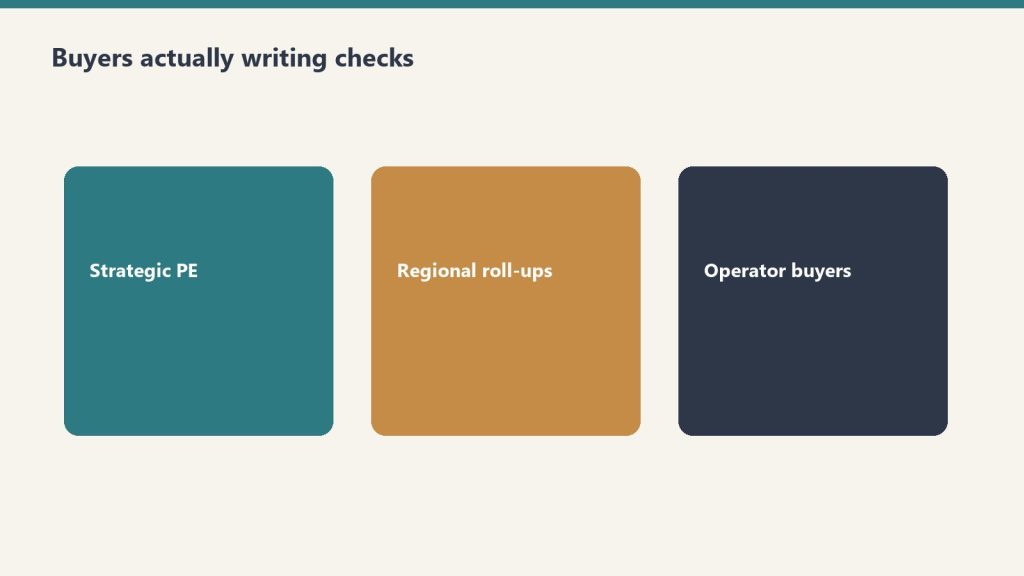
The buyers actually writing checks right now
Know who is writing checks before you polish the teaser.
The named platforms most active in restoration add-ons through 2025 and into 2026 include:
Morgan Stanley Capital Partners (American Restoration): An 8-brand roll-up across 10 states, headquartered in Dallas. Acquired by MSCP after building out residential and commercial mitigation in regional markets. Looking for tuck-ins that fit the regional brand model.
Knox Lane (HighGround): 13 acquisitions in 5 years before exit. Aggressive on multiples for the right strategic geography.
LP First Capital / Align Collaborate (Rewind Restoration): Newer platform, launched with the Icon Restoration acquisition in Rochester Hills, Michigan. Stated goal of building one of the largest residential restoration businesses in the US — meaning they are at the early, hungry stage of a platform.
Osceola Capital (Fortify Restoration): Platform launched mid-2025. First add-on was Beach Contracting in South Florida. Focused on structural restoration and southeast geography.
Crossplane Capital (Mooring USA): Dallas-based PE shop that took Mooring private. Commercial-leaning thesis.
None of these buyers want a vendor brochure. They want clean books, low owner dependence, and a story about how revenue keeps coming after closing.
What buyers actually grade you on
Buyers grade transferability — same scorecard as valuations.
Pretend you are sitting in the LOI meeting. The questions on the buyer’s checklist, in order of how much they move the multiple:
Revenue mix. Buyers want recurring service contracts, TPA program participation, and managed-repair work. They penalize reconstruction-heavy mix (lower gross margins) and they penalize catastrophe-heavy revenue. The savvy ones expect CAT work to represent no more than 15–20% of total revenue — anything north of that gets discounted as unpredictable.
TPA and carrier relationships. A documented Contractor Connection, Alacrity, Code Blue, or PSA program book — with active job volume and clean compliance history — is worth real multiple turns. A regional platform with $4M–$12M EBITDA and a strong TPA book is the difference between a 6x deal and an 8x deal.
Owner dependence. If you sign every estimate, talk to every adjuster, and make every hiring call, your business is not transferable. Most buyers want a turnkey, profitable operation, and creating SOPs that remove yourself from the daily grind is the single highest-ROI thing you can do in the 18 months before a sale.
Financial cleanliness. Multiples above the median require demonstrably above-median EBITDA margin and clean financial documentation that survives a third-party Quality of Earnings review. If your bookkeeper is your spouse and your books are on QuickBooks with no monthly close, you will get repriced in due diligence.
Management depth. A strong GM, an operations lead, and a finance person who isn’t you. Buyers will request to meet key employees during due diligence and may want to adjust transition terms based on who is staying.
The things that quietly destroy your multiple
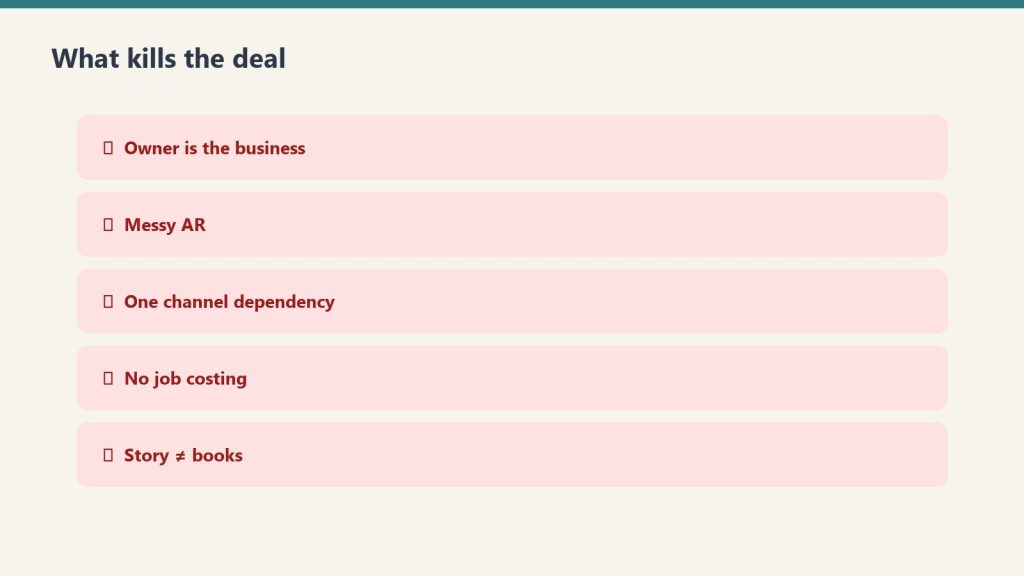
Quiet destroyers of multiple look a lot like deal killers.
Sellers walk into deals not knowing these compress them by 1–2 turns:
Reconstruction-heavy revenue mix with low gross margin.
No TPA program participation — meaning revenue is fully dependent on local marketing and referrals.
Weak 24/7 response infrastructure (no real on-call rotation, no after-hours dispatch).
Paper-based or hybrid workflow with no modern job management system.
Single-territory exposure with no expansion playbook.
Lapsed or thin IICRC certifications across the technician base.
Concentration risk — one TPA or one big carrier representing more than 25% of revenue.
The timeline that wrecks sellers
Due diligence typically runs 30 to 90 days and is the most intensive phase of any restoration sale. Owners who go into LOI without having done their own internal QoE, their own SOP documentation, and their own legal cleanup almost always get retraded. Sometimes the retrade is mild — $200K off the headline number. Sometimes the buyer walks. The sellers who hold their price are the ones who showed up ready: trailing twelve-month EBITDA reconciled monthly, contracts organized, employee agreements in place, tax returns matching financials, and a clean cap table.
Most restoration deals take six to twelve months from first conversation to close. If you are thinking about an exit in 2027, the time to start is now.
The honest bottom line
If you are under $2M in revenue, an owner-operator, and reconstruction-heavy: your real exit number is probably $400K–$800K, not the $2M figure you’ve been telling yourself. Sell to a local strategic, take three years of earn-out, and get to your number that way.
If you are $3M–$10M with a working TPA book and a real management bench: you are exactly what every active PE platform is shopping for. Get a Quality of Earnings done now, fix the obvious holes, and start taking the calls. There are a dozen named buyers with active mandates, and the market for quality regional restoration assets is the strongest it has ever been.
If you are $12M+ EBITDA with multi-state coverage and a modern operating system: you are not selling a business, you are negotiating a platform price. Hire a sell-side advisor who has actually closed restoration deals — not a generalist broker. The difference between a competitive process and a one-buyer conversation is two turns of EBITDA, which on your numbers is real money.
The window for premium restoration exits is open. It will not stay open forever. Climate-driven loss frequency is up roughly 35% since the 1990s, which is fueling buyer enthusiasm — but interest rates and PE fundraising cycles will eventually cool the market. Sellers who prepare now will catch this wave. Sellers who wait for “the right time” will sell into a softer market.
The right time is when your business is ready, not when the market is hot. The good news is the market is hot and the operational work to be ready is straightforward. Get started.
Most restoration buyers in 2026 are paying for the wrong things. They look at top-line revenue, the truck count, the trailing-twelve EBITDA — and miss the structural details that decide whether the company they just bought is a $4M business or a slow-motion writedown. Private equity has deployed over $6 billion across 50-plus platforms since 2018, and the buyers who keep winning at these multiples are the ones with a checklist that goes deeper than the broker’s pitch deck.
Here is what the disciplined buyers — strategic acquirers, PE platforms, and operator-buyers — actually look at when they price a restoration company in 2026, and the five line items that quietly kill more deals than anything in the financials.
What buyers are actually paying for in 2026
What buyers pay for in 2026 — transferability over heroics.
Median sale prices in restoration have risen to roughly $2.2M. Shops under $2M in revenue tend to clear at 2.5x to 3.0x SDE. The $2M to $5M EBITDA band — what the industry calls the PE feeder zone — trades at 4x to 6x EBITDA. Platforms above $10M EBITDA push 6x to 8x with strategic buyers willing to stretch further for the right geography or carrier panel. The spread between bottom and top of that range is not random. It is a function of five drivers that a thorough buyer will price line by line.
Carrier preferred-vendor status is the first thing on every diligence sheet. A company on the preferred panel of two or more Tier 1 carriers — State Farm, Allstate, USAA, Liberty Mutual — gets a multiple premium because that revenue is durable, repeatable, and very hard for a new entrant to replicate. A company that depends on one TPA program for half its work gets discounted because that revenue is one phone call away from disappearing.
Revenue mix matters almost as much. Mitigation-heavy companies — fast-turn water and emergency services — carry better margins and more predictable cash conversion than companies leaning on large-loss reconstruction. Reconstruction-heavy shops can still trade well, but buyers will model lower margins and longer working-capital cycles, which compresses the multiple.
Management depth below the founder is the third lever. If the owner is the estimator, the rainmaker, and the operations lead, the buyer will assume a 12 to 24 month earnout structure and discount the price accordingly. A general manager, an estimating lead, and a production manager who are staying through transition can add an entire turn of EBITDA to the offer.
CAT exposure is the fourth. Companies with more than 20-25% of revenue tied to catastrophic events get valued on a normalized basis — buyers strip the spike years out of the average. If you bought a restoration company on a peak hurricane year’s numbers, you overpaid. Sophisticated buyers know this and adjust before they sign the LOI.
The fifth is books that survive a quality-of-earnings review. In about 85% of deals, the QoE adjusts down from the seller’s claimed EBITDA, and the average haircut runs 10 to 15%. Companies that have already run a sell-side QoE and addressed the easy adjustments hold their price better than companies that hand a buyer a QuickBooks export and a confident shrug.
The five quiet deal-killers
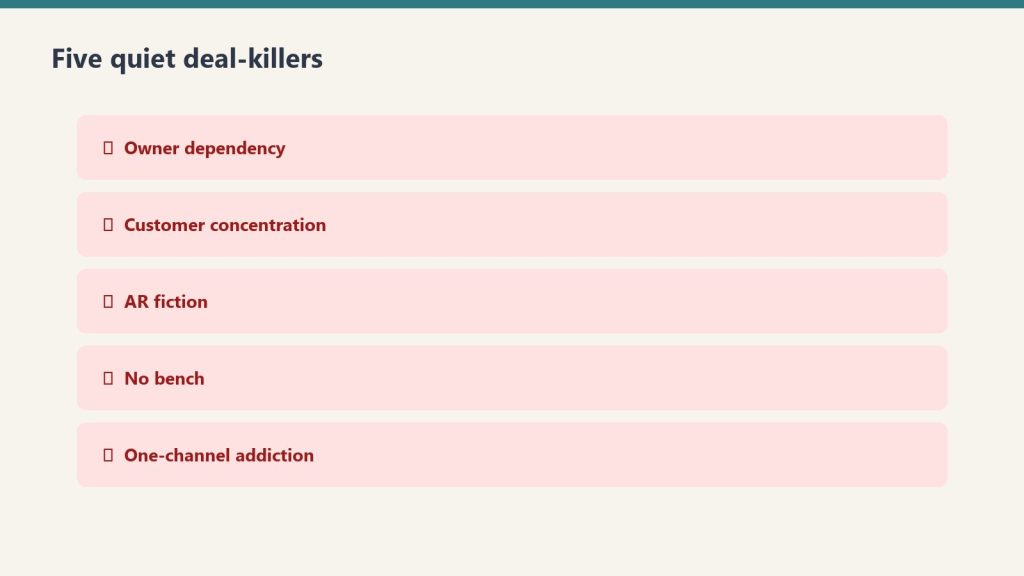
Five quiet deal-killers — fix before the LOI.
Most deals do not die on price. They die in the back half of due diligence, when something surfaces that the seller either did not disclose or did not realize mattered. These are the five issues that show up most often, and what a disciplined buyer does about each one.
1. Customer or carrier concentration over 20%. If a single carrier, TPA program, or property manager drives more than a fifth of revenue, the company has a single point of failure. Buyers either re-price the deal, structure a larger earnout tied to retention, or walk. The honest fix on the seller side is to diversify the book 18 months before going to market, but most do not have that luxury once they have decided to sell.
2. Licensing and certification gaps. Restoration is a regulated trade in most states. Buyers verify IICRC firm certification, individual technician WRT and ASD credentials, AMRT for mold work, state contractor licenses, and any specialty endorsements required locally. A lapsed firm certification or an expired mold license is not always a deal-killer, but it is always a price renegotiation and sometimes a regulatory exposure that gets baked into the purchase agreement as an indemnity.
3. Aged accounts receivable. Restoration AR ages slowly because insurance carriers and TPAs pay slowly. Buyers will look at the receivables aging report and discount anything over 90 days, sometimes severely. If a meaningful portion of the company’s "earnings" is actually trapped in 180+ day AR that nobody is going to collect, the working capital adjustment at close will swallow a real chunk of the purchase price.
4. Founder dependency in estimating and sales. This is the single most common reason restoration deals collapse or restructure into heavy earnouts. If the founder writes 60% of the estimates and personally manages the top carrier relationships, buyers know the business does not transfer. The seller who builds a real estimating department and pushes carrier relationships down to a sales lead two years before sale will capture meaningfully more value.
5. Compliance and labor exposure. 1099 versus W-2 misclassification, prevailing wage issues on commercial jobs, OSHA history, and EMR trends all surface in diligence. Buyers will hire an HR specialist on any deal above a few million in revenue, and a clean compliance picture is worth 0.25x to 0.5x of EBITDA on its own.
What a buyer should actually run before the LOI
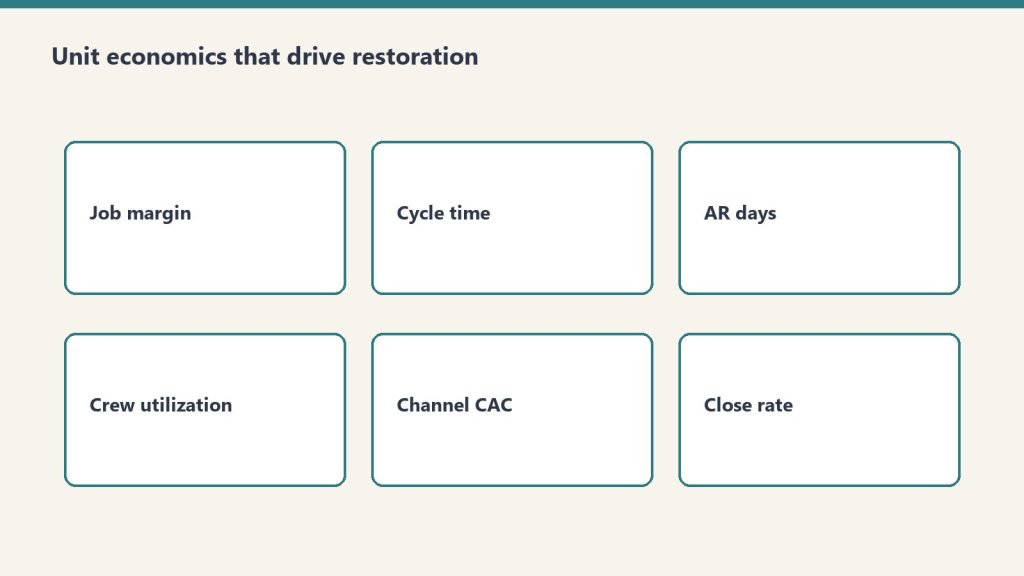
Run unit economics before the LOI — not after.
The minimum diligence package on a serious restoration acquisition includes: a quality-of-earnings review by a firm that has seen at least a dozen restoration deals, an independent verification of carrier preferred-vendor status and any TPA contracts, a customer concentration analysis at the carrier and account level, an AR aging review by a buyer-side accountant, an IICRC and state licensing audit, and a sit-down with the operations and estimating leads with the founder out of the room. That last item is the most underused and the most predictive.
Buyers who skip any of these line items end up renegotiating after close or eating a writedown a year in. Buyers who run all of them tend to pay slightly less and own businesses that transfer cleanly.
Bottom line
The 2026 restoration market is the best buyer’s window of the next five years, but only for buyers with discipline. The capital is there, the seller pipeline is there as the founder generation exits, and the platform playbook has been proven by HighGround, American Restoration, and a half-dozen others. The companies worth buying at top-of-range multiples are the ones with diversified carrier mix, real management depth, and books that survive a serious QoE. Everything else is a turnaround dressed up as an acquisition — and turnarounds in restoration take 18 to 36 months to fix and often cost more than the purchase premium ever saved. Pay for what transfers. Walk from what does not.
What multiple do restoration companies sell for in 2026?
Sub-$2M revenue shops typically trade at 2.5x to 3.0x SDE. Companies in the $2M to $5M EBITDA range — the PE feeder zone — clear 4x to 6x EBITDA. Platforms above $10M EBITDA reach 6x to 8x, with strategic premiums pushing higher in the right geography or carrier panel.
What kills restoration acquisition deals most often?
Customer or carrier concentration above 20%, founder dependency in estimating and sales, aged accounts receivable that does not collect, licensing or IICRC certification gaps, and labor compliance exposure — in roughly that order of frequency.
How long should a buyer-side diligence process take?
For a sub-$5M revenue restoration acquisition, plan on 60 to 90 days from signed LOI to close. Quality of earnings runs three to five weeks, legal and licensing diligence runs parallel, and customer/carrier verification typically lands in the final two weeks before close.
Is buying a restoration franchise better than buying an independent?
Franchises like SERVPRO or ServiceMaster Restore deliver brand, training, and national-account access at the cost of royalties and territorial restrictions. Independents give you full margin upside and the freedom to build proprietary carrier relationships, but require self-built systems and certifications. For first-time operators, the franchise reduces execution risk. For experienced operators, an independent acquisition tends to compound faster.
Every restoration owner over fifty has the same question stuck in the back of their head: what is this thing actually worth? The honest answer in 2026 is somewhere between 2.3x SDE and 7x EBITDA — and the spread between those two numbers is not luck. It is the difference between a company a buyer wants and a company a buyer tolerates.
Here is what is happening in the market right now, what private equity is paying, and what kills the deal at the eleventh hour.
The 2026 Multiple Spread
Restoration M&A in 2026 sorts cleanly into three tiers. The cutoffs matter — they are not aesthetic.
Tier 1 — Sub-$2M revenue shops. Owner-operator businesses with one or two trucks, dependent on the founder for sales and crew leadership. These transact on Seller’s Discretionary Earnings (SDE), not EBITDA. Typical multiples: 2.3x to 3.0x SDE. The buyer is usually another restoration owner, a search-fund operator, or an industry veteran on their second act. There is no PE in this tier. The owner doing the work IS the asset, and that is exactly the problem.
Tier 2 — $2M to $5M revenue shops. The PE feeder zone. These get bought by platforms like BluSky, First Onsite, Belfor, ATI, and Code Red as bolt-on acquisitions. Multiples: 3.0x to 3.5x SDE, or 4x to 5x EBITDA if the company is clean enough to have real EBITDA at all. Purchase prices land between $900K and $2.5M. This is the sweet spot for industry roll-ups — large enough to have a real second-in-command, small enough to absorb without indigestion.
Tier 3 — $10M+ revenue, $2M+ EBITDA platforms. Now you are talking to PE directly, not through a strategic. Multiples: 5x to 7x EBITDA, occasionally higher for the right footprint. BluSky has announced 13 acquisitions in the last six years under Kohlberg & Company and Partners Group ownership. American Restoration rolled up 8 brands before exiting to Morgan Stanley. HighGround did 13 deals in five years before selling to Knox Lane. The playbook is well-documented. PE has put more than $6 billion into the space since 2018.
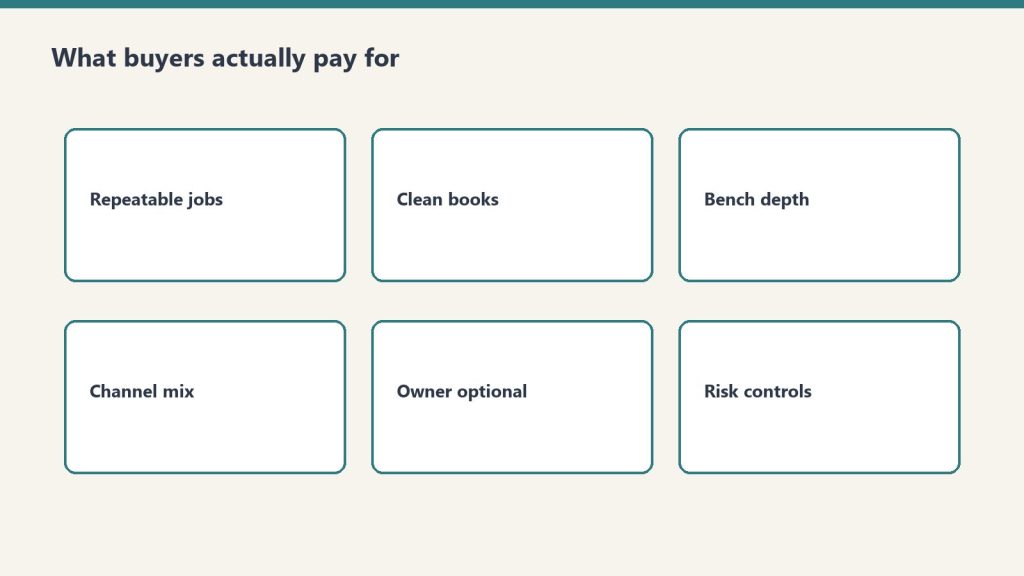
What Buyers Actually Pay For
Buyers pay for transferability — not heroic owners.
The multiple is a function of risk, not affection. Sophisticated buyers pay up for five things, in roughly this order:
1. Insurance carrier preferred-vendor status. If you are on the panel for State Farm, Allstate, USAA, Liberty Mutual, or any TPA program — Contractor Connection, Alacrity, Code Blue — that contract is the asset. It is also the hardest thing to replicate. Buyers will pay a premium for it because they cannot buy it any other way except by buying you.
2. Mitigation-heavy revenue mix. Water mitigation runs gross margins around 70-80%. Reconstruction often runs 10% or less. A company that is 65% mitigation and 35% reconstruction is worth materially more than the same revenue split inverted. Buyers will pull your job-cost reports line by line during diligence to confirm the mix is real and not just how you are categorizing.
3. Management depth below the founder. If you can take a two-week vacation and revenue does not blink, your multiple goes up by half a turn. If the phones stop ringing the moment you leave, you are selling a job, not a business. Hire a real general manager 18 months before you list.
4. CAT exposure under 20%. Catastrophic event revenue is lumpy and cannot be modeled. If 40% of your last three years came from one hurricane season, buyers will discount that revenue heavily — sometimes valuing CAT-driven dollars at half the multiple of recurring carrier work. Diversify your revenue base before going to market.
5. Clean books with a Quality of Earnings opinion. Every PE-backed deal includes a QoE — an outside accounting firm that re-audits your trailing twelve months and normalizes EBITDA. If your books are run on a personal-finance app and your CPA does taxes once a year, expect the QoE to find $200K-$500K of EBITDA adjustments that go against you. Spend $40K on a CFO-for-hire and a real GAAP P&L two years before sale.
What Kills the Deal
What kills the deal is usually quiet and operational.
Roughly 30-40% of restoration LOIs do not close. Almost always for reasons the seller could have prevented.
The biggest deal-killer is customer concentration. If one TPA program represents more than 35% of revenue, buyers panic. They have seen what happens when Contractor Connection decides to rebid a region — entire $8M revenue lines disappear in a quarter. Diversify before you list.
The second is uncollected aged receivables. Restoration AR over 90 days is not an asset, it is a write-down waiting to happen. Buyers will deduct uncollected AR from purchase price dollar-for-dollar. Aggressively collect or write off everything before you go to market.
The third is licensing and certification gaps. IICRC, state contractor licenses, mold remediation certifications by state — buyers run a full compliance audit. A single expired contractor license in a key state can cost $50K-$150K at close.
The fourth is founder dependency on first-call relationships. If the property manager calls you personally when there is a flood — not a dispatch number, not a sales rep — buyers will require an earnout structure that makes you stay another three to five years. Most owners hate earnouts because they convert sale price into deferred contingent comp. Build the dispatch infrastructure before you list, and you keep the cash up front.
The Honest Bottom Line
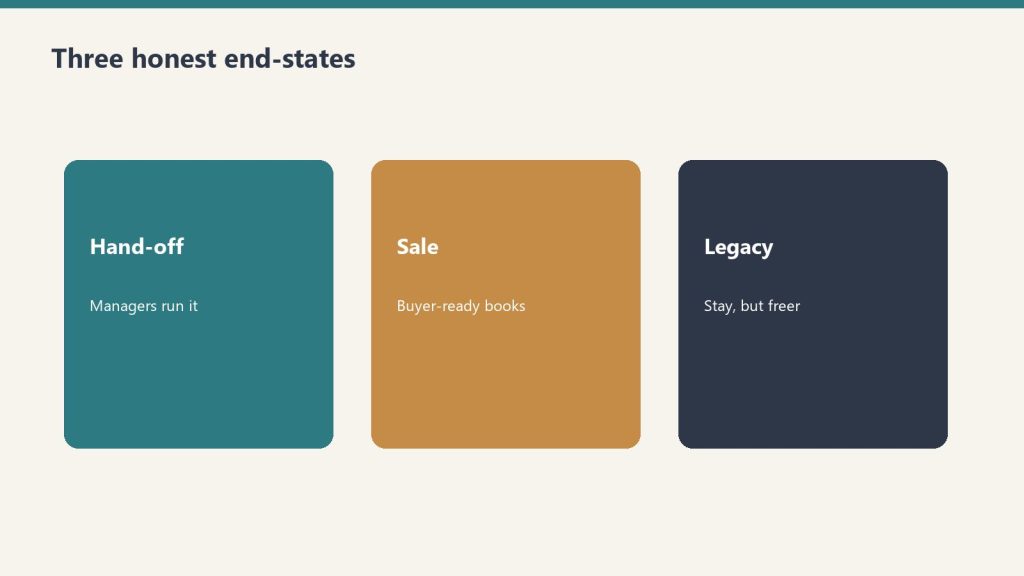
Honest bottom line: pick an end-state and work backward.
If you are a $3M revenue restoration company today and you want a clean exit at a real multiple, you have an 18-to-24 month preparation window. Use it to get the books on accrual, hire a GM, diversify off any single TPA, build mitigation revenue past 60% of mix, and get every certification current.
Do that, and a $3M shop running 18% EBITDA margins ($540K) sells at 4.5x to a strategic — about $2.4M cash at close. Skip it, and the same company sells at 2.6x SDE — closer to $1.4M, often with a punishing earnout attached.
The difference is one million dollars. The work to capture it is roughly nine months of operator focus. That is the highest-ROI work an exiting restoration owner can do.