Restoration company marketing is one of the most expensive paid-search categories in the United States. “Water damage restoration” keywords routinely clear $60–$85 per click in competitive markets, with reported outlier bids running well over $200 in metros like New York, Houston, and South Florida. Industry tracking has flagged some emergency-restoration terms breaking $500 per click in specific moments. Meanwhile, the average home-services lead via Google Local Service Ads (LSA) is roughly $53 — but water damage restoration sits at the premium end, with reported LSA cost-per-lead ranges of approximately $80–$180 depending on market.
If you run a $3M–$15M restoration company, this is the single biggest line item that nobody on your team is staring at correctly. Owners hear “marketing” and think website. The real fight in 2026 is channel allocation: how much should you spend on LSA, how much on Google Search Ads, and how much on owned SEO — and at what point does each one stop scaling? Here is the honest breakdown a $5M owner needs before their next marketing budget meeting.
The three channels that actually matter
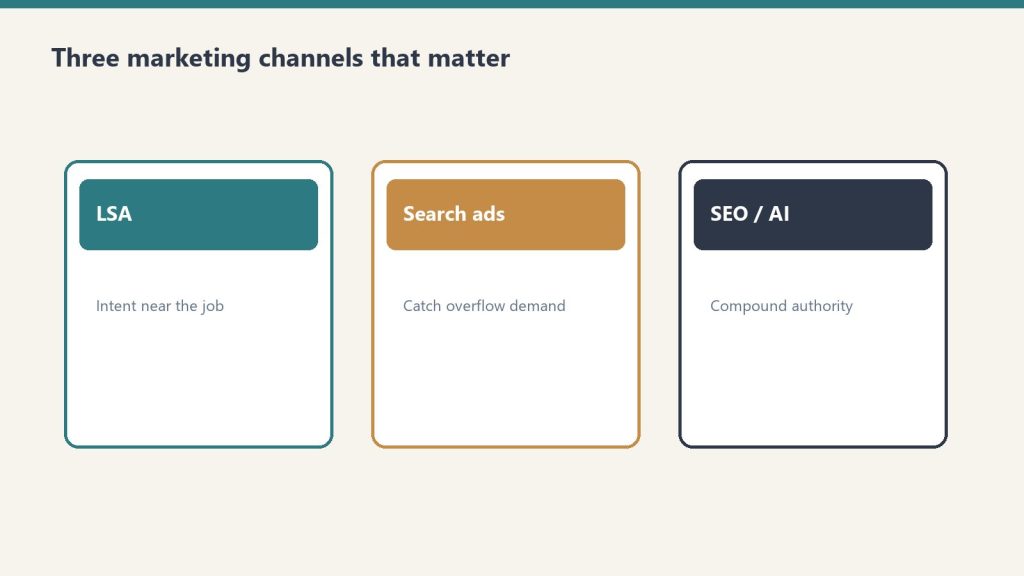
For commercial water and fire restoration in 2026, three channels do the heavy lifting: Google Local Service Ads (the LSA “Google Guaranteed” boxes at the very top of the SERP), Google Search Ads (the paid text ads below LSA), and organic SEO (the map pack plus blue links). Everything else — Yelp, Angi, HomeAdvisor, Facebook, programmatic display, lead-broker buys — is either supplemental, declining, or actively cannibalizing your margin. The first decision is choosing where the bulk of your new-customer budget goes among those three.
Local Service Ads (LSA) — the default starting point in 2026
LSA is the highest-real-estate placement on a phone screen, period. For emergency-driven categories like water damage and mold, that real estate matters more than anything else. Reported 2026 cost-per-lead for water damage restoration through LSA generally falls in the $80–$180 range, with some markets reporting averages closer to $100 in stable competitive conditions. On a $6,000 average ticket, even a $150 LSA lead at a 25–35% close rate produces a customer acquisition cost (CAC) of roughly $450–$600 — which is workable on jobs that gross $1,800–$2,400.
The catch: Google removed credits for “job type not serviced” and “geo not serviced” leads in 2025, meaning every junk lead now hits your card with no recourse. You have to dispute leads inside Google’s dispute window and you have to answer your phone in under 30 seconds. LSA also weights reviews more heavily than any other channel — a 4.6 average will visibly underperform a 4.9 in the same zip code. If your review velocity is under 8 per month, fix that before you scale LSA spend.
Google Search Ads — the diminishing-returns layer
Below LSA, traditional Google Search Ads remain expensive and uneven. Reported 2026 average CPC for water damage restoration keywords falls into bands: bottom-of-funnel emergency keywords like “emergency water damage [city]” run $60–$85; less-direct terms like “water damage cleanup near me” run $40–$65; awareness-stage keywords like “what to do after a flood” run $20–$40. The trap is that close rates on Search Ads have been compressing for three reasons: LSA is taking the highest-intent clicks, AI Overviews are stealing informational queries, and click fraud from competitor bots remains nontrivial.
Get The Signal
What we actually ran, what it measured, and what it means for a restoration shop — every week, including the flops.
For most restoration owners, Search Ads should be a defense-and-coverage play, not a primary growth channel. Bid on your own brand name to keep TPA programs and franchise competitors from arbitraging your traffic. Bid on the keywords LSA does not cover well (commercial, mold remediation, biohazard, contents pack-out). Cap monthly spend. Watch the CAC, not the CPC.
SEO — the compounding asset that owners under-invest in
Owned SEO — Google Business Profile plus a real content engine on the company website — is where the math eventually breaks in your favor. Multiple cross-industry benchmarks in 2025–2026 put the cost-per-lead delta between SEO and paid search at roughly 4x–6x lower for SEO once a site is mature (typically 12–18 months in). One widely cited cross-industry benchmark places SEO CPL near $31 versus paid search closer to $181. Restoration-specific tracking from agencies serving the category has reported organic CPL well under $50 in established markets after 18+ months of investment, while paid CPL stays in the $150+ band.
The painful truth: SEO has a CAC of essentially zero on the marginal lead, but you cannot start it in January and expect leads in March. The owners who win SEO in restoration started 24 months ago, publish 6–12 useful pieces a month, and have a Google Business Profile with 500+ reviews and weekly post activity. If you have not started, your starting line is today — not next quarter.
The honest allocation for a $5M restoration company in 2026
A defensible 2026 marketing budget for a $5M residential and small-commercial restoration company, assuming 60% TPA-fed and 40% self-generated, looks roughly like this on the self-gen side:
- LSA: 45–55% of self-gen ad spend. Highest immediate ROI. Cap by service area until close rate clears 30%.
- Google Search Ads: 15–20%. Brand defense plus commercial, mold, and biohazard keywords LSA underweights.
- SEO and Google Business Profile: 25–35%. This is content, on-site technical work, review-generation systems, and GBP weekly posts. Treat it as an asset, not a cost.
- Everything else (Yelp, Angi, Nextdoor, paid social): under 5% combined, and only with tracked phone numbers per channel.
If your current mix is 80%+ LSA and 0% SEO, you are renting your customer pipeline from Google at a rate that will keep rising. If your current mix is 80%+ SEO and 0% LSA, you are leaving the highest-intent emergency calls on the table for competitors who will outbid you for them.
What to measure, not what to chase
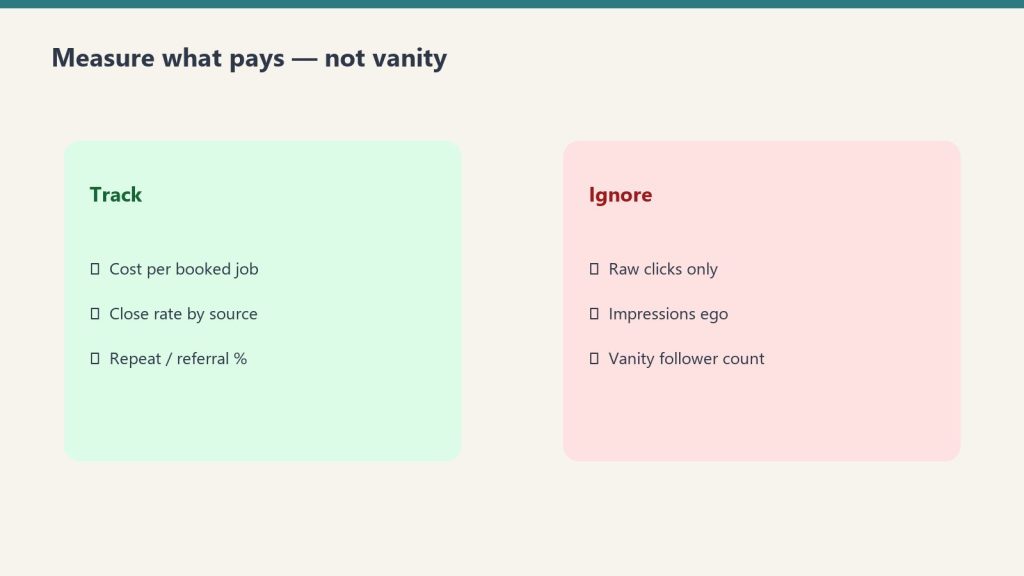
CPC, CPL, and CAC are not the same number. Restoration owners chase CPC because Google Ads dashboards make it visible. The metric that should sit on your monitor is blended CAC by channel, calculated quarterly: total channel spend divided by booked jobs from that channel. Track three more numbers next to it — close rate from lead to booked job, average ticket size by channel, and lifetime value adjustments for repeat and referral. A $180 LSA lead with a 35% close on $7,000 average ticket is a different business than a $40 organic lead with a 12% close on $2,200 average ticket — even though the CPL looks better in column B.
Bottom line
In 2026, LSA pays the bills, Search Ads defends the perimeter, and SEO is the only channel that compounds. The restoration owners who will be writing larger checks to their estimators in 2028 are the ones who fund all three this year — and the ones who refuse to pay $150 for a water damage lead because “that’s expensive” will keep watching franchise competitors and out-of-town aggregators win the calls that finance their own retirement. The expensive lead is the one you didn’t bid on at 2 a.m. when the house was actively flooding.
Related on Tygart Media: Starlink on a water job · S500 in the van · local SEO for restoration.
Frequently Asked Questions
What is a good cost per lead for a water damage restoration company in 2026?
Reported 2026 ranges put water damage LSA cost-per-lead at roughly $80–$180, with some stable markets averaging closer to $100. Google Search Ads CPL is generally higher and more volatile. Organic SEO CPL trends well under $50 in mature programs after 12–18 months. Evaluate against your average job size and close rate, not against a flat industry number.
Are Google Local Service Ads still worth it for restoration companies?
Yes, for emergency categories LSA remains the most cost-efficient paid channel in 2026 because of its top-of-screen placement and pay-per-lead structure. The caveats: Google removed credit for off-service-area and wrong-job-type leads, review velocity matters more than ever, and you have to answer the phone in under 30 seconds to keep ranking.
How long until SEO produces restoration leads?
Plan on 9–12 months for a Google Business Profile and review-driven program to generate meaningful local-pack volume, and 12–18 months for content-driven organic leads to show up in any volume. Owners who treat SEO as a 6-month sprint nearly always abandon it 30 days before it would have started working.
Should I use a marketing agency or build in-house?
Under $3M revenue, hire one credible local agency for LSA plus GBP and own SEO with a part-time writer. From $3M–$10M, split LSA/Search Ads with an agency and bring SEO content in-house under a marketing coordinator. Above $10M, build the function internally with a director-level hire — at that size your marketing spend funds a salary and the data needs to live on your side of the firewall.
📖 Recommended Reading in Restoration Intelligence
Get The Signal
What we actually ran, what it measured, and what it means for a restoration shop — every week, including the flops.
Leave a Reply