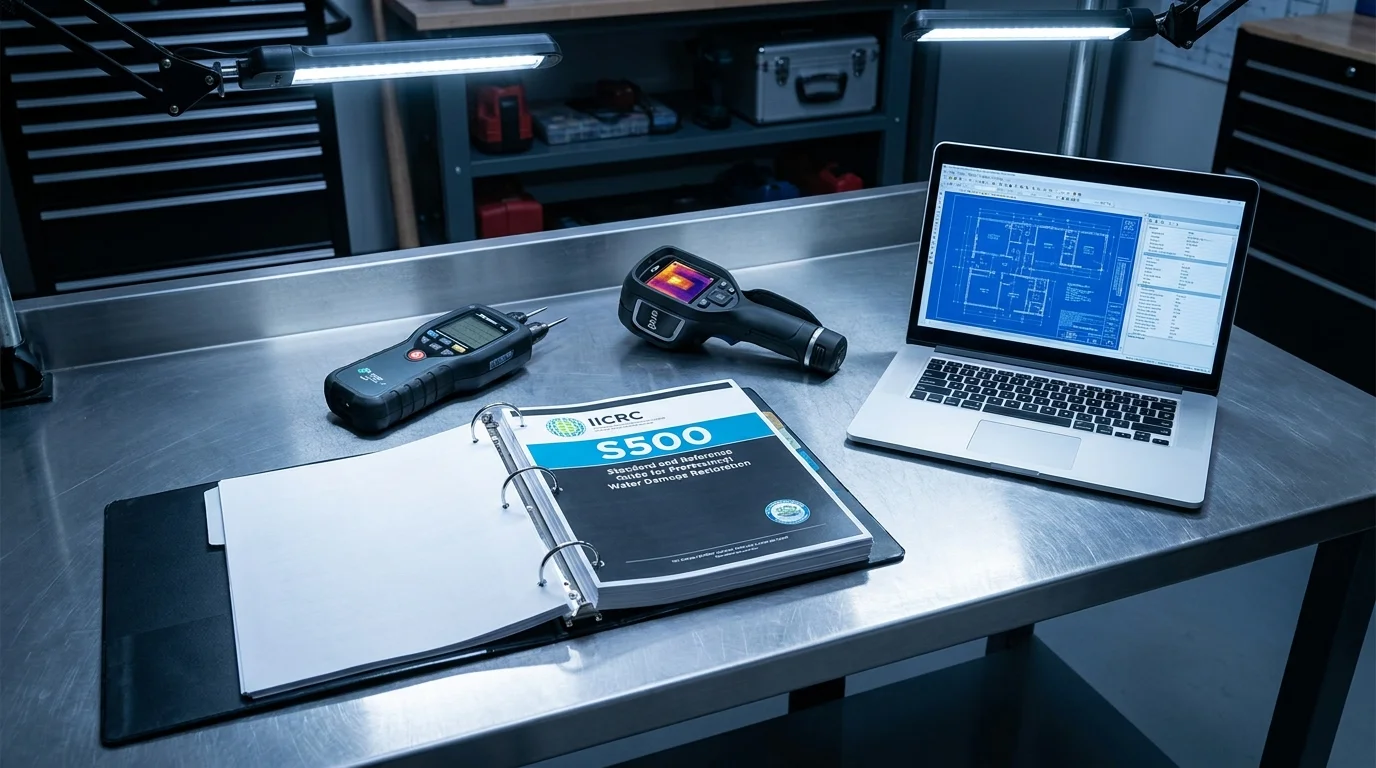
Three IICRC technician certifications anchor the technical credibility of almost every restoration company in North America: Water Damage Restoration Technician (WRT), Applied Structural Drying (ASD), and Applied Microbial Remediation Technician (AMRT). For owners building or expanding a production team, knowing what each certification covers, what it costs, and how to sequence them is the difference between a planned training investment and a reactive scramble before a TPA audit.
This guide is part of our broader restoration training and certification master guide.
WRT — The Foundational Certification
The Water Damage Restoration Technician (WRT) certification is the entry point into IICRC’s restoration credentialing. It covers the fundamentals of water damage response: water categories and classes, drying principles, equipment selection, and the IICRC S500 standard. WRT is also the prerequisite for both ASD and AMRT, which makes it the right starting point for every technician on the team.
Course costs vary by training provider. A common reference point is around $449 per person for a WRT course delivered by a well-established training school. The IICRC exam fee for WRT is $80, with $80 retest fees if a candidate does not pass on the first attempt.
ASD — The Drying Specialist Credential
Applied Structural Drying (ASD) builds on WRT and goes deeper into the science and equipment of structural drying. ASD covers psychrometry, dehumidifier selection and sizing, air mover placement, monitoring methodology, and drying chamber strategy. For technicians who lead drying jobs in the field, ASD is the right second certification.
WRT is a prerequisite for ASD, and most restoration training schools offer the two as a combined WRT/ASD program. Combo courses commonly run from $1,395 to $1,495 per person, plus the combined IICRC exam fees of $160 ($80 per certification). The combo format is more cost-effective than taking the two separately and reduces the time technicians spend off production.
AMRT — The Mold Remediation Credential
Applied Microbial Remediation Technician (AMRT) is the IICRC certification for mold remediation work. It covers the IICRC S520 standard, containment, PPE, antimicrobial application, HEPA equipment, and remediation protocols. For any restoration company performing mold work — even occasionally — AMRT is the credential that protects the business legally and operationally.
WRT is a prerequisite for AMRT. Course costs are commonly around $995 per person, and the IICRC exam fee is $150. AMRT must be taken in person at a training center; the course is not approved for online delivery.
How to Sequence Certifications Across a Team
The right certification sequence for a typical restoration team:
- All field technicians — WRT within the first 90 days of hire
- Senior technicians and lead drying techs — WRT/ASD combo, ideally within the first year
- Technicians performing mold work — AMRT after WRT, before the first solo mold job
- Project managers and crew leads — All three (WRT + ASD + AMRT) as a baseline
- Operations managers and owners — At minimum WRT, plus ASD and AMRT for credibility on customer and adjuster calls
Budgeting Annual Certification Spend
For a 10-person restoration team running this certification map, expect first-year certification spend in the $8,000 to $12,000 range when WRT, WRT/ASD combos, and AMRT courses are layered in. Subsequent years drop to a continuing education rhythm (covered in a separate spoke) plus new-hire WRT certifications.
The right way to think about this spend is per-job risk reduction. A single audit reduction or compliance issue that the certification would have prevented typically pays for the certification several times over.
Choosing a Training Provider
The IICRC accredits multiple training schools, and not all are equivalent. The factors that matter most: instructor field experience (vs. pure classroom background), hands-on lab time built into the course, exam pass rates, and post-course support. Reading provider reviews from operators in your region is the most reliable selection signal.
Frequently Asked Questions
How much does IICRC WRT certification cost in 2026?
WRT courses commonly run around $449 per person from established training schools, plus an $80 IICRC exam fee. Retest fees if needed are also $80. Pricing varies by provider and region — confirm current rates with your selected training school before budgeting.
Is WRT a prerequisite for ASD and AMRT?
Yes. WRT is the prerequisite for both Applied Structural Drying (ASD) and Applied Microbial Remediation Technician (AMRT). The standard pathway is to complete WRT first, then add ASD or AMRT depending on the technician’s role.
Can IICRC certifications be earned online?
WRT can be taken online through several approved providers. The WRT/ASD combo course must be taken at a training center because of the hands-on drying lab requirements. AMRT is approved for in-person delivery only. Always verify the delivery format with the provider before registering.
How long does it take to earn WRT certification?
Most WRT courses run two to three days of instruction, followed by the IICRC exam. The full timeline from course start to active certification is typically one to two weeks once exam scheduling is included. Online formats may compress the calendar but require the same instructional hours.
How long is IICRC certification valid before renewal?
IICRC certifications are renewed through continuing education credits (CECs) on a recurring cycle, not through a single fixed expiration date. Technicians need 14 CECs every four years; advanced certifications and Certified Inspectors require 14 CECs every two years. The CEC system is covered in detail in our continuing education spoke.
Leave a Reply