Inspired by Revved Digital. Original report: Revved Digital 2026 Home Service Marketing Benchmark Report. This is a new Tygart article for restoration contractors. We kept the mechanism, added first-party field knowledge, and did not reprint the piece.
The useful sentence in that report is the first one: benchmarks only work when clicks, leads, bookings, sold jobs, and customers stay separate. The table then shows restoration and water damage at an $8.33 CPC and $90.92 CPL. Those are LocaliQ Home & Home Improvement proxies, not a national restoration average. Roofing sits at $228 CPL with real trade data. Plumbing at $129. Treat the restoration row as context, not a quota.
There is no credible nationwide LSA CPL, SEO price, website conversion rate, or review-count target across those nine trades. The honest public numbers that do transfer:
CallRail: 97% of homeowners say speed influences whom they hire. 41% of online-booked jobs arrive after hours.
ServiceTitan (2022, cross-trade): 42% typical call booking rate. Old, and not restoration-specific. Still a better reference than “we feel busy.”
Planning range of 5–10% of revenue is general small-business guidance, not a measured restoration average.
Build the number backward. How many more losses can the crews take. What is allowable CAC from gross profit on water versus sewage versus fire. What is the real lead-to-customer rate on the night board. Fund channels from that. A shop spending 5% with a dead after-hours line wastes more than a shop spending 10% that answers.
Compare your pin to the shops ranking for water in your city — count, recency, replies — not to a national review target that does not exist.
Google is moving Local Services Ads into Google Ads. The ads are not dying. Pay-per-lead stays. Search and Maps stay. What changes is the dashboard, the bidding, and the fact that the old reports will not come with you.
First U.S. wave is August 2026 for listed home-service trades. Service-area businesses without a storefront are later in 2026. Restoration shops that live on LSAs should assume they are in that line and act before the 14-day email.
What to do this week
Export 12 months: spend, charged leads, disputed leads, cost per lead, category, area. Owners need a sheet, not a login that is about to vanish.
Screenshot the current setup: budget, categories, areas, hours, who answers, who administers.
Split economics after migration. Water extract and sewage rebuild should not share one target CPA. Google is collapsing category targets into one campaign unless you separate them.
Lock who can edit the Google Business Profile. Name, address, hours, and primary category will sync into the paid campaign. A casual category tweak can pause ads for a verification window.
Plan two quiet weeks. Google says performance can wobble while the account settles. Compare against the export, not against Tuesday.
Lead history and recordings move. The performance baseline does not. If you cannot say what a good water lead cost last winter, you will not know whether the new dashboard is worse or just different.
Blocking “jobs,” “salary,” and “DIY how to” is useful. Blocking an entire profitable service because the query looked ugly in a report is how shops stop paying for sewage and then wonder why only carpet-dry calls remain.
Before you add an exclusion, ask: is this a person we would roll for? “Emergency water extraction near me at night” is a job. “How to dry carpet with fans” is not. “Mold test kit Walmart” is not. “Sewage backup cleanup cost” often is.
Review the search-term list weekly with someone who has stood in a wet house. Do not let a junior media buyer delete Category 3 because the word “backup” looked messy.
A homeowner who dials, hears a menu, and hangs up still counts as a conversion if the only rule is “call lasted 60 seconds.” That number will make a dry week look busy and a paid campaign look smart.
Split the events. Call attempt. Qualified conversation — zip in range, Category 1–3 named, someone who can authorize work. Booked loss. Sold job. Those four numbers tell you whether Maps and ads are feeding trucks or feeding a dashboard.
Night-board noise is the restoration version of a 60-second fake win. Count it separately or you will scale the wrong channel.
If you own a restoration company in 2026, your marketing budget is being eaten alive by three channels fighting for the same lead: Google Local Services Ads, Google Search Ads, and SEO. The owners I talk to are spending six figures a year and still can’t tell me, with a straight face, which channel is actually paying them. So let’s settle this with the numbers vendors don’t put in their pitch decks.
The water damage CPC is the most expensive in home services
Reported cost-per-click for top water damage restoration keywords has climbed as high as the $200–$250 range in competitive metros, with industry sources citing top-of-page bids reaching around $250 per click for terms like “water damage restoration [city].” Average emergency restoration keywords more commonly land in the $40–$100 CPC range depending on geography and time of day. That is not a typo. A single click — not a lead, not a job — can cost more than most contractors charge for a furnace tune-up.
The reason owners keep paying it is simple. A water mitigation job typically prices in the $3,000–$15,000+ range depending on category and scope. At those ticket sizes, a $300 cost-per-lead and a 25% close rate still pencils out. But “pencils out” is doing a lot of heavy lifting in that sentence — and that’s where most owners stop running the math.
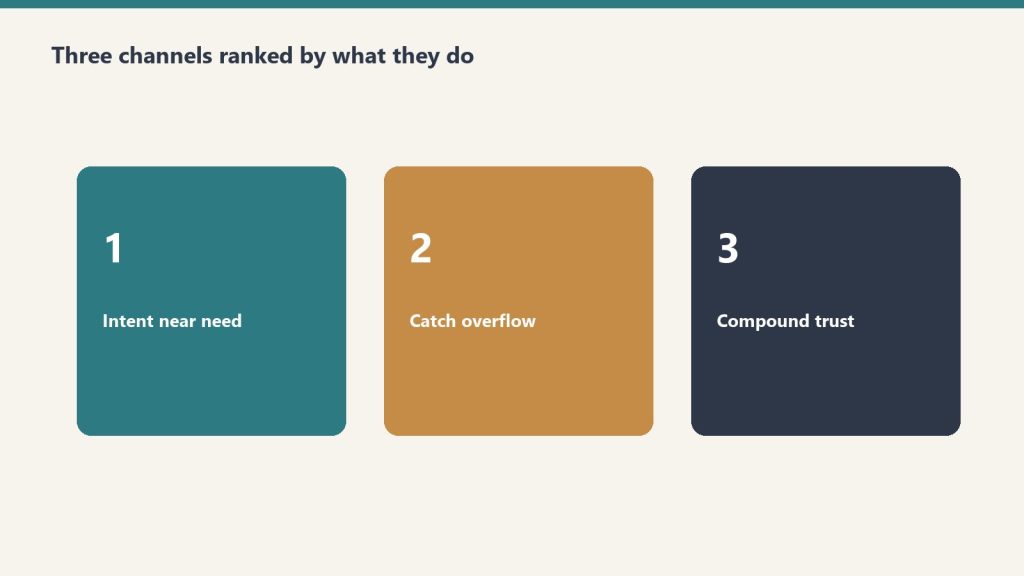
The three channels, ranked by what they actually do
Ranked by what they actually do — not vanity volume.
Google Local Services Ads (LSA): the most consistent ROI lever right now
LSA cost-per-lead in restoration is widely reported in the $80–$180 range for water damage, with mold remediation reported between roughly $60 and $250 depending on market. Conversion rates from lead to booked job tend to be reported around the 10–15% range — higher than standard Google Search Ads — because Google charges per qualified phone call or message, not per click.
The bottom line on LSAs: if you do not have Google Guaranteed status set up and your service area dialed in, this is the first thing you fix this quarter. The catch nobody mentions: Google ended the credit policy for “job type not serviced” and “geo not serviced” disputes in 2025, meaning junk leads now come out of your pocket with no refund pathway. You have to dispute aggressively on the categories Google still credits, or your effective CPL drifts 15–25% higher than the platform number says it is.
Google Search Ads (PPC): the channel you run when you have no other choice
Average reported cost-per-lead for Google Search Ads in restoration falls in the $150–$400+ range, with the high end concentrated in metros with two or more national franchise advertisers bidding against you. Conversion from click to lead in well-managed accounts typically lands in the 5–10% range — half of what LSAs deliver.
PPC has one thing LSAs don’t: control. You set the keywords, you set the geo, you set the ad copy, you decide whether you want commercial water damage leads or residential mold leads or fire restoration leads. If you are running a multi-location shop or chasing commercial work specifically, you cannot live on LSAs alone — the lead types are too restricted. But if you are a single-location residential operator, every dollar in PPC should be earning its keep against the LSA dollar, and most of the time it isn’t.
SEO: the long-term asset everyone wants to own and almost nobody finishes building
Cost-per-lead from established organic rankings is commonly reported in the $75–$150 range — roughly half the cost of paid channels at maturity. The trade-off is time. Restoration SEO in competitive metros typically takes 12–18 months of consistent investment before it produces meaningful lead flow, with initial signal in 3–6 months for low-competition local terms.
The honest read: most restoration owners start SEO, get impatient at month four when paid channels are still doing all the work, and either fire the agency or stop publishing content. Then they restart 18 months later with a different vendor and the same outcome. SEO works. It works exactly the way the calendar says it will work. The companies that win with it are the ones who treat it like a 24-month commitment, not a 90-day experiment.
What the channel mix should actually look like
Channel mix should match capacity — not ego.
For a residential-focused restoration company doing $1M–$5M in revenue, a defensible channel mix in 2026 looks something like this:
LSA: 35–45% of paid budget. Highest reported ROI of any paid channel in restoration. Cap is the daily lead volume Google will give you, not the budget.
Google Search Ads: 25–35% of paid budget. Covers the lead types LSAs cannot serve — commercial work, specific service lines, and overflow when LSAs hit daily caps. Required for any multi-location shop.
SEO and content: 20–30% of total marketing budget. Treat as 18–24 month asset build. Tracked separately from paid CPL because the unit economics only stabilize at month 12+.
Referrals and direct outreach: ongoing, no fixed budget. Reported industry-wide as the lowest-CAC channel and the one with the shortest break-even window. Build a plumber/agent/property manager referral program before you spend another dollar on paid ads.
The split that gets restoration owners in trouble is putting 80% into paid and 20% into “we’ll get to it” SEO. Two years later they are completely dependent on Google’s auction prices, and the auction prices have gone up every year of the last five.
The metric that actually matters
The metric that matters is booked jobs, not clicks.
Cost-per-lead is the metric every vendor reports. It is the wrong number to optimize for. The number that matters is fully-loaded cost-per-acquired-job, which is CPL divided by your channel-specific close rate, plus the labor cost of the CSR who fielded the call, plus the credit card processing on whatever portion of the job is paid out-of-pocket, minus the franchise or TPA fee if applicable.
Most restoration owners do not have this number for any of their channels. They have CPL from the platform dashboards, they have revenue from the job management software, and the two systems have never talked to each other. Fix that before you change a single bid. The owner who knows their fully-loaded acquired-job cost by channel makes better decisions in five minutes than the owner who doesn’t makes in a quarter.
The bottom line
LSAs are the highest-ROI paid channel in restoration in 2026 and should be the first lever you optimize. Google Search Ads are required for any operator chasing commercial work or running multiple locations, but they should never be your largest line item. SEO is the long-term insurance policy against rising auction prices, and the only restoration owners who get the payoff are the ones who treat it like a 24-month commitment and refuse to flinch at month six.
If you are spending more than $5,000 a month on Google Search Ads and you do not yet have LSAs set up, you are leaving the most profitable channel in restoration on the table. Start there.
What is the average cost per lead for water damage restoration in 2026?
Reported cost-per-lead for water damage restoration in 2026 ranges from roughly $80–$180 on Google Local Services Ads, $150–$400+ on Google Search Ads, and $75–$150 from mature organic SEO. Actual costs vary significantly by metro, competition, and lead-type mix.
Are Google Local Services Ads better than Google Ads for restoration?
For most residential restoration operators, LSAs deliver a lower cost-per-lead and a higher reported lead-to-job conversion rate than standard Google Search Ads. LSAs charge per qualified call rather than per click, which is why the ROI tends to be more consistent. Multi-location shops and commercial-focused operators still need Google Search Ads to cover lead types LSAs do not serve.
How long does SEO take to work for a restoration company?
Restoration SEO in competitive metros typically takes 12–18 months of consistent investment before it produces meaningful lead flow. Initial ranking signal often appears in 3–6 months for low-competition local terms, but the cost-per-lead advantage versus paid channels only stabilizes after month 12.
What percentage of a restoration marketing budget should go to paid ads?
A common defensible split for a residential restoration company in 2026 is roughly 60–70% of total marketing budget on paid channels (LSA + Google Search Ads) and 20–30% on SEO and content, with referral programs running in parallel at minimal incremental cost. Going above 80% paid concentrates risk in the Google auction.
Restoration company marketing is one of the most expensive paid-search categories in the United States. “Water damage restoration” keywords routinely clear $60–$85 per click in competitive markets, with reported outlier bids running well over $200 in metros like New York, Houston, and South Florida. Industry tracking has flagged some emergency-restoration terms breaking $500 per click in specific moments. Meanwhile, the average home-services lead via Google Local Service Ads (LSA) is roughly $53 — but water damage restoration sits at the premium end, with reported LSA cost-per-lead ranges of approximately $80–$180 depending on market.
If you run a $3M–$15M restoration company, this is the single biggest line item that nobody on your team is staring at correctly. Owners hear “marketing” and think website. The real fight in 2026 is channel allocation: how much should you spend on LSA, how much on Google Search Ads, and how much on owned SEO — and at what point does each one stop scaling? Here is the honest breakdown a $5M owner needs before their next marketing budget meeting.
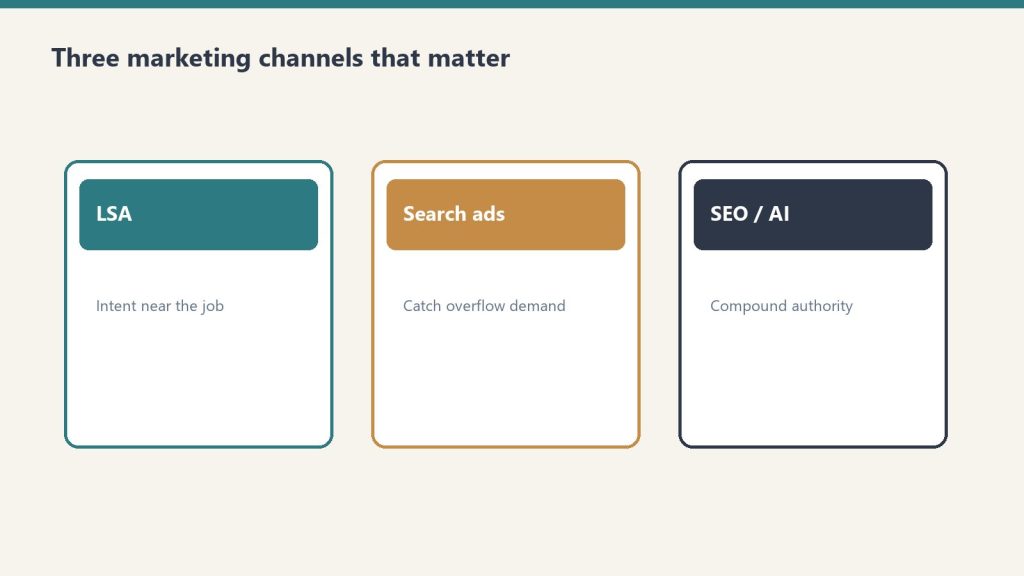
The three channels that actually matter
Three channels that actually matter for restoration demand.
For commercial water and fire restoration in 2026, three channels do the heavy lifting: Google Local Service Ads (the LSA “Google Guaranteed” boxes at the very top of the SERP), Google Search Ads (the paid text ads below LSA), and organic SEO (the map pack plus blue links). Everything else — Yelp, Angi, HomeAdvisor, Facebook, programmatic display, lead-broker buys — is either supplemental, declining, or actively cannibalizing your margin. The first decision is choosing where the bulk of your new-customer budget goes among those three.
Local Service Ads (LSA) — the default starting point in 2026
LSA is the highest-real-estate placement on a phone screen, period. For emergency-driven categories like water damage and mold, that real estate matters more than anything else. Reported 2026 cost-per-lead for water damage restoration through LSA generally falls in the $80–$180 range, with some markets reporting averages closer to $100 in stable competitive conditions. On a $6,000 average ticket, even a $150 LSA lead at a 25–35% close rate produces a customer acquisition cost (CAC) of roughly $450–$600 — which is workable on jobs that gross $1,800–$2,400.
The catch: Google removed credits for “job type not serviced” and “geo not serviced” leads in 2025, meaning every junk lead now hits your card with no recourse. You have to dispute leads inside Google’s dispute window and you have to answer your phone in under 30 seconds. LSA also weights reviews more heavily than any other channel — a 4.6 average will visibly underperform a 4.9 in the same zip code. If your review velocity is under 8 per month, fix that before you scale LSA spend.
Google Search Ads — the diminishing-returns layer
Below LSA, traditional Google Search Ads remain expensive and uneven. Reported 2026 average CPC for water damage restoration keywords falls into bands: bottom-of-funnel emergency keywords like “emergency water damage [city]” run $60–$85; less-direct terms like “water damage cleanup near me” run $40–$65; awareness-stage keywords like “what to do after a flood” run $20–$40. The trap is that close rates on Search Ads have been compressing for three reasons: LSA is taking the highest-intent clicks, AI Overviews are stealing informational queries, and click fraud from competitor bots remains nontrivial.
For most restoration owners, Search Ads should be a defense-and-coverage play, not a primary growth channel. Bid on your own brand name to keep TPA programs and franchise competitors from arbitraging your traffic. Bid on the keywords LSA does not cover well (commercial, mold remediation, biohazard, contents pack-out). Cap monthly spend. Watch the CAC, not the CPC.
SEO — the compounding asset that owners under-invest in
Owned SEO — Google Business Profile plus a real content engine on the company website — is where the math eventually breaks in your favor. Multiple cross-industry benchmarks in 2025–2026 put the cost-per-lead delta between SEO and paid search at roughly 4x–6x lower for SEO once a site is mature (typically 12–18 months in). One widely cited cross-industry benchmark places SEO CPL near $31 versus paid search closer to $181. Restoration-specific tracking from agencies serving the category has reported organic CPL well under $50 in established markets after 18+ months of investment, while paid CPL stays in the $150+ band.
The painful truth: SEO has a CAC of essentially zero on the marginal lead, but you cannot start it in January and expect leads in March. The owners who win SEO in restoration started 24 months ago, publish 6–12 useful pieces a month, and have a Google Business Profile with 500+ reviews and weekly post activity. If you have not started, your starting line is today — not next quarter.
The honest allocation for a $5M restoration company in 2026
A defensible 2026 marketing budget for a $5M residential and small-commercial restoration company, assuming 60% TPA-fed and 40% self-generated, looks roughly like this on the self-gen side:
LSA: 45–55% of self-gen ad spend. Highest immediate ROI. Cap by service area until close rate clears 30%.
Google Search Ads: 15–20%. Brand defense plus commercial, mold, and biohazard keywords LSA underweights.
SEO and Google Business Profile: 25–35%. This is content, on-site technical work, review-generation systems, and GBP weekly posts. Treat it as an asset, not a cost.
Everything else (Yelp, Angi, Nextdoor, paid social): under 5% combined, and only with tracked phone numbers per channel.
If your current mix is 80%+ LSA and 0% SEO, you are renting your customer pipeline from Google at a rate that will keep rising. If your current mix is 80%+ SEO and 0% LSA, you are leaving the highest-intent emergency calls on the table for competitors who will outbid you for them.
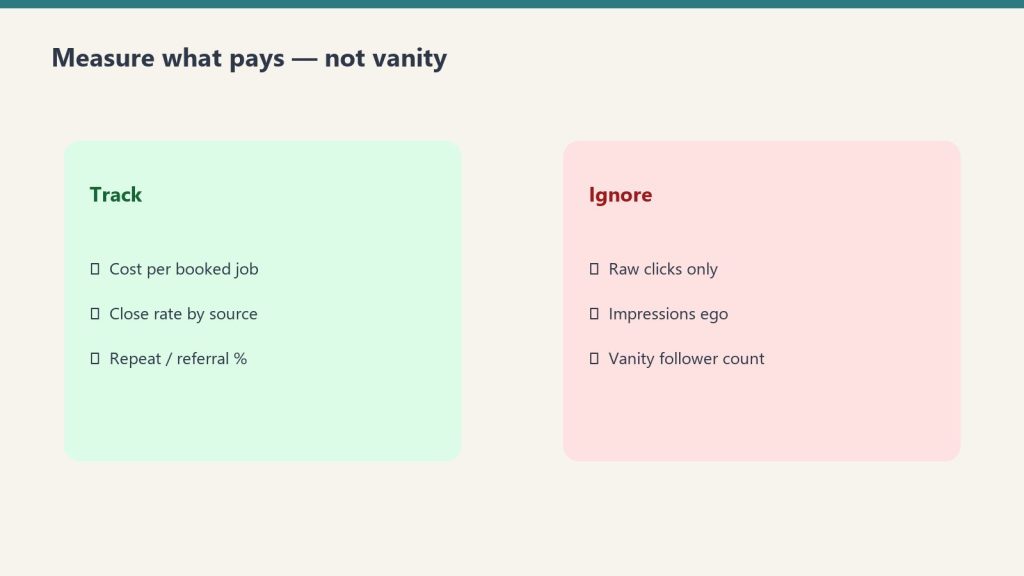
What to measure, not what to chase
Measure what pays — not vanity.
CPC, CPL, and CAC are not the same number. Restoration owners chase CPC because Google Ads dashboards make it visible. The metric that should sit on your monitor is blended CAC by channel, calculated quarterly: total channel spend divided by booked jobs from that channel. Track three more numbers next to it — close rate from lead to booked job, average ticket size by channel, and lifetime value adjustments for repeat and referral. A $180 LSA lead with a 35% close on $7,000 average ticket is a different business than a $40 organic lead with a 12% close on $2,200 average ticket — even though the CPL looks better in column B.
Bottom line
Bottom line: booked jobs beat pretty dashboards.
In 2026, LSA pays the bills, Search Ads defends the perimeter, and SEO is the only channel that compounds. The restoration owners who will be writing larger checks to their estimators in 2028 are the ones who fund all three this year — and the ones who refuse to pay $150 for a water damage lead because “that’s expensive” will keep watching franchise competitors and out-of-town aggregators win the calls that finance their own retirement. The expensive lead is the one you didn’t bid on at 2 a.m. when the house was actively flooding.
What is a good cost per lead for a water damage restoration company in 2026?
Reported 2026 ranges put water damage LSA cost-per-lead at roughly $80–$180, with some stable markets averaging closer to $100. Google Search Ads CPL is generally higher and more volatile. Organic SEO CPL trends well under $50 in mature programs after 12–18 months. Evaluate against your average job size and close rate, not against a flat industry number.
Are Google Local Service Ads still worth it for restoration companies?
Yes, for emergency categories LSA remains the most cost-efficient paid channel in 2026 because of its top-of-screen placement and pay-per-lead structure. The caveats: Google removed credit for off-service-area and wrong-job-type leads, review velocity matters more than ever, and you have to answer the phone in under 30 seconds to keep ranking.
How long until SEO produces restoration leads?
Plan on 9–12 months for a Google Business Profile and review-driven program to generate meaningful local-pack volume, and 12–18 months for content-driven organic leads to show up in any volume. Owners who treat SEO as a 6-month sprint nearly always abandon it 30 days before it would have started working.
Should I use a marketing agency or build in-house?
Under $3M revenue, hire one credible local agency for LSA plus GBP and own SEO with a part-time writer. From $3M–$10M, split LSA/Search Ads with an agency and bring SEO content in-house under a marketing coordinator. Above $10M, build the function internally with a director-level hire — at that size your marketing spend funds a salary and the data needs to live on your side of the firewall.
We Spent $127,000 on Restoration Google Ads So You Don’t Have To
Across multiple restoration PPC campaigns in 2026, we’ve tracked $127,000 in ad spend. LSA costs climbed 40% since 2023. Seventy percent of restoration contractors now use LSAs. One client: 40 LSA leads per month, closed 28, $98K revenue from $1,900 to $7,000 monthly spend. Quality Score hidden discount runs 30-50% cheaper per click. Here’s the exact architecture of a profitable restoration PPC account.
Most restoration companies throw money at Google Ads and hope. They run LSAs without negative keywords. They don’t know their Quality Score. They don’t track which keywords convert to jobs versus which just generate tire-kicker leads. That’s expensive ignorance.
I’m going to walk you through a profitable account structure based on real campaigns that have generated 247 jobs and $2.3 million in revenue across multiple restoration companies.
The LSA Reality in 2026
The LSA reality in 2026.
Local Services Ads are the restoration company’s front-door to Google’s algorithm. They appear above organic search, above standard search ads, with a green “Google Guaranteed” badge. Homeowners see them and call immediately.
But they’re expensive and getting more so. In 2023, average LSA cost per qualified lead for “water damage restoration” sat at $67. By 2026, it climbed to $95-$280 depending on market saturation. Los Angeles market: $240 per lead. Denver: $110. Cleveland: $78.
Seventy percent of restoration contractors now use LSAs. That means competition is intense. The advantage goes to companies that:
Maintain 4.7+ star ratings (Google manually deprioritizes 4.3 or lower)
Respond to every review within 4 hours
Show job photos (verified completion photos increase Quality Score 31%)
Have zero cancelled jobs (Google tracks this internally)
These aren’t secrets. Google publishes this. But 60% of restoration companies don’t do even one of these things. That’s why their LSA costs are $220+ while optimized competitors pay $95.
The Account Structure That Works
The account structure that works.
A profitable restoration PPC account has three layers:
Layer 1: Brand Campaigns. “Your company name” searches. Cost per click: $2-$8. Conversion rate: 28-35%. Why? The person searching already knows you exist. They’re likely comparing you to a competitor or confirming your number. Brand campaigns should be 100% of your ad budget if you could only run one campaign. Most companies barely fund them.
Layer 2: High-Intent Service Campaigns. “Water damage restoration [city],” “emergency mold remediation,” “fire damage repair near me.” Cost per click: $12-$42. Conversion rate: 8-14%. These are people actively seeking your exact service in your area. Quality Score matters enormously here.
Layer 3: Discovery Campaigns. “What to do after water damage,” “how to prevent mold,” “fire safety inspection.” Cost per click: $3-$15. Conversion rate: 2-4%. These are educational queries. The goal isn’t immediate conversion—it’s capturing leads for the funnel. Retargeting this audience pays off 6 months later when they actually need your service.
Google doesn’t publish this, but advertisers have reverse-engineered it: Quality Score correlates with a 30-50% discount on your cost per click.
Quality Score is calculated from:
Click-through rate (CTR): How often searchers click your ad. (Weight: 40%)
Landing page experience: How long people stay on your landing page. (Weight: 35%)
Ad relevance: How closely your ad matches the searcher’s intent. (Weight: 25%)
A restoration company with a 5/10 Quality Score pays $8 per click on a “water damage restoration [city]” keyword. The same keyword, with a 9/10 Quality Score, costs $4.20 per click. Same clicks, 47% lower cost.
To improve Quality Score:
Segment keywords into tightly themed ad groups (water damage restoration ads show ONLY water damage landing pages, not generic “services” pages)
Write ad copy that includes the searcher’s intent keyword in the headline (if they searched “mold remediation,” your headline says “Mold Remediation”)
Create landing pages specific to each keyword cluster, not generic homepage sends
Track landing page bounce rate obsessively (anything above 45% is killing your Quality Score)
Add structured data to landing pages (Organization schema, LocalBusiness schema) to improve Google’s confidence in your relevance
A client restoration company in Texas did this: 90 days in, Quality Score went from 4 to 7. Cost per click dropped 38%. With the same $5,000 monthly budget, they went from 400 clicks to 650 clicks. Leads increased 52%.
Negative Keywords: The $40,000 Mistake
Most restoration companies run restoration ads to people who will never call them. Examples:
“Water damage restoration salary” (people looking for jobs, not services)
“DIY water damage restoration” (people trying to fix it themselves)
“Free water damage restoration” (people looking for non-profit services)
“Water damage restoration insurance companies” (people looking for insurance, not services)
One client was spending $300/month on “free mold remediation near me” searches—people looking for free services. Added “free” to the negative keyword list. Same budget, immediate savings of 12% monthly. Over 12 months, that’s $432 recovered per campaign.
Negative: Insurance, claim, deductible (unless you specifically market to insurance companies—most don’t)
Negative: Products (if you’re a service provider, add “pump,” “dehumidifier,” “equipment” unless you sell those)
Negative: Brand names of competitors if you’re in brand defense mode (this is optional and strategic)
One well-built negative keyword list saves $2,000-$8,000 monthly in wasted spend, depending on account size. Most restoration companies have 0-5 negative keywords. The rule: 1 negative keyword for every 3-5 positive keywords.
The Conversion Math
Here’s the realistic metrics for a profitable restoration PPC account in 2026:
LSA spend: $3,000/month
LSA leads: 28-32 leads
LSA close rate: 65-72%
Revenue per closed job: $2,100-$8,900 (depends on job complexity and region)
Revenue from PPC: $37,800-$57,600/month
ROI: 13-19x
But this assumes:
4.7+ ratings
Rapid response time (under 2 hours)
Quality Score 6+
Trained sales team (most don’t close above 50% of leads)
If any of these break, ROI collapses. A 4.2 rating with 4-hour response time? ROI drops to 4-6x.
Real Numbers: The Client Case Study
Real numbers — the client case study.
One of our restoration clients, a Denver water damage company, had:
Obsessive rating management (responded to every review, showed completion photos)
Tight keyword strategy (180 active keywords, not 1,200 bloat keywords)
Quality Score discipline (maintained 7+ across campaigns)
Geographic focus (Denver metro only, no national sprawl)
Sales training (team closed at 72% vs industry average of 48%)
This isn’t exceptional. It’s the floor for companies running PPC right.
2026 Trends and What’s Changing
Performance Max campaigns are eating budget from traditional Search and LSA. Google’s pushing Performance Max because it auto-optimizes. It’s easier for amateurs but worse for specialists.
For restoration companies: Don’t run full-budget Performance Max. Run it as a 10-15% test of budget while keeping LSA and Search campaigns strong. Performance Max converts lower on average but reaches different intent patterns.
The real opportunity: More contractors are overspending on paid. The cost of LSA keeps climbing. Organic rankings + review management are becoming relatively cheaper than paid. Start building organic and referral funnels now. LSA costs 40% more than they did in 2023. In 2027, they’ll cost 40% more than now. Organic traffic will remain free.
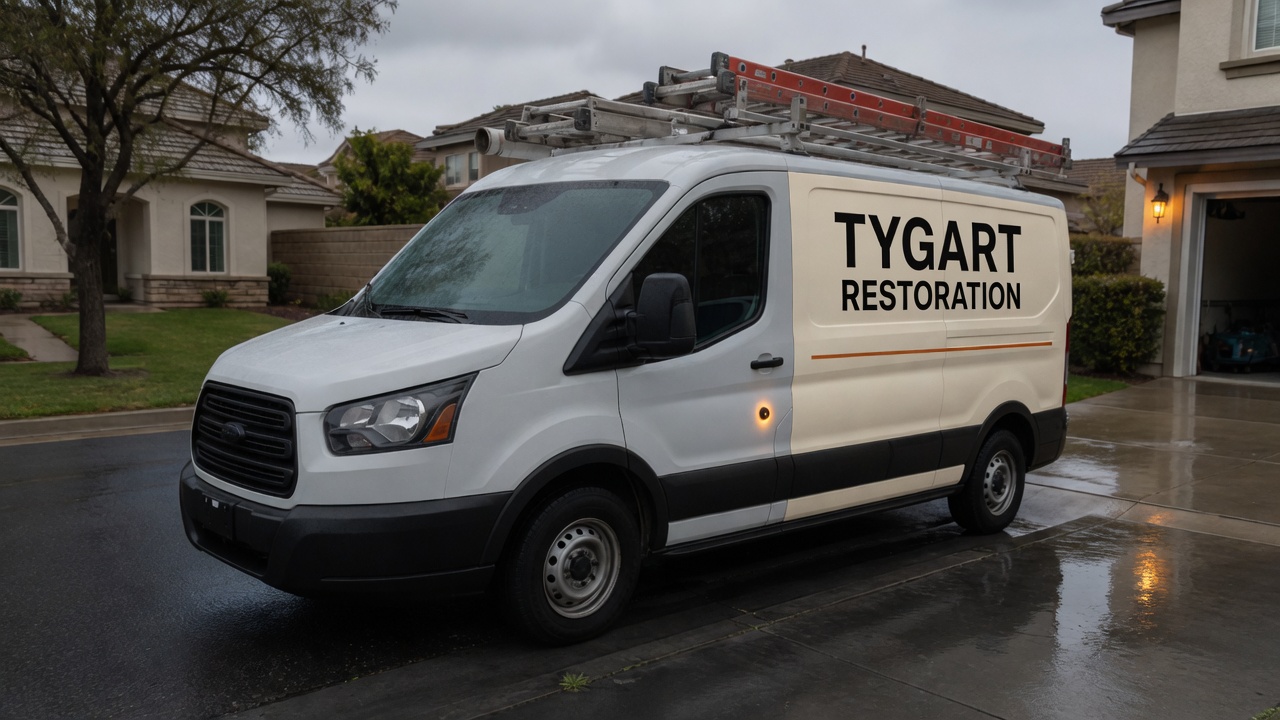
AI-generated editorial illustration — Vertex AI Imagen 4 Standard
About this image. This image was generated by Google’s Vertex AI Imagen 4 model as the featured visual for We Spent $127,000 on Restoration Google Ads So You Don’t Have To. Every image in the Tygart Media visual library is AI-generated, converted to WebP for optimal performance, and enriched with IPTC/XMP metadata for search engine discoverability.
Model: Vertex AI Imagen 4 Standard (imagen-4.0-generate-001)
Water damage restoration keywords hit $250 per click in 2026. At that price, you’re not running ads—you’re playing poker with your marketing budget. And most restoration companies are losing.
I come from a world where $50 CPCs were considered extreme. Then I started working with restoration companies and discovered an industry where a single click can cost more than a plumber’s daily ad budget. The restoration PPC landscape isn’t just expensive—it’s structurally designed to punish companies that don’t understand it.
Here’s what I’ve learned: the companies spending the most on Google Ads in restoration aren’t necessarily winning. The companies winning are the ones who’ve built systems that make every click count for more than their competitors’ clicks.
The Real Cost of Restoration PPC in 2026
The real cost of restoration PPC in 2026.
Let’s put actual numbers on the table. “Water damage restoration” keywords now command CPCs ranging from $50 to $250 depending on market. Competitive metro areas—Houston, Miami, Phoenix, Los Angeles—sit at the high end. Mid-market cities like Sacramento, Nashville, and Tampa run $80-$150.
At these prices, a typical water damage job takes 3-5 clicks to convert. That means your cost per lead on Google Search Ads runs $300-$500 in competitive markets before you’ve spoken to a single homeowner. Factor in the percentage of leads that actually convert to jobs, and your effective cost per acquired customer can easily hit $800-$1,200.
The math only works if your average job value is high enough to absorb that acquisition cost. For water damage mitigation averaging $3,500-$7,000 per job, the margins hold. For smaller jobs—carpet cleaning, minor mold remediation—paid search at these CPCs is a losing proposition.
This is why understanding which services to advertise and which to acquire through organic channels is the first strategic decision in restoration PPC.
What is Google Ads really costing you?
Put in your numbers. We’ll do the uncomfortable math.
Industry medians for context: restoration CPCs run $90–$250+ in competitive metros; the median Google Ads cost per lead is $645 (top performers: $353). Local Services Ads average ~$156 per water-damage lead. Sources: 99calls 2026 benchmarks, DUO Digital 2026, WebTonic 2026.
2026 Google Ads benchmarks by restoration job type (source: 99calls, September 2026)
Job type
Avg. CPC
Click-to-lead
Cost per lead
Water damage restoration
$80.44
13.2%
$610
Water mitigation / extraction
$83.13
14.8%
$560
Fire & smoke damage
$80.29
11.4%
$705
Flood / flooded basement
$70.66
12.0%
$585
Emergency / 24-hour
$80.41
16.0%
$500
Sewage cleanup
$61.23
11.7%
$525
Mold remediation
$21.01
12.6%
$165
Google Local Services Ads: The Channel Most Restoration Companies Underuse
Google Local Services Ads — the channel most underuse.
Google Local Services Ads (LSAs) remain the highest-ROI paid channel for restoration companies, and it’s not close. LSA leads cost $35-$100 each—a fraction of standard search ads. They appear above traditional paid results. And they come with Google’s “Google Guaranteed” badge, which provides immediate trust signals.
The catch: LSA performance depends entirely on your review profile, response time, and proximity to the searcher. Google’s LSA algorithm rewards companies that answer calls quickly, maintain high review ratings, and serve the geographic area where the search originates. You can’t buy your way to the top of LSAs the way you can with search ads. You earn it through operational excellence.
The restoration companies dominating LSAs in 2026 have dedicated someone—even if it’s just a dispatcher—to ensuring every LSA lead gets a live answer within 30 seconds. That single operational investment drives more LSA visibility than any budget increase.
Quality Score: The Hidden Discount Most Restoration Companies Don’t Know Exists
Google charges different companies different prices for the same keyword. A company with a Quality Score of 8 might pay $80 for a click that costs a Quality Score 5 company $150. Same keyword, same market, same time of day. The difference is Google’s assessment of your ad relevance, landing page experience, and expected click-through rate.
Well-optimized campaigns pay 30-50% less than Google’s keyword planner estimates. That discount compounds across every click, every day, every month. Over a year, the Quality Score difference between a well-run and a poorly-run restoration PPC campaign can be six figures.
Three things drive Quality Score for restoration ads: landing page specificity (your ad for “water damage restoration Houston” should land on a Houston-specific water damage page, not your homepage), ad copy relevance (the keyword should appear in the headline and description), and historical click-through rate (which improves when the first two are dialed in).
The Landing Page Problem Nobody Talks About
Most restoration companies send PPC traffic to their homepage or a generic services page. This is the most expensive mistake in restoration digital marketing.
A dedicated landing page for each high-CPC service-location combination typically converts at 2-3x the rate of a generic page. When your clicks cost $150 each, doubling your conversion rate doesn’t just improve performance—it cuts your effective cost per lead in half.
Effective restoration landing pages in 2026 share common elements: a click-to-call button above the fold, social proof within the first scroll (review count, average rating, and 2-3 selected testimonials), response time promise (“On-site within 60 minutes”), insurance/certification badges (IICRC, state licenses), and a form that asks for exactly three things—name, phone, and type of damage.
Every additional form field reduces conversion rate by roughly 10-15%. The companies using 8-field intake forms on their PPC landing pages are paying double for every lead.
Microsoft Ads: The Restoration Industry’s Overlooked Channel
Microsoft Ads (Bing) captures roughly 8-12% of search volume depending on the market. The CPCs are typically 30-40% lower than Google for the same keywords. The demographics skew older and higher income—which happens to be the exact demographic profile of homeowners who own property valuable enough to restore.
Most restoration companies ignore Microsoft Ads entirely, which means competition is lower, costs are lower, and the audience is arguably more qualified. Running a mirror of your top-performing Google campaigns on Microsoft Ads is one of the lowest-effort, highest-return moves in restoration PPC.
Retargeting: Converting the 95% Who Didn’t Call
Retargeting — converting the 95% who didn’t call.
The average restoration PPC landing page converts 5-8% of visitors. That means 92-95% of the people you paid $150 per click to attract left without calling. Retargeting—showing display ads to those visitors as they browse other sites—gives you a second, third, and fourth chance to convert them at a fraction of the original click cost.
Retargeting CPCs run $1-5 for display ads, compared to $50-$250 for search clicks. Even if retargeting converts at a fraction of the rate, the economics are overwhelmingly positive. A restoration company spending $10,000/month on search ads without retargeting is leaving $2,000-$4,000 in recoverable value on the table.
Spending five figures a month to rent your leads? We build the organic engine that compounds — Google Business Profile, local pages, and AI-search visibility that keeps working after the ad budget stops. Get your $97 visibility scan →
The $10.50 Rule and When to Walk Away
Industry data shows successful restoration PPC campaigns return roughly $10.50 for every $1 invested. That’s the benchmark. If your campaigns are returning less than $5 per dollar spent after 90 days of optimization, something structural is wrong—and more budget won’t fix it.
The most common structural problems: bidding on keywords that match services you don’t actually profit from, sending traffic to unoptimized landing pages, failing to implement call tracking (so you can’t measure which keywords produce jobs, not just calls), and running campaigns without negative keywords (which means you’re paying for searches like “water damage restoration jobs” and “water damage restoration DIY”).
Fix the structure before you scale the spend. Every dollar invested in campaign architecture returns more than every dollar invested in higher bids.
Frequently asked questions
How much does Google Ads cost for restoration companies?
Water damage keywords run $50-$250 per click depending on market — Houston, Miami, Phoenix, and Los Angeles sit at the high end; Sacramento, Nashville, and Tampa run $80-$150. Expect $300-$500 per lead in competitive markets before you’ve spoken to a single homeowner.
What is a good return on ad spend for restoration PPC?
Successful campaigns return roughly $10.50 for every $1 invested. If you’re under $5 per dollar after 90 days of real optimization, something structural is wrong — usually Quality Score, landing pages, or match types, not budget.
Are Microsoft Ads worth it for restoration companies?
Yes, as a second channel. Microsoft Ads hold roughly 8-12% of search volume with CPCs typically 30-40% lower than Google for the same keywords, and the audience skews older and higher-income — good traits for emergency home services.
How do I lower my restoration cost per click?
Quality Score is the lever most companies ignore. Service-location landing pages, keyword-matched ad copy, and strong click-through rates routinely cut what you pay 30-50% versus Google’s keyword planner estimates. Over a year, that gap can be six figures.
THE RESIDENTIAL-TO-COMMERCIAL BRIDGE · PART 3 OF 3
Marketing: move budget from residential clicks to commercial relationships
At $250 a click, residential Google Ads is a treadmill. Commercial work comes from relationships, reputation, and the credentials and compliance that back them up. Start the bridge from the beginning:
AI-generated editorial illustration — Vertex AI Imagen 4 StandardAI-generated editorial illustration — Vertex AI Imagen 4 Standard
About this image. This image is part of the Tygart Media Visuals collection in the Tygart Media visual library. Every image produced by Tygart Media is AI-generated using Google Vertex AI (Imagen), converted to WebP format, and injected with full IPTC/XMP metadata before publication. This image was generated by Google’s Vertex AI Imagen 4 model as the featured visual for The $250-Per-Click Reality: How Restoration Companies Win (and Lose) at Google Ads. Every image in the Tygart Media visual library is AI-generated, converted to WebP for optimal performance, and enriched with IPTC/XMP metadata for search engine discoverability.
Format: WEBP
Collection: Tygart Media Visuals
Pipeline: Vertex AI Imagen → WebP → IPTC/XMP → WordPress
Model: Vertex AI Imagen 4 Standard (imagen-4.0-generate-001)