
Every restoration owner who clears $5M in annual revenue eventually faces the same fork in the road: dominate the home market harder, or plant a flag in a second city. The wrong answer is not financially fatal — but it usually adds two or three years of expensive learning before the business starts compounding again. With private equity platforms now operating in 30+ states and the industry consolidating from roughly 15,000 firms toward fewer than 10,000 by 2030, that learning window is closing.
This is the operator-level decision underneath the M&A headlines. Here is the honest framework for it.
The PE backdrop you are competing against
Before deciding whether to open a second location, understand what the buyers up the food chain are doing. Reported industry coverage in 2025 and 2026 shows over $6 billion has been deployed across roughly 50+ restoration platforms since 2018, with quality operators trading in the 4x–7x EBITDA range. Fortify Companies — backed by Osceola Capital — combined Rytech Restoration and Insurcomm to serve more than 100 markets across 30+ states. LP First Capital launched Rewind Restoration with an explicit “partner with local leaders, then scale via acquisitions” thesis. Morgan Stanley Capital Partners acquired American Restoration, which operates across approximately 10 states through eight regional brands.
The pattern is the same in every deal: platforms are not opening locations. They are buying them. A platform spends 18 months building infrastructure, then acquires a $3M–$5M regional operator and bolts it on at a roughly 5x EBITDA multiple. If you are an owner expanding organically into a new market the slow way, you are competing for the same techs, the same referral relationships, and the same carrier slots against a buyer with cheaper capital and a centralized back office.
That does not mean organic expansion is wrong. It does mean you need to be honest about why you are doing it and what the finish line looks like.
The four real reasons owners open a second location (only two are good)
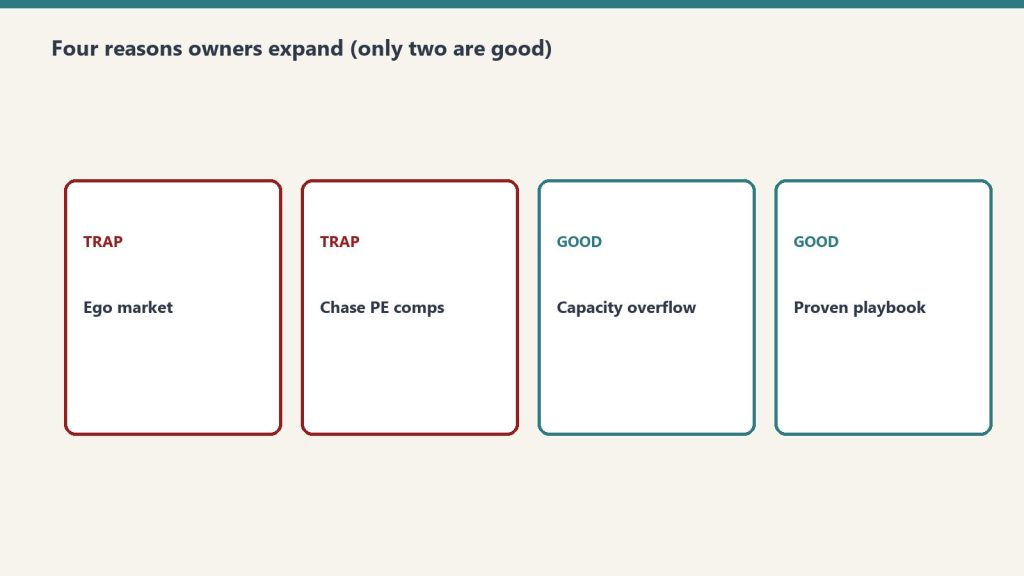
In conversations across the industry, the rationales for a second location tend to cluster into four categories. Two of them tend to work. Two of them tend to bleed cash.
1. The carrier asked for it. Strong reason. If you are on a Contractor Connection, Alacrity, or Code Blue program and your performance metrics in market A have earned you a request to cover market B, the demand is already there before you sign the lease. The carrier is effectively pre-funding your CAC. This is the cleanest second-location case in restoration.
2. A key employee will leave if they do not get equity in something they can run. Reasonable reason. Promoting your best operations manager into a second-market GM role with a real P&L and a real equity slice is often cheaper than losing them to a competitor. The risk is that you are choosing the market for HR reasons, not market reasons. Mitigate it by making the GM put together a real go-to-market plan before you commit capital.
3. The home market feels “tapped out.” Usually wrong. Industry coverage of restoration economics in 2026 — including reporting from Push Leads and Paul Davis — repeatedly notes that most owners who feel tapped out have actually capped their CAC channels, not their market. A second location does not solve a Google Ads ceiling, an LSA neglect problem, or a referral program that has gone stale. It just spreads the same problem over two cities.
4. “It will be worth more at exit.” Almost always wrong on its own. Multi-location restoration platforms do command higher multiples, but the premium comes from diversified revenue and demonstrated systems — not from the existence of a second address. A second location that loses money for three years actively destroys exit value because it drags EBITDA and signals that the operator cannot run multi-site.
The financial test before you sign the lease
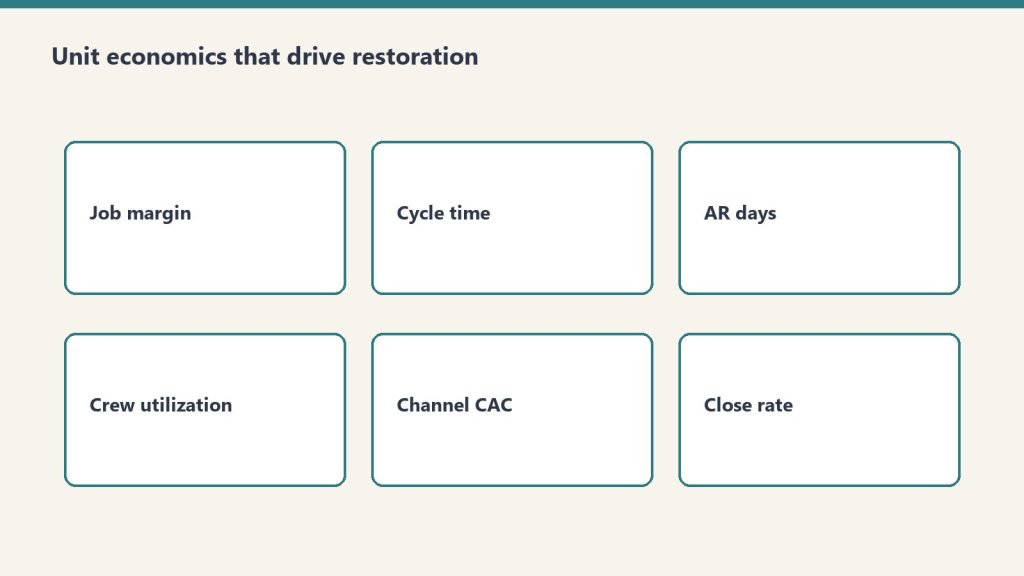
The math is unforgiving. Restoration industry reporting on unit economics generally points at the same benchmarks: water mitigation gross margins in the high 40s to mid 50s, blended company gross margins of roughly 38–45%, and net margins for healthy operators in the 8–15% range. Channel CAC tends to run roughly $100–$180 per acquired job on well-optimized Google Ads, $200–$400 on poorly run campaigns, and effectively the lowest CAC on agent and adjuster referrals.
Run this test before committing:
- Home market net margin must be at least 10% on a trailing-twelve-month basis. If it is not, you do not have a scalable model yet. Fix the unit economics in market A before duplicating them in market B.
- You must have at least 6 months of fully loaded operating cash for the new market. A new market typically does not break even on operating cash for 12–18 months. Most “failed” second locations actually ran out of patience before they ran out of demand.
- CAC in the new market should be modeled at 2x your home-market CAC for the first year. No agent relationships, no adjuster history, no organic search ranking. Plan for it, do not be surprised by it.
- You must have a designated GM willing to live in the new market. Owner-commuter second locations have a documented bad track record across the industry. The job is too relationship-driven for absentee leadership.
What the structure should look like in year one
The second-location org chart that tends to survive is lean and asymmetric. The home market keeps centralized accounting, marketing, estimating support, and Xactimate review. The new market gets a GM, two to three production crews, one project manager, and a dedicated office coordinator. Sales and BD belong to the GM full time — this is non-negotiable because nothing else recovers if local referral relationships are not being built.
Approximate revenue target in year one for a single new market: $1.2M–$2.0M, with a planned net loss in the first 6–9 months and a target of break-even monthly run-rate by month 12. If you cross break-even faster, the carrier-pre-funded scenario was real. If you are still bleeding past month 18, the most common honest answer is that the market choice was wrong — not that the team needs more time.
Single-market dominance: the underrated alternative
For a meaningful share of $3M–$8M restoration operators, the highest-return move is not a second location at all. It is doubling down on the existing market with a vertical-line expansion — adding contents cleaning, mold remediation, or reconstruction in-house — and grinding the home metro toward 6–10% market share.
The math favors this more often than owners assume. A second service line in an existing market shares overhead, shares referral relationships, and adds revenue at a lower marginal CAC than any new geography can. A $5M single-market shop with diversified service lines and clean books frequently exits at a higher multiple than a $7M two-market shop with one money-losing location, because buyers price systems and predictability, not address count.
The exit-aware framing
If your 5-year plan is to sell to a PE platform or a strategic buyer, the question is not “how many locations do I have.” The question is “how cleanly does my next location bolt onto a buyer’s system.” That means:
- Standard chart of accounts across locations from day one
- One CRM and one estimating workflow across all sites
- Documented SOPs for water, fire, mold, contents, and reconstruction
- Carrier program enrollment at the parent entity level, not the location level
- GMs on real comp plans with documented KPI scorecards
If you cannot do those five things in your current single location, you are not ready for a second one. Buyers can tell within a single diligence meeting.
The bottom line
A second location is the right move when a carrier is pulling you into a new market, when you would otherwise lose a key operator, and when your home-market unit economics already produce 10%+ net margins and 6+ months of operating runway. It is the wrong move when it is a substitute for fixing CAC, when you are betting on multiple expansion alone, or when the GM does not actually live in the new city. Most owners would create more enterprise value by adding a service line in their existing market than by adding a city.
The window matters. With platforms still buying regional operators at reported 4x–7x EBITDA multiples and the operator base aging into exit-readiness, the next 3–5 years is the time to either build a defensible multi-market platform or to be the kind of clean, single-market operator that those platforms want to acquire. Both are good outcomes. The bad outcome is being stuck in the middle — two locations, neither profitable, three years older.
Related on Tygart Media: Starlink on a water job · S500 in the van · local SEO for restoration.
Frequently Asked Questions
When should a restoration company open a second location?
When home-market net margins exceed 10% on a trailing-twelve-month basis, when you have 6+ months of fully loaded operating cash to fund the new market, and when either a carrier is requesting expansion or a key operator needs an equity-and-P&L opportunity to retain. Opening a second location to escape a CAC ceiling or to chase a higher exit multiple alone is generally a money-losing decision.
How long does a second restoration location take to break even?
Industry experience suggests 12–18 months to monthly operating break-even is normal for a new restoration market without a carrier program pre-funding the launch. With an active carrier program request, the timeline can compress materially. Owners should plan for a net loss in months 1–9 and budget cash accordingly.
Is it better to add service lines or open a second location?
For most restoration operators in the $3M–$8M range, adding service lines in the existing market — contents, mold, reconstruction — produces a higher marginal return on capital than geographic expansion, because overhead and referral relationships are already paid for. Geographic expansion makes more sense once a single market is diversified across service lines and approaching 6–10% local share.
What multiple do multi-location restoration companies sell for?
Industry reporting in 2026 generally cites a range of approximately 4x–7x EBITDA for quality restoration operators with diversified service lines, with sub-$2M shops trading closer to 2.8x–3.0x SDE. Location count alone does not drive the premium; diversified revenue, documented systems, clean financials, and demonstrated GM-led management at each site are what move the multiple.
📖 Recommended Reading in Restoration Intelligence
- 🎯 Pillar Guide: Does Homeowners Insurance Cover Radon Mitigation?
- 🔗 Next Topic: The Xactimate Supplement Audit Your Estimator Probably Isn’t Running
Leave a Reply