Inspired by Bodhi (@irentdumpsters). Original post: retention beats front-end acquisition. This is a new Tygart article for restoration contractors. We kept the mechanism, added first-party field knowledge, and did not reprint the thread.
The agency version is keep clients for years. The restoration version is keep sources. The plumber who has sent three burst pipes. The property manager with twelve roofs. The adjuster who knows your documentation will not embarrass them.
New-logo marketing is expensive. A source you already earned compounds when you close clean, send the photos the same night, and call after the dry-out instead of disappearing into the next storm.
Put a name on a card. Last loss sent. Last thank-you. Next touch that is not a pitch. That list is the growth plan when Maps is quiet.
Two Bodhi posts from other trades belong on the restoration Monday meeting, even though neither says “mitigation.”
One: a contractor with 170 reviews at 4.8 will outconvert a spotless 5.0 with 50 reviews. Homeowners treat a clean 5.0 as purchased. One cranky note about a driver being ten minutes late makes the other 169 look like real work.
The review should sound like this job happened, not like a template.
Two: revenue and a full calendar are lagging indicators. They came from marketing, reviews, and pipeline three to six months ago. Stop those because the board is full and the drought shows up next quarter.
What a restoration review has to do
A five-star “great job, very professional” is almost useless. Google indexes owner replies. Bodhi’s plumber version is: thank them for the Sunday sewer replacement in Coral Springs. That plants service and geography inside the verified profile.
Restoration version of the same reply:
“Grateful we could get extractors running the same night on the burst-pipe loss in [neighborhood]. Crew followed IICRC S500 dry-out, and we will be back for the rebuild walk-through.”
Neighborhood. Loss type. Standard. Next step. No keyword stuffing. No “thanks for choosing us.”
Velocity beats the weekend dump
Forty reviews in one weekend and then silence for a quarter looks like spam. Three honest reviews a week from closed jobs beats a purchased spike. For restoration that means the request goes out when the job is actually closed — after dry-out or after rebuild, not while the house is still in containment and the homeowner is still mad at the carrier.
Build the ask into the close-out in the field software. SMS with a short GBP link. Track asks, not only reviews received. A 3.9 profile with angry “they billed insurance and left a mess” threads should not get more Maps traffic until the work and the follow-up change.
The full board is last quarter’s marketing
Restoration operators feel this in weather. A wet spring plus a decent pin fills trucks. Someone kills Google posts, review asks, and adjuster touches because “we cannot take more water.” Then July is dry and August is quiet and the story becomes “SEO stopped working.” It did not stop. You stopped feeding it on a lag.
Keep a minimum cadence even when every van is out:
Review ask on every closed job
Owner reply within a day
Fresh job photos on the GBP
One service-page or city-page improvement a week
Adjuster and property-manager touches that do not depend on a storm
Pest control at $7M in six years, in Bodhi’s telling, stacked local SEO, review velocity, and recurring contracts. Restoration already has the recurring analog: maintenance, mold follow-up, commercial agreements, and rebuild after mitigation. Organic search without a second touch after the dry-out is a one-call business wearing a marketing budget.
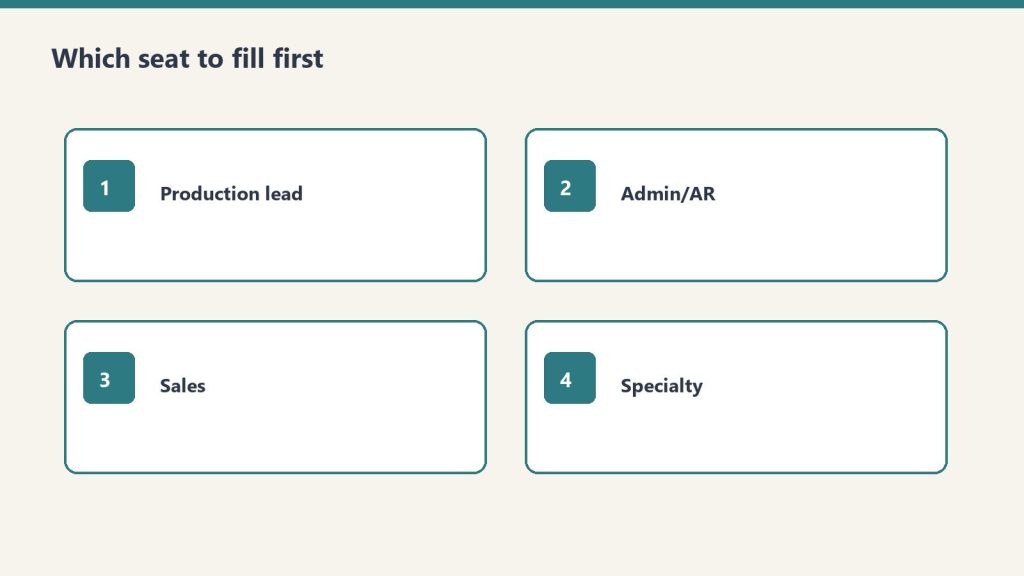
The hardest org-chart decision in restoration is not who to hire. It is what order to hire them in. Get the sequence wrong and you spend money on a seat that doesn’t relieve the bottleneck — while the real constraint, almost always you, keeps strangling growth.
Most owners build their team reactively. A big loss comes in, they’re underwater, so they grab whoever is available — usually another tech. Six months later they have more trucks and the same problem: every job, every estimate, and every collections call still routes through the owner. They added capacity to the field and zero capacity to the bottleneck.
Here is the honest sequence — the one that actually pulls the owner out of the truck — mapped to the revenue milestones where each hire pays for itself.
First, Find Your Real Bottleneck (It’s Probably You)
Find the real bottleneck before you hire more techs.
Before you hire anyone, do the boring exercise. List every function the company performs — answer the phone, dispatch, scope the loss, write the estimate, run the crew, order equipment, invoice the TPA, chase payment, do payroll. Next to each one, write the name of who actually does it. Count how many times your own name appears. That number is your bottleneck, and the first hire should remove the most expensive, most repeatable item from your list — not the one you enjoy least.
The trap is hiring for relief instead of leverage. Hiring a third tech feels good because the trucks are full. But if you are still the only person who can scope a loss and write a winning estimate, those trucks just create more work that funnels back to you.
$0–$1M: You and a Lead Tech
At startup scale, the org chart is two boxes: you and a strong lead technician. You are the estimator, the PM, the dispatcher, and the collections department. That’s fine — and unavoidable — at this stage. The rule of thumb most operators use is roughly $150,000–$200,000 in annual revenue per field technician before adding the next one, because that’s the point where there is genuinely enough work to keep another body busy and billable.
The mistake here is hiring a second tech too early to look bigger than you are. Idle techs are the fastest way to torch a thin startup margin.
$1M–$2M: The First Office Hire — Not Another Tech
First office hire — not another tech — unlocks the owner.
This is the milestone where most owners hire wrong. They add a second or third tech when the seat that actually frees them is administrative. An office coordinator or office manager who owns scheduling, job-file documentation, TPA paperwork, and the collections follow-up is the single highest-leverage hire at this stage. Restoration office and administrative coordinator roles commonly run in the $45,000–$60,000 range depending on market, and that one seat can claw back ten to fifteen owner-hours a week — hours you can redirect into estimating and sales, which are the only two activities that grow revenue.
The math is simple. If you are personally billing $150-plus per estimating hour and you hand off twelve hours of admin a week to a $55,000 coordinator, the hire pays for itself almost immediately and converts owner time into top-line growth.
$2M–$3.5M: A Dedicated Estimator / Project Manager
Once admin is covered, the next thing chained to the owner is almost always scoping and estimating. This is the hardest seat to give up because it feels like the part only you can do — and at first, it is. But a $2M shop cannot scale on a single estimator who is also the CEO.
Hire a restoration estimator/PM who can scope a loss, write the Xactimate estimate, and manage the job to completion. Expect this to be one of your more expensive seats: restoration project manager and estimator compensation broadly lands in the $60,000–$90,000 range nationally, with experienced, supplement-savvy PMs commanding more in tight labor markets. Plan for a ramp — a new PM rarely writes estimates as tight as an experienced owner on day one, and supplement recovery may dip during the handoff before it recovers.
This is also where your tech stack starts to matter. If your estimating, job management, and TPA reporting all live in the owner’s head or a spreadsheet, the new PM can’t be effective. The hire and the system have to land together.
$3.5M–$5M: An Operations Manager and the Owner Comes Off the Truck
Ops manager stage: owner comes off the truck on purpose.
By this stage you should have a small bench: lead techs, an office manager, and at least one PM/estimator. The seat that defines a $5M shop is an operations manager — someone who is not you and, ideally, not a relative — who owns daily execution: dispatch, crew utilization, equipment, and job throughput. Restoration operations manager pay broadly runs from roughly $63,000 on the lower end to around $89,000-plus for experienced managers, depending heavily on market and revenue scale.
This is the hire that lets the business survive without the owner physically present. It is also the one that most directly changes what the company is worth. Restoration shops under about $2M tend to trade at roughly 2.8x–3.0x SDE, while companies that cross $5M with a diversified service mix and a real second layer of leadership command 4x–7x EBITDA. Buyers aren’t paying that premium for revenue — they’re paying for an operation that runs without the founder in the dispatch seat. The operations manager is what makes that true.
A Sanity Check on Labor Cost
As you build the team, keep the whole picture in view. Healthy restoration shops generally run blended gross margins in the 50–75% range depending on mix — water mitigation sits at the high end (roughly 70–80%) because equipment does much of the work, while reconstruction and fire work run leaner. Well-run operations keep total operating expense, excluding direct job cost, in the rough range of 40–55% of revenue. If a new hire pushes overhead past that band without a clear path to more billable throughput, you’ve hired ahead of your revenue — slow down and fill the pipeline before you fill the seat.
The Bottom Line
The order is admin, then estimator/PM, then operations manager — and only more techs as billable volume genuinely demands them. Hire to remove yourself from the bottleneck, not to make the trucks look full. The owners who hit $5M and sell at a 4x-plus multiple are not the ones who hired the most people fastest. They’re the ones who hired the right seat next, every time, until the day the business no longer needed them in the truck.
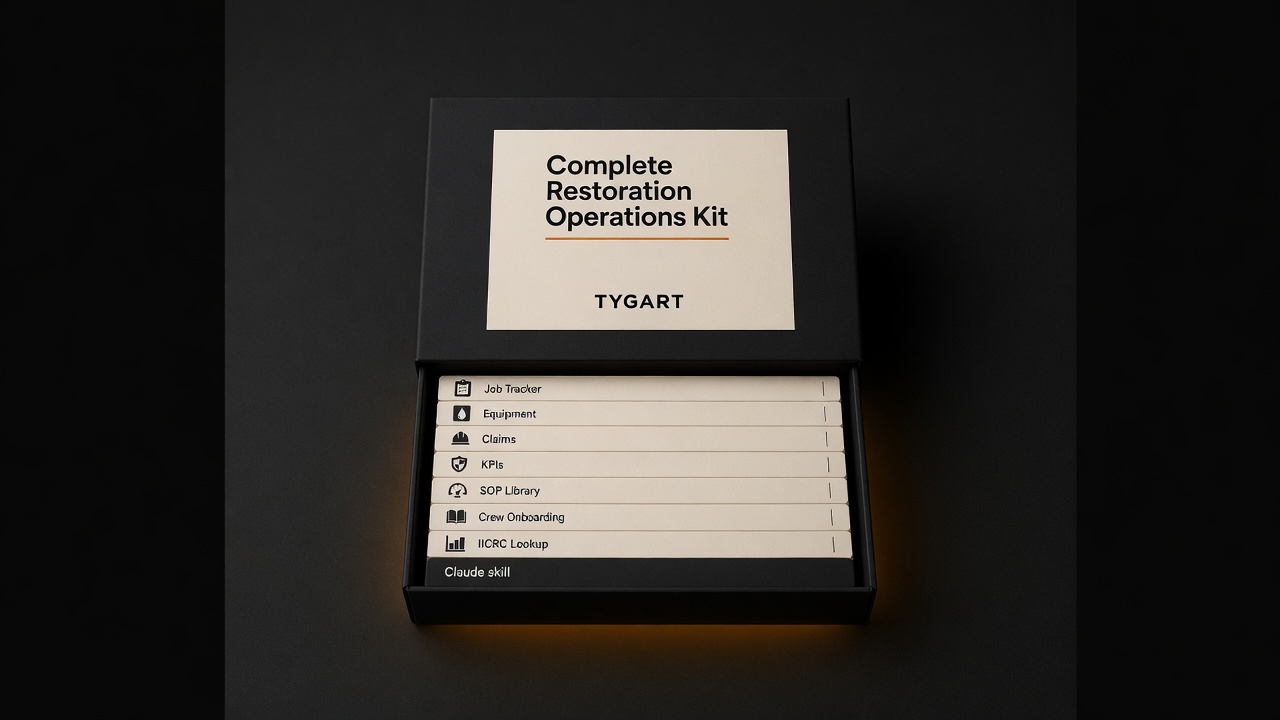
If you’re still running the whole company from the van, the Complete Restoration Operations Kit gives you the connected job tracker, equipment, claims, SOPs, KPIs, and crew tools that make those hires actually stick. Pair it with the Restoration Leadership Toolkit — Claude Edition when you’re ready to build the bench that lets you step out of the truck.
Most restoration owners get the second-location itch around $3M. The honest answer is they shouldn’t scratch it until $5M — and even then, only if a specific list of things is already true inside the first shop.
Opening a branch is one of those decisions that looks like growth on the surface and turns into the slow bleed underneath. The mistake is almost never the second location itself. The mistake is the first location wasn’t ready to be left alone yet, and the owner went from running one healthy business to running two broken ones.
Here’s the honest framework. Not the cheerleader version.
Why $5M Is the Real Threshold (Not $3M)
Industry valuation data makes this concrete: restoration shops under $2M trade at roughly 2.8x–3.0x SDE. Once you cross $5M with a diversified service mix, multiples jump to 4x–7x EBITDA. That gap is not just about revenue — it reflects what buyers see in the operation. A $5M shop has a real second layer of leadership. A $3M shop almost always doesn’t.
When you open a second location from a $3M base, you are usually taking the only person who knows how to run the business — you — and splitting yourself in half. The first location’s gross margin starts compressing within ninety days. The new location burns cash for twelve to eighteen months before it stabilizes. Now you have two locations that both need you and neither one is the business it used to be.
At $5M, you typically have an operations manager, a production manager, a dedicated estimator or project manager bench, and recurring TPA volume that doesn’t depend on the owner answering the phone. That is the difference. The threshold isn’t a dollar figure — it’s whether the first location can run a full week without you in the building.
The Five Things That Have to Be True Before You Open
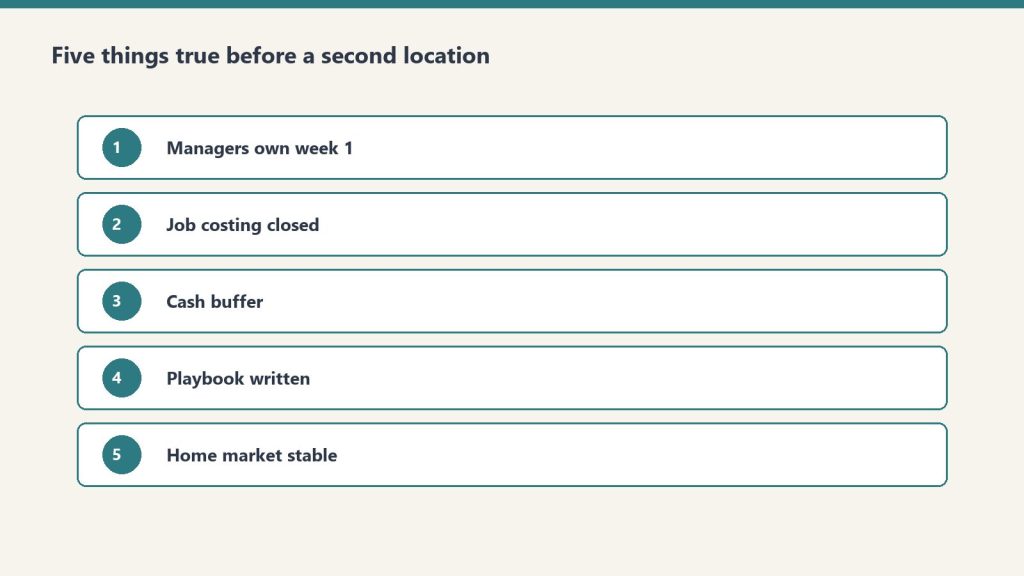
Five things have to be true before you open.
1. The first location can survive 30 days without you. Not “the work gets done.” That you can be unreachable for a month and the financials, the TPA scorecards, and the production schedule all stay inside normal range. If you can’t do that, you don’t have a second-location problem. You have a delegation problem at the first one, and adding geography won’t fix it.
2. You have an operations manager who is not you and is not a relative. Family members can run a second location, but only if they were already running a P&L inside the first one. The second-location playbook is the operations manager playbook. If you don’t have someone who can hold gross margin, manage WIP, and run a weekly production meeting without you in the room, the branch will not work.
3. The new market has documented demand, not a feeling. Pull the data before you sign a lease. Carrier referrals you’re already turning down in the target market. TPA territory gaps your existing programs have flagged. Search volume for “water damage restoration [city]” and the CPC on it. If the only reason you’re picking the market is that your cousin lives there or you saw a competitor’s truck, you don’t have a market — you have a hunch.
4. The first location is throwing off enough cash to fund 18 months of branch burn. A new restoration location typically loses money for twelve to eighteen months. Plan for the long end. SBA expansion loans usually want a 1.25 DSCR before they’ll touch it, which means your existing operation has to be healthy enough to service the new debt while the branch is still in the red. If the math doesn’t work without the new location immediately producing, the math doesn’t work.
5. Your tech stack scales without bolt-ons. If your job management software, Xactimate workflow, and TPA portal logins are all stitched together by tribal knowledge inside the first office, the second location will not run the same playbook. It will run a worse one. The system has to be portable before the branch opens, not after.
What Most Owners Get Wrong
Most owners get people depth wrong — not the lease math.
The most common second-location failure pattern goes like this. Owner hits $3.5M. Owner is tired, ambitious, and has an opportunity — a competitor closing down, a key employee asking for an ownership path, a city forty-five minutes away that “doesn’t have anyone good.” Owner signs a lease, hires a production lead, and tells himself the branch will be self-sufficient by month six.
Month six arrives. The branch is at 40% of projected revenue. The original location’s gross margin has slipped four points because the best production manager got moved to the new branch and the bench underneath wasn’t ready. The owner is driving between two offices three days a week. Cash is tight. The owner doubles down — hires another person, runs a Google Ads campaign in the new market, increases the burn — and by month eighteen the branch is either limping or being quietly wound down.
This isn’t a hypothetical. It is the most common growth-stage failure in the industry, and it happens because the second location was opened as a revenue bet when it should have been opened as an operational bet.
The owners who successfully open second locations almost always share three traits. First, they spent eighteen to twenty-four months building the leadership bench inside the first location before they ever talked about a branch. Second, they entered the new market with a known revenue floor — either a TPA program that committed volume, a large commercial client base in the geography, or a key person from the new market with their own book. Third, they treated the first six months of the branch as an investment, not a revenue line. They didn’t expect the branch to carry itself. They expected to lose money buying market presence and learning the territory.
The phrase that separates the two camps is simple. Failed openings start with “we need to grow.” Successful openings start with “we have the team and the demand to grow.”
The Bottom Line
If you’re under $5M and you don’t have a real operations bench, do not open a second location. Spend the next twelve months building the bench, hardening the tech stack, and proving the first location can run without you. The valuation gap between a clean $5M single location and a $7M two-location operation where both are slightly broken is enormous — and it almost always favors the clean single.
The second location is a multiplier. It multiplies whatever is true about the first one. If the first one is humming, you’ll build something worth selling for 5x EBITDA. If the first one is fragile, you’ll build two fragile ones and discover that the buyers paying premium multiples will pass on both.
Build the bench. Document the playbook. Hit $5M with the owner out of the truck. Then open the second.
Every restoration owner who clears $5M in annual revenue eventually faces the same fork in the road: dominate the home market harder, or plant a flag in a second city. The wrong answer is not financially fatal — but it usually adds two or three years of expensive learning before the business starts compounding again. With private equity platforms now operating in 30+ states and the industry consolidating from roughly 15,000 firms toward fewer than 10,000 by 2030, that learning window is closing.
This is the operator-level decision underneath the M&A headlines. Here is the honest framework for it.
The PE backdrop you are competing against
Before deciding whether to open a second location, understand what the buyers up the food chain are doing. Reported industry coverage in 2025 and 2026 shows over $6 billion has been deployed across roughly 50+ restoration platforms since 2018, with quality operators trading in the 4x–7x EBITDA range. Fortify Companies — backed by Osceola Capital — combined Rytech Restoration and Insurcomm to serve more than 100 markets across 30+ states. LP First Capital launched Rewind Restoration with an explicit “partner with local leaders, then scale via acquisitions” thesis. Morgan Stanley Capital Partners acquired American Restoration, which operates across approximately 10 states through eight regional brands.
The pattern is the same in every deal: platforms are not opening locations. They are buying them. A platform spends 18 months building infrastructure, then acquires a $3M–$5M regional operator and bolts it on at a roughly 5x EBITDA multiple. If you are an owner expanding organically into a new market the slow way, you are competing for the same techs, the same referral relationships, and the same carrier slots against a buyer with cheaper capital and a centralized back office.
That does not mean organic expansion is wrong. It does mean you need to be honest about why you are doing it and what the finish line looks like.
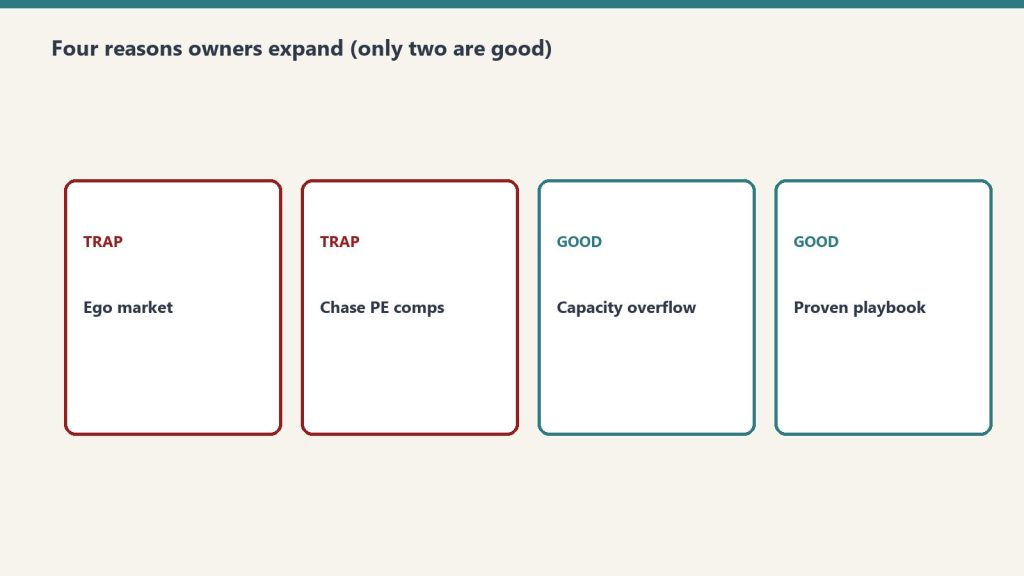
The four real reasons owners open a second location (only two are good)
Only two of the four expansion reasons are good.
In conversations across the industry, the rationales for a second location tend to cluster into four categories. Two of them tend to work. Two of them tend to bleed cash.
1. The carrier asked for it. Strong reason. If you are on a Contractor Connection, Alacrity, or Code Blue program and your performance metrics in market A have earned you a request to cover market B, the demand is already there before you sign the lease. The carrier is effectively pre-funding your CAC. This is the cleanest second-location case in restoration.
2. A key employee will leave if they do not get equity in something they can run. Reasonable reason. Promoting your best operations manager into a second-market GM role with a real P&L and a real equity slice is often cheaper than losing them to a competitor. The risk is that you are choosing the market for HR reasons, not market reasons. Mitigate it by making the GM put together a real go-to-market plan before you commit capital.
3. The home market feels “tapped out.” Usually wrong. Industry coverage of restoration economics in 2026 — including reporting from Push Leads and Paul Davis — repeatedly notes that most owners who feel tapped out have actually capped their CAC channels, not their market. A second location does not solve a Google Ads ceiling, an LSA neglect problem, or a referral program that has gone stale. It just spreads the same problem over two cities.
4. “It will be worth more at exit.” Almost always wrong on its own. Multi-location restoration platforms do command higher multiples, but the premium comes from diversified revenue and demonstrated systems — not from the existence of a second address. A second location that loses money for three years actively destroys exit value because it drags EBITDA and signals that the operator cannot run multi-site.
The financial test before you sign the lease
Financial test before the lease — unit economics first.
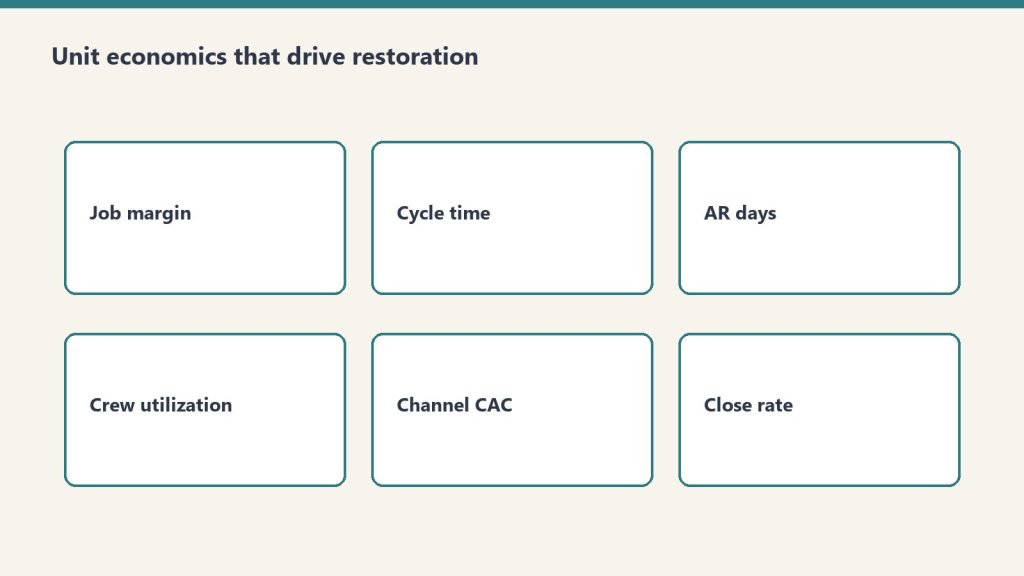
The math is unforgiving. Restoration industry reporting on unit economics generally points at the same benchmarks: water mitigation gross margins in the high 40s to mid 50s, blended company gross margins of roughly 38–45%, and net margins for healthy operators in the 8–15% range. Channel CAC tends to run roughly $100–$180 per acquired job on well-optimized Google Ads, $200–$400 on poorly run campaigns, and effectively the lowest CAC on agent and adjuster referrals.
Run this test before committing:
Home market net margin must be at least 10% on a trailing-twelve-month basis. If it is not, you do not have a scalable model yet. Fix the unit economics in market A before duplicating them in market B.
You must have at least 6 months of fully loaded operating cash for the new market. A new market typically does not break even on operating cash for 12–18 months. Most “failed” second locations actually ran out of patience before they ran out of demand.
CAC in the new market should be modeled at 2x your home-market CAC for the first year. No agent relationships, no adjuster history, no organic search ranking. Plan for it, do not be surprised by it.
You must have a designated GM willing to live in the new market. Owner-commuter second locations have a documented bad track record across the industry. The job is too relationship-driven for absentee leadership.
What the structure should look like in year one
The second-location org chart that tends to survive is lean and asymmetric. The home market keeps centralized accounting, marketing, estimating support, and Xactimate review. The new market gets a GM, two to three production crews, one project manager, and a dedicated office coordinator. Sales and BD belong to the GM full time — this is non-negotiable because nothing else recovers if local referral relationships are not being built.
Approximate revenue target in year one for a single new market: $1.2M–$2.0M, with a planned net loss in the first 6–9 months and a target of break-even monthly run-rate by month 12. If you cross break-even faster, the carrier-pre-funded scenario was real. If you are still bleeding past month 18, the most common honest answer is that the market choice was wrong — not that the team needs more time.
Single-market dominance: the underrated alternative
Single-market dominance is often the underrated alternative.
For a meaningful share of $3M–$8M restoration operators, the highest-return move is not a second location at all. It is doubling down on the existing market with a vertical-line expansion — adding contents cleaning, mold remediation, or reconstruction in-house — and grinding the home metro toward 6–10% market share.
The math favors this more often than owners assume. A second service line in an existing market shares overhead, shares referral relationships, and adds revenue at a lower marginal CAC than any new geography can. A $5M single-market shop with diversified service lines and clean books frequently exits at a higher multiple than a $7M two-market shop with one money-losing location, because buyers price systems and predictability, not address count.
The exit-aware framing
If your 5-year plan is to sell to a PE platform or a strategic buyer, the question is not “how many locations do I have.” The question is “how cleanly does my next location bolt onto a buyer’s system.” That means:
Standard chart of accounts across locations from day one
One CRM and one estimating workflow across all sites
Documented SOPs for water, fire, mold, contents, and reconstruction
Carrier program enrollment at the parent entity level, not the location level
GMs on real comp plans with documented KPI scorecards
If you cannot do those five things in your current single location, you are not ready for a second one. Buyers can tell within a single diligence meeting.
The bottom line
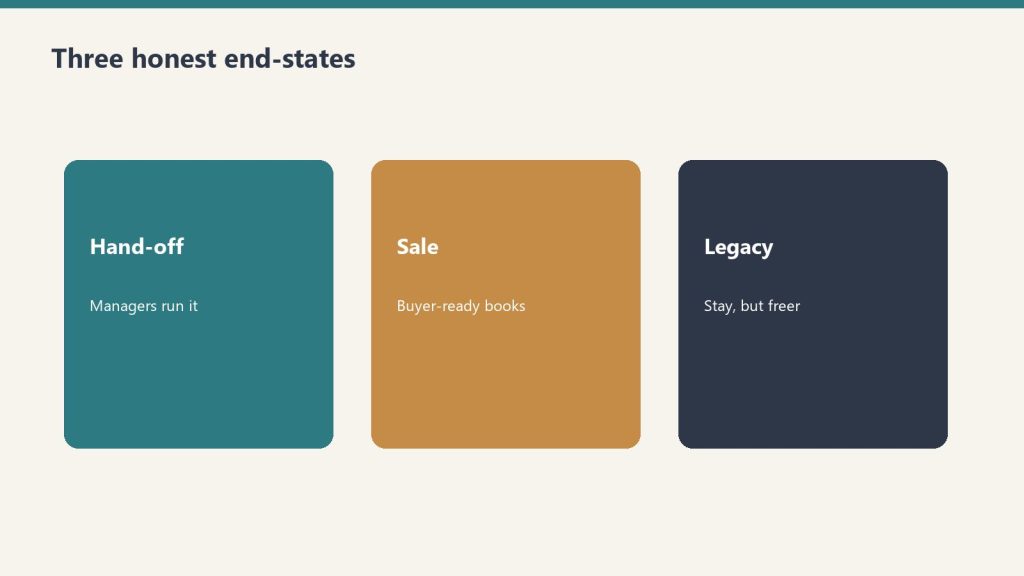
A second location is the right move when a carrier is pulling you into a new market, when you would otherwise lose a key operator, and when your home-market unit economics already produce 10%+ net margins and 6+ months of operating runway. It is the wrong move when it is a substitute for fixing CAC, when you are betting on multiple expansion alone, or when the GM does not actually live in the new city. Most owners would create more enterprise value by adding a service line in their existing market than by adding a city.
The window matters. With platforms still buying regional operators at reported 4x–7x EBITDA multiples and the operator base aging into exit-readiness, the next 3–5 years is the time to either build a defensible multi-market platform or to be the kind of clean, single-market operator that those platforms want to acquire. Both are good outcomes. The bad outcome is being stuck in the middle — two locations, neither profitable, three years older.
When should a restoration company open a second location?
When home-market net margins exceed 10% on a trailing-twelve-month basis, when you have 6+ months of fully loaded operating cash to fund the new market, and when either a carrier is requesting expansion or a key operator needs an equity-and-P&L opportunity to retain. Opening a second location to escape a CAC ceiling or to chase a higher exit multiple alone is generally a money-losing decision.
How long does a second restoration location take to break even?
Industry experience suggests 12–18 months to monthly operating break-even is normal for a new restoration market without a carrier program pre-funding the launch. With an active carrier program request, the timeline can compress materially. Owners should plan for a net loss in months 1–9 and budget cash accordingly.
Is it better to add service lines or open a second location?
For most restoration operators in the $3M–$8M range, adding service lines in the existing market — contents, mold, reconstruction — produces a higher marginal return on capital than geographic expansion, because overhead and referral relationships are already paid for. Geographic expansion makes more sense once a single market is diversified across service lines and approaching 6–10% local share.
What multiple do multi-location restoration companies sell for?
Industry reporting in 2026 generally cites a range of approximately 4x–7x EBITDA for quality restoration operators with diversified service lines, with sub-$2M shops trading closer to 2.8x–3.0x SDE. Location count alone does not drive the premium; diversified revenue, documented systems, clean financials, and demonstrated GM-led management at each site are what move the multiple.
If you own a restoration company doing somewhere between $2M and $10M a year, you are operating in the most actively consolidated environment this industry has ever seen. Reported figures put the U.S. restoration market at roughly $7.1B in 2025, growing in the 5–6% CAGR range, with 50+ private equity platforms reportedly acquiring operators at multiples in the 4x–7x EBITDA range. Quality scaled operators in the $8M+ range have reportedly traded at the upper end — approximately 6x–8x EBITDA — when the asset is built right.
Almost none of that value gets captured by accident. The org chart you build at $2M determines whether you can survive $5M. The systems you install at $5M determine whether $10M makes you or breaks you. And the structure at $10M determines whether a PE platform sees you as a bolt-on at a discount or a regional anchor at a premium.
Here is the honest breakdown of what the org should look like at each revenue milestone, what the typical owner gets wrong, and what an exit-aware growth path actually requires.
$2M: The owner-operator squeeze
At $2M, the owner is still the bottleneck of every consequential decision. A typical structure: the owner does sales, estimating, and major-loss oversight; one office admin handles AR/AP and scheduling; six to eight technicians split across two to three trucks; one lead tech runs supplements informally. Reconstruction is either non-existent or subcontracted ad hoc.
What this stage actually feels like: gross margins on mitigation can run in the reported 65–75% range, but the owner’s labor is uncosted. If you charged your own time at the rate of a real operations manager (approximately $80K–$110K fully loaded), most $2M shops would discover their actual margin is thinner than their P&L suggests.
The mistake at this stage: hiring more techs to grow revenue. More techs at $2M without a coordination layer creates more chaos, not more profit. The next hire is not a fifth tech. It is the first non-owner decision-maker.
$5M: The operations manager inflection
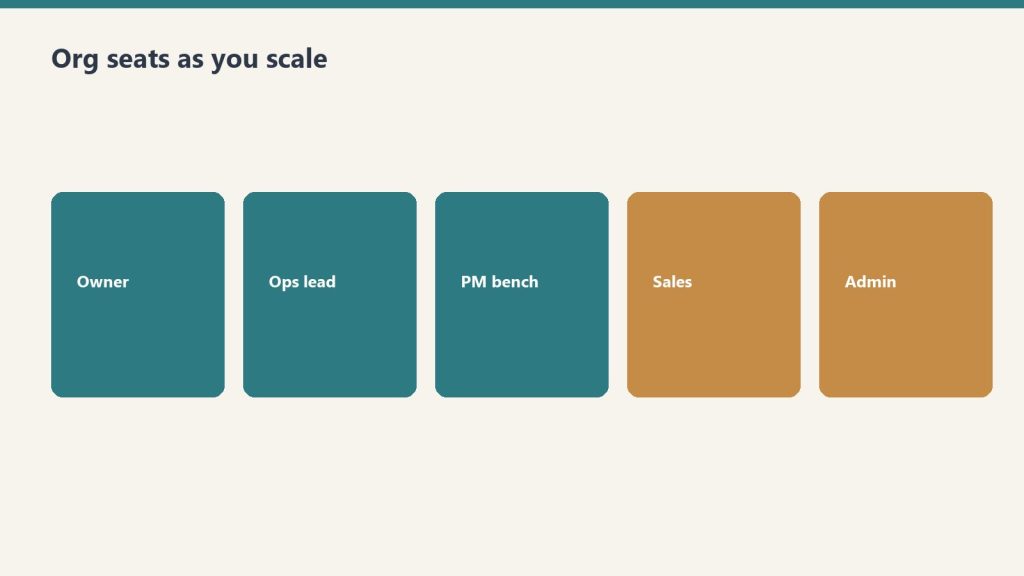
Seats change as revenue changes — titles are not the strategy.
$5M is where the structure has to change or the owner will burn out. The proven move is to hire a real operations manager — someone who owns the mitigation P&L day to day so the owner can focus on relationships, supplements, and growth. Reported compensation ranges for restoration operations managers cluster around $80K–$120K base plus variable, depending on market.
The $5M org typically looks like: owner; operations manager; one project manager for mitigation; one project manager (or a lead carpenter functioning as one) for reconstruction; office admin handling AR/AP; a dedicated estimator or supplement coordinator; 10–14 technicians across 4–6 trucks; one or two carpenters or subs handling reconstruction in-house.
This is also the stage where adding reconstruction matters disproportionately. Reported gross margins on reconstruction land in the 25–40% range — lower than mitigation but on much larger ticket sizes. A company that captures 25–30% of its mitigation revenue as in-house reconstruction by Year 3 of scaling tends to be substantially more valuable at exit, because reconstruction revenue is harder to replicate and stickier with carriers.
The mistake at this stage: the owner refuses to fully hand over the mitigation P&L. The operations manager becomes a dispatcher instead of a real GM. The org gets stuck at $5M for years.
$10M: The platform-decision stage
Platform-decision stage: managers own the week.
At $10M, the question is no longer “how do we grow?” — it is “what are we growing into?” There are two paths and they require different org structures.
Path A — single-market dominance. Stay in one metro, deepen TPA relationships (typically expanding from 2–3 carrier programs to 4–6), build a dedicated commercial division, and push toward $15M–$18M in a single footprint. Org: owner shifts to CEO role; operations manager promoted to COO; one mitigation manager; one reconstruction manager; commercial division lead; in-house controller or fractional CFO; dedicated marketing manager; office admin team of 2–3; 20–30 field staff.
Path B — multi-location expansion. Open a second branch in an adjacent market. This is where most $10M companies break. The org has to duplicate without doubling overhead: branch manager who reports to a regional operations leader; standardized SOPs, training, and KPIs; shared back-office (AR/AP, HR, marketing) from the home office; one finance function across both branches.
Reported industry experience is that the second location is the hardest. Branch three and four are dramatically easier if branch two is run with discipline. Most owners who fail at multi-location failed because they opened branch two as a bolted-on copy of branch one and did not build a real regional management layer in between.
$25M: Platform-ready
By $25M, the company is no longer a restoration business in the operational sense. It is a portfolio of branches with a central operating system. Org at this stage typically includes: CEO; COO; CFO (real, not fractional); VP of operations; regional operations managers (one per 2–3 branches); a dedicated commercial sales team; a marketing director; HR director; training manager; and 60–120+ field staff.
This is the structure PE platforms actually pay premiums for. The reported pattern: companies built around the owner trade at the lower end of the 4x–7x EBITDA range. Companies built around a system, with EBITDA visibility, repeatable branch economics, and a non-owner-dependent management team, trade at the upper end — approximately 6x–8x EBITDA, with some strategic transactions reportedly going higher.
The exit-aware framing
Exit-aware framing — org chart is part of the multiple.
Most restoration owners build the org chart they need today. Owners who exit well build the org chart their next buyer will want. The functional difference is small. The financial difference is enormous.
At $5M EBITDA of $1M, the difference between a 4x exit and a 7x exit is $3M. That gap is almost entirely a function of org structure, not revenue. Two restoration companies with identical revenue and identical margins will trade at different multiples if one is owner-dependent and the other is system-dependent.
Bottom line
The growth path is not a revenue chart. It is a sequence of structural inflection points. At $2M, the next hire is not a tech — it is a manager. At $5M, the next decision is not “more sales” — it is whether the owner will actually hand over the mitigation P&L. At $10M, the decision is single-market depth versus regional expansion, and the org has to be built before the second branch opens. At $25M, the company is either a platform asset or a glorified job shop — and the buyer can tell the difference in the first meeting.
The market is paying premium multiples for companies that look like platforms. Build the org that gets paid.
What is the right first non-tech hire for a $2M restoration company?
An operations manager or general manager who can own the mitigation P&L day to day, freeing the owner to focus on sales, supplements, and growth. Hiring another technician at this stage typically adds chaos, not profit, because the coordination bottleneck is the owner, not the field capacity.
When should a restoration company add in-house reconstruction?
Most owners benefit from adding reconstruction once they hit roughly $3M–$5M in mitigation revenue and have a stable operations manager in place. Reconstruction increases average ticket size, deepens carrier relationships, and is harder to replicate, which raises the exit multiple. Adding reconstruction before the org can support it usually just adds risk and overhead.
What EBITDA multiple do restoration companies sell for in 2026?
Reported ranges put quality restoration operators at 4x–7x EBITDA, with companies scaled to $8M+ in revenue and built around a system rather than the owner reportedly trading at the upper end of approximately 6x–8x EBITDA. Smaller operations under $500K in SDE often transact closer to 2.8x–3x on an SDE basis rather than an EBITDA basis. Numbers vary by region, carrier relationships, and quality of management team.
Is multi-location expansion or single-market depth the better growth strategy?
Both work, but they require different org investments. Single-market depth at $15M–$18M from one footprint can produce strong cash flow with less management complexity. Multi-location expansion produces higher exit valuations and platform optionality, but only if a regional management layer is built before the second branch opens. The most common failure mode is opening a second location without that layer in place.