Restoration Marketing Campaigns - Tygart Media

Category: Restoration Marketing Campaigns

  • The Google Verified Badge and the Death of LSA Lead Disputes: What Restoration Owners Need to Know in 2026

    The Google Verified Badge and the Death of LSA Lead Disputes: What Restoration Owners Need to Know in 2026

    If you have been running Google Local Services Ads (LSAs) for your restoration company for more than a year, the platform you’re managing today is not the one you signed up for. Two changes that landed in late 2025 quietly rewrote the economics of LSAs for restoration contractors — and most owners I talk to are still operating on outdated assumptions. The badge you bragged about is gone. The dispute process you relied on to claw back bad leads is gone. And the insurance trap that can silently kill your campaign is bigger than ever. Here is what actually changed and what you should do about it.

    The badge consolidation: “Google Guaranteed” is now “Google Verified”

    Effective October 20, 2025, Google folded its three trust badges — “Google Guaranteed,” “Google Screened,” and “License Verified by Google” — into a single unified “Google Verified” blue checkmark. For restoration owners who spent months getting the green Google Guaranteed badge and then put it on their trucks and websites, this matters. The badge you earned still exists, it just looks different and means something slightly different now.

    The verification requirements themselves haven’t loosened. You still pass a background check (Google runs this free through its partner Evident), and Google still verifies your license and insurance. Reported approval timelines run roughly three to four weeks once your documents are submitted — budget for that lag if you’re launching into a busy season.

    The money-back guarantee is dead — and that changes your pitch

    Here’s the change almost nobody talks about: the consumer money-back guarantee that was the whole point of the “Google Guaranteed” name was discontinued on November 7, 2025. Under the old program, if a customer was unhappy with a job booked through LSAs, Google would reimburse them up to a lifetime cap. That backstop is gone.

    Why should a restoration owner care? Because if your sales process or your website copy still leans on “we’re backed by Google’s money-back guarantee,” you are now making a claim that is no longer true. Audit your marketing materials. The badge now signals verification — that you are who you say you are, licensed and insured — not a satisfaction guarantee. That’s a meaningful difference in how you should position it to a homeowner who just had a pipe burst.

    The bigger story: manual lead disputes are gone

    This is the change that hits your wallet directly. For years, the LSA model let restoration contractors manually dispute junk leads — wrong number, spam, a caller looking for a service you don’t offer, a job outside your service area — and recover a meaningful share of those charges. Reports from contractors who worked the old system suggest manual disputes recovered credits on a solid majority of flagged bad leads when documented well.

    Google removed manual disputes in 2024 and replaced them with an automated credit system. Here’s how it works now: Google’s machine learning reviews leads, typically within about 72 hours of being charged, and automatically applies credits for leads it deems invalid, with credits generally appearing within roughly 30 days. You no longer build a case and submit it. The algorithm decides.

    Two limitations matter enormously for restoration:

    • “Job type not serviced” and “geo not serviced” leads are no longer creditable. If a caller wants mold remediation and you only do water mitigation, or the job is two counties away, Google will not credit that charge anymore. Restoration owners across the home-services space have reported receiving out-of-area and out-of-category leads with no recourse — and that’s now baked into the system, not a glitch.
    • The automated system is reportedly less generous. Practitioner estimates put the current automated credit rate well below what manual disputes used to recover. You will eat more bad-lead cost than you used to. Plan your cost-per-acquisition math accordingly.

    The one lever you still have: rate every lead

    The “Rate this lead” feedback tool in your LSA dashboard is not a customer-satisfaction survey — it’s the primary input the automated credit engine uses. Marking a lead as “Very dissatisfied” with a specific, accurate reason is reportedly the most reliable way to nudge a credit. The discipline here is operational: whoever answers your LSA calls needs a standing instruction to rate every single lead the same day, with notes. If you’re not rating leads, you’ve handed the algorithm zero signal and you’re leaving credits on the table.

    The silent campaign-killer: your insurance certificate

    Here is the trap that takes down more restoration LSA accounts than bad creative ever will. Google periodically re-checks the license and insurance on file in your LSA account. When your general liability policy renews and you don’t upload the new certificate, Google can pause your ads automatically — no warning email that most owners notice, no grace period you can count on. For a restoration company, an unexplained pause during storm season is real revenue walking out the door.

    The fix is trivial and free: set a calendar reminder for two weeks before your GL policy renews each year to upload the fresh certificate of insurance into your LSA account. This single recurring task prevents the most common avoidable outage in the channel.

    What this costs you in restoration

    For context on the stakes: water damage restoration sits at the expensive end of LSAs because the jobs are big and contractors bid the channel up. Reported cost-per-lead figures for water damage restoration commonly land in roughly the $75–$200 range depending on market competition, with some sources citing $300+ per call in the most aggressive markets. Cost per acquired job is reported in the rough range of $200–$800. With restoration margins what they are, those numbers can still pencil out — but only if you’re not silently absorbing uncreditable junk leads and only if your account never goes dark over a lapsed insurance cert. The platform changes above all push in the same direction: the margin of error on LSA management got thinner in late 2025.

    The bottom line

    If you run LSAs for a restoration company, do three things this week. First, scrub any “money-back guarantee” language from your marketing — it’s no longer accurate. Second, make daily lead-rating a non-negotiable task for whoever fields your LSA calls, because rating is now your only real influence over credits. Third, put a recurring two-weeks-before-renewal reminder on the calendar to update your insurance certificate. None of these cost a dollar, and together they protect the most expensive lead channel in your marketing budget from the changes Google made while you weren’t watching.

  • LSAs vs Google Ads vs SEO for Restoration Companies in 2026: The Channel Comparison Vendors Won’t Show You

    LSAs vs Google Ads vs SEO for Restoration Companies in 2026: The Channel Comparison Vendors Won’t Show You

    If you own a restoration company in 2026, your marketing budget is being eaten alive by three channels fighting for the same lead: Google Local Services Ads, Google Search Ads, and SEO. The owners I talk to are spending six figures a year and still can’t tell me, with a straight face, which channel is actually paying them. So let’s settle this with the numbers vendors don’t put in their pitch decks.

    The water damage CPC is the most expensive in home services

    Reported cost-per-click for top water damage restoration keywords has climbed as high as the $200–$250 range in competitive metros, with industry sources citing top-of-page bids reaching around $250 per click for terms like “water damage restoration [city].” Average emergency restoration keywords more commonly land in the $40–$100 CPC range depending on geography and time of day. That is not a typo. A single click — not a lead, not a job — can cost more than most contractors charge for a furnace tune-up.

    The reason owners keep paying it is simple. A water mitigation job typically prices in the $3,000–$15,000+ range depending on category and scope. At those ticket sizes, a $300 cost-per-lead and a 25% close rate still pencils out. But “pencils out” is doing a lot of heavy lifting in that sentence — and that’s where most owners stop running the math.

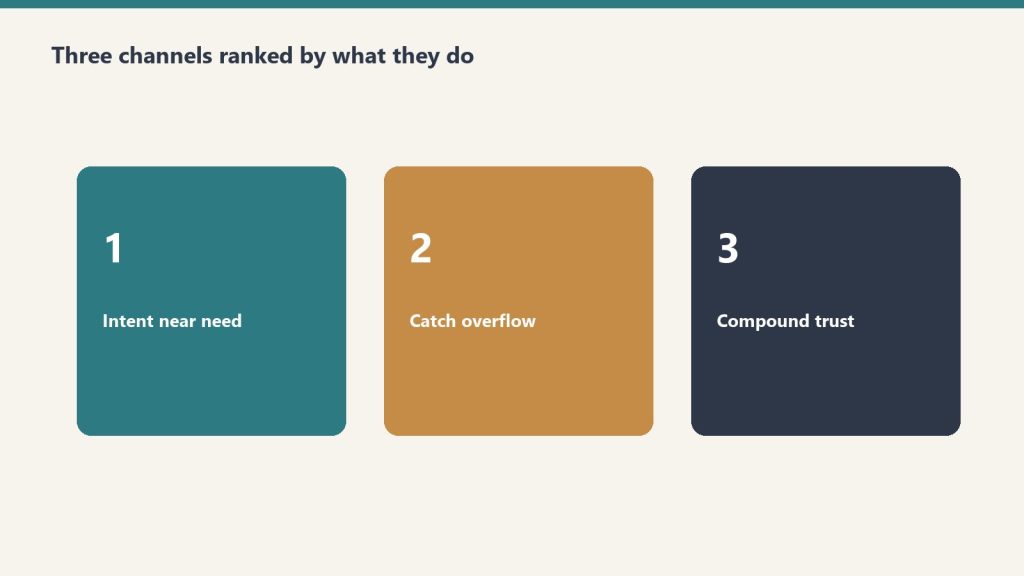
    The three channels, ranked by what they actually do

    Google Local Services Ads (LSA): the most consistent ROI lever right now

    LSA cost-per-lead in restoration is widely reported in the $80–$180 range for water damage, with mold remediation reported between roughly $60 and $250 depending on market. Conversion rates from lead to booked job tend to be reported around the 10–15% range — higher than standard Google Search Ads — because Google charges per qualified phone call or message, not per click.

    The bottom line on LSAs: if you do not have Google Guaranteed status set up and your service area dialed in, this is the first thing you fix this quarter. The catch nobody mentions: Google ended the credit policy for “job type not serviced” and “geo not serviced” disputes in 2025, meaning junk leads now come out of your pocket with no refund pathway. You have to dispute aggressively on the categories Google still credits, or your effective CPL drifts 15–25% higher than the platform number says it is.

    Google Search Ads (PPC): the channel you run when you have no other choice

    Average reported cost-per-lead for Google Search Ads in restoration falls in the $150–$400+ range, with the high end concentrated in metros with two or more national franchise advertisers bidding against you. Conversion from click to lead in well-managed accounts typically lands in the 5–10% range — half of what LSAs deliver.

    PPC has one thing LSAs don’t: control. You set the keywords, you set the geo, you set the ad copy, you decide whether you want commercial water damage leads or residential mold leads or fire restoration leads. If you are running a multi-location shop or chasing commercial work specifically, you cannot live on LSAs alone — the lead types are too restricted. But if you are a single-location residential operator, every dollar in PPC should be earning its keep against the LSA dollar, and most of the time it isn’t.

    SEO: the long-term asset everyone wants to own and almost nobody finishes building

    Cost-per-lead from established organic rankings is commonly reported in the $75–$150 range — roughly half the cost of paid channels at maturity. The trade-off is time. Restoration SEO in competitive metros typically takes 12–18 months of consistent investment before it produces meaningful lead flow, with initial signal in 3–6 months for low-competition local terms.

    The honest read: most restoration owners start SEO, get impatient at month four when paid channels are still doing all the work, and either fire the agency or stop publishing content. Then they restart 18 months later with a different vendor and the same outcome. SEO works. It works exactly the way the calendar says it will work. The companies that win with it are the ones who treat it like a 24-month commitment, not a 90-day experiment.

    What the channel mix should actually look like

    For a residential-focused restoration company doing $1M–$5M in revenue, a defensible channel mix in 2026 looks something like this:

    • LSA: 35–45% of paid budget. Highest reported ROI of any paid channel in restoration. Cap is the daily lead volume Google will give you, not the budget.
    • Google Search Ads: 25–35% of paid budget. Covers the lead types LSAs cannot serve — commercial work, specific service lines, and overflow when LSAs hit daily caps. Required for any multi-location shop.
    • SEO and content: 20–30% of total marketing budget. Treat as 18–24 month asset build. Tracked separately from paid CPL because the unit economics only stabilize at month 12+.
    • Referrals and direct outreach: ongoing, no fixed budget. Reported industry-wide as the lowest-CAC channel and the one with the shortest break-even window. Build a plumber/agent/property manager referral program before you spend another dollar on paid ads.

    The split that gets restoration owners in trouble is putting 80% into paid and 20% into “we’ll get to it” SEO. Two years later they are completely dependent on Google’s auction prices, and the auction prices have gone up every year of the last five.

    The metric that actually matters

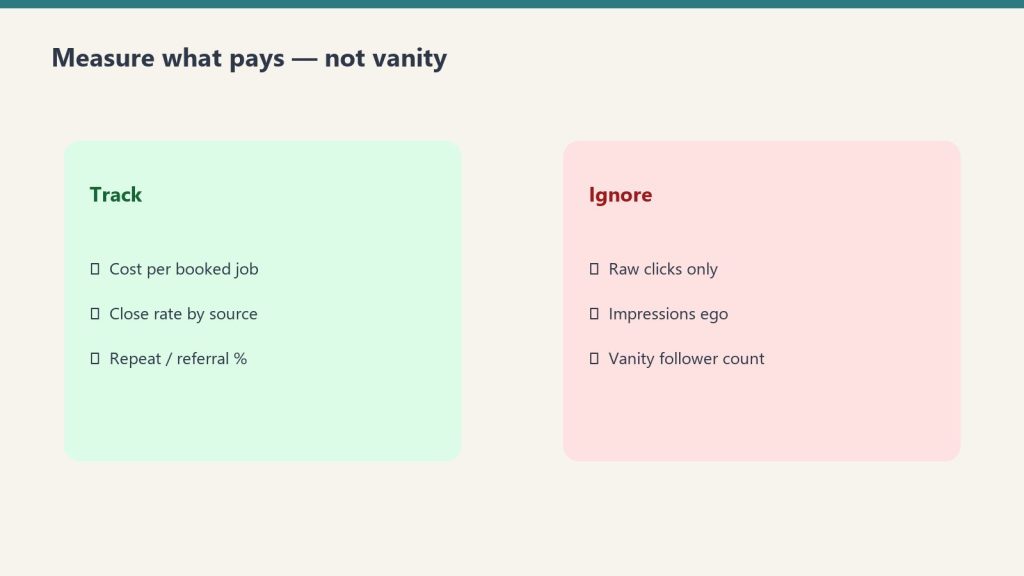
    Cost-per-lead is the metric every vendor reports. It is the wrong number to optimize for. The number that matters is fully-loaded cost-per-acquired-job, which is CPL divided by your channel-specific close rate, plus the labor cost of the CSR who fielded the call, plus the credit card processing on whatever portion of the job is paid out-of-pocket, minus the franchise or TPA fee if applicable.

    Most restoration owners do not have this number for any of their channels. They have CPL from the platform dashboards, they have revenue from the job management software, and the two systems have never talked to each other. Fix that before you change a single bid. The owner who knows their fully-loaded acquired-job cost by channel makes better decisions in five minutes than the owner who doesn’t makes in a quarter.

    The bottom line

    LSAs are the highest-ROI paid channel in restoration in 2026 and should be the first lever you optimize. Google Search Ads are required for any operator chasing commercial work or running multiple locations, but they should never be your largest line item. SEO is the long-term insurance policy against rising auction prices, and the only restoration owners who get the payoff are the ones who treat it like a 24-month commitment and refuse to flinch at month six.

    If you are spending more than $5,000 a month on Google Search Ads and you do not yet have LSAs set up, you are leaving the most profitable channel in restoration on the table. Start there.

    Frequently Asked Questions

    What is the average cost per lead for water damage restoration in 2026?

    Reported cost-per-lead for water damage restoration in 2026 ranges from roughly $80–$180 on Google Local Services Ads, $150–$400+ on Google Search Ads, and $75–$150 from mature organic SEO. Actual costs vary significantly by metro, competition, and lead-type mix.

    Are Google Local Services Ads better than Google Ads for restoration?

    For most residential restoration operators, LSAs deliver a lower cost-per-lead and a higher reported lead-to-job conversion rate than standard Google Search Ads. LSAs charge per qualified call rather than per click, which is why the ROI tends to be more consistent. Multi-location shops and commercial-focused operators still need Google Search Ads to cover lead types LSAs do not serve.

    How long does SEO take to work for a restoration company?

    Restoration SEO in competitive metros typically takes 12–18 months of consistent investment before it produces meaningful lead flow. Initial ranking signal often appears in 3–6 months for low-competition local terms, but the cost-per-lead advantage versus paid channels only stabilizes after month 12.

    What percentage of a restoration marketing budget should go to paid ads?

    A common defensible split for a residential restoration company in 2026 is roughly 60–70% of total marketing budget on paid channels (LSA + Google Search Ads) and 20–30% on SEO and content, with referral programs running in parallel at minimal incremental cost. Going above 80% paid concentrates risk in the Google auction.

  • Restoration Company Marketing in 2026: LSA vs Google Ads vs SEO — Real CAC Numbers

    Restoration Company Marketing in 2026: LSA vs Google Ads vs SEO — Real CAC Numbers

    Restoration company marketing is one of the most expensive paid-search categories in the United States. “Water damage restoration” keywords routinely clear $60–$85 per click in competitive markets, with reported outlier bids running well over $200 in metros like New York, Houston, and South Florida. Industry tracking has flagged some emergency-restoration terms breaking $500 per click in specific moments. Meanwhile, the average home-services lead via Google Local Service Ads (LSA) is roughly $53 — but water damage restoration sits at the premium end, with reported LSA cost-per-lead ranges of approximately $80–$180 depending on market.

    If you run a $3M–$15M restoration company, this is the single biggest line item that nobody on your team is staring at correctly. Owners hear “marketing” and think website. The real fight in 2026 is channel allocation: how much should you spend on LSA, how much on Google Search Ads, and how much on owned SEO — and at what point does each one stop scaling? Here is the honest breakdown a $5M owner needs before their next marketing budget meeting.

    The three channels that actually matter

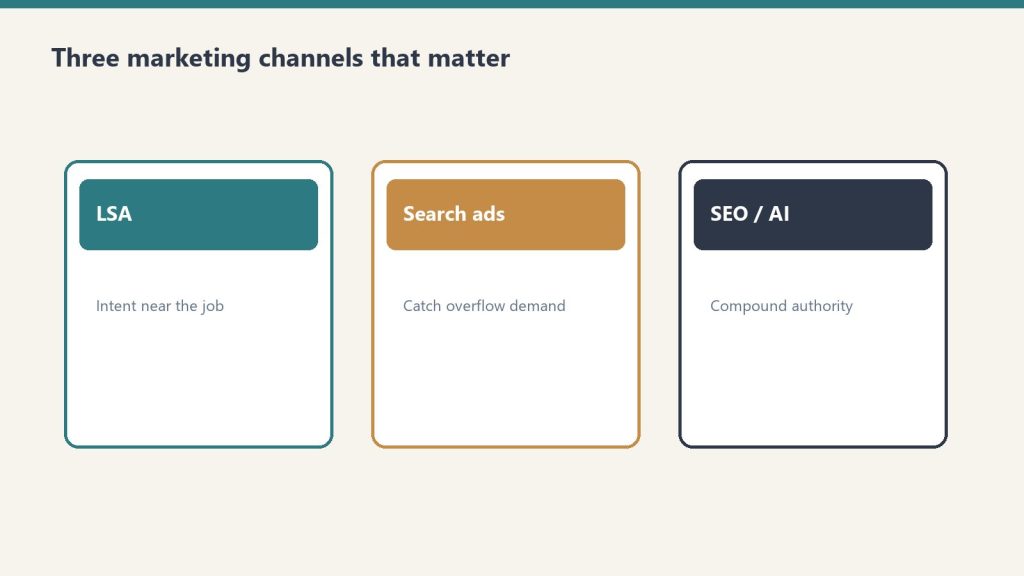
    For commercial water and fire restoration in 2026, three channels do the heavy lifting: Google Local Service Ads (the LSA “Google Guaranteed” boxes at the very top of the SERP), Google Search Ads (the paid text ads below LSA), and organic SEO (the map pack plus blue links). Everything else — Yelp, Angi, HomeAdvisor, Facebook, programmatic display, lead-broker buys — is either supplemental, declining, or actively cannibalizing your margin. The first decision is choosing where the bulk of your new-customer budget goes among those three.

    Local Service Ads (LSA) — the default starting point in 2026

    LSA is the highest-real-estate placement on a phone screen, period. For emergency-driven categories like water damage and mold, that real estate matters more than anything else. Reported 2026 cost-per-lead for water damage restoration through LSA generally falls in the $80–$180 range, with some markets reporting averages closer to $100 in stable competitive conditions. On a $6,000 average ticket, even a $150 LSA lead at a 25–35% close rate produces a customer acquisition cost (CAC) of roughly $450–$600 — which is workable on jobs that gross $1,800–$2,400.

    The catch: Google removed credits for “job type not serviced” and “geo not serviced” leads in 2025, meaning every junk lead now hits your card with no recourse. You have to dispute leads inside Google’s dispute window and you have to answer your phone in under 30 seconds. LSA also weights reviews more heavily than any other channel — a 4.6 average will visibly underperform a 4.9 in the same zip code. If your review velocity is under 8 per month, fix that before you scale LSA spend.

    Google Search Ads — the diminishing-returns layer

    Below LSA, traditional Google Search Ads remain expensive and uneven. Reported 2026 average CPC for water damage restoration keywords falls into bands: bottom-of-funnel emergency keywords like “emergency water damage [city]” run $60–$85; less-direct terms like “water damage cleanup near me” run $40–$65; awareness-stage keywords like “what to do after a flood” run $20–$40. The trap is that close rates on Search Ads have been compressing for three reasons: LSA is taking the highest-intent clicks, AI Overviews are stealing informational queries, and click fraud from competitor bots remains nontrivial.

    For most restoration owners, Search Ads should be a defense-and-coverage play, not a primary growth channel. Bid on your own brand name to keep TPA programs and franchise competitors from arbitraging your traffic. Bid on the keywords LSA does not cover well (commercial, mold remediation, biohazard, contents pack-out). Cap monthly spend. Watch the CAC, not the CPC.

    SEO — the compounding asset that owners under-invest in

    Owned SEO — Google Business Profile plus a real content engine on the company website — is where the math eventually breaks in your favor. Multiple cross-industry benchmarks in 2025–2026 put the cost-per-lead delta between SEO and paid search at roughly 4x–6x lower for SEO once a site is mature (typically 12–18 months in). One widely cited cross-industry benchmark places SEO CPL near $31 versus paid search closer to $181. Restoration-specific tracking from agencies serving the category has reported organic CPL well under $50 in established markets after 18+ months of investment, while paid CPL stays in the $150+ band.

    The painful truth: SEO has a CAC of essentially zero on the marginal lead, but you cannot start it in January and expect leads in March. The owners who win SEO in restoration started 24 months ago, publish 6–12 useful pieces a month, and have a Google Business Profile with 500+ reviews and weekly post activity. If you have not started, your starting line is today — not next quarter.

    The honest allocation for a $5M restoration company in 2026

    A defensible 2026 marketing budget for a $5M residential and small-commercial restoration company, assuming 60% TPA-fed and 40% self-generated, looks roughly like this on the self-gen side:

    • LSA: 45–55% of self-gen ad spend. Highest immediate ROI. Cap by service area until close rate clears 30%.
    • Google Search Ads: 15–20%. Brand defense plus commercial, mold, and biohazard keywords LSA underweights.
    • SEO and Google Business Profile: 25–35%. This is content, on-site technical work, review-generation systems, and GBP weekly posts. Treat it as an asset, not a cost.
    • Everything else (Yelp, Angi, Nextdoor, paid social): under 5% combined, and only with tracked phone numbers per channel.

    If your current mix is 80%+ LSA and 0% SEO, you are renting your customer pipeline from Google at a rate that will keep rising. If your current mix is 80%+ SEO and 0% LSA, you are leaving the highest-intent emergency calls on the table for competitors who will outbid you for them.

    What to measure, not what to chase

    CPC, CPL, and CAC are not the same number. Restoration owners chase CPC because Google Ads dashboards make it visible. The metric that should sit on your monitor is blended CAC by channel, calculated quarterly: total channel spend divided by booked jobs from that channel. Track three more numbers next to it — close rate from lead to booked job, average ticket size by channel, and lifetime value adjustments for repeat and referral. A $180 LSA lead with a 35% close on $7,000 average ticket is a different business than a $40 organic lead with a 12% close on $2,200 average ticket — even though the CPL looks better in column B.

    Bottom line

    In 2026, LSA pays the bills, Search Ads defends the perimeter, and SEO is the only channel that compounds. The restoration owners who will be writing larger checks to their estimators in 2028 are the ones who fund all three this year — and the ones who refuse to pay $150 for a water damage lead because “that’s expensive” will keep watching franchise competitors and out-of-town aggregators win the calls that finance their own retirement. The expensive lead is the one you didn’t bid on at 2 a.m. when the house was actively flooding.

    Frequently Asked Questions

    What is a good cost per lead for a water damage restoration company in 2026?

    Reported 2026 ranges put water damage LSA cost-per-lead at roughly $80–$180, with some stable markets averaging closer to $100. Google Search Ads CPL is generally higher and more volatile. Organic SEO CPL trends well under $50 in mature programs after 12–18 months. Evaluate against your average job size and close rate, not against a flat industry number.

    Are Google Local Service Ads still worth it for restoration companies?

    Yes, for emergency categories LSA remains the most cost-efficient paid channel in 2026 because of its top-of-screen placement and pay-per-lead structure. The caveats: Google removed credit for off-service-area and wrong-job-type leads, review velocity matters more than ever, and you have to answer the phone in under 30 seconds to keep ranking.

    How long until SEO produces restoration leads?

    Plan on 9–12 months for a Google Business Profile and review-driven program to generate meaningful local-pack volume, and 12–18 months for content-driven organic leads to show up in any volume. Owners who treat SEO as a 6-month sprint nearly always abandon it 30 days before it would have started working.

    Should I use a marketing agency or build in-house?

    Under $3M revenue, hire one credible local agency for LSA plus GBP and own SEO with a part-time writer. From $3M–$10M, split LSA/Search Ads with an agency and bring SEO content in-house under a marketing coordinator. Above $10M, build the function internally with a director-level hire — at that size your marketing spend funds a salary and the data needs to live on your side of the firewall.