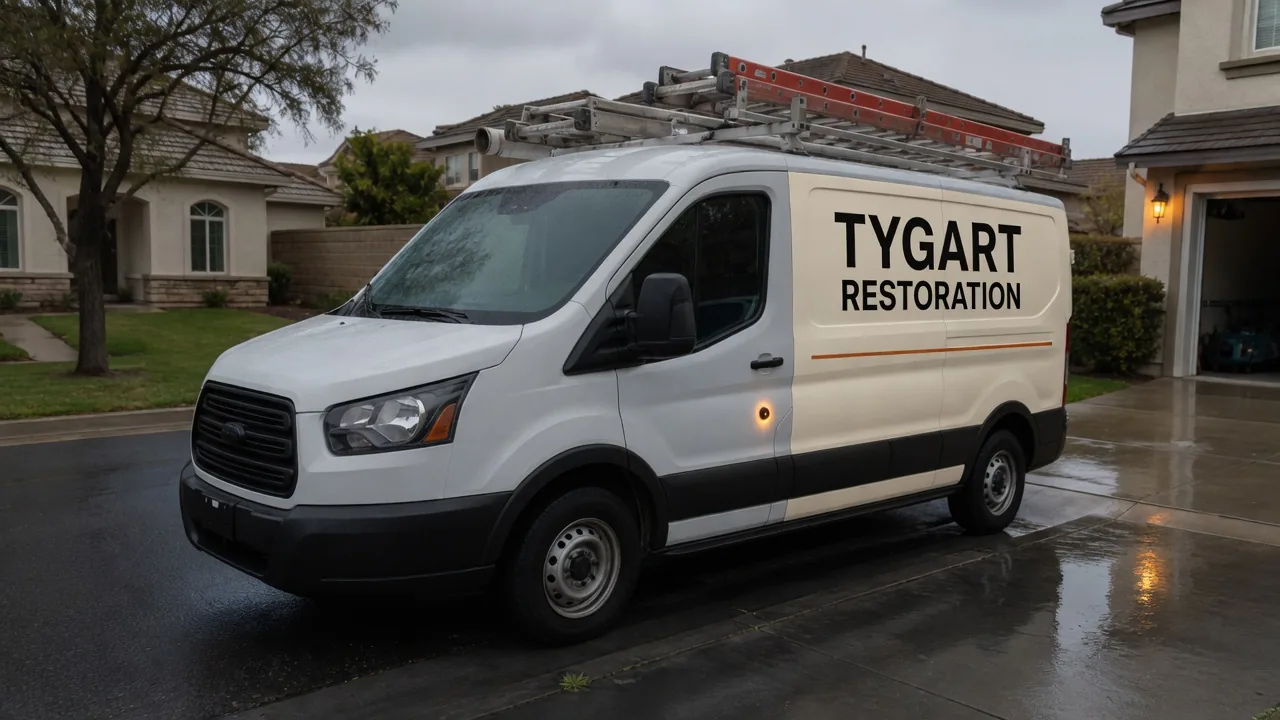
Bodhi at @irentdumpsters writes plumber and HVAC stories. Restoration owners should read them as dispatch rules, not as another trade’s marketing tips.
Three recent posts, three different trades, one mechanism.
A Boca homeowner with water across the kitchen called three plumbers off Maps at 7:30 a.m. Voicemail lost. Six-ring menu lost. Ring-two booked a $4,200 repipe that afternoon.
A lead form on a water or plumbing homepage loses the emergency call. Nobody in a puddle types an email and waits.
Most emergency contractor calls happen on a cracked iPhone while the basement is flooding. The About Us paragraph and the hamburger menu are not in the path.
Swap plumber for restorer and the dollar amount goes up, not down. The homeowner is not shopping a $189 service call. They are trying to stop Category 2 or 3 water before the pad and the drywall come out. The shop that makes the local number easiest to tap, then answers it, gets the mitigation and the rebuild conversation that follows.
The call is placed from the loss, not from a desktop contact form.
Reframe: speed-to-lead is part of the estimate
Restoration marketing budgets get judged on cost per lead. That number is a lie if the night board lets three rings dump to voicemail. Maps ranking, LSAs, and SEO are just pipes. The conversion event is a human voice in two rings saying they can roll a crew.
If you are number one on Maps and the CSR is on a seven-minute hold script, you are paying to educate the competitor who picks up.
What to change on the site this week
Header on mobile: local area code, tap-to-call, IICRC or license line. No hamburger hunt.
Homepage and every emergency service page: click-to-call first, form second. Forms are for commercial RFPs and insurance follow-up, not for a burst pipe at 11 p.m.
After-hours path that is a person, not a menu tree. If you use an answering service, the first sentence they say has to be dispatch, not “press 2 for billing.”
Measure answer rate and time-to-answer on Map and LSA calls separately from website forms. If ring-two is not the median, fix staffing before you buy more clicks.
What restoration adds that the plumber post skips
A plumber can book a morning slot. A restorer often has to quote emergency service, set expectations on source identification, and get permission to start dry-out before the adjuster is awake. The first 90 seconds on the phone are not “can we come out.” They are “are you safe, where is the water, is it sewage, can we roll now.” Script that. The marketing post only gets you the ring.
One account is not a research desk. The job now is a living watchlist of people who talk like operators about local SEO, Maps, speed-to-lead, and high-ticket home services — then translate every useful post into language a water, fire, or mold shop can run this week. Most of Bodhi’s best material is not labeled restoration. It is plumber, HVAC, roofing, dumpster, turf, and pest. The method for those posts is here: how to steal a plumber thread and make it a restoration SOP.
These are not endorsements and they are not a vendor shortlist. They are source nodes. Steal the rule. Ignore the pitch. Rewrite for restoration.
The ten accounts
1. @irentdumpsters — Bodhi, Stryker Digital
The seed. Dumpster operator turned local SEO. Writes in job stories, not frameworks. Recent restoration-usable posts: content mismatch and high-ticket terms; click-to-call instead of homepage forms; one URL per trade; answer in two rings; call-tracking NAP damage; mold as the retail lane while water stays locked by adjusters; Maps number one with a dead phone in a dry season.
Use him for: emergency-intent architecture and the reminder that weather creates demand, rankings only capture it. Also use every other-trade post. That is now the default ingest rule.
2. @drewdoesmarktng — Andrew Palacios, Revved Digital
Home-service SEO and AI. Publishes marketing benchmarks by trade, including water damage restoration, drain and sewer, roofing, and a dedicated restoration report. Talks audits as visibility, tracking, and follow-up problems wearing a marketing costume.
Use him for: numbers to compare against your own cost per booked mitigation, not for copying another vertical’s offer.
3. @noahiglerSEO — Noah Igler, Sustained Media
Calls himself the local SEO guy for home services. Cleanest recent framework on X: GBP wins the map pack, the location page supports that pin, service pages win organic, tracking has to reach sold revenue. Also the rare voice that will tell a $2M plumber not to buy SEO until the review rating is trustworthy.
Use him for: map-pack vs organic division of labor, and the rule that a 3.8-star restoration profile should not be fed more traffic.
4. @theseoguy_ — The SEO Guy, Vineyard Growth
High-volume local SEO checklists. GBP first, physical pin over a fake service-area blob, weekly photos, keyworded review replies, city plus service in the H1, stop writing history-of-the-trade blogs. Explicit that answering the phone is part of SEO.
Use him for: the unsexy weekly cadence a one-shop restoration company can actually keep. Filter out any “exact match business name” tricks that would look like spam to a carrier or a city inspector.
5. @localseobot
Grid-rank case notes, including water and fire restoration terms in Atlanta-area scans. Not narrative. Just “this keyword moved from X to Y on a 169-point grid.”
Use him for: how to talk about Maps movement without lying. Average rank on a grid is the honest metric. “We are number one” is usually a zip code lie.
6. @GeorgianBaySEO
Local SEO for trades. Public portfolio includes roofing, electrical, pest, waterproofing, and water damage restoration. Talks templates and schema as the reason site eight ships in a day after site one took weeks.
Use him for: the operations lesson. Restoration content should be a reusable service-page system (water, sewage, mold, fire, pack-out) plus local proof — not a new design every time you add a county.
7. @doctorcalf
Former SEO and GBP lead-gen for mold remediation. Long client cycles. Useful because mold is the retail lane Bodhi keeps pointing restorers toward when water is locked by preferred-vendor lists.
Use him for: mold-specific demand and the reminder that remediation clients return years later when the next leak shows up.
8. HouseCall SEO / Lior Daniel
Boutique restoration local SEO. Public positioning is six-plus years ranking crews on emergency terms, with published monthly ranges. Less of a daily X firehose than Bodhi, more of a restoration-only specialist to watch when he does post.
Use him for: emergency-query page structure aimed at 2 a.m. water and fire searches, not general home-service theory.
9. Outpace SEO (restoration-only shop)
Oklahoma City firm built around water damage and restoration SEO. Public case: OKC Restorations and a large year-over-year lift in organic clicks. Follow the company and principals when they publish market notes.
Use him for: single-market restoration case texture — what a water shop’s keyword set actually looks like when it is not mixed with roofing and HVAC.
10. Restoration Inbound / Restoration Digital Marketing cluster
Agencies that only sell to restorers (Restoration Inbound, Restoration Digital Marketing, and peers on the 2026 water-damage agency lists). They post less like dumpster-Twitter and more like vendor blogs. Still worth a weekly scan because they write to IICRC language, TPA friction, and storm season instead of “plumber near me.”
Use them for: insurance-aware copy and the difference between retail water, program work, and storm surge. Discard anything that sounds like a franchise pitch deck.
Inspired by Bodhi (@irentdumpsters). Original post: the Delray plumber / faucet-blog thread. This is a new Tygart article for restoration contractors. We kept the mechanism, added first-party field knowledge, and did not reprint the thread.
On September 5, 2026, Bodhi at @irentdumpsters posted a plumber story that restoration owners should tape to the office wall.
A shop in Delray Beach could not understand why the phone only rang for fifty-dollar drain snakes. The website had forty blog posts about leaky faucets and loose toilet handles. The work that buys trucks and pays commercial mortgages was emergency slab leaks and broken sewer mains. When water is moving under tile at two in the morning, the homeowner is not reading a faucet explainer. They are typing slab leak detection plus the city name while standing in a puddle.
They rebuilt the site around high-ticket emergency terms. In ninety days the shop booked three slab leak jobs averaging sixty-eight hundred dollars each, and stopped waking techs at midnight for kitchen sinks.
That is not a plumbing anecdote. That is the default failure mode of independent restoration marketing.
The restoration version of the faucet blog
Walk most water, fire, and mold sites and you will find the same mismatch. The company owns extractors, dehumidifiers, containment, and an IICRC-trained crew. The content library is “10 tips to prevent a wet basement,” “what is humidity,” and a single Services page that dumps water, fire, mold, biohazard, and pack-out onto one URL.
Google does not send the job you want. It sends the job your pages describe.
If the strongest pages on the domain answer “how to dry a small leak” and “when to call a plumber,” you will get small leaks and plumber overflow. If the strongest pages answer “sewage backup cleanup [city],” “category 3 water damage [city],” “hidden slab leak under tile,” and “mold remediation after a slow leak,” you get the jobs that fill a week of labor and a rebuild estimate.
What homeowners actually type at 2 a.m.
Emergency restoration search is not a research session. It is a cracked-phone query from a hallway that smells like drywall. The phrases that buy trucks look like this:
water damage restoration + city
emergency water extraction + city
burst pipe water damage + neighborhood
sewage backup cleanup + city
slab leak detection + city
black water cleanup
mold remediation + city
fire damage restoration + city
smoke damage cleanup
Those queries need a dedicated URL, a visible click-to-call number, license and IICRC proof above the fold on mobile, and photos from real local jobs. They do not need a 400-word “welcome to our family-owned company” block.
The 90-day rebuild for a restoration domain
Do not start by writing more blog posts. Start by killing the mismatch.
1. List the jobs that pay the mortgage
Pull last year’s sold jobs. Rank them by gross and by contribution margin, not by call volume. For most shops the list is some mix of category 2 and 3 water, sewage, hidden leaks, mold after a delayed loss, fire/smoke, and commercial emergency response. Those become the only service pages that matter for ninety days.
2. Give each high-ticket job its own URL
Google ranks distinct URLs for specific intent. A single “Our Services” page that lists water, fire, mold, and contents will not outrank a competitor who published 1,200 words on sewage backup cleanup with local photos, category definitions from IICRC S500, and a same-night dispatch CTA.
Build silos, not buckets. Water extraction. Sewage. Slab / hidden leak. Mold remediation. Fire and smoke. Pack-out. Commercial emergency. Each page answers one search, shows one class of proof, and asks for one action: tap to call.
3. Stop hiding the phone behind a form
A lead form on the homepage of a water restoration site loses emergency calls. Nobody standing in Category 3 water wants to type an email and wait. They tap click-to-call and hire the first crew that picks up. Put the local area code, a giant tap target, and license proof at the top of the mobile template. Answer in two rings or the ranking is buying leads for the shop that does.
4. Write the questions the CSR already answers
The content calendar is already sitting on the phone log. How long before mold after a flood. Will insurance cover a slab leak. What is Category 3 water. How fast can a crew be on site in this zip. Those are real searches. Company picnic posts are not.
5. Pick a lane insurance has not locked
Every restoration owner wants to rank for “water damage repair” on day one. In many markets the twenty-year shops already own the adjuster list. Mold remediation is often the faster retail lane: homeowners pay out of pocket or choose the contractor without waiting on a preferred-vendor sheet. Jobs in the three-to-eight-thousand range, shorter sales cycle, keywords you can actually move in ninety days. Use that cash to stay in front of the water losses when the weather finally turns.
What not to copy blindly
SEO puts you in front of demand that exists. It does not invent a wet spring. Rankings without weather, without an answered line, and without a review profile people trust are decoration.
Call tracking can also sink the listing. Dynamic number insertion that swaps the header number away from the Google Business Profile creates NAP conflict. Track without making Google think the shop moved.
The operator checklist
Print last year’s jobs by margin. Circle the five that buy trucks.
Map each circled job to one live URL. If it shares a page with three other trades, it does not count.
Open the site on a phone. If the number is not tappable in two seconds, fix the header before you write another paragraph.
Kill or noindex the faucet-class posts that train Google you are a handyman blog.
Publish one emergency page per week for eight weeks: sewage, hidden leak, Category 3, mold after water, fire/smoke, commercial after-hours, pack-out, storm response.
Put IICRC S500 / S520 language and real job photos on those pages, not stock “happy family” images.
Last verified: September 5, 2026 (Pacific). Source: Thanks.io product email from Ryan Hartman. Product docs: How To Create A Dynamic Postcard Template and thanks.io. This is an operator read of a vendor update, not a paid placement.
Direct answer: Thanks.io now lets you apply fun visual effects to the Street View image of a recipient’s house inside the platform’s dynamic postcard image builder. The house photo was already a merge field. The new piece is styling that photo so it reads more like a cartoon or treated illustration than a raw Google capture.
That is the whole announcement. The rest of this page is how to treat it as a control, not a novelty.
Vendor example from Thanks.io's September 5, 2026 product update. Editorial use.
What actually shipped
Thanks.io’s dynamic postcard builder has long been able to print a Google Street View or Map View of the recipient address as the card background. Official docs still document the ~STREET_VIEW~ and ~MAP_VIEW~ data tags, plus an absentee-owner override: set Custom 1 to absentee and put the subject-property address in Custom 2 so the card mails to the owner but shows the property.
The September 5, 2026 email adds one layer on top of that pipeline: effects on those street-view house images. The subject line called them “cartoonified houses.” The body called them “fun effects.” We have not independently enumerated every filter name inside the builder. Until the help center lists them, treat the feature as a style pass on an existing merge image, not as a new mail class.
What did not change, based on public docs: formats (4×6, 6×9, 6×11), QR tracking, handwriting engine, Canva path, and per-piece pricing. Do not rewrite a media plan because the house now looks drawn.
Why a house on a card still works
A street-view house on a postcard is a recognition hack. The recipient does not have to decode a brand. They decode their own porch. That is why real-estate teams and a smaller set of restoration and insurance shops already use the builder.
A cartoon or stylized treatment changes the emotional register. A raw Street View can feel like surveillance. A treated image can feel like a sketch of the place. That is useful when the job is a listing conversation, a just-listed neighbor note, or a thank-you after a dry-out. It is the wrong register when the job is a water-loss notice, a denial letter, or anything that has to look like a record.
Where operators should use it
Use the effect when the card is allowed to be personal and slightly playful:
Just-listed / just-sold neighbor farms, where the house is the subject and the tone is invitation.
Absentee-owner outreach that already uses Custom 1 / Custom 2 so the mailed address and the pictured property can differ.
Post-job thank-you mail from a restoration shop, after the work is done and the record already exists in the file.
Seasonal or sphere mail where the house is a landmark, not evidence.
Do not use the effect when the image has to stand as a document. Street View is already a dated, third-party capture. Cartoonizing it does not make it more accurate. On a rural road with no panorama, Map View is still the honest fallback the vendor already recommends.
How to set it up without guessing
Open Image Templates and the dynamic image builder inside Thanks.io.
Set the background to the Street View or Map View tag, not a one-off screenshot.
Apply the new effect on that street-view layer. Preview more than one address before you lock a campaign. Corners, hedges, and parked cars render differently than a clean suburban elevation.
Keep headline, QR, and handwriting as separate layers. The effect is decoration on the house, not a reason to hide the offer.
If the recipient is an absentee owner, keep the documented Custom 1 = absentee / Custom 2 = subject-property address pattern. The effect does not replace that mapping.
Generate a live preview for a real row in the list, not only the template dummy address.
This feature is not an SEO tactic. It is a physical-mail personalization tactic. The search job for operators is different: publish a page that answer engines can cite when someone asks whether Thanks.io can stylize a house photo on a postcard.
AEO. Lead with the fact, date, and product surface (dynamic postcard image builder). Put the same answer in the FAQ so extractors do not have to invent one.
SEO. Rank for the query family around Thanks.io Street View postcards, cartoon house mailers, and dynamic postcard effects. Those phrases now have a dated source page.
GEO. Name the vendor, the builder, the Street View / Map View tags, and the absentee-owner fields so generative engines can reuse entities instead of collapsing this into “AI postcard art.”
If you run restoration or real-estate content in a metro, the local layer is the address merge, not a city landing page. The card is already geo-personal. Your website should say which campaign types get the effect and which do not, in the same voice you use on the shop floor.
Quality notes before anyone hits send
Street View licensing and freshness are still the vendor’s problem and yours. Preview ugly captures. Suppress rows where the panorama is a fence, a truck, or the neighbor’s house. Do not imply the cartoon is a current photo of completed work. Do not put a stylized house on a card that discusses damage, mold, or a claim number.
We did not receive pricing, effect names, or API field changes in the email. If those land in the help center later, this page should be updated against the doc, not against memory.
FAQ
Can Thanks.io put a cartoon version of a house on a postcard?
Yes, as of September 5, 2026. Thanks.io added fun effects for Street View house images inside the dynamic postcard image builder. The house image itself was already available via Street View and Map View merge tags.
Is this a new postcard size?
No. It is a style option on the existing dynamic image builder. Public pricing pages still list 4×6, 6×9, and 6×11 postcards.
Can the pictured house be different from the mailing address?
Yes. Thanks.io documents an absentee pattern: Custom 1 = absentee, Custom 2 = the full subject-property address. Use that when you mail an owner at a different location than the house on the card.
Should a restoration company cartoonify every job-site house?
No. Keep raw or unused imagery for anything that has to look like a file. Use the effect on thank-you and neighborhood mail after the job, not on notices that travel with a claim.
Where is the official documentation?
Start with How To Create A Dynamic Postcard Template. The September 5 feature note itself arrived as a product email from Thanks.io, not as a new help-center article at the time this page was written.
The magazine piece tells the facility manager why the gap exists. This is the shop version. Same week. Different door.
A water job ends when the last air mover comes off the truck, not when the invoice hits QuickBooks. After that, the only carbon record most shops have is a line item and a memory. The facility manager who hired you will get asked for numbers tied to greenhouse gas reporting—specifically Scope 3 under the GHG Protocol. Two buckets show up again and again in those conversations.
Category 1 (purchased goods and services) covers what the organization bought and had performed on its behalf: labor, equipment run on site, materials installed, subcontractor work. Your job is part of that spend chain. Category 5 (waste generated in operations) covers waste the organization’s activities create when it operates the building—demolition debris, wet carpet, contents sent to landfill, hauls off the loading dock. Restoration generates both in a compressed window.
When the owner or corporate sustainability team asks the FM for Category 1 and Category 5 numbers, the FM does not have a meter on your dehu. They call you. If you cannot produce a job-level record with a timestamp from the week of the loss, you are not the vendor who gets the next call. Not because anyone hates paper. Because “we’ll get back to you” reads as “we don’t know what we did on your floor.”
What has to change is not your craft. It is what leaves with the crew.
The dozen fields: what to write while the floor is still wet
Not a sustainability essay. A dozen fields, filled before the truck rolls. If a tech cannot complete it in five minutes, the form is wrong. If it waits for the office on Monday, it will be invented.
The Restoration Carbon Protocol knowledge base is the open mapping if you do not want to invent the buckets. Use it, rename it, or steal the twelve fields. The standard is not the point. The timestamp is.
Field
Why it matters (carbon math)
Capture in under a minute
1. Equipment runtime (hours) — dehus, air movers, scrubbers, etc.; mark primary or estimated
Electric or fuel burned on site drives emissions attributed to purchased services (Category 1).
Photo hour meters or write run hours from the panel; note if rounded from crew shift length.
2. Generator runtime (hours) + fuel type — diesel, gasoline, propane, or grid tie-in; primary or estimated
Generator fuel is a direct combustion source; grid power still needs kWh or hours for conversion factors.
Generator hour meter or fuel fill log; one line for fuel type; photo of meter.
3. Crew trips — count and approximate miles (shop to site and return, or per day); primary or estimated
Vehicle miles stack into purchased services when your crew travels to perform the work.
Crew lead odometer at departure and return, or map estimate; one number per trip day.
4. Haul trips — count, approximate miles, truck type if mixed; primary or estimated
Hauling moves mass; miles and trips feed transport emissions tied to the job.
Dump run tally on the clipboard; odometer photo or dispatcher mileage note.
5. Debris — wet drywall (volume) — bags, yards, or tons as your shop measures; primary or estimated
Material mass and disposal path drive Category 5 waste reporting.
Count bags or roll-off fraction; photo of loaded trailer or ticket weight if scaled.
6. Debris — carpet / pad (volume); primary or estimated
Same stream: landfill vs recycle changes the waste factor.
Square feet removed × layers, or roll-off estimate; note wet vs dry.
7. Debris — contents (volume or weight); primary or estimated
Contents off-site as waste or salvage still count in what left the building.
Box count, pod fraction, or invoice from pack-out vendor.
8. Debris — mixed C&D (volume); primary or estimated
Mixed loads need a declared split or honest “mixed” with disposal site.
Roll-off size × fill level, or scale ticket photo.
9. Disposal method + receiving facility / transfer station — landfill, recycle, waste-to-energy, donation, etc.
Category 5 is not “garbage” in the abstract; method and location determine factors.
Photograph dump ticket; copy facility name and address from ticket.
10. Materials removed (summary) — what came out; primary or estimated
Mass balance: what left the building anchors waste and demo attribution.
One line from demo scope: “~800 sf carpet, 200 lf baseboard, 12 sheets drywall.”
11. Materials installed (summary) — what went back in; primary or estimated
Installed goods are purchased goods/services (Category 1) the owner will allocate.
Pull from pick ticket or invoice stub; photo of delivery slip.
12. Job class + duration — water / fire / mold / mechanical (or your codes); start and close dates; primary or estimated
Duration scales equipment and trip totals; class tells the FM which protocol line to use.
Dates from work auth; class from loss type already on the folder.
Every number gets a flag: primary (measured — meter, ticket, scale, invoice) or estimated (judgment — “~half a 20-yard,” “assume 40-mile round trip”). Never fake precision. An honest estimate with a date beats a fabricated decimal from accounting six months later.
Building the capture habit
Nobody fills a questionnaire after the trucks have gone. They fill what stands between them and getting paid.
Tie it to the invoice trigger
Put one clause in the work authorization or master agreement: the per-job record is a condition of final invoice. Same shape as a moisture log. Same habit as photos. Final invoice does not go out until the record is attached to the job file—PDF photo of the clipboard, form in your CRM, whatever your shop already uses for documentation that must exist to get paid.
That single gate does more than a training deck. The crew lead knows the rule: no record, no release. Office staff stop chasing “sustainability forms” and start enforcing the same checklist they enforce for signed auth and dry standard.
Who owns it, and when
Owner: crew lead on site—not the office on Monday. The lead has the hour meters, the dump runs, and the conversation with the FM at the door.
When: before the truck rolls, while the floor is still wet and the debris stream is visible. Last hour on site, not first hour back at the shop.
What it looks like: one page. Checkbox for job class. Table for the twelve fields. Two columns for primary vs estimated initials. Signature and date. Lives on the clipboard that already holds the moisture log.
The discipline matches what you already run on the first day of a water loss: document early, while evidence is in front of you. The first-24-hours water loss operators checklist is the same muscle—capture before memory replaces the floor.
Pushback you will hear
“We don’t have time.” Five minutes. Hour-meter photos and a dump ticket fit in the same walk-through where you pick up the last cord.
“We’ll do it Monday.” Monday produces fiction. Miles blend across jobs. Fuel type becomes “diesel probably.” The FM’s deadline will not wait for fiction.
“The office can estimate.” The office was not on the roll-off. Estimates are fine when labeled estimated—not when invented without a witness.
Estimates vs primary data: Mark every field. Primary data comes from meters, tickets, invoices, or counted units on site. Estimates are allowed when measurement was impossible—note the reason in one word (“no scale,” “combined load”). Reporting downstream can treat estimates differently; lying about precision cannot be untangled later.
Feeding Scope 3 reporting from the job file
Facility managers and owners are not asking you to file their corporate inventory. They need defensible inputs they can map into Scope 3 workbooks.
Your twelve fields supply the bridge. Category 1: equipment and generator runtime (especially fuel type and grid vs diesel), materials installed, crew and subcontractor effort represented by trips and job duration, and the job class that tells them this was restoration services—not janitorial, not capital project. Category 5: debris by stream, volumes, disposal method, and receiving facility name—so their waste factor matches what actually left the dock, not a generic “construction waste” line.
When you hand the FM a completed record dated the week of closeout, you give them primary or honestly labeled estimated data with a chain of custody: ticket photos, meter photos, material slips. Their sustainability consultant can plug factors without calling you twelve times. When you hand them silence, they spread one invoice total across a quarter and hope nobody audits.
The Restoration Carbon Protocol (RCP) documents how restoration-specific activity maps to those reporting needs—field names, streams, and guidance so shops and FMs speak one language. You do not have to adopt every label. You do have to leave a record that can be mapped.
Who this is for
Commercial water, fire, mold, and the one-off mechanical swap. The FM inside the building is the only person who can demand the data at the door. You are the only person who can produce it on the job.
The sentence that pays: “We capture the job record before we leave. You can hand it to whoever asks.” Only say it if the clipboard is on the truck.
Frequently asked questions
What if the job is already done and we captured nothing?
Document what you can reconstruct from tickets, invoices, and photos—with every number marked estimated and the reconstruction date noted. Send it anyway. Partial honest data beats silence. Change the process for the next job; do not rewrite history as primary.
Who owns the record — the crew or the office?
The crew lead captures it on site before departure. The office verifies it is attached before final invoice release. Capture is field work; gatekeeping is office work.
How precise do the numbers need to be?
Precise enough to be honest. Primary when you have meters and tickets; estimated when you do not—never unlabeled guesses. Facility reporting uses ranges and factors; they cannot use numbers you pretended were weighed when they were guessed.
Does this replace our moisture log or invoice documentation?
No. It sits beside them. Same invoice gate, same job file. Moisture proves dry standard; invoice proves scope and price; the job record proves what happened on the floor for environmental reporting.
What does the FM actually do with these numbers?
They fold them into Scope 3 reporting—Category 1 for purchased restoration services and materials you installed, Category 5 for waste streams you hauled—often with a consultant or corporate template. Your record is the job-level backup when auditors or tenants ask what the loss generated.
Do we have to use the Restoration Carbon Protocol name?
No. Use the twelve fields, your own form, or RCP’s mapping. The FM needs consistent fields and a date from closeout week, not a brand.
Open field playbook. No patent. Copy it, rename it, change the nouns to fire / mold / rebuild. If it makes you money, good. If it puts another dish on a wet roof, also good.
License: do what you want. Attribution nice, not required. Tygart Media is not a Starlink, SpaceX, Tesla, or xAI partner. Links below go straight to them. No tracking parameters. No referral codes.
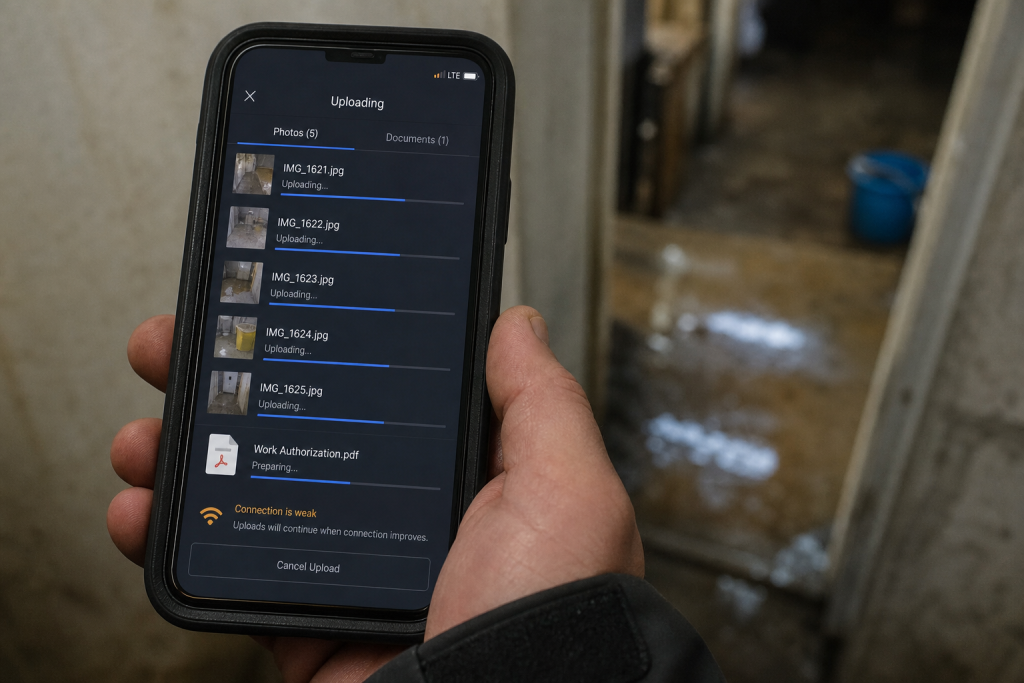
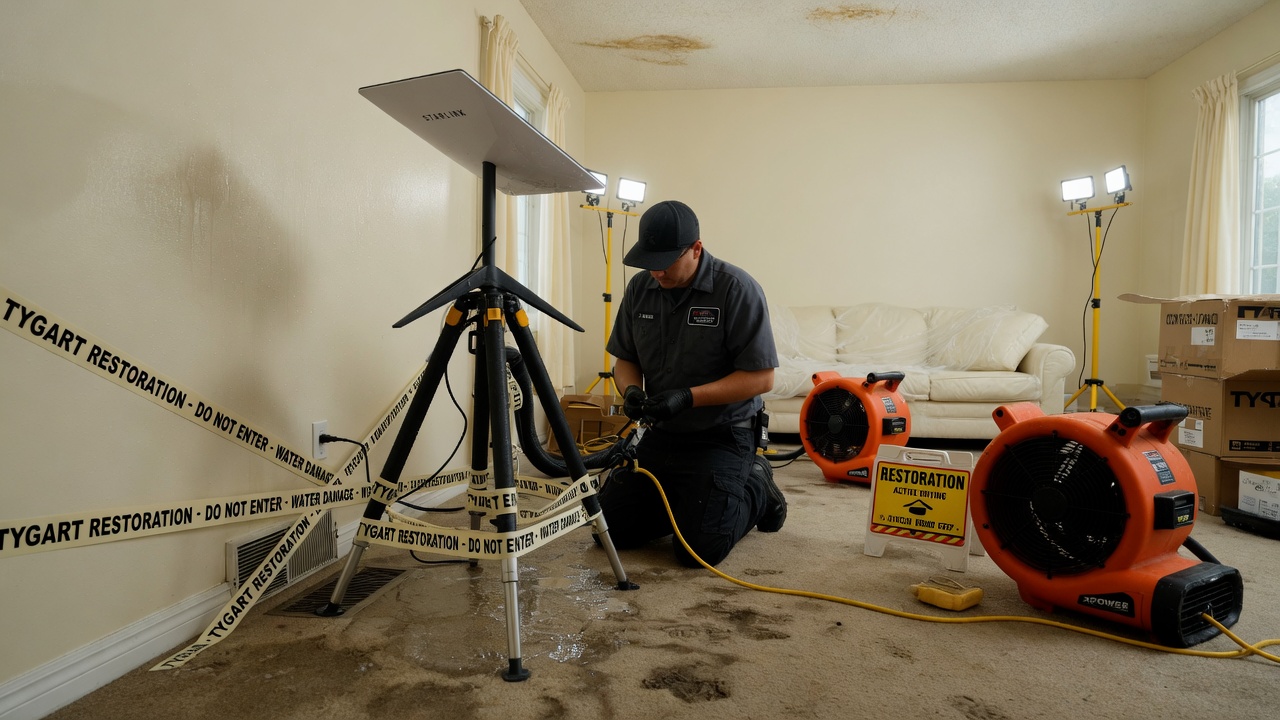
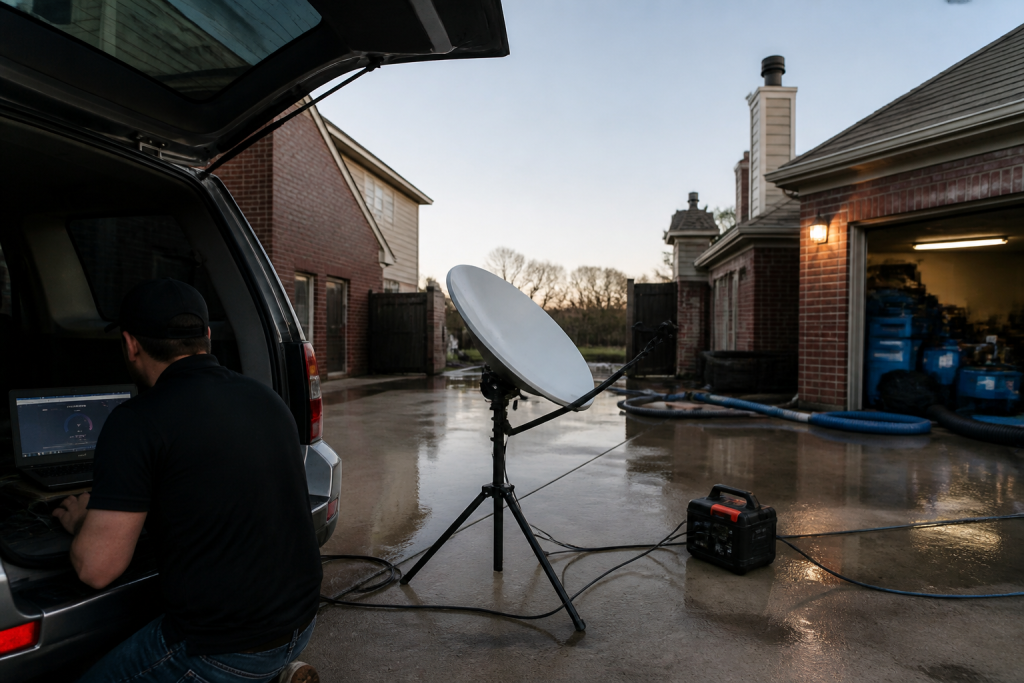
Why this exists: restoration work happens where fiber is dead, the house is a Faraday cage of wet drywall, and the phone that “has bars” cannot upload a moisture map. Starlink is a sky-view pipe. More honest job-site pipes → more honest traffic on the constellation → more reason to fly birds. The selfish clause is allowed: a 4G phone in the sticks should still talk to a voice agent when the street is dark.
Bars on the phone. Upload still dead. That is the job the dish is for.
Buy and read from the source. Prices move. The impedance rule does not.
The structure or the street has no working cable/fiber (storm, rural, construction, “the pole is in the river”).
You need to upload, not just talk: photos, video walkthrough, Xactimate sketch, moisture log, signed work auth.
You will be on site more than an hour and cell is congested or roaming into a dead pocket.
The office needs a second path so after-hours voice and dispatch do not die with the cable modem.
Do not use it as:
A replacement for a good office fiber drop.
A phone. Voice agents still ride the pipe; the dish is not Jarvis.
A “we have Starlink” line on the website. Homeowners hire the truck that showed up.
Cell first if it works. Starlink is the sink when cell is the bottleneck.
2. Two kits (steal one)
Kit A — truck / first-on-site (most shops)
Starlink Mini on a Roam plan or, if this is actually a business WAN, start at Business and read the current hardware list. Mini is the backpack dish. In-motion rules live here. The home V5 kit is not the roam toy.
Power: Mini wants a USB-PD source rated 65–100 W even though it only drinks ~25–40 W. A 45 W phone brick will lie to you. Truck: 12 V → 30 V / Anderson, or a 500 Wh class station.
Plan: numbers on starlink.com move. Roam is written for travel. If the kit is production, read Business vs Enterprise. Mini often does not sit on the Priority SLA. Do not tell a carrier you have enterprise uptime because you paid a business invoice for a Mini.
One cheap travel router if Mini Wi-Fi dies inside a metal trailer.
Power before the meter. 65–100 W brick. Phone chargers lie.
Standby the truck kit when it is not a weather week. Idle is cheaper than a second hardware buy because someone borrowed it.
6. Dispatch and voice
Dispatch and voice when the site is remote.
The dish is layer 0. The voice agent is layer 1.
On a dead-fiber job: photos go up the pipe; the after-hours line stays reachable; the agent writes a new row (address, standing water y/n, next action). It does not edit your website.
If you already have a process, add one rule: when cell upload fails, kit A comes off the hook.
7. Failure modes
Trees and eaves. Rain. 45 W bricks. Consumer Roam sold as production WAN. Twelve intake fields before anyone asks “can we come now?”
8. The sentence that pays the shop
“If the street internet is out we still upload your photos and get the adjuster pack off the truck tonight.”
Only say it if the kit is in the truck.
This document stays free. Charge for the hour you spend teaching another shop the first 30 minutes if you want. Do not charge Starlink. They already sold you the dish.
9. What this is not asking
No meeting. No partnership badge. No official anything.
Redmond already knows how to stamp birds. The ground should not be a graveyard of unused kits. Order here. Then put the dish where the sky is.
In a Paul trap, a single calcium ion sits in an oscillating electric field—too small to see, easy to lose if you blink at the wrong moment. Cool it anyway. A laser tuned slightly red of the ion’s transition shines on it. When the ion drifts toward the beam, Doppler shift brings the light closer to resonance; it absorbs photons more often. Each absorption kicks a tiny bit of momentum opposite its motion. That is Doppler cooling: velocity stolen photon by photon, direction by direction, until the ion mostly sits still in the trap.
It never hits absolute zero. Random fluorescence puts heat back in. The best you get is the Doppler limit—a floor, not a fantasy of perfect stillness. Stochastic cooling at CERN pushed antiprotons further with timed kicks instead of photons; same moral: you shrink a hot cloud with deliberate impulses, not with wishes.
Your shop has the same shape, minus the vacuum chamber. The leftover pile is the ion: quotes written but not booked, supplements submitted but not approved, inbound rings that became someone else’s water job. Cooling kicks are follow-ups that book or honestly kill. Noise is new quotes, missed calls, ghost rows in the CRM. More leads without follow-up is blue-detuned laser work—more energy in, same jobs out, pile hotter. The physics will not save a broken sales process; it only names what you are already doing wrong.
The four columns on your whiteboard
Think in rates, not vibes. Four symbols are enough for a Monday conversation:
n — open quotes and stalled files you still treat as live.
A− — follow-ups that book work or honestly kill the row (closed-lost with a reason, not “maybe later”).
A+ — everything that adds pile without a matching close: new estimates, voicemails never logged, supplements you forgot to track, adjuster silence you stopped measuring.
Floor — the leftover you will always carry. Speed-of-life, tire-kickers, carriers that pay on geological time. Not shame; physics.
When A− ≈ A+ → pile stays flat. When A+ > A− → pile runs. When you pretend A+ is zero → you predicted a miracle.
Most owners stare at n and feel virtuous. n is a thermometer. A− and A+ are the levers. If you only measure n, you are reading temperature while the laser points the wrong way.
Cooling kicks: quote follow-up that actually moves n
A quote without a cadence is not cooling; it is fluorescence—pretty light that heats the pile. Use a simple clock. Adjust timing to your market; count your own conversion by touch and fix the script, do not copy someone else’s calendar from a podcast.
Day 1 — confirm reality
Within one business day of sending the estimate: call if you have a number, text if that is how the customer reached you. Say what is in the document, what happens next if they say yes, and one clear question (“Do you want us to hold a start window this week, or are you still comparing?”). Log the answer in the row. No answer is data; “still thinking” without a date is A+ wearing a friendly mask.
Day 3 — remove friction
Second touch: one concrete obstacle. Deductible confusion, landlord delay, another contractor’s line item they do not understand. Offer a ten-minute walkthrough of scope—not a lecture on your brand. If they are not the decision-maker, ask who is and whether you may include them on the next call. Still no response: note “attempted day 3” and move the clock.
Day 7 — decision fork
Third touch: binary. “We can mobilize on X or close this file on our side so you are not getting pings—which do you want?” Polite, not passive-aggressive. Restoration is urgent until it is not; your job is to learn which side of that line this file sits on.
Day 14 — honest kill
If nothing after a real fork, close-lost. Reason code: no response, chose competitor, insurance denied, scope withdrawn—pick one that is true. Rotting quotes inflate n and train your team that follow-up is theater. Honest kill is A−. It shrinks the pile you actually work.
Speed-to-lead is the biggest heat source. The unanswered ring is A+ at industrial scale. Answer live when you can. Call back in minutes, not hours. Text-first when the caller already texted. The first 24 hours on a water loss belong to whoever shows up—not whoever sends the prettiest PDF three days later.
Estimator craft still matters: vague scopes cool nothing. If line items fight the adjuster on day one, you added noise before the laser turned on. A tight scope language habit—your own cheat sheet, verified against carrier pushback you have actually seen—feeds A− later. See your Xactimate line-item cheat sheet as cooling prep, not as a substitute for picking up the phone.
Supplements: the unpaid tail nobody plots
Residential files rarely die on the first packet. Several supplement rounds is normal in many shops that measure; your count will differ by carrier mix and how aggressively you document on site. Treat each open supplement as its own row in the pile—not as “part of the job we already won.”
Loop: submit → track → escalate → collect. Every open supplement needs an owner name and a next-action date. No date means A+. The unpaid tail—approved on paper, not in the bank—is pure pile growth while everyone celebrates revenue on a spreadsheet.
Escalation with dates on every step
Adjuster — documented follow-up (email plus call log). Note what you sent and when.
Supervisor — same file, new name, reference prior contact dates.
Carrier escalation — formal, factual, no throat-clearing novellas; timeline of submissions and responses.
If step three is a fantasy because step one never happened, you do not have an escalation problem—you have a tracking problem. Drywall documentation standards on the truck—what S500 in the van means in practice—feeds supplements that survive first review. That is upstream cooling; downstream is still the calendar on each open dollar.
Measuring the pile: Monday one-sheet
Once a week, one page. No dashboard archaeology.
Count open quotes (n at start).
Count new quotes and missed-call rows added (A+ for the week—be honest about voicemails).
Count booked jobs and honest closes from follow-up (A−).
Plot leftover at end of week.
If leftover does not fall over a month while you “follow up,” either follow-up is theater or miss rate is the heat. Voice that texts back in a minute is a kick. Voice that only writes a pretty card is a thermometer.
Pair the sheet with job memory: what repeated on lost files, what line items got kicked back, what adjuster phrases mean “send photos again.” Turning closed jobs into searchable notes—restoration jobs as a knowledge base—cuts A+ from repeated mistakes. It does not replace the cadence above.
Field connectivity is pile-adjacent: if the crew cannot upload while the homeowner is still anxious, you slow the proof loop and invite competitor speed. Reliable site internet is boring ops; it is also fewer ghost supplements. Worth reading once if you still fight dead zones: Starlink on a water job.
Not this
The metaphor has boundaries. It will not cool your brand. It will not set ad spend. It will not fix hiring. It only describes piles that shrink when kicked and grow when ignored. If your marketing pours leads into a CRM nobody touches, you are not running a trap—you are heating ions on purpose and calling it growth.
Do not overclaim the physics. You are not hitting the Doppler limit on receivables. You are choosing whether A− happens often enough that n is workable. That is enough math for a contractor who would rather dry a wall than derive one.
FAQ
What is the “leftover pile” in plain language?
It is work you already touched but have not collected or closed: open quotes, stalled supplements, and leads you let slip. It is not evil; it is inventory that costs attention until you book it, kill it, or collect it.
Why compare follow-up to laser cooling?
Because each good follow-up removes a little uncertainty the way each absorbed photon removes a little velocity—not all at once, and never to zero. Random noise—new leads, missed calls—puts heat back. The comparison keeps you honest about rates, not miracles.
How many follow-ups before I close a quote as lost?
A common working structure is day 1, day 3, day 7, and a day 14 fork with an honest close if there is still no decision. Count your own bookings by touch; shorten or lengthen only when your numbers say so.
What belongs on a supplement escalation?
Dates, names, and what was submitted each round. Move adjuster → supervisor → carrier escalation with a logged step at each level. Missing dates mean you are guessing, not escalating.
What should the Monday one-sheet prove?
Whether leftover shrank. If new noise and open quotes outrun closes for weeks, your pile is running hot—fix speed-to-lead or cadence before you buy more leads.
Can this framework fix slow insurance pay?
It helps you see unpaid approved work as pile growth and assign owners. It does not change carrier calendars. It keeps you from mistaking “approved on email” for collected cash.
You do not need another binder in the truck. You need the protocol answer while the carpet is still wet.
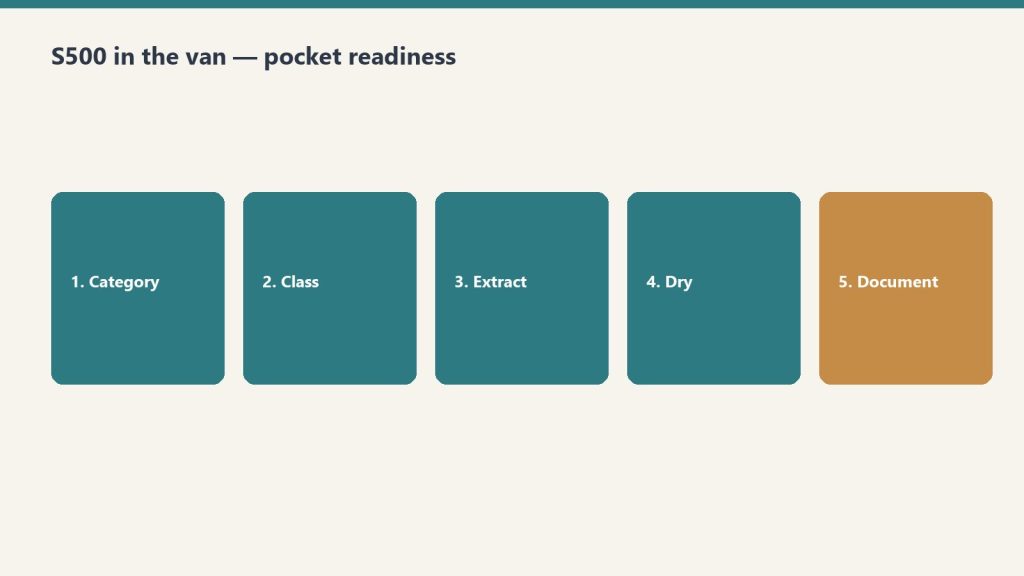
IICRC S500 is not mysterious. The failure mode is that the PM is standing in a basement and the binder is in the office. That is how a supplement dies in email.
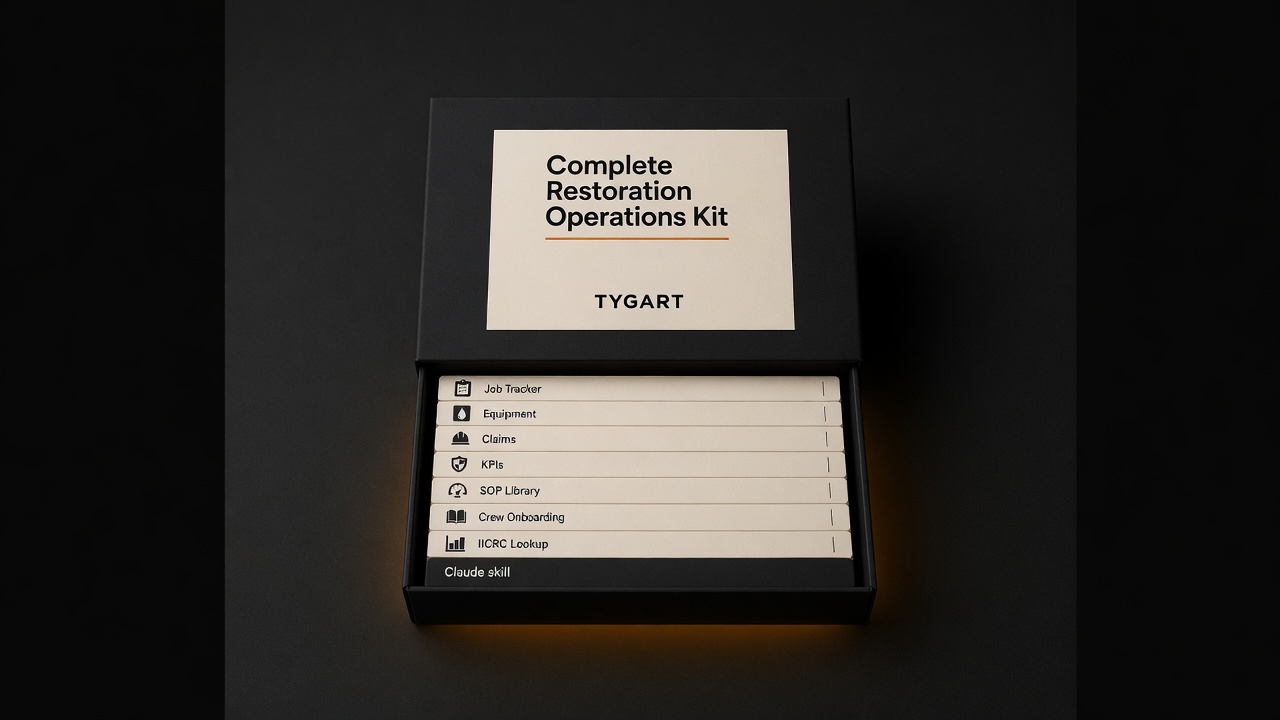
Office owns jobs, fleet, claims, and certs. Van gets a work order. When the question is S500-shaped, ask Claude with a protocol-grounded skill — not a Facebook group.
That stack is the Complete Restoration Operations Kit — six Notion templates plus the IICRC lookup skill. $97 on Square. No email to purchase.
Need only the lookup? Buy the skill. Need more than two pieces? The kit is cheaper.
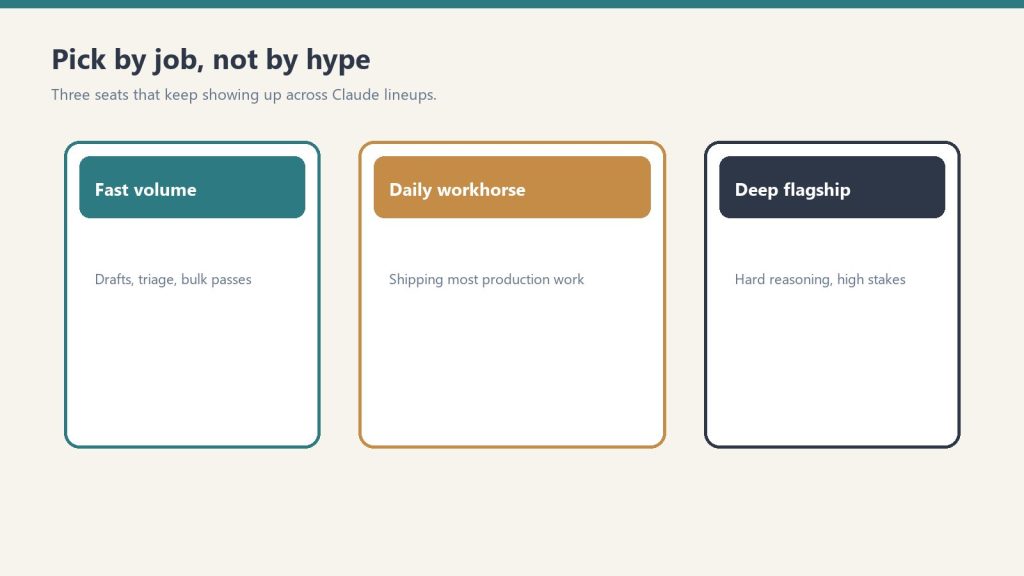
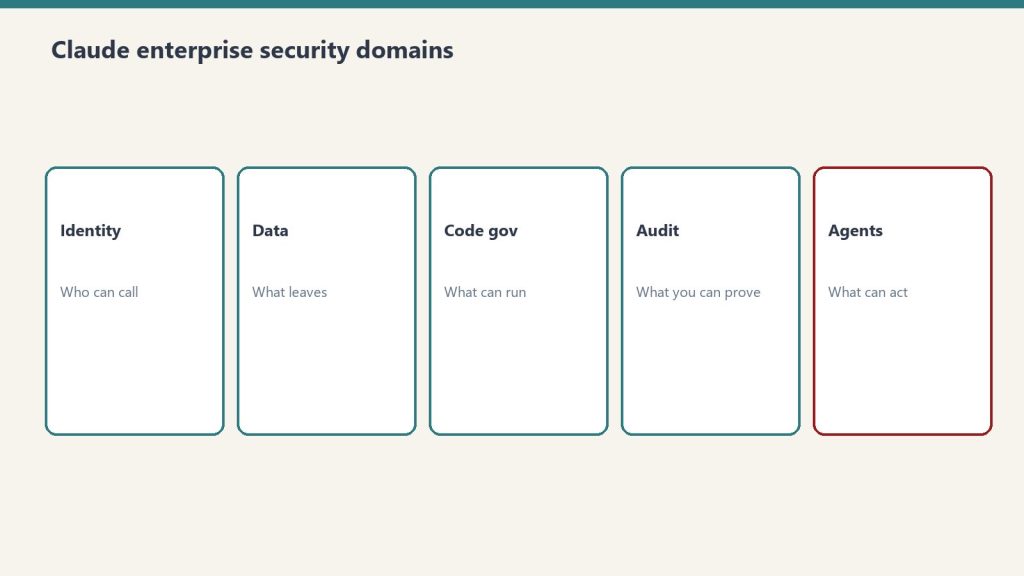
Claude Managed Agents is the product. Slack, Notion, Jira, and Asana are just the interface. Anthropic is building the invisible execution layer that powers the next generation of enterprise software.
Last refreshed: October 20, 2026 (Pacific)
There is a pattern emerging in enterprise AI that most people are reading wrong. They see Anthropic launch Claude Tag in Slack and think “chatbot upgrade.” They see Claude show up inside Notion and think “productivity feature.” They see AI agents appear in Jira and Asana and think “automation plugin.”
They are missing the architecture underneath all of it.
Anthropic is not building a better chatbot. It is building the invisible agent runtime that sits beneath every collaboration tool your team already uses. The company’s Claude Managed Agents (CMA) platform — launched in public beta on April 8, 2026 — is the infrastructure layer that makes this possible. And the speed at which partners are embedding it tells you everything about where enterprise software is heading.
What Claude Managed Agents Actually Is
What Claude Managed Agents actually is — the runtime layer.
Claude Managed Agents is a set of composable APIs for building and deploying production AI agents on Anthropic’s cloud infrastructure. The service handles sandboxed code execution, session persistence, credential management, scoped permissions, and end-to-end tracing — all the operational complexity that previously kept agents stuck in proof-of-concept limbo.
The architecture rests on three primitives: the Agent (configuration and behavior), the Environment (sandboxed execution), and the Session (the event log that tracks everything the agent does). What makes this interesting architecturally is how Anthropic decoupled the “brain” from the “hands.” Claude’s reasoning runs on Anthropic’s own infrastructure while the code execution sandbox spins up independently — and in parallel. The brain starts reasoning immediately while the sandbox provisions, delivering roughly 60% faster time-to-first-token at the p50 level and over 90% faster at p95, according to Anthropic’s engineering team.
Pricing follows a transparent model: standard Claude API token rates plus $0.08 per session-hour of active runtime during the current beta period. Runtime is measured to the millisecond and only accrues while the agent is actively executing — idle time waiting for input or tool confirmations does not count.
For teams that need to keep execution inside their own perimeter, CMA supports self-hosted sandboxes through partners including Cloudflare, Daytona, Modal, and Vercel, or custom VPC deployments. MCP tunnels allow agents to connect to private Model Context Protocol servers inside your network without exposing them to the public internet. A Vaults system keeps credentials out of the sandbox entirely using envelope encryption. And a feature called Dreaming runs scheduled reviews of past sessions to curate agent memory — essentially letting agents learn from their own operational history.
The Embedded Layer: Where CMA Actually Lives
Embedded layer: where CMA actually lives in the stack.
The real story is not the infrastructure. It is where that infrastructure shows up. In the ten weeks since CMA launched, Anthropic has embedded its agent runtime inside the collaboration tools that enterprises already depend on. This is not a roadmap — these integrations are live or in active beta.
Slack: Claude Tag as Persistent Team Member
Claude Tag, launched in late August 2026, replaces Anthropic’s original Claude in Slack integration with something fundamentally different. This is not a chatbot you summon with a slash command. It is a persistent AI team member that lives in your channels, builds memory across conversations, and can take initiative through what Anthropic calls “ambient mode” — proactively surfacing information, following up on forgotten threads, and keeping teams updated across the organization.
Claude Tag is multiplayer by design: one Claude identity per channel, accessible to everyone, with the ability to hand off half-finished tasks between team members. It launched on Claude Opus 4.8 and now runs on Claude Opus 5.5 (see our Claude Tag pricing guide). And internally, Anthropic reports that Claude Tag is already approving and incorporating 65% of the code changes their product team submits. The existing Claude in Slack app will be retired on August 3, 2026. Claude Tag is available on Enterprise and Team plans.
Notion: Claude as External Agent
On May 13, 2026, Notion launched its Developer Platform version 3.5, which introduced the External Agents API. This API lets AI agents — including Claude — operate inside your Notion workspace as first-class participants. They can read pages, write to databases, create tasks, trigger automations, and be @-mentioned directly in documents. Claude operating through this API can chain actions together: read a project brief, check the task database for related work, draft a new document, and create a linked task entry — all in a single session, running on CMA infrastructure with full sandboxing.
Asana: AI Teammates
Asana built AI Teammates on CMA — agents that pick up assigned tasks inside projects, draft deliverables, and hand back outputs for human review. Specialist agents handle specific workflows: the Campaign Brief Writer turns scattered notes into structured briefs, the Workflow Optimizer identifies process gaps and builds automations, and the Compliance Specialist checks work against regulatory standards. Asana’s CTO said CMA let them ship these features “dramatically faster” than any prior approach to agent development.
Atlassian: Claude Agent for Jira
Atlassian released Claude Agent for Jira, built on CMA infrastructure, which lets teams assign work items directly to Claude from the Jira UI. The agent clones the repository, analyzes the codebase, implements changes on an independent branch, pushes the code, and opens a draft pull request — streaming real-time status updates back to the Jira work item throughout the process.
Sentry: From Bug Detection to Merge-Ready PR
Sentry’s existing AI debugging agent, Seer, already used Claude for root cause analysis. With CMA, Sentry extended the workflow from diagnosis to automated fixing — the agent takes Seer’s root cause output, generates a fix, opens a branch with the changes, and creates a pull request for developer review. Sentry processes over one million root cause analyses per year and provides near-immediate reviews on over 600,000 pull requests per month. The CMA integration was built by a single engineer in weeks, eliminating months of custom agent runtime development.
Rakuten: Specialist Agents Across the Enterprise
Rakuten deployed specialist agents across product, sales, marketing, and finance using CMA, with each agent deployed in approximately one week. Agents plug into Slack and Teams, letting employees assign tasks and receive deliverables including spreadsheets, slides, and applications. In the pilot, Rakuten reported a 97% drop in critical first-pass errors, with cost down more than 30% and latency reduced by 34%, without any loss in output quality.
KPMG: Global Professional Services Alliance
On May 19, 2026, KPMG and Anthropic announced a global alliance and launched “Digital Gateway Powered by Claude.” The partnership embeds Claude, Cowork, and CMA directly into KPMG’s client delivery platform, with an initial focus on tax and private equity clients. Building an AI agent for tax regulation workflows previously took weeks and required switching between multiple tools. With CMA integrated into Digital Gateway, KPMG says the same capability takes minutes. The alliance extends to KPMG’s 276,000-person global workforce.
The Strategic Pattern: Agent Runtime as a Service
Step back from the individual integrations and the strategic pattern becomes clear. Anthropic is not trying to own the interface. It is deliberately positioning CMA as the execution layer underneath interfaces that other companies own. Slack owns the messaging UI. Notion owns the workspace UI. Jira owns the project tracking UI. Anthropic owns the agent brain that powers all of them.
This is a fundamentally different strategy from its two largest competitors.
OpenAI chose vertical integration. When OpenAI launched Workspace Agents on April 22, 2026, it positioned ChatGPT itself as the central hub — a no-code successor to custom GPTs that connects to Slack, Salesforce, Google Drive, and Notion through plugins. Agents are created inside ChatGPT, accessed from ChatGPT, and managed through ChatGPT. OpenAI wants to own the surface area.
Google chose platform depth. At Google Cloud Next on April 22, 2026, Google unveiled the Gemini Enterprise Agent Platform — a reimagined evolution of Vertex AI — alongside Workspace Intelligence, a semantic unifying layer that connects data across Docs, Slides, Gmail, and the broader Google Cloud ecosystem. Google’s agent platform supports 200+ models including Claude, and the Agent2Agent (A2A) protocol enables distributed peer-to-peer agent communication. Google is leveraging its data moat and distribution at the platform level.
Anthropic chose tool-centric orchestration. Rather than owning the UI (OpenAI) or the platform (Google), Anthropic is embedding its agent runtime into every tool through composable APIs and the Model Context Protocol. The platform you use becomes irrelevant — whether it is Slack, Notion, Jira, Asana, or Sentry — because the agent brain running underneath is Claude on CMA.
This is the agent-as-a-service model. And it may be the most defensible position of the three, because it does not require users to change their behavior or migrate to a new platform. The agent shows up where they already work.
What the Numbers Say About Enterprise Agent Adoption
The macro context supports Anthropic’s timing. Gartner predicts that 40% of enterprise applications will include embedded task-specific agents by the end of 2026, up from less than 5% in 2025. McKinsey’s April 2026 analysis found that agentic AI can enable automation of 60 to 80 percent of routine infrastructure work over time, translating to a 20 to 40 percent run-rate cost reduction in initial deployments.
The gap between experimentation and production remains the defining challenge. Industry research compiled from major firms shows that nearly four in five enterprises have experimented with or deployed agents in some form, but fewer than one in nine are running them in production at a scale that generates measurable business value. For the agents that do reach production, the average return on investment is 171% — though 19% of deployments never reach payback at all.
That production gap is exactly what CMA is designed to close. The infrastructure burden — sandboxing, session persistence, credential isolation, error recovery, observability — is the bottleneck. Engineering teams routinely dedicated significant senior engineering resources for months before a single agent reached production. CMA eliminates that layer entirely, which is why partners like Asana, Sentry, and Rakuten report shipping production agents in days or weeks rather than quarters.
What This Means for Businesses Already Using These Tools
If your organization uses Slack, Notion, Jira, or Asana — and statistically, you use at least two of them — you are about to encounter Claude whether you planned to adopt it or not. This is not a technology decision your IT team is making. It is a feature that your existing vendors are shipping.
The practical implications are significant. Claude Tag in Slack means your team channels will have an AI participant that remembers past conversations, can be handed tasks asynchronously, and may proactively surface information. Claude in Notion means your project documentation, databases, and task boards can be read, analyzed, and acted upon by an agent that chains actions together. Claude Agent for Jira means development tickets can be assigned to an AI that clones your repo, writes code, and opens pull requests.
For agencies and service providers managing client work across multiple tools, the embedded agent layer changes the economics fundamentally. Work that previously required a human to context-switch between Slack, Notion, and a project management tool — reading a brief here, updating a task there, drafting a document somewhere else — can be handled by an agent that operates across all of them simultaneously. The coordination tax that consumes a substantial share of knowledge work time is the exact problem embedded agents are built to solve.
The companies that benefit most will be the ones that have clean operational systems — structured task boards, documented processes, well-organized project databases — because agents can only act on information they can read. Messy Notion workspaces and disorganized Jira boards will limit what agents can accomplish. Operational hygiene just became a competitive advantage.
What This Means for Solo Operators Already Running Agent Infrastructure
There is a specific audience that should be paying very close attention to CMA: the solo operators and small agency owners who have already built their own agent stacks from scratch. If you are running scheduled Claude tasks on a GCP Compute Engine VM, connecting to WordPress via REST API proxies, piping work orders through Notion, monitoring Gmail for client replies, and publishing content through MCP-connected pipelines — you have already built a version of what CMA is productizing.
The economics question is worth doing the math on. A lightweight GCP VM running 24/7 to host recurring agent tasks — news desk monitors, outreach reply checks, newsletter extraction, scheduled content audits — costs a fixed monthly rate whether the agents are actively working or sitting idle. CMA at $0.08 per session-hour of active runtime only charges when agents are executing. For tasks that run for a few minutes every few hours, the per-session billing model could be substantially cheaper than keeping a VM warm around the clock. A task that runs for ten minutes six times a day would cost roughly $0.08 per day on CMA, versus the cost of a VM instance that never sleeps.
But the migration path is not ready yet, and solo operators should understand exactly where the gaps are before making any infrastructure decisions.
The biggest gap is MCP tunnels. CMA’s ability to connect agents to private MCP servers inside your network is still in research preview — not production-ready. If your agent stack depends on a private WordPress REST API proxy, a Notion workspace connected via MCP, or any internal tool that is not exposed to the public internet, CMA cannot reach it today. The Vaults system for credential management is promising, but it does not solve the network connectivity problem for self-hosted infrastructure.
The second gap is orchestration control. Solo operators who have built their own agent infrastructure typically have precise control over scheduling, retry logic, error handling, and the exact sequence of tool calls. CMA’s Dreaming feature — which reviews past sessions to curate agent memory — is an interesting approach to agent learning, but it is not the same as having direct control over a cron job that fires at 6:00 AM, checks three data sources in a specific order, and writes results to a specific Notion database with a specific schema.
The thesis for solo operators is straightforward: CMA is almost certainly the future migration path for self-hosted agent infrastructure. The economics favor it for intermittent workloads, the managed security and sandboxing eliminate operational risk you are currently carrying yourself, and the session persistence model solves problems that custom agent runtimes handle poorly. But the plumbing — particularly MCP tunnels to private infrastructure — is not production-ready. Track it closely. Do not migrate yet. When MCP tunnels graduate from research preview to general availability, revisit the math and the connectivity story. That is the trigger point.
The Risk Nobody Is Talking About
The risk nobody talks about — agents that act with memory.
There is a tension in this model that deserves attention. When Claude operates as an invisible layer inside tools you already trust, the boundary between the tool’s native capabilities and the AI agent’s actions blurs. A Jira ticket that was “completed” might have been implemented by Claude, reviewed by a human for thirty seconds, and merged. A Notion project plan that looks thorough might have been generated by an agent that filled in the sections with plausible-sounding content.
The embedded model works precisely because it reduces friction — but reduced friction also means reduced scrutiny. Organizations adopting embedded agents need to build review processes that match the speed at which agents can produce output. The 171% average ROI from agent deployments accounts for the value created, but it does not account for the subtle quality risks of production work generated by systems that are confident, fluent, and occasionally wrong.
Anthropic has built guardrails into CMA — sandboxed execution, credential isolation, session logging — but the governance layer for reviewing agent output at enterprise scale is still largely unsolved. This is a space where internal operational discipline matters more than the technology itself.
Where This Goes Next
Claude Tag launched on Slack first. Anthropic has indicated plans for wider rollout beyond Slack. If the pattern holds, expect Claude Tag’s persistent team member model to appear in Microsoft Teams, Discord, and any other collaboration surface where teams coordinate work.
The CMA primitives are designed to be composable, which means the partner integration list will grow rapidly. Any SaaS company with an API and a workflow that involves reading context, making decisions, and taking actions is a candidate for CMA integration. Customer support platforms, CRM systems, design tools, analytics dashboards, HR systems — the addressable surface is essentially every tool that knowledge workers touch.
Gartner’s long-term projection estimates that agentic AI could drive approximately 30% of enterprise application software revenue by 2035, surpassing $450 billion. If Anthropic’s embedded strategy succeeds, a meaningful slice of that revenue flows through CMA as the underlying runtime — regardless of whose logo is on the interface.
The chatbot era is ending. The embedded agent era is starting. And Anthropic is betting that the company that owns the invisible execution layer wins the market, even if no end user ever sees its name.
Claude Managed Agents is a set of composable APIs launched by Anthropic on April 8, 2026 in public beta. CMA lets developers build and deploy production AI agents on Anthropic’s cloud infrastructure, handling sandboxed code execution, session persistence, credential management, and end-to-end tracing. The architecture separates the “brain” (Claude reasoning) from the “hands” (code execution sandbox), enabling parallel processing and faster agent responses.
How much do Claude Managed Agents cost?
During the current public beta, CMA pricing is standard Claude API token rates plus $0.08 per session-hour of active runtime. Runtime is measured to the millisecond and only accrues while the agent is actively executing — idle time does not count. GA pricing has not been finalized and may differ from the beta rate.
What is Claude Tag in Slack?
Claude Tag is Anthropic’s persistent AI team member for Slack, launched in late August 2026. Unlike a traditional chatbot, Claude Tag lives in channels, builds memory across conversations, takes initiative through ambient mode, and works asynchronously. It is multiplayer — one Claude identity per channel that all team members interact with. Claude Tag now runs on Claude Opus 5.5 (launched on Opus 4.8) and is available on Enterprise and Team plans. It replaces the original Claude in Slack app, which retired August 3, 2026.
Which tools have Claude Managed Agents embedded?
As of October 2026, CMA is embedded in Slack (via Claude Tag), Notion (via the External Agents API), Asana (AI Teammates), Atlassian Jira (Claude Agent for Jira), and Sentry (extending the Seer debugging agent). Enterprise deployments include Rakuten (specialist agents across product, sales, marketing, and finance) and KPMG (Digital Gateway Powered by Claude for tax and private equity clients).
How does Anthropic’s agent strategy differ from OpenAI and Google?
Anthropic uses a tool-centric orchestration approach, embedding its agent runtime inside existing tools via composable APIs and the Model Context Protocol (MCP). OpenAI chose vertical integration with Workspace Agents, positioning ChatGPT as the central hub. Google chose platform depth with the Gemini Enterprise Agent Platform and Workspace Intelligence semantic layer. Anthropic’s approach does not require users to change platforms — the agent shows up where they already work.
What percentage of enterprise apps will have embedded AI agents by end of 2026?
Gartner predicts that 40% of enterprise applications will include embedded task-specific agents by the end of 2026, up from less than 5% in 2025. However, fewer than one in nine enterprises currently run agents in production at scale, suggesting significant growth ahead.
Can Claude Managed Agents run inside a private network?
Yes. CMA supports self-hosted sandboxes through partners including Cloudflare, Daytona, Modal, and Vercel, or custom VPC deployments. MCP tunnels allow agents to connect to private Model Context Protocol servers inside your network without public exposure. A Vaults system keeps credentials out of the sandbox using envelope encryption.
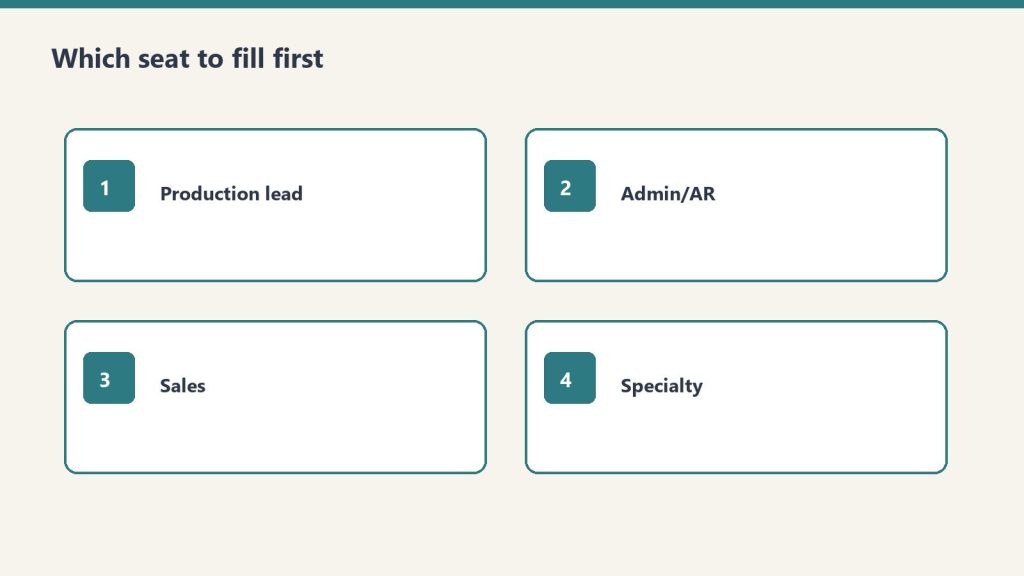
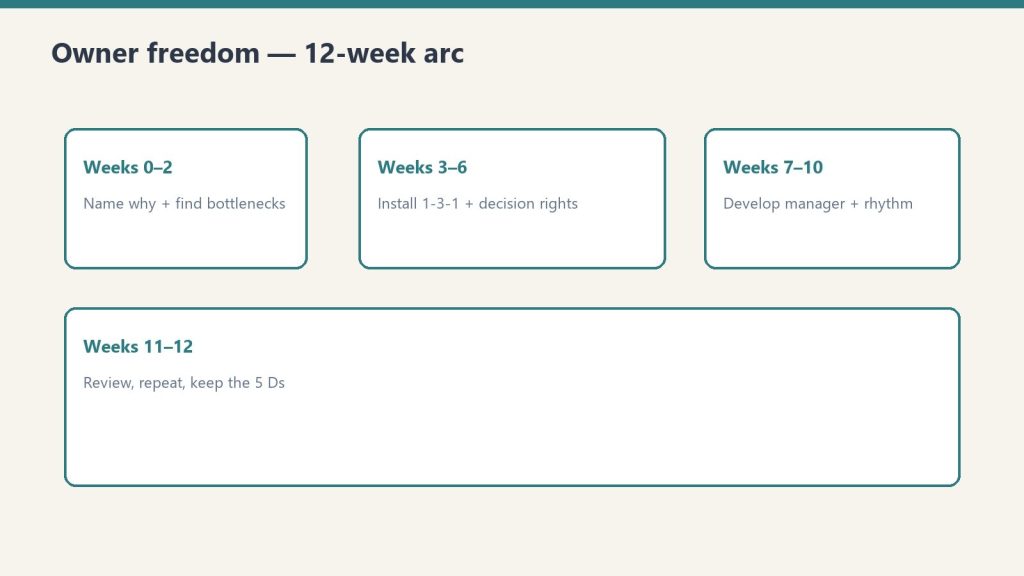
The hardest org-chart decision in restoration is not who to hire. It is what order to hire them in. Get the sequence wrong and you spend money on a seat that doesn’t relieve the bottleneck — while the real constraint, almost always you, keeps strangling growth.
Most owners build their team reactively. A big loss comes in, they’re underwater, so they grab whoever is available — usually another tech. Six months later they have more trucks and the same problem: every job, every estimate, and every collections call still routes through the owner. They added capacity to the field and zero capacity to the bottleneck.
Here is the honest sequence — the one that actually pulls the owner out of the truck — mapped to the revenue milestones where each hire pays for itself.
First, Find Your Real Bottleneck (It’s Probably You)
Find the real bottleneck before you hire more techs.
Before you hire anyone, do the boring exercise. List every function the company performs — answer the phone, dispatch, scope the loss, write the estimate, run the crew, order equipment, invoice the TPA, chase payment, do payroll. Next to each one, write the name of who actually does it. Count how many times your own name appears. That number is your bottleneck, and the first hire should remove the most expensive, most repeatable item from your list — not the one you enjoy least.
The trap is hiring for relief instead of leverage. Hiring a third tech feels good because the trucks are full. But if you are still the only person who can scope a loss and write a winning estimate, those trucks just create more work that funnels back to you.
$0–$1M: You and a Lead Tech
At startup scale, the org chart is two boxes: you and a strong lead technician. You are the estimator, the PM, the dispatcher, and the collections department. That’s fine — and unavoidable — at this stage. The rule of thumb most operators use is roughly $150,000–$200,000 in annual revenue per field technician before adding the next one, because that’s the point where there is genuinely enough work to keep another body busy and billable.
The mistake here is hiring a second tech too early to look bigger than you are. Idle techs are the fastest way to torch a thin startup margin.
$1M–$2M: The First Office Hire — Not Another Tech
First office hire — not another tech — unlocks the owner.
This is the milestone where most owners hire wrong. They add a second or third tech when the seat that actually frees them is administrative. An office coordinator or office manager who owns scheduling, job-file documentation, TPA paperwork, and the collections follow-up is the single highest-leverage hire at this stage. Restoration office and administrative coordinator roles commonly run in the $45,000–$60,000 range depending on market, and that one seat can claw back ten to fifteen owner-hours a week — hours you can redirect into estimating and sales, which are the only two activities that grow revenue.
The math is simple. If you are personally billing $150-plus per estimating hour and you hand off twelve hours of admin a week to a $55,000 coordinator, the hire pays for itself almost immediately and converts owner time into top-line growth.
$2M–$3.5M: A Dedicated Estimator / Project Manager
Once admin is covered, the next thing chained to the owner is almost always scoping and estimating. This is the hardest seat to give up because it feels like the part only you can do — and at first, it is. But a $2M shop cannot scale on a single estimator who is also the CEO.
Hire a restoration estimator/PM who can scope a loss, write the Xactimate estimate, and manage the job to completion. Expect this to be one of your more expensive seats: restoration project manager and estimator compensation broadly lands in the $60,000–$90,000 range nationally, with experienced, supplement-savvy PMs commanding more in tight labor markets. Plan for a ramp — a new PM rarely writes estimates as tight as an experienced owner on day one, and supplement recovery may dip during the handoff before it recovers.
This is also where your tech stack starts to matter. If your estimating, job management, and TPA reporting all live in the owner’s head or a spreadsheet, the new PM can’t be effective. The hire and the system have to land together.
$3.5M–$5M: An Operations Manager and the Owner Comes Off the Truck
Ops manager stage: owner comes off the truck on purpose.
By this stage you should have a small bench: lead techs, an office manager, and at least one PM/estimator. The seat that defines a $5M shop is an operations manager — someone who is not you and, ideally, not a relative — who owns daily execution: dispatch, crew utilization, equipment, and job throughput. Restoration operations manager pay broadly runs from roughly $63,000 on the lower end to around $89,000-plus for experienced managers, depending heavily on market and revenue scale.
This is the hire that lets the business survive without the owner physically present. It is also the one that most directly changes what the company is worth. Restoration shops under about $2M tend to trade at roughly 2.8x–3.0x SDE, while companies that cross $5M with a diversified service mix and a real second layer of leadership command 4x–7x EBITDA. Buyers aren’t paying that premium for revenue — they’re paying for an operation that runs without the founder in the dispatch seat. The operations manager is what makes that true.
A Sanity Check on Labor Cost
As you build the team, keep the whole picture in view. Healthy restoration shops generally run blended gross margins in the 50–75% range depending on mix — water mitigation sits at the high end (roughly 70–80%) because equipment does much of the work, while reconstruction and fire work run leaner. Well-run operations keep total operating expense, excluding direct job cost, in the rough range of 40–55% of revenue. If a new hire pushes overhead past that band without a clear path to more billable throughput, you’ve hired ahead of your revenue — slow down and fill the pipeline before you fill the seat.
The Bottom Line
The order is admin, then estimator/PM, then operations manager — and only more techs as billable volume genuinely demands them. Hire to remove yourself from the bottleneck, not to make the trucks look full. The owners who hit $5M and sell at a 4x-plus multiple are not the ones who hired the most people fastest. They’re the ones who hired the right seat next, every time, until the day the business no longer needed them in the truck.
If you’re still running the whole company from the van, the Complete Restoration Operations Kit gives you the connected job tracker, equipment, claims, SOPs, KPIs, and crew tools that make those hires actually stick. Pair it with the Restoration Leadership Toolkit — Claude Edition when you’re ready to build the bench that lets you step out of the truck.
The Signal — Tygart Media's weekly brief. What we actually ran, what it measured, and what it means for a restoration shop.