Exploring Everett - Tygart Media

Category: Exploring Everett

Everett, Washington is in the middle of something big. A $1 billion waterfront transformation. A Boeing workforce that built the world’s largest commercial jets. A port city with a downtown that’s finally catching up to its potential. A Navy presence at Naval Station Everett. A comedy and arts scene punching above its weight. And neighborhoods — Riverside, Silver Lake, Downtown, Bayside — each with their own identity and story.

Exploring Everett is Tygart Media’s hyperlocal coverage vertical for Snohomish County’s largest city. We cover the waterfront redevelopment, Boeing and Paine Field, city hall, the food and arts scene, real estate, neighborhoods, and everything in between — written for people who live here, work here, or are paying attention to what’s coming.

Coverage categories include: Everett News, Waterfront Development, Boeing & Aerospace, Business, Arts & Culture, Food & Drink, Real Estate, Neighborhoods, Government, Schools, Public Safety, Events, and Outdoors.

Exploring Everett content is also published at exploringeverett.com.

  • For Boeing Line Workers in Everett: An Aerospace Worker’s Guide to Aviation Technical Services Down the Road at Paine Field

    For Boeing Line Workers in Everett: An Aerospace Worker’s Guide to Aviation Technical Services Down the Road at Paine Field

    For Boeing Line Workers in Everett: An Aerospace Worker’s Guide to Aviation Technical Services Down the Road at Paine Field

    If you have spent any time on a Boeing factory floor in Everett, you already know the second-largest aerospace employer in this city. You drive past it on the way home. The buildings at the south end of Paine Field, Airport Road side, hangar doors big enough to swallow a 777 — that is Aviation Technical Services. ATS. About 800 people in Everett. The largest MRO operation on the West Coast.

    This is the worker’s guide to ATS as it relates to a Boeing-line career: what the work looks like, how the skills transfer, how the trade-offs compare, and what to watch for as Everett’s aerospace economy heads into a 737 MAX 10 North Line activation, a 777-9 ramp, and a regional 5,200-worker aerospace shortage.

    What ATS Does That Boeing Doesn’t

    Boeing builds airplanes. ATS fixes them after they’re built. That is the core distinction.

    The work that happens inside the ATS Everett hangar is heavy maintenance — C-checks, D-checks, structural repair, cabin reconfigurations, modifications, avionics upgrades. Airlines fly their planes to Paine Field, ATS technicians take them apart, look at every inch of structure and system, fix what is worn or damaged, and put the airplane back together to fly another five to ten years. The 500,000-square-foot hangar fits up to 14 airliners simultaneously. The 50,000-square-foot component shop next door handles the parts that come off them.

    For a Boeing-line worker, that is a very different cadence. Factory work is repetitive at scale: same station, same job, same airplane type, in volume. MRO work is investigative: each airplane comes in with a different history, different fleet leader, different damage pattern. You spend more time troubleshooting and less time executing a fixed task.

    How Boeing-Line Skills Transfer to ATS

    The trade itself is the same. Aerospace mechanics use the same toolboxes, the same FAA airframe-and-powerplant fundamentals, the same sheet-metal and structures techniques whether they’re building a 737 MAX or repairing a 757 that has been flying for fifteen years. Specifically:

    • Sheet metal mechanics — riveting, drilling, structural repair, skin replacement. Direct transfer.
    • Structures specialists — composite repair, frame work, wing-box and empennage repair. Direct transfer, with the difference that MRO sees more in-service damage and corrosion than factory work does.
    • Hydraulics and pneumatics technicians — same systems on Boeing factory floor and on ATS hangar floor.
    • Avionics technicians — Boeing factory wiring and ATS in-service wiring share the same diagnostic toolkit.
    • Electrical mechanics — same wire bundles, same installation standards.
    • Inspectors and quality — Boeing’s quality system is FAA-aligned; ATS operates under FAA Part 145 repair-station rules. The discipline carries.

    What does not always transfer one-to-one is the work pace. A Boeing 737 line moves at production cadence — Rate 47 is coming this summer per Boeing’s own forecasts. ATS work is paced by airline turn time: how fast an airline wants the airplane back in revenue service. Some checks turn in two weeks, some in two months. The variance is wider than a factory line allows.

    The Commute Math From the Boeing Side of the Field

    ATS is on the other end of the same airport. From Boeing’s main entrance to the ATS hangars at the south end of Paine Field, you are looking at a few minutes of drive time inside the Paine Field campus. If you currently commute to Boeing from Mukilteo, Mill Creek, Lake Stevens, Marysville, Lynnwood, or anywhere else in the Paine Field catchment, the commute math is essentially identical at ATS.

    That has practical implications. If you are house-shopping in Everett — and given Snohomish County’s 51.8% housing inventory jump in March 2026 a lot of aerospace workers are — the same neighborhoods work for both employers. Silver Lake, Mukilteo, Harbour Pointe, Mill Creek, Lake Stevens. Same drive, same options.

    Why ATS Matters as a Career Anchor in Everett

    MRO demand runs countercyclical to new-aircraft production. When Boeing slows, airlines fly older airplanes longer; that is more MRO work. When Boeing accelerates, the older airplanes still come due for their checks. For a worker thinking about a 25-year career in Everett aerospace, that countercyclical relationship is a hedge most factory positions do not offer.

    The other anchor is the building itself. The Tramco-to-Goodrich-to-ATS hangar has been an MRO operation in Everett since the 1980s. That kind of footprint stability is rare in commercial aviation; programs come and go but the airframe hangars persist because the in-service fleet keeps coming back.

    What’s Different About the Day-to-Day

    Talk to anyone who has worked both sides — Boeing factory and ATS hangar — and a few patterns come up:

    You learn more airframes faster at ATS. The hangar sees 737 NG, 737 MAX, 757, 767, 777, A320 family. A Boeing line worker often spends years on one type. An ATS mechanic rotates across types as the work comes in.

    You troubleshoot more at ATS, execute more at Boeing. MRO is built around finding what is wrong with a specific airplane. Factory work is built around installing a specific component to a specific spec on every airplane that comes down the line.

    Quality systems are different but parallel. Boeing has its production quality apparatus; ATS has FAA Part 145 repair-station governance. Both are heavily documented and audited. The discipline carries.

    Shift structures vary. MRO often runs around customer turn times — heavier nights and weekend coverage when an airline needs the airplane back fast.

    The 2026 Window

    Three things make 2026 a good year to know what’s at the south end of Paine Field if you work for Boeing:

    The aerospace shortage is real. Snohomish County is short an estimated 5,200 aerospace workers across factory and MRO. That puts upward pressure on wages and competition for skilled labor at every employer in the cluster, including ATS.

    The 737 MAX 10 North Line activation is happening this summer. That brings new demand to Boeing — and over time, new airplanes that will eventually need MRO work. ATS sits two miles from where they’re being built.

    The 777-9 ramp into 2027 is real, even with Lufthansa’s first delivery slipping to Q1 2027. That fleet, when it deploys, will become MRO inventory across the next two decades.

    Frequently Asked Questions

    Is ATS hiring Boeing line workers?

    ATS regularly recruits airframe mechanics, structures specialists, sheet metal mechanics, avionics technicians, and quality inspectors — the same trades Boeing employs. The Snohomish County aerospace pipeline feeds both companies, and lateral moves are not unusual.

    Do my Boeing factory skills transfer to ATS?

    Most aerospace trade skills transfer cleanly: sheet metal, structures, composites, hydraulics, avionics, electrical. The major differences are work pace (more investigative at ATS, more repetitive at Boeing) and airframe variety (more types at ATS, often one type at Boeing).

    How far is ATS from the Boeing Everett factory?

    ATS operates at the south end of Paine Field, on Airport Road. From the Boeing Everett main entrance, the drive is short — both employers share the Paine Field campus.

    What aircraft does ATS work on?

    737 NG and MAX, 757, 767, 777, and A320 family aircraft are the primary fleet types serviced at the Everett MRO. The component shop supports rotable parts across those fleets.

    Is MRO work less stable than factory work?

    Industry data shows MRO demand running countercyclical to new-aircraft production. When new deliveries slow, airlines fly older airplanes longer, which is more MRO work. When deliveries accelerate, scheduled checks on the existing fleet continue. That countercyclical relationship is a structural feature of the sector.

    How big is the ATS Everett facility compared to a Boeing factory bay?

    The ATS airframe hangar is 500,000 square feet and fits up to 14 commercial airliners at a time. That is smaller than the Boeing Everett factory’s full footprint but is the largest single MRO building on the U.S. West Coast.

    What is the ATS Part 145 repair station designation?

    FAA Part 145 is the federal regulatory framework for certificated repair stations. ATS Everett operates under that designation, which governs work scope, quality systems, training, and recordkeeping.


    Related Exploring Everett coverage:


  • Aviation Technical Services in Everett: The Complete 2026 Guide to Paine Field’s MRO Anchor and Snohomish County’s #2 Aerospace Employer

    Aviation Technical Services in Everett: The Complete 2026 Guide to Paine Field’s MRO Anchor and Snohomish County’s #2 Aerospace Employer

    Aviation Technical Services in Everett: The Complete 2026 Guide to Paine Field’s MRO Anchor and Snohomish County’s #2 Aerospace Employer

    Everett has an aerospace identity problem. Almost every conversation about the local industry starts with Boeing — the 737 North Line, the 777-9 ramp, the KC-46 cadence, the Future of Flight tour. That isn’t wrong. It’s just incomplete. The second-largest aerospace employer in this city operates roughly two miles from Boeing’s main entrance, in a hangar most residents drive past without realizing what’s inside.

    That company is Aviation Technical Services — ATS. About 800 employees. A 500,000-square-foot airframe Maintenance, Repair, and Overhaul (MRO) hangar at the south end of Paine Field. A 50,000-square-foot component repair facility next door. And the title of the largest MRO on the U.S. West Coast.

    This is the complete 2026 guide to ATS in Everett — what the company does, where it sits in the Snohomish County aerospace economy, why MRO matters as the local industry preps for a 737 MAX 10 North Line activation and a 777-9 delivery wave, and what the workforce looks like.

    What ATS Does in Everett

    ATS is a heavy-maintenance MRO operator. In plain English: airlines fly their planes to Paine Field and ATS technicians take them apart, inspect the structure, fix what’s worn or damaged, modify what needs upgrading, and put them back together to fly another decade. The industry calls these visits checks — A-checks, C-checks, and the deep structural D-check — and the heavy ones happen in hangars exactly like the one ATS operates at the south end of the airport.

    The Everett campus runs two integrated facilities:

    • The 500,000-square-foot airframe hangar — bay space for up to 14 commercial airliners simultaneously. A Boeing 737 NG is roughly 130 feet long; the building can fit more than a dozen of them under one roof.
    • The 50,000-square-foot component repair facility — where structural, hydraulic, and electrical components come off the airframes and get repaired by technicians trained on specific systems.

    Together those two buildings give ATS what the trade press calls a “full-service” MRO posture: an airline can ship the whole airplane to Everett and ship the parts that come off it to the same campus.

    The Building’s History: Tramco, Goodrich, ATS

    The hangar is not new. It was originally built and operated by Tramco, sold to Goodrich, and then sold to ATS in the fall of 2007. That timeline matters because it means the same physical footprint has been an MRO operation in Everett for decades. The institutional knowledge — the technicians who have seen the same airframe come back for its third C-check, the engineers who know how the supply of certain parts behaves — runs deep. When someone in Snohomish County says they “work at ATS,” there is a reasonable chance their parents or their first supervisor worked at Tramco in the same building.

    Where ATS Sits in the Snohomish County Aerospace Economy

    Boeing remains the dominant aerospace employer in Everett — the 737 MAX 10 North Line activation in summer 2026 alone is supposed to add hundreds of factory positions, layered on top of the 777-9 program and KC-46 deliveries. ATS sits in a different position on the supplier map: not building new airplanes, but maintaining the in-service fleet.

    That position has structural value. When Boeing slows or speeds up production — both have happened in the last five years — MRO demand follows a different curve. Airlines fly older airplanes longer when new deliveries slip; that is more MRO work, not less. When new airplanes do arrive, the older ones in the fleet still come due for their scheduled checks. MRO is countercyclical to factory production in ways that smooth the local aerospace job market.

    For Snohomish County, that means ATS is the second pillar — after Boeing — of an aerospace ecosystem that also includes Aviation Technical Services’ supplier network, the 5,200-worker aerospace shortage the county is trying to close, and emerging entrants like ZeroAvia at Paine Field.

    What ATS Works On

    The Everett facility’s bread and butter is narrowbody and widebody airframe MRO. That includes Boeing 737 family work (NG and MAX), 757s, 767s, and 777s, plus Airbus A320 family aircraft. ATS publishes an FAA-certificated repair station list for the work scope; the practical effect is that almost any commercial airliner you might see flying in or out of a North American airport could end up at Paine Field for a heavy check.

    Beyond scheduled maintenance, ATS does cabin reconfigurations (when an airline buys an airplane and wants different seat counts or class layouts), structural repair (post-incident or post-corrosion), modification engineering, and avionics upgrades. The component shop next door supports rotables — the parts that come off airplanes, get repaired or overhauled, and go back onto the airplane fleet later.

    Why MRO Matters in an Aerospace Town

    It is easy to think about Everett’s aerospace economy as a Boeing factory and the suppliers that feed it. That model misses the after-market. Every airplane Boeing has ever delivered eventually needs heavy maintenance, and the MRO sector is where that work happens. Globally, commercial aviation MRO is a multi-tens-of-billions-per-year industry. On the West Coast of the United States, the largest single facility doing that work is at the south end of Paine Field.

    That has implications for workforce. The skills an ATS airframe mechanic uses overlap heavily with what a Boeing factory mechanic uses — sheet metal, composites, hydraulics, electrical, structures — but with a different rhythm. Factory work is repetitive at scale. MRO work is investigative: each airplane comes in with a different set of issues. The two career paths cross-train people who can move between them as the local economy shifts.

    The 2026 Context: Why ATS Matters Right Now

    Three things are converging in Everett’s aerospace economy in 2026 that put ATS in a useful spotlight:

    1. The 737 MAX 10 North Line activation. Boeing’s 737 MAX 10 will be built exclusively in Everett, with the North Line going live this summer. New airplanes need eventual MRO. ATS sits two miles from where they will be built.

    2. The 777-9 ramp into 2027. Lufthansa just confirmed first 777-9 delivery slips to Q1 2027. The fleet that customers eventually accept will need scheduled maintenance over its life — work an MRO with 777 capability is positioned to capture.

    3. The 5,200-worker aerospace shortage. Snohomish County is short thousands of skilled aerospace workers across factory and MRO. The pipeline that fills Boeing also fills ATS. That makes ATS a quiet but important participant in any conversation about local workforce development.

    Frequently Asked Questions

    Where is Aviation Technical Services located in Everett?

    ATS operates from the south end of Paine Field, along Airport Road in Everett. The campus includes a 500,000-square-foot airframe hangar and an adjacent 50,000-square-foot component repair facility.

    How many people does ATS employ in Everett?

    About 800 people work at the ATS Everett campus. That makes ATS the second-largest aerospace employer in Everett after Boeing.

    What is MRO, and why does it matter for Everett?

    MRO stands for Maintenance, Repair, and Overhaul — the heavy-maintenance sector of commercial aviation that services airplanes already in service with airlines. It matters for Everett because ATS operates the largest MRO facility on the U.S. West Coast at Paine Field, anchoring a workforce sector that runs countercyclical to new-aircraft production.

    How many airplanes can fit in the ATS Everett hangar?

    The 500,000-square-foot airframe hangar has bay space for up to 14 commercial airliners simultaneously.

    Who used to own the ATS Everett hangar?

    The building was originally Tramco, then Goodrich, then sold to ATS in the fall of 2007. The footprint has been an MRO operation in Everett for decades.

    What aircraft types does ATS work on?

    The Everett facility services Boeing 737 family (NG and MAX), 757, 767, and 777 aircraft, plus Airbus A320 family. The component shop supports rotable parts across those fleets.

    Is ATS hiring in Everett in 2026?

    ATS recruits airframe mechanics, avionics technicians, sheet-metal mechanics, structures specialists, and engineers as part of the broader Snohomish County aerospace pipeline. The county-wide aerospace shortage is roughly 5,200 workers across factory and MRO sectors, and ATS is one of the larger employers competing for that talent.

    Is ATS related to Boeing?

    No. ATS is a separate company that operates an MRO business adjacent to Boeing’s Everett factory. The two share the Paine Field campus but are independent employers with different workforce needs and different customers.


    Related Exploring Everett coverage:


  • Das Bratmobile: Everett’s German Food Truck Is Making Uli’s Brats and Schnitzel From Scratch — And Most People Don’t Know It Exists

    Das Bratmobile: Everett’s German Food Truck Is Making Uli’s Brats and Schnitzel From Scratch — And Most People Don’t Know It Exists

    Das Bratmobile has been feeding Everett the real thing for years, and most of the city still hasn’t found it. A German food truck run by a brother and sister from Rheinland-Pfalz, Germany, Das Bratmobile is the kind of operation that food-obsessed locals discover and immediately tell everyone they know. It’s authentic, it’s handcrafted, and it shows up at the Beverly Food Truck Park with the kind of menu that makes you realize how many years you’ve been settling for inferior sausages.

    If you haven’t been, here’s everything you need to know.

    Who’s Behind the Truck

    Ferdi and Uschi moved to the United States from Pirmasens, a town in Rheinland-Pfalz in western Germany, in the early 1990s. They built Das Bratmobile themselves — not because it was the trendy thing to do, but because buying a pre-built food service trailer was too expensive and building their own was the only realistic path. That’s the origin story of a truck built with genuine stakes, not a lifestyle pivot. When you taste the food, that history makes sense. This isn’t a German-themed food truck. It’s a truck run by Germans cooking the food they grew up eating.

    The Menu: Uli’s Sausages, Schnitzel, and Frikadelle

    Das Bratmobile sources its sausages from Uli’s Famous Sausage, the Seattle institution that has been making old-world European sausages since 1982. If you know Uli’s, you know what that means: these aren’t grocery-store brats. These are serious sausages made with care from a supplier that takes the craft seriously. The lineup includes smoked, jalapeño cheddar, currywurst, and polish — mild to spicy, with something for every heat tolerance.

    The Jaegerschnitzel is a bestseller — a German classic done right: breaded and fried pork cutlet with mushroom gravy. When it’s made well, schnitzel is one of the most satisfying foods in existence. Ferdi and Uschi make it well.

    Then there’s the Frikadelle — a homemade German burger. Not an American burger with a German twist. A proper German pan-fried meatball patty, seasoned the way it should be, served with German-style potato salad. If you’ve only ever had American versions of this concept, the real thing will recalibrate your expectations.

    German-style potato salad rounds out the sides — vinegar-based, not the mayo-loaded American picnic version. It’s the right call alongside sausages.

    Where to Find Das Bratmobile

    Das Bratmobile rotates through several Everett-area spots. Your most reliable bet:

    Beverly Food Truck Park — 6731 Beverly Blvd, Everett. The park runs Monday through Saturday, 4–7 PM with a rotating lineup of 2–4 trucks. Das Bratmobile is one of the regulars here, alongside other standouts we’ve covered. Check StreetFoodFinder before you go to confirm they’re on the schedule that day.

    They’ve also appeared at Scuttlebutt Brewing’s Cedar Street taproom, the Everett Food Truck Festival, and at various events around Snohomish County. Scuttlebutt + Das Bratmobile is one of those pairings that doesn’t need a lot of explaining — a cold craft beer and a proper Uli’s brat is a complete evening.

    What to Order

    First visit: Get the Jaegerschnitzel. It’s the benchmark — if they can do schnitzel right, they can do everything right. Spoiler: they can. Add a brat on the side and get the potato salad. This is a two-hands meal.

    Second visit: Try the Frikadelle. It’s different from what you expect a “burger” to be, and that difference is entirely the point.

    For heat seekers: the jalapeño cheddar brat from Uli’s brings real spice without gimmick. Most vegetarian and vegan customers will find options with the potato salad and some of the sides — but this is fundamentally a meat-forward menu.

    Price Range and Parking

    Food truck pricing — typically $10–$16 per item. Cash and cards accepted. The Beverly Food Truck Park has surface parking on-site, free. When Das Bratmobile is at Scuttlebutt, street parking on Cedar Street or the nearby lots applies.

    Why This Truck Matters

    Everett’s food truck scene has real range: Uzbek street food at Tabassum, Indian chaat at The Food Atlas, Mexican-Cuban fusion at Mexicuban, Central Asian flavors at Beverly Food Truck Park regulars. Das Bratmobile adds German to that list — and it’s not a novelty version of German food. It’s the real thing, from people who know exactly what the real thing tastes like because they grew up eating it.

    We’ve covered food trucks in Everett before, and one pattern holds: the trucks worth returning to are the ones where the operators have a personal stake in the food being right. Das Bratmobile is exactly that. Ferdi and Uschi built this truck with their own hands. The food shows it.

    Frequently Asked Questions

    Where is Das Bratmobile food truck in Everett?

    Das Bratmobile regularly appears at Beverly Food Truck Park (6731 Beverly Blvd, Mon–Sat 4–7 PM), Scuttlebutt Brewing taproom, and various Snohomish County events. Check StreetFoodFinder at streetfoodfinder.com/DasBratmobile for the current schedule.

    What sausages does Das Bratmobile use?

    They source from Uli’s Famous Sausage in Seattle — one of the best European-style sausage makers in the Pacific Northwest. Varieties include smoked, jalapeño cheddar, currywurst, and polish.

    What is Frikadelle?

    Frikadelle is a traditional German pan-fried meatball patty — similar to a burger but seasoned and prepared in the German style. Das Bratmobile makes it homemade.

    Is Das Bratmobile vegetarian-friendly?

    This is primarily a meat-focused menu (sausages, schnitzel, meatball patties). The German potato salad and some sides are vegetarian. Not the best choice for fully plant-based eaters.

    Who owns Das Bratmobile?

    Brother and sister Ferdi and Uschi, who immigrated from Pirmasens, Rheinland-Pfalz, Germany in the early 1990s and built the trailer themselves.

    What’s the best thing to order at Das Bratmobile?

    Start with the Jaegerschnitzel — breaded pork cutlet with mushroom gravy. It’s their benchmark dish and consistently excellent. Add a brat and German potato salad to round out the meal.

  • Everett Asks Residents What 2027 Federal Housing Dollars Should Pay For — Public Hearing Is Tuesday at 5

    Everett Asks Residents What 2027 Federal Housing Dollars Should Pay For — Public Hearing Is Tuesday at 5

    If you have ever wondered who decides how Everett spends its federal housing and community development money — and how a regular resident gets a vote in that conversation — Tuesday, May 5 is your answer.

    The Community Development Advisory Committee, the citizen body that recommends how the city spends Community Development Block Grant (CDBG), HOME Program, and 2060 Affordable Housing Trust Fund (AHTF) dollars, is holding a public hearing at 5 p.m. on May 5 to set the priority needs for the 2027 program year. The hearing is hybrid — in person at the Everett Municipal Building (2930 Wetmore Avenue) or virtual — and written comments are accepted any time before then at communitygrants@everettwa.gov.

    For most Everett residents, this is the most direct line into how millions of federal pass-through dollars get aimed at the city’s biggest housing and neighborhood needs each year. The committee uses what it hears Tuesday to write the priorities that will determine which projects, programs, and nonprofits get funded twelve to eighteen months from now.

    What the CDAC Actually Does

    The Community Development Advisory Committee is a volunteer body of Everett residents appointed to recommend how the city distributes a specific group of housing and community-development funding sources. The dollars flow from three main pots:

    The Community Development Block Grant (CDBG) is a federal HUD formula grant that has funded local affordable housing, homeless services, neighborhood infrastructure, and small-business assistance since 1974. Cities the size of Everett receive CDBG annually as an entitlement community.

    The HOME Investment Partnerships Program is a separate HUD funding stream specifically for affordable housing — acquisition, rehab, new construction, and tenant-based rental assistance.

    The 2060 Affordable Housing Trust Fund (AHTF) is a state-authorized local fund supported by document recording fees collected by Snohomish County. It pays for affordable housing projects inside Everett city limits and is one of the few flexible local sources for housing that serves people earning under 50% of area median income.

    Municipal funding may also be added to the mix in any given cycle, depending on the council’s budget decisions.

    CDAC does not write checks. It writes the priorities. City staff then issue requests for proposals to nonprofits, housing developers, and service providers, who apply for funding that lines up with whatever the committee identified as a priority. That is why the May 5 hearing matters: the priorities decided in this room shape who gets funded a year from now.

    What Tuesday’s Hearing Is For

    The agenda has two pieces. The first and bigger one is identifying the community priority needs for 2027. CDAC is asking residents to tell them what they see as the most pressing community-development issues in Everett right now — affordable housing, homelessness response, infrastructure in lower-income neighborhoods, services for seniors or people with disabilities, microenterprise development, anything that fits inside the federal CDBG eligibility framework.

    The second item is a review of updates to the Citizen Participation Plan (CPP), the document that governs how CDAC engages the public on these decisions. The CPP is technical, but it matters: it sets the rules for how hearings are publicized, how public comment is collected, and how the committee responds to feedback. Updates to the CPP every few years bring it in line with current HUD requirements and the city’s changing communications channels.

    Why This One Is Worth Showing Up For

    Federal CDBG and HOME funds have been under sustained pressure at the national level for years. Every cycle, the local conversation about what to prioritize gets a little harder because the formula allocations have not kept pace with cost inflation in housing, services, or infrastructure. That makes the priority-setting decision more consequential, not less. Fewer dollars chasing more needs means the priorities the committee writes down really do determine which neighborhoods, populations, and project types get served — and which get told to wait another year.

    This is also a moment when Everett is making bigger housing decisions on parallel tracks. The Snohomish County Council voted unanimously on April 24 to award $23 million in Housing & Behavioral Health Capital Fund money to six projects, three of them inside Everett — the EGM 172-bed shelter expansion at 3530 Smith Avenue, Helping Hands Broadway 33 at 2410 and 2412 Broadway, and the Everett Station District Alliance 58-unit transit-oriented building at 3102 Smith. Those were county dollars. The CDBG, HOME, and AHTF priorities the city sets May 5 are a different pipeline — and they fund a different layer of the housing system, often the smaller, more locally specific projects that do not pencil at the scale a $5 million county capital award requires.

    How to Participate

    There are four ways to weigh in:

    Attend in person. Arrive at the Everett Municipal Building, 2930 Wetmore Avenue, by 4:50 p.m. on Tuesday, May 5. City staff will escort attendees to the meeting room. Public comment is taken during the hearing portion of the agenda.

    Attend virtually. A virtual attendance option is available. Instructions for joining remotely are posted on the Community Development Advisory Committee page at everettwa.gov.

    Email written comments. Send to communitygrants@everettwa.gov any time before or after the hearing. Written comments become part of the official record.

    Mail written comments. Send to 2930 Wetmore Avenue, Suite 8A, Everett, WA 98201.

    If you need translation services, ASL interpretation, or any other accommodation to participate, contact communitygrants@everettwa.gov or call (425) 257-7185 in advance so the city can make arrangements. Spanish-language information about the hearing is published on the same news flash on the city’s website.

    What Comes After May 5

    Once CDAC adopts the 2027 priorities — typically at a meeting following the public input hearing — city staff translate those priorities into a request-for-proposals timeline. Nonprofits, housing developers, and service providers will apply against those priorities later in 2026. CDAC reviews the applications and recommends an allocation to the City Council. Council takes the final vote, usually as part of the broader 2027 budget adoption in late 2026.

    In other words, what happens Tuesday night is the front end of a process that ends with line items in next year’s budget. The closer to that front end residents weigh in, the more influence they have over what eventually gets funded.

    What to Do Next

    • Read the agenda and the Citizen Participation Plan update at the Community Development Advisory Committee page on everettwa.gov.
    • Submit written comments to communitygrants@everettwa.gov before or after the hearing.
    • Show up Tuesday, May 5 at 4:50 p.m. at the Everett Municipal Building, 2930 Wetmore Avenue, if you want to give in-person testimony.
    • Request accommodations at communitygrants@everettwa.gov or (425) 257-7185 if you need translation, interpretation, or accessibility help.
    • Track the funding cycle by following the Community Development Block Grant page on the city’s website to see what gets recommended after this hearing.

    Frequently Asked Questions

    What is CDAC and what does it decide? The Community Development Advisory Committee is a citizen body that recommends how Everett spends federal CDBG and HOME funds, the state’s 2060 Affordable Housing Trust Fund dollars, and any municipal funding added to the mix. It does not allocate dollars directly — it writes the priorities and reviews applications, then recommends to the City Council.

    When and where is the public hearing? Tuesday, May 5, 2026 at 5 p.m. The hearing is hybrid: in person at the Everett Municipal Building, 2930 Wetmore Avenue (arrive by 4:50 p.m.), or virtual. Virtual instructions are on the CDAC page at everettwa.gov.

    What funding sources are CDAC’s priorities for 2027 going to shape? Community Development Block Grant (CDBG), HOME Program, 2060 Affordable Housing Trust Fund (AHTF), and any municipal funding added to the cycle.

    Can I submit comments without attending the hearing? Yes. Email communitygrants@everettwa.gov or mail to 2930 Wetmore Avenue, Suite 8A, Everett, WA 98201. Written comments are part of the official record.

    Is this related to the $23M county housing vote on April 24? No — those are separate pots. The April 24 vote was Snohomish County’s Housing & Behavioral Health Capital Fund, awarded to six projects (three inside Everett). The CDAC priorities being set May 5 govern a different funding stream — the city’s CDBG, HOME, and AHTF dollars — and typically fund a different layer of projects.

    Who can request accommodations? Anyone. Translation, ASL interpretation, accessibility help, and other accommodations can be arranged by contacting communitygrants@everettwa.gov or calling (425) 257-7185 in advance of the hearing.

    Is information available in Spanish? Yes. The official city news flash about the hearing includes a full Spanish-language version, and Spanish-language assistance can be requested through the same email and phone number.

  • Everett’s Bicycle Master Plan Is Getting Its First Major Update in 15 Years — Here’s What 41 Miles of Bike Infrastructure Has Bought So Far

    Everett’s Bicycle Master Plan Is Getting Its First Major Update in 15 Years — Here’s What 41 Miles of Bike Infrastructure Has Bought So Far

    Fifteen years into a thirty-year Bicycle Master Plan, Everett is somewhere near the halfway mark. The city has built about 41 miles of on-street bike infrastructure and 23 miles of off-street trails since the plan was adopted in 2011, and a 2026 update — funded by a federal Safe Streets for All grant — will redraw the priorities for the next half of the build-out and merge bicycle planning with pedestrian planning for the first time.

    May is the month the city is using to put a public face on it. Mayor Cassie Franklin has issued a National Bike Month proclamation, Everett Transit is hosting two events at Everett Station (a Wednesday-morning Bike to Work coffee on May 13 and the Bike Everett Festival on Friday, May 15 from 3 to 7 p.m.), and the League of American Bicyclists has again recognized Everett as a bronze-level Bicycle Friendly Community — the same designation the city first earned in 2021.

    Underneath the festival programming is a more consequential conversation: how the next decade of bike and pedestrian infrastructure investment gets prioritized, where it lands, and which neighborhoods see the next protected lanes, bicycle boulevards, and trail connections.

    What Has Actually Been Built

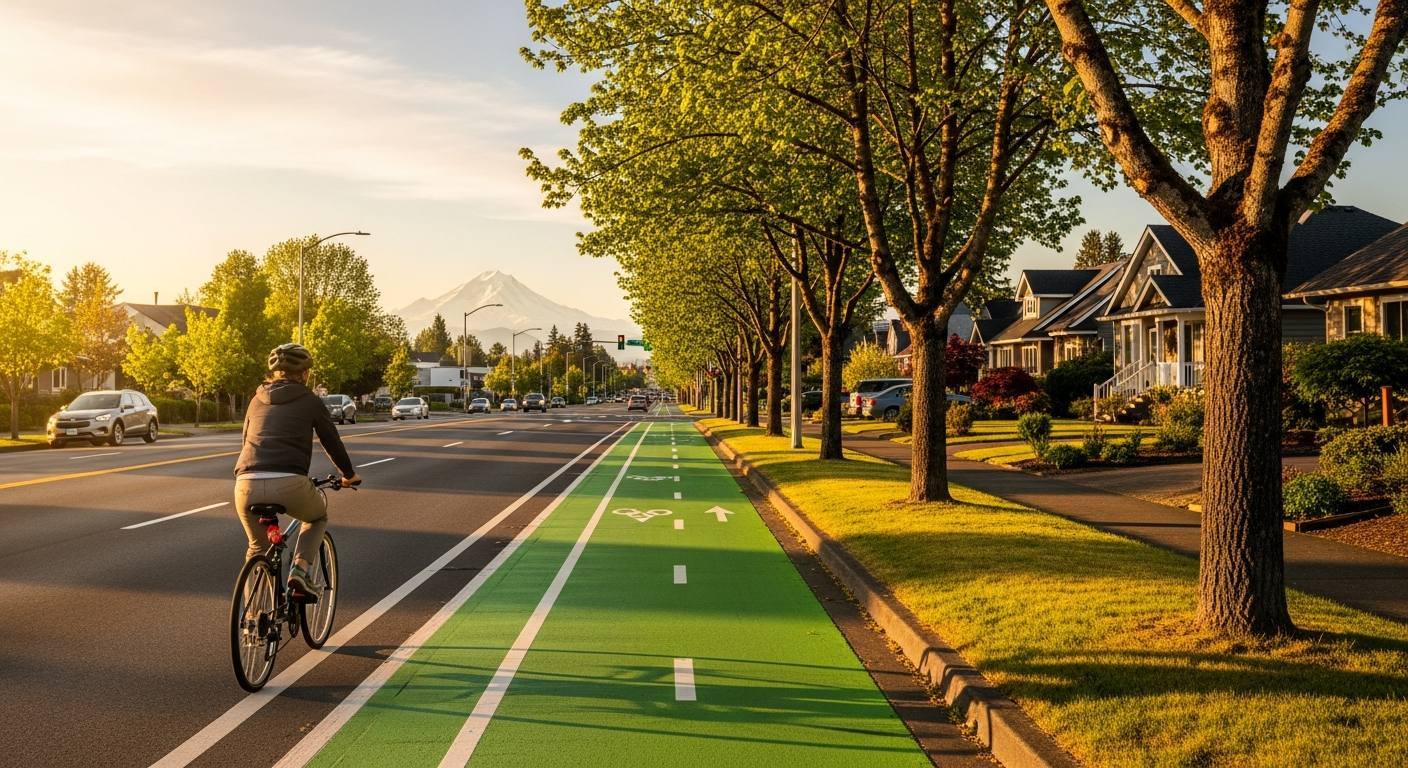
    The 2011 Bicycle Master Plan committed Everett to a specific build-out of bike lanes, sharrows, off-street trails, and bicycle boulevards over thirty years. As of an April 2026 review presented to the city’s transportation advisory committee, about 41 miles of on-street bike infrastructure are in place, plus roughly 23 miles of off-street projects like trails. That is on the order of half the work the original plan envisioned.

    What that has meant on the ground over the past few years includes the buffered bike lanes on Rucker Avenue, the bicycle boulevard work in residential neighborhoods, the city’s Bicycle Friendly Driver education program, and the widely-used Interurban Trail and Lowell Riverfront Trail connections. None of that happened by accident — each piece traces back to a specific line item in the master plan that staff and elected officials worked through over multiple budget cycles.

    That is the case the city makes for keeping the plan as a living document. A long-horizon plan that residents can read tells the next planning director and the next council which projects are next in line, and it makes the case to outside funders — like the federal Safe Streets for All program — that the city has done the homework to deserve the grant.

    What the 2026 Update Changes

    Two things make this update meaningfully different from a routine refresh.

    The first is the scope. The current plan covers bicycle infrastructure. The 2026 update will incorporate pedestrian infrastructure and what the city calls supportive facilities — the bike racks, repair stations, secure parking, signage, and crossings that determine whether a bike lane actually gets used. By 2027, when the updated plan is expected to be adopted, Everett will have a single integrated active-transportation plan covering people who walk, bike, and roll.

    The second is the funding source. The update is being paid for through a Safe Streets for All grant — a federal program created under the 2021 infrastructure law and run through the U.S. Department of Transportation. Safe Streets for All explicitly requires applicants to build a Vision Zero–style safety action plan that ties infrastructure decisions to fatality and serious-injury reduction targets. That requirement is already pulling Everett’s planning toward a more data-driven framework: which corridors have the most crashes, where the high-injury network is, and which interventions show the strongest evidence of reducing serious injuries.

    Cities that complete Safe Streets for All planning grants become eligible for substantially larger implementation grants in subsequent funding rounds. That is the strategic bet behind doing this update now: the planning work is the on-ramp to the construction money.

    What This Means for Residents

    For most Everett residents, the practical question is not how the master plan is structured — it is whether their street is going to get a bike lane, whether their kid’s walk to school is going to get a safer crossing, and whether the trail they use to commute is going to get connected to the next neighborhood over.

    Those decisions get made through the priority list inside the master plan. When the update comes back to the City Council for adoption, it will include a ranked project list. Projects high on the list get built sooner. Projects lower on the list get built when funding shows up. Public input during the planning process is the period when residents have real influence over where their neighborhood sits on that list.

    The city is also pointing residents toward existing tools. A map of Everett’s trails, bike lanes, and other infrastructure is posted online at everettwa.gov/bikes, and paper copies will be available at the May 15 festival. Following @EverettTransit on Facebook and Instagram is the city’s recommended channel for catching the smaller, quieter input opportunities — neighborhood-scale meetings, online surveys, and pop-ups — between now and the plan’s adoption.

    The May Events

    Two events anchor National Bike Month locally:

    Bike to Work Coffee — Wednesday, May 13, 6 to 8 a.m. at Everett Station (3201 Smith Avenue). Free coffee, Bike Everett t-shirts, and an e-bike raffle. Everett Transit is hosting.

    Bike Everett Festival — Friday, May 15, 3 to 7 p.m. at Everett Station (3201 Smith Avenue). Family-friendly. Free games, t-shirts, food trucks, entertainment, an e-bike raffle, and an Everett Transit bus staged for people to practice loading and unloading bikes from the front-mounted bike rack. The festival is the city’s biggest public-facing bike event of the year and the easiest entry point for residents who have not engaged with city transportation planning before.

    Where the Bicycle Friendly Community Designation Comes From

    The bronze-level Bicycle Friendly Community recognition comes from the League of American Bicyclists, a national advocacy organization that runs the BFC program as a benchmarking tool for cities. Communities apply, the League scores them across five categories — engineering, education, encouragement, enforcement, and evaluation — and assigns one of five ranks: bronze, silver, gold, platinum, or diamond.

    Everett first earned bronze in 2021. The 2026 renewal at the same level reflects the continued work on infrastructure, the Bicycle Friendly Driver program, and ongoing community programming. Moving up to silver — the next tier — typically requires a measurable jump in bike commute mode share, a more developed protected-lane network, and a deeper safety-data culture. The 2026 master plan update is the kind of work that, done well, can underwrite a future application at the next level.

    What to Do Next

    • Show up to the Bike Everett Festival Friday, May 15 from 3 to 7 p.m. at Everett Station, 3201 Smith Avenue. It is the easiest way to talk to city transportation staff face-to-face about where you ride and what is missing.
    • Catch the Wednesday coffee May 13 from 6 to 8 a.m. if you commute through downtown.
    • Read the existing bicycle map and master plan at everettwa.gov/bikes. The current map shows what is on the ground today; the plan shows what is supposed to come next.
    • Follow @EverettTransit on Facebook and Instagram for the smaller input opportunities between now and adoption — surveys, neighborhood meetings, and pop-ups.
    • Track the Safe Streets for All work at everettwa.gov/1802/Public-Safety-Safe-Streets-Program. The Safety Action Plan is the document that will shape which corridors the master plan update prioritizes.

    Frequently Asked Questions

    When was Everett’s Bicycle Master Plan first adopted? 2011. The current update is the first major revision in that thirty-year planning horizon.

    How much bike infrastructure has been built so far? About 41 miles of on-street bike infrastructure and roughly 23 miles of off-street trails, as of an April 2026 review.

    What is changing in the 2026 update? Two things. The plan is expanding to cover pedestrian infrastructure and supportive facilities (bike parking, repair stations, signage, crossings) in addition to bike lanes. And the planning framework is being aligned with Vision Zero / Safe Streets for All requirements, which means safety data — crashes, fatalities, serious injuries — drives more of the prioritization.

    Who funded the master plan update? A federal Safe Streets for All grant administered by the U.S. Department of Transportation. The program was created under the 2021 infrastructure law.

    When will the updated plan be adopted? The city expects to bring an integrated bicycle and pedestrian plan forward by 2027.

    What is the bronze Bicycle Friendly Community designation? A recognition from the League of American Bicyclists. It is one of five tiers (bronze, silver, gold, platinum, diamond) and reflects evaluation across engineering, education, encouragement, enforcement, and evaluation. Everett first earned bronze in 2021 and has been re-recognized in 2026.

    When and where is the Bike Everett Festival? Friday, May 15, 3 to 7 p.m. at Everett Station, 3201 Smith Avenue. Free, family-friendly.

    Is there a Bike to Work Day event? Yes. Wednesday, May 13 from 6 to 8 a.m. at Everett Station. Coffee, t-shirts, and an e-bike raffle.

  • Kasch Park: Everett’s Premier Athletic Complex Just Got a Major Turf Upgrade — A Local’s Guide to South Everett’s Most-Used Park

    Kasch Park: Everett’s Premier Athletic Complex Just Got a Major Turf Upgrade — A Local’s Guide to South Everett’s Most-Used Park

    Q: What is Kasch Park in Everett?

    A: Kasch Park is the City of Everett’s premier athletic complex, located at 8811 Airport Road in the Westmont area of south Everett. It features four lighted multi-sport synthetic-turf fields, a four-field lighted softball complex, one Little League field, basketball courts, a Weevos-style playground, picnic shelters, restrooms, and walking trails. The park is open daily from 6 a.m. to 10 p.m. and connects via trail to the nearby Loganberry Lane Dog Park.

    Kasch Park is the south Everett athletic complex everyone in town has played at — even if they did not know its name

    Kasch Park sits on Airport Road just past the Boeing fence line, inside the Westmont area of south Everett. If you have ever played adult-league soccer in Snohomish County, watched a kid’s softball tournament under the lights, or pushed a stroller through a quiet weekend afternoon while teenagers ran a flag-football scrimmage, there is a strong chance you have been here. It is the kind of public park that becomes invisible because it works. The fields show up on hundreds of league schedules every year. The playground stays full on summer weekends. The parking lot empties at 10 p.m. and refills at 6 a.m. the next morning, every day, year-round.

    And quietly, over the last few years, it has become a much better park than most south-Everett residents realize. Here is what makes Kasch Park the city’s premier athletic complex, what got upgraded recently, and what locals should know before their next visit.

    The basics: address, hours, parking

    Address: 8811 Airport Road, Everett, WA 98204
    Hours: 6 a.m. to 10 p.m. daily
    Parking: Free, ample on-site lot

    The park sits between Airport Road and 100th Street SW, a quick drive from Boulevard Bluffs, Pinehurst-Beverly Park, Glacier View, and Westmont — and convenient to Boeing, Paine Field, and the Cascade High School zone for Casino Road and Pinehurst families.

    What Kasch Park has — by the field

    Kasch Park is the City of Everett’s flagship athletic facility. The amenity list is long enough that it is worth grouping by use case.

    Multi-sport turf fields. Four lighted, synthetic-turf fields sized for soccer but lined for multiple sports. After the most recent surface replacement, the fields are now playable for soccer, lacrosse, ultimate frisbee, flag football, and kickball. The lights mean evening league play continues year-round; the synthetic turf means rain rarely cancels a game.

    Softball complex. A four-field lighted softball complex with bleachers anchors the eastern half of the park. This is where most of Everett’s adult coed leagues, men’s leagues, and tournament play happens. Under a recent management agreement with NWS Holdings, the previously dirt infields on softball fields one through four are being upgraded with turf surfacing, additional fencing, and safety netting — improvements that bring the complex closer to tournament-grade specification.

    Little League field. One dedicated Little League diamond serves the park’s youth baseball programming.

    Basketball courts. Outdoor courts available for casual pickup play.

    Playground. The park’s playground, designed and built by PlayCreation, features a Weevos-brand structure with a Cozy Coaster Slide, Wee Pod Climber, and Boppity Bridge — the kind of contemporary play equipment designed for both motor-skill development and durability. Restrooms are immediately adjacent.

    Picnic shelter. A reservable picnic shelter is available through the City of Everett’s facilities reservation system at everettwa.gov.

    Walking trail. A short on-site loop connects the parking, playground, fields, and the trail spur that links to nearby Loganberry Lane Dog Park.

    Restrooms. Permanent restroom facilities are available on the playground side; portable toilets supplement the field areas during peak league season.

    Recent upgrades: what changed and why it matters

    The biggest change in the last few years has been the synthetic-turf replacement on the multi-sport fields. The original turf had aged out of safe play; the replacement re-lined the fields for soccer plus multiple secondary sports, expanding the park’s usable league bookings dramatically. The Wildlife Recreation Coalition lists the project among its supported recreation grants for the region.

    The second change is the softball management partnership. NWS Holdings now manages softball fields one through four under an agreement with the City of Everett, with infield turf upgrades, fencing improvements, and additional safety netting in progress. For league players, the difference is noticeable: fewer rainouts on dirt infields, better backstop coverage for tournaments, and a more consistent maintenance cadence.

    What has not changed: dogs are still prohibited from all field areas. The trail connection to Loganberry Lane Dog Park gives dog owners a nearby alternative for off-leash play.

    Who actually uses Kasch Park

    If you visit on a weekday evening between April and October, the parking lot will be mostly league players — adult coed soccer, men’s softball, kickball nights, and the occasional ultimate frisbee tournament. Weekend mornings tilt toward youth: Little League, youth soccer, and the occasional flag-football clinic. Weekday afternoons before 5 p.m. lean stroller crowd — the playground area is genuinely well-shaded in the summer and the layout works for parents with multiple kids of different ages.

    For visitors driving in from outside south Everett, the park is also a reliable rainy-day option. The combination of synthetic turf and field lights means scheduled play continues through Pacific Northwest spring weather that would shut down a grass-field park entirely.

    How to book a field or shelter

    The City of Everett handles all field reservations through the Parks Department. Reservations open seasonally; the most popular weekend slots fill quickly. Field permits are typically required for any organized group play of more than a casual pickup game. Picnic shelter reservations follow the same process. Both can be initiated through everettwa.gov/parks.

    NWS Holdings handles the softball-fields-one-through-four scheduling separately under its management agreement. League organizers should reach out through the City Parks office for the current contact path.

    Why Kasch Park belongs on every south Everett family’s short list

    The Everett park system has more famous names — Forest Park draws the headlines, Howarth gets the Instagram shots, Sullivan at Silver Lake has the destination amenity, Garfield is the playground showpiece. Kasch is none of those things. It is the working park. It is where Everett actually plays. And after the recent turf and softball-field upgrades, the working park works even better than it used to. For families in Westmont, Boulevard Bluffs, Pinehurst-Beverly Park, Glacier View, and Twin Creeks, Kasch Park is probably the single most-used piece of public infrastructure in the neighborhood. It is worth knowing the address, the hours, and the booking process the next time a Saturday plan goes sideways and the kids need a field.

    Frequently Asked Questions

    Where is Kasch Park located?

    Kasch Park is at 8811 Airport Road, Everett, WA 98204, in the Westmont area of south Everett. It is convenient to Boeing, Paine Field, and the Cascade High School attendance zone.

    What are Kasch Park’s hours?

    The park is open daily from 6 a.m. to 10 p.m. The lighted fields support evening league play through the posted closing time.

    Does Kasch Park have a dog park?

    No. Dogs are prohibited from all field areas inside Kasch Park. The on-site trail connects to the nearby Loganberry Lane Dog Park, which is the closest off-leash option.

    Are there pickleball courts at Kasch Park?

    Not currently. Kasch Park’s primary courts are basketball and the multi-sport synthetic-turf fields. Pickleball courts in Everett are located at other parks; the City of Everett maintains a pickleball-court list at everettwa.gov/parks.

    How do I reserve a field or picnic shelter at Kasch Park?

    Field permits and picnic shelter reservations go through the City of Everett Parks Department at everettwa.gov/parks. Softball fields one through four are managed by NWS Holdings under a separate agreement; the City Parks office can route league organizers to the current contact path.

    What sports can be played on Kasch Park’s turf fields?

    After the synthetic-turf replacement, the four multi-sport fields are lined and approved for soccer, lacrosse, ultimate frisbee, flag football, and kickball.

    Is Kasch Park a good park for young children?

    Yes. The Weevos-brand playground, designed and built by PlayCreation, includes a Cozy Coaster Slide, Wee Pod Climber, and Boppity Bridge — equipment well-suited for early-childhood and elementary-aged kids. Permanent restrooms are immediately adjacent. The picnic shelter is reservable for parties.

  • Housing Hope Is Building a New Tomorrow’s Hope at 4526 Federal Avenue — The Quiet Powerhouse Behind Everett’s Affordable Housing

    Housing Hope Is Building a New Tomorrow’s Hope at 4526 Federal Avenue — The Quiet Powerhouse Behind Everett’s Affordable Housing

    Q: What is Housing Hope and what does it do in Everett?

    A: Housing Hope is an Everett-headquartered nonprofit that builds and operates affordable rental housing, supports homeownership through sweat-equity construction, and runs childcare and workforce-training programs for families exiting homelessness or poverty across Snohomish County and Camano Island. It manages more than 650 affordable units across 24 sites, has helped 328 households become homeowners through its Team HomeBuilding program, and is building a new 26,700-square-foot Tomorrow’s Hope Child Development Center at 4526 Federal Avenue in partnership with Compass Health.

    Housing Hope is the quietest big nonprofit in Everett — and 2026 is its biggest year in a long time

    If you have driven past the Compass Health campus at 4526 Federal Avenue lately, you have probably noticed survey stakes and site-prep work on the northeast corner. That is a 26,700-square-foot child development center that has been thirty years in the making. It belongs to Housing Hope — Everett’s largest affordable-housing nonprofit and probably the most consequential community organization in town that most residents could not pick out of a lineup.

    That is changing in 2026. Housing Hope has a new CEO. It is breaking ground on a new childcare facility that triples the capacity of its current Tomorrow’s Hope program. It manages more than 650 affordable units across 24 sites in Snohomish County. And it is doing all of this while quietly chasing a 1,000-unit goal by 2030. Here is what every Everett resident should know about the organization that is rewriting what affordable housing looks like in this corner of Puget Sound.

    What Housing Hope actually does

    Housing Hope’s mission is to promote and provide affordable housing and tailored services that reduce homelessness and poverty for residents of Snohomish County and Camano Island. That single sentence covers a lot of ground. In practice, the organization runs five integrated programs:

    Affordable rental housing. More than 650 units across 24 sites. Rents are set on a sliding scale based on household income and family size — not market rate. Housing Hope’s portfolio includes everything from single-room transitional units to family-sized apartments designed for households exiting homelessness.

    Team HomeBuilding. A sweat-equity homeownership program in which working families help build their own and each other’s homes. The program has produced 328 first-time homeowner households. Participants commit hundreds of hours of construction labor in exchange for a deeply discounted mortgage on a home they helped frame, side, and finish.

    Tomorrow’s Hope Child Development Center. Quality childcare for kids aged four weeks through twelve years, with a sliding-scale fee structure that prioritizes families currently living in Housing Hope properties or recently exited from homelessness. The current facility has operated for more than 30 years out of a former Sizzler restaurant building. The new building changes that.

    College of Hope. Workforce training, financial coaching, life-skills classes, and case management built directly into the housing-and-childcare model. Residents do not have to drive across town to access employment services — those services are delivered on-site.

    HopeWorks. A separate but affiliated social-enterprise nonprofit that runs job-training businesses (catering, landscaping, building trades) where Housing Hope residents and other low-income community members earn paychecks while building career skills. HopeWorks shares leadership with Housing Hope.

    Kathryn Opina takes over as CEO

    The Housing Hope Executive Board appointed Kathryn Opina as Chief Executive Officer for both Housing Hope and HopeWorks effective September 1, 2025. The announcement followed the departure of previous CEO Donna Moulton in early 2025 for family reasons. The leadership transition was reported by My Everett News and confirmed on the organization’s leadership page.

    Opina inherits an organization in the middle of one of its most ambitious capital phases in years — the new Tomorrow’s Hope facility, ongoing portfolio growth toward the 1,000-unit 2030 goal, and a continued role as the lead nonprofit voice in Snohomish County’s affordable-housing conversation.

    The new Tomorrow’s Hope is the headline project of 2026

    The current Tomorrow’s Hope center serves about 130 children. It has, in fact, outgrown the old Sizzler building it occupies. The new facility — sited at the northeast corner of Compass Health’s Federal Avenue Campus at 4526 Federal Avenue — solves three problems at once.

    First, capacity. The 26,700-square-foot building is designed to substantially increase enrollment beyond the current 130-child level. Second, integrated services. The new building includes on-site showers, laundry, a pantry, and computer stations — features that recognize many of the families using Tomorrow’s Hope are working through housing instability and need wraparound support to stay in childcare. Third, the partnership. Compass Health, Snohomish County’s largest behavioral-health provider, is leasing the corner to Housing Hope as a continuation of a 35-year partnership between the two nonprofits. Both organizations serve overlapping populations. Co-locating the new childcare center on Compass’s campus means a parent receiving behavioral-health support can drop their child off in the same parking lot.

    The site is in central Everett, walkable from several Housing Hope properties and on a Community Transit route. Construction is starting this year.

    Why Housing Hope matters for Everett specifically

    Snohomish County’s affordable-housing math is brutal. The 51.8% inventory jump that lit up the headlines in 2026 was concentrated in the market-rate single-family segment, not in the income-restricted units that working families actually qualify for. Housing Hope is the largest single producer of those income-restricted units in the county, and the bulk of its portfolio sits inside Everett city limits.

    That portfolio is also unusually integrated. Most affordable-housing developers build the building and walk away. Housing Hope builds the building, runs the childcare center next door, employs residents through HopeWorks, trains them through College of Hope, and has built sweat-equity homeowners out of dozens of its own former tenants. The model is not new — Housing Hope has been doing it since 1987 — but the scale (650+ units, 24 sites, 35-year partnerships with major institutions) is.

    For Casino Road residents, Boulevard Bluffs renters, and Twin Creeks families pricing out of Snohomish County’s higher-rent neighborhoods, Housing Hope is often the answer to “where do we go next.” The organization’s waitlists are long — as is the case for every affordable-housing operator in the region — but the units exist, and they keep getting built.

    How to engage with Housing Hope

    Housing Hope’s main offices are at 5830 Evergreen Way in Everett. The organization’s housing application process and waitlist information are available on housinghope.org, along with a current property list. For families seeking childcare, Tomorrow’s Hope information lives at tomorrowshopechildcare.com — and the new Federal Avenue location will list its enrollment process there once the building opens.

    For neighbors who want to support the work, Housing Hope accepts both donations and volunteer hours through Team HomeBuilding (no construction experience required for many roles). HopeWorks’s social-enterprise businesses also welcome contracts for catering, landscaping, and small construction projects. The organizations are 501(c)(3) nonprofits; gifts are tax-deductible.

    The bigger picture

    The story of Everett’s housing crisis usually focuses on what the market and the city are not doing — the stalled stadium financing, the utility-tax debate, the Sound Transit timeline that keeps slipping. Housing Hope’s story is the inverse. It is a nonprofit that has been quietly stacking units, training workforce, and feeding children for nearly four decades while the broader debate has gone sideways. The new Tomorrow’s Hope center, the new CEO, and the unbroken march toward 1,000 units by 2030 are the same story Housing Hope has been telling all along — just with a bigger building, a new face at the top, and an unmistakable signal that 2026 is when the organization plans to be louder about it.

    Frequently Asked Questions

    Where is Housing Hope located in Everett?

    Housing Hope’s main administrative offices are at 5830 Evergreen Way in Everett. The organization manages more than 24 housing sites across Snohomish County and Camano Island. The new Tomorrow’s Hope Child Development Center is being built at 4526 Federal Avenue on Compass Health’s campus.

    Who is the CEO of Housing Hope in 2026?

    Kathryn Opina has served as Chief Executive Officer of both Housing Hope and HopeWorks since September 1, 2025. She succeeded former CEO Donna Moulton, who departed in early 2025.

    How many affordable housing units does Housing Hope operate?

    More than 650 affordable rental units across 24 sites in Snohomish County and Camano Island, with a stated goal of 1,000 units by 2030. The organization has also helped 328 households achieve homeownership through its Team HomeBuilding sweat-equity program.

    What is Tomorrow’s Hope?

    Tomorrow’s Hope is Housing Hope’s child development center. The current facility serves roughly 130 children aged four weeks to 12 years out of a former Sizzler restaurant building in Everett. A new 26,700-square-foot facility is under construction at 4526 Federal Avenue with significantly expanded capacity and on-site family services including showers, laundry, a pantry, and computer stations.

    How can I apply for Housing Hope housing?

    Housing applications and waitlist information are available at housinghope.org. Demand exceeds supply at every Housing Hope property, and waitlists can be long. The organization’s leasing staff can advise on which properties have the shortest current waitlists and what documentation is required.

    How can I support Housing Hope?

    Donations are accepted through housinghope.org and are tax-deductible. Team HomeBuilding accepts volunteer construction labor. HopeWorks’s catering, landscaping, and trades businesses welcome contracts from neighbors and local employers. Both organizations also publish event calendars on their respective websites.

    Is Housing Hope related to Volunteers of America Western Washington or Cocoon House?

    They are separate organizations with overlapping missions. Housing Hope focuses on long-term affordable housing and homeownership for families. Volunteers of America Western Washington runs the regional food bank and broader social-services portfolio. Cocoon House serves youth experiencing homelessness. All three are major Everett nonprofits and frequently collaborate through Snohomish County’s housing and homelessness coalitions.

    Deeper coverage on this story:

  • All City Fight Night: Worlds Collide Lands at Kings Hall on May 16 — A Six-Hour Amateur Kickboxing Card on Everett’s Best New Stage

    All City Fight Night: Worlds Collide Lands at Kings Hall on May 16 — A Six-Hour Amateur Kickboxing Card on Everett’s Best New Stage

    Q: What is All City Fight Night: Worlds Collide and when is it at APEX Everett?
    A: All City Fight Night: Worlds Collide is an amateur kickboxing card on Saturday, May 16, 2026 at Kings Hall inside APEX Everett (1611 Everett Avenue, third floor). Doors are at 5 PM and the event runs until 11 PM. VIP tickets are on sale through Ticketmaster; general admission is set to drop later. The card features fighters from across the Pacific Northwest and is open to all ages with the venue’s standard event policies.

    Verdict: GO. Three reasons, named: (1) amateur kickboxing on this scale is genuinely scarce in the I-5 corridor north of Seattle, and the matchups are billed as fighters traveling in from across the Pacific Northwest “and beyond,” (2) Kings Hall is the right room for a fight night — it is the largest room at APEX Everett, with sight lines built for stage-forward shows and capacity that sits in the meaningful middle between a club and an arena, and (3) the format is six hours of action from doors to last bell, which is the kind of value that does not happen at a music show in this city.

    The Friday-and-Saturday-night culture in downtown Everett right now is mostly tribute bands and touring rock acts at the Historic Everett Theatre and Tony V’s Garage. May 16 breaks that pattern. If you have ever wanted to watch live combat sports without driving to Tacoma or down to Tukwila, this is the date you put on the calendar.

    What’s Actually on the Card

    The official All City Fight Night listing through APEX Everett describes “Worlds Collide” as an evening of amateur kickboxing with fighters drawn from across the Pacific Northwest and beyond. The promoter pitches every bout as action-packed and skill-forward — language that the APEX events page reproduces verbatim from the All City Fight Night camp.

    A few specifics worth holding onto. Doors open at 5 PM. The event is scheduled to run six hours, ending at 11 PM. The venue is Kings Hall, which is the third-floor performance space inside APEX Everett at 1611 Everett Avenue. VIP tickets are already on sale through Ticketmaster — the event listing carries Ticketmaster’s “GA tickets drop soon” call-out at the time of publication, which means general admission has not yet been released to the public. Watch the Ticketmaster page if you want a non-VIP seat.

    The promoter — All City Fight Night, based in Everett — runs amateur kickboxing cards on a recurring basis under the same brand. Their .com lists the May 16 Kings Hall date among their upcoming events and routes ticketing directly to the same Ticketmaster URL APEX uses on its venue page. Two independent sources, same date, same venue, same ticket URL: the show is real.

    Why Kings Hall Is the Right Room for This

    Kings Hall is the largest performance room inside APEX Everett, a multi-floor downtown entertainment complex that the operators have built out specifically around live programming. It sits on the third floor of the building. Four other rooms operate inside APEX — El Sid, the Box Office Bar, Penny Lane, and the rooftop — but Kings Hall is where the touring acts land. The Crystal Method and Rabbit in the Moon are playing the same room on June 13. Antwane Tyler and Fretland played it on May 2.

    A kickboxing card needs a room with a center-stage focal point and clear sight lines from every level. Kings Hall delivers that. The capacity sits in the right zone for a regional amateur card — large enough to feel like a real event, small enough that no seat in the building is bad. That matters for combat sports because fight nights die in cavernous arenas where the crowd cannot see the canvas.

    The age policy for a typical Kings Hall touring show is 18-plus or 21-plus depending on the act. The All City Fight Night listing on the APEX events page does not explicitly call out an age restriction in the visible event metadata, so confirm at the door or via the Ticketmaster purchase flow before you bring anyone under 21.

    What “Amateur Kickboxing” Actually Means

    If you have not been to a live fight card before, here is the short version. Amateur kickboxing in the United States operates under sanctioning bodies that enforce weight classes, headgear and shin-pad requirements, three-round bout formats, and strict referee oversight. The fighters are not professionals — they do not get paid purses — but the talent at this level can be extraordinary. Many of the fighters on a card like this one are training out of legitimate gyms in the region and chasing either pro debuts or amateur national titles.

    Pacific Northwest amateur kickboxing has a deeper bench than most casual fans realize. Seattle, Tacoma, Spokane, Portland, and the smaller Snohomish County gyms feed cards like this one. The “and beyond” language in the promoter’s pitch suggests fighters traveling in from outside the immediate region as well — possibly British Columbia, Oregon, or Northern California, depending on the matchmaking.

    Six hours of fight cards typically means somewhere in the range of 10 to 14 bouts, with breaks between fights. Plan accordingly. Eat before you arrive. The Box Office Bar and El Sid downstairs in the APEX complex are options for between-fight food and drink without leaving the building.

    How to Get In and Where to Park

    APEX Everett sits at 1611 Everett Avenue in downtown Everett, two blocks east of Wetmore and a block north of Pacific. Kings Hall is the third-floor space; you’ll see signage in the lobby. The building has its own elevator access for upper floors.

    Parking in downtown Everett on a Saturday night is real but not impossible. The Everpark Garage at 2802 Wetmore Avenue runs $1 per hour and is a five-minute walk to APEX. Street parking on Hewitt, Wetmore, and Colby is free after 6 PM. The lots on the north side of Everett Avenue closer to APEX itself fill up first.

    VIP ticket holders should check their Ticketmaster confirmation for any included perks — fight cards in this format sometimes include early entry, reserved seating, or meet-and-greet access depending on the package. The general admission tickets, when they release, will be the standing-or-first-come seating in the rest of the room.

    What This Says About APEX’s Programming

    The question every venue operator in the city was quietly asking when APEX Everett opened was whether downtown could support another mid-size live entertainment room. The booking pattern through spring 2026 is the answer. Kings Hall is booking rock, electronic, country, comedy, and now combat sports — a programming spread that suggests the operators are betting on the room’s flexibility rather than a single genre.

    A May 16 fight card slotted between a country show on May 2 and an electronic-music night on June 13 is exactly the kind of programming a healthy mid-size venue does. Tony V’s Garage cannot host a kickboxing card. Historic Everett Theatre will not. The Funko Field grandstand is a baseball park, not a fight venue. Kings Hall is the only Everett room equipped to put on this kind of show, and they’re using it.

    The downtown cultural calendar is denser in May 2026 than in any month since pre-2020. Sorticulture is three weeks out. Schack Art Center’s Contemporary Northwest Artists exhibit opens May 28. The Historic Everett Theatre has Richard Marx on May 8, Corduroy on May 9, Canned Heat and Big Brother and the Holding Company on May 29. Tony V’s has a full slate. Inside that calendar, the All City Fight Night date is the one event that brings a different audience downtown — combat-sports fans who do not necessarily show up for a Pearl Jam tribute or a garden festival. That is good for the city.

    The Bottom Line

    May 16, 5 PM doors, 11 PM finish, Kings Hall at APEX Everett, 1611 Everett Avenue, third floor. VIP tickets through Ticketmaster now; GA when it drops. Six hours of amateur kickboxing on the best mid-size stage in downtown Everett. If the matchups even come close to the promoter’s pitch, this is the most interesting Saturday night the city has hosted in months.

    Wear something you can move in. The room is upstairs.

    Frequently Asked Questions

    Where is All City Fight Night: Worlds Collide on May 16, 2026?
    Kings Hall, the third-floor performance room at APEX Everett, 1611 Everett Avenue, downtown Everett.

    What time does it start?
    Doors at 5 PM, event runs through 11 PM Pacific Time.

    How do I buy tickets?
    VIP tickets are on sale through Ticketmaster. General admission is listed as “drop soon” on the APEX official event page and the All City Fight Night promoter’s site. Watch the Ticketmaster event page (event ID 0F00645A8B44775F) for the GA release.

    Is there an age restriction?
    The official APEX listing does not call out a specific age restriction in the visible event metadata. Confirm at point of purchase on Ticketmaster or at the door, especially if you plan to bring guests under 21.

    Where do I park?
    Everpark Garage at 2802 Wetmore Avenue is $1 per hour and a five-minute walk. Free street parking on Hewitt, Wetmore, and Colby after 6 PM. Lots closer to APEX on Everett Avenue fill up first.

    What kind of fights are on the card?
    Amateur kickboxing. The promoter pitches the bill as fighters from across the Pacific Northwest and beyond, with every bout described as action-packed and skill-forward.

    Where else is APEX programming this spring?
    The Crystal Method and Rabbit in the Moon are playing Kings Hall on June 13. Antwane Tyler, Fretland, and Racyne Parker played the same room May 2. APEX is becoming the booked-most-nights room in downtown Everett.


  • WHL Eastern Conference Final Heads to Game 5 in Prince Albert Tonight — and the Silvertips Are Still Watching for an Opponent

    WHL Eastern Conference Final Heads to Game 5 in Prince Albert Tonight — and the Silvertips Are Still Watching for an Opponent

    WHL Eastern Conference Final Goes to Game 5 in Prince Albert Tonight — and the Silvertips Are Still Watching to See Who They Get in the Final

    The Everett Silvertips have been on the couch since April 28, when Hayden Vanhanen scored the game-winner and Adam Miettinen tacked on an empty-netter to finish a four-game sweep of the Penticton Vees in the Western Conference Final. Twelve playoff games. One loss. Three series wins. A WHL Final berth and home-ice advantage in the bag.

    Now they wait — and Game 5 of the Eastern Conference Final on Friday, May 1, may or may not deliver them an opponent. The Prince Albert Raiders host the Medicine Hat Tigers tonight at 7:00 p.m. CT (5:00 p.m. PT) at the Art Hauser Centre in Prince Albert with the best-of-seven series tied 2-2.

    If the Raiders win, the series goes to a best-of-three. If the Tigers win, they head home with a chance to close it out at Co-op Place.

    Either way, the Silvertips’ WHL Final opens at Angel of the Winds Arena in Everett next Friday, May 8. The opponent’s just the variable.

    Where the Series Sits

    The Eastern Conference Final hasn’t been the runaway some predicted when the No. 1 Raiders met the No. 2 Tigers. Prince Albert tied things up Wednesday night with a 6-3 win at Co-op Place, scoring three straight in the second period after going into the intermission tied 2-2. The series now stands 2-2 with three games left to play if needed.

    Medicine Hat coach Willie Desjardins didn’t sugarcoat it after Game 4. “We have to play better,” he told Medicine Hat News. Tigers forward Ethan Neutens said the team was “pretty lackadaisical in some areas of our game” and “weren’t winning our battles.” When you let the No. 1 seed in the East score three unanswered to take a swing series, that’s the kind of postgame quote you give.

    The remaining schedule:

    • **Game 5:** Friday, May 1 — Medicine Hat at Prince Albert, 7:00 p.m. CT (Art Hauser Centre)
    • **Game 6 (if necessary):** Sunday, May 3 — Prince Albert at Medicine Hat, 6:00 p.m. CT (Co-op Place)
    • **Game 7 (if necessary):** TBD if needed

    Why It Matters for Everett

    The Silvertips earned the right to host the WHL Final by going 12-1 through the West playoffs and finishing the regular season as the Scotty Munro Trophy winners (best regular-season record in the league at 57-8-2-1, 117 points). That means Games 1 and 2 of the WHL Final are both at Angel of the Winds Arena on May 8 and May 9 — regardless of which Eastern team comes out.

    But the matchup matters from a strategic standpoint, and from a fan-narrative standpoint:

    If it’s Medicine Hat

    The Tigers are a Top-2 seed with elite depth and a goaltender, Harrison Meneghin, who’s putting up sharp numbers. Medicine Hat plays a structured, neutral-zone-pressure style that has given Penticton-style transition teams trouble all year. They’d be the more rested matchup, too — they finished off Calgary in five and only got their fourth ECF game on May 1. The Tigers are the analytics darling.

    If it’s Prince Albert

    The Raiders are the higher seed and the physical mismatch favorite. They have the league’s best regular-season defensive rating, deeper experience at every position group, and Prince Albert plays a heavy, structured game that typically slows down high-flying Western Conference teams. Anders Miller’s 8-0 / 1.55 GAA / .948 SV% playoff resume gets stress-tested by a team built to grind possessions and win in tight.

    Either matchup is a real series. Neither team is going to be intimidated by the Silvertips’ 12-1 playoff record.

    What Tips Fans Are Watching For Tonight

    1. **Special teams.** The Raiders’ power play has carried them in this series. If Prince Albert keeps converting, they take this series in six.

    2. **Goaltending.** This Eastern Final has been a goaltending-deciding series — the team with the better third-period save percentage has won three of the four games so far.

    3. **The East’s third-period play.** Whichever team holds a third-period lead has won every game in this series. So when the puck drops at the Art Hauser Centre tonight, watch the second-intermission scoreboard. If a team’s up after 40, they’re probably winning.

    What’s Confirmed for the WHL Final at Angel of the Winds Arena

    • **Game 1:** Friday, May 8 at Angel of the Winds Arena
    • **Game 2:** Saturday, May 9 at Angel of the Winds Arena
    • **Games 3-4:** At the Eastern team’s home rink (Prince Albert’s Art Hauser Centre or Medicine Hat’s Co-op Place)
    • **Games 5-7 (if necessary):** Alternate between Everett and the Eastern host

    Tickets for Games 1-2 of the Final are on sale through the Silvertips’ website and Ticketmaster. Demand has been heavy ever since the Penticton sweep — the Tips are 12-1 in the playoffs and back in the WHL Final for the first time in a generation.

    The Silvertips Squad That’s Waiting

    Quick refresher on the team that Game 5 winners will face:

    • **Anders Miller:** 8-0, 1.55 GAA, .948 SV%. The best playoff save percentage among WHL goalies with 9+ games played, ever.
    • **Landon DuPont:** Already at 13 playoff points despite being a defenseman. Shooting from the point with NHL-prospect confidence.
    • **Hayden Vanhanen:** Game-winner Game 4 vs. Penticton; 14 playoff points and the team’s leading scorer.
    • **Carter Bear:** 10 playoff goals, including a shorthanded shift-changer in Game 5 of the WCF.
    • **Rylan Gould:** Two power-play goals in Game 2 of the WCF, including the loose-puck 2OT winner.
    • **Anders Miller’s brother in arms — AJ Reyelts:** Has played sparingly but stepped up with a goalie clinic in OT1 of WCF Game 2.

    This is a team that has scored 51 goals and surrendered 12 across 13 playoff games. They are 8-0 at home in the postseason. They have not allowed more than 3 goals in any playoff game.

    The Eastern Conference winner has a problem — and tonight in Prince Albert, that problem will get a name.

    Frequently Asked Questions

    Who plays in WHL Eastern Conference Final Game 5?

    The Prince Albert Raiders host the Medicine Hat Tigers at 7:00 p.m. CT on Friday, May 1, 2026 at the Art Hauser Centre. The series is tied 2-2.

    What’s the WHL Final schedule?

    Games 1 and 2 are at Angel of the Winds Arena in Everett on Friday, May 8 and Saturday, May 9. The series then shifts to the Eastern team’s home rink for Games 3 and 4. The series alternates from there if it goes longer.

    Does Everett have home-ice advantage in the WHL Final?

    Yes. As the Scotty Munro Trophy winners (best regular-season record), the Silvertips host the higher-seeded series throughout the WHL playoffs.

    When are Silvertips Final tickets on sale?

    Tickets for Games 1 and 2 at Angel of the Winds Arena are available through silvertips.com and Ticketmaster.

    What’s Anders Miller’s playoff save percentage?

    .948 across eight games — the best playoff save percentage among WHL goaltenders with nine or more playoff games played, in league history.

    How did the Silvertips get to the WHL Final?

    By going 12-1 through the Western Conference playoffs: a 4-2 first-round win over Spokane, a 4-1 second-round win over Kelowna, and a 4-0 sweep of Penticton in the Western Conference Final. They finished the regular season 57-8-2-1 (117 points), the best record in the WHL.

    Who’s the favorite if it’s Everett vs. Prince Albert?

    Toss-up. The Silvertips have the better playoff record and home-ice advantage; the Raiders have the deeper roster and a heavier style of play that has given high-octane teams problems all year. Vegas would probably set Everett at -130 to -150 in that matchup.

    Who’s the favorite if it’s Everett vs. Medicine Hat?

    Slight edge to the Silvertips. Medicine Hat has elite goaltending and structure, but the Tigers have shown vulnerability in this series and don’t have the same depth advantage.

  • Bryce Miller’s Second AquaSox Rehab Start Is Wednesday May 6 at Funko Field — Likely His Last Stop Before Seattle

    Bryce Miller’s Second AquaSox Rehab Start Is Wednesday May 6 at Funko Field — Likely His Last Stop Before Seattle

    Bryce Miller Is Back at Funko Field on Wednesday, May 6 — His Second AquaSox Rehab Start Could Be His Last Stop Before Seattle

    The Mariners made it official on May 1: right-hander Bryce Miller will make his second rehab start with the Everett AquaSox on Wednesday, May 6, with first pitch scheduled for 7:05 p.m. at Everett Memorial Stadium.

    This is the start a lot of Funko Field regulars have been waiting on. Miller’s first rehab outing in Everett — back on April 24 against the Spokane Indians — was the kind of outing where everyone in the ballpark left going yeah, he’s back. Three innings, six strikeouts (five swinging, one looking), one hit, one walk, no runs. He went through the first two frames clean and worked out of a jam in the third by punching out Fitzer on four pitches with the bases threatening. The radar gun showed 98+ mph. His pitches looked like Bryce Miller pitches again.

    So Wednesday is the next step on a rehab calendar that, if it stays clean, almost certainly ends with Miller back in the Mariners’ rotation by mid-May.

    Where Miller Is in the Rehab Timeline

    By the time he takes the mound May 6, Miller will be making his fourth rehab start of 2026. The breakdown so far, per Mariners EVP and GM Justin Hollander:

    • **Triple-A Tacoma — April 18.** 1.2 IP, 33 pitches, 4 H, 3 R, 1 BB, 2 K. Velocity was building, command wasn’t there yet.
    • **Triple-A Tacoma — second outing.** Not his sharpest, but progress.
    • **High-A Everett (AquaSox) — April 24.** 3 IP, 47 pitches (35 strikes), 1 H, 0 R, 1 BB, 6 K. Best outing of the rehab.
    • **High-A Everett — May 6.** Wednesday. Likely 4-5 IP / 60-75 pitches if everything’s healthy.

    Across his three outings to date, Miller has put up 8.2 innings of 3.12 ERA work with 12 punchouts. The fastball has peaked north of 98 mph — an encouraging sign as he comes back from the oblique strain that landed him on the injured list in spring training.

    In MLB rehab math, you typically build a starter back to 75-80 pitches before you call him up. Miller threw 47 last time. A jump to ~70 on Wednesday would put him in striking distance of one more rehab start (or none) before he rejoins Seattle’s rotation.

    Why a Funko Field Rehab Start Matters for Everett

    Bryce Miller in Everett uniform isn’t just a rehab assignment — it’s a homecoming. Miller pitched for the AquaSox in 2022, going 3-3 with a 3.24 ERA across 16 games (15 starts), striking out 99 and walking just 25. He held opposing hitters to a .194 average that season before getting the bump to Double-A Arkansas. He went from Everett to the Mariners’ rotation in roughly 14 months.

    For the AquaSox crowd, that 2022 season is part of why this Wednesday matters. Funko Field saw the version of Miller that became a 12-game winner with a 2.94 ERA across 180.1 innings in his 2024 breakout campaign with Seattle. Now they get to see him on his way back, working live against High-A hitters with a 98-mph fastball that’s already been doing damage in his rehab outings.

    It’s also one of the rare nights at Funko Field where the AquaSox aren’t the only story — the Mariners are. People drive in from Seattle for these starts. Walk-up ticket lines get long. The AquaSox front office is straight up about it: “Walk-up quantities may be limited as seats are expected to sell fast.”

    Tickets and Logistics for Wednesday

    • **First pitch:** 7:05 p.m., Wednesday, May 6
    • **Where:** Everett Memorial Stadium (Funko Field), 3802 Broadway
    • **Gates:** Season ticket holders 5:30 p.m., main gates 6:00 p.m.
    • **Tickets:** Online at AquaSox.com or by calling the front office at 425-258-3673
    • **Bonus:** It’s also Silver Sluggers Night (the second of 2026), Baseball Bingo from Tulalip Bingo & Slots, and $5 Wednesday — bring a Mechanics Bank coupon for a $5 Upper Reserved ticket.

    The AquaSox front office strongly recommends advance purchase. Funko Field can pack out for these starts, and Wednesday lines up with the kind of walk-up demand that empties the upper deck early.

    What to Watch For on Wednesday

    Three things the eye should be on if you’re at the ballpark:

    1. **Pitch count.** A jump from 47 to 65-75 pitches signals the rehab is on schedule. Anything below 60 might mean the Mariners want one more start in Everett before promoting him.

    2. **Fastball velocity in the third and fourth innings.** Anyone can sit 98 in the first. The question is whether Miller can hold velocity into the back half of his outing — the moment that tells the Mariners’ staff he’s stretched out enough.

    3. **The slider.** Miller’s secondary stuff was the difference between rotation Bryce and post-injury Bryce in 2024. If he’s confidently throwing his slider for strikes Wednesday, this rehab is over fast.

    What Comes After

    If Wednesday goes the way April 24 did, Miller’s rehab clock is nearly out. Major League rehab assignments are limited (30 days max for pitchers), and he’d be activated either before that window expires or moved between affiliates. The most likely scenario, assuming health: one more rehab start at the AquaSox or Tacoma level, then back to Seattle.

    For the Mariners, that timing matters. Bryce Miller-as-rotation-piece is a top-half-of-the-rotation arm. He’s the guy who went 12-8 with a 2.94 ERA over 180.1 innings in 2024. Getting him back into the major league rotation by mid-to-late May is one of the better things that could happen for Seattle’s playoff math.

    For Everett, this is the kind of moment that fits the city’s baseball identity perfectly: the future of the Mariners works through Funko Field. Always has.

    Frequently Asked Questions

    When is Bryce Miller’s next rehab start with the AquaSox?

    Wednesday, May 6, 2026. First pitch is at 7:05 p.m. at Everett Memorial Stadium against the Hillsboro Hops.

    How did his last AquaSox rehab outing go?

    Miller threw 3 scoreless innings against the Spokane Indians on April 24 — 47 pitches, 35 strikes, 1 hit, 1 walk, 6 strikeouts, fastball peaking over 98 mph. The AquaSox walked off Spokane 2-1 that night.

    How much will Miller pitch on Wednesday?

    The Mariners haven’t given a specific pitch count, but rehab starters typically increase by 15-25 pitches per outing. A jump from 47 to roughly 65-75 pitches would be normal.

    How can I get tickets to see Miller pitch?

    Tickets are available at AquaSox.com or by calling the team’s front office at 425-258-3673. The team is recommending advance purchase — walk-up tickets may be limited.

    Why is Miller on rehab assignment?

    He’s coming back from an oblique strain suffered during spring training. He started his rehab with two outings at Triple-A Tacoma before stepping down to Everett.

    What’s Miller’s career record with the Mariners?

    24-21 with a 4.01 ERA across 74 starts and three big-league seasons. His best year was 2024: 12-8, 2.94 ERA, 180.1 IP, 171 K, 45 BB.

    Did Bryce Miller play for the AquaSox before?

    Yes. He pitched in Everett in 2022, going 3-3 with a 3.24 ERA across 15 starts and racking up 99 strikeouts. He was promoted to Double-A Arkansas later that season and made his MLB debut in 2023.