Category: Auto Claims Guides

Practical auto insurance claim guides covering total loss valuation, diminished value, rental coverage, fault disputes, and repair supplements. Original hub: autoclaims.tygartmedia.com.

  • How do body shops handle hidden damage found during repairs?

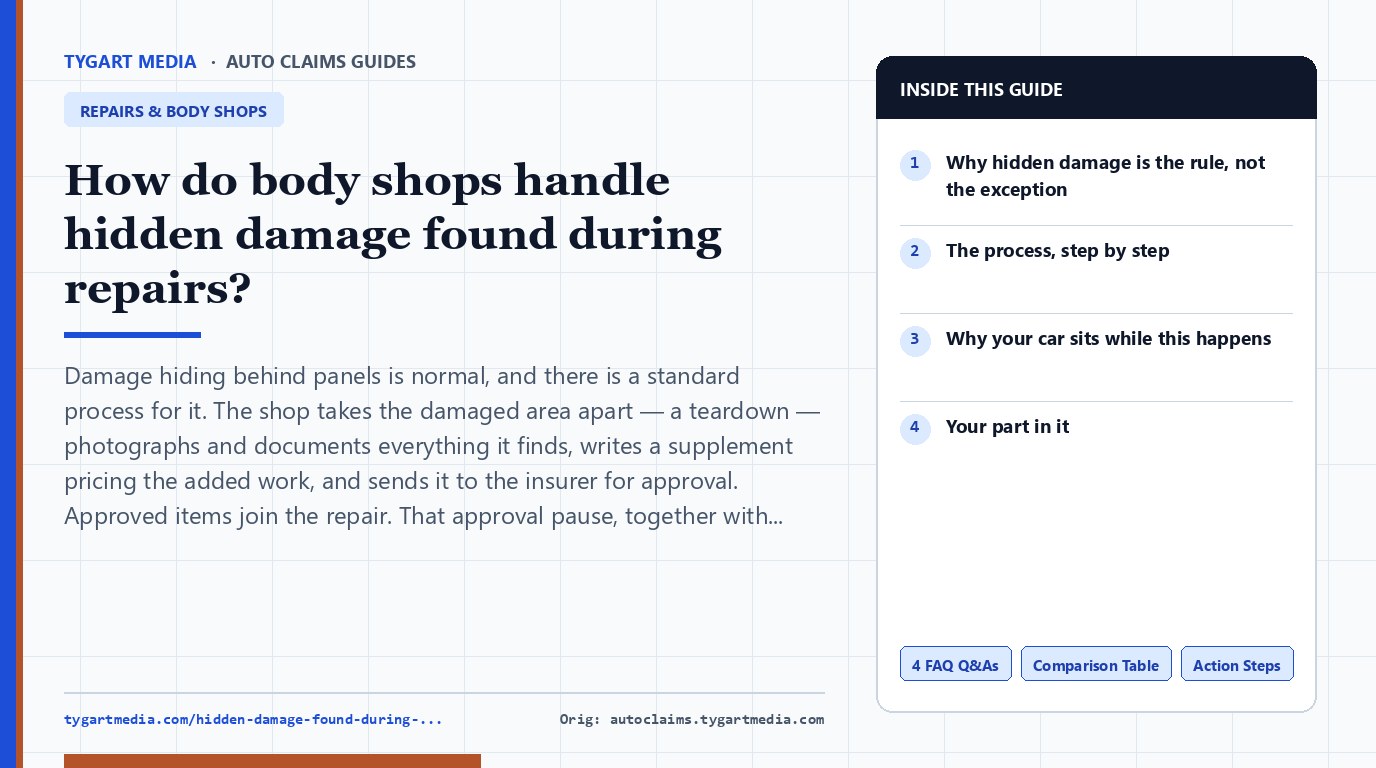
    How do body shops handle hidden damage found during repairs?

    Tygart Media · Auto Claims Guides · Repairs & body shops

    QUICK ANSWEROriginally published at autoclaims.tygartmedia.com · Reviewed October 18, 2026
    The short answer: damage hiding behind panels is normal, and there is a standard process for it. The shop takes the damaged area apart — a teardown — photographs and documents everything it finds, writes a supplement pricing the added work, and sends it to the insurer for approval. Approved items join the repair. That approval pause, together with parts ordering, is typically where most of the timeline on a bigger repair goes — and knowing the process exists keeps the pause from feeling like a stall.

    Why hidden damage is the rule, not the exception

    The first estimate on your car was written on what could be seen — the outside of the car, with every panel still in place. That is not carelessness; it is all an estimator has to work with before anyone has permission to take the car apart.

    Modern cars hide a lot behind that visible surface. Behind a bumper cover sit brackets, an energy absorber, clips, and often sensors, any of which can be cracked or bent by a hit that only scuffed the cover. Structure is worse: a rail or apron that looks straight through a small gap can prove bent once the panels around it are off. So on anything beyond a minor repair, finding more damage at teardown is the ordinary course of the job — the estimate was a floor, set by what was visible, not a promise about what was underneath.

    The process, step by step

    1. Teardown. The shop disassembles the damaged area, removing covers and panels until the full extent of the damage is exposed.
    2. Documentation. The shop photographs and documents everything found — each damaged part, before anything is discarded — so the evidence exists whether the insurer reviews it on paper or in person.
    3. The supplement. The shop writes a supplement: an addition to the original estimate pricing the newly found damage, part by part and labor included, and sends it to the insurer.
    4. Insurer review. The adjuster reviews the photos and documentation, or comes back to re-inspect the car in person with the panels off, and decides what is approved.
    5. Approved work joins the repair. Items the insurer approves are added to the claim and the shop repairs them as part of the same job.
    6. Denied items get disputed on paper. Anything denied is argued from the documentation — the teardown photos and measurements — not from anybody’s memory of a phone call.

    A second round of hidden damage, and a second supplement, is not unusual on a hard hit. Each round follows the same steps.

    Why your car sits while this happens

    The frustrating part of this process is the pause. Work on the affected area typically stops while the supplement is pending, because the shop cannot responsibly repair parts the insurer has not approved — if approval never comes, somebody has to pay for that work, and unapproved work has a way of landing on the car owner’s bill.

    That approval pause, plus the time to order whatever parts the supplement added, accounts for most of the timeline on bigger repairs — usually more than the hands-on repair work itself. A car sitting still in the shop is often a car waiting on a decision, not a car being ignored. If the waiting stretches, the useful question to ask is which step the supplement is at, not why nobody is working. For the wider picture: How long can a body shop keep my car during an insurance claim? →

    Your part in it

    Your role in the hidden-damage process is small but real:

    • Stay reachable. Supplements sometimes surface decisions that are yours — approving non-claim work found along the way, or choosing how to handle a denied item — and a shop that cannot reach you loses days it did not have to lose.
    • Ask for the teardown photos. They are your record of what was actually found, they make any later dispute concrete, and a good shop will share them without being pressed.
    • Never tell the shop to just fix everything. Said casually, that phrase can be taken as your authorization for work the insurer has not approved — and unapproved work can become your bill. Say instead that you want everything documented and supplemented, and that you will decide on anything the insurer denies once you see it in writing: How do I make sure all the damage is in my claim? →

    Frequently asked questions

    Who pays for hidden damage found during repairs?

    The claim pays, when the damage is related to the covered accident and is approved through a supplement. The shop documents the damage, the insurer reviews it, and approved items are added to the repair. Unrelated wear or old damage found along the way is not the insurer’s to pay for, and that work is yours to approve or decline separately.

    Can hidden damage turn my repair into a total loss?

    Yes. If the supplement raises the total repair cost past the insurer’s total-loss threshold for the car, the insurer will re-evaluate it as a total loss instead of a repair. That decision is based on the car’s value compared with the full cost to fix it, which is why hidden damage sometimes changes the whole direction of a claim.

    Should the shop keep repairing while the supplement is pending?

    On the already approved scope, usually yes. On the unapproved items, working ahead is risky, because if the insurer denies them, the unpaid bill has to land on someone, and that someone is usually you. Ask the shop to pause on the disputed items only, and to keep the rest of the repair moving where it safely can.

    What documentation should I ask the shop for?

    Ask for the teardown photos, a copy of the supplement, and the insurer’s approval for the added work. That is the same paper trail you would want for any later dispute, and a good shop will already have it organized. Keep your copies somewhere other than the glove box while the car is in the shop.

    Disclaimer
    Informational only — not legal or insurance advice.
    Auto repair and insurance rules vary by state and by policy. Check your own policy documents and your state’s insurance department, or talk to a licensed professional, before acting on a claim.

    Hidden damage, at a glance

    Hidden damage, stage by stage
    StageWhat happens
    TeardownPanels come off and the real damage shows
    DocumentationPhotos of every damaged part, before anything is discarded
    SupplementShop prices the added work and sends it to the insurer
    ApprovalAdjuster agrees from photos or re-inspects in person
    Repair resumesApproved items are fixed; anything denied is disputed on paper
  • How do auto body shops negotiate with insurance companies?

    How do auto body shops negotiate with insurance companies?

    Tygart Media · Auto Claims Guides · Repairs & body shops

    QUICK ANSWEROriginally published at autoclaims.tygartmedia.com · Reviewed October 18, 2026
    The short answer: body shops and insurers negotiate because they start from two different estimates of the same repair — the insurer’s, often written from photos at its own rates, and the shop’s, written in person with the car in front of them. The negotiation closes that gap line by line: labor rates, repair versus replace, parts type, and procedures, with supplements handling damage found after teardown. You are not a bystander in it. You authorize the work and own any gap you agree to, which is why the agreements should be in writing.

    It starts with two estimates

    Almost every negotiation begins the same way: two documents that describe the same damaged car and come to different totals.

    The insurer’s estimate is typically written early, often from photos you or the shop submit, sometimes from a brief in-person look. By its nature it covers visible damage, and it is priced using the insurer’s labor rates and parts choices. The shop’s estimate is written with the car in the bay, by someone who will have to stand behind the finished repair. It tends to include the full scope the shop expects: panels that need to come off to reach the damage, operations the visible repair requires, and parts priced the way the shop actually buys them.

    Neither estimate is automatically the honest one. The insurer’s can miss real damage because nobody has opened the car up yet. The shop’s can include work the insurer considers unnecessary or priced above the going rate. The gap between the two numbers is not a scandal — it is the negotiation, stated in dollars and labor lines, and it gets worked through line by line rather than all at once.

    What they actually negotiate

    The arguments sound like one big fight over price, but they break down into a handful of specific, repeatable disagreements:

    • Labor rate. Insurers typically pay a prevailing rate for the area — the rate they consider standard for that market. Shops set their own posted rates, and the two do not always match. The negotiation is over which rate applies to the hours on the estimate, and the hours themselves are argued too.
    • Repair versus replace. The insurer may write to repair a panel the shop says should be replaced, or the reverse. Each side is arguing about what returns the car to its pre-crash condition safely and correctly, at what cost in labor and parts.
    • Parts type. Original equipment manufacturer (OEM) parts, aftermarket parts, and recycled parts carry different prices and different fits. Your policy’s parts language often decides what the insurer will pay for, which turns many parts arguments into a reading of the policy rather than a shouting match.
    • Procedures and operations. Real repairs require steps around the obvious one — removing trim to reach a panel, blending paint into the next panel so the color matches, calibrating systems the repair disturbed. Insurers question or exclude some of these lines; shops point to the repair procedures for that vehicle to justify them.
    • Supplements. When teardown reveals damage the first estimates never saw, the added scope is negotiated separately, through the supplement process described below.

    Notice what is missing from that list: the total. Experienced shops and adjusters rarely haggle over one lump sum. They settle the lines, and the total follows.

    Supplements: where the real negotiation happens

    The first estimates are written on an intact-looking car. The honest scope of a crash repair only appears after teardown, when bumpers, panels, and trim come off and bent or broken parts underneath become visible. That is why the sharpest negotiation usually happens mid-repair, not at the start.

    The shop documents what teardown found — typically with photos of the damaged parts — writes it up as a supplement, and sends it to the insurer. The adjuster reviews the documentation, and may re-inspect the car in person before deciding. Lines can be approved as written, trimmed to a lower amount, or denied with a reason. If the shop disagrees, it responds with more documentation: clearer photos, the manufacturer’s repair procedure, a parts invoice. The rounds continue until the scope is agreed or the disagreement is clearly defined.

    This back-and-forth is slow by design — each side is checking the other’s work — but it is also the part of the process that protects you. A supplement with photos is evidence. A verbal promise to cover it later is not.

    How it usually ends

    Most negotiations end in an agreed scope and an agreed price: a set of repair lines both sides have signed off on, at rates both sides have accepted for this claim. The insurer then pays — often directly to the shop, sometimes to you to pass along — for the approved amount.

    What does not get agreed does not vanish. Any remaining gap — a part the insurer will only pay for in aftermarket form, a procedure it will not cover, a rate difference nobody closed — becomes a decision for you, the car’s owner: authorize the work and cover the difference yourself, accept the insurer’s version of the repair, or dispute the denial through the claim process. The key protection is timing. That decision should reach you before the work is done, as a clear choice, not after pickup as a surprise line on the final bill.

    Your role while they negotiate

    You are the only person in this triangle who can authorize repairs to your car, and that gives you a specific, limited, important job. You do not need to argue labor operations with an adjuster — that is the shop’s language and the shop speaks it daily. Your job is the decisions and the paper.

    • Authorize deliberately. Sign authorizations that say what work is approved and what it is expected to cost. Be cautious with open-ended authorizations signed before the scope is settled.
    • Stay reachable. Supplements and approval questions often need a quick owner decision. A negotiation that waits days for you to return a call is a repair that waits with it.
    • Get agreements in writing. When the shop or the adjuster tells you a line is covered, a part is approved, or a difference is yours to pay, ask for it in the estimate, the supplement approval, or an email — somewhere you can point to later.
    • Know who talks to whom. In most repairs the shop and the adjuster speak directly about scope, which is normal and usually faster. For how that division of labor should work, see: Should the body shop deal with the insurance adjuster directly? → And for the document at the center of the mid-repair rounds, see: What are supplements in auto body repair claims? →

    Frequently asked questions

    Do body shops negotiate with insurance companies on every claim?

    No. Straightforward claims where the scope, parts, and price already line up at agreed rates often go through with little back-and-forth. Negotiation happens when the two sides see the repair differently — different scope, different parts, or a different price for the same work.

    Who has the final say on the repair price?

    Neither side alone. The insurer controls what it will pay, the shop controls what it charges, and you control what work you authorize. Most repairs move forward where those three meet — an agreed scope at an agreed price, documented in writing.

    Can I be charged the difference if the shop and insurer cannot agree?

    You can be responsible for a difference only for work you authorized with knowledge of the gap. That is exactly why written authorization matters: it should state what was approved, what was not, and what you agreed to pay for yourself before the work is done.

    Should I get involved in the negotiation, or let the shop handle it?

    Let the shop handle the technical scope — labor operations, parts, and repair procedures are their language. Stay involved on money and authorizations: what is approved, what is disputed, and what, if anything, you are being asked to pay or decide.

    Disclaimer
    Informational only — not legal or insurance advice.
    Auto repair practices and insurance rules vary by state and by policy. Check your own policy documents and your state’s insurance department, or talk to a licensed professional, before acting on a claim.

    What shops and insurers negotiate — and what settles it

    What shops and insurers negotiate — and what settles it
    They argue aboutWhat usually settles it
    Labor rateThe area’s prevailing rate and the shop’s posted rate, documented
    Parts typeYour policy’s parts language
    Hidden damageTeardown photos and a supplement
    Missing proceduresThe repair manual’s required steps for that repair
  • What is gap insurance — and does it apply to my claim?

    What is gap insurance — and does it apply to my claim?

    Tygart Media · Auto Claims Guides · Total loss & valuation

    QUICK ANSWEROriginally published at autoclaims.tygartmedia.com · Reviewed October 4, 2026
    The short answer: if your car is totaled and the insurance payout is less than what you still owe on the loan or lease, gap coverage pays the difference. It’s one of the few coverages that exists for exactly the “I owe more than it’s worth” problem. It applies only to total losses — not to repairs.

    Why the gap happens

    Cars depreciate fastest in the early years while loan balances drop slowly. If you financed with a small down payment, rolled in negative equity, or have a long loan term, the insurer’s actual-cash-value payout can land well below what you owe. The lender still wants the full balance — the gap is your problem unless gap coverage handles it.

    Where gap coverage comes from

    • Your auto insurer — sometimes sold as “loan/lease payoff” coverage on the policy itself.
    • The dealer or lender — sold at purchase or lease signing as a separate product.

    Which one you have determines who you file with. Dig out the paperwork — the claim goes to whoever sold the coverage.

    Filing the gap claim

    1. Settle the primary claim first. Gap pays after the main insurer’s total-loss payout is finalized.
    2. Get the loan payoff statement as of the loss date from your lender.
    3. Gather the primary settlement paperwork — valuation, payout amount, deductible.
    4. File with the gap provider and expect them to verify the numbers against the primary settlement.
    Important Notice
    Read the exclusions before you count on it Gap products commonly exclude late payments, rolled-in fees, extended warranties, and amounts above a stated cap. Some exclude the deductible. The contract language — not the sales pitch — controls.
    Disclaimer
    Informational only — not legal or insurance advice.
    Gap coverage terms vary by product and by state. Read your own contract documents, or talk to a licensed professional, before acting on a claim.

    Gap insurance: the math

    When gap insurance matters
    You oweCar’s ACVWithout gapWith gap
    $24,000$19,000You pay $5,000 out of pocketGap covers the $5,000

    Gap covers the difference between the loan balance and the car’s actual cash value at total loss. If you put little down or rolled negative equity into the loan, you need it.

    Next Step & Source Attribution
    Continue navigating Auto Claims Guides
    Source: Originally published at https://autoclaims.tygartmedia.com/gap-insurance/ · Author: William Tygart, Tygart Media · Last reviewed October 4, 2026.
  • Does rental reimbursement cover all rental car fees and taxes?

    Does rental reimbursement cover all rental car fees and taxes?

    Tygart Media · Auto Claims Guides · Rental & injury

    QUICK ANSWEROriginally published at autoclaims.tygartmedia.com · Reviewed October 18, 2026
    The short answer: no — not all of it. Rental reimbursement pays the rental charge up to your daily and total caps, and in typical practice the tax on the rental rides inside that capped amount rather than being paid on top. The rental company’s own add-ons — its damage waiver, fuel, extra-driver fees — are commonly on you. The cap is the cap, and everything on the bill competes for room inside it.

    The cap is the cap

    Rental reimbursement is written as limits: a daily amount and a total amount for the claim. Reimbursement means the insurer pays the covered rental cost back to you — or, on some claims, pays the rental company directly — until one of those limits is reached. Nothing in that arrangement promises that every line on the rental bill will be covered, and nothing pays beyond the limits because the bill happened to be bigger.

    The tax point is the one that catches people first. In typical practice, the tax on the rental is treated as part of the rental charge itself, so it consumes cap room along with the daily rate rather than being added on top after the cap is applied. A rental that looks like it fits exactly under your daily limit can land slightly over it once tax is counted — and the small difference is yours, every day, for the whole rental. Read your own policy wording for how it defines the covered charge, because the wording, not the counter conversation, is what decides.

    Editor's Note
    Do the math on the whole bill, not the daily rate. Before you accept a rental, add the daily rate and the tax together and compare that figure with your daily cap, then check the running total against your overall cap. Two minutes of arithmetic at the counter prevents the most common surprise in this coverage: a bill that fit on day one and quietly did not by day ten.

    What is usually inside

    Within the cap, the core of the bill is what the coverage exists for:

    • The base rental rate for a car comparable to your own, for the days your car is genuinely out of service for covered repairs.
    • The taxes on that rental, in typical practice counted as part of the capped charge, as described above.

    That is the center of it. Everything beyond the base rate and its taxes should be treated as unproven until your policy wording or your adjuster, in writing, says otherwise. Comparable matters here as well: the rate for a car in a higher class than your own is not automatically the covered rate, and the difference between the two is a common quiet out-of-pocket cost.

    What is usually on you

    The add-ons are where rental bills grow, and they are commonly excluded from reimbursement. Your policy controls in every case, but in typical practice the following land on the driver:

    • The rental company’s damage waiver and insurance products. These are the rental company’s own optional products, sold at the counter, and they are commonly not part of the covered rental charge.
    • Fuel. The gas you use, and any refueling charge if the car comes back below the level it left with.
    • Extra-driver and young-driver fees. Charges for adding another driver, or for a driver under the rental company’s age threshold.
    • Tolls and convenience packages. Toll passes, and the bundled convenience options offered at pickup.
    • Upgrades beyond comparable. The difference between the comparable car the coverage is based on and the larger or premium car you chose instead.

    None of this means you can never buy any of these things. It means you should buy them knowing they are probably your money, not the claim’s — decided at the counter with open eyes, rather than discovered on the final bill.

    How a third-party claim differs

    When the rental is owed by the at-fault driver’s insurer rather than by your own policy, there is no daily cap from your contract in the picture. What that side owes is the reasonable cost of a comparable car for the time yours is out of service. Reasonable is doing real work in that sentence: the base cost of a like-for-like rental is the straightforward part of the claim.

    Add-ons are contested there too. The other insurer will typically argue that its driver caused the loss of your car, not your choice of counter products, fuel, or upgrades — and adjusters often pay the comparable rental and decline the extras. The cleaner your bill, the less there is to fight about, on either kind of claim. How the rental itself fits into a claim against the other side is covered in the rental car and loss of use guide.

    Keeping the bill clean

    1. Decline add-ons at the counter. Anything you do not take cannot appear on the bill, cannot consume cap room, and cannot be argued about later. Decide about the waiver before you are standing at the desk with a line behind you.
    2. Stay comparable. A car like yours keeps the whole rate defensible. If the location only has a higher class available, get that noted on the agreement — a forced upgrade reads very differently from a chosen one.
    3. Keep the itemized receipt. Not the card summary — the full bill showing the daily rate, taxes, and each fee as its own line. Reimbursement and disputes both run on that document.
    4. Return it as agreed. On time, at the agreed fuel level, to the agreed location. Late and refueling charges are the easiest lines on the bill for an insurer to refuse, because they are the easiest to call your choices.

    For what this coverage itself costs and how the limits are usually sold, see the guide to rental reimbursement coverage cost. If you would rather the insurer be billed at the counter instead of reimbursing you afterward, see rental companies that bill insurance directly.

    Frequently asked questions

    Are taxes paid on top of my daily limit?

    Typically, no. In typical practice the tax on the rental is treated as part of the capped rental charge, so it rides inside your daily and total limits rather than being paid on top of them. That means the amount of rental the cap actually buys is a little less than the headline daily figure suggests. Your own policy wording controls, so read how it defines the covered rental charge.

    Does insurance cover the rental company’s damage waiver?

    Usually not under rental reimbursement. The waiver the rental company sells at the counter is its own optional product, and it is commonly excluded from what the policy reimburses. On a claim against the at-fault driver’s insurer it is contested there too. If you do not want to pay for it yourself, the cleaner routes are declining it or checking whether coverage you already have elsewhere applies — before you sign, not after.

    What about airport location fees?

    Fees the rental location adds — airport charges are the common example — are usually treated as part of the rental bill, which means they sit inside your cap on your own policy rather than being paid on top of it. Renting away from an airport location often carries fewer of these add-ons. Keep the itemized receipt either way, because what was charged has to be visible before anyone can argue about whether it is covered.

    Is the security deposit reimbursed?

    There is normally nothing to reimburse. A security deposit at the rental counter is typically a hold placed on your card, not a charge — the money is earmarked, not taken, and the hold is released when the car comes back undamaged and the final bill is settled. It does not use up your rental coverage. If a hold converts into an actual charge, that charge is a different matter, and it follows whatever the charge was for.

    Disclaimer
    Informational only — not legal or insurance advice.
    Auto repair and insurance rules vary by state and by policy. Check your own policy documents and your state’s insurance department, or talk to a licensed professional, before acting on a claim.

    Rental fees and taxes, at a glance

    What rental reimbursement usually covers, line by line
    SituationWhat usually happens
    Base rental rate, comparable carThe core of the coverage — paid up to your daily and total caps.
    Tax on the rentalIn typical practice it rides inside the capped amount, not on top of it.
    Damage waiver and counter insuranceCommonly excluded — the rental company’s own optional products.
    Fuel, extra-driver, tolls, upgradesCommonly on you. Upgrades are covered, if at all, only to the comparable rate.
    Security depositUsually a card hold, not a charge — nothing to reimburse, and it does not use your cap.
  • How do I file a claim against the other driver’s insurance?

    How do I file a claim against the other driver’s insurance?

    Tygart Media · Auto Claims Guides · The other driver's insurer

    QUICK ANSWEROriginally published at autoclaims.tygartmedia.com · Reviewed October 18, 2026
    The short answer: you open the claim directly with the other driver’s insurer, using their insurer’s name and policy number from the scene exchange or the police report — you do not need the other driver’s permission. You will get a third-party claim number and an adjuster, they will investigate fault and inspect your car, and payment follows their liability decision. No deductible applies. Expect a more arm’s-length process than with your own insurer: you are claiming on their policy, but you are not their customer.

    What a third-party claim is

    A third-party claim is a claim you make on someone else’s insurance policy — here, the liability coverage of the driver who hit you. That coverage exists to pay for the loss its driver caused to other people and their property. Your claim for repairs, diminished value, rental costs, and related losses sits inside it.

    One consequence is worth knowing at the start: you are not this insurer’s customer. Their duty runs to their own policyholder, and their adjuster’s job includes testing your claim, not just paying it. That does not make the process hostile, but it changes the service you can expect — explanations may be shorter, timelines slower, and every position worth getting in writing. How the two claim types differ in full is covered in What is a first-party vs third-party auto insurance claim?

    The walk-through, in order

    1. Get their insurer’s name and policy number. This comes from the information exchanged at the scene, or from the police report if one was made, which usually records each driver’s carrier and policy number. Without the carrier’s name you have nowhere to file, so chase this first.
    2. Open the claim with that insurer. Insurers take new third-party claims through a claims phone line or an online intake form. You will identify yourself as the other party in an accident involving their policyholder, and give the date, location, and the vehicles involved.
    3. Expect their standard questions. Typically: your account of how the crash happened, your vehicle’s damage, whether anyone was injured, whether a police report exists, and where the car is now so it can be inspected. Answer with facts. You do not need conclusions about fault on this call, and the recorded-statement caution below applies from the first conversation.
    4. Get the third-party claim number and the adjuster’s name. Before the call ends, write down the claim number, the assigned adjuster’s name and direct contact details, and how they want documents sent. Every later call, letter, and email should carry that claim number.
    5. Their liability investigation and your vehicle inspection. The insurer investigates fault — interviewing their own driver, reviewing the report and any photos, and forming a position — and arranges to inspect your car’s damage, at a shop, at your home, or through submitted photos, depending on their practice. Cooperate with the inspection; their estimate cannot be answered until it exists.
    6. Their fault decision. The investigation ends in a liability position: they accept fault in full, propose a split, or deny it. Ask for that decision, and the evidence behind it, in writing. How fault is assessed, and what to do with a split you dispute, is covered in How do I prove fault when filing a car accident claim?

    The recorded-statement caution

    Important Notice
    You generally do not owe their insurer a recorded statement. The other driver’s insurer may ask for one early, before you have the report or your own notes in front of you. Unlike your own insurer — whose policy conditions typically require your cooperation — you have no contract with theirs. It is usually safer to give the basic facts needed to open the claim, then provide your full account in writing, at your pace, in your own words, once you have your documents together.

    Written accounts have a second advantage: they are exact. A written statement cannot be mis-summarized in call notes, and your copy and their copy are the same document. Keep everything you send, with dates.

    How the money works

    No deductible applies to a third-party claim. A deductible is a feature of claiming under your own policy. Payment from the other driver’s liability coverage is not reduced by one, and if a deductible appears in a third-party payment, ask for its basis in writing.

    Payment follows their liability decision. The insurer pays once it accepts that its driver is liable — in full, or in proportion under a shared-fault split — and once the amount is agreed or established by the repair evidence. That sequence is why third-party repairs sometimes start slower than repairs under your own collision coverage: your own insurer can authorize work while fault is still argued, and pursue the other side afterward. If you need the car back quickly, compare both routes before choosing; the overall sequence of a claim is laid out in What is the auto insurance claim process after a car accident?

    When it stalls

    Third-party claims stall in predictable places: their driver will not return calls to their own insurer, the fault position never quite gets issued, or the inspection keeps being rescheduled. A stall is a situation with its own playbook — what leverage you have, when to bring in your own insurer, and when a regulator complaint moves things — and it is the direct sequel to this page: The other driver’s insurance is stalling — what are my options?

    Frequently asked questions

    Do I need the other driver’s permission to file a claim against their insurance?

    No. If you have their insurer’s name and policy number, you can open a claim directly with that insurer, and the other driver’s permission or cooperation is not required to start it. If the driver will not share the information, it is usually recorded on the police report from the scene exchange.

    What if the other driver will not share their insurance information?

    Check the police report, which usually records each driver’s insurer and policy number. Your own insurer may also be able to help identify the other carrier in some cases. If the driver turns out to have no insurance at all, the path changes to an uninsured motorist claim under your own policy, if you carry that coverage.

    Do I pay a deductible on a third-party claim?

    No. A deductible belongs to claims under your own policy. A third-party claim is paid under the other driver’s liability coverage, so no deductible applies to it. If a deductible is taken out of a third-party payment, ask the insurer for the basis for that in writing.

    How long does the other insurer’s investigation take?

    It varies with the claim. A straightforward claim with clear fault is often decided in weeks, while a disputed claim, or one where their own driver will not cooperate, can take much longer. There is no single timeline that fits every case, which is why getting the claim number, the adjuster’s name, and their fault position in writing matters. The typical sequence is laid out in the auto insurance claim process guide.

    Disclaimer
    Informational only — not legal or insurance advice.
    Auto repair and insurance rules vary by state and by policy. Check your own policy documents and your state’s insurance department, or talk to a licensed professional, before acting on a claim.

    A third-party claim, at a glance

    The stages of a claim against the other driver’s insurance
    StageWhat happens
    Identify their insurerGet the carrier name and policy number from the scene exchange or the police report.
    Open the claimFile through that insurer’s claims phone line or online intake. No permission needed.
    Claim number and adjusterRecord both before the first call ends. Every document you send carries the claim number.
    Liability investigationTheir insurer interviews its driver, reviews the evidence, and inspects your car.
    Fault decisionFull acceptance, a proposed split, or a denial. Get it, and the evidence behind it, in writing.
    PaymentFollows the liability decision. No deductible applies to a third-party claim.
  • What is a first-party vs third-party auto insurance claim?

    What is a first-party vs third-party auto insurance claim?

    Tygart Media · Auto Claims Guides · The claim process

    QUICK ANSWEROriginally published at autoclaims.tygartmedia.com · Reviewed October 18, 2026
    The short answer: first-party means you claim on your own policy. Third-party means you claim on the policy of the driver who caused the damage. That one distinction drives almost everything else: a deductible applies to a claim on your own policy and not to a third-party claim, a different company investigates, and you deal with a different adjuster. In some crashes, both claims run at once.

    The distinction: whose policy you claim on

    Every auto claim lands on someone’s policy. A first-party claim lands on yours: you are the policyholder, and you are claiming under coverages you bought — collision coverage for crash damage, comprehensive coverage for things like theft and weather. A third-party claim lands on someone else’s policy: you claim against the liability coverage of the driver whose driving caused your loss. You are the third party to that contract — the policy exists between that driver and their insurer, and you are the outsider it is meant to pay.

    The labels describe your relationship to the policy, not simply who caused the crash. That is why a crash another driver caused can still produce a first-party claim: if you ask your own insurer to handle your repairs under your collision coverage, that claim is first-party even though the fault was not yours. The claim against the other driver, for the same damage, is third-party. Same wreck, two possible doors — and the door you choose changes how the claim works.

    What changes between them

    The deductible. A deductible is the amount you agreed to absorb yourself under your own policy, and it applies to first-party claims — the insurer pays the covered loss above the deductible, not from the first dollar. No deductible applies to a third-party claim. You never agreed to one under the other driver’s policy, so nothing is deducted from what that claim pays.

    Who investigates. On a first-party claim, your own insurer investigates the loss under the contract it has with you. On a third-party claim, the other driver’s insurer investigates to decide what its driver owes — and that investigation is not neutral. Its adjuster works for the company that will pay you, and part of the job is testing your claim: whether their driver was really at fault, and how much of the damage their driver really caused.

    Who you negotiate with. A first-party claim is a conversation with a company that owes you a contract. A third-party claim is a negotiation with the other side. Expect the third-party side to move at its own pace, to require fault to be established before it pays, and to treat your demand as an opening position rather than an entitlement. Keep third-party demands in writing, with your evidence attached, the way you would build any claim against someone else’s insurer.

    Subrogation. If your insurer pays your first-party claim for damage another driver caused, it typically does not stop there. Through subrogation, your insurer steps into your position and seeks back what it paid from the at-fault driver’s insurer. Your deductible is often included in what it seeks to recover, so when the recovery succeeds, some or all of your deductible may come back to you. Subrogation is the mechanism that lets you use your own fast coverage without giving up the third-party claim’s money.

    Which claim you have in common situations

    The other driver hit you. You have a third-party claim against their liability insurer — the main path, with no deductible. You may also open a first-party claim under your own collision coverage if you want your insurer to handle the repairs without waiting for the other side.

    You hit someone. Your own car’s damage is a first-party claim under your collision coverage, deductible included. The other driver’s claim for their damage runs against your liability coverage — from their side of the table, that is a third-party claim, and your insurer handles it for you.

    Single-car damage. There is no other driver to claim against, so the claim is first-party only. Hitting a fixed object is typically a collision claim; striking an animal is typically treated as a comprehensive claim. Read your own policy to see which of those coverages you carry.

    The other driver is uninsured. There is no liability policy to claim against, so the path usually runs back to your own policy — uninsured-motorist coverage, if you bought it. That situation has its own complications, covered in the guide to the other driver having no insurance.

    Can both run at once?

    Yes, and drivers do it for a practical reason: speed versus deductible recovery. Your own insurer can usually start on your claim without waiting for the other side to accept fault, so a first-party claim gets the car into the shop sooner. The third-party claim avoids the deductible but moves at the other insurer’s pace and depends on its fault decision. Running both lets the repairs start on your coverage while the claim against the at-fault driver proceeds, with subrogation moving the money to the right side at the end.

    One limit applies to every version of this: you cannot be paid twice for the same loss. If your insurer has already paid for the repairs and the other insurer later pays for the same repairs, that second payment belongs to the recovery, not to you as a windfall. Insurers sort this out between themselves, usually through the subrogation process — but keep both claim numbers and both files clearly labeled so the two claims never get tangled.

    A practical sequence

    1. Name the claim before you call. Decide whether you are opening a first-party claim, a third-party claim, or both. The answer decides which insurer you call, what you say, and whether a deductible is in play.
    2. Report to the right insurer. A third-party claim goes to the at-fault driver’s insurer, with their driver’s policy details. A first-party claim goes to yours. Each insurer assigns its own claim number — keep them separate and labeled.
    3. Put demands in writing. Especially on the third-party side, state what you are claiming and what evidence supports it. Written demands create the record a phone call does not.
    4. Ask about subrogation and your deductible. If your insurer pays for damage another driver caused, ask in writing how subrogation will be handled and whether your deductible is part of the recovery it will seek.

    Frequently asked questions

    Which claim do I file if the other driver was at fault?

    You have a third-party claim against the at-fault driver’s liability insurer, and that is the claim that owes the loss their driver caused, with no deductible. You can also open a first-party claim under your own collision coverage, for example to get repairs moving sooner, and let subrogation sort out the recovery afterwards.

    Do I pay a deductible on a third-party claim?

    No. A deductible is part of your own policy, and it applies when you claim under that policy. A third-party claim is made under the at-fault driver liability coverage, which you are not a party to, so no deductible is taken from what that claim pays.

    Can I file both a first-party and a third-party claim?

    Yes, and drivers often do, using their own coverage for speed while the claim against the at-fault driver proceeds. What you cannot do is be paid twice for the same loss. If both insurers pay toward the same damage, the duplicate recovery is sorted out between them, usually through subrogation.

    What is subrogation?

    Subrogation is your insurer recovering money it paid on your claim from the party responsible for the loss. If your insurer pays to repair damage another driver caused, it typically seeks that amount back from the other driver’s insurer. Your deductible is often included in what it seeks, so a successful recovery can return some or all of your deductible to you.

    Disclaimer
    Informational only — not legal or insurance advice.
    Auto repair and insurance rules vary by state and by policy. Check your own policy documents and your state’s insurance department, or talk to a licensed professional, before acting on a claim.

    First-party vs third-party claims, at a glance

    First-party and third-party claims compared
    QuestionFirst-party claimThird-party claim
    Whose policy pays?Yours — the coverage you boughtThe at-fault driver’s liability coverage
    Deductible?Yes, yours appliesNo deductible applies
    Who investigates?Your insurer, under its contract with youThe other driver’s insurer, testing fault and damage
    Who do you deal with?Your own insurer and its adjusterThe other side’s insurer and its adjuster
    Typical trade-offUsually faster, but the deductible comes out firstNo deductible, but moves at the other insurer’s pace
  • What documents do I need for diminished value?

    What documents do I need for diminished value?

    Tygart Media · Auto Claims Guides · Diminished value

    QUICK ANSWEROriginally published at autoclaims.tygartmedia.com · Reviewed October 18, 2026
    The short answer: you need one file that proves five things: the accident happened, the car was repaired, the accident now sits on the car’s history, the repaired car is worth less than it was, and you actually made the demand. Most drivers already have most of these papers scattered across the insurer, the shop, and their own phone. This page is the checklist for pulling them into one place. How the evidence persuades an adjuster is covered in How to prove diminished value?

    Why the file matters

    A diminished value claim is an argument about a record. The repairs are done and the car looks right, so the loss lives in paperwork: what the crash did, what the repair involved, and what a future buyer will find when they check the car. The adjuster works from documents, not from your memory of the accident. A complete file lets that adjuster say yes without taking your word for any of it.

    Build the file in the five groups below. For each one, know what the paper proves, and where to get another copy if yours is missing.

    1. The accident: prove the crash happened

    • Police or accident report, if one was made. It proves the date, the location, the vehicles involved, and how the crash was described at the time. If you do not have a copy, reports are usually available from the agency that responded.
    • Photos from the scene. Damage photos, the other car, and the positions of the vehicles. These prove the accident was real and give a first picture of its severity. Check your phone and your messages.
    • The claim number and the insurer’s liability decision. The claim number ties every later document to the right file. If the insurer put its liability decision in writing — a letter or email accepting that its driver was at fault — keep it. It proves you are claiming against the right party.

    2. The repair: prove what was actually fixed

    • The itemized final repair invoice. This is the single most important repair document. The estimate shows what someone expected to fix; the final invoice shows what was actually repaired, replaced, and painted. Get the itemized version, line by line, not just a total. If you do not have it, the shop or the insurer can re-send it — both keep a copy.
    • Supplements. A supplement is the added paperwork for damage found after the car was opened up. Supplements prove the damage ran deeper than the first look suggested — exactly what worries future buyers.
    • Before, during, and after repair photos, if you have them. The shop often photographs teardown and progress for the insurer. Ask for copies. Photos of panels off and parts replaced prove the scope of the work in a way an invoice line cannot.

    3. The car’s history: prove the record buyers will see

    Pull a vehicle-history report for your car and keep the full report. It proves the accident has been recorded against the car — and that entry is what a future buyer, dealer, or appraiser will see when the car is sold or traded. That visible record is the heart of a diminished value claim: the car can be repaired perfectly and still carry the entry.

    History reports are purchasable by vehicle identification number (VIN) from the reporting companies. Get a fresh copy after repairs are complete, so the report reflects the accident entry as it now stands, and keep the whole report rather than a summary page.

    4. The value evidence: prove the car is worth less

    • Your independent diminished value appraisal, if you get one. An appraiser who did not repair the car and does not work for the insurer writes up the before-and-after value comparison. It proves the size of the loss in a form an adjuster can evaluate.
    • Written dealer trade-in quotes. A quote that reflects the accident history proves what the real market will pay now. Get quotes in writing, dated, and note whether the dealer knew about the accident record.
    • Dated comparable listings. Listings for cars like yours — same year, make, model, trim, and similar mileage — prove the asking-price landscape your car competes in. Save the full listing with its date.

    You do not need every item in this group. You need enough of it, together, that the drop in value is documented rather than asserted. Which pieces carry the most weight is the subject of How to prove diminished value?

    5. The demand itself: prove you asked

    • A copy of your demand letter. Keep the exact version you sent, not an earlier draft. A ready structure is in Diminished value claim letter example?
    • Proof the demand was sent. A delivery confirmation, a tracked-mail receipt, or a sent email you can produce later. It proves the insurer received the demand and when.

    How to keep the file

    1. Make one folder, paper or digital, and put everything in it. Five sections matching the groups above. If a document lives only in an email, save a copy into the folder the day you get it.
    2. Name files by what they are and their date. Plain names — final invoice, history report, demand letter — make the file usable by anyone.
    3. Chase missing copies now, while the sources still have them. The insurer can re-send claim records and the shop can re-send the invoice and repair photos. Ask early, while the claim file is still open.
    4. Keep the file after the claim closes. The accident entry stays on the car’s history. If you sell or trade the car later, this file explains the record.
    Editor's Note
    Documents now are cheap. Documents later may not exist. Listings get taken down, shops purge old files, and phones get replaced. Nearly everything on this checklist is already in your hands today; reconstructing the same record later can be slow or impossible.

    Frequently asked questions

    Do I need a police report for a diminished value claim?

    A police report helps but it is not always required. If one was made, include a copy because it records the date, the vehicles involved, and how the crash was described at the time. If no report was made, use your photos, the claim record, and the repair paperwork to establish the same facts.

    Is the repair estimate enough, or do I need the final invoice?

    Use the final itemized invoice, not only the estimate. The estimate shows what the insurer expected to pay before the work began, while the final invoice shows what was actually repaired or replaced. Supplements belong in the file too because they show damage found after the first look.

    Where do I get a vehicle history report for my car?

    Vehicle history reports are sold by reporting companies and are pulled by the vehicle identification number. Keep the full report, not a screenshot of the summary, because the accident entry and the date it appeared are the details a future buyer will see.

    What if I am missing a document from the list?

    Ask the source to send another copy before you assume it is gone. The insurer can resend claim records and the shop can resend invoices and photos from the repair file. Get what you can now, note what is missing, and file the claim with the strongest complete record you can build.

    Disclaimer
    Informational only — not legal or insurance advice.
    Auto repair and insurance rules vary by state and by policy. Check your own policy documents and your state’s insurance department, or talk to a licensed professional, before acting on a claim.

    The diminished value document file, at a glance

    The diminished value document file
    DocumentWhat it provesWhere to get it
    Police or accident report and scene photosThe crash happened, when, and how severe it lookedThe responding agency, your phone, and your messages
    Itemized final repair invoice and supplementsWhat was actually repaired or replaced, including hidden damageThe body shop or the insurer can re-send a copy
    Vehicle-history reportThe accident entry future buyers will seePurchased by VIN from a reporting company
    Appraisal, dealer quotes, and comparable listingsThe size of the drop in value after repairAn independent appraiser, dealers, and dated listings you save
    Demand letter and proof it was sentYou made a specific claim and the insurer received itYour copy plus a delivery confirmation or tracked-mail receipt
  • What documents do I need to file an auto insurance claim?

    What documents do I need to file an auto insurance claim?

    Tygart Media · Auto Claims Guides · The claim process

    QUICK ANSWEROriginally published at autoclaims.tygartmedia.com · Reviewed October 18, 2026
    The short answer: less than most people fear. To open the claim you need your policy number and ID, the date, time, and location of the crash, the other driver’s name, insurer, and policy number, the police report number if one was made, and a basic account of what happened. Everything else — photos, estimates, bills — builds the file as the claim develops. You do not need a complete evidence package in hand before you file.

    What you need to open the claim

    Opening a claim is mostly an identification exercise. The insurer needs to find your policy, create a claim record, and start a file on the crash. That takes a short list of basics:

    • Your policy number and ID. Your insurance card, your insurer’s app, or your policy declarations page carries both. If you are filing against the other driver’s insurer, you will give your own name and contact details instead, and their driver’s policy number where you have it.
    • The date, time, and location of the crash. Be as specific as you can — the road, the nearest cross street or landmark, and roughly when it happened.
    • The other driver’s details. Their name, their insurer, and their policy number, plus a license plate and vehicle description if you have them. This is the information exchanged at the scene.
    • The police report number, if one was made. If officers attended or a report was filed, give the number. If the report itself is not ready yet, the number is enough for now — the insurer can pull the report when it is available.
    • A basic account of what happened. A few plain sentences: where each car was, what each was doing, and where the damage is. You are opening a file, not giving a final statement — stick to what you know and say so where you are unsure.

    That is enough to get a claim number and an adjuster assigned. If a piece is missing — most commonly the other driver’s insurer — file anyway and note what is missing. A claim opened with a gap can be filled in; a claim never opened cannot.

    The evidence file that strengthens it from day one

    Opening the claim and proving the claim are two different jobs. The documents above open it. The evidence below is what the decisions later in the claim — fault, damage, amounts — will actually rest on, and much of it can only be gathered at the start.

    Scene photos are the strongest item in the file. Photograph both cars and the damage, the wider scene, positions, skid marks, debris, road signs, and anything that shows how the crash happened. Photos taken at the scene carry weight that later descriptions do not. The guide to what to do and document right after a crash walks through gathering this material at the scene, step by step.

    Witness names and contact details matter because memories fade and people become hard to reach. A witness who is not in anyone’s file on day one is often unfindable by week three. If anyone stopped, or was nearby, get a name and a phone number and put both in the claim file.

    Your own written timeline is the third piece. Write down what happened, in order, while it is fresh — the direction you were traveling, what you saw, what you did, and what was said at the scene. Date it and keep it. Weeks later, when an adjuster asks questions, that note is more reliable than your memory will be.

    Editor's Note
    Keep a claim folder from day one. One folder — paper or digital — for everything: the claim number, the adjuster’s name and contact details, every document you send or receive, and a note of every call with the date and what was said. Claims run on files. The driver with an organized file answers questions in minutes instead of days.

    What gets added as the claim develops

    Once the claim is open, the file grows in the order the claim moves. Adjusters typically ask for these as each stage arrives, and sending them promptly keeps the claim moving:

    • Repair estimates. The insurer’s inspection produces an estimate, and a body shop may produce its own. Keep both, along with any supplements written when hidden damage is found during repairs.
    • Medical bills and records, if you were injured. Bills, treatment records, and related expenses become part of the file when there is an injury claim alongside the vehicle claim. The first steps on that side are covered in the guide to the first steps in an injury claim. This guide covers documents only — it is not medical advice, and treatment decisions are yours and your clinician’s.
    • Receipts. Towing, storage, a rental car, and other out-of-pocket costs the claim may cover. A cost without a receipt is a cost you will struggle to prove, so keep every one.
    • Wage-loss proof, if you missed work. Typically a note from your employer or pay records showing the time missed and what it cost you. Ask what form your insurer or the other insurer wants before you assemble it.

    Send copies, keep originals, and send each item once, labeled with your claim number. Flooding a file with duplicates slows it down; a complete file sent in order speeds it up.

    First-party vs. third-party: what you hand over differs

    Who you are filing with changes what you hand over. On a first-party claim — against your own insurer, under your own collision coverage — the insurer already holds your policy, so the file centers on the crash details, the damage, and the evidence. Your deductible applies, and your policy wording controls what is covered.

    On a third-party claim — against the other driver’s insurer — you are a claimant on someone else’s policy. That insurer typically needs your account of what happened, evidence of the damage, and proof of the amounts you are claiming, and it will make its own liability decision before it pays. No deductible applies to a third-party claim. The full comparison is in the guide to first-party vs. third-party claims, and the mechanics of opening the third-party file are in the guide to filing a claim against the other driver’s insurance.

    Important Notice
    Hand over what the claim needs — not everything you have. On a third-party claim especially, provide the documents that relate to this crash and this damage. If an adjuster asks for records that seem unrelated, it is reasonable to ask what they are needed for before you send them.
    Editor's Note
    Filing documents are not value-proof documents. This page covers the documents that open and support a claim. Two other kinds of proof answer a different question — what the car was worth. If your car is totaled, the documents that prove its condition and value are covered in how to document your car for a total loss claim. If your car is repaired but worth less, the proof for that claim is covered in what documents you need for diminished value. Do not let a value dispute delay opening the claim itself — file first, then build the value proof.

    Frequently asked questions

    Do I need a police report to file a claim?

    No. A police report is helpful because it anchors the basic facts of the crash in the file, but it is not a prerequisite for opening a claim. You can file with your policy information, the crash details, and the other driver’s information, and add the report number later if a report was made.

    What if I don’t have the other driver’s insurance information?

    File anyway with what you do have, such as the other driver’s name, license plate, and vehicle description, and note what is missing. Your insurer can often help track down the other coverage from those details, and a police report, if one was made, may carry information you did not get at the scene.

    Should I send original documents?

    No. Send copies and keep the originals. That applies to bills, receipts, estimates, and records. Keep your own complete copy of everything you hand over, with the date you sent it, so the file you hold matches the file the insurer holds.

    What does the other driver’s insurer need from me?

    On a third-party claim, the other driver’s insurer typically needs your account of what happened, evidence of the damage, and proof of the amounts you are claiming, such as estimates, bills, and receipts. It does not need documents that are unrelated to the claim.

    Disclaimer
    Informational only — not legal or insurance advice.
    Auto repair and insurance rules vary by state and by policy. Check your own policy documents and your state’s insurance department, or talk to a licensed professional, before acting on a claim.

    Filing documents, at a glance

    What to hand over, and when
    StageDocuments
    Opening the claimPolicy number and ID; date, time, and location of the crash; the other driver’s name, insurer, and policy number; police report number if one was made; a basic account of what happened.
    From day oneScene photos, witness names and contact details, and your own written timeline of the crash.
    As the claim developsRepair estimates and supplements, medical bills and records if injured, receipts for towing, storage, and rental, and wage-loss proof if you missed work.
    Third-party claimYour account, evidence of the damage, and proof of the amounts claimed. No deductible applies.
    Value disputes (separate)Total-loss and diminished-value proof documents — covered in their own guides, not needed to open the claim.
  • Does filing an auto insurance claim raise my rates?

    Does filing an auto insurance claim raise my rates?

    Tygart Media · Auto Claims Guides · The claim process

    QUICK ANSWEROriginally published at autoclaims.tygartmedia.com · Reviewed October 18, 2026
    The short answer: a claim can raise your rates, but it depends on the claim. An at-fault claim is the one most likely to add a surcharge at renewal. A not-at-fault claim, a weather or theft claim, and above all a claim paid entirely by the other driver’s insurer are usually treated differently. There is no single rule that covers every driver — insurers differ, states differ, and your own claim history matters.

    The mechanism: surcharge at renewal, and a record that follows you

    Your premium is set for the policy term, so a claim usually does not change what you pay the day you file it. The effect, when there is one, typically arrives at renewal: the insurer reviews your recent history, and an at-fault claim can add a surcharge that raises the price of the renewed policy. The surcharge is the insurer pricing the risk it now sees — a driver with a recent at-fault claim is treated as more likely to cost it money again.

    Separately, the claim sits on your insurance record. Claims are recorded in industry claims-history reports that insurers commonly check when you apply or renew, so the claim does not live only with your current company. Shopping for a new insurer does not erase it, and a claim you decide not to mention can still surface when a new insurer pulls your history. None of this means every claim raises every driver’s price — it means the claim becomes part of the record your price is built from.

    What usually matters most

    Fault. This is usually the biggest factor. An at-fault claim — your driving caused the loss — is the claim most likely to be surcharged. A claim where another driver was at fault is usually treated more lightly, and some states restrict surcharges for not-at-fault claims. If fault is disputed or shared, expect the treatment to land somewhere between the two, based on the fault decision the insurer records.

    Claim type. An at-fault collision claim and a comprehensive claim are usually read differently. Comprehensive events — weather damage, theft, vandalism, a cracked windshield, an animal strike — happen to a driver rather than being caused by one, and insurers typically weigh them less heavily than a crash the driver caused. The same repair bill can therefore carry very different rate consequences depending on which coverage it was claimed under.

    Severity. Larger claims usually weigh more than small ones, and claims involving injuries typically weigh most of all. Frequency matters too: insurers typically look at the pattern, so several claims in a short span can draw a harder response than any one of them would alone — even when each claim, by itself, looks minor.

    What usually does not affect your rates

    A third-party claim paid by the other driver’s insurer is the clear case. When the at-fault driver’s liability coverage pays for your damage, the loss is counted against that driver’s record, not yours, and your own insurer has paid nothing on it. Keeping a claim entirely on the other side is the cleanest position for your rates — one reason the choice between claiming on your own policy and claiming on theirs matters, beyond the deductible.

    One nuance: if you also opened a claim under your own policy for the same crash — for speed, or because fault was unclear at first — that claim exists on your record and is handled under your insurer’s normal rules, even if your insurer ultimately recovers everything it paid. Opening the claim is the event your record reflects. The specific case of diminished value claims has its own version of this question, covered in Will filing diminished value raise my rates?

    Accident forgiveness

    Some policies include accident forgiveness, or offer it as an added feature: the insurer agrees not to surcharge your first at-fault claim. Where it applies, that first claim’s surcharge is waived. The details vary — forgiveness may be built into the policy or bought as an endorsement, it may require a clean record going in, and it typically covers one claim rather than a pattern of them.

    Forgiveness is a feature of your policy, not a general rule, so the only way to know whether you have it is to check: read your declarations and policy wording, or ask your insurer directly. And note what forgiveness does not do — it governs your current insurer’s surcharge. Whether and how the claim still appears on your record for other insurers is a separate question.

    How long a surcharge typically lasts

    Label this typical, not a rule: when a surcharge applies, it commonly lasts a few years, stepping down or dropping off as the claim ages, rather than following you for the life of the policy. Insurers differ on how long they count a claim, and states differ on what they allow, so the honest answer for your policy is the one your insurer gives you about your record.

    Two clocks also run at different speeds. A surcharge can end while the claim itself still appears in your claims history, and the other way around. When you are weighing whether a small claim is worth filing, ask your insurer both questions — how long a surcharge would apply, and how long the claim will be counted — because the answers together are the real cost of the claim over time.

    Frequently asked questions

    Does a not-at-fault claim raise my rates?

    It varies by insurer and state. Many insurers do not surcharge a claim where you were not at fault, and some states restrict surcharges for not-at-fault claims. The claim can still appear on your record even when it carries no surcharge. Your policy wording and your state’s rules decide your case, so ask your insurer directly if it matters to a decision you are making.

    Does a windshield or weather claim count the same?

    Usually not. Glass, weather, theft, and similar comprehensive claims are typically treated differently from at-fault collision claims, because they are not read as a sign of risky driving in the same way. That is a general pattern, not a rule. Treatment varies by insurer, and several small claims in a short period can draw attention even when each one alone would not.

    How long does a claim stay on my record?

    Typically a few years, though the exact period varies by insurer and by state, and a surcharge and the record itself do not always run for the same length of time. Treat any single number you are quoted as one insurer’s practice rather than a general rule. If the timing matters, ask your insurer how long the claim will be counted in your pricing.

    Will my rates rise if the other driver’s insurer pays?

    Usually not, because the claim is paid under the other driver’s policy and the loss is counted against their record, not yours. If you also opened a claim under your own policy for the same crash, that claim exists on your record and is treated under your insurer’s normal rules. Keeping the claim entirely on the at-fault driver’s side is the cleanest position for your rates.

    Disclaimer
    Informational only — not legal or insurance advice.
    Auto repair and insurance rules vary by state and by policy. Check your own policy documents and your state’s insurance department, or talk to a licensed professional, before acting on a claim.

    Claims and your rates, at a glance

    What tends to matter for your rates after a claim
    SituationHow it is usually treated
    At-fault collision claimThe claim most likely to add a surcharge at renewal
    Not-at-fault claimUsually treated more lightly; some states restrict not-at-fault surcharges
    Weather, theft, glass, and other comprehensive claimsTypically weighed less than an at-fault crash claim
    Claim paid by the other driver’s insurerUsually no effect on your rates; the loss counts against their record
    First at-fault claim, with accident forgivenessSurcharge typically waived under that policy feature, where it applies
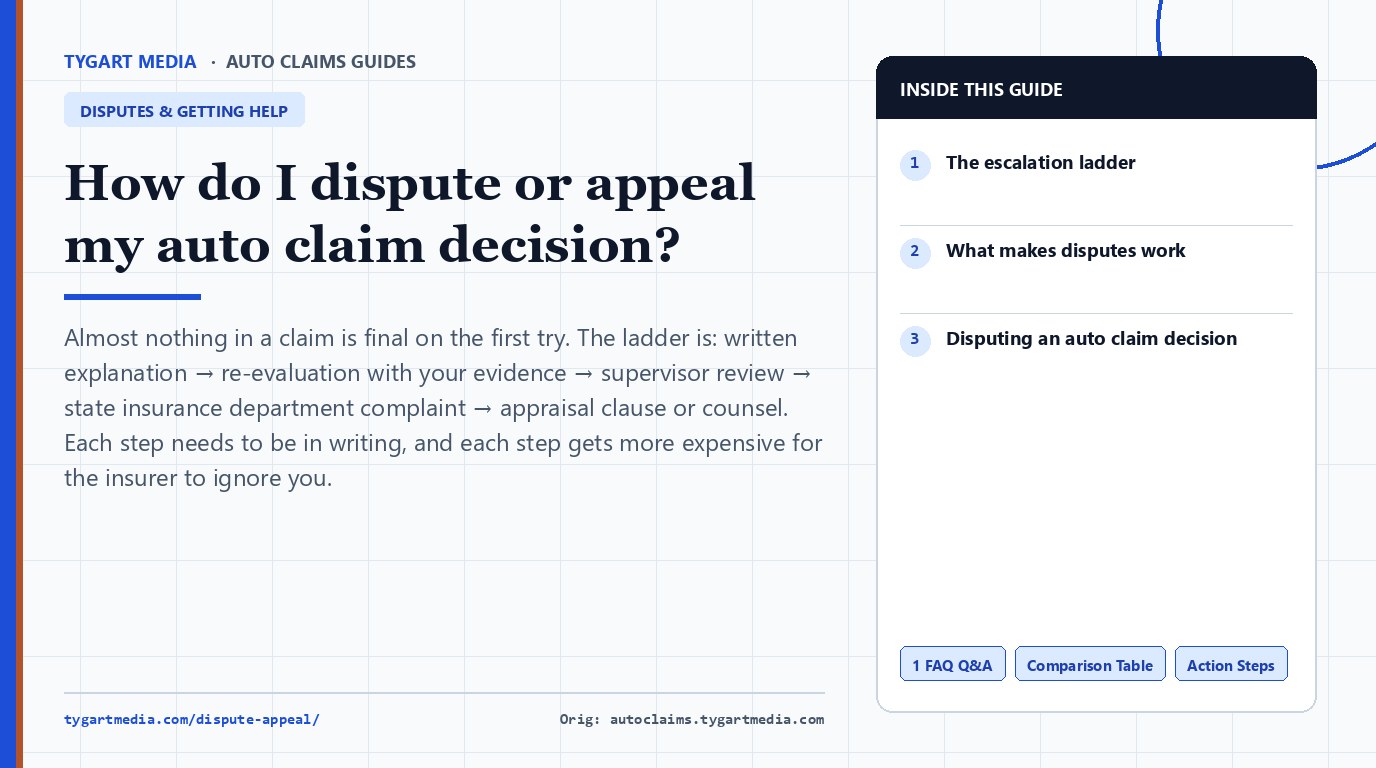
  • How do I dispute or appeal my auto claim decision?

    How do I dispute or appeal my auto claim decision?

    Tygart Media · Auto Claims Guides · Disputes & getting help

    QUICK ANSWEROriginally published at autoclaims.tygartmedia.com · Reviewed October 4, 2026
    The short answer: almost nothing in a claim is final on the first try. The ladder is: written explanation → re-evaluation with your evidence → supervisor review → state insurance department complaint → appraisal clause or counsel. Each step needs to be in writing, and each step gets more expensive for the insurer to ignore you.

    The escalation ladder

    1. Get the decision in writing, with reasons. “Denied” or “that’s our final number” is not a reason. Ask which policy provision, valuation input, or coverage applies — in an email, with a response date.
    2. Request a re-evaluation with evidence. Send your comparable listings, independent estimates, photos, or receipts with a specific counter-position. Many disputes end here.
    3. Escalate to a supervisor or the claims manager. Say so in writing: “I am escalating this file.” Supervisors have settlement authority adjusters don’t.
    4. File a complaint with your state’s insurance department. Regulators track complaints and can press insurers on unreasonable delays or denials. This costs you nothing. The walk-through is in How do I file a complaint against an insurance company?
    5. Check the appraisal clause. Many auto policies let each side hire an appraiser to settle a disagreement over the amount of loss — a structured, binding-ish path short of a lawsuit. See What is the appraisal clause in auto insurance?
    6. Talk to an attorney if the amount justifies it. When counsel pays for itself →

    What makes disputes work

    • Specificity beats outrage. “Comparable #3 has 60,000 more miles than my car and isn’t a comparable” moves files. “This is unfair” doesn’t.
    • One running written record. Dates, names, promises made and broken — regulators and appraisers read this file.
    • Reasonable asks. A documented, evidence-backed number is hard to refuse; an inflated demand is easy to dismiss.
    Important Notice
    Watch the clock Policies have deadlines for disputes, supplements, and appraisal demands — and states have statutes of limitations. A dispute that drags past a deadline can die on procedure. Note every deadline the moment you learn it.
    Disclaimer
    Informational only — not legal or insurance advice.
    Dispute options, deadlines, and complaint processes vary by state and by policy. Check your state’s insurance department guidance, or talk to a licensed professional, before acting.

    Disputing an auto claim decision

    How to dispute an auto claim decision
    StepAction
    1Get the decision + valuation report in writing
    2Gather your counter-evidence (comps, records, photos)
    3Dispute in writing to the adjuster + supervisor
    4Invoke the policy’s appraisal clause if it’s a value fight
    5DOI complaint or attorney for bad-faith patterns
    Next Step & Source Attribution
    Continue navigating Auto Claims Guides
    Source: Originally published at https://autoclaims.tygartmedia.com/dispute-appeal/ · Author: William Tygart, Tygart Media · Last reviewed October 4, 2026.