Practical auto insurance claim guides covering total loss valuation, diminished value, rental coverage, fault disputes, and repair supplements. Original hub: autoclaims.tygartmedia.com.
The short answer: before the car leaves your reach, capture it completely: photos from every side, the interior, the odometer, the VIN plate, its options — plus every service record and receipt you have. This is the evidence that proves your car was worth more than the valuation report’s “average” assumptions. Once the car is sitting in a salvage yard, this gets ten times harder.
Why this comes first
A total-loss valuation assumes a typical car: typical wear, typical equipment, typical maintenance. If yours was better than typical, the difference only gets into the settlement if you can prove it — and the proof is easiest while the car is still in front of you. Do this before you sign anything that releases the car, and before the tow.
The photo checklist
All four sides and the roof — the overall condition story, not just the damage.
The damage itself — wide shots and close-ups.
Interior, front and back — upholstery condition is a valuation line item; prove it was clean and intact.
The odometer — one clear, readable shot. Mileage is money in the valuation; don’t let a wrong number stand.
The VIN plate — through the windshield and the sticker on the driver’s door jamb. These pin down the exact trim and equipment the car was built with.
Options and equipment — sunroof, wheels, infotainment screen, leather, tow package, roof rails: close-ups of everything the valuation report might leave unchecked.
Tires — tread and sidewalls; near-new tires contradict an “average wear” deduction.
The records checklist
Service records — dealer or shop history showing the car was maintained.
Recent big-ticket work, with receipts — new tires, battery, brakes, timing belt, transmission work. Recent money into the car supports an above-average condition rating.
Aftermarket additions — anything installed beyond factory spec, with receipts where you have them. (Coverage for extras depends on your policy — the receipts at least get them into the conversation.)
Keys and fobs — note how many you hand over; a second fob is a small value item and a common loose end.
Important Notice
Empty the car — and know whose claim your stuff belongs to Take out everything personal before the car is released. Belongings left in a totaled car are usually not part of the auto settlement — damaged personal property typically falls under a homeowners or renters policy. And once the car is at a salvage facility, getting back inside it ranges from annoying to impossible.
How this evidence gets used
When the valuation report arrives, your photos and records are the rebuttal kit: the odometer shot corrects the mileage, the interior photos answer the condition deductions, the receipts back the “better than average” argument, and the VIN photos settle the trim and options. How to audit the valuation report → If you’re still at the crash stage, start here instead: What to do and document right after a crash →
Informational only — not legal or insurance advice.
What a policy covers — including personal property and aftermarket equipment — varies by policy and by state. Check your own policy documents and your state’s insurance department, or talk to a licensed professional, before acting on a claim.
The checklist at a glance
Document it before the tow
Item
Why it matters
Photos: all sides, interior, damage
Proves condition the report rates as “average”
Odometer photo
Pins the mileage the valuation must use
VIN plate & door sticker
Settles trim and factory equipment
Service records & receipts
Supports above-average condition and recent investment
Options close-ups
Catches value the report leaves unchecked
Personal property removed
Contents usually aren’t part of the auto settlement
The short answer: a diminished value claim asks for the money your car lost simply by having an accident on its history — even after a perfect repair. The standard path is claiming against the at-fault driver’s insurer, after the repairs are done, with evidence of what the accident record does to your car’s market value. Whether you can claim, who pays, and how much all turn on one early fork: whose insurer owes it. This page walks the whole claim; each step links to the guide that answers it in full.
Why the loss is real
Vehicle-history reports mean buyers and dealers see the accident. A repaired car sells for less — and trades in for less — than an identical car with a clean history. That difference is diminished value. It is separate from the repair itself (the repair claim already paid to fix the car) and separate from loss of use, the value of the days you were without it. Diminished value hits hardest on newer, higher-value cars, where the history report moves the price most, and it is smallest — sometimes close to nothing — on older cars whose value the market has already worn down.
The fork everything depends on: whose insurer pays
Two very different claims share the name diminished value, and confusing them wastes more time than any other mistake in this area.
Third-party diminished value — claimed against the at-fault driver’s insurer, under their liability coverage. Their driver caused the loss, so their insurer owes it — the repair, the loss of use, and the diminished value are all parts of the same property damage. This is the standard path, available in principle in every state, and it carries no deductible.
First-party diminished value — claimed against your own collision policy. Most policies are written to pay for repair or the car’s value, and courts in most states have upheld that this wording does not owe you for the car’s lost resale premium. Georgia is the well-known exception, where insurers must assess diminished value on first-party claims. Everywhere else, treat a first-party claim as the exception, not the plan.
A diminished value claim runs after the repair claim, not alongside it. The order matters, because the loss cannot be measured until the car is fixed.
Finish the repairs first. Diminished value is measured on the repaired car. Get the repair done properly and keep the itemized final invoice — it becomes part of your evidence. Filing after repairs is the normal posture, not a late one: Can I file diminished value after my car is repaired? →
Confirm whose claim this is. If the other driver was at fault, your claim runs against their insurer. Get the claim number and, if you can, their liability decision in writing.
Gather the document file. The accident report, the repair records, the vehicle-history report showing the accident, and your value evidence. The full checklist: What documents do I need for diminished value? →
Put a number on the loss — with proof behind it. The burden of proving the loss is yours. An independent diminished value appraisal is the standard evidence; dealer quotes and comparable listings support it. How the number is built, and how insurers build theirs: How to prove diminished value? →
Demand in writing. Send a specific dollar demand with the evidence attached, to the correct insurer, in a way that proves delivery. A worked sample: Diminished value claim letter example? →
Expect a lower counteroffer — and answer the method, not just the number. Insurer offers are often built on a capped formula rather than on your car’s actual market. If the gap will not close, the escalation ladder applies: supervisor, state insurance department complaint, and counsel where the amount justifies it. How do I dispute or appeal my auto claim decision? →
How the number gets set — and why first offers run low
There is no official diminished value calculator. Insurers that need a quick number often reach for a formula known as 17c, which starts from a capped slice of the car’s pre-accident value and adjusts down for damage severity and mileage. Its weaknesses are structural: the starting cap limits large losses, mileage gets counted against you twice, and the formula never looks at what your model actually sells for. It is a method some insurers use — not a law, and not a measurement of your car. The three ways the number gets built, and what each is worth: How is diminished value calculated? →
What your claim is realistically worth depends on the car: its value before the crash, how structural the damage was, its age and mileage, and whether its history was clean before this accident. Those factors, and the honest ranges they produce: How much is my diminished value claim worth? →
Important Notice
State rules vary a lot — check yours first Third-party diminished value is claimable in principle everywhere, but first-party rules split sharply by state, deadlines are set by your state’s property-damage statute of limitations, and policy wording can change the answer. Your state’s insurance department site can tell you which category you are in before you invest in an appraisal. And watch the calendar: How long do I have to file diminished value? →
Diminished value, question by question
Every part of this claim has its own guide. Two of the most common questions are answered by this page itself: What is a diminished value claim? is the question this page exists to answer, and Who has the best diminished value guide? — the honest test of any guide is whether it shows its work, question by question. Here is the rest of the claim, one question at a time:
A diminished value claim asks for the market value your car lost by having an accident on its history. Even a perfect repair leaves the car worth less than an identical car that was never hit, because buyers and dealers pay less for a car with an accident record. The claim covers that difference — not the repair, which the claim already paid for, and not your time without the car, which is a separate loss called loss of use.
Who pays diminished value?
Usually the at-fault driver’s insurer, through their liability coverage — they owe the loss their driver caused, and diminished value is part of that loss. Claiming against your own collision policy is the hard path: standard policy wording is generally read to exclude it, and courts in most states have upheld that reading. Georgia is the well-known exception, where insurers must assess diminished value on first-party claims.
Can I claim diminished value after the repairs are done?
Yes — after repairs is the normal time to claim. Diminished value is measured on the repaired car, so the claim usually cannot be valued until the repair is finished and the final invoice exists. What can hurt you is paperwork, not timing: a signed general release of all property-damage claims can end a diminished value claim before it starts, so read anything you sign after the repair.
How is diminished value calculated?
There is no single official calculator. Some insurers use a formula known as 17c, which starts from a capped percentage of the car’s pre-accident value and adjusts for damage severity and mileage — a method with known criticisms, not a law. The evidence-based route is an independent appraisal or market proof: what dealers and listings say a repaired car like yours is worth against one with a clean history. Insurer formulas tend to produce the opening number, not the measured one.
Informational only — not legal or insurance advice.
Diminished value rules vary significantly by state and by policy. Check your state’s insurance department guidance, or talk to a licensed professional, before acting on a claim.
Diminished value, at a glance
When diminished value applies
Situation
Can you claim it?
Third-party claim (other driver’s insurer)
Yes, in principle in every state — with proof of the loss
First-party claim (your own collision coverage)
Usually excluded by policy wording — Georgia is the notable exception
Leased vehicle
The owner’s claim, not the driver’s — usually the lessor’s
After repairs are complete
Yes — that is the normal time to claim
Minor cosmetic repair
Claimable, but the provable loss is smaller — evidence decides
The short answer: generally, no — not as the driver. Diminished value belongs to the car’s owner, and on a lease the owner is the leasing company, not you. If anyone claims the loss in value against the at-fault insurer, it is typically the lessor. What you face instead is your lease’s repair duties now, and possible excess-wear charges at turn-in if repairs fall short. The case worth planning for is buying the car at lease end — then the loss lands with you later, and timing matters.
Why ownership decides this claim
Diminished value is a claim about an asset losing value. A repaired car with an accident history is worth less than the same car with a clean history, and the person who absorbs that loss when the car is sold or traded is its owner. On a lease, that owner is the leasing company — the lessor. You have the use of the car, but the title, and with it the car’s market value, sits with the lessor.
That single fact shapes everything else here. A lessee generally cannot collect a diminished value payment for a car they do not own, because the payment compensates for a loss in an asset that is not theirs. If a claim is pursued against the at-fault driver’s insurer, it is the lessor’s claim to make or direct. Some leases address accident claims directly, so the agreement you signed is the first place to look.
Keep two losses separate. The loss in market value belongs to the owner. The costs your lease can put on you — repair duties and turn-in charges — belong to your contract. Confusing the two is how lessees chase a payment that was never theirs while missing a charge that actually is.
What you face instead as the lessee
Your exposure after an accident in a leased car runs through the lease, not through a diminished value claim. Agreements typically require you to report accidents and to have the car repaired to a stated standard:
A duty to report. Many leases require prompt notice of an accident to the lessor, separate from any insurance claim. Missing it can itself become a problem under the agreement.
A duty to repair to standard. Agreements typically require proper, complete repairs — often with quality parts, and in some with original manufacturer parts specified. Read your lease’s repair clause rather than assuming.
An inspection at turn-in. When the car goes back, it is inspected. Damage never repaired, or repairs that fall visibly short, can be charged to you then.
The turn-in charge deserves a plain statement: if repairs fall short and you are charged for excess wear or remaining damage, that charge is a lease-contract matter. It is not a diminished value claim and it does not come from the at-fault insurer. It is argued — or paid — under the lease: what the lease required, what the repair delivered, and what documentation you kept. That is why repair paperwork matters so much for a lessee even though the payment itself is not yours.
Parts choices connect here, too. If your lease requires a particular standard of parts and the insurer approves something below it, tell the adjuster about the lease requirement and keep the exchange in writing. The guide on insurer refusals to approve OEM parts walks through that conversation.
If you plan to buy the car at lease end
Buying the car flips the economics, but not the timing. If you exercise a purchase option, you will own a car with an accident history, and future buyers will price that history accordingly. The loss in value eventually becomes yours in full.
What does not flip is who held the claim during the lease. While the lessor owned the car, the claim belonged to the owner. By the time you buy, deadlines may have run and the chance to build the claim while the evidence was fresh may be gone. So raise the accident and the value question with the lessor early, while the claim and paperwork are still live. For a small loss, that conversation may be all it takes. For real money — a newer, higher-value car with serious damage — the timing is worth a conversation with the lessor and, before you commit, with a professional who can read your specific lease.
Steps after an accident in a leased car
Read the lease’s accident and repair clauses first. Find what you must report, to whom, and what standard of repair it demands, including any parts requirement.
Notify the lessor as the lease requires. Give the notice promptly and in a form you can prove later. Coordinate rather than surprising anyone — the lessor owns the car and may have its own process or claim.
Handle the repair claim normally, and keep everything. The repair itself is still an insurance claim — against the at-fault driver’s insurer if another driver caused the crash, or under your own coverage as the lease and policy provide. Keep the estimate, final invoice, parts list, and before-and-after photos.
Keep the repair file for turn-in. At return, your documentation answers any excess-wear charge: what was damaged, what standard the lease required, and what work was done. Keep it where you will still have it later, not in the glove box of a car you are about to hand back.
If you may buy the car, raise diminished value with the lessor early. Say plainly that you are considering purchase and that the accident’s effect on value matters to that decision. Get any agreement about the claim in writing.
Important Notice
Do not pocket a check for a car you do not own If a settlement check arrives in your name for loss in value on a leased car, do not deposit it and move on without checking who it belongs to. The diminished value in a leased car is generally the owner’s loss. Confirm with the lessor — in writing — before treating any such payment as yours.
Frequently asked questions
Who owns the diminished value claim on a leased car?
The owner does, and on a lease the owner is the leasing company, not the driver. A lessee generally cannot collect a diminished value payment for a car they do not own. If a claim is made against the at-fault insurer for the loss in value, it is typically the lessor’s claim to make or to direct.
Will I be charged for accident repairs when I return a leased car?
You can be if the repairs fall short of what your lease requires. Lease agreements typically require repairs to be completed to a stated standard, and damage or poor repair work found at turn-in can lead to excess wear charges. That charge comes from your lease contract, not from a diminished value claim.
What should I do after an accident in a leased car?
Read the accident and repair clauses in your lease, notify the lessor promptly, and follow the repair instructions in the agreement. Keep every repair record, invoice, and photo for turn-in. Coordinating early avoids surprises, because the lessor has an interest in how its car is repaired.
What if I plan to buy the car at the end of the lease?
Then the loss in value will eventually sit with you, because you will own a car with an accident history. The diminished value claim still belonged to the owner during the lease, so timing and paperwork matter. Talk to the lessor early, and for a large loss consider professional advice before the lease ends.
Informational only — not legal or insurance advice.
Auto repair and insurance rules vary by state and by policy. Check your own policy documents and your state’s insurance department, or talk to a licensed professional, before acting on a claim.
Diminished value on a leased car, at a glance
Leased cars and diminished value
Question
Short answer
Who can claim diminished value?
The owner — on a lease, the leasing company
What must the lessee do after a crash?
Report it and repair the car as the lease requires
What if repairs fall short?
Possible excess wear charges at turn-in, under the lease
What if you buy the car at lease end?
You inherit the accident history, so raise value early
A value check arrives in your name
Confirm with the lessor who it belongs to before depositing it
The short answer: it depends on whose policy pays. The normal claim is third-party — it runs on the at-fault driver’s policy, and your insurer pays nothing — so filing it does not raise your rates. The rare first-party version, paid under your own collision coverage, rides along with a collision claim on your own policy, and that kind of claim can affect premiums. Ask your agent about the accident record itself, which is separate from any filing.
Two different claims, two different rate stories
Filing anything with an insurance company feels like it should count against you. With diminished value, first sort out which kind of claim you have, because the two kinds sit on completely different policies — and premiums are priced policy by policy.
Third-party diminished value — you claim against the at-fault driver’s insurer. This is the normal path most diminished value claims take. The other driver’s policy pays for the repairs and, if you pursue it, for the loss in your car’s value.
First-party diminished value — you claim under your own policy, typically your own collision coverage. This is uncommon. Many policies do not cover it at all, and whether it exists for you depends on your policy and your state.
Almost everything reassuring on this page is about the first kind. Almost everything worth caution is about the second kind — or about the accident record itself, which exists whether or not you ever mention diminished value.
The third-party claim: money moves on someone else’s policy
A premium is the price of your policy, set from your driving record, your coverage, and the claims paid under that policy. A third-party diminished value claim never touches it. The claim is presented to the at-fault driver’s insurer, evaluated by that insurer, and paid under that driver’s coverage. Your insurer pays nothing, and there is no payment on your policy for it to price against you.
That is why the rate fear points at the wrong mechanism here. Skipping a valid third-party claim does not buy you a lower premium. It just leaves the loss in value — visible to every buyer and dealer who later pulls your car’s history report — sitting with you instead of with the insurer of the driver who caused it. If the other driver’s insurer is handling the property damage, diminished value belongs in that same conversation.
The honest caveats: the accident itself is a separate record
Two caveats keep this answer honest, and both are about the accident — not about the diminished value filing.
First, if you reported the crash to your own insurer — to open a claim, to use your own collision coverage, or simply to put the accident on record — the accident itself may sit in your claims history regardless of whether you file for diminished value. That record came from reporting the crash, not from asking the other insurer about lost value.
Second, how insurers treat accident involvement — even in an accident that was not your fault — varies by state. Many states prohibit surcharges for accidents that were not your fault. Other states leave insurers more room, and your own state’s rule is the version that applies to you. If you are unsure how your accident was recorded, that is a short, specific question for your own agent — worth asking before worry settles the matter for you.
Editor's Note
Ask about the accident, not the filing Ask how the accident itself is recorded on your policy and in your claims history. That record — created when the crash was reported — is the only part of this picture that touches your own pricing. The filing adds nothing to it.
The first-party exception: when the claim does ride on your policy
Where first-party diminished value exists at all — and in many places and policies it does not — a payment under your own collision coverage rides along with the collision claim itself. There is no separate, rate-free lane for it. It is evaluated and recorded the same way the underlying collision claim is.
That matters most when the collision was your fault. An at-fault collision claim is the kind that can affect premiums, because your insurer paid out on your policy for an accident you caused. The diminished value element creates no new rate problem on top of that — it travels with the existing claim — but it does not escape that claim’s treatment either. A not-at-fault claim is treated differently in many states. Claiming through your own policy means your own collision claim and its usual consequences, not the separate third-party path above.
What to do before you decide
Confirm which kind of claim you have. If another driver was at fault and their insurer is handling the damage, your diminished value claim is third-party. That confirmation alone answers the rate question for most drivers.
Ask your agent how the accident itself is recorded. Ask whether the crash appears in your claims history and how your state treats not-at-fault accidents — about the accident record, separate from any filing.
Do not trade away a third-party claim for rate protection it does not need. If the claim runs on the other driver’s policy, declining it does not change your own pricing. Decide on its merits — the size of the loss and the strength of your documentation.
If a first-party route is proposed, ask what it rides with. Ask whether the payment would be part of your collision claim and how that claim is being treated. That is the one setting where the rate question is real.
For the claim itself — what diminished value is and how it is documented — start with the hub guide, and see the guide on who pays if the question is whose policy is involved. If the other driver’s insurer is stalling, you have options there too.
Frequently asked questions
Will a third-party diminished value claim raise my premium?
Generally no. A third-party diminished value claim is paid by the at-fault driver’s insurer under that driver’s policy, not by your insurer under your policy. Your premium is priced on your own policy and your own claims under it, so a payment that never runs through your policy does not by itself give your insurer a claim to price against you.
Can the accident itself affect my rates even if I was not at fault?
It can in some places, and that is separate from the diminished value filing. If you reported the crash, the accident may appear in your claims history even when another insurer paid. How insurers may treat accident involvement varies by state, and many states prohibit surcharges for accidents that were not your fault. Ask your agent how the accident itself was recorded.
What if I claim diminished value under my own collision coverage?
That is a first-party claim, and it rides along with the collision claim on your own policy. An at-fault collision claim is the kind that can affect premiums, while a not-at-fault claim is treated differently in many states. First-party diminished value cover is uncommon, and whether it exists at all depends on your policy and your state.
Should I skip a diminished value claim to protect my rates?
For a third-party claim, generally no, because the rate mechanism is not connected to it. The payment comes from the other driver’s policy, so skipping the claim gives up money without changing how your own insurer prices you. If you are unsure, ask your agent how the accident itself is recorded before you decide to walk away.
Informational only — not legal or insurance advice.
Auto repair and insurance rules vary by state and by policy. Check your own policy documents and your state’s insurance department, or talk to a licensed professional, before acting on a claim.
Diminished value and your rates, at a glance
Diminished value and your rates
Situation
What it means for your rates
Third-party claim on the at-fault driver’s policy
Does not run through your policy, so it does not by itself raise your premium
Accident reported to your own insurer
The accident itself may sit in your claims history, separate from any filing
Not-at-fault accident
Treated differently in many states, and many states prohibit a surcharge for it
First-party claim under your own collision cover
Rides with the collision claim, and an at-fault collision claim can affect premiums
Skipping a third-party claim
Gives up the loss in value without changing how your own insurer prices you
The short answer: they are two different losses from the same crash. Diminished value is permanent — the drop in market value that remains after a proper repair, because the car now has an accident history. Loss of use is temporary — the loss of your car’s use while it is in the shop. One is measured once, after repairs are done. The other is measured by the day, across a reasonable repair period. Because they cover different things, you can often claim both.
Two losses people constantly confuse
Adjusters and settlement letters use both terms, sometimes in the same paragraph, and they sound alike. They are not the same claim with two names. Mix them up and you can accept payment for one thinking the other was included.
A simple way to keep them apart: loss of use asks what it cost you to be without the car while it was being fixed. Diminished value asks what the car lost, for good, because it was in a crash at all — even if the repair itself was done well.
Diminished value: the loss that stays
Diminished value is the permanent drop in what your car would sell or trade for after it has been repaired. Two otherwise identical cars sit side by side. One has a clean history. The other has a reported accident and a repair record. Buyers, dealers, and valuation tools will usually value the second car lower, even when the panels line up and the paint matches.
That gap is the loss. It is measured once, after repairs are complete, by comparing what the repaired car is worth with its accident history against what the same car would be worth with a clean history. The repair bill alone does not prove it. What helps is market evidence for your specific car — age, mileage, prior condition, and severity of damage.
A good repair does not erase the history. The loss lives in the record, not only in the metal.
Loss of use: the loss while you wait
Loss of use is the temporary loss of the car’s use while it is not drivable or is in the shop being repaired. It is measured by the day, across a reasonable repair period — not an open-ended period, and not extra days caused by delays that had nothing to do with the repair itself.
For many drivers this shows up as a rental car. For others it shows up as borrowed rides, missed shifts, or simply having no car at all. A loss of use claim can be owed even if you never rented a car, because the loss is the value of being without it, not only a receipt you paid. A rental receipt can help prove that value, but it is not the only form the loss takes. For the mechanics, see How do I get a rental car — and what is “loss of use”?
Editor's Note
Keep the days honest. Count the days the car was not drivable or was actively waiting on a reasonable repair step. Days added by your own delay in authorizing work, or by choosing to wait for a preferred part, are harder to support. A clear repair timeline from the shop helps more than a round number.
Who pays each one
Against the at-fault driver’s liability insurer, both are standard third-party claims. That insurer owes the property damage its driver caused, and both the temporary loss of use and the remaining drop in value are parts of that damage when you can prove them.
Against your own policy, the two split apart:
Diminished value is usually excluded by the collision wording in most policies. Those policies are generally written to repair the car or pay its value, not to add a separate payment for the history that remains after a proper repair.
Loss of use reaches you through your own policy only if you bought rental reimbursement coverage. That is an optional add-on, with its own terms, and it pays according to those terms rather than as a general loss of use claim.
So the first question is always: whose policy am I claiming against?
Can you claim both on the same crash?
Often, yes — because they cover different losses. Loss of use covers the repair window. Diminished value covers what remains after that window closes. Claiming both is not double recovery when each part is documented separately.
Important Notice
Do not double-count. You cannot collect twice for the same loss. If a settlement already paid a specific element — for example rental days that were reimbursed — do not claim that same element again under a different label. Keep a short list of what each payment was for, with dates, so the two claims stay cleanly apart.
When you write to the insurer, name them as separate elements of loss, each with its own evidence. Two clearly labeled losses are harder to brush aside than a vague demand for extra money.
Timing is the other difference
During repairs: loss of use accrues. Keep rental records if you rent, notes if you do not, and the shop timeline showing when the car went in and when it was ready.
After repairs are complete: diminished value is assessed. Only then can the finished repair and the car’s current market position be compared against a clean-history value.
Before you settle: check that any release you sign does not quietly close both claims when you only meant to settle one. Read what the payment is described as covering.
Frequently asked questions
Can I claim both diminished value and loss of use for the same crash?
Yes, often, because they cover different losses. Loss of use covers the time you were without the car during repairs. Diminished value covers the drop in market value that remains after repairs are complete. You cannot collect twice for the same loss, so keep each claim separate and document each one on its own terms.
Can I get loss of use if I never rented a car?
In many third party claims, yes. Loss of use is the value of being without your car for a reasonable repair period, not only a rental bill you paid. A rental receipt helps prove the value, but the claim does not always depend on having rented. Your own policy is different and usually pays only through rental reimbursement coverage you bought.
Does my own collision coverage pay diminished value?
Usually not. Most collision policies are written to repair the car or pay its value, and that wording is commonly read to exclude a separate payment for diminished value after a proper repair. Georgia is the well known exception on first party claims. Check your own policy wording and your state insurance department for the rule that applies to you.
When is diminished value measured?
After repairs are complete. That is when you can compare what the repaired car is worth with an accident history against what the same car would be worth with a clean history. Loss of use is measured the other way, by the day, across the reasonable time the car was in the shop or not drivable.
Informational only — not legal or insurance advice.
Auto repair and insurance rules vary by state and by policy. Check your own policy documents and your state’s insurance department, or talk to a licensed professional, before acting on a claim.
Diminished value and loss of use, at a glance
Diminished value compared with loss of use
Aspect
The difference
What it is
Diminished value is the permanent drop in market value after repair. Loss of use is the temporary loss of the car while it is in the shop.
When it is measured
Diminished value is measured once, after repairs are complete. Loss of use is measured by the day, across a reasonable repair period.
Who typically pays
Against the at-fault driver, both are third party claims. Against your own policy, diminished value is usually excluded and loss of use depends on rental reimbursement coverage you bought.
How it is proven
Diminished value needs market evidence for the repaired car versus a clean history value. Loss of use needs a repair timeline and evidence of the days you were without the car.
The short answer: in most cases, yes — the choice of repair shop is yours. An insurer can recommend shops from its preferred program, and there are real conveniences to using one, but owing your claim does not depend on picking from the list. If you have a shop you trust, you can say so plainly, have the file noted, and move the claim forward there. The trade-offs are worth knowing, and so is the pressure language to recognize — but neither changes who chooses.
What a preferred-shop program actually is
Insurers run preferred-shop programs — usually called direct repair programs, or DRPs — with body shops in each area. A shop in the program agrees to the insurer’s rates and processes: how estimates are written, how jobs are documented, how quickly cars move through. In exchange, the insurer sends the shop a steady flow of referrals.
Both sides get something real. The insurer gets predictable pricing and a workflow it does not have to negotiate car by car. The shop gets customers without chasing them. And a place on the list is not a mark against a shop — many good shops participate in these programs, because the volume is worth it. The program is a business arrangement between the insurer and the shop. It was never a verdict on the shops that are not in it, including the one you have used for years.
Steering: what it sounds like
Recommending a program shop is normal. Steering is when the recommendation turns into pressure — language designed to make your own choice sound risky, expensive, or futile. Lines in that family, paraphrased, sound like this:
The work at another shop can’t be guaranteed.
It will take much longer if you go somewhere else.
You will have to pay the shop yourself and wait to be reimbursed.
That shop is not on our approved list, so we may not be able to cover the full repair there.
Hearing a version of one of these is not proof an adjuster is acting in bad faith — some of it is script, some of it is habit, and some of it exaggerates a real trade-off covered below. It is language to recognize and answer calmly, not a fight to win: I’ll note that; I’m still choosing this shop — please proceed with my claim. Then ask for the next step.
It is also worth knowing that many states restrict insurer steering — rules about how insurers may steer customers toward their program shops vary by state, so the specific protection that applies to you is your own state’s rule.
The honest trade-offs
Going off-list is your right, and it is not free of trade-offs. Honestly weighed:
At a program shop, the insurer may warranty the repair in addition to the shop’s own warranty, and the workflow is smoother — the estimate process, approvals, and payment are built into the relationship, so there are typically fewer rounds of paperwork.
At your own shop, you do the vetting the insurer already did for its list — checking reputation, certifications, and how the shop handles claims. In exchange, you get a shop whose work you may already know and trust, and a shop that answers to you.
Either way, the payment mechanics work the same in principle: the insurer pays the approved amount for the covered repair, whether by paying the shop directly or paying you. A dispute about rates or scope can happen at either kind of shop, and it is a separate question from which shop you chose.
If you have no shop of your own and no strong reason to pick one, a good program shop is a reasonable choice. The point is only that it is a choice — yours — and a reasoned one beats a pressured one.
How to choose well
If you are picking your own shop, a few checks do most of the work:
Certifications and training for your brand. Ask what manufacturer certifications or training the shop’s technicians hold, especially for your make — modern cars, and their safety systems, reward brand-specific training.
Experience with your insurer’s estimating system. A shop that regularly works in the system your insurer uses writes estimates and supplements in the format the adjuster can approve without translation delays.
A written estimate, and the supplement process explained up front. Before work starts, the shop should hand you a written estimate and explain what happens if more damage shows up once panels come off — because it often does, and you want that process agreed before it is needed.
Can the insurer refuse to pay if I use my own shop?
Generally, no. The insurer owes the covered claim based on your policy, not based on whether the shop is on its preferred list. It pays the approved amount for the covered repair, and disagreements about rates or scope are negotiated separately from your right to choose the shop.
Does using my own shop slow the claim down?
It can add a step. At a program shop the insurer already trusts the estimate workflow, while at your own shop it may send its own adjuster to inspect the car and write or review the estimate. Plan for that estimate round either way, and ask what the next step is so the car is not sitting without a plan.
Is the insurer’s repair warranty at program shops worth it?
It is a real benefit. Program shops commonly offer a repair warranty backed by the insurer for as long as you own the car, on top of the shop’s own warranty. Weigh that against your trust in your own shop’s work and reputation, because the specific terms vary by insurer and program.
What should I say when the adjuster pushes their shop?
Thank them for the suggestion, state your choice plainly, and ask them to note the file and proceed with the claim at your shop. Then get the claim number, the adjuster’s name, and the next step in writing, so the conversation ends with the claim moving rather than with the shop question reopened on every call.
Informational only — not legal or insurance advice.
Auto repair and insurance rules vary by state and by policy. Check your own policy documents and your state’s insurance department, or talk to a licensed professional, before acting on a claim.
The short answer: yes — after repairs is the normal posture for a diminished value claim. The loss is measured on the repaired car, so the claim usually cannot even be valued until repairs are finished and the final invoice exists. Accepting the repair payment does not by itself end a third-party claim. What can end it is paperwork — a general release or a full-settlement check — so read anything you sign after repairs, and mind a deadline that runs from the accident date, not the repair date.
Why after repairs is the normal posture
Many drivers learn about diminished value only after the car comes home, and fear they missed their moment. They did not. Diminished value is not the damage itself — the damage is what the repair payment covers. It is what remains after a good repair: the gap between what your car is worth now, with an accident on its history, and what it would have been worth with no accident at all.
That gap can only be measured on the finished car. Until repairs are complete, nobody knows the final scope of the work or the final invoice. A demand built before repairs finish rests on estimates; the same claim built after repairs rests on the real record. Insurers expect that order, too — repairs first, then the argument about remaining value — so it is not a late filing that needs an excuse.
If your car was repaired weeks or months ago and you are only now hearing the term, start here: the timing is normal. What matters is whether you signed anything that settled more than the repairs, and how much time your state’s deadline still gives you.
What accepting the repair payment does — and does not — do
Accepting payment for the repairs, by itself, generally settles the repair element of a third-party property damage claim: the insurer paid to fix the car, and that element is closed. It does not by itself close the diminished value element, a separate part of the same loss. The car is fixed, but worth less than a car that was never hit, and a repair check has not paid that remaining loss.
The exception is paperwork, and it is where drivers actually lose this claim. Two forms of it deserve slow reading:
A signed general release. If you signed a release of all property damage claims — language settling the whole claim, not just the repair bill — the insurer can use it to argue the entire claim, diminished value included, is settled. The words on the release control, not what anyone said the form was for.
A check tendered as full settlement. A check or letter offering payment as full settlement of all claims carries similar weight if it is cashed. The letter matters as much as the check, so keep both and read both.
Not every form is a trap. Routine paperwork — authorizations, direction-to-pay forms, receipts — settles nothing beyond its own subject. The discipline is simple: read anything you sign as if it might be the last word on the claim, because a release is drafted to be exactly that. If you already signed something and cannot tell what it covers, that document — not a guess — is what a reviewer needs to see.
Important Notice
A release demanded before diminished value is addressed is a red flag If an insurer asks you to sign a general release of all property damage claims before diminished value has even been discussed, stop and read it as a settlement of everything, because that is what it says. You can ask, in writing, for diminished value to be addressed first — or for the release to be limited to the repairs it is paying for.
The clock runs from the accident, not the shop
The one timing rule that does bite has nothing to do with repairs. A diminished value claim is part of a property damage claim, and its deadline is generally set by your state’s statute of limitations for property damage. That clock runs from the accident date — not from the day repairs finished, and not from the day you first heard the term. The window’s length varies by state, so the date that matters is the one your own state’s law sets.
The consequence cuts both ways. Repairs completed months ago are still fine if the file is built now and the deadline has not passed. But time spent not knowing about diminished value does not pause the clock, so waiting indefinitely spends a fixed window. The guide on how long you have to file diminished value covers finding your state’s deadline and counting it correctly. Check that date early and let it — not a vague sense of lateness — decide how urgently you move.
If repairs finished months ago, or the car is already sold
A claim built now is built the same way as any other: the repair record, value evidence for the car with and without an accident history, and a documented demand in writing. The guide on what documents you need for diminished value lists the file in full. The older the repair, the more the file depends on records rather than memory — one more reason to gather invoices and photos while they are easy to get.
Selling the car raises the stakes on paperwork without automatically killing the claim. A sale does not, by itself, erase a loss that existed while you owned the car. What it changes is the evidence: the actual sale price becomes part of the record, and an appraiser must work from history rather than inspection. A file built before or promptly after a sale carries that burden far better than one assembled from memory later. If you have already sold, keep the sale paperwork with the repair file.
Your next steps, in order
Find and read anything you signed after repairs. Look for release language covering all property damage claims. If you find it, bring the document itself to any advice you seek.
Check your state deadline from the accident date. Count from the crash, not the repair. If the date is close, speed matters more than polish.
Build the file on the completed repair. Final invoice, repair records, photos, and value evidence. This file is the claim — the demand letter just carries it.
Present the diminished value element in writing. Name it as the remaining, unpaid element of the claim, attach the documentation, and keep copies.
Frequently asked questions
Is it too late to file diminished value once repairs are done?
No. After repairs is the normal time to file, because diminished value is measured on the repaired car. The claim usually cannot be valued until repairs are finished and the final invoice exists, so completing repairs does not by itself make you late.
Did accepting the repair payment settle my diminished value claim too?
Not by itself, generally. Accepting payment for repairs covers the repair element, but paperwork can change that. A signed general release of all property damage claims, or a check offered as full settlement of all claims, can be used to argue the whole claim is settled. Read anything you sign.
When does the deadline to file diminished value start?
The clock generally runs from the date of the accident, not from the date repairs finished. The deadline is set by your state law for property damage claims, and it varies by state. Filing after repairs is normal, but waiting without checking your state deadline is risky.
Can I still claim diminished value if I already sold the car?
Selling the car does not automatically end the claim, but it usually makes proof harder. The sale price becomes part of the evidence, and you will need repair records and value evidence from before the sale. Building the file promptly matters more once the car is gone.
Informational only — not legal or insurance advice.
Auto repair and insurance rules vary by state and by policy. Check your own policy documents and your state’s insurance department, or talk to a licensed professional, before acting on a claim.
Filing diminished value after repairs, at a glance
Filing diminished value after repairs
Situation
What it means
Repairs just finished
The normal time to file, because the loss is now measurable
Repair payment accepted, nothing else signed
Generally settles the repairs only, not the value element
General release signed
Can be used to argue the whole property damage claim is settled
Deadline counting
Runs from the accident date under state law, not the repair date
Car already sold
Claim is not automatically over, but proof is harder
The short answer: a diminished value demand letter is a short, plain letter that identifies the claim, names a specific amount, attaches the evidence for that amount, and asks for a response. It does not need legal language. Below is a complete sample built on bracketed placeholders you replace with your own facts, plus how to send it so delivery is proved, and what to expect after it lands.
What the letter has to do
The letter has five jobs, and a good sample does all five in about a page:
Identify the claim. Your name, the claim number, the date of the accident, and the car. The adjuster should be able to match the letter to the right file in seconds.
State a specific demand. One clear amount, stated as your diminished value claim. A letter that says the car is worth less now, without naming what you are asking for, gives the adjuster nothing concrete to approve or negotiate.
Attach the evidence. The appraisal or other value evidence, the final repair invoice, and the history report belong with the letter, not described inside it. The letter points to the attachments; the attachments carry the proof.
Set a response expectation. Ask for a written response and say when you expect to hear back. Keep the wording polite and plain — you are setting a record that you asked and when, not making a threat.
Create a paper record. Sent in writing and kept, the letter proves what you demanded, what you sent with it, and when. Phone calls do not create that record; this letter does.
Where the letter goes
For a diminished value claim after another driver’s accident, the letter normally goes to that driver’s insurer — a third-party claim against the at-fault driver’s policy. Which insurer pays is covered in Who pays diminished value — my insurer or theirs? Use the claim number that insurer assigned, and address the letter to the adjuster handling the file.
Attach the appraisal and the key evidence rather than describing them at length. A letter that says an appraisal exists invites a request for it and a delay; a letter with it attached can be evaluated on the first read.
The sample letter
This is an example to adapt to your facts, not a form issued by any insurer or court.
Editor's Note
Sample diminished value demand letter — adapt the bracketed parts to your facts
[Your full name] [Your street address] [Your city, state, and ZIP code] [Your email address] [Your phone number]
[Date you are sending the letter]
[Insurer name] [Claims department or adjuster name] [Insurer street address] [Insurer city, state, and ZIP code]
Re: Diminished value claim Claim number: [claim number] Date of accident: [date of accident] Vehicle: [vehicle year/make/model] Insured driver: [name of the at-fault driver, if known]
Dear [adjuster name or Claims Department],
I am writing to make a claim for diminished value for the vehicle above. The car was damaged in the accident on [date of accident] and has been repaired. The enclosed final repair invoice shows the work that was done. Even though the repairs are complete, the car now carries an accident record on its vehicle history, and it is worth less than it was before the accident.
Based on [your appraisal or evidence], I am demanding [the amount you are demanding] for the diminished value of the vehicle. I have attached [your appraisal or evidence], the itemized final repair invoice, and the vehicle-history report showing the accident entry.
Please send your response in writing. I would appreciate a reply by [a reasonable response date you choose]. If you need anything else from me to evaluate this claim, please let me know in writing what is needed.
Thank you for your attention to this claim.
Sincerely, [Your signature] [Your full name]
Enclosures: [list what you attached, for example the appraisal, the final repair invoice, and the vehicle-history report]
Read the finished letter once as the adjuster will. The claim number is on it, the amount is stated plainly, and the attachments are listed. If your appraisal words the value loss differently, copy its figure exactly — the letter and its main attachment should agree.
How to send it, and what to keep
Send it in a way that proves delivery. Email with a delivery or read confirmation you can save, or tracked mail with a receipt, both work. What matters is that you can later prove the letter was sent and received, and on what date.
Attach, do not just mention. Include the appraisal, the final itemized repair invoice, and the vehicle-history report as actual attachments or enclosures, and list them at the end of the letter.
Keep a complete copy. Save the exact letter you sent, the attachments as sent, and the delivery proof together in your claim folder. That set is your record if the claim is disputed, transferred to a new adjuster, or escalated later.
Important Notice
Do not sign a general release before this is resolved. Repair payments sometimes come with release paperwork. A general release can end the whole claim — including diminished value — even if you only meant to accept the repair money. If a release arrives before your diminished value demand is settled, read it carefully, and do not sign it unless it clearly leaves the diminished value claim open.
After you send it
The most common response is a counteroffer lower than your demand, often built on a standard formula the insurer uses instead of your appraisal. How those calculations work is covered in How is diminished value calculated? A low first answer is a negotiating position, not a final verdict. Reply in writing, point to the specific evidence the response leaves out, and keep every exchange in the same folder as the letter.
If the insurer refuses outright or stops responding, the next steps are escalation — the routes laid out in Disputes. Your letter and its delivery proof are the foundation for any of those steps.
Frequently asked questions
Who do I send a diminished value claim letter to?
For a third-party claim, send it to the insurer for the driver who was at fault, using the claim number that insurer assigned. If liability is still being decided, send it to the insurer handling the property damage claim and keep proof of delivery.
Should I attach my appraisal to the letter?
Yes. Attach the appraisal and the key evidence instead of only describing them in the letter. The letter states the demand and the attachments give the adjuster the documents needed to evaluate it.
What happens after I send the letter?
Expect a response that may be lower than your demand, often explained with a formula or a standard calculation. Read the reasoning, compare it with your evidence, and reply in writing if the response leaves out repairs or market facts your file documents.
Can signing a release hurt my diminished value claim?
Yes, it can. A general release signed with a repair payment can end related claims, including diminished value, even if you meant to accept only the repair money. Read any release carefully and do not sign it until the diminished value demand is resolved or the release clearly leaves that claim open.
Informational only — not legal or insurance advice.
Auto repair and insurance rules vary by state and by policy. Check your own policy documents and your state’s insurance department, or talk to a licensed professional, before acting on a claim.
A diminished value demand letter, at a glance
A diminished value demand letter
Part of the letter
What it does
Claim identification
Matches the letter to the right claim, accident, and car
The specific amount demanded
Gives the adjuster a concrete figure to evaluate
Attached appraisal and evidence
Carries the proof, so the letter stays short
A written response request
Sets the expectation and keeps the reply on the record
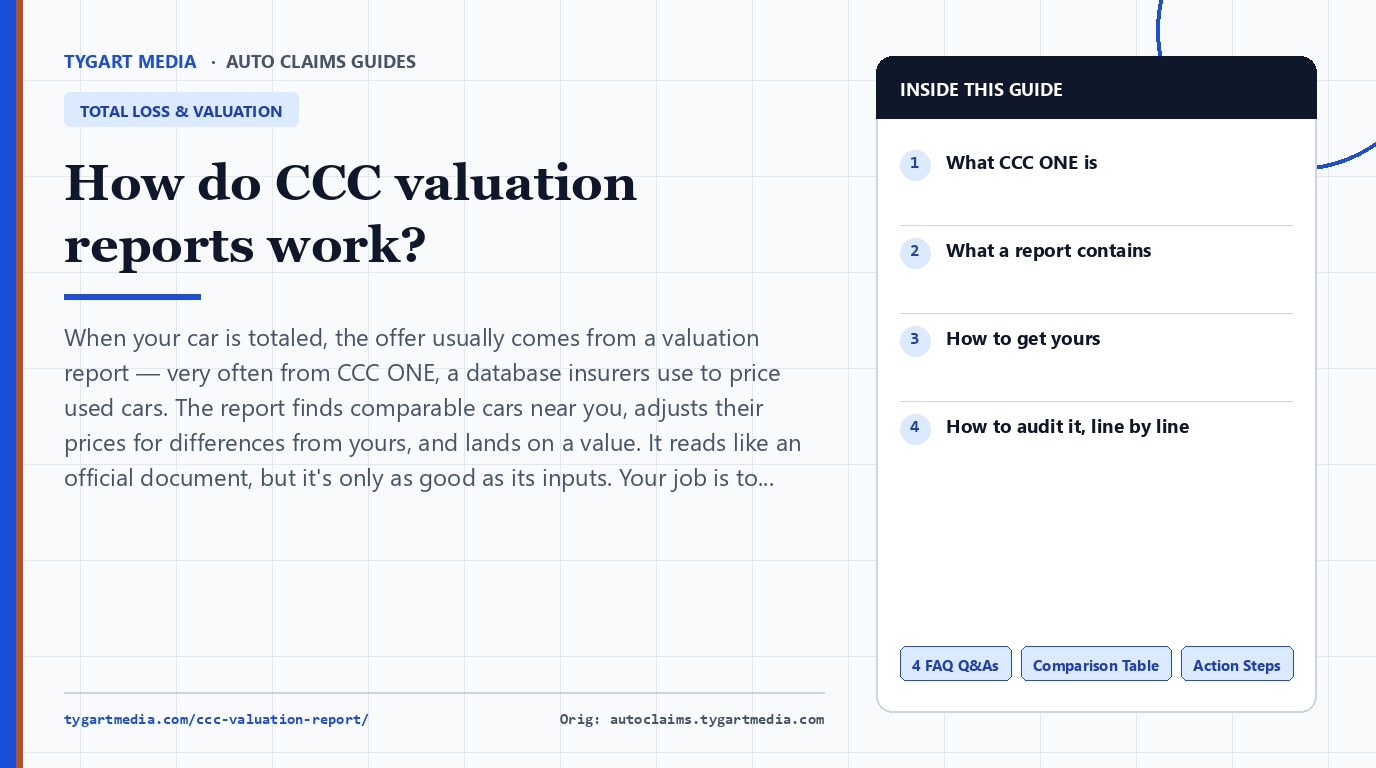
The short answer: when your car is totaled, the offer usually comes from a valuation report — very often from CCC ONE, a database insurers use to price used cars. The report finds comparable cars near you, adjusts their prices for differences from yours, and lands on a value. It reads like an official document, but it’s only as good as its inputs. Your job is to check those inputs, line by line, against the car you actually owned.
What CCC ONE is
CCC ONE is a valuation platform insurers subscribe to. Instead of an adjuster researching prices by hand, the system searches listings and recent sales, builds a set of comparable vehicles, and applies standardized adjustments. Other insurers use equivalents — Mitchell and Audatex produce the same kind of report. The vendor differs; the method doesn’t: comparables in, adjustments applied, value out.
What a report contains
Your car’s identity page — year, make, model, and the trim, options, and mileage the system believes your car had. This page is where expensive mistakes live.
The comparable vehicles — the listings or sales the value is built from, with each car’s location, mileage, and asking or sold price.
Adjustments — dollar amounts added or subtracted per comparable for mileage differences, options, and condition, to make each comp “match” your car.
Condition line items — ratings and deductions for body, interior, tires, and mechanical condition, often benchmarked against an assumed “average” car.
The base value — the result everything flows into, before taxes, fees, and your deductible.
How to get yours
Ask the adjuster for the full valuation report — every page, including the comparables and adjustments, not just the summary page with the final number. Make the request in writing so it’s part of the claim record. You can’t audit a number you can’t see, and the full report is a normal thing to ask for.
How to audit it, line by line
Check the trim and packages. Does the report describe your car — or a base model? A missing trim level or option package (all-wheel drive, sunroof, navigation, tow package) quietly takes real money off.
Check the mileage. Compare the report’s mileage to your odometer photo or service records. Inflated mileage is a direct deduction.
Check the options boxes. Equipment your car had that the report left unchecked is value left on the table.
Challenge the condition deductions. Reports often assume average wear. If your car was cleaner than average — and your photos, detail receipts, or service history show it — say so, with the evidence attached.
Grade the comparables. How far away are they? Much higher mileage than yours? Older, or a different trim? A comp that isn’t comparable is adjustable — flag each one specifically.
Send your corrections in writing, with your own comps. Listings for your exact year, trim, and mileage range in your region, screenshotted with dates and prices. Here’s the full fight plan: How to fight a low total-loss offer →
Important Notice
Errors are inputs, not verdicts A low report usually isn’t anyone deciding to cheat you — it’s a wrong trim, a stale listing, or an unchecked box flowing through the math. That’s good news: wrong inputs can be corrected, one line at a time, and corrections are hard to argue with.
Informational only — not legal or insurance advice.
Valuation methods and your rights to claim documents vary by state and by policy. Check your own policy documents and your state’s insurance department, or talk to a licensed professional, before acting on a claim.
The line-by-line audit
What to check in your valuation report
Report line
What to verify
Trim & packages
Matches the car you owned — not a base model
Mileage
Matches your odometer and service records
Options
Every factory option your car had is checked
Condition deductions
Reflect your car’s real condition, with your photos as proof
Comparables
Same trim, close mileage, your region, current or recent
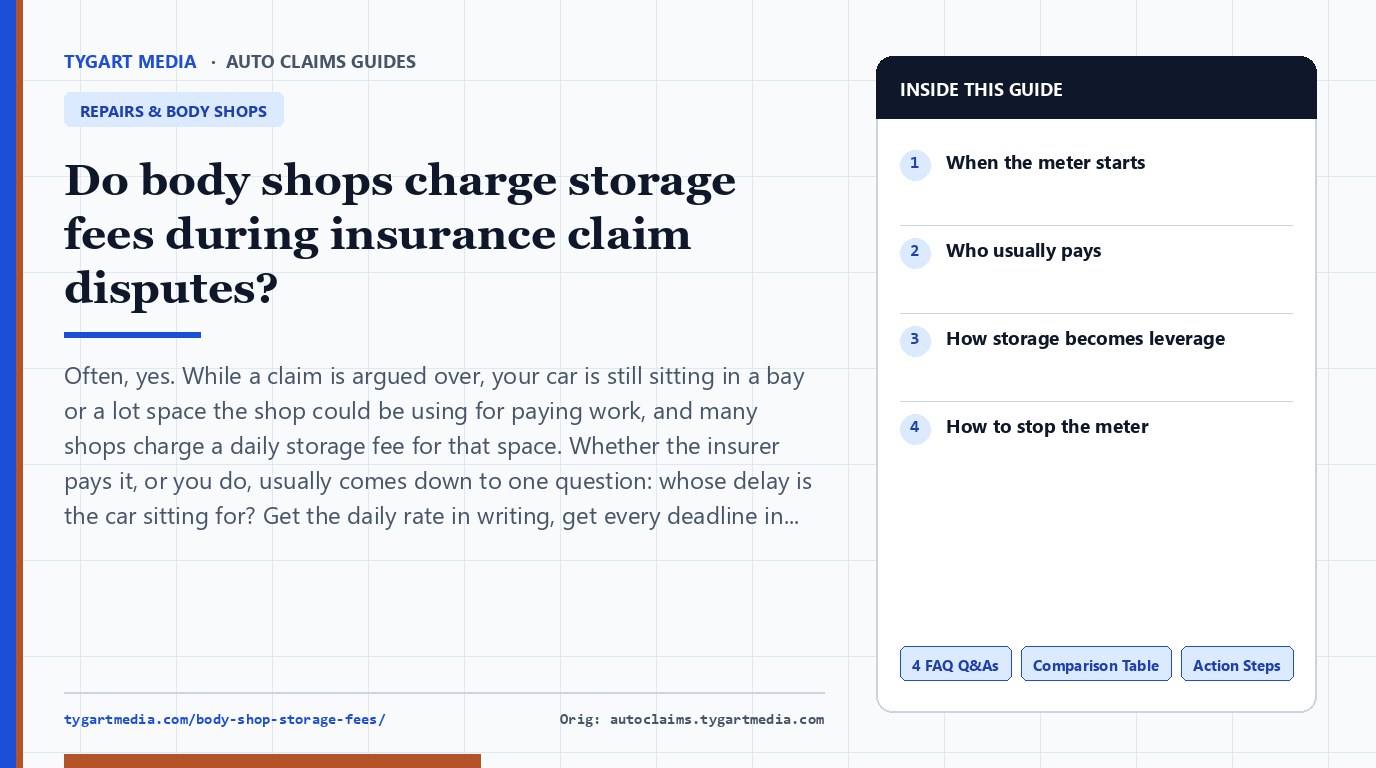
The short answer: often, yes. While a claim is argued over, your car is still sitting in a bay or a lot space the shop could be using for paying work, and many shops charge a daily storage fee for that space. Whether the insurer pays it, or you do, usually comes down to one question: whose delay is the car sitting for? Get the daily rate in writing, get every deadline in writing, and treat a running meter as a reason to force the pending decision — not as background noise.
When the meter starts
Storage commonly begins when a car sits waiting instead of being worked on. The usual triggers:
After teardown, with no repair authorization — the car is apart, the damage is documented, and nobody has approved the next step.
While insurer decisions are pending — a supplement, an inspection, or a coverage call is sitting on someone’s desk and the car is sitting at the shop.
After a total-loss decision — the insurer has declared the car a total loss, but the car has not been picked up or moved, and it keeps occupying space.
None of this is the shop being difficult. A shop charges for the space your car occupies because that space is its inventory. What matters for you is that rates are set by the shop, not by any standard schedule — so ask for the daily rate in writing up front, before the car sits, not when the bill is presented.
Who usually pays
It depends on why the car is sitting, and the pattern is consistent enough to plan around:
Delay caused by the insurer’s approval process — waiting on an inspection, a supplement approval, or a decision the insurer owes — is commonly treated as part of the claim.
Delay caused by the owner weighing decisions — taking time to decide whether to repair, where to repair, or whether to accept an offer — commonly lands on the owner.
After a written cutoff — once an insurer sets a storage cutoff or a total-loss pickup deadline in writing, the days after that deadline commonly shift to the owner.
Notice the thread running through all three: the writing. A deadline you were told on the phone and a deadline you were sent in writing lead to very different arguments later.
How storage becomes leverage
A running meter pressures everyone at the table, and everyone knows it. Insurers may cap storage or cut it off on a date certain, because an open-ended meter is an open-ended cost. Shops use the meter to force decisions that would otherwise drift — a car nobody decides about is a car nobody is repairing. And the owner in the middle can get squeezed by both: the insurer’s deadline on one side, the shop’s daily charge on the other.
That is exactly why dates in writing matter more here than almost anywhere else in a claim. The meter turns a slow disagreement into an expensive one, and the side with the dated paper usually wins the argument about who pays for the wait.
How to stop the meter
Get the pending decision in writing, with a date. Whatever the car is waiting on — an approval, an inspection, a settlement call — ask the side that owes it to state it in writing and say when it will be made.
Make the call. Authorize the repair, move the car, or settle the point being argued. A decision you dislike usually costs less than another stretch of daily storage while you avoid it.
If you are moving the car, do the comparison first. Weigh the cost of a tow against a few more days of storage — sometimes moving is the cheap option, sometimes a short wait is.
Confirm the fee total in writing before pickup. Ask the shop for the itemized storage total before you arrive, so pickup day is a signature, not a negotiation.
Frequently asked questions
How much are body shop storage fees per day?
There is no standard rate. The daily rate is set by the shop and varies by market, so the only number that matters is the one your shop charges. Ask for the daily rate in writing before the car sits, and confirm the total in writing again before pickup so there are no surprises at the counter.
Will insurance reimburse storage fees?
Storage tied to the claim — inspection waits, approval waits, and delays on the insurer’s side — is commonly covered as part of the claim, within reason. Storage that piles up because a decision sat unmade after you were notified often is not. The reason the car is sitting is what decides it, so keep the dates in writing.
Can a body shop keep my car until storage fees are paid?
In many states, shops can hold a car for charges you agreed to, under lien rules that vary by state. If it comes to that, get the itemized total and your options in writing before you pay or argue at the counter, and check your state’s rules or ask a licensed professional if the amount is worth fighting over.
Do storage fees accrue on weekends and holidays?
Typically yes. Storage is usually charged per calendar day the car occupies the space, including weekends and holidays and days the shop is closed. Confirm the shop’s own policy in writing, because the count of days is part of the bill.
Informational only — not legal or insurance advice.
Auto repair and insurance rules vary by state and by policy. Check your own policy documents and your state’s insurance department, or talk to a licensed professional, before acting on a claim.
Storage fees at a glance
Storage fees: who usually bears them
Why the car is sitting
Who usually bears the storage
Waiting on the insurer’s approval
The claim, within reason
Torn down, awaiting your decision
Often you, once you have been told
Declared a total loss and not picked up
Shifts to you after the insurer’s written deadline
Dispute between shop and insurer
Fought over in the claim — get every date in writing