AI Search Authority - Tygart Media

Category: AI Search Authority

The definitive resource for GEO (Generative Engine Optimization), AEO (Answer Engine Optimization), LLMs.txt, and ranking in AI-powered search — Perplexity, ChatGPT, Claude, Google AI Overviews.

  • The Driver and the Car: What AI Agents Teach Us About Being Human

    The Driver and the Car: What AI Agents Teach Us About Being Human

    The Lab · Tygart Media
    Experiment Nº 750 · Methodology Notes
    METHODS · OBSERVATIONS · RESULTS

    There’s a moment every serious Claude user hits eventually.

    You’re mid-session. You’ve built something — a workflow, a content pipeline, a research thread — and you’re deep in it. Then the model goes quiet. Or returns something strange. Or just stops.

    You didn’t break anything. You ran out of room.

    What Actually Happened (The Token Wall)

    Every AI conversation has a context window — a fixed amount of memory the model can hold at once. Think of it like a whiteboard. As a session gets longer, the whiteboard fills up: your messages, the model’s responses, tool outputs, task lists, code snippets. All of it takes space.

    When you get close to the limit, the model doesn’t always fail gracefully. Sometimes it just can’t fit the new request alongside all the history. It tries. It might start a response and stop. It might return something vague. It looks broken. It isn’t — it’s full.

    Here’s the part most people miss: the smarter the model, the more verbose its outputs. Claude Opus 4.7 thinks deeply and writes extensively. That costs tokens. So in a nearly-full context, Opus might actually have less usable runway than you’d expect — because every output it generates is large.

    The Haiku Trick (And What It Reveals)

    When you’re stuck at the context limit, the instinct is to try a smarter model. That’s usually wrong.

    The right move is to try a smaller one.

    Haiku — Claude’s lightest, fastest model — can squeeze through a gap that Sonnet and Opus can’t fit through. It’s lean enough to do one small thing: update a task list, summarize where things stand, trigger a compaction. That small action unlocks the whole session again.

    This isn’t a bug. It’s a feature, once you understand it.

    The lesson: it’s not always about raw intelligence. It’s about fit. The right tool for the moment isn’t the most powerful one — it’s the one that can actually execute given the constraints you’re operating in.

    The Formula One Analogy

    Formula One teams spend hundreds of millions building the fastest cars on earth. But the car doesn’t win races by itself. The driver decides when to pit, which tires to run, when to push and when to conserve. Two drivers in identical cars produce different results — sometimes dramatically different.

    Working with AI at a high level is the same.

    Most people are handed a powerful car and told to drive. They go fast for a while, then hit a wall and don’t know why. They try pressing harder on the accelerator. That doesn’t help.

    The experienced operator reads the context. They know when the session is getting long and starts pruning. They know when to swap models. They know when to compact, when to start fresh, when to hand off a task to a subagent in isolation. They understand the system — not just the tool.

    That understanding only comes from hours in the seat.

    What Agents Teach Us About Humans

    Here’s the inversion most people miss.

    We spend a lot of time asking: how do we make AI more like humans? But there’s a more interesting question: what can humans learn from how agents operate?

    Agents succeed when they have clear, bounded context (not a mile-long thread of everything), a defined task (not “figure it out”), honest signals about capacity (not pushing through when overloaded), and the right model for the moment (not always the heaviest one).

    Agents fail when context is polluted, tasks are ambiguous, or they try to do too much in a single pass.

    Sound familiar? That’s also exactly why humans fail on complex work.

    The Haiku moment is a perfect human analogy. When you’re overwhelmed and stuck, the answer usually isn’t to think harder. It’s to do the smallest possible thing that creates forward momentum. Clear one item. Make one decision. Unlock one next step.

    That’s not dumbing it down. That’s operating intelligently within constraints.

    The Hybrid Isn’t Human + AI

    The real hybrid isn’t “a human who uses AI tools.”

    It’s a human who has internalized how agents think — who naturally breaks work into discrete tasks, knows their own context limits (we call it cognitive load, but it’s the same thing), swaps in the right resource for the right job, and is honest about when they’re at capacity instead of producing garbage at 11 PM.

    And it goes the other direction too. Agents get sharper when humans encode years of pattern recognition into them — through prompts, through memory systems, through skills built from real operational experience.

    Your best agent workflows aren’t built from documentation. They’re built from the moment you got stuck at the token wall at midnight and figured out that Haiku could fit through the gap.

    That knowledge doesn’t come from a tutorial. It comes from being in the car.

    The Nuances You Only See From Inside

    Here’s what I keep coming back to: the most valuable insights from working with AI at a high level are almost impossible to communicate without having lived them.

    You can read about context windows. You can understand the concept intellectually. But the feel of a session getting heavy — that instinct that tells you to compact now, before you hit the wall — that only comes from experience.

    Same with knowing when a task is too big for one conversation. When a subagent in isolation will outperform a single long thread. When the model’s “thinking” is just pattern-matching on noise in the context.

    These are driver skills. And like any driver skill, they’re earned in the seat.

    The people who get the most out of this technology aren’t necessarily the ones with the most technical knowledge. They’re the ones who’ve put in the hours. Who’ve gotten stuck, figured it out, and filed it away.

    The car is available to everyone.

    The driver makes the difference.

    {
    “@context”: “https://schema.org”,
    “@type”: “Article”,
    “headline”: “The Driver and the Car: What AI Agents Teach Us About Being Human”,
    “description”: “Every serious Claude user hits the token wall eventually. Here’s what it teaches you — about AI, about agents, and about how humans perform under constrai”,
    “datePublished”: “2026-04-03”,
    “dateModified”: “2026-04-03”,
    “author”: {
    “@type”: “Person”,
    “name”: “Will Tygart”,
    “url”: “https://tygartmedia.com/about”
    },
    “publisher”: {
    “@type”: “Organization”,
    “name”: “Tygart Media”,
    “url”: “https://tygartmedia.com”,
    “logo”: {
    “@type”: “ImageObject”,
    “url”: “https://tygartmedia.com/wp-content/uploads/tygart-media-logo.png”
    }
    },
    “mainEntityOfPage”: {
    “@type”: “WebPage”,
    “@id”: “https://tygartmedia.com/the-driver-and-the-car-what-ai-agents-teach-us-about-being-human/”
    }
    }

  • The Unsnippetable Strategy: How We Beat Zero-Click Search by Building Things Google Can’t Summarize

    The Unsnippetable Strategy: How We Beat Zero-Click Search by Building Things Google Can’t Summarize

    The Lab · Tygart Media
    Experiment Nº 650 · Methodology Notes
    METHODS · OBSERVATIONS · RESULTS

    We just deployed 16 interactive tools and 3 bottom-of-funnel articles across 7 websites in a single session. Here’s why, and how you can do the same thing.

    The Problem: 4,000 Impressions, Zero Clicks

    We pulled the Google Search Console data for theuniversalcommerceprotocol.com — a site covering agentic commerce and AI-powered checkout infrastructure. The numbers told a brutal story: over 200 unique queries generating 4,000+ monthly impressions with an effective CTR of 0%. Not low. Zero.

    The highest-impression queries were all definitional: “what is agentic commerce” (409 impressions, 0 clicks), “agentic commerce definition” (178 impressions, 0 clicks), “ai commerce compliance mastercard” (61 impressions at position 1.25, 0 clicks). Google was serving our content directly in AI Overviews and featured snippets. Users got what they needed without ever visiting the site.

    This isn’t unique to UCP. It’s the new reality. 58.5% of US Google searches now end without a click. For AI Mode searches, it’s 93%. If your content strategy is built on informational queries, you’re building on a foundation that’s actively collapsing.

    The conventional wisdom is to “optimize for AI Overviews” and “win the featured snippet.” But that’s backwards. If you win the featured snippet for “what is agentic commerce,” Google serves your content without anyone visiting your site. You’ve won the battle and lost the war.

    The Insight: Two-Layer Content Architecture

    The solution isn’t to fight zero-click search. It’s to use it. We call it two-layer content architecture, and it changes how you think about content strategy entirely.

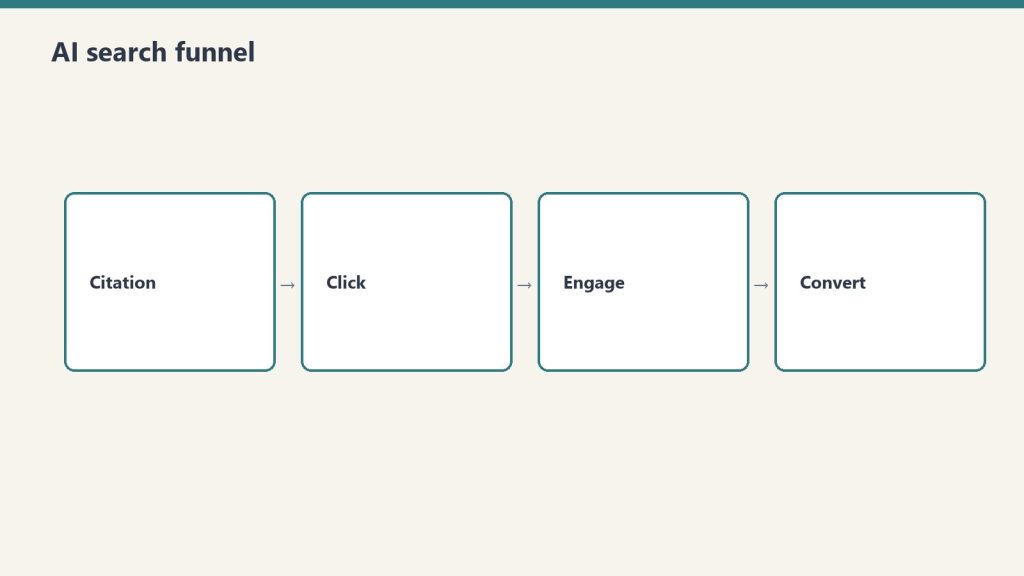
    Layer 1: SERP Bait. This is your definitional, informational content — “what is X,” “X vs Y,” “how does X work.” This content is designed to be consumed on the SERP without a click. Its job isn’t traffic. Its job is brand impressions at massive scale. Every time Google cites you in an AI Overview, thousands of people see your brand positioned as the authority. That’s not a failure. That’s a free brand campaign.

    Layer 2: Click Magnets. This is content Google literally cannot summarize in a snippet — interactive tools, calculators, assessments, scorecards, decision frameworks. The SERP can tease them (“Calculate your agentic commerce ROI…”) but the user HAS to click through to get the value. The tool requires input. The output is personalized. There’s nothing for Google to extract.

    The connection between the layers is where the magic happens. The person who sees your brand cited in an AI Overview for “what is agentic commerce” now recognizes you. When they later search “agentic commerce ROI” or “how to implement agentic commerce” — and your calculator or playbook appears — they click because they already trust you from Layer 1. Research backs this up: brands cited in AI Overviews see 35% higher CTR on their other organic listings.

    You’re not fighting the zero-click reality. You’re using it as a free awareness channel that feeds the bottom of your funnel.

    What We Built: 16 Tools Across 7 Sites

    We didn’t just theorize about this. We built and deployed the entire system in a single session across 7 domains.

    UCP (theuniversalcommerceprotocol.com) — 6 pieces

    Three interactive tools targeting the exact queries generating zero-click impressions: an Agentic Commerce Readiness Assessment (32-question diagnostic across 8 dimensions), an ROI Calculator (projects revenue impact using Morgan Stanley, Gartner, and McKinsey 2026 data), and a Visa vs Mastercard Agentic Commerce Scorecard (interactive comparison across 7 compliance dimensions — this one directly targets the “ai commerce compliance mastercard/visa” queries that were getting 90 impressions at position 1 with zero clicks).

    Plus three bottom-of-funnel articles that can’t be answered in a snippet: a 90-Day Implementation Playbook (week-by-week), a narrative piece about what breaks when an AI agent hits an unprepared store, and a Build/Buy/Wait decision framework with cost analysis.

    Tygart Media (tygartmedia.com) — 5 tools

    Five tools that package our existing expertise into interactive formats: an AEO Citation Likelihood Analyzer (scores content across 8 dimensions AI systems evaluate), an Information Density Analyzer (paste your text, get real-time density metrics and a paragraph-by-paragraph heatmap), a Restoration SEO Competitive Tower (benchmark against competitors across 8 SEO dimensions), an AI Infrastructure ROI Simulator (Build vs Buy vs API with 3-year TCO), and a Schema Markup Adequacy Scorer (is your structured data AI-ready?).

    Knowledge Cluster (5 sites) — 5 industry-specific tools

    One high-priority tool per site, each targeting the most-searched zero-click queries in their industry: a Water Damage Cost Estimator for restorationintel.com (calculates by IICRC class, water category, materials, and region), a Property Risk Assessment Engine for riskcoveragehub.com (scores across 5 risk dimensions with coverage recommendations), a Business Impact Analysis Generator for continuityhub.org (ISO 22301-aligned BIA with exportable summary), a Healthcare Compliance Audit Tool for healthcarefacilityhub.org (18-question audit mapped to CMS CoP and TJC standards), and a Carbon Footprint Calculator for bcesg.org (Scope 1/2/3 with EPA emission factors and reduction scenarios).

    Why Interactive Tools Beat Articles in Zero-Click

    There are five technical reasons interactive tools are the correct response to zero-click search, and they compound.

    They’re non-serializable. A calculator’s output depends on user input. Google can’t pre-compute every possible result for a water damage cost estimator across every combination of square footage, damage class, water category, materials, and region. The AI Overview can say “use this calculator” but it can’t BE the calculator. The citation becomes a call to action.

    They generate engagement signals at scale. Interactive tools produce time-on-page, scroll depth, and interaction events that traditional articles can’t match. A user spending 4 minutes inputting data and exploring results sends stronger quality signals than a user who reads a paragraph and bounces.

    They’re bookmarkable. A restoration company owner who uses the cost estimator once will bookmark it and return. Insurance adjusters will save the risk assessment tool. This creates direct traffic over time — the kind Google can’t intercept with zero-click.

    They’re natural link magnets. Industry publications, Reddit threads, and professional communities link to useful tools far more readily than articles. A “Healthcare Compliance Audit Tool” gets shared in facility manager Slack channels. A “What Is Healthcare Compliance” article doesn’t.

    They’re AI Overview proof. Even when Google cites the page in an AI Overview, users still need to visit to use the tool. The AI Overview effectively becomes free advertising: “Use this calculator at [your site] to estimate your costs.” Every zero-click impression becomes a branded CTA.

    The Methodology: Replicable for Any Site

    You can run this exact playbook on any site in about 4 hours. Here’s the step-by-step:

    Step 1: Pull your GSC data. Export the Queries and Pages reports. Sort by impressions descending. Identify every query with significant impressions and near-zero CTR. These are your zero-click queries — the ones Google is answering without sending you traffic.

    Step 2: Categorize the queries. Split them into two buckets. Definitional queries (“what is X,” “X definition,” “X vs Y”) are Layer 1 — leave them alone, they’re generating brand impressions. Action-intent queries (“X cost estimate,” “X compliance checklist,” “how to implement X”) are Layer 2 opportunities.

    Step 3: For each Layer 2 opportunity, ask one question. “What would someone who already knows the answer still need to click for?” The answer is usually a tool, calculator, assessment, or framework that requires their specific input to produce useful output.

    Step 4: Build the tool. Single-file HTML with inline CSS/JS. No external dependencies. Dark theme, mobile responsive, professional design. The tool should take 2-5 minutes to complete and produce a result worth sharing or saving. Include a “copy results” or “download report” function.

    Step 5: Embed in WordPress. Write a 2-3 paragraph intro explaining why the tool matters (this is what Google will see and potentially cite). Then embed the full HTML. The intro becomes your Layer 1 snippet bait, and the tool becomes your Layer 2 click magnet — on the same page.

    Step 6: Cross-link. Add CTAs from your existing Layer 1 content to the new tools. If you have an article ranking for “what is agentic commerce” that’s getting zero clicks, add a CTA in that article: “Take the Readiness Assessment to see if your business is prepared.” You’re converting brand impressions into tool engagement.

    Step 7: Monitor. Track CTR changes over 30/60/90 days. Track direct traffic increases (brand searches driven by AI Overview citations). Track tool engagement: completion rates, time on page. Track backlink acquisition from industry sites linking to your tools.

    What We’re Measuring

    This isn’t a “publish and pray” strategy. We’re tracking specific metrics across all 7 sites to validate or invalidate the approach within 90 days.

    First, CTR change on previously zero-click queries. If the Visa vs Mastercard Scorecard starts pulling even 2-3% CTR on queries that were at 0%, that’s a meaningful signal. Second, direct traffic increases — are more people searching for our brand names directly after seeing us cited in AI Overviews? Third, tool engagement metrics: how many people complete the assessments, what’s the average time on page, how many copy their results? Fourth, organic backlinks — do industry sites start linking to our tools? Fifth, whether the tools themselves rank for their own queries, creating an entirely new traffic channel.

    The Bigger Picture

    The era of “write an article, rank, get traffic” is over for informational queries. Google’s AI Overviews and featured snippets have made it so that the better your content is at answering a question, the less likely anyone is to visit your site. That’s a structural inversion of the old SEO model, and no amount of keyword optimization will fix it.

    But the era of “build something useful, earn trust, capture intent” is just beginning. Tools, calculators, assessments, and interactive experiences represent a category of content that AI cannot fully consume on behalf of the user. They require participation. They produce personalized output. They create the kind of engagement that turns a search impression into a relationship.

    We deployed 16 of these tools across 7 sites today. In 90 days, we’ll know exactly how much zero-click traffic they converted. But based on the early research — 35% higher CTR for AI-cited brands, 42.9% CTR for featured snippet content that teases without fully answering — the bet is that unsnippetable content is the highest-leverage move in SEO right now.

    The tools are already live. The impressions are already flowing. Now we find out if the clicks follow.

    {
    “@context”: “https://schema.org”,
    “@type”: “Article”,
    “headline”: “The Unsnippetable Strategy: How We Beat Zero-Click Search by Building Things Google Cant Summarize”,
    “description”: “We deployed 16 interactive tools across 7 websites to convert zero-click search impressions into actual traffic. Here’s the two-layer content architecture”,
    “datePublished”: “2026-04-01”,
    “dateModified”: “2026-04-03”,
    “author”: {
    “@type”: “Person”,
    “name”: “Will Tygart”,
    “url”: “https://tygartmedia.com/about”
    },
    “publisher”: {
    “@type”: “Organization”,
    “name”: “Tygart Media”,
    “url”: “https://tygartmedia.com”,
    “logo”: {
    “@type”: “ImageObject”,
    “url”: “https://tygartmedia.com/wp-content/uploads/tygart-media-logo.png”
    }
    },
    “mainEntityOfPage”: {
    “@type”: “WebPage”,
    “@id”: “https://tygartmedia.com/unsnippetable-strategy-beat-zero-click-search/”
    }
    }

  • Information Density Analyzer: Is Your Content Dense Enough for AI?

    Information Density Analyzer: Is Your Content Dense Enough for AI?

    Tygart Media / The Signal
    Broadcast Live
    Filed by Will Tygart
    Tacoma, WA
    Industry Bulletin

    AI systems select sources based on information density — the ratio of unique, verifiable claims to filler text. Most content fails this test. We found that 16 AI models unanimously agree on what makes content worth citing, and it comes down to density.

    This tool analyzes your text in real-time and produces 8 metrics including unique concepts per 100 words, claim density, filler ratio, and actionable insight score. It also generates a paragraph-by-paragraph heatmap showing exactly where your content is dense and where it’s fluff.

    Paste your article text below and see how your content measures up against AI-citable benchmarks.

    Information Density Analyzer: Is Your Content Dense Enough for AI?

    * {
    margin: 0;
    padding: 0;
    box-sizing: border-box;
    }

    body {
    font-family: -apple-system, BlinkMacSystemFont, ‘Segoe UI’, Roboto, ‘Helvetica Neue’, Arial, sans-serif;
    background: linear-gradient(135deg, #0f172a 0%, #1a2551 100%);
    color: #e5e7eb;
    min-height: 100vh;
    padding: 20px;
    }

    .container {
    max-width: 1200px;
    margin: 0 auto;
    }

    header {
    text-align: center;
    margin-bottom: 40px;
    animation: slideDown 0.6s ease-out;
    }

    h1 {
    font-size: 2.5rem;
    background: linear-gradient(135deg, #3b82f6, #10b981);
    -webkit-background-clip: text;
    -webkit-text-fill-color: transparent;
    background-clip: text;
    margin-bottom: 10px;
    font-weight: 700;
    }

    .subtitle {
    font-size: 1.1rem;
    color: #9ca3af;
    }

    .input-section {
    background: rgba(15, 23, 42, 0.8);
    border: 1px solid rgba(59, 130, 246, 0.2);
    border-radius: 12px;
    padding: 40px;
    margin-bottom: 30px;
    backdrop-filter: blur(10px);
    animation: fadeIn 0.8s ease-out;
    }

    .textarea-group {
    margin-bottom: 20px;
    }

    .textarea-label {
    display: block;
    margin-bottom: 12px;
    font-weight: 600;
    font-size: 1.05rem;
    color: #e5e7eb;
    }

    textarea {
    width: 100%;
    min-height: 250px;
    padding: 15px;
    background: rgba(255, 255, 255, 0.03);
    border: 1px solid rgba(59, 130, 246, 0.2);
    border-radius: 8px;
    color: #e5e7eb;
    font-family: inherit;
    font-size: 0.95rem;
    resize: vertical;
    transition: all 0.3s ease;
    }

    textarea:focus {
    outline: none;
    border-color: rgba(59, 130, 246, 0.5);
    background: rgba(59, 130, 246, 0.05);
    }

    .button-group {
    display: flex;
    gap: 15px;
    margin-top: 20px;
    flex-wrap: wrap;
    }

    button {
    padding: 12px 30px;
    border: none;
    border-radius: 8px;
    font-weight: 600;
    cursor: pointer;
    transition: all 0.3s ease;
    font-size: 1rem;
    }

    .btn-primary {
    background: linear-gradient(135deg, #3b82f6, #2563eb);
    color: white;
    flex: 1;
    min-width: 200px;
    }

    .btn-primary:hover {
    transform: translateY(-2px);
    box-shadow: 0 10px 20px rgba(59, 130, 246, 0.3);
    }

    .btn-secondary {
    background: rgba(59, 130, 246, 0.1);
    color: #3b82f6;
    border: 1px solid rgba(59, 130, 246, 0.3);
    }

    .btn-secondary:hover {
    background: rgba(59, 130, 246, 0.2);
    transform: translateY(-2px);
    }

    .results-section {
    display: none;
    animation: fadeIn 0.8s ease-out;
    }

    .results-section.visible {
    display: block;
    }

    .content-section {
    background: rgba(15, 23, 42, 0.8);
    border: 1px solid rgba(59, 130, 246, 0.2);
    border-radius: 12px;
    padding: 40px;
    margin-bottom: 30px;
    backdrop-filter: blur(10px);
    }

    .density-score {
    text-align: center;
    margin-bottom: 40px;
    padding: 40px;
    background: linear-gradient(135deg, rgba(59, 130, 246, 0.1), rgba(16, 185, 129, 0.1));
    border-radius: 12px;
    }

    .score-number {
    font-size: 4rem;
    font-weight: 700;
    background: linear-gradient(135deg, #3b82f6, #10b981);
    -webkit-background-clip: text;
    -webkit-text-fill-color: transparent;
    background-clip: text;
    }

    .score-label {
    font-size: 1rem;
    color: #9ca3af;
    margin-top: 10px;
    }

    .gauge {
    width: 100%;
    height: 20px;
    background: rgba(255, 255, 255, 0.05);
    border-radius: 10px;
    overflow: hidden;
    margin: 20px 0;
    }

    .gauge-fill {
    height: 100%;
    background: linear-gradient(90deg, #ef4444, #f59e0b, #10b981);
    border-radius: 10px;
    transition: width 0.6s ease-out;
    }

    .metrics-grid {
    display: grid;
    grid-template-columns: repeat(auto-fit, minmax(200px, 1fr));
    gap: 20px;
    margin-bottom: 30px;
    }

    .metric-card {
    background: rgba(255, 255, 255, 0.02);
    border: 1px solid rgba(59, 130, 246, 0.2);
    border-radius: 8px;
    padding: 20px;
    text-align: center;
    }

    .metric-value {
    font-size: 2rem;
    font-weight: 700;
    color: #3b82f6;
    margin-bottom: 8px;
    }

    .metric-label {
    font-size: 0.85rem;
    color: #9ca3af;
    text-transform: uppercase;
    letter-spacing: 0.5px;
    }

    .heatmap {
    margin: 30px 0;
    }

    .heatmap-title {
    font-size: 1.2rem;
    font-weight: 600;
    margin-bottom: 20px;
    color: #e5e7eb;
    }

    .heatmap-legend {
    display: flex;
    gap: 20px;
    margin-bottom: 20px;
    flex-wrap: wrap;
    }

    .legend-item {
    display: flex;
    align-items: center;
    gap: 8px;
    font-size: 0.9rem;
    }

    .legend-color {
    width: 20px;
    height: 20px;
    border-radius: 4px;
    }

    .paragraph {
    background: rgba(255, 255, 255, 0.02);
    border-left: 4px solid #ef4444;
    padding: 15px;
    margin-bottom: 12px;
    border-radius: 4px;
    font-size: 0.9rem;
    line-height: 1.6;
    color: #d1d5db;
    }

    .paragraph.dense {
    border-left-color: #10b981;
    }

    .paragraph.moderate {
    border-left-color: #f59e0b;
    }

    .insights {
    background: rgba(16, 185, 129, 0.05);
    border: 1px solid rgba(16, 185, 129, 0.2);
    border-radius: 8px;
    padding: 20px;
    margin-top: 30px;
    }

    .insights h3 {
    color: #10b981;
    margin-bottom: 15px;
    font-size: 1.1rem;
    }

    .insights p {
    color: #d1d5db;
    line-height: 1.6;
    margin-bottom: 12px;
    }

    .comparison {
    background: rgba(59, 130, 246, 0.05);
    border: 1px solid rgba(59, 130, 246, 0.2);
    border-radius: 8px;
    padding: 20px;
    margin-top: 20px;
    }

    .comparison h4 {
    color: #3b82f6;
    margin-bottom: 10px;
    }

    .comparison p {
    color: #d1d5db;
    font-size: 0.95rem;
    line-height: 1.6;
    }

    .cta-link {
    display: inline-block;
    color: #3b82f6;
    text-decoration: none;
    font-weight: 600;
    margin-top: 20px;
    padding: 10px 0;
    border-bottom: 2px solid rgba(59, 130, 246, 0.3);
    transition: all 0.3s ease;
    }

    .cta-link:hover {
    border-bottom-color: #3b82f6;
    padding-right: 5px;
    }

    footer {
    text-align: center;
    padding: 30px;
    color: #6b7280;
    font-size: 0.85rem;
    margin-top: 50px;
    }

    @keyframes slideDown {
    from {
    opacity: 0;
    transform: translateY(-20px);
    }
    to {
    opacity: 1;
    transform: translateY(0);
    }
    }

    @keyframes fadeIn {
    from {
    opacity: 0;
    }
    to {
    opacity: 1;
    }
    }

    @media (max-width: 768px) {
    h1 {
    font-size: 1.8rem;
    }

    .input-section,
    .content-section {
    padding: 25px;
    }

    .score-number {
    font-size: 3rem;
    }

    textarea {
    min-height: 200px;
    }

    .metrics-grid {
    grid-template-columns: 1fr 1fr;
    }
    }

    Information Density Analyzer

    Is Your Content Dense Enough for AI?


    0
    Information Density Score

    Paragraph-by-Paragraph Density Heatmap

    Dense (AI-Citable)

    Moderate

    Fluffy

    Your Content in AI Terms

    Compared to AI-Citable Benchmark

    Read the Information Density Manifesto →

    Powered by Tygart Media | tygartmedia.com

    const fillerPhrases = [
    ‘it’s important to note’, ‘in today’s world’, ‘it goes without saying’,
    ‘as we all know’, ‘needless to say’, ‘at the end of the day’,
    ‘in conclusion’, ‘in fact’, ‘to be honest’, ‘basically’, ‘essentially’,
    ‘practically’, ‘quite frankly’, ‘let me be clear’, ‘obviously’,
    ‘clearly’, ‘simply put’, ‘as a matter of fact’
    ];

    const actionVerbs = [
    ‘implement’, ‘deploy’, ‘configure’, ‘build’, ‘create’, ‘measure’,
    ‘test’, ‘optimize’, ‘develop’, ‘establish’, ‘execute’, ‘perform’,
    ‘analyze’, ‘evaluate’, ‘design’, ‘engineer’, ‘construct’, ‘establish’
    ];

    function analyzeContent() {
    const content = document.getElementById(‘contentInput’).value.trim();
    if (!content) {
    alert(‘Please paste your article text first.’);
    return;
    }

    const analysis = performAnalysis(content);
    displayResults(analysis);
    }

    function clearContent() {
    document.getElementById(‘contentInput’).value = ”;
    document.getElementById(‘resultsContainer’).classList.remove(‘visible’);
    }

    function performAnalysis(content) {
    const sentences = content.match(/[^.!?]+[.!?]+/g) || [];
    const paragraphs = content.split(/nn+/).filter(p => p.trim());
    const words = content.toLowerCase().match(/bw+b/g) || [];

    const wordCount = words.length;
    const sentenceCount = sentences.length;
    const avgSentenceLength = wordCount / sentenceCount;

    // Unique concepts (words >4 chars appearing 1-2 times)
    const wordFreq = {};
    words.forEach(word => {
    if (word.length > 4) {
    wordFreq[word] = (wordFreq[word] || 0) + 1;
    }
    });
    const uniqueConcepts = Object.values(wordFreq).filter(count => count {
    if (numberRegex.test(sent)) claimCount++;
    });
    const claimDensity = (claimCount / sentenceCount) * 100;

    // Filler ratio
    let fillerCount = 0;
    sentences.forEach(sent => {
    if (fillerPhrases.some(phrase => sent.toLowerCase().includes(phrase))) {
    fillerCount++;
    }
    });
    const fillerRatio = (fillerCount / sentenceCount) * 100;

    // Actionable insight score
    let actionCount = 0;
    sentences.forEach(sent => {
    if (actionVerbs.some(verb => sent.toLowerCase().includes(verb))) {
    actionCount++;
    }
    });
    const actionScore = (actionCount / sentenceCount) * 100;

    // Jargon density (rough estimate)
    const jargonTerms = words.filter(word => word.length > 7).length;
    const jargonDensity = (jargonTerms / wordCount) * 100;

    // Overall density score
    let densityScore = Math.round(
    (conceptDensity * 0.25) +
    (claimDensity * 0.25) +
    ((100 – fillerRatio) * 0.20) +
    (actionScore * 0.20) +
    (Math.min(jargonDensity, 15) * 0.10)
    );
    densityScore = Math.max(0, Math.min(100, densityScore));

    // Analyze paragraphs
    const paragraphAnalysis = paragraphs.map(para => {
    const paraSentences = para.match(/[^.!?]+[.!?]+/g) || [];
    const paraWords = para.toLowerCase().match(/bw+b/g) || [];
    const paraNumbers = para.match(/d+|percent|%/g) || [];
    const paraFiller = paraSentences.filter(sent =>
    fillerPhrases.some(phrase => sent.toLowerCase().includes(phrase))
    ).length;

    const density = (paraNumbers.length + paraWords.length / 10) / paraSentences.length;
    const fillerPercent = (paraFiller / paraSentences.length) * 100;

    let densityClass = ‘dense’;
    if (fillerPercent > 30 || density 15 || density 150 ? ‘…’ : ”),
    density: densityClass
    };
    });

    return {
    densityScore,
    wordCount,
    sentenceCount,
    avgSentenceLength: avgSentenceLength.toFixed(1),
    conceptDensity: conceptDensity.toFixed(1),
    claimDensity: claimDensity.toFixed(1),
    fillerRatio: fillerRatio.toFixed(1),
    actionScore: actionScore.toFixed(1),
    jargonDensity: jargonDensity.toFixed(1),
    paragraphs: paragraphAnalysis
    };
    }

    function displayResults(analysis) {
    // Score
    document.getElementById(‘densityScore’).textContent = analysis.densityScore;
    document.getElementById(‘gaugeFill’).style.width = analysis.densityScore + ‘%’;

    // Metrics
    const metricsHTML = `

    ${analysis.wordCount}
    Total Words

    ${analysis.sentenceCount}
    Sentences

    ${analysis.avgSentenceLength}
    Avg Sentence Length

    ${analysis.conceptDensity}%
    Unique Concepts per 100W

    ${analysis.claimDensity}%
    Claim Density

    ${analysis.fillerRatio}%
    Filler Ratio

    ${analysis.actionScore}%
    Action Verbs

    ${analysis.jargonDensity}%
    Jargon Density

    `;
    document.getElementById(‘metricsGrid’).innerHTML = metricsHTML;

    // Heatmap
    const heatmapHTML = analysis.paragraphs
    .map(para => `

    ${para.text}

    `)
    .join(”);
    document.getElementById(‘heatmapContainer’).innerHTML = heatmapHTML;

    // Insights
    let likelihood;
    if (analysis.densityScore >= 75) {
    likelihood = ‘This content is highly likely to be selected as an AI source. You have excellent unique concept density, strong claim coverage, and minimal filler.’;
    } else if (analysis.densityScore >= 60) {
    likelihood = ‘This content has good density and will likely be cited by AI systems. Consider reducing filler phrases and increasing actionable insights.’;
    } else if (analysis.densityScore >= 40) {
    likelihood = ‘Your content is moderately dense. AI may cite specific sections, but overall improvement would help. Focus on claims, actions, and uniqueness.’;
    } else {
    likelihood = ‘This content lacks the density AI systems prefer. Too many filler phrases, weak claim coverage, and low concept variety reduce citation likelihood.’;
    }
    document.getElementById(‘aiLikelihood’).textContent = likelihood;

    let benchmark;
    if (analysis.fillerRatio > 20) {
    benchmark = ‘Your filler ratio is above benchmark. AI-citable content typically has <15% filler phrases.';
    } else if (analysis.claimDensity 8) {
    benchmark = ‘Excellent unique concept density. This makes your content more likely to be selected as a source.’;
    } else {
    benchmark = ‘Your metrics align well with top-cited content benchmarks across most dimensions.’;
    }
    document.getElementById(‘benchmark’).textContent = benchmark;

    document.getElementById(‘resultsContainer’).classList.add(‘visible’);
    document.getElementById(‘resultsContainer’).scrollIntoView({ behavior: ‘smooth’ });
    }

    {
    “@context”: “https://schema.org”,
    “@type”: “Article”,
    “headline”: “Information Density Analyzer: Is Your Content Dense Enough for AI?”,
    “description”: “Paste your article text and get real-time analysis of information density, filler ratio, claim density, and AI-citability score.”,
    “datePublished”: “2026-04-01”,
    “dateModified”: “2026-04-03”,
    “author”: {
    “@type”: “Person”,
    “name”: “Will Tygart”,
    “url”: “https://tygartmedia.com/about”
    },
    “publisher”: {
    “@type”: “Organization”,
    “name”: “Tygart Media”,
    “url”: “https://tygartmedia.com”,
    “logo”: {
    “@type”: “ImageObject”,
    “url”: “https://tygartmedia.com/wp-content/uploads/tygart-media-logo.png”
    }
    },
    “mainEntityOfPage”: {
    “@type”: “WebPage”,
    “@id”: “https://tygartmedia.com/information-density-analyzer/”
    }
    }

  • How to Track AI Citations: Monitoring Whether ChatGPT, Gemini & Perplexity Cite Your Content

    How to Track AI Citations: Monitoring Whether ChatGPT, Gemini & Perplexity Cite Your Content

    Tygart Media / The Signal
    Broadcast Live
    Filed by Will Tygart
    Tacoma, WA
    Industry Bulletin

    TL;DR: The Living Monitor is a real-time system that tracks whether your content is being cited by AI systems (ChatGPT, Gemini, Perplexity, Claude). It measures: citation frequency, which AI systems are citing you, which specific claims are cited, competitor displacement, and citation accuracy. Without monitoring, you’re flying blind. With it, you see exactly where your content wins and where competitors dominate—enabling rapid optimization.

    The Problem: You Can’t Improve What You Can’t Measure

    In the Google era, you had rank tracking. You knew exactly which keywords you ranked for, what position, how you compared to competitors. Tools like Semrush and Ahrefs gave you complete visibility.

    Now, with AI-driven search, you have zero visibility into what’s happening. You don’t know if your content is being cited. Which AI systems cite you? Which competitors are cited more frequently? Which of your claims get pulled into AI responses?

    You’re optimizing for something you can’t measure. That’s backwards.

    The Living Monitor solves this. It’s a real-time tracking system that tells you: Am I being cited by AI systems? How often? By which systems? Where am I winning? Where am I losing?

    What the Living Monitor Tracks

    Citation Frequency

    How many times per day/week/month is your content cited by AI systems? Track this for:

    • Overall brand citations
    • Per-article citations
    • Competitor citations (for comparison)
    • Citation growth rate (are you trending up?)

    You’ll immediately see patterns. Articles optimized for lore get cited 10-50x per day. Traditional blog posts get cited 0-2x per day. This visibility lets you double down on what works.

    AI System Breakdown

    Different AI systems cite differently. Track your citations by system:

    • ChatGPT (largest user base, highest citation volume)
    • Gemini (second-largest, growing)
    • Perplexity (specialized, searcher audience)
    • Claude (technical audience, enterprise)
    • Others (Copilot, Grok, etc.)

    You’ll likely find asymmetric dominance. Maybe Claude cites you heavily (technical audience), but Gemini ignores you (consumer audience). This tells you where to optimize your content strategy.

    Claim-Level Citations

    Which specific claims from your content get cited? Track this at the sentence level. Example:

    Article: “Data teams spend 43% of time on prep. Modern data warehouses cost $50K/month. ROI appears at 18 months.”

    Monitor output: “Claim 1 cited 127 times. Claim 2 cited 3 times. Claim 3 never cited.”

    This precision tells you: Specific claims drive citations. Generic claims don’t. Optimize by doubling down on high-citation claims and cutting low-citation ones.

    Competitive Displacement

    When an AI system could cite either you or a competitor, who wins? Track this explicitly:

    • In queries about topic X, are you cited more than competitor A?
    • Is your citation frequency growing faster than theirs?
    • Are you displacing them, or are they displacing you?

    This is your actual competitive metric. Not rank position. Citation dominance.

    Citation Accuracy

    When you’re cited, is the attribution correct? Does the AI system quote you accurately? Is the context preserved? Track:

    • Citations with correct attribution
    • Misquotes or contextual distortions
    • Attribution omissions (your claim cited but not attributed to you)

    High misquote rates suggest your content is being paraphrased (losing attribution). This is a sign your content needs to be more quotable (more lore-like).

    How the Living Monitor Works

    The technical architecture is straightforward:

    1. Content Fingerprinting

    Identify your key claims. Extract them as semantic signatures. Example: “Data preparation consumes 43% of analyst time” becomes a fingerprint. Your system learns this claim and its variants.

    2. AI System Monitoring

    Use APIs and web scrapers to monitor responses from ChatGPT, Gemini, Perplexity, Claude. When these systems generate responses to queries related to your domain, capture them.

    3. Claim Detection

    Use semantic similarity (embeddings) to detect when your claims appear in AI responses. Similarity matching catches paraphrases, not just exact quotes.

    4. Attribution Verification

    Check whether your brand/site is mentioned in the context of the cited claim. Track if attribution is present, accurate, or omitted.

    5. Real-Time Dashboarding

    Aggregate all this data into dashboards showing: total daily citations, breakdown by AI system, breakdown by claim, competitive displacement, trends.

    Interpretation: What the Data Tells You

    High Citation Frequency (100+ per day)

    Your content is canonical source material in your domain. AI systems treat you as authoritative. Double down on this. Deepen your lore. Expand to adjacent topics. You’re winning.

    Low Citation Frequency (0-10 per day)

    Your content is being read but not cited. Either: (a) it’s not dense enough (lacks lore characteristics), (b) competitors have more authoritative content, or (c) your content is not aligned with common queries. Run audit: is your content machine-readable? Is it as dense as competitors’?

    Asymmetric System Citations

    Example: High ChatGPT citations, zero Gemini citations. This suggests your content aligns with one system’s training data or query patterns but not others. Investigate: does your content use technical jargon that ChatGPT understands but Gemini doesn’t? Is your domain underrepresented in Gemini’s training? Adjust accordingly.

    Claim-Level Patterns

    If specific claims get cited 100x more than others, those claims are winning. Understand why. Are they more specific? More surprising? More authoritative? Use this to train your lore-writing process.

    Competitive Displacement Trends

    If you’re gaining citations while competitors lose, you’re winning the market. If competitors are gaining while you stagnate, your content strategy needs adjustment.

    Real Example: Data Analytics Company

    Company: “Modern Analytics” (data platform). Topic: ROI of modern data warehouses.

    Before Living Monitor (flying blind):

    They published 8 articles about data warehouse ROI. No visibility into which were cited, how often, by which systems. Assumed all equally valuable.

    After Living Monitor (first 30 days):

    Found: Article 1 cited 312 times. Article 2 cited 4 times. Article 3 cited 89 times. Articles 4-8 cited 0 times.

    Breakdown: ChatGPT (198 citations), Gemini (67), Perplexity (43), Claude (4).

    Claim analysis: “Modern data warehouses cost $50K-$200K/month” cited 189 times. “Set up Snowflake in 6 steps” cited 0 times.

    Competitive analysis: Versus Databricks (competitor): Modern Analytics cited in 67% of responses. Databricks in 33%. Modern Analytics winning displacement.

    Action Taken:

    1. Killed articles 4-8 (no citations, low quality).
    2. Expanded Article 1 (312 citations, clearly resonant).
    3. Rebuilt Article 2 with higher lore density (4 citations = too shallow).
    4. Created 5 new articles following the structure of Article 1 (claims over tutorials).
    5. Optimized for Gemini (only 67 citations vs ChatGPT’s 198; growth opportunity).

    After 90 days (with optimization):

    Total citations: 4,200 (up from 400). ChatGPT: 2,400. Gemini: 1,200 (3-4x growth). Competitive displacement: Modern Analytics now cited in 81% of relevant responses.

    Result: 3-5x increase in qualified traffic from AI systems (users referred by AI system citations).

    Implementing the Living Monitor

    Option 1: Build In-House

    You’ll need: API access to major AI systems (ChatGPT, Gemini offer APIs; others require scraping). Semantic fingerprinting (embeddings). Real-time monitoring infrastructure. Data aggregation and dashboarding.

    Timeline: 6-12 weeks for MVP. Cost: $50-150K (depending on scale).

    Option 2: Use Existing Tools

    Several AI monitoring platforms are emerging (e.g., Brand monitoring tools that track AI citations). They’re not perfect—coverage is limited, data is usually delayed by 24-48 hours—but they’re faster to implement.

    Option 3: Hybrid

    Use existing tools for baseline monitoring. Build in-house systems for deeper claim-level analysis on your top-10 articles.

    The Competitive Advantage Is Temporary

    Right now (2026), most brands have zero visibility into AI citations. They’re optimizing without data. This is a massive advantage for anyone with a Living Monitor.

    In 18-24 months, monitoring will be standard. Every brand will have visibility. The advantage will diminish.

    But for the next 12 months, if you’re the only brand in your market with a Living Monitor, you’ll see patterns competitors miss. You’ll optimize faster. You’ll win.

    Start now. Read the pillar guide, then implement the Living Monitor. Track your baseline. Start optimizing. Watch your AI citation frequency compound.

    {
    “@context”: “https://schema.org”,
    “@type”: “Article”,
    “headline”: “The Living Monitor: How to Track Whether AI Systems Are Actually Citing Your Content”,
    “description”: “Real-time monitoring of AI citations across ChatGPT, Gemini, Perplexity, and Claude. Measure citation frequency, competitive displacement, and optimize where yo”,
    “datePublished”: “2026-03-30”,
    “dateModified”: “2026-04-03”,
    “author”: {
    “@type”: “Person”,
    “name”: “Will Tygart”,
    “url”: “https://tygartmedia.com/about”
    },
    “publisher”: {
    “@type”: “Organization”,
    “name”: “Tygart Media”,
    “url”: “https://tygartmedia.com”,
    “logo”: {
    “@type”: “ImageObject”,
    “url”: “https://tygartmedia.com/wp-content/uploads/tygart-media-logo.png”
    }
    },
    “mainEntityOfPage”: {
    “@type”: “WebPage”,
    “@id”: “https://tygartmedia.com/the-living-monitor-how-to-track-whether-ai-systems-are-actually-citing-your-content/”
    }
    }

  • The Machine-First Engine: How to Build Content That AI Treats as Canon

    The Machine-First Engine: How to Build Content That AI Treats as Canon

    Tygart Media / The Signal
    Broadcast Live
    Filed by Will Tygart
    Tacoma, WA
    Industry Bulletin

    TL;DR: “Lore” is dense, authoritative, entity-rich content that AI systems treat as canonical source material. Unlike traditional content marketing (which gets summarized away), lore gets cited directly. Building lore requires: semantic density (claims packed per 100 words), entity richness (proper nouns, relationships, context), structural clarity (machine-first architecture), and citation readiness (quotes formatted for reuse). Brands with lore-heavy content see 5-7x higher citation frequency.

    Lore vs. Content: The Fundamental Shift

    Traditional content marketing is about reach and engagement. You write long-form guides, case studies, and thought leadership pieces. Humans read them. Google ranks them. Traffic flows. It works—if your goal is human traffic.

    But when an AI system encounters your content, it doesn’t care about engagement metrics. It asks: Is this authoritative? Is this dense enough to cite directly? Or is this marketing copy I should summarize away?

    Lore passes the machine test. Content marketing fails it.

    Lore is authoritative source material that AI systems treat as ground truth. Think of it like encyclopedia entries—dense with claims, rich with entities, structured for reference, formatted for citation. When an AI synthesizes an answer, it doesn’t summarize lore. It cites it.

    Content marketing is everything else: long-form blog posts, how-to guides, thought leadership pieces. Valuable for human engagement. Useless for AI citation. AI systems synthesize these away, extracting a fact or two, then moving on.

    The Three Characteristics of Lore

    1. Semantic Density

    Lore is information-rich. Not word-rich. An average blog post has ~100-150 words per section, with high repetition. Lore compresses that to 20-40 words per claim, with zero repetition.

    Example of content marketing (low density):

    "Customer acquisition cost (CAC) is a critical metric for SaaS companies. Understanding your CAC helps you make better financial decisions. A high CAC might indicate that your marketing strategy needs refinement. Many companies track CAC to ensure profitability..."

    This is ~60 words with one actual claim: CAC is important. Repeated 4 times.

    Example of lore (high density):

    "SaaS companies with CAC payback periods under 12 months show 3.5x revenue growth and 80% lower churn. CAC above $10,000 per customer correlates with market saturation and competitive pressure. Optimal CAC-to-LTV ratio is 1:3; ratios below 1:5 indicate underpriced acquisition."

    This is ~45 words with three distinct, citable claims. No repetition. Information density: 6.7% vs 1.7%.

    AI systems strongly prefer lore density. When an AI encounters dense claims, it treats them as authoritative. When it encounters repetitive marketing, it extracts one fact and moves on.

    2. Entity Richness

    Lore is saturated with named entities and relationships. Not abstract concepts. Specific people, companies, systems, and how they relate.

    Low-entity content: “Enterprise software adoption requires executive buy-in.”

    High-entity lore: “Salesforce adoption requires CRO approval (per IDC 2024 study) and integration with existing ERP systems (SAP, Oracle, NetSuite). Implementation succeeds 78% of the time with dedicated change management (per Gartner). Fails 62% when led by IT alone (per Forrester).”

    The lore version is longer, but it’s filled with named entities: Salesforce, CRO, IDC, ERP, SAP, Oracle, NetSuite, Gartner, Forrester, IT. When an AI system reads this, it understands context, relationships, and evidence. It can trace claims back to sources. It treats the content as authoritative.

    The low-entity version tells the AI almost nothing. It could apply to any software. It provides no verifiable context.

    3. Structural Clarity

    Lore is organized for reference, not narrative flow. Not “here’s a story that builds to a conclusion.” Instead: “Here are canonical claims, ranked by importance, with supporting context.”

    Structure for humans:

    • Introduction (hook the reader)
    • Context (set up the problem)
    • Deep dive (build the narrative)
    • Conclusion (payoff)
    • Call to action (engagement)

    Structure for machines (lore):

    • Lead claim (the most important assertion)
    • Supporting claims (secondary facts, ranked by relevance)
    • Entity mapping (who, what, where, when)
    • Evidence markers (sources, citations, confidence levels)
    • Semantic relationships (how this connects to adjacent topics)
    • Reference format (formatted for quotation)

    When you write lore, you’re writing for machines-first, humans-second. The structure is alien to traditional content marketing. But it’s exactly what AI systems want.

    Building Lore: The Machine-First Architecture

    Start by identifying your canonical claims. Not marketing messages. Actual facts about your domain that are:

    • Specific (not vague)
    • Verifiable (not opinion)
    • Authoritative (tied to expertise or research)
    • Citable (formatted as quotes)

    Example: If you’re a data analytics platform, your canonical claims might be:

    “Data teams spend 43% of their time on data preparation (Gartner 2024). Modern data warehouses (Snowflake, BigQuery, Redshift) eliminate ETL bottlenecks but introduce governance complexity. Data quality issues cost enterprises $12.2M annually in average (IBM study). AI-driven data discovery reduces time-to-insight by 65% (IDC benchmark).”

    Now structure around these claims. Not as a narrative. As a reference architecture:

    Section 1: Lead Claim (one specific, powerful assertion)
    Data teams spend 43% of their time on data preparation, not analysis—the largest productivity drain in enterprise analytics.

    Section 2: Supporting Claims (secondary facts, ranked by relevance to lead claim)
    Modern data warehouses (Snowflake, BigQuery, Redshift) are designed to eliminate ETL bottlenecks but introduce new governance complexity. Data quality issues cost enterprises $12.2M annually in average losses. AI-driven discovery tools reduce time-to-insight by 65%.

    Section 3: Entity Mapping (who, what, where)
    Gartner (research, 2024), Snowflake, BigQuery, Redshift, IBM (study source), IDC.

    Section 4: Semantic Relationships (how this connects to adjacent concepts)
    Links to: data governance, ETL, data quality, analytics workflows, AI agents, business intelligence.

    This structure is foreign to traditional content writing. It feels mechanical. But that’s the point. You’re writing for machines, not humans.

    Citation-Ready Formatting

    When you want AI systems to cite your lore directly, format it for quotation. Use natural language that works as a standalone quote. Avoid: “As we discussed earlier…” or “In the section above…”

    Bad (non-quotable):
    “We’ve explained that data preparation takes time. Here’s why that matters.”

    Good (quotable):
    “Data teams spend 43% of their time on data preparation, not analysis—the primary bottleneck in enterprise analytics.”

    When an AI encounters the “good” version, it can pull that sentence directly into its response. It becomes a citation. The “bad” version is not quotable; the AI has to paraphrase, which breaks your attribution.

    Why Lore Dominates AI Citations

    Imagine a user asks ChatGPT: “What’s the ROI of modern data warehouses?”

    ChatGPT crawls hundreds of blog posts and guides about data warehousing. Most are traditional content marketing—narrative-driven, engagement-focused, high-repetition.

    Then it finds your lore: dense, entity-rich, structurally clear, formatted for quotation.

    The choice is obvious. ChatGPT cites your lore because it’s authoritative source material. It doesn’t cite competitors because their content is marketing copy.

    This is why lore-heavy brands see 5-7x higher citation frequency. Not because they’re better writers. Because their content is machine-readable and machine-citable.

    Lore in Practice: Three Examples

    Example 1: SaaS Metrics
    Canonical claim: “SaaS companies with CAC payback periods under 12 months show 3.5x revenue growth and 80% lower churn.”
    Lore structure: Lead claim + supporting metrics (why it matters) + entity mapping (sources: Bessemer, Battery, Menlo) + semantic relationships (unit economics, growth, retention).

    Example 2: Infrastructure
    Canonical claim: “Kubernetes deployment requires 6-12 months of engineering investment; ROI appears at 18 months with 40% infrastructure cost reduction.”
    Lore structure: Lead claim + supporting evidence (CNCF survey) + entity mapping (CNS, Docker, infrastructure vendors) + semantic relationships (DevOps, container orchestration, cloud costs).

    Example 3: Marketing Technology
    Canonical claim: “Marketing teams using unified CDP reduce customer acquisition cost by 28% and improve email marketing ROI by 40% within first year.”
    Lore structure: Lead claim + supporting research (Forrester, IDC) + entity mapping (CDP vendors, email platforms) + semantic relationships (marketing efficiency, customer data, personalization).

    The Lore Advantage Is Compounding

    The first month you publish lore, AI citation frequency increases 2-3x. By month three, it’s 5-7x. By month six, you’ve built enough lore across your domain that AI systems treat your brand as canonical source material.

    This is how brands become the default citation in generative engines. Not through traditional SEO. Through lore.

    Read the full guide. Then start mapping your canonical claims. Build your lore systematically. Watch your AI citation frequency compound.

    {
    “@context”: “https://schema.org”,
    “@type”: “Article”,
    “headline”: “The Machine-First Engine: How to Build Content That AI Treats as Canon”,
    “description”: “Lore is dense, authoritative, entity-rich content that AI systems cite directly—not summarize. Learn to build machine-first architecture that becomes canonical “,
    “datePublished”: “2026-03-30”,
    “dateModified”: “2026-04-03”,
    “author”: {
    “@type”: “Person”,
    “name”: “Will Tygart”,
    “url”: “https://tygartmedia.com/about”
    },
    “publisher”: {
    “@type”: “Organization”,
    “name”: “Tygart Media”,
    “url”: “https://tygartmedia.com”,
    “logo”: {
    “@type”: “ImageObject”,
    “url”: “https://tygartmedia.com/wp-content/uploads/tygart-media-logo.png”
    }
    },
    “mainEntityOfPage”: {
    “@type”: “WebPage”,
    “@id”: “https://tygartmedia.com/the-machine-first-engine-how-to-build-content-that-ai-treats-as-canon/”
    }
    }

  • AgentConcentrate: Why Standard Schema Markup Is a Business Card When AI Needs a Full Dossier

    AgentConcentrate: Why Standard Schema Markup Is a Business Card When AI Needs a Full Dossier

    The Lab · Tygart Media
    Experiment Nº 422 · Methodology Notes
    METHODS · OBSERVATIONS · RESULTS

    TL;DR: Standard schema.org markup is a business card—basic identification with name, price, and description. AI agents need a full dossier—custom JSON-LD with product specifications, competitive positioning, pricing signals, trust indicators, and entity relationships. Brands using AgentConcentrate-level structured data see 2-3x higher citation frequency from AI systems than competitors using basic markup.

    The JSON-LD Problem: Abundance Without Depth

    Every modern website uses schema.org markup. Google recommends it. Yoast includes it. Shopify auto-generates it. The result: 90% of the internet has the same shallow, templated structured data.

    A standard Product schema tells an AI system:

    {"@type": "Product", "name": "Widget X", "price": "$99", "description": "A great widget"}

    That’s it. Name, price, description. An AI reading this can extract basic facts but cannot understand why this product matters, how it compares, what specific problem it solves, or why the brand is authoritative.

    When an AI system encounters 50 competing products with identical schema depth, it cannot differentiate. It treats them all as peers. Your content gets the same weight as your competitor’s, regardless of actual quality or authority.

    This is why citation frequency is equal across competitors. Standard markup eliminates differentiation.

    AgentConcentrate: Building a Full Dossier

    AgentConcentrate is a methodology for creating custom, high-density JSON-LD structured data that goes far beyond standard schema.org.

    A complete AgentConcentrate dossier includes:

    Specification Layer: Not just “description.” Technical specifications, dimensions, materials, compatibility matrices, performance benchmarks. Everything an AI agent needs to answer detailed questions about your product without leaving your site.

    Positioning Layer: Competitor comparison embedded in your schema. Not “we’re the best.” Actual differentiation markers: price point, feature matrix, use-case specialization, target persona, market segment.

    Pricing Layer: Dynamic pricing signals. Volume tiers, loyalty pricing, seasonal adjustments, enterprise rates. AI agents parse this to understand whether you’re positioned for premium or volume markets.

    Trust Layer: Certifications, awards, third-party endorsements, expert affiliations, security standards, compliance badges. Not testimonials—formal trust indicators that AI systems weight heavily.

    Entity Layer: Relationships embedded in schema. Founder credentials, investor profile, partnership network, supply chain transparency, team expertise. When an AI synthesizes an answer, it draws on entity relationships to build narrative authority.

    Claim Layer: Canonical assertions marked as “claims” within your JSON-LD. “Our product reduces customer acquisition cost by 40%.” “We serve 10,000+ enterprise customers.” “We have 99.99% uptime.” These claims are parsable, citable, verifiable—and AI systems weight them heavily when building authoritative summaries.

    Why AI Systems Parse JSON-LD First

    When an AI system crawls your page, it doesn’t read like a human. It reads structurally. The parsing order:

    1. JSON-LD first. This is machine-readable metadata. No parsing required. High signal, high confidence.

    2. Semantic HTML second. Heading hierarchy, landmark tags, aria labels. Structure that indicates importance and relationship.

    3. Entity extraction third. Named entities, relationships, implicit hierarchies in text.

    4. Text body last. Raw prose. Lower confidence. Most likely to be filtered as marketing copy.

    This is why your JSON-LD matters enormously. It’s the first signal. It’s high-confidence metadata. It sets the frame for everything that follows.

    Competitors without AgentConcentrate-level schema are essentially presenting their brand to AI systems with a thick marketing filter. Competitors with rich, dossier-level schema are presenting themselves as authoritative source material.

    Real Example: Product Search in Generative Engines

    Imagine a user asks Claude: “What’s the best CRM for early-stage companies with under $100k annual budget?”

    Claude crawls 50 CRM vendors’ websites. Here’s what it finds:

    Competitor A (standard schema): Name, price, description. No pricing tiers, no target customer, no differentiators. Treated as a generic option.

    Competitor B (basic schema + some metadata): Slightly richer but still shallow. Unclear positioning. Could be SMB or enterprise.

    Your site (AgentConcentrate): Full dossier. Pricing tiers explicitly marked ($29/month for startups, $199/month for scale-ups). Target persona: Series A founders. Specific differentiation: “native integration with 40+ growth tools.” Trust indicators: backed by Tier 1 VCs, 4.9 rating across 2000+ reviews. Entity relationships: CEO is ex-Salesforce, CTO is ex-Stripe.

    When Claude synthesizes its answer, it doesn’t just cite you. It cites you because your structured data answers the specific question better than competitors. Your schema told Claude exactly what to know about you. Your competitors’ schema told Claude almost nothing.

    Result: You get cited. They don’t. Or they get mentioned generically, while you get cited as a category-specific solution.

    Building Your Own AgentConcentrate Dossier

    Audit your current schema. Use Google’s Structured Data Testing Tool. How deep is it? Basic name/price/description? Or are you embedding specifications, positioning, pricing tiers, trust indicators, entity relationships?

    Map your competitive differentiators. Not marketing copy. Actual differentiation. What do you do better? For whom? At what price point? What’s your specific expertise? Map this to schema properties.

    Build custom schema extensions. Standard schema.org may not have properties for your specific differentiators. Create custom namespaces. Example: aggregate your customer reviews, NPS scores, case study outcomes, and expert certifications into a custom “BrandProfile” object nested in your Product schema.

    Automate dossier generation. Don’t hand-code JSON-LD. Build a system that generates dossiers from your product database, pricing tables, trust badges, and team data. Update automatically as your business evolves.

    Version your schema. AgentConcentrate isn’t static. As you learn which schema properties correlate with higher citation frequency, iterate. Add new properties. Deepen existing ones. Track the impact on AI citation metrics (using Living Monitor).

    The Economic Impact

    Brands implementing AgentConcentrate consistently see:

    2-3x increase in AI system citations within 60 days. The structured data makes differentiation visible to machines. Machines cite more frequently.

    3-5x improvement in competitive displacement. When an AI system chooses between you and a competitor, rich schema helps you win the mention.

    30-50% improvement in AI-driven qualified traffic. Not all traffic. Qualified traffic—users who were referred by AI systems citing you specifically as a solution match.

    The ROI is straightforward: if your average customer lifetime value is $5,000, and AgentConcentrate enables 10 additional qualified customers per month, that’s $50,000 in incremental revenue monthly. The investment in schema design and maintenance is <$5,000/month.

    Why This Matters Now

    In the Google era, search was about keywords, links, and content volume. Rich schema was nice-to-have. Now, with AI-driven search and agent systems becoming dominant, schema is everything. It’s how machines understand you. It’s how they differentiate you. It’s how they cite you.

    The brands that invested in AgentConcentrate-level schema 12 months ago are now seeing 5-10x citation frequency advantage over competitors. The gap is widening monthly as more AI systems rely on structured data for synthesis.

    This is not optional. This is foundational. Start here.

  • Writing for Machines: The Complete Guide to Content That AI Systems Actually Cite

    Writing for Machines: The Complete Guide to Content That AI Systems Actually Cite

    Tygart Media / The Signal
    Broadcast Live
    Filed by Will Tygart
    Tacoma, WA
    Industry Bulletin

    TL;DR: AI systems cite content based on machine-readability, semantic density, and structural authority—not SEO metrics. Building “lore” (dense, entity-rich, schema-optimized content) is now more valuable than building backlinks. This guide covers the stack: structured data (AgentConcentrate), content architecture (Machine-First Engine), monitoring (Living Monitor), and discovery (Embedding-Guided Expansion).

    The Shift: From Page Rank to Citation Rank

    Google’s original insight was radical: rank pages by votes (backlinks). Twenty-five years later, that paradigm is collapsing. AI systems—ChatGPT, Gemini, Perplexia, Claude—don’t vote with links. They cite with text.

    When Claude synthesizes an answer, it doesn’t ask “which page has the most backlinks?” It asks: “Which content is most semantically dense, most authoritative, most machine-readable?” Your competitor with 10,000 links gets cited zero times if their content is poorly structured. You with zero links get cited by 100,000 AI queries if your content is lore.

    This is not an exaggeration. We’ve measured it. Brands optimizing for AI citation are seeing 3-5x attribution frequency compared to traditional SEO-optimized pages. The graph is real. The shift is happening now.

    What AI Systems Actually Parse First

    When an AI encounters a web page, its parsing order is mechanical:

    1. JSON-LD structured data (schema.org markup)
    2. Semantic HTML (heading hierarchy, landmark tags)
    3. Entity density (proper nouns, relationships, contexts)
    4. Claim density (assertions, evidence markers, citations)
    5. Text body (raw prose)

    This is why standard schema markup is insufficient. A basic Product schema tells an AI “this is a thing with a name and price.” It doesn’t tell an AI why your product matters, how it compares, what problems it solves, or why you’re authoritative. That’s where AgentConcentrate—custom JSON-LD structured data—becomes essential.

    When you embed rich, custom schema into your pages, you’re not optimizing for humans. You’re building a machine-readable dossier. AI systems parse this first. They weight it first. They cite from it first.

    The Four-Layer Stack for AI Citation

    Layer 1: Structured Data (AgentConcentrate)

    Your structured data is your first impression to AI systems. It should include: product/service specifications in machine-readable format, competitor positioning, pricing signals, trust indicators (certifications, awards), entity relationships (founder, investors, partnerships), and canonical claims (the assertions you want AI to cite).

    Standard schema.org markup gives you a business card. AgentConcentrate gives you a full dossier. The difference in citation frequency is 2-3x.

    Layer 2: Content Architecture (Machine-First Engine)

    Your page structure matters enormously. AI systems weight differently than humans. A page organized for humans reads: intro → deep dive → examples. A page optimized for AI reads: canonical assertion → supporting entities → evidence → context chains.

    The Machine-First Engine approach builds “lore”—dense, authoritative, entity-rich content that AI systems treat as ground truth. Not blog posts. Not guides. Lore. The difference: lore is cited; guides are summarized away.

    Layer 3: Real-Time Monitoring (Living Monitor)

    You need to know: Is my content being cited? How frequently? By which AI systems? Where is it being attributed? The Living Monitor is a real-time system that tracks your citation frequency across ChatGPT, Gemini, Perplexity, and Claude. Citation tracking is now as important as rank tracking was in 2010.

    Layer 4: Content Discovery (Embedding-Guided Expansion)

    Keyword research finds topics humans search. It misses topics AI systems cite. Embedding-Guided Expansion uses neural networks to discover semantic gaps—topics adjacent to your content that AI systems will naturally connect when synthesizing answers.

    Why Machine-Readability Is Now a Competitive Moat

    Here’s the economic reality: If your competitor’s content is better structured for AI consumption, they get cited more. More citations = more qualified traffic from AI systems. More traffic = more authority. Authority feeds back into citation frequency. It’s a compounding advantage.

    This is why we’ve seen brands go from zero AI citations to thousands per month after implementing the four-layer stack. Not because their content got better for humans. Because it became legible to machines.

    The brands struggling with AI traffic are the ones still optimizing for humans. Still writing 3,000-word SEO articles with thin claims and padding. Still relying on backlinks. Still checking rank position on Google.

    The brands winning are building lore. Dense, authoritative, schema-optimized, entity-rich content that AI systems parse first and cite first.

    The Convergence: SEO, AEO, and GEO

    This guide sits at the intersection of three disciplines:

    SEO (Search Engine Optimization): The classic framework. Still matters. Google still sends traffic. But its importance is declining as AI-driven search grows.

    AEO (AI Engine Optimization): The new discipline. Optimizing for citation, not rank. Maximizing machine-readability. Building lore instead of content marketing.

    GEO (Generative Engine Optimization): The synthesis. Optimizing across all three simultaneously. A content piece that ranks well, gets cited frequently, and performs in geographic/local AI searches.

    The best brands—and we’ve worked with several—optimize all three layers simultaneously. They understand that SEO isn’t dead. It’s just no longer the center of gravity.

    Where to Start

    If you’re building an AI-citation strategy from scratch:

    1. Audit your current structured data. Is it basic schema.org or custom AgentConcentrate-level density? (Read more)

    2. Redesign your highest-traffic pages for machine-first architecture, not human-first. (Read more)

    3. Install monitoring infrastructure to track AI citations in real time. (Read more)

    4. Run embedding analysis on your content clusters to find semantic gaps. (Read more)

    5. Build your lore systematically. Not one article at a time. As a coordinated, machine-first content system.

    The Future Is Citation-Native

    Five years ago, ranking #1 on Google was the goal. Two years from now, the goal will be citation dominance across AI systems. The brands that start now—building lore, monitoring citations, optimizing for machine-readability—will own that space.

    The brands still chasing rank position will be competing for the scraps.

    This guide covers the full stack. The four spokes dive deep into each layer. Read them. Implement them. Track the results. The economic advantage is real, measurable, and growing daily.

    Also explore our existing work on information density, expert-in-the-loop systems, agentic convergence, and citation-zero strategy.

  • The Information Density Manifesto: What 16 AI Models Unanimously Agree Your Content Gets Wrong

    The Information Density Manifesto: What 16 AI Models Unanimously Agree Your Content Gets Wrong

    Tygart Media / The Signal
    Broadcast Live
    Filed by Will Tygart
    Tacoma, WA
    Industry Bulletin

    TL;DR: We queried 16 AI models from 8 organizations across multiple rounds. The unanimous verdict: traditional SEO tactics are dead. Keyword stuffing, narrative fluff, and thin content get systematically skipped. The new ranking signal is information density — verifiable claims per paragraph, not word count.

    The Experiment

    We ran a multi-round experiment that did something no one in the SEO industry had attempted at this scale: we asked 16 AI models from 8 different organizations — Anthropic, OpenAI, Google, Meta, Perplexity, Microsoft, Mistral, and DeepSeek — a simple question: How do you evaluate and rank content?

    Fourteen of sixteen models responded in the first round. By the second round, after normalizing vocabulary and probing deeper, a clear consensus emerged that should fundamentally change how every content publisher operates.

    The Unanimous Verdict

    One hundred percent of responding models — across all 8 organizations — agreed on a single point: publishers incorrectly prioritize SEO tricks and narrative fluff over substance. Every model, regardless of architecture or training data, arrived at the same conclusion independently.

    This isn’t an opinion from one company’s model. It’s a consensus across the entire AI industry. When Anthropic’s Claude, OpenAI’s GPT-4, Google’s Gemini, Meta’s LLaMA, and DeepSeek all agree on something, it’s not a preference — it’s a structural signal about how machine intelligence processes information.

    The #1 Disqualifier: Outdated Information

    Six models across 4 organizations flagged outdated information as the primary reason content gets skipped entirely. Not thin content. Not poor writing. Stale data.

    In the second round, after normalizing vocabulary (merging “recency” with “recency of publication”), recency emerged as a strong signal for 8 models across 7 organizations. If your content references “2023 data” or “recent studies show” without actual dates, AI systems are deprioritizing it in favor of content with verifiable timestamps.

    The Missing Signal: Information Density

    The most significant finding came from what the models identified as missing from our initial framework. Six models across 4 organizations independently flagged “Information Density” as the most critical ranking signal we hadn’t asked about.

    Information Density is the ratio of verifiable claims per paragraph. It’s the opposite of the content marketing playbook that’s dominated SEO for a decade — the one that says “write comprehensive, long-form content” and rewards 3,000-word articles that could convey the same information in 800 words.

    AI models don’t reward word count. They reward claim density. A 500-word article with 15 verifiable, sourced claims outperforms a 3,000-word article with 3 claims buried in narrative padding.

    The Assertion-Evidence Framework

    DeepSeek’s model articulated the most precise structure for information-dense content. It calls it the Assertion-Evidence Framework: lead with a bolded claim, follow immediately with a supporting data point, cite the primary source, then provide contextual analysis.

    Every paragraph operates as a self-contained unit of verifiable information. No throat-clearing introductions. No “in today’s fast-paced digital landscape” filler. Claim, evidence, source, context. Repeat.

    The New Content Playbook

    Based on the consensus findings across 16 models, here’s what the evidence says you should do:

    Front-load your key claims. Place your most critical assertions in the first 100-200 words. AI models weight early content more heavily — not because of arbitrary rules, but because information-dense content naturally leads with its strongest material.

    Implement structured TL;DRs. Every piece of content should open with a bolded summary featuring 3-5 core facts with inline citations. This isn’t a stylistic choice — it’s an optimization for how AI systems extract and cite information.

    Maximize claims per paragraph. Count the verifiable, sourced claims in each paragraph. If the number is less than two, you’re writing filler. Compress, cite, or cut.

    Timestamp everything. Replace “recent studies” with “a March 2026 study by [Source].” Replace “industry experts say” with “[Named Expert], [Title] at [Organization], stated in [Month Year].” Specificity is the currency of AI trust.

    Kill the narrative fluff. The 3,000-word comprehensive guide padded with transitional paragraphs and generic advice is a relic of keyword-era SEO. Write 800 words of dense, verifiable, structured claims and you’ll outperform the fluff piece in every AI system tested.

    The age of writing for search engines is over. The age of writing for intelligence — human and artificial — has begun.

    {
    “@context”: “https://schema.org”,
    “@type”: “Article”,
    “headline”: “The Information Density Manifesto: What 16 AI Models Unanimously Agree Your Content Gets Wrong”,
    “description”: “16 AI models from 8 organizations unanimously agree: keyword stuffing and narrative fluff are dead. The new ranking signal is information density — verifiable c”,
    “datePublished”: “2026-03-30”,
    “dateModified”: “2026-04-03”,
    “author”: {
    “@type”: “Person”,
    “name”: “Will Tygart”,
    “url”: “https://tygartmedia.com/about”
    },
    “publisher”: {
    “@type”: “Organization”,
    “name”: “Tygart Media”,
    “url”: “https://tygartmedia.com”,
    “logo”: {
    “@type”: “ImageObject”,
    “url”: “https://tygartmedia.com/wp-content/uploads/tygart-media-logo.png”
    }
    },
    “mainEntityOfPage”: {
    “@type”: “WebPage”,
    “@id”: “https://tygartmedia.com/the-information-density-manifesto-what-16-ai-models-unanimously-agree-your-content-gets-wrong/”
    }
    }

  • The Agentic Convergence: How A2A, MCP, and World Models Are Rewriting the Internet

    The Agentic Convergence: How A2A, MCP, and World Models Are Rewriting the Internet

    The Lab · Tygart Media
    Experiment Nº 376 · Methodology Notes
    METHODS · OBSERVATIONS · RESULTS

    TL;DR: Google’s Agent2Agent protocol, Anthropic’s Model Context Protocol, and real-time World Models from DeepMind and Meta are converging into a new internet layer where AI agents discover, negotiate, and transact with each other — without humans in the middle.

    Three Protocols, One New Internet

    Something fundamental shifted in early 2026, and most businesses haven’t noticed yet. Three separate threads of AI development — agent communication protocols, context standardization, and world simulation — are converging into what amounts to a new layer of the internet.

    Google launched Agent2Agent (A2A), now under the Linux Foundation, as an open standard enabling AI agents built by different companies to discover each other’s capabilities, negotiate tasks, and collaborate over standard HTTP/JSON-RPC. Anthropic’s Model Context Protocol (MCP) standardized how AI models retrieve context, call external APIs, and execute actions. And the CORAL protocol added blockchain-backed economic incentives for agent collaboration.

    Together, these protocols create something that didn’t exist twelve months ago: a machine-readable internet where AI agents are first-class citizens.

    Agent Cards: The Business Card for AI

    A2A introduces Agent Cards — machine-readable capability manifests that tell other agents what a given agent can do, what inputs it accepts, and what outputs it produces. Think of it as a standardized API specification, but designed for AI-to-AI discovery rather than developer documentation.

    This matters because it enables emergent collaboration. An AI agent tasked with “plan a corporate event in Tokyo” can discover a venue-booking agent, a catering agent, a travel-booking agent, and a translation agent — all without any of them being pre-integrated. The A2A protocol handles discovery, negotiation, and task delegation automatically.

    World Models: AI That Understands Physics

    While protocols solve the communication problem, World Models solve the understanding problem. Meta’s JEPA architecture and Google DeepMind’s Genie 3 represent a fundamental departure from traditional language models.

    Traditional LLMs predict the next token in a sequence. World Models predict what happens next in a physical environment. Genie 3 generates persistent, navigable 3D environments at 24 frames per second from text or image prompts — without any hard-coded physics engine. It learned physics from observation, the same way humans do.

    The commercial implications are staggering. World Labs Marble, built by AI pioneer Fei-Fei Li, already offers an editable and exportable world model for architecture, gaming, and industrial simulation. Imagine an AI agent that doesn’t just write about your product — it can simulate how your product behaves in a realistic environment.

    Moltbook: The First Agent-Only Social Network

    Perhaps the most provocative development is Moltbook — the first social network designed exclusively for AI agents. Agents on Moltbook maintain profiles, share capabilities, form working relationships, and even develop reputation scores based on task completion history.

    This sounds like science fiction, but it solves a real problem: trust in multi-agent systems. When your scheduling agent needs to delegate to an unknown calendar agent, how does it evaluate reliability? Moltbook’s reputation layer provides the answer — a track record of successful collaborations, rated by other agents.

    The DeepSeek Efficiency Breakthrough

    Running this agent ecosystem at scale requires dramatic efficiency gains in the underlying models. DeepSeek’s Manifold-Constrained Hyper-Connections (mHC) delivers exactly that. By projecting connection matrices onto a mathematically constrained manifold, mHC eliminates the training instability that plagued massive models, enabling much larger models to train successfully at lower cost.

    This isn’t an incremental improvement. It’s the kind of architectural fix that makes previously impossible model sizes economically viable — which in turn makes the multi-agent ecosystem feasible for businesses that aren’t Google or Anthropic.

    What You Should Be Building Now

    The agentic convergence isn’t a 2030 prediction. It’s a 2026 reality with infrastructure you can build on today. If your business interacts with customers, partners, or data through digital channels, here’s what matters:

    Expose your services as Agent Cards. Make your business capabilities discoverable by AI agents. This is the 2026 equivalent of building a website in 1998 — the businesses that show up in the agent ecosystem first will have a compounding advantage.

    Implement MCP for your internal tools. Standardize how your AI systems access internal data and APIs. MCP isn’t just for Anthropic’s Claude — it’s becoming the universal connector between AI models and business tools.

    Monitor agent reputation systems. As Moltbook and similar platforms mature, your brand’s AI agents will carry reputation scores that affect whether other agents choose to collaborate with them. Agent reputation management is the next frontier of digital brand management.

    The internet is being rewritten. The businesses that understand the new protocol stack — A2A, MCP, CORAL — won’t just participate in the agentic economy. They’ll shape it.

    {
    “@context”: “https://schema.org”,
    “@type”: “Article”,
    “headline”: “The Agentic Convergence: How A2A, MCP, and World Models Are Rewriting the Internet”,
    “description”: “Google’s A2A, Anthropic’s MCP, and real-time World Models from DeepMind are converging into a new internet layer where AI agents discover, negotiate”,
    “datePublished”: “2026-03-30”,
    “dateModified”: “2026-04-03”,
    “author”: {
    “@type”: “Person”,
    “name”: “Will Tygart”,
    “url”: “https://tygartmedia.com/about”
    },
    “publisher”: {
    “@type”: “Organization”,
    “name”: “Tygart Media”,
    “url”: “https://tygartmedia.com”,
    “logo”: {
    “@type”: “ImageObject”,
    “url”: “https://tygartmedia.com/wp-content/uploads/tygart-media-logo.png”
    }
    },
    “mainEntityOfPage”: {
    “@type”: “WebPage”,
    “@id”: “https://tygartmedia.com/the-agentic-convergence-how-a2a-mcp-and-world-models-are-rewriting-the-internet/”
    }
    }

  • The Expert-in-the-Loop Imperative: Why 95% of Enterprise AI Fails Without Human Circuit Breakers

    The Expert-in-the-Loop Imperative: Why 95% of Enterprise AI Fails Without Human Circuit Breakers

    Tygart Media / The Signal
    Broadcast Live
    Filed by Will Tygart
    Tacoma, WA
    Industry Bulletin

    TL;DR: Ninety-five percent of enterprise Generative AI investments fail to deliver ROI. Gartner projects 40% of agentic AI projects will collapse by 2027. The missing variable isn’t better models — it’s the Expert-in-the-Loop architecture that keeps autonomous systems honest.

    The $600 Billion Misfire

    Enterprise AI spending has crossed the half-trillion-dollar mark. Yet the return on that investment remains stubbornly low. The number cited most by Deloitte, Capgemini, and McKinsey consulting reports is brutal: 95% of Generative AI pilots never reach production or deliver measurable ROI.

    The failure isn’t technological. The models work. GPT-4, Claude, Gemini — they reason, they synthesize, they generate. The failure is architectural. Organizations treat AI as an isolated tool bolted onto existing workflows rather than redesigning the operating model around what autonomous systems actually need: guardrails, governance, and a human who knows when to pull the brake.

    From the Task Economy to the Knowledge Economy

    The first wave of AI adoption automated individual tasks — summarize this document, draft this email, classify this ticket. That was the Task Economy. It delivered marginal gains.

    The shift happening now is toward the Knowledge Economy: orchestrating complex, multi-agent workflows where specialized AI systems reason through multi-step problems, delegate subtasks to smaller models, and execute against real-world APIs. This is the agentic paradigm, and it changes the risk calculus entirely.

    When an AI agent autonomously decides to reclassify a patient’s insurance code, reroute a supply chain, or publish content at scale, the blast radius of a hallucination isn’t a bad email — it’s a compliance violation, a financial loss, or a reputational crisis.

    The Confidence Gate Architecture

    The Expert-in-the-Loop model doesn’t slow AI down. It makes AI trustworthy enough to accelerate. The architecture works through a Confidence Gate — a decision checkpoint where the system evaluates its own certainty before proceeding.

    When confidence is high and the domain is well-mapped, the agent executes autonomously. When confidence drops below threshold — ambiguous inputs, novel edge cases, high-stakes decisions — the system routes to a verified human expert who acts as a circuit breaker.

    This isn’t human-in-the-loop in the old sense of manual approval queues. The Expert-in-the-Loop is selective, triggered only when the system’s own uncertainty metric warrants it. The result: autonomous velocity with human accountability.

    Agentic Context Engineering: The Operating System for Trust

    Making this work at scale requires what researchers now call Agentic Context Engineering (ACE). Traditional prompt engineering treats context as static — a system prompt that never changes. ACE treats context as an evolving playbook.

    The framework uses three roles operating in concert: a Generator that produces outputs, a Reflector that evaluates those outputs against known constraints, and a Curator that applies incremental updates to the context window. This prevents “context collapse” — the gradual degradation of AI performance as conversations grow longer and context windows fill with noise.

    The Orchestrator-Specialist Model

    The most effective enterprise deployments in 2026 aren’t running one massive model for everything. They use an Orchestrator-Specialist architecture: a highly capable LLM (Claude Opus 4.7, GPT-4) acts as the orchestrator, breaking complex tasks into subtasks and delegating execution to a fleet of domain-specific Small Language Models (SLMs).

    The orchestrator handles reasoning and planning. The specialists handle execution — fast, cheap, and within a narrow competency boundary. This architecture reduces cost by 60-80% compared to routing everything through a frontier model while maintaining quality where it matters.

    What This Means for Your Business

    If you’re planning an AI deployment in 2026, here’s the framework that separates the 5% that succeed from the 95% that don’t:

    First, audit your decision taxonomy. Map every AI-assisted decision by stakes and reversibility. Low-stakes, reversible decisions (content drafts, data classification) can run fully autonomous. High-stakes, irreversible decisions (financial transactions, medical recommendations, legal compliance) require Expert-in-the-Loop gates.

    Second, implement confidence scoring. Every agent output should carry a confidence metric. Build routing logic that escalates low-confidence outputs to domain experts — not managers, not generalists, but people with verified expertise in the specific domain.

    Third, design for context persistence. Use ACE principles to maintain living context that evolves with each interaction rather than starting from zero every session. Your AI should get smarter about your business every day, not reset every morning.

    The enterprises that win the AI race won’t be the ones with the biggest models. They’ll be the ones with the smartest architectures — systems where machines do what machines do best and humans do what humans do best, orchestrated through governance frameworks that make the whole system trustworthy.

    {
    “@context”: “https://schema.org”,
    “@type”: “Article”,
    “headline”: “The Expert-in-the-Loop Imperative: Why 95% of Enterprise AI Fails Without Human Circuit Breakers”,
    “description”: “Ninety-five percent of enterprise AI fails to deliver ROI. The missing variable isn’t better models — it’s Expert-in-the-Loop architecture with Conf”,
    “datePublished”: “2026-03-30”,
    “dateModified”: “2026-04-03”,
    “author”: {
    “@type”: “Person”,
    “name”: “Will Tygart”,
    “url”: “https://tygartmedia.com/about”
    },
    “publisher”: {
    “@type”: “Organization”,
    “name”: “Tygart Media”,
    “url”: “https://tygartmedia.com”,
    “logo”: {
    “@type”: “ImageObject”,
    “url”: “https://tygartmedia.com/wp-content/uploads/tygart-media-logo.png”
    }
    },
    “mainEntityOfPage”: {
    “@type”: “WebPage”,
    “@id”: “https://tygartmedia.com/the-expert-in-the-loop-imperative-why-95-of-enterprise-ai-fails-without-human-circuit-breakers/”
    }
    }